Iglesia Catolica; Pio V, Papa, Santo (1504-1572); Marin, Pedro; Concilio de Trento (1545-1563)Biblio.com

42 résultats
1775H1686Madrid Mantuae Carpentanorum: Ex Typographia Petri Marin 1775. Hardcover. Good. Published 1775 in Madrid 8vo 8 x 6 inches xliv 495 pp complete. Good copy in original vellum which is wrinkled and slightly stained some curling to covers contents good to very good light foxing a number of pages dog-eared or creased occasional small stains still a good solid working copy. Text in Latin. Ex Typographia Petri Marin hardcover
17251802070043Paris: Guillaume DeLisle Quai de l'Horloge 1725. First Edition. Map. Very Good. Original hand colored map. Crease at center fold of map. 62 x 47.5 cm. Scale: 1300000. Engraved by Marin. <br> "The second largest Caribbean island known to the Spanish as Hispaniola or Espanola and to the French as Saint Domingue was first explored by Christopher Columbus in 1492 and became the center of Spanish rule in the 16th century. While the Spanish settlements were concentrated on the eastern two thirds of the island buccaneers occupied the western third during the 17th century. Consequently in 1697 Spain ceded the western third to France. Although the French name is applied to the entire island on this 1725 map by the noted French geographer Guillaume Delisle the Spanish presence on the eastern part of the island is acknowledged with the designation "Quartiers des Espagnols" while the French area is labeled "Quartiers du Nord " and "Quartiers du Sud." Delisle's rendition of the island is based on a 1722 map prepared by the French engineer Amedee Frezier." <br> "DeLisle is important as the first "scientific" cartographer who incorporated the most current information on exploration and topography into his maps. . Lloyd Brown states that DeLisle "undertook a complete reform of a system of geography that had been in force since the second century and by the time he was twenty five he had very nearly accomplished his purpose." - David Rumsey Historical Map Collection. <br> Refs: Tooley Mapping of America 59. Paris: Guillaume DeLisle, Quai de l'Horloge unknown
17581601120066Paris Tilliard 1758-01-01. First Edition. Hardcover. Very Good. 2 volume set. First edition. Collated: 4 xvi 464 pp.; iv 518 pp. with three folding maps and plans. Full contemporary mottled calf bindings. Gilt stamping to spines. Solid bindings some rubbing to covers. Edges red. Marbled end pages. Very good internally. Refs: Ibrahim Hilmy II 17; Gay 2132; Brunet 28372; and Mayer 2075. Atabey 768. Stanley Lane Poole's "Saladin and the Fall of the Kingdom of Jerusalem". speaks very highly of Marin's Historie de Saladin. Paris, Tilliard hardcover
178330521Paris: printed by François-Ambroise Didot l'ainé published by Alexandre Jombert jeune 1783. Large quarto. 11 1/2 x 8 1/4 inches. Half-title title with wood-engraved vignette letterpress dedication with engraved armorial headpiece printed in colours. 11 engraved plates 10 folding printed in colours "en manière de pastel" by Louis-Marin Bonnet "premier Graveur en ce genre" each plate hinged to the upper margin of the relevant caption leaf as issued. Contemporary tree calf covers bordered in gilt flat spine divided in compartments with gilt roll tools red morocco lettering piece in the second the others with a repeat decoration in gilt marbled endpapers<br/> <br/>The first edition of a work of great importance to the history of the development of colour printing.<br/> <br/>One of the most successful eighteenth century experiments in colour-printing this is the only book illustrated by Bonnet the inventor of pastel manner engraving or "gravure en maniere de pastel." The crayon manner technique for reproducing chalk drawings in three-colour prints had been invented by J.C. François in 1757 and Bonnet was his pupil. Bonnet extended the technique to suggest tone and printed additional colours calling his new method the pastel manner. This technically demanding process allowed Bonnet to produce colour prints of the highest quality and paved the way for the great French illustrated works of the late-18th and early-19th century. The text is the work of the French military engineer Charles-Louis de Fossé and divides naturally into two sections. The first dealing with the strategies to be employed when attacking or defending a small military outpost manned by between 30 and 300 men; the second dealing with the correct use of colour when drawing military maps and plans and touching on perspective drawing as applied to military plans. This second part is illustrated using Bonnet's plates. Apart from the colour printing another unusual feature of this beautifully produced work is that the plates are all attached along the upper margin of the descriptive associated caption leaves: this allows for individual plans to be folded out whilst the relevant text in the body of the book is studied.<br/> <br/>Brunet II1354; cf. V. Carlson & J. Ittmann Regency to empire: French Printmaking 1715 - 1814 Baltimore Museum of Art 1984; Colorful Impressions: The Printmaking Revolution in Eighteenth-Century France. Washington: National Gallery of Art 2003-2004 no. 46; Jean Fürstenberg Das französische Buch im 18 Jahrhundert p. 121; Graesse II:620; Jacques Herold Louis-Marin Bonnet catalogue de l'Oeuvre grav. Paris: 1935 p.28; Joseph Marie Quérard La France littéraire ou Dictionnaire bibliographique des savants Paris: 1829 III p.173 'ouvrage estimé'. printed by François-Ambroise Didot l'ainé, published by Alexandre Jombert, jeune unknown books
1747NN5581Thomas Meighan 1747. ~Late-20th century quarter-calf marbled paper to boards. 17 x 10.5cm. Bookplate. Browning to page edges and many margins. Errata page at end. Marin Filassier ca. 1677-1733. ~Robust packaging. Overseas tracking available on request. Used books are exempt from USA tariffs. 1st Eng edn. Hardcover. Hardcover. Very Good. xviii 245pp. Thomas Meighan Hardcover
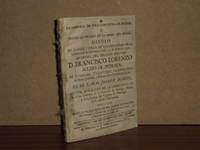
1777023019Salamanca: Oficina de la Santa Cruz por Domingo Casero 1777. No consta edición. Tapa blanda. Good. 30 63 pp. 14 x 195 cm. LA SABIDURIA DEL SIGLO CONVENCIDA DE NECEDAD Ó ELOGIO DE UN SABIO EN LO MISMO QUE IGNORO - DIXOLO EN LA REAL CAPILLA DE SAN GERONIMO DE LA Universidad de Salamanca el dia 15 de julio de 1777 EN HONRA DEL DIFUNTO DOCTOR D. FRANCISCO LORENZO AGUDO DE PEDRAZA el RR. P. M. Fr. Joseph Marin. Papel con algún oscurecimiento en las juntas con el lomo. Por lo demás limpio en general. Oficina de la Santa Cruz por Domingo Casero unknown
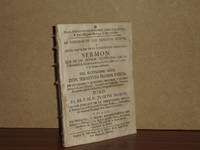
1778023020Salamanca: Oficina de la Santa Cruz por Domingo Casero 1778. No consta edición. Tapa blanda. Good. 16 71 pp. 14 x 195 cm. SERMÓN QUE EN LAS HONRAS CELEBRADAS POR LA UNIVERSIDAD DE SALAMANCA EL 23 DE DICIEMBRE DE 1778 A LA BUENA MEMORIA DEL ILUSTRISIMO SEÑOR DON SEBASTIÃN FLORES PABON DIXO el RR. P. M. Fr. Joseph Marin. Papel limpio. Oficina de la Santa Cruz por Domingo Casero unknown
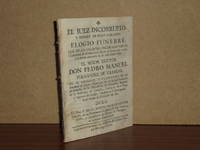
1776023018Salamanca: Oficina de la Santa Cruz por Domingo Casero 1776. No consta edición. Tapa blanda. Good. 14 33 pp. 14 x 195 cm. EL JUEZ INCORRUPTO Y HOMBRE DE BUEN CORAZON - ELOGIO FÚNEBRE QUE EN LAS EXEQUIAS CELEBRADAS POR LA UNIVERSIDAD DE SALAMANCA EL DÃA 30 DE MARZO DE 1776 A LA BUENA MEMORIA DE SU MUI ILUSTRE HIJO EL SEÑOR DOCTOR DON PEDRO MANUEL FERNÃNDEZ DE VILLEGAS DIXO el Rmo. P. Mro. Fr. Joseph Marin. Papel en buen estado limpio. Oficina de la Santa Cruz por Domingo Casero unknown
1780342628En Madrid : Por Don Joaquin Ibarra 1780. New edition. Hardcover. Full contemporary gilt-bordered aniline calf worn. Hinges starting gutters worn. Crudely re-cased with the original boards retained. Inner gilt dentelles. Prelim plates detached. All edges gilt. Wide margins with the text remaining in uncommonly good condition; scans and additional bibliographic detail on request. Physical description plates : ill. ; fol.Notes; Added title-page engraved; engraved head- and tail-pieces; initials; vignettes. Preliminary matter v. 1 p. i-ccii includes; Prólogo de la Academia; Vida de . Cervántes Saavedra y anälisis del Quixote por Vicente de los Ríos; Plan cronológico del Quixote; Pruebas y documentos que justifican la Vida de Cervántes. Plates by Antonio Carnicero José del Castillo José Brunete Bernardo Barranco Pedro Arnal Gerónimo Gil and Gregorio Ferro; engraved by Fernando Selma Manuel Salvador y Carmona Gerónimo A. Gil Pedro Pasqual Males J. Joaquín Fabregat Joaquín Ballester Juan de la Cruz Francisco Muntaner and Juan Barceló. Referenced by: Palau y Dulcet 2nd ed. 52024. Language; Spanish. En Madrid : Por Don Joaquin Ibarra hardcover
1777115583Paris: Nyon and Stoupe 1777. The invention of ball bearings making possible one of the great engineering feats of the 18th century First edition of this account of this remarkable feat the first practical use of ball bearings in engineering. Charged with designing the bronze equestrian statue of the Russian emperor Peter the Great that remains a celebrated landmark of St Petersburg the French sculptor Etienne Falconet decided that the traditional pedestal for equestrian statues would be too mundane. Only a massive rock would suffice. Eventually an enormous piece of granite was located in a marsh near the Gulf of Finland. The Thunder Stone as it was dubbed was estimated to be 40 feet long 25 feet side and 21 feet tall and weighed some 1800 tons: about 1300 tons more than any of the obelisks moved by the ancient Egyptians or Romans. Most engineers declared its removal impossible but Catherine the Great turned to Carburi a Greek of dubious moral reputation who had banished himself from his native island of Cephalonia and had come to Russia where he found favour with the empress. To move the giant rock Carburi devised a gigantic sled moving on a system of rails and six-inch bronze ball bearings. Although ball bearings had been shown in earlier sketches by both Leonardo da Vinci and Agostino Ramelli Carburi's feat was the first practical demonstration of their use. It predated the first modern recorded patent on ball bearings that awarded to Philip Vaughan a British inventor and ironmaster who created a design for a ball bearing in Carmarthen in 1794 by more than two decades. The project invited comparison to the moving of the Vatican obelisk by Fontana in the 16th century which Carburi here argues must have been easier because it was a shorter distance. Folio 423 x 280 mm. With 12 folding engraved plates most double-page by Sellier and d'Elvaux after Blarenberg. Contemporary mottled calf red morocco label spine gilt in compartments marbled endpapers red edges. Armorial bookplate of Henry Tronchin. Skilful and unobtrusive repairs to joints and tips final two plates with a couple of very light red paint marks occasional variable light browning and offsetting overall a pleasing copy of this handsome folio. Berlin Kat. 1794. unknown
177710110London: F. Vivares in great Newport Street 1777. Colour-printed mixed method engraving. Printed on laid paper. In excellent condition with the exception of being trimmed within the platemark. Small tear in lower left corner and another small tear on bottom margin. Image size: 10 9/16 x 8 1/4 inches. A lovely impression of this famous print by Louis-Marin Bonnet one of the most celebrated masters of French colour-printing.<br/> <br/> The son of a Parisian stocking manufacturer Louis-Marin Bonnet 1736-1793 trained with the engravers Louis-Claude LeGrand and Jean-Charles François the latter the inventor of the chalk-manner technique of printmaking. Throughout his career Bonnet developed Francois's printing technique producing some of the most beautiful prints of the period. Bonnet's chalk-manner prints became immensely popular with collectors seeking images that imitated the subtle effects of drawing but he also experimented with various forms of colour printing as seen in this charming print of a young lady playing the guitar. During the late 1770s and 1780s Bonnet's success as a color printmaker was unrivaled and hence he counted among his patrons the wealthiest Parisian collectors of the time. This spectacular print exemplifies the single plate colour printing technique developed in England but quickly adopted by French engravers. The effect is achieved by inking a single plate with several different colours by using a rag stump this process is known as a la poupée. These English colour prints became very popular in Paris and threatened to affect the market for French prints. In an effort to capitalize on this vogue for English prints a few clever French engravers printed their own colour prints with London addresses. This charming image is just such a print; Bonnet published it with F. Vivares's address in London although it was probably published in Paris. He also uses a different variation on his name and lists himself as L. Marin instead of Louis-Marin Bonnet. This is not only an exquisite image from one of the most renowned French engravers but a fascinating glimpse at the practices of the print market in France.<br/> <br/> Le Blanc Manuel de L'Amateur D'Estampes No. 386. F. Vivares in great Newport Street unknown
177710110London: F. Vivares in great Newport Street 1777. Colour-printed mixed method engraving. Printed on laid paper. In excellent condition with the exception of being trimmed within the platemark. Small tear in lower left corner and another small tear on bottom margin. Image size: 10 9/16 x 8 1/4 inches. A lovely impression of this famous print by Louis-Marin Bonnet one of the most celebrated masters of French colour-printing.<br/> <br/>The son of a Parisian stocking manufacturer Louis-Marin Bonnet 1736-1793 trained with the engravers Louis-Claude LeGrand and Jean-Charles François the latter the inventor of the chalk-manner technique of printmaking. Throughout his career Bonnet developed Francois's printing technique producing some of the most beautiful prints of the period. Bonnet's chalk-manner prints became immensely popular with collectors seeking images that imitated the subtle effects of drawing but he also experimented with various forms of colour printing as seen in this charming print of a young lady playing the guitar. During the late 1770s and 1780s Bonnet's success as a color printmaker was unrivaled and hence he counted among his patrons the wealthiest Parisian collectors of the time. This spectacular print exemplifies the single plate colour printing technique developed in England but quickly adopted by French engravers. The effect is achieved by inking a single plate with several different colours by using a rag stump this process is known as a la poupée. These English colour prints became very popular in Paris and threatened to affect the market for French prints. In an effort to capitalize on this vogue for English prints a few clever French engravers printed their own colour prints with London addresses. This charming image is just such a print; Bonnet published it with F. Vivares's address in London although it was probably published in Paris. He also uses a different variation on his name and lists himself as L. Marin instead of Louis-Marin Bonnet. This is not only an exquisite image from one of the most renowned French engravers but a fascinating glimpse at the practices of the print market in France.<br/> <br/>Le Blanc Manuel de L'Amateur D'Estampes No. 386. F. Vivares in great Newport Street unknown books
17282410240334xbvk'Venezia. Apresso Cristoforo Zane. Con Licenza de' Superiori, e Privilegio. MDCCXXVIII' (1728). xl, 454 pages, 1 blank sheet. - Strong italian vellum binding of the period over 5 slightly raised bands with blank endpapers, all edges sparkled red; 8vo.(ca. 18 x 12 x 3 cm).
175530842Amberes Antwerp: Andres Perisse 1755. Good. Amberes Antwerp: Andres Perisse 1755. 12mo 16 cm; xvi 318pp. Full bound in contemporary dark brown roan gilt spine. Edges red speckled. Boards worn at edges and corners with some loss to spine ends. Generally scuffed and scratched with minor staining. Boards lifting at fore edge but binding tight. Pages foxed and toned. Previous owner's manuscript ex libris pasted in at first pastedown with a small illustrated icon of Saint Philomena loosely laid in. First endsheet stained and has lifted some of the facing page. A few signatures sit slightly proud. A Good copy. <br /> <br /> This revised and expanded edition of The Art of Knowing Men and the Maxims of Civil Society was originally published in French. Sections include Of Shame On the Disregard of Death and On the Honesty of Women. Andres Perisse unknown
17392092902141700270Not Available 1739. Soft Cover. Fine. Volume: 1 Not Available paperback
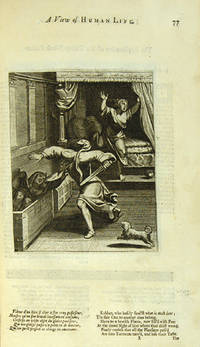
1726013796London: J. Darby A. Betteswort &c 1726. Second Edition. Hardcover. Neat contemporary ink inscription to first title very small worm tracks to upper corner of about half of the pages. Lovely plates very clean. Near Fine. Tall Folio 8-3/4" x 14-1/2" bound in full calf leather neatly rebacked. Two parts in one volume lacking the printed title page as seems often to be the case. Text in French and English. Translated by Thomas Manington Gibbs. Illustrated with two engraved title pages a frontispiece a portrait and 103 engraved plates all nearly full page along with engraved head- and tail-pieces. <br/><br/> [J. Darby, A. Betteswort &c] hardcover
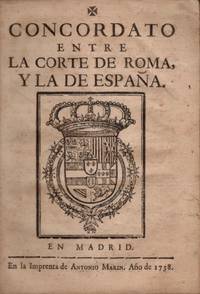
173832319Madrid: En la Imprenta de Antonio Marin 1738. Wraps. Very good. Approx. 7.75" x 5.75" marbled paper covered wraps. 57 pages. The first 46 pages are printed in double columns. Page 47- 57 is printed in standard fashion with chapter heading that reads "Plenipotencia De Su Santidad." Title translates to: "Concordat between the Court of Rome and the Court of Spain. En la Imprenta de Antonio Marin unknown