740 résultats
195556299Vienna: Wiener Modellgesellschaft M.B.H. Editions de Mode Fashion Publications 1955. Folio. 9 x 13 in. 23 colour plates in pochoir-inspired hand-coloured style. Printed beige softcovers minor creasing head of spine minor dustsoiling still VG bright copy. First edition thus of this beautifully rendered collection of haute couture summer dress designs issued by the Viennese fashion cooperative in the 1950s. These designs show the decided shift towards elegance and perfectly matched accessories for women during the 1950s with nipped-in waists full-skirted dresses as well as tailored fitted clothes with a hint of playfulness and exuberance inspired by the designs of Cristobal Balenciaga and Hubert de Givenchy as well as the feminine silhouette of Christian Dior. No copies in Worldcat of this issue. Wiener Modellgesellschaft, M.B.H., Editions de Mode, Fashion Publications], paperback
195061482Tokyo Japan: Mikimoto ca. 1950. Oblong folio. 14.5 x 11.5 x 1.4 in. Original wooden shadow box sample display case holding 10 opened & cleaned pearl oyster shells on white padded fibers and 5 varying grades of cultured pearls showing progression of growth minor scuffing to corners of polished wood frame backed w/ birch plywood box a VG exemplar. Commercial cultured pearls were first developed by Kokichi Mikimoto who succeeded in creating semi-spherical cultured pearls in 1893 by developing the exacting method of inserting grains into pearl oysters and harvesting two years. later. The company exhibited at many International World’s Fairs in the succeeding years and following World War I gained a foothold in Europe during the Art Deco jewelry phase. Virulently opposed by European jewelers who attacked cultured pearls as imitations rather than real pearls Mikimoto would win the lawsuit at the “Paris Trial†and quickly established the custom of distributing trade literature explaining the pearl process as well as visual sample cases. Although the 1930’s saw the emergence of very good glass imitation pearls cultured pearls continued to be valued and in post-World War II America reached their heyday with elegance and femininity favored with designs inspired by Grace Kelly and later Jackie Kennedy of single strands of pearls and pearl studs. These sample boxes continued to remind customers that the pearls were actually cultivated and harvested from oysters. See: Mikimoto Brand Story Our Founder Kokichi Mikimoto 2024; Amber Michelle A History of Cultured Pearls IAJA 2022. Mikimoto?, unknown
193562566Tacoma WA: Day’s Tailor-D Clothing Inc. ca. 1935. Folio. 15.75 x 22 in. Colour serigraph counter display on masonite w/ cardboard stand unfolded on verso minor tidemark some soiling back cover minor curving to the masonite still VG bright exemplar. An exceptional original brightly counter display for these popular durable corduroy slacks which became known as the “College Cords†and expanded the company’s popular offerings beyond their iconic “Big 5†work overalls. The “College Cords†also proved to be popular durable work pants but were initially targeted towards the college man. The company was founded by Day 1874-1947 in 1903 and quickly began selling the “Big 5†work overalls and in 1906 were unionized by the United Garment Workers of America forming Local 201 and embraced the slogan “Western Made Union Made.†The company in 1928 changed its name to Day’s Tailor-D Clothing Inc. and sons Hollis and Judd Day took over the company after 1947. During the 1950’s they maintained 400 employees and $ 1 million dollar payroll best known as one of the largest Pacific Northwest employers of women in the region. In 1973 the company merged with Warnaco. See: Day’s College Cords Marketing Tacoma Library Northwest Room 2022; Day’s Tailor-D Clothing, Inc., hardcover
195161036New York: G.P. Putnam’s Sons 1951. 8vo. 8 310 pp. Photo frontisp. numerous photo plates. Gray publisher’s cloth scuffing at front hinge w/ d.j. photo of author on back cover by Robert Avedon minor chipping edgewear old tape repairs still VG-/VG- copy signed by author on ffep. from the library of Maebelle Doolittle Traylor 1881-1961 former Pasadena socialite longtime widow of stock trader Neal Traylor and daughter of Pasadena pioneer developer Samuel Hosmer Doolittle 1850-1942 w/ clipping laid-in. First edition signed of this memoir by the famed Hollywood fashion designer who had begun his career before World War I with Lucile and would later design for the Lasky Players Silent movies. Later after setting up his own Fashion House he designed clothes for Greta Garbo Shirley Temple Theda Bara Gloria Vanderbilt Mary Pickford Ginger Rogers Irene Dunne Ingrid Bergman and Katharine Hepburn emphasizing eye-catching elements and fitted torso evening garments. G.P. Putnam’s Sons, hardcover
199747024New York: Christie’s Park Avenue 1997. 4to. 212 pp. Over 200 colour photos & designs. Colour-illustrated softcovers NF copy. First edition of this fascinating catalogue documenting the style of the tragic Princess whose fashion sense preferred English designers. This catalogue includes original fashion drawings and renderings with some of the dresses chronicles where and when they were worn and pays homage to the memory of Diana. Some of the designers include Gina Fratini Catherine Walker Zandra Rhodes Sassoon Victor Edelstein and others. Christie’s Park Avenue, paperback
193963709Aussig Usti Nad Labem Czechoslovakia & Vienna: C. Wolfrum ca. 1939. Folio. 50 leaves. 1 leaf with type-written explanation of all the fashions illustrated in the catalogue. 44 hand-coloured pochoir fashion designs on translucent paper each with item number printed below 5 leaves with printed designs showing the backs of all the fashions some pencil shading and details added. Original textured beige softcovers embossed WMI Wolfrum Manufacturing on front cover metal spiral bound as issued some dustsoiling & wear to fore-edges of covers very slight bumping to couple corners still a VG copy w/ beautifully illustrated fashion designs. First edition of this exceedingly scarce original trade catalogue issued by the C. Wolfrum textile firm in Czechoslovakia for its Vienna Austria market around the time of the forced annexation of the Sudetenland by Nazi Germany in 1939. The firm was famed for its woolen & silk textiles for women’s fashions and their catalogues were very desired. This catalogue includes fashions for silk rayon & wool women’s dress suits leisure suits formal evening dresses & winter coats all evoking the fashion trends of the period. The designs in the catalogue reflect the rising influence of militaristic styles and fascism with square-edged shoulder pads the plate hats as well as the emphasis on tight waists and long skirts. There are a couple designs with distinctive chocolate brown for leisure wear reflecting the heavy Nazi-influenced fashion design of the period. In addition the slim lines were enhanced by cutting clothes across the fabric avoiding bunches of gathers at the waist for full skirts allowing material to flow. In addition the evening wear dresses emphasized low or no backs and hair was to be grown long and worn swept up. This catalogue also includes a few evening formal dress designs clearly inspired by the dresses worn by Vivien Leigh in the 1939 Gone With the Wind Movie with the puffed sleeves polk-a-dot patterns and fabrics. No copies in Worldcat. C. Wolfrum, paperback
194562617Philadelphia: J.B. Lippincott Co. 1945. 8vo. 204 2 pp. With 22 photo plates. Black publisher’s cloth silver lettering front cover & spine slight shelfwear minor bumping at foot of spine w/ d.j. cover art of Dragonia fabric by Everfast chipping & tear to upper fore-edge minor chipping foot of spine couple minor closed tears still VG/VG- copy. Second printing of this work drawn from interviews with 12 leading American fashion designers intended as a “splendid career book full of suggestions for the girl who who feels drawn to the great world of clothes and designers.†Those interviewed included Clare Potter - considered inventor of American sportswear; Emily Wilkens - pioneer in fashion clothing for teenagers; Hattie Carnegie with her ever elegant dresses; Edith Head - famed Hollywood costume designer; Louella Ballerino -- famed California designer of sportswear swimwear and distinct ethnographic influenced fashions and others. J.B. Lippincott Co., hardcover
189554146New York: Standard Fashion Company June 1895. 4to. 96 pp. 1 large folding colour chromolithograph frontisp. sized 21.5 x 10.75 in. 1 colour chromolithograph plate over 150 woodcut text illustrations & engravings. Gold-coloured printed softcovers brick-red lettering minor dustsoiling light wear to creases of folding frontisp. still VG copy. First edition of this scarce and beautifully printed fashion magazine which was published under this title only from 1894 through 1896 when it was forced to change the name to The Standard Designer after losing a lawsuit brought by the Butterick Publishing Co. against Frank Koewing d. 1933 their former western sales manager for Butterick. Founded in 1887 the Standard Fashion Co. would eventually become a serious rival to the Butterick Pattern Co. appropriating the “Delineator†for his magazine poaching employees and eventually building the company to issuing over 100000 cut patterns a week. While often facing bankruptcy and litigious to a fault the company was acquired as a subsidiary in 1900 by Butterick and the combined companies would thrive through the ensuing decades. Each of the Standard Delineator magazine issues featured a large chromolithograph frontispiece of the latest fashions as well as a smaller one of millinery designs. Worldcat locates primarily microfilm copies however individual issues are held by Notre Dame and Davidson College; See; A Man of the Hour Frank Koewing The Bookseller and Newsman Vol. 13 1896 pp. 4-5; Carol Ann Dickson Patterns for Garments: A History of the Paper Garment Pattern Industry in America 1979. Standard Fashion Company, paperback
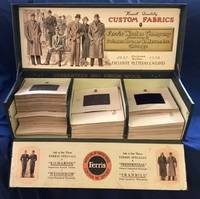
193754988Chicago: Ferris Woolen Co. Successor to Detmer Brewer & Mason Wawak Co. Inc. 1937. Sample case. 27.75 x 11 x 7.5 in. Containing 172 thick cards w/ black & red advertising lettering stock & style Nos. with 172 woolens worsted wool imported wool samples some preshrunk all mounted on the cards. Original sample display case w/ green textured cloth over boards divided into 3 compartments nickel plate slider hinges printed advertising on inner lid and drop front reinforced corners some minor wear insect predation around fore-edges of a few samples still a remarkable display case from the John the Tailor Shop Suits and Overcoats made to order Wausau WI w/ stamp on top Wawak sample card. First edition of this spectacular tailoring sample counter display for men’s suits and overcoats in the Fall & Winter of 1937-1938. Ferris Woolen Company a subsidiary of Wawak Woolens was originally founded in 1922 in Chicago along with Detmer Woolen Co. Bruner Woolen Co. Mason & Hanson Inc. and Salter & Wolf to supply woolens & trimmings to tailors and department stores across the United States. The companies were known for their high-quality wools at a reasonable price and often incorporated imported wool wool silk blends gabardines and tweeds especially from Scotland Wales France and Great Britain. In 1933 the Wawak Co./Ferris Woolen Co. purchased the exclusive right to all the Detmer Bruner Co. customers West of the Mississippi. They quickly began commissioning and producing display cases reflecting the change and proved very successful with the Ferris Woolen Co. catering to the trade into the 1960s. These sample cases were very expensive to produce and so were most often found in department stores mercantiles and men’s stores which would have these display on the sales floor for two seasons or more often adding or subtracting fabrics as they became available. The samples included with this case offer invaluable textile reference for the colours and fabrics during the era of fashion influenced by the elegance and glamor of Hollywood films and film noir at the time. The styles depicted on the inside of the lid and the drop-down front are reminiscent of the very popular Thin Man fashions worn by William Powell and Myrna Loy at the time. No copies located in Worldcat. Ferris Woolen Co., Successor to Detmer, Brewer & Mason, Wawak Co., Inc., hardcover
193456170Omaha NE: Northwestern Fur Company ca. 1934. Two vols. 4to. 15 1; 16 pp unpaginated. with numerous photo and text illustrations diagrams. Self-printed illustrated softcovers both with cover art of stylish young women wearing furs including one in front of an Art Deco screen both with centerfold creases as issued minor shelfwear rubbing still VG set retaining original mailing envelope addressed to A.lbert H.enry McConnell 1861-1939 Payette Valley Silver Fox Farm Fruitland ID formerly of Gunnison CO set up his fruit orchards ranching business and other opportunities in Idaho. First editions of these very rare fur fashion and furrier supply catalogues issued by the Northwestern Fur Co. of Omaha NE including in the first catalogue furs for sale such as chokers scarfs muskrat Northern Seal Hudson Seal Caracul Siberian Squirrel and others. Also included are listings for furriers’ tools and equipment taxidermy work fasteners and more while the second catalogue promotes the complete furrier course offered by the company. Elwood 1875-1947 with two partners Paul F. Greve and R.H. Smith incorporated the Northwestern Fur Company school of taxidermy and the Northwestern Fur Company furs mail order in 1903 and quickly expanded for the succeeding decades. Elwood had previously taught and been director at a trade school in Iowa before moving to Omaha NE and continued as the public face of the mail order company for decades eventually closing down in the 1980s. No copies located in Worldcat; See: Northwestern School of Taxidermy Northwestern Fur Company Nebraska State Historical Society Manuscript Finding Aid RG5451.AM. Northwestern Fur Company, paperback
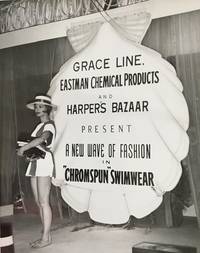
195956594New York & Rochester NY: Grace Line Harper’s Bazaar & Eastman Chemical Products subsidiary of Eastman Kodak 1959. 4to. With 33 black & white photographs inserted in mylar sleeves. Recent flexible black vinyl cover portfolio NF exemplar w/ images having bright strong contrast. First edition of this remarkably scarce group of photos advertising the 1959 fashionable swimsuits made from Chromspun acetate yarn developed for textiles by Eastman Kodak in the early 1950s. Discovered while developing cigarette filters the yarn proved durable and elastic enough for swimsuits other apparel home furnishings and other applications. The swimsuits modeled in this show were influenced by and possibly included the very popular Rose Marie Reid line of swimwear which was heavily marketed by Harper’s Bazaar during the 1940s and 1950s and was considered to be the quintessential California swimsuit worn by such stars as Jane Russell and Sandra Dee in the first Gidget movie produced by Columbia in 1959. Represented in these photos are the swimsuits included the strapless bikini princess bubble Baby Doll often with stripes and cover-ups. Although not indicated in the photographs this fashion show was probably held on one of the new Grace Line ocean liners the Santa Rosa which was delivered in 1958 and serviced the Caribbean South America and traveled through The Saint Lawrence Seaway into the Great Lakes. See: Rose Marie Reid Glamour by Design Special Collections Exhibit Brigham Young University 2015-2016; Michael Grace The Grace Line History Cruising the Past Travel and Social History 2009; Jean Was a “Young American Goddess of Paris Couture†Jean Patchett Prose on Genesis 2020. Grace Line, Harper’s Bazaar, & Eastman Chemical Products, subsidiary of Eastman Kodak, unknown
195061496Chicago IL: Hart Schaffner & Marx ca. 1950. Two large colour lithograph advertising posters sized 38.25 x 51 in. and 28.75 x 38.5 in. respectively both bearing the Golden Trumpeter logo as rendered by noted artist Robert Reinhardt von Liski minor dustsoiling creasing faint dampstain to very lower right fore-edge of larger poster minor closed tears neatly repaired light age toning still both bright VG- copies now mounted and shrink wrapped on archival foam core. The Hart Schaffner & Marx logo for men’s fashion was first created by Edward Penfield in 1914 with the trumpeter bearing an upright lance but the next year had turned into a trumpet and would continue on HSM suits until the late 1980’s. Hart Schaffner & Marx was founded in 1887 by Harry and Max Hart Marcus Marx and Joseph Schaffner. By the early 20th century they owned dozens of small garment factories around Chicago and was one of the first tailoring/garment manufacturing firms to become unionized. They continued to grow through the 20th century and by the end of the 1960s had 38 factories and 250 retail stores around the country. The Company continues to operate under the Hartmarx label and is one of the leading men’s clothing wholesalers to this day. Von Liski 1908-1991 was a noted self-taught artist and commercial artist who worked for various studios and was a partner in a Chicago advertising agency. No copies located in Worldcat; See: Leif Peng & Nan Hall Tom Hall Today’s Inspiration Celebrating Illustrations Design Cartoon and Comic Art of the Mid-20th century 2016; Hart Schaffner & Marx Encyclopedia of Chicago 2005. Hart Schaffner & Marx, hardcover
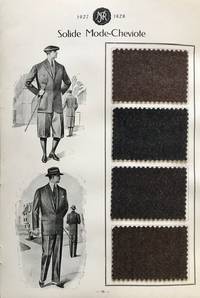
192757311Graz Austria: Richard Neurath Kaiserfeldgasse 19 und 21 1927. Two vols. 1st - Folio. 11 x 13.75 in. 45 1 pp. on thick boards. With 246 tipped-in fabric samples of wools wool blends 27 fashion plate illustrations 2 for women’s coats w/ price list and letter to salesmen dated August 1927. Original quarter-black cloth over embossed & decorated boards flaps at fore-edges w/ handle and clasp raised gilt lettering on front cover minor shelfwear rubbing clasp guard repaired & reinforced still VG complete exemplar retaining the original button clasp; together with 4to. 8.25 x 11.25 in. 4 pp unpaginated. w/ 16 additional wool and wool-blend samples tipped-in self-printed covers rounded corners. First edition of this unusually rare fashion salesman sample catalogue for men’s suits and sporting wear during the Roaring 20’s with many of the suits sporting vests while also featured are shooting & hiking suits sportswear and a rich array of fabrics drawing upon English fashion designs. Following World War I there was a concerted move away from starched collars and formal three-piece suits towards soft collars one- or two-button suit jackets and even often worn without a waistcoat. Also featured in this catalogue are many examples of the plus-fours developed out of ordinary knickers these short-legged pants were a baggier version of their predecessors and proved popular for hikers golfers and other outdoors activities. Also featured are winter coat fabrics and designs for women in velour and thick felt twill. The laid-in additional catalogue promoted the latest Loden Merino wool fabrics and thick camel hair woolens. Neurath 1882-1948 operated a successful mail-order tailoring business until the 1938 Anschluss when the Nazi’s annexed Austria and forced the April 10 plebiscite. He survived the War and later died in Tel Aviv Israel in 1948. The building which housed his offices and tailoring facilities in Graz is now the home of the popular Cafe Kaiserfeld. No copies in Worldcat. Richard Neurath, Kaiserfeldgasse 19 und 21, hardcover
188848840Paris: Grande Maison de Blanc ca. 1888. 12mo. 42 pp unpaginated. Colour chromolithograph illustrated title 18 colour chromolith plates. Dark green silk gilt lettering on front cover very minor soiling edgewear front cover rear inner hinge starting still a VG bright copy stapled textblock as issued. First edition of this delightfully produced and illustrated history of gloves through the ages. These include descriptions of mesh gloves used by the Egyptians metal gauntlets used by Roman gladiators gloves to keep warm by monks during the Middle Ages leather gloves to protect the hands and arms of the falconer fencing gloves beautiful silk & lace gloves for noblewomen at the courts of Louis XV and Louis XVI and riding gloves for women during the Second Empire of Napoleon III and finally the Belle Epoque. Grande Maison de Blanc was a renowned firm in Paris during the Belle Epoque who were especially proud of selling French-manufactured gloves linens cravats and other household goods at a discount compared to many other stores at the time. They were pioneers in not only producing their own products in house by maintaining factories in Tarare Lille Fives and other areas around France but pushing other suppliers to offer steep wholesale discounts. Worldcat locates 2 copies NYU Princeton. Grande Maison de Blanc, hardcover
194061376Laguna Beach CA: Walter T. Foster Foreman & Clark 1940. Folio. 8 x 14 in. 40 pp unpaginated. Illustrated throughout self-printed softcovers cover art illustration of Foreman & Clark men’s tweed suit minor shelfwear slight rubbing still VG copy. First edition thus of this scarce installment in the Foster “How to Draw Library†series instructing aspiring commercial artists step-by-step in creating ads for men’s “Noir†period double-breasted suits and drawing primarily from the 1940 ad campaigns of the famed Foreman & Clark men’s stores based out of Southern California. Of particular interest is the inclusion by Foster of gray scale and tints from the Craftint Co. of Cleveland OH which instructs the artist on how their colours will appear when reproduced in black & white tones for commercial advertisements. The ad at rear for “Female Fashion†includes woman saluting. Worldcat locates 1 copy Ohio State. Walter T. Foster, [Foreman & Clark], paperback
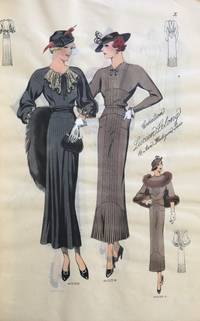
193058140Paris Vienna New York et al: Societe Graphique S.A. Editions de Mode Classique Modes Co. Importers of Fashions 303 Fifth Ave. ca. 1930. Folio. 9 x 13 in. IV pp. leaves as V-XX hand-coloured pochoir plates 2 pp. pattern cutting plates. Quarter-embossed gold foil over pink printed softcovers gilt & black decorative lettering minor shelfwear slight bumping to corners rubbing still a VG copy. First edition of this beautifully coloured collection of haute couture Parisian fashion dress designs by Lucien LeLong 1889-1958. Lelong was a contemporary designer alongside Chanel Vionnet Molyneux Lanvin & Patou focusing on designing for cafe society during the 1920’s and 1930’s. These designs emphasize Lelong Schiaparelli and Vionnet’s move towards a more sophisticated and elegant feminine silhouette during the 1930’s with hemlines dropped to mid-calf or close to the ankle soft slim-fitting dresses and backless evening gowns. Classique Modes also distributed other similar pochoir-illustrated fashion design periodicals such as Paris Chic Elite Robes elegantes Iris and others. The final 2 plates No copies in Worldcat. Societe Graphique S.A., Editions de Mode, Classique Modes Co., Importers of Fashions, 303 Fifth Ave., paperback
193956900Chicago IL: Jackman Sportswear Co. Inc. 14 E. Jackson Blvd. 1939. 8vo. 5.5 x 8.5 in. which opens up into 8 pp. Oblong 4to. 11 x 8.5 in. printed in brown on cream-coloured paper w/ numerous illustrations 4 fabric sample swatches tipped-in self-printed softcovers together w/ 3 leaves of price-lists and order forms preserved w/ mailing envelope to Henry Mayer Mahoning Valley Country Club Lehighton PA very slight shelfwear creasing NF. First edition of this scarce sample catalogue for men’s sporting clothes on the eve of World War II. This catalogue offers Raglander Raglan Sport Shirts Tommy Armour Gaucho Raglan golf shirts Jerry Glynn jackets in single-ply gabardine or wool tweed water proof silk shirts for golfers bowling shirts golf gloves Camel cloth caps and more. The famed golfer’s Jerry Glynn reversible golf jackets were taken over and produced by Whitewater following World War II and with elastic back and wind and rain resistance proved popular for decades. Tommy Armour Gaucho Raglan shirts first made their appearance in the 1930s after he had largely retired to Boca Raton FL and golf equipment is still marketed with his name. No copies located in Worldcat. Jackman Sportswear Co., Inc., 14 E. Jackson Blvd., paperback
193656297Vienna Austria & Paris: Les Editions Leon Claude 4 Rue mayran 1936. Folio. 10.75 x 14.6 in. 4 pp. With 25 colour fashion plates text printed in French English & German. Textured beige softcovers raised & embossed gilt lettering front cover black lettering for Leon Claude minor chipping head & foot of spine edgewear some scuffing still a VG copy w/ the fashion plates in bright condition. First edition of this very scarce and beautifully printed fashion design magazine from the mid 1930s produced by the publishing house which also published fashion publications such as Paris Chic La Coquette and Le Gout Parisien. These designs show the dominant influence of Elsa Schiaparelli’s fashions in the 1930s as she continued Chanel’s idea of comfortable jackets but with the emphasis on beautiful tailoring. The designs here include most in 3/4 length with some sporting shapes and belted jackets as well as fancy wraps made from leopard panther kid-astrakhan Buenos broadtail lamb beaver otter Persian lamb musk mink fox and others. The collars are voluminous and flaring all the way around and the linings are often chosen to complement and match the dresses worn by the models. These 1930s fashions show a dramatic drop in hem lengths the new French beret style hats worn at an angle and designs which inspired the Hollywood glamor look of the era popularized by Joan Crawford Carole Lombard and others. The designs are glamorous and chic with many having geometric patterns and reflecting the Art Deco influence. These fashion designs were issued only to subscribing specialty shops boutiques and fashion enthusiasts at the time with eight different issues on assorted subjects appearing annually. No copies of this issue located in Worldcat. Les Editions Leon Claude, 4, Rue mayran, paperback
194056298Vienna Germany & Paris: La Mode Artistique S.A. 4 Rue mayran 1940. Folio. 10.75 x 14.6 in. 4 pp. With 28 colour fashion plates text printed in French English & German. Textured beige softcovers raised & embossed gilt lettering front cover black lettering for La Mode Artistique minor chipping head & foot of spine edgewear some scuffing still a VG copy w/ the fashion plates in bright condition. First edition of this very scarce and beautifully printed fashion design magazine issued in the opening years of World War II following the occupation of Paris in the summer of 1940 originally owned by Leon Claude. The firm had also published fashion publications such as Paris Chic La Coquette and Le Gout Parisien. These fashion designs show the growing restraint and conservatism of Nazi Germany and reflecting the desire by Adolf Hitler to extinguish French influence in European fashion. The designs here include most in 3/4 length with some sporting shapes and belted jackets as well as fancy wraps made from seal kid-astrakhan Buenos broadtail lamb beaver otter nutria ocelot Persian lamb musk mink fox and others. The collars are trimmer and the linings are often chosen to complement and match the dresses worn by the models. These 1940s fashions still show the dramatic drop in hem lengths feathered hats worn by Germans & Austrians and designs which inspired the Hollywood glamor look of the era popularized by Greta Garbo Joan Crawford Carole Lombard and others. These fashion designs were issued only to subscribing specialty shops boutiques and fashion enthusiasts at the time with eight different issues on assorted subjects appearing annually. No copies of this issue located in Worldcat. La Mode Artistique, S.A., 4, Rue mayran, paperback
194456300Nice Paris & Maresille: A La Francaise May 1944. 4to. 78 14 pp. With numerous colour plates colour ads over 100 black & white text illustrations & photos. Colour-illustrated softcovers colour cover art on rear minor shelfwear slight rubbing light spotting to front cover and first couple leaves still VG- bright copy. First edition of this very scarce French fashion and luxury goods magazine published in occupied France a few months before the “liberation of Paris†and the Battle of Marseille. The lavish ads and articles tout the achievements of Parisian fashion designers French artists the cosmetics & perfume industry of Paris theatre productions Nazi-controlled French cinema and more. There are few of these occupied France publications surviving and Worldcat does locate a complete run at the Bibliotheque National. A La Francaise], paperback
190556908Chicago IL: American Woolen Mills Co. 1905. Thick elephant folio 17.5 x 21.5 x 3.25 in. 58 pp. printed on thick card stock each mounted on linen hinge. With 6 black & white fashion plates illustrating suit styles of the period with 380 of 400 -- many marked in pencil “O.S.†or Out-of-Stock mounted textile samples in wool wool-silk blends -- all samples clearly marked with prices and availability numerous text illustrations decorative borders printed in colour many showing bucolic scenes of sheep pastures and winter frolics. Black & blue cloth Arts & Crafts gilt lettering & ornament on front cover expertly rebacked and back cover renewed dustsoiling and occasional soiling to some leaves some samples w/ predation and minor loss dampstaining to gutter margin of last few leaves minor loss & damage to last couple leaves still a good copy. First edition of this scarce Progressive-era salesman sample catalogue for Winter season men’s suits overcoats and evening wear. The American Woolen Mills Company also known as the “Progressive Tailorsâ€maintained a huge tailoring operation in Chicago at Union & Washington until the Great Depression employing hundreds of tailors and seamstresses to fill orders. Unlike J.L. Taylor Royal Tailors and many of the other tailoring houses of the period the American Woolen Mills targeted the average white collar clerk or American immigrant salesman and merchant trying to look professional and offered $ 15.00 high class made to measure suits. These catalogues were very expensive to produce and were often issued with minimal company brand names allowing their sales force to target small shops mercantiles and general stores which would have these catalogues on the sales floor for several years. Sales people were directed to simply clip the corners of samples for out-of-stock and discontinued fabrics but they often chose to remove the entire sample in order to not distract potential customers. The catalogue offers invaluable illustrated historical reference for the colours styles and fabrics during the era of Teddy Roosevelt and the Anti-Trust policies even referring to these in their sales pitch by claiming that unlike Trusts which “by combining saves numerous expenses and sticks ALL the savings in its own pocket. . . there is no Trust in the tailoring trade.†They further claim that they remove all middlemen procure woolens directly from the weavers and by avoiding wastes of all kinds that AWM CO. lowers their prices and “it is a public benefit.†The textiles here focus on darker shades and very muted colours along with durable thick fabrics while marketing their double-breasted sacks 3-button frock coats 2-button single breasted suits assorted overcoats and more. No copies in Worldcat; See: Swell Nifty Suit Free! The Household Journal Vols. V No. 8 August 1912 p. 6; Machinists’ Monthly Journal Vol. XVII No. 3 March 1905 p. 282. American Woolen Mills Co., hardcover
193953215New York: Singer Sewing Machine Manufacturing Co. Departamento de Educacion January 1941; 1939. Two vols. 1st - Tall 8vo. 225 1 pp. Over 150 colour and black & white photo illustrations diagrams. Black textured softcovers gilt lettering & decoration printed on front cover edgewear bumping to corners minor soiling old tape repairs to front cover still G- copy; 2nd -- Oblong 4to. 12 x 7.75 in. 54 pp. on pink-tinted paper with 57 tipped-in fabric embroidered sewing samples including over on linen silk lace satin and wool textiles each w/ school stamp approving sample. Half-blue cloth post-binder over blue goards gilt lettering stamped on front cover sewn at gutter margin w/ white silk ribbon soiling minor dampstain curving to covers from the bulk of the tipped-in samples on the leaves still a VG exemplar. Both preserved in blue textured cardboard box & lid minor edgewear faint tidemark to lower fore-edge 1 corner. Fourth revised edition of this well-illustrated embroidery guide on stitches to be learned and executed on Singer Sewing Machines together with a beautifully done sample book showing Ms. Alos’ skills in learning the necessary skills in her Singer school in Villa Canas Argentina. The Singer Sewing Machine company developed special Singer Sewing Academia in Argentina Mexico and many other South American countries as well as Spain between the World Wars. These special private schools for professional dressmakers using the Singer manuals allowed female-owned dressmaking businesses to grow and create professional spaces separte from men. In addition these academias allowed women to pay by the class and embroidery was one of the advanced skills which commanded higher wages for women at the time. Singer actively encouraged this movement in order to develop home-based businesses and academias which in turn increased their sales of sewing machines. The sample book begins with a number of decorative types of embroidery stitches monograms and then displays floral patterns spider-web patterns laces a beautifully embroidered red roses and carnations on purple silks and satins. Worldcat locates 2 copies of the Libro Singer Bibliotecas del Tecnologico de Monterrey Mexico; British Library 3rd editions; See: Ketteler Sewing through the years in art women and society; Paula de la Cruz-Fernandez Atlantic Threads: Singer in Spain and Mexico 1860-1940 pp. 198-210. Singer Sewing Machine Manufacturing Co., Departamento de Educacion, paperback
197254492Chicago & New York: Montgomery Ward Steinthal Sample Co. Inc. 1972. Folio. 13 x 11.5 in. 50 pp unpaginated. printed on Harvest Gold Avocado Green and blue tinted textured papers. Numerous fashion plates and fashion sketches throughout w/ 89 fabric samples tipped-in Carol Brent label mounted. Black vinyl metal spiral wire binding as issued gilt lettering and logo stamped on front cover rounded corners minor foxing to pastedowns otherwise an excellent copy. First edition of this scarce and fascinating salesman’s sample catalogue for men and women’s suits leisure wear and formal tuxedos offered by Montogmery Ward at the beginning of the 1970s. This line of clothing featured English fabrics from Herbert Gladson Inc. tailored portions by Imperial in New York some Jacquard fabrics from David H. Small Co. in New York assembled for tailored clothing bearing Carol Brent Lady Brummell and the Designer’s Showcase labels. The men’s suits feature the slim fit with early bell bottoms wide lapels loud and vivid colour linings reverse welt hip pockets cardigans and even matching belts. Women’s clothing featured flared skirts double-breasted suit coats belted coats five-button pantsuits and fly front topcoats. No copies located in Worldcat. Montgomery Ward, Steinthal Sample Co., Inc., hardcover
195346794New York: McGregor Doniger ca. 1953. Elephant folio. 19 x 28 in colour poster expertly mounted on linen backing with 1.5 in. border around the entire poster NF copy. A wonderfully rendered advertisement which was intended for men’s sportswear and jackets sold by the McGregor-Doniger company as part of their Color of the Hebrides campaign in 1953. The image shows the model dressed in the Hebrides Mustard-coloured corduroy suit with blue & gray tartan vest & lining against the backdrop of Lewis Island with the bold McGregor company name in tartan colours at the lower fore-edge. The McGregor company was founded in 1921 by David D. Doniger a hat-maker and tailor from Scotland who left the family clothing business to establish himself in the United States. He focused on sportswear clothing that was both comfortable but also with fabrics colours and styles which were chosen to compliment one another. The McGregor line became the epitome of Preppy fashion during the 1940s and are perhaps best remembered for the red Anti-Freeze jacket worn by James Dean in the 1955 Rebel without a cause. McGregor Doniger, hardcover
195346793New York: McGregor Doniger ca. 1953. Elephant folio. 19 x 28 in colour poster expertly mounted on linen backing with 1.5 in. border around the entire poster NF copy. A wonderfully rendered advertisement which was intended for men’s sportswear and jackets sold by the McGregor-Doniger company as part of their Color of the Hebrides campaign in 1953. The image shows the model dressed in the coat against the backdrop of the Isle of Skye with the bold McGregor company name in tartan colours at the lower fore-edge. The McGregor company was founded in 1921 by David D. Doniger a hat-maker and tailor from Scotland who left the family clothing business to establish himself in the United States. He focused on sportswear clothing that was both comfortable but also with fabrics colours and styles which were chosen to compliment one another. The McGregor line became the epitome of Preppy fashion during the 1940s and are perhaps best remembered for the red Anti-Freeze jacket worn by James Dean in the 1955 Rebel without a cause. McGregor Doniger, hardcover