184 824 résultats
20192090502113715429Not Available 2019. Soft Cover. Fine. The book is in fine condition. Not Available paperback
19712090502113715432Not Available 1971. Soft Cover. Fine. The book is in fine condition. Not Available paperback
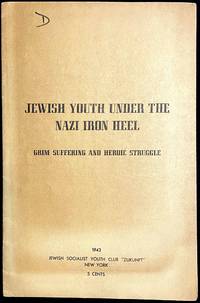
194243351New York: Jewish Socialist Youth Club 1942. Paper Wrappers. Illustrated by 2 Facimilie Illustrations. 1st edition Original Paper Wrappers 8vo 16 pages another variant we have seen has 15 pages. <br> From the year before the Warsaw Ghetto Uprising an early 1942 report by the American branch of the Bund on Jewish resistance by young people in Eastern Europe. <br> "Hand in hand with the underground organizations of the General Jewish Labor Union and in contact with the organization of the Polish socialists the Youth Union 'Zukunfst' conducts an untiring and ramified activity which is preparing the ground for the open struggle of tomorrow against Hitlerism" p. 13. <br> "Tsukunft or Cukunft or Zukunft Yiddish for future was the youth organization of the General Jewish Labor Union or Bund. It was founded in 1910 and in 1916 it was officially called Yugnt-Bund Tsukunft. Their newspaper was the Yugnt veker.<br> In 1922 the organization changed its name to Yugnt-bund "Tsukunft" in poyln 'Youth Bund "Tsukunft" in Poland'.At the time of the sixth Tsukunft conference in 1936 the last before the outbreak of the Second World War the organization counted with 184 local groups.<br> On the eve of the Second World War the organization had 15000 members. The Tsukunft took part in the Warsaw ghetto uprising as part of the Jewish Fighting Organization" Wikipedia.<br> SUBJECTS: Jewish youth -- Poland. Holocaust Jewish 1939-1945 -- Jewish resistance. World War 1939-1945 -- Atrocities. <br> OCLC: 6871875. <br> Covers toning with pen notation to cover otherwise Very Good Condition B Holo2-139-22A-XAECC-'l. Jewish Socialist Youth Club unknown
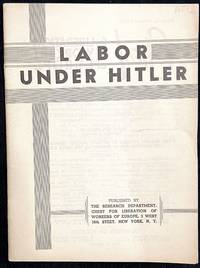
193543345New York : Published by the Research Department. Chest for Liberation of Workers of Europe 1935. 1st edition original printed paper wrappers 31 pages; 18 cm.<br> “When it became apparent that the German government was determined to absolutely destroy the trade union movement in that country the American Federation of Labor in convention assembled in 1933 declared a boycott against German made goods and German service such boycott to continue until such time as the German government recognized the right of the working people of Germany to organize in bona fide trade unions of their own choosing and until Germany ceased its policy of persecution of Jewish people merely because of their religious beliefs. <br> Subsequent events which have transpired in Germany and in Austria have fully justified the position taken by the American Federation of Labor in 1933 and reaffirmed in 1934†from the foreword. <br> The "Chest for Liberation of Workers of Europe" was an American organization formed in the 1930s to oppose European fascism and support labor victims of dictatorships. Led by prominent labor leaders including American Federation of Labor president William Green its activities involved educating the public about the dangers of Nazism and Fascism organizing boycotts against goods from Nazi Germany and fundraising to aid European labor movements. <br> For more see a period description by the executive secretary Harry Lee Franklin at https://cdnc.ucr.edu/a=d&d=OLSF19350713.2.36&e=-------en--20--1--txt-txIN -------- .<br> OCLC: 444336. <br> Very Good Condition an excellent example. B Holo2-163-18-LAMMFVDECCXI-BB@. New York : Published by the Research Department. Chest for Liberation of Workers of Europe unknown
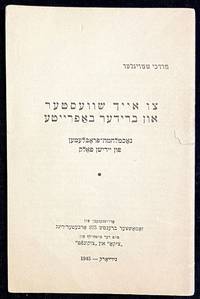
194543346Nyu-York New York: Zamoshtser Brentsh 375 Arbeter-Ring 1945. 1st edition of author’s first of seven published monographs all on the Shoah. Original printed paper wrappers small 8vo 31 pages 20 cm. In Yiddish. Title translates as “To You My Freed Brothers and Sisters: Postwar Problems of the Jewish People.†<br> Author's afterword:<br> <br> “In 1939 the author published a book about the formation of a young Jew. The author then wrote his book on Orthodox concepts. During the six years of camp life he grew older and changed. Along with all his works and writings this work was also lost to him. His motto at the time ‘Turn my back to Europe!’ confirmed the story with his bloodiest pen. <br> It is still quite a long way even with the current treacherous number of Jews in Europe to bring them all out in the best and only way for them: To the Land of Israel! With the ending of the exile we will lose the last psychologically and morally broken Jews. A seriously ill person is not taken a long way to a ‘Fulkom Heilanstalt’ but is given first aid on the spot right where he is lying!<br> And here is the cry for immediate momentary help concerning the present brochure.<br> As with a seriously ill patient - it has no son to lead in political or religious discussions! And so it is for the rest of our nation still in danger of going under as a nation perhaps even more than in the past! This brochure is therefore an appeal first of all to all political parties about the over-political danger of moral and physical collapse; About the suicidal and self-deprecating mendation of weak sick souls and the various evildoers of all kinds.<br> Of course it still lacks the concreteness the planning. But it is only a shriek which cannot be evaluated according to all the rules of the art of singing.<br> Here it is shouted: from one who has not lost the last bit of fire and the last bit of patience! It is only to encourage to remind and to make attention in every way.<br> To all those who consider themselves to be Jewish organizations this should be the call of the Ribs: come and strengthen the Jewish trembling knees! Keep them first at the Jewish consciousness and at their human height and later my dear later we will discuss.<br> <br> Paris June 1945.â€<br> <br> <br> Mordechai Strigler 1918/21-1998 was a “prolific Polish-born Yiddish writer and editor of the Yiddish Forward….<br> He…obtained a rabbi diploma….From 1937 he worked as a moral preacher in the Warsaw Great Synagogue. After the Germans invaded Poland he tried to return to his parents. However he failed was captured by the Germans and spent the following years in various forced ghettos and concentration camps. <br> From June 1943 he was then a prisoner in the Majdanek concentration camp. On July 28 1943 he was transported from there to work camp C in Skarzysko-Kamienna by prisoner transport. It was an ammunition factory belonging to the HASAG Group in which the prisoners without protective clothing were exposed to the picric acid used to fill underwater mines. This yellowing substance led to severe poisoning and reduced the life expectancy of the inmates to three months. <br> He wrote about his one-year stay there during his imprisonment but these records were lost. He was released on 11 April 1945 in Buchenwald….<br> After the end of the World War Strigler found a job with the Yiddish magazine Undzer Vort in Paris and settled there for the next seven years. The six-volume work Oisgebrente Likht Extinguished Lights was written here between 1948 and 1952 in which Strigler reports on his experience of the Shoah. Strigler had been in contact with the American-Jewish poet H. Leivick since 1945. He quickly recognized its literary potential. In 1952 Strigler emigrated to the United States and became editor of the Yiddish weekly Yidischer Kemfer in New York. He worked there until 1995 and wrote countless articles under 20 pseudonyms; between 1987 and 1998 the year of his death he also worked for the then Yiddish daily newspaper Forverts. <br> In addition to his journalistic texts Strigler also wrote poems memoirs political commentaries and stories and novels. The focus of his fictional narrative texts was the life of Polish Jews before the Second World War. It was also important to him not only to depict the personal and collective experience of the camp stays during the Nazi regime in a literary way but also to analyze it….<br> In 1978 Strigler received the Itzik Manger Prize for Yiddish Literature. In 1998 he was to be awarded an honorary doctorate in Hebrew literature from the Jewish Theological Seminary of America. A few days before the award ceremony however Strigler died†Wikipedia. <br> OCLC: 7413354. The University of Toronto keeps their copy in their Rare Book Collection<br> Light toning Very Good Condition. Important work holo2-163-19-XLGGAEO-IBB-’. Nyu-York [New York]: Zamoshtser Brentsh 375 Arbeter-Ring unknown
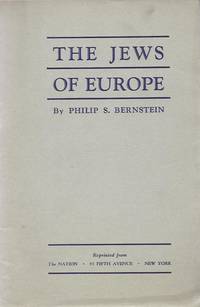
194335037New York: The Nation 1943. First Edition Thus. Paper Wrappers. First separate edition. Original Paper Wrappers. 8vo. 38 pages. 22 cm. "Reprinted from the Nation." <br> Holocaust-era analysis and proposals for post-war solutions for Jewish settlement citizenship and rights from this important Left-Liberal American magazine. <br> During the critical period for the Displaced Persons DPs of August 1945- December 1949 seven American Jews served as Advisers on Jewish Affairs to the Theater Commanders of the U.S. Forces in Europe interpreting Army regulations to the DPs and advising and guiding the American commanders who were not familiar with Jewish matters. The longest serving of these advisors was the author Philip S. Bernstein.<br> For a full analysis of Bernstein’s role and biography see Haim Genizi’s excellent essay “Philip S. Bernstein: Adviser on Jewish Affairs May 1946-August 1947†at https://www.museumoftolerance.com/education/archives-and-reference-library/ online-resources/simon-wiesenthal-center-annual-volume-3/annual-3-chapter-6 .html<br> Contents include: The remnants of a people; Seven ways to help them now; Alternatives to Zion; The case for Zionism. Nice clean copy in very good condition. B/3 HOLO2-65-22/W-62-XX. The Nation unknown
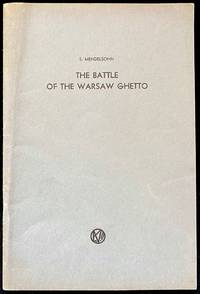
19444620<p>New York: Yiddish Scientific Institute 1944. Paperback. 1st separate edition. Original Paper Wrappers. 8vo. 28 pages. 23 cm. Wolff #I: 1441. Includes map in black red and white as the full-page center spread. <br />Early report on the uprising: "It is as yet impossible to give a complete picture of the resistance in the Warsaw Ghetto.The material is as yet too scarce. " <br />"This paper was read at the eighteenth annual conference of the Yiddish scientific institute on January 9 1944 .The paper was delivered in Yiddish and is published in the Yivo bleter Journal of the Yiddish scientific institute XXIII 1 January-February 1944." <br />Very good condition. B HOLO2-65-17.</p> Yiddish Scientific Institute paperback
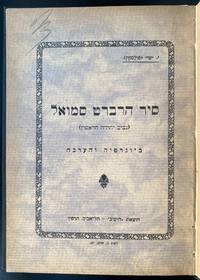
192643378Tel Aviv: Hotsa'at "ha-Yishuv 1926. 1st edition. Period boards with original printed paper wrappers bound in 8vo 11 127 pages. Includes illustrations. 22 cm. In Hebrew. Title translates as “Sir Herbert Samuel the First Governor of Judah: Biography and Assessment.â€<br> Herbert Louis Samuel 1st Viscount Samuel 1870-1963 “was a British Liberal politician who was the party leader from 1931 to 1935.<br> He was the first nominally-practising Jew to serve as a Cabinet minister and to become the leader of a major British political party. Samuel had promoted Zionism within the British Cabinet beginning with his 1915 memorandum entitled The Future of Palestine. In 1920 he was appointed as the first High Commissioner for Palestine in charge of the administration of the territory†Wikipedia. <br> Poleskin was born in the Ukraine in 1886 and relocated to Palestine in 1905 where he worked on some of the earliest kibbutzim though he found himself exiled to America during the first world war. He returned to Palestine in 1920 and wrote as an overseas journalist for the Forverts.<br> SUBJECTS: Statesmen -- Great Britain -- Biography. Zionism -- History. Hommes d'E´tat -- Grande-Bretagne -- Biographies. Politics and government -- History -- 20th century. Great Britain -- Politique et gouvernement -- 20e sie`cle. Grande-Bretagne --Middle East. OCLC: 19201104. Date stamp on final blank endpaper toning as expected Very Good Condition. B Zion2-4-9-BECCMZZ-'lxgg. Tel Aviv: Hotsa'at "ha-Yishuv unknown
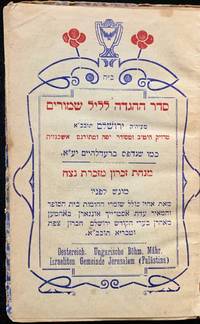
190043365Jerusalem: 'Adat Ostrikh Hungarn Bohemen Mahrn be-'are ha-kodesh 1900. No Date ca 1900 Later binding 8vo 41 pages. 15 cm. In Hebrew and Judeo-German and Yiddish. Yaari 2573. Originally published in 1822. Title translates as: “Haggadah Seder; Narrative of the Exodus of Israel from Egypt. â€<br> An edition of the famous Heidenheim German-Hebrew Haggadah published in the Land of Israel around 1900 by the Association for the Austro-Hungarian Bohemian-Moravian Community of Jerusalem Palestine. <br> Heidenheim's German-Hebrew hagadah became the standard hagadah in householdsacross Germany for much of the 19th and early 20th Century. Wolf Heidenheim 1757–1832 is among the most recognizable Jewish publishers and exegetes of the 19th century. In 1798 he received a license to establish a German and Hebrew press in partnership with Baruch Baschwitz. In 1800 Heidenheim began the publication of his most famous work the nine-volume edition of the mahzor Sefer Kerovot Roedelheim 1800–02 which went through numerous printings. The work included the first pure German translation in Hebrew characters of the liturgical poems for the festivals a Hebrew commentary and a literary historical introduction. Heidenheim devoted great care to typographical setup as well as to the restoration of the correct text of the prayers.<br> SUBJECTS: Haggadot -- Texts. Judaism -- Liturgy -- Texts. Passover -- Prayers and devotions. Judaism -- Liturgy. OCLC: 83892178. OCLC locates only 1 copy of this edition or any edition of Heidenheim’s hagadah published in Jerusalem at Harvard. <br> Some wear to edges and spine. Tape on internal spine. Some wine stains throughout. Good- Condition. Rare. HAG-27-4. Jerusalem: 'Adat Ostrikh, Hungarn, Bohemen, Mahrn be-'are ha-kodesh unknown
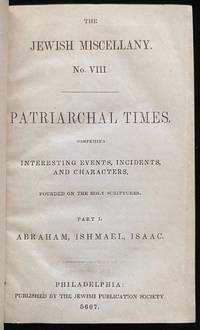
42790Philadelphia: Jewish Publication Society 5607. 1st Jewish Publication Society edition with new preface by “The Committee" Probably Isaac Leeser. Period cloth 16mo small vi 108 pages. Singerman 0994. Rosenbach: American Jewish bibliography; 612 633. <br> Comprises Nr 8 of “The Jewish Miscellany. †Includes Part 1 Abraham Ishmael Isaac but not Part 2: Jacob Esau Joseph Benjamin would be pages 110-319. One of the few publications from the first Jewish Publication Society founded by Isaac Leeser and which lasted only 3 years from 1845-1848. <br> No copies appearing at major auction in the last century. SUBJECTS : Patriarchs Bible -- Fiction. OCLC: 970980302. OCLC-Worldcat lists only 6 copies worldwide Penn HUC AJHS YU Temple Princeton. Jewish institutional bookplate period paper label on front board wear to blank inside rear cover internally clean and nice Good Condition. KH-9-8A-DB. Philadelphia: Jewish Publication Society unknown
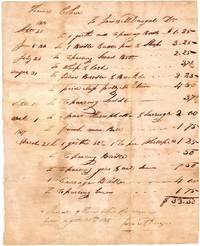
181743332Chillicothe OH 1817. Original double-sided sheets total 4 sides 2 leaves one folded as a legal document with document title “Thomas Cohen Account with J McDougal $33.50†on the verso.<br> The Rental agreements reads:<br> <br> “Chillicothe August 7th 1817<br> The Article made & interred sic: entered in this Day & Date above Ritten sic: Written witness that I Wm Nichols Have Rented of Thos Cohen of Chillicothe one House & Lot at twenty four feet at front on water Street formiley sic the John Walker a man of illeg town name & being the west quarter of indicated Lot No 214 & adjoining the Lot that Sawyer Chrigttow Now lives on for whitch sic I am to pay said Cohen five Dollars pur sic month for three months & as mutch sic illeg as may be a greed on between my self and His agent<br> <br> Testified<br> James Inglish___________________Wm Nichols X His markâ€<br> <br> Thomas Cohen’s account ledger with James McDougal lists 14 purchases dated between Sept 1815 and March 1817 for what appears to be tack horse equipment including bridles a “bridle coat pad and straps†a “whip and lash†saddles etc. <br> The account totaling $33.50 was closed out Aug 25 1817 “Received of Thomas Cohen the above in full†and signed “James McDougal.â€<br> <br> Toby Brief the executive director and curator for the Columbus Jewish Historical Society notes in a 2019 article in the Columbus Ohio Jewish News that “Thomas Cohen…. was born in Virginia to a Jacob Cohen and became a silversmith. He was in Chillicothe Ohio by 1815. He was advertising in the local paper. He then left and became the mayor of St. Louis . There is a lot of discussion about whether he was Jewish. It’s pretty clear that his paternal line was Jewish.â€<br> Brief notes that until recently “the first Jew to settle in Ohio is commonly believed to be Joseph Jonas an English-born Jew who arrived in Cincinnati in 1817†but with the evidence of Thomas Cohen the silversmith in Chillicothe “We’re not so sure about that†Columbus Jewish News: July 31 2019: https://share.google/2UdsU0WyyHXMt7v3h. See also https://www.columbusjewishhistory.org/histories/jews-first-capital-history- chillicothes-jewish-families <br> <br> Not surprisingly Cohen’s rental agent for his property in the document the “testifyer†witness on the rental agreement “James Inglish born at Shippensburg Pennsylvania Aug. 9 1768 was an early settler of Chillicothe and one of its pioneer lumber dealers†ohiogenealogyexpress.com/ross/rossco_bios_1917/rossco_bios_1917_a.html. <br> James Inglish shows up in other documents related to Chillicothe and nearby Pickaway County from this period. See for example:<br> Richard Clough Anderson Papers 1782-1905 1912-1914 https://files.archon.library.illinois.edu/ihlcsfa/andersonrc.pdf; "Chancery and Common Pleas Court Records: Fayette County Ohio: 1828-1878" https://www.seekingmyroots.com/members/files/H008985.pdf; Genealogy of John Burgett and Catherine Henderson https://freepages.rootsweb.com/~hutch/genealogy/PURGETT/BurgettTwo.htm <br> Interestingly the tenant Wm. Nichols signs with “His mark†an “X†an indication that Nichols was illiterate. <br> An example of Thomas Cohen’s silverwork can be seen at https://live.jeffreysevans.com/online-auctions/jeffrey-evans/thomas-cohen-p robably-virginia-coin-silver-tablespoon-6802298<br> <br> Chillicothe played an important role in the westward expansion of the early United States. “In 1796 Nathaniel Massie laid out the town of Chillicothe on the Scioto River. Massie a Virginian originally laid 456 lots on his own land to establish Chillicothe promising free plots to the first 100 settlers. Chillicothe became the center of political life in the Northwest Territory attracting prominent politicians and later Governors of Ohio; Thomas Worthington and Edward Tiffin. In 1800 Chillicothe became the capital of the Northwest Territory and in 1802 hosted the Ohio Constitutional Convention later becoming the first capital of Ohio at statehood in 1803.<br> Chillicothe remained Ohio's capital until 1810 when it was briefly moved to Zanesville only to return to Chillicothe two years later. In 1816 however the capital of Ohio was moved permanently to Columbus in order to be closer to the geographic center of the state†chillicotheoh.gov.<br> Folds and light toning as expected. Heavy rag paper and ink remain bright and strong. Very Good Condition. Displayable and important. BK5 AMR-72-8. unknown
Very Good Very Good English Original bdg. Dust wrapper. 4to. (29 x 22 cm). In English. 157, [3] p., color and b/w ills. Türkiye Sise ve Cam Fabrikalari A.S. Ancient Glass Collection. Türkiye Sise ve Cam Fabrikalari A.S. Ancient Glass Collection.
Fine English Paperback. Pbo. Roy. 8vo. (24 x 17 cm). In English. [iii], 122 p. The political and economic experience of a liberal entrepreneur.
New English Paperback. Pbo. Roy. 8vo. (24 x 16 cm). In Turkish. 442 p. Sani ve Türkçe divani. Ubeydullah Han ö.1539 sairi.
New Turkish Paperback. Pbo. 4to. (30 x 21 cm). In Turkish. [10], 127 p., b/w ills. Anadolu Selçuklu figürlü dirhemleri. H. 699-701 / M. 1299-1302. Seljuq of Rum figural dirhams. 699-701 A.H. / 1299-1302 C.E. 300 copies were printed. Contents; Preface; Intro.; Seljuks of Anatolia; The Latter period; Catalogue; An unpulished dirham; depictions of human head; Bafa, Milas; Finike; Döger; Map; Abbrev.; Bibliography.
New English Paperback. Pbo. 4to. (30 x 21 cm). In English. [10], 127 p., b/w ills. Seljuq of Rum figural dirhams. 699-701 A.H. / 1299-1302 C.E. 300 copies were printed. Contents; Preface; Intro.; Seljuks of Anatolia; The Latter period; Catalogue; An unpulished dirham; depictions of human head; Bafa, Milas; Finike; Döger; Map; Abbrev.; Bibliography.
New English Paperback. Pbo. Cr. 8vo. (20 x 14 cm). English Edition of Dökmen's 'Kelebekler ve insanlar'. 240 p. Butterflies and people.
Fine English Paperback. Pbo. Roy. 8vo. (24 x 17 cm). In Turkish. 336 p., ills. Orhan Alsaç. Bir Türk mimarinin anilari, yasami, etkinlikleri. Memoirs of a Turkish architect. ARCHITECTURE Memoirs Turkish architecture Republican Turkey History of art.
Fine Turkish Paperback. Roy. 8vo. (24 x 16 cm). In Turkish. [xiii], 378 p. Divan. Tenkidli basim. Prep. by Mehmed Çavusoglu, M. Ali Tanyeri. TURKISH LITERATURE Traditional Ottoman literature Divan poetry.
Very Good English Paperback. Pbo. Roy. 8vo. (24 x 17 cm). In Turkish. [x], 226 p., b/w ills. Old water structures in Anatolia. Su mühendisligi tarihi açisindan Anadoludaki eski su yapilari. First and Only Edition.
Fine English Paperback. Roy. 8vo. (24 x 17 cm). In Turkish. [4], 64 p., color ills. Çaglar boyunca Anadolu'da su mühendisligi.", ÜNAL ÖZIS, TMMOB Insaat Mühendislari Odasi Istanbul Subesi, Ist., 1995. -- Arkeoloji Anadolu uygarliklari Mühendislik Su medeniyeti Sehircilik Mimari.
New Turkish Paperback. Roy. 8vo. (24 x 17 cm). In Turkish. [xxxix], 305 p., 1 map. Osmanli idaresinde Safed, (1516-1600). (Tarih Subesi Yayinlari No. 17). Safed under Ottoman rule. Under the Ottomans, Safed was the capital of the Safad Sanjak, which encompassed much of the Galilee and extended to the Mediterranean coast. This sanjak was part of the Eyalet of Damascus until 1660, when it was united with the sanjak of Sidon into a separate eyalet, of which it was briefly the capital. Finally, from the mid-19th century it was part of the vilayet of Sidon. The orthodox Sunni courts arbitrated over cases in 'Akbara, Ein al-Zeitun and as far away as Mejdel Islim. In 1549, under Sultan Suleiman the Magnificent, a wall was constructed and troops were stationed to protect the city. During the early Ottoman period from 1525 to 1526, the population of Safed consisted of 633 Muslim families, 40 Muslim bachelors, 26 Muslim religious persons, nine Muslim disabled, 232 Jewish families, and 60 military families. In 1553-54, the population consisted of 1,121 Muslim households, 222 Muslim bachelors, 54 Muslim religious leaders, 716 Jewish households, 56 Jewish bachelors, and 9 disabled persons. The Kurdish quarter was established in the Middle Ages and continued through to the 19th century. Printed to 1000 copies.
New English Original bdg. hc. 4to. (32 x 24,5 cm). In English and Turkish. [xiv], 213 p., color ills. Yenikapi shipwrecks. Vol. 2: Woods of Yenikapi shipwrecks.= Yenikapi batiklari. Cilt 2: Yenikapi batiklarinin ahsaplari. Salvage excavations conducted at Yenikapi within the frame of Marmaray and Metro projects brought to light the Theodosian Harbour and rare archaeological remains. The new finds that extended Istanbul's history to 8000 BP include an assembly of 37 shipwrecks dated to the fifth through eleventh centuries AD. This book deals with the genus-species identifications of 27 shipwrecks unearthed by Istanbul Archaeological Museums Directorate and processed by the Division of Conservation of Marine Archaeological Objects, Faculty of Letters, Istanbul University. More than 3000 samples were analysed by Prof. Dr. Ünal Akkemik of Istanbul University's Faculty of Forestry. All the shipwrecks uncovered belong to the Byzantine period; however, those of the fifth-seventh centuries were built with coniferous trees like cypress and pine whereas those of the ninth-eleventh centuries were built with broad-leaved trees like oak and chestnut. Ships of the seventh-ninth centuries, on the other hand, reflect a mixture of both tree groups. In overall, the wood identifications indicate a change from the coniferous trees to broad-leaved trees in the time span of fifth to eleventh centuries. Study of the 27 wrecks has not only cast light onto the shipbuilding techniques of the Byzantine period but also produced an invaluable database revealing the change in woods used.
As New English Paperback. Pbo. Mint. Large 8vo. (20 x 20 cm). In Turkish. Color ills. 50 p. Painting Competition for UNESCO 2011 "Evliya Celebi Year". Subject: Road and travel. UNESCO 2001 Evliya Çelebi Yili münasebetiyle 7. Geleneksel Yagli Boya Resim Yarismasi. "Yol ve seyahat".
New Turkish Paperback. In Turkish. 229 p. Dede Korkut anlatilarinda doga ve kültür. Culture and nature in the Dede Qorqut legends.