184 824 résultats
Engberg, JensIn Pristine Condition. unknown
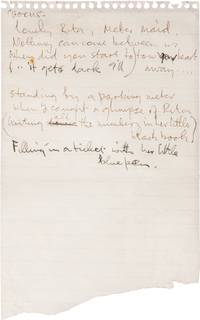
19672451967. Paul McCartney’s handwritten working manuscript as Beatle for “Lovely Rita†from the album Sgt. Pepper’s Lonely Hearts Club Band. the most famous album in the entire panorama of modern music. This is the very first rough draft 10 lines in ink all in Paul’s handwriting and all written on a single side of an irregular scrap of lined paper 7 1/2†X 5†torn from a spiral notebook. 7 lines in black are Paul’s first concept. 3 lines of changes have been added later in blue such as “writing all the numbers in her little black book†changed to “filling in a ticket with her little blue pen†and still later recorded as “filling in a ticket in her little white book.†Near fine condition. Lavishly matted and framed with a full size uncorrected 1st state proof photograph of the album cover varying in that McCartney is kneeling the band instruments have been passed around and 2 people are among the onlookers who would not sign releases and therefore did not appear on the published album. Ex–Butterfield’s Dec. 12 1993. Rare. Icon time. Beatles manuscripts from Sargent Pepper held all the rock & roll world records until Bob Dylan’s Like a Rolling Stone sold at auction for $2000000 in 2014. But it’s been a while now and another Sgt. Pepper manuscript will take the record back eventually and someday soon the only way to see one will be in a museum at the end of a long line behind velvet ropes. The last authentic Sgt. Pepper manuscript at auction A Day in the Life admittedly a greater song sold for $1202500 at Sotheby’s in 2010. The last real McCartney manuscript of a Beatles song at auction was an abridged later fair copy of 10 condensed lines from Hey Jude that he wrote out to be used as a key by a backup musician at a recording session $910000 at Julian’s in 2020 and that one in contrast to ours was not a working manuscript carrying his thoughts inner debates and changes.<br /> <br /> The handwritten lyrics to "Lovely Rita Meter Maid" represent an intimate window into The Beatles' conceptual shift during their psychedelic period showcasing McCartney's evolving storytelling approach. Unlike their earlier love songs centered on direct romantic sentiments this track exemplifies their move toward character-driven narratives with whimsical scenarios and playful humor. This creative direction coincided with broader cultural movements challenging conventional structures and celebrating the previously overlooked aspects of daily life. The track's transformation of a mundane authority figure into the subject of amorous pursuit subtly subverted social norms while maintaining a façade of innocent charm—a hallmark of the band's distinctive cultural impact during this period.<br /> <br /> McCartney's composition emerged during a pivotal moment in Western society when art was increasingly blurring distinctions between "high" and "low" culture. The Beatles' work on "Sgt. Pepper" helped legitimize popular music as culturally significant with songs like "Lovely Rita" demonstrating how seemingly simple pop compositions could contain nuanced social observation. The character sketch format allowed the band to adopt personas and perspectives outside their own experiences expanding their artistic range while connecting with the era's interest in identity exploration and social role-playing. This approach positioned the band as both participants in and commentators on the rapid social changes reshaping 1960s culture making even their lighthearted works like "Lovely Rita" meaningful cultural documents of their time. unknown
Hannestad, Lise, VladimirIn Pristine Condition. unknown
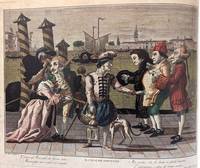
1219<p>A source collection of antiquarian books and engravings formed by Richard von Hunderdorff on Cicisbeismo the unusual social convention peculiar to the Italian Enlightenment. The subject of the catalogue is the relationship between married women and young men of noble birth in 18th century Italy and Spain. This collection is a sophisticated look at 18th century continental women and their position in society. The collection deals with the status of noble women their place in society the restraints to their freedoms and the ways they were able to engage men as escorts and confidants which allowed them to participate more openly in the social setting of their period. </p> <br /> <p>What is perhaps most interesting about the collection is that it not only chronicles the evolution of the position of women in Italy and Spain but records the reaction to this social phenomenon by French German and English writers and visitors to these countries. The criticism was almost universal and at times ferocious. The English and the Germans in particular portrayed the women as prostitutes the young gentleman as sodomites and the husbands as cockolds and by doing so provide stunning insights into the social status of women in their own country. </p> <br /> <p>This collection is a remarkable library of books and illustrations documenting the struggle for women to become greater participants in the societies in which they lived.</p> <br /> <p> A Copy of a Printed Catalogue is Available upon Request. Payment terms are available. </p> . unknown
186166<p>Original rubbing for the Stele of Second Opium War Arrow War in China during 1856-1860. Stele erected in 1861 in Canton Guangzhou City in GuangTong Province in China.</p><p>Very big size on a whole thick rice paper 152cm X 98cm The original stone had been demolished long long ago. This rubbing is the only one found in the world. Folded a few wears at edges. Both text and pictures were fine copied and undamaged but had some folds.</p><p>Rubbing is an ancient Chinese method to copy text and pictures on stone or on bronze wares by hand.</p>
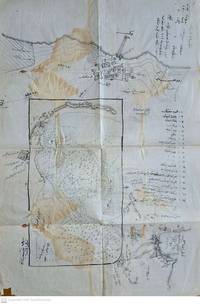
1902000110<p><strong>29 × 20 cm. Comprising 158 text plates including 95 photographs produced by the committee of which 42 photographs appear on separate plates measuring approximately 23 × 15 cm.</strong></p><p>The work documents the Photography Committee's journey from Istanbul to MaÊ¿Än in Transjordan. The accompanying text was compiled from articles originally published without illustrations in various issues of the newspaper <em>Vakit</em> "Time" in 1902.</p><p>This is a unique work prepared for publication with photographs taken by a private committee that included prominent figures such as the German general Karl Auler Pasha who served as an adviser on Hejaz affairs until the fall of Medina in 1918.</p> hardcover
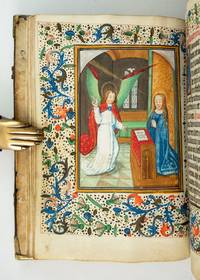
BOH 217FASCINATING MEDIEVAL BOOK OF HOURS WITH EXTENSIVE ILLUMINATIONS BY THREE DIFFERENT ARTISTS. In Latin and some French illuminated manuscript on parchment Southern Netherlands Mons c. 1460 original portion c. 1480-1490 updated. Dimensions 167 x 116 mm. 199 folios lacking one text leaf written by two different scribes in gothic textualis bookhand in single column on 17 lines; BINDING: seventeenth century brown calf over wooden boards spine with four raised bands gold-tooled gilt title "OFFICIU / BEATEM / VIRGIN" partly worn out gilt edges. ILLUSTRATION: 22 full-page miniatures within full rinceaux borders by the Mildmay Master 13 the Master of Philippe de Croÿ 7 and a third Mons illuminator follower of Simon Marmion 2 and 4 small miniatures by the Mildmay Master additional sixteen full rinceaux borders and 5-line initials in pink or blue on burnished gold grounds. The Mildmay Master was responsible for the core of the original manuscript; the artist paints elongated figures with small heads and slender bodies mostly situated on pale yellow tiled grounds. His outdoor landscapes are cursory. Unusual here are his delicate acanthus and floral borders sprinkled with fanciful grotesques. The artist responsible for updating the manuscript is the Philippe de Croÿ Master. He favors tiled floors in brown or gray and white with a generally somber almost grisaille palette with blue and white grey and a burnt brownish orange. A third painter a follower of Simon Marmion intervened during this second campaign. The most skilled of the three illuminators his delicate figures are well-modeled with tiny hands and individualized faces. PROVENANCE: The manuscript was made in Southern Netherlands probably in two different stages. The core of the Hours and the calendar were written in Mons for an unknown patron c. 1460. Then around 1480 the manuscript was updated also in Mons for a couple represented in prayer in the manuscript: Jean Antoine de Mahieu Lord of Bosqueau and his wife Jacqueline de Sivry Lady of Buath; belonged to Jean-Baptiste-Florentin Gabriel de Meyran marquis de Lagoy 1764-1829; inside front cover: "Jean Fransois de Lescluse demeurant a Frasne." CONDITION: ink stain in the margin of f. 1 water stains in lower margins of first 32 leaves colors slightly faded on marginal decoration f. 120v stain in the marginal decoration f. 77v other minor signs of use otherwise in very good condition. Binding condition: leather very rubbed gold tooling worn front cover almost detached hinges of the back cover fragile. Full description and images available. BOH 217 Southern Netherlands, Mons, c. 1460 (original portion), updated c. 1480-1490
TM 767MEDIEVAL SERMON MANUSCRIPT IN A FIFTEENTH-CENTURY CHAINED BINDING CHAIN INTACT decorated manuscript on parchment in Latin Austria Vienna or Southern Germany c. 1275-1300. 182 x 127 mm. 190 folios complete written in a rapid Gothic hand with cursive influence in two columns of thirty-two to thirty-seven lines justification 141-143 x 96-100 mm. parchment ruled in brown ink quire signatures guide notes for rubrication red rubrics capitals and names of cited authorities stroked in red rhymed phrases underlined in red red paraphs two- to three-line plain red initials two-line red initial with pen flourishing in red f. 131v occasional scribal corrections and marginalia. BINDING: Fifteenth-century blind-tooled and -stamped red calf with eight engraved and bossed cornerpieces intact fore-edge clasp and chain hasp with intact chain with two manuscript fragments serving as front flyleaf and lower pastedown. Chained libraries were a late medieval solution to the problem of providing access to needed books in an institution while at the same time preventing theft and we can assume many late medieval volumes were once chained. Most however have been rebound or survive without the chain and other metalwork and intact chained bindings such as this one are uncommon. TEXT: This extensive collection includes more than one hundred sermons from the <i>Sermones de sanctis et de communi sanctorum</i> of the early Franciscan writer Conrad of Saxony d. 1279 together with his very popular text the <i>Speculum beatae Mariae virginis</i> all copied not long after their composition. This is however not simply a copy of Conrad's sermon cycle since some of his sermons are omitted and six sermons by contemporary Dominican authors Martinus Polonus Aldobrandinus de Calvacantibus and Antonius Azaro de Parma as well as eight sermons by unidentified authors were also included. It seems likely this is an example of a re-working of Conrad's texts for a Dominican audience who would have prized it as a preaching aid and for its pronounced Marian focus. Marginal annotations attest to the early use of these sermons most likely by preachers. PROVENANCE: Written in Southern Germany or Austria at the end of the thirteenth century as suggested by evidence of spelling script and decoration. Belonged to the Dominican house attached to the Church of St. Maria Rotunda in Vienna as indicated by two fifteenth-century inscriptions; here it was probably part of the house's chained library. Belonged to a Dominican convent at KosiÄe in present-day Slovakia as indicated by a sixteenth-century inscription. Belonged to Maurice Burrus 1882-1959 Alsatian philatelist; his ex libris on the front pastedown. CONDITION: Slight rust stains and corrosion in the outer margins of ff. 184-188 margins trimmed away overall in good condition. Full description and photographs available TM 767. books
1917000214<p><strong>We believe this to be the first complete collection of its kind</strong> including several items that we have not encountered in public libraries or archival sources. In any case it represents the most comprehensive collection of issues that we have traced over a period of twenty-five years of Ottoman state publications many of which are difficult to assemble. The collection essentially consists of official reports most of which were prepared by the two ambassadors <strong>Fakhr al-Din Rûm Bey Oğlu</strong> and <strong>Muhammad Nâbi</strong>. These reports are highly restricted official documents.</p>Description of the Collection<p>The reports were prepared in <strong>Ottoman Turkish</strong> except for four items written in modern Turkish after the alphabet reform; these were prepared by <strong>İsmail Hakkı Tevfik</strong> and <strong>Abdulgani Seni Bey</strong>.</p>1. <em>Najd Issue</em> Najd Question<p>Ottoman Turkish report published by the Ministry of Foreign Affairs Istanbul 1918. 15 pages octavo.<br />Prepared by Ambassador Fakhr al-Din Rûm Bey Oğlu and the Ottoman Ambassador in Rome Muhammad Nâbi dated 11 March 1917.</p><p>The report discusses the political borders of Ottoman Najd; the treaty signed between Süleyman Şefik Pasha and Abdulaziz ibn Saud; the Ottoman–British treaty concerning Najd including Qatar; and the Ottoman treaty with Ibn Saud converting Najd from a <em>mutasarrifate</em> into a province <em>vilayet</em> appointing Ibn Saud as governor and commander-in-chief including military organization.</p><p>Topics include:<br />Midhat Pasha's report; Wahhabis; the conflict between Saud and Abdullah ibn Faisal; the sheikhs of Muscat Mukalla Oman Hadhramaut and Bahrain and their relations with Britain; Saudi movements along eastern Najd; Ottoman naval response under Midhat Pasha; the administrative difficulty of Najd; support of Mubarak al-Sabah for the Ottomans; coercion of Abdullah al-Faisal to sign the al-Ahsa treaty; Ibn Rashid's advances; tribal dynamics; British support of Al-Sabah; British protection; Ibn Saud and the Muntafiq sheikh; Ottoman–Wahhabi agreements 10 April 1905; British protests regarding Ibn Saud's border violations and interference in Qatar and Oman; the 12-article Ottoman–Ibn Saud treaty of 12 July 1913 including the separation of Qatar from Najd; maritime boundaries; recognition of Jasim Al Thani; compensation to the Sheikh of Bahrain.</p>2. <em>Muscat Issue</em><p>Ottoman Turkish report Ministry of Foreign Affairs Istanbul 1918. 6 pages.<br />Prepared by Fakhr al-Din Rûm Bey Oğlu and Muhammad Nâbi dated 27 November 1916.</p><p>Covers Muscat modern Oman the Imamate foreign involvement Ottoman views rejecting Muscat's independence from the Arabian Peninsula; relations between Najd Muscat and British India; strategic location; occupation history; Al-Sa'id relations with Wahhabis; British and French recognition of Omani independence in 1862; Ottoman perspective on Oman's connection to Arabia.</p>3. <em>Qatar Coasts Issue</em><p>Prepared 8 January 1917. Printed at the Imperial Press. 7 pages plus 9 pages of French appendices.</p><p>Topics include British expansion from Bahrain to Qatar; Ottoman claims; British intervention since 1891; correspondence with the Ottoman state; Bahrain–Qatar disputes over Zubarah and al-'Udayd; appointment of Abd al-Rahman Al Thani; British encroachments; Qatar within the Kuwait treaty framework; confirmation of Jassim Al Thani's authority in 1913.</p>4. <em>Kuwait Issue</em><p>Fakhr al-Din Rûm Bey Oğlu & Muhammad Nâbi. Imperial Press Istanbul 1334 AH. 34 pages.</p><p>Geography population sect history of Al-Sabah; Ottoman administration of Baghdad and Basra; British policy; secret treaties 1899–1904; borders; railways; maritime flags; taxation refusal; British attempts to place Kuwait under protection; Ottoman responses; oil islands Bubiyan Khor Abdullah; Sheikh's declaration of being an officer in the British army. Dated 31 August 1918.</p>5. <em>Basra Gulf Issue</em> Bahrain Qatar Pirate Coast/Emirates<p>İsmail Hakkı Tevfik. Ankara 1931. 32 pages.<br />Political tribal and documentary history in Turkish English and French.</p>6. <em>Irrigation in Arabia</em><p>Fakhr al-Din Rûm Bey Oğlu & Muhammad Nâbi. 14 pages.<br />Ottoman irrigation projects; British interference since 1910; German involvement.</p>7. <em>Asir Revolt of 1911</em><p>Report by Consul General İsmail Hakkı. 31 pages.<br />Ottoman military actions; Idrisi revolt; tribal loyalties; Wahhabi involvement; detailed military maps.</p>8. <em>Aqaba Issue</em><p>By Rashdi Infantry Brigade Commander. Istanbul 1326 AH. 154 pages.<br />Ottoman–British relations; Egypt's role; Hijaz railway; Aqaba dispute.</p>9. <em>War in Arabia between Ibn Saud and the Imam of Yemen</em><p>By Abdülgani Sünni Bey. Ankara 1934. 20 pages.<br />Unique copy. Covers causes tribal alignments Asir Aden Najran foreign involvement.</p>10. <em>Guide to the Gulf of Aden</em><p>Ottoman Turkish. Istanbul 1310 AH. 276 pages.<br />Includes maps; authored by naval officer Süleyman Nutqi.</p>11. <em>Tripoli Benghazi and the Twelve Islands Issue</em><p>Report dated 27 November 1916. 24 pages French treaty texts.<br />Ottoman North Africa American conflicts Italian ambitions Lausanne Treaty.</p>12. <em>Sheikh Sa'id Island Issue</em><p>Istanbul 1916. 4 pages.<br />Strategic Bab al-Mandab island dispute with France.</p>13. <em>Palestine Issue – Zionist Claims</em><p>Istanbul 3 March 1918. 43 pages.<br />Origins of Zionism; European diplomacy; Jerusalem administration.</p>14. <em>Notes on the Iraq War</em><p>Military Press 1333 AH. 88 pages.<br />Translated from English for official use only. Rare.</p>15. <em>Bahrain Issue</em><p>Report dated 8 January 1917. 12 pages French texts.<br />History British protection treaties 1820–1898 inclusion in 1913 Gulf treaty.</p>16. <em>Muhammarah Issue</em><p>Report dated 1 March 1917. 8 pages.<br />Borders oil Sheikh Khaz'al Anglo-Iranian-Ottoman relations.</p>17. <em>Oil Concessions in Arabia</em><p>Report dated 26 March 1917. 9 pages English treaty.<br />Mosul Baghdad Basra Shell Najd Kuwait.</p>18. <em>Baghdad Issue</em><p>Report dated 31 August 1917. 53 pages French texts.<br />Baghdad Railway; British–Ottoman rivalry; Gulf politics.</p>19. <em>Farasan Islands Issue</em><p>Report dated 28 November 1916. 8 pages.<br />German coal depot request; British occupation; oil and gas.</p>20. <em>Hadhramaut Issue</em><p>Report dated 11 March 1917. 6 pages.<br />Tribal governance; British relations via Aden.</p>21. <em>Aden and the Nine Districts</em><p>Report dated 27 November 1916. 39 pages French annexes.<br />Portuguese Ottoman British rule; Yemen administration; sovereignty claims.</p>22. <em>Memorandum on British Claims Regarding the Baghdad Line and Basra Gulf</em><p>Istanbul 21 January 1911. 35 pages appendices.<br />Detailed diplomatic negotiations since 1903.</p>23. <em>Guide to the Red Sea</em><p>Istanbul 1307 AH. 459 pages.<br />Comprehensive nautical and railway guide with ports and routes.</p>24. <em>South Arabia Issue</em> Hadhramaut Socotra etc.<p>İsmail Hakkı Tevfik. Bulgaria 1935. 132 pages with photographs and maps.</p>25. <em>The Egyptian Issue</em><p>Prepared March 1918. 186 pages.<br />Ottoman legal and political analysis of Egypt from Muhammad Ali to British occupation.</p>26. <em>Shatt al-Arab Issue</em><p>Istanbul 1917. 30 pages.<br />1913 treaty with Britain; navigation borders Iran Muhammarah.</p><p><strong>Note</strong><br />İsmail Hakkı Tevfik was a senior Ottoman and Republican diplomat and son-in-law of Sultan Mehmed VI. Fakhr al-Din Rûm Bey Oğlu and Muhammad Nâbi were leading Ottoman statesmen. Other contributors include Süleyman Nutqi naval officer and Abdulgani Seni Bey later a key Republican thinker.</p><ul><li><strong> 26 items</strong></li></ul> Ottoman Ministry of Foreign Affairs paperback
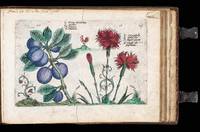
159416352Amsterdam 1594-1635. Oblong quarto 260 by 170mm 176 engraved plates numbered in an early hand 1-46 48-54 57-69 80-189 including 8 title-pages all with fine contemporary hand-colour in full occasionally heightened in silver two plates torn with slight loss to image and with early repairs six plates with slight worming to margins and three plates trimmed to neatline and laid down on old paper front free endpaper with later ownership inscription; mid-seventeenth century English red morocco elaborately gilt silver clasps and catches. A magnificent album of natural history engravings collected and bound for an English patron containing two complete suites of plates: Hoefnagel's 'Diversæ insectarum volatilium'; and Woutneel's 'Cognoscite lilia agri quomodo crescent' often bound as the fifth part 'Altera Pars' to the Crispin de Passes' 'Hortus Floridus' - the "most ambitions if not the first early effort to employ Continental resources to produce a set of botanical engravings designed for the English market" Gerard; and nine near complete or partial suites including an early issue of tulip plates from the 'Hortus Floridus'. All plates have been numbered consecutively in manuscript at the time of binding to a rudimentary scientific rubric: insects first then aquatic animals quadrupeds birds and botanicals last but not least. As a result some plates are bound with like subject rather than with their original publications. The album represents the work of some of the most famous natural history artists of the late sixteenth and early seventeenth centuries. The majority are published by Claes Jansz Visscher 1587-1652 the most important publisher of prints and maps in Amsterdam of his day. Recorded as an engraver in Amsterdam as early as 1608 he built a distinctive inventory of prints after the designs of Flemish artists which proved extremely popular and formed the basis of Visscher's early success as a publisher. INSECTS HOEFNAGEL Jacob. Diversæ insectarum volatilium: icones ad vivum accuratissmè depictæ per celeberrimum pictorem D.I. Hoefnagel typisq. Mandatae a Nicolao Ioannis Visscher anno 1630 Engraved title-page complete with 15 numbered plates of insects misbound including some upside-down bound with plates 11 and 12 from 'Volatilium varii generis effigies' after Nicolaes de Bruyn all with contemporary hand-colour heightened in silver consecutively numbered in an early hand 1-18. North German insects with the exception of the tarantula and scorpion. Engraved by Visscher after those by Jacob Hoefnagel 1573-1632 court painter for Emperor Rudolph from 1607 son of Joris Hoefnagel whose drawings of animals flowers and insects he engraved and published as the 'Archetypa Studiaque Patris Georgii Hoefnagelii' 1592. He also engraved plates for Braun and Hogenburg's 'Civitates Orbis Terrarum' 1512 - 1617. Ebert 798; Hagen I 371f; Hollstein IX 46 1-16; Nissen 1955; Horn-Schenkl. 10473. AQUATIC ANIMALS BRUYN Nicolaes de. Libelius sic varia genera piscium compectens pictoribus sculptoribus etc mire utilis et necessaries Nicolaes de Bruyn inventor Claes Ianss. Visscher excudit. interspersed with: COLLAERT Adrian. Piscium vivae icones inventae ab Adrian Collardo et excusae a Nicolao Ioannis Visscher anno 1634 Engraved allegorical title-page for 'Libillus' 11 of 12 without the sea-horse plates of aquatic animals and sea-monsters; 19 of 20 engraved plates of aquatic animals numbered in an early hand 19-44 followed by the allegorical title-page for 'Piscium' numbered 45 all with contemporary hand-colour all annotated in an early hand with common names in English. An early state of the title-page for de Bruyn's 'Libellus' before correction. Nicolaes de Bruyn 1571-1656 is best known for his large engraved landscapes "after designs by artists such as Gillis van Coninxloo and David Vinckboons from around 1600 his pupil and brother-in-law was Jan van Londerseel" Hollstein online A near complete suite of plates from a later edition of Collaert's famous work on fish first published in about 1598 in which the original engravings included elaborate landscape backgrounds. For his version Claes Visscher has incorporated his harpoon monogram into the dramatic title-page. Collaert 1560-1618 married engraver and publisher Philippe Galle. WEYER Gabriel. Monstra marina dat is verscheydon zee-monsters ge inventeert door Gabriel Weyer gedrucht by Claes Ianss. Visscher a.o 1634 Engraved allegorical title-page 7 of 12 plates of mermaids and mermen all with contemporary hand-colour numbered in an early hand 46 48-54. Berliner 'Ornamentstichkatalog' 4292 I; Nagler XXIV S. 220 I QUADRUPEDS BOLSWERT Boetius Adams after Adrien BLOEMAERT. Natus Dei solius ad servitium cinctis homo per hund creates imperat. Volentibus promisq.e; ut huic puessulo blande Leo Jouisq.e ales submittitur. ABloemaert invent: BA. Bolsuerd: sculp C Visscher excudebat 1632 G. Ryckius interspersed with: BRUYN Nicolaes de. Animalium quadrupedum varii generis effigies Allerley viervuessiger thier eigentliche abbildung den goltschmieden dienlich 1594. 8 of 14 without plates 1 5 and 11 plates 12 13 14 bound below with 'Volatilium' engraved plates of pastoral scenes from 'Natus'; 11 of 12 bound without the title-page engraved plates of animals from 'Animalium' all with contemporary hand-colour numbered in an early hand 57-69 and 80-85 allegorical title-page for 'Natus' numbered 86 annotated with the common names in English. The artistic Bolswert and Bloemaert families of Utrecht seem to have been very close frequently working together. Bloemaert met a grisly death at the hands of one of his students in 1666. 'Animalium' cf Hollstein 303-310; 'Natus' cf Hollstein 406-419 BIRDS BRUYN Nicolaes de. Volatilium varii generis effigies in tyronum praecipue vero aurisabrorum gratiam aeri incisa Claes Ianss. Visscher exu. NB. interspersed with: COLLAERT Adrian. Avium vivae icones Adriano Collardo inventore et excusum apud C Visscher anno 1625. 9 of 13 without plate 13 and plates 11 and 12 bound with 'Diversæ insectarum volatilium' above engraved plates of birds from 'Volatilium'; 12 of 18 without plates 4 9 14 15 18 plate 1 title-page bound separately below engraved plates of birds from 'Avium'; plates 12 13 and 14 from 'Natus' see above all with contemporary hand-colour numbered in an early hand 87-110 allegorical title-page for 'Volatilium' numbered "1" in the plate in manuscript "iii" ie 111 and with "Thretti" in the lower margin. BOTANICAL PASSE Crispin van de the elder and younger. Hortus Floridus Utrecht 1614 12 engraved plates of tulips numbered 32 43-53 all with early hand-colour numbered in an early hand 112-123 one ascribed to Willem de Pass in the plate. An early issue with no text on verso and captions only in Latin of a selection of tulip plates from "the most popular florilegium ever published" 'An Oak Spring Flora'. The work was first issued in a number of states between 1614 and 1617 and is often hailed as "the most important of early examples of botanical illustration" Gerard. It was issued in four sections on for each season with text in Latin and subsequently a selection of vernacular languages. 'An Oak Spring Flora' 12 WOUTNEEL Hans; and possibly Crispin van de PASSE the elder. Cognoscite lilia agri quomodo crescent non laborant neque nent: attamen dico vobis ne salomonem quidem in universa Gloria sua sic amic tum fuisse.ut unum ex his. Matthe: 6 Cap. Formulis Crispiam Passaei et Joannis Waldnelij 1603-1608 Allegorical title-page 61 engraved plates captions in Latin French English and Dutch all with early hand-colour numbered in manuscript 124-185 annotated throughout in two early hands with the months in which they flower and their medicinal properties in the "first" "second" and "third degree" misbound. The "most ambitions if not the first early effort to employ Continental resources to produce a set of botanical engravings designed for the English market" Gerard. Complete a suite of 61 plates depicting 120 plants published as a separate work in its own right but often issued as the fifth part of the de Passe's 'Hortus Floridus' when it appears with an additional letterpress title-page as the 'Altera Pars'. An early issue with no text on verso. "Traditionally the 'Alera Pars' has been considered as an aesthetically inferior appendage to the 'Hortus Floridus' and has received little attention from historians of prints or botanical illustration. However the presence on the title-page of the imprint of Hands Woutneel "Joannis Waldelij" an Antwerp native who was a bookseller and publisher in London from 1576 until his death sometime between 1603 and 1608 implies that the 'Altera pars' had a significant English component. As such it stands as an early example of Anglo-Continental print publishing collaboration. Prior to publication of the 'Altera Pars' the demand in England for botanical illustrations had been met primarily by relatively crude highly schematic collections of woodcuts such as those in Jacques LeMoyne de Morgue's 'La Clef des Champs' 1586 and John Norton's publication of Gerard's 'Herball' 1597. The 'Altera Pars' with its more naturalistic depictions of 120 plants set a new standard and served as the primary source of botanical images for English engravers and publishers from the late years of the reign of James I through the Restoration' Gerard. Hans Woutneel first appears in London on being admitted to the Stationers Company in 1579-80. Cartographer Abraham Ortelius mentions him frequently in his correspondence with his nephew Jacob Cole Gerard and Woutneel appears to have worked as Christopher Plantin's London agent. de Belder 272; Gerard 'Woutneel de Passe and the Anglo-Netherlandish Print Trade' 1996; Hunt 199; Nissen BBI 1494 Avium vivae icons Adriano Collardo inventore et excusum apud C Visscher anno 1625 Engraved allegorical title-page numbered 186 see above for plates. Untitled composite natural history. Claes Janss Visscher excudibat A.o 1625 A suite of 12 numbered engraved plates of composite natural history subjects all with early hand-colour numbered in manuscript 187-198 11 with the joint imprint of Assuerus van Londerseel and Claes Visscher. In the style of Hoefnagel's 'Archetypa Studiaque ' 1592 this is a very scarce suite of plates with only one uncoloured set known in the British Library.
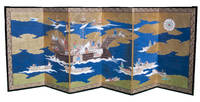
1700ABC_49540Japan 1700. 104 x 272 cm each illustrated panel: ca. 90.5 x 44.5 cm. Ink watercolours gold paint and gold leaf on paper. The image is surrounded by a frame of silk brocade a narrow frame in burgundy and gold and a wider frame in yellow gold and black with a clear floral pattern; together the frame is 5 cm wide the whole is mounted on six roiro black lacquered wood panels with gilt metal fittings on the outer corners of the outer panels. The panels are backed with decorative paper. A remarkable example of a Nanban byobu literal translation: Southern Barbarian screen a type of Japanese folding screen byobu depicting the arrival of Europeans especially the Portuguese in Japan during the late 16th- and early 17th centuries. It shows the vast expanse of the Portuguese seaborne empire. From their possessions along the coast of the Indian subcontinent and their lease of Macau individual Portuguese reached Japan in 1542 and were followed by traders and missionaries the most famous being Francis Xavier. Nanban art provides a unique glimpse into a period of significant cultural exchange and the Japanese perspective on the arrival of the Portuguese in their islands. While inspired by the arrival of and trade with the Portuguese in Japan before the enforcement of the isolationist foreign policy commonly known as Sakoku by the Japanese Tokugawa shogunate from 1633/1639 onwards it remained a popular subject to depict on these folding screens and in other artworks during the Edo period and beyond. The image on the present folding screen shows a large four-masted ship probably approaching the port of Nagasaki. Crew members both Portuguese and people from Portuguese possessions in the Indian subcontinent are seen furling the sails and performing remarkable acrobatic feats in the ship's rigging. The artist emphasises the balloon-like bagginess of their bombacha trousers typically associated with the Portuguese and other Europeans but focuses also on distinctive details such as heavy gold necklaces facial hair hats capes frilly white handkerchiefs and ruffled collars. The foreigners are depicted as being exotic but not scary or very "other" they are depicted as being different while still simply being human. The decoration and colours of the flags flown at the top of each mast are reminiscent of Christian symbols the Cross of Christ and Portugal's colours green and red. Cargo and passengers are offloaded into small boats that pull alongside the ship the top right corner shows a 12-point wind rose including a depiction of the globe. The whole scene is enschrouded in gold clouds.After the Sengoku period a period of practically consecutive and almost continuous civil wars and social upheavals in the 15th- and 16th centuries Japan entered a more peaceful and prosperous period. Folding screens such as the present example were used to divide larger homes and generally show of the growing wealth and prosperity of the warrior and merchant classes. The screens are finely executed in detail and using vibrant colours and copious amounts of gold paint and/or gold leaf. Thematically the painting here continues a tradition of now-lost screens of Chinese trade ships that were in vogue during the 15th- and 16th centuries at the peak of the Sino-Japanese tribute missions that brought entourages numbering in the thousands from the Ming court. The precise subject of these paintings had since shifted from Chinese trade ships to Chinese- or more general Southeast Asian-style ships carrying European including men from the European possessions in Africa and Asia crews. The scene illustrates the dynamic convergence of Eastern and Western cultures through trade around 1600. Portuguese traders first arrived in Japan in 1543 and by 1570 they had established the Bay of Nagasaki as a strategic hub for their commercial operations which were largely unregulated. They generated significant profits by exchanging Chinese silk for Japanese silver although some European goods were also part of the trade. The Portuguese carracks massive three-decked vessels weighing up to 1600 tons captivated local observers with their impressive scale unfamiliar crews and exotic cargo.Alongside these traders Jesuit missionaries sought to spread Christianity finding particular success in Kyushu where many local daimyo converted. However a Christian-led rebellion in 1638 alarmed the Tokugawa authorities raising fears of European colonial interference. As a result the Portuguese were expelled in 1639. When a Portuguese delegation attempted to restore diplomatic relations the following year all sixty members were executed. In 1640 the shogunate instituted a policy of national seclusion restricting foreign contact to limited trade with Chinese merchants a small number of Dutch traders and occasional Korean envoys. By 1650 Christianity was outlawed and any missionary work was punishable by death. The present screen is a slightly later example and the focus of the scene lies mostly on trade and the ship's crew itself and not directly on any Christian identity of the foreigners arriving on Japanese shores.This screen belongs to approximately ninety surviving Nanban screens ranking second only to capital city scenes in popularity among Japanese patrons. The earliest examples date to the 1590s and their continued production throughout the Edo period demonstrates the lasting impact of the Portuguese encounter on Japanese culture.Some minor flaking of the gold paint/gold leaf barely any soiling the decorative paper back of the work shows some traces of wear and use. The image remains clear and the colours vibrant. Overall in very good condition. This exceptional screen offers collectors an important historical document that captures both Portuguese maritime exploration and the Jesuit mission to Japan-a unique period of cultural exchange between East and West. unknown
37<p>Very fine and clean. Bound tight. Printed by The Commercial Press Ltd. Shanghai - China 1936. Very Rare.</p><p>Sebuah buku antik dari sekolah Tionghoa di Tegal THHK Tegal Java yang merupakan buku peringatan THHK yang ke 30 tahun.</p> hardcover
1470CLe2501Low Countries probably Bruges ca. 1470-80. 186 x 135 mm. 7 3/8 x 5 1/4". Single column 20 lines in a gothic book hand. i blank 108 i blank leaves bound too tightly for a close collation but APPARENTLY COMPLETE. Contents: Calendar f. 1r; Gospel Lessons f. 7r; Hours of the Holy Cross f. 11r; Hours of the Holy Spirit f. 15r; Mass of the Virgin 18r; "Obsecro te" f. 21r; "O Intemerata" f. 23r; Suffrages f. 24r; Hours of the Virgin f. 33r; Office of the Virgin as said throughout Advent f. 71r; Penitential Psalms f. 76r; Litany and petitions f. 81v; Office of the Dead f. 87r. <br/> HANDSOME RENAISSANCE ENTRELAC BINDING upper joint and parts of spine very skillfully repaired covers with a gilt floral border surrounding a central panel of gilt strapwork design with traces of original polychrome painting raised bands spine gilt in compartments original bosses and catchplates clasps renewed all edges gilt. Rubrics in red numerous one-line initials in blue with red penwork or gold with dark purple penwork many two-line initials in burnished gold on pink and blue ground with white highlights most of these with floral sprays extending into the margins 22 SMALL MINIATURES measuring approximately 45 x 37 mm. each with panel borders of colorful acanthus and flowers at the top and bottom of the page connected by a strand of gilt bezants and 14 FULL-PAGE MINIATURES each surrounded by a full border of acanthus flowers and bezants the facing pages also with full borders and a large six-line initial painted pink or blue filled with swirling vines and flowers on gilt and painted ground. Subjects of the large miniatures being: Crucifixion f. 10v; Pentecost f. 14v; Virgin and Child f. 17v; Annunciation f. 32v; Visitation f. 42v; Nativity f. 49v; Annunciation to the Shepherds f. 52v; Adoration of the Magi f. 55v; Presentation in the Temple f. 58v; Massacre of the Innocents f. 61v; Flight into Egypt f. 66v; Coronation of the Virgin f. 70v; David in Prayer f. 75v; Raising of Lazarus f. 86v. Front pastedown with a 16th century inscription see below; rear pastedown with a 17th century ownership inscription in ink signed François le Paige. Lower joint a bit rubbed margins with a little soiling and occasional wrinkle fore-edge border rule just grazed by binder in a few places the other borders quite ample miniatures with tiny chips light fading or rubbing in a couple places etc. but IN EXCELLENT CONDITION the attractive period binding very well preserved with boards showing virtually no signs of wear the vellum generally clean and bright and the miniatures fresh and richly colored.<br/> <br/> This is an extensively illustrated Book of Hours preserved in an especially attractive early binding with richly colored miniatures attributed to the Master of Philip of Cleves' "Book of the Hunt." Active in the Low Countries from approximately 1470-90 this artist was patronized by some of the area's wealthiest elite and is known to have collaborated with another important illuminator called the Bruges Master of 1482. Some trademarks of our painter include faces with subtle blue shading; high arched eyebrows; thin golden halos; and women with very straight shoulder-length hair highlighted with strands of gold. Outdoor scenes often contain narrative elements in the distance such as the figures of a young David and Goliath in the miniature of King David at Prayer or pagan idols dropping from a column in the Flight into Egypt recalling a popular apocryphal tale of pagan relics miraculously falling to pieces as the Holy Family passes by. Some miniatures of note in addition to these two are the Raising of Lazarus for the Office of the Dead--a popular alternative to funeral images particularly among Flemish illuminators--and the Massacre of the Innocents for the hour of Vespers a particularly violent episode in which King Herod commands his soldiers to slaughter the male infants of Bethlehem. Like other miniatures in this work the action in these scenes is spread out between the fore middle and background creating a multi-layered narrative that invites the eye to explore and meditate. The artist's color palette in this manuscript is quite memorable and includes a bright mustard yellow pale green and cherry blossom pink. The Coronation of the Virgin makes particularly strong use of color with a sunset-like gradient giving way to billowy blue clouds. The Annunciation miniature also demonstrates the Master's facility with color; here the Angel Gabriel's red and green wings are fully extended while the Virgin is radiant against a golden yellow wall covering. In addition to the large compositions we are treated to 22 smaller miniatures depicting the Evangelists and saints each of which is charming in its more confined presentation. Although the saints found in the Suffrages are quite typical for a Book of Hours the Calendar is another story. Despite being rather sparsely filled out the calendar here includes several feast days some of them unusual enough to provide additional insight into the manuscript's localization and use. For example there is St. Landoaldi 19 March a missionary to Northern France and Belgium and St. Winnoc 6 November the son of a Breton king with a former abbey in the far north of France. The calendar is idiosyncratic in other ways as well with saints' names that are repeated and others that are either extremely obscure or whose dates seem to be wrong. Whatever the case additional research into the calendar would undoubtedly prove revealing. We are fortunate to have some early provenance information written into this Book of Hours. The inscription on the front pastedown reads: "This last day of September 1590 we name erased but Claude le Paige lieutenant of the guards of his highness of Bar le Duc on the one hand and Alix de la Taxe on the other hand have married in front of the holy Catholic church at the place of Mirecourt." Below this inscription are notes indicating the ages of the bride and groom 17 and 36 respectively as well as the dates of their deaths: he died on 9 May 1610 and she on 14 September 1622. Located in the strategically important Meuse region in northeastern France the Duchy of Bar-le-Duc unified with Lorraine in 1480 and became extremely wealthy during the 16th century. Although we do not know for whom the manuscript was originally made it seems quite possible that it was commissioned for a forebear of the named Bar-le-Duc spouses and was perhaps passed down through later generations of the family. The signature on the pastedown indicates that François le Paige son of Claude and Alix inherited the book from his parents. This manuscript was lavishly and tastefully bound early in the 16th century and has survived in excellent condition to the present day. This binding would originally have been painted but even without its original colors it is still quite attractive perhaps even splendid. In excellent condition inside and out the manuscript is a fortunate survival and a testament to generations of careful stewardship. unknown
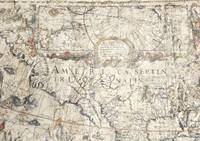
167312722Bologna Guiseppe Longihi Pietro Todeschi 1673. Nova et accurata totius Americae tabula auct. G. I. Blaeu America quarta pars orbis quam plerunq nuvum orbem apellitant primo detecta est anno 1492 a Christophoro Columbo . A hand-coloured engraved wall map printed on 4 joined sheets. Size: 86 x 110 cm. / 33.9 x 433 inch. Large very rare hand coloured copy of Willem Blaeu's famous wall map of the Americas which is considered ""one of the most influential maps of America ever made"" Burden. The map is based on the latest explorations and shows everything known at the time about the American continent as well as the north and south poles which are included on two inset maps. As the wall map was in great demand but expensive and difficult to transport it was also printed by various French and Italian publishers for the local market. Like Blaeu's edition the French and Italian editions are very scarce as it is highly unusual for wall maps from this period to survive. We have only been able to trace 4 other copies of the present edition in sales records of the past hundred years of which only 1 is also hand coloured. Willem Janszoon Blaeu 1571-1638 first published the wall map in 1608 together with similar maps of Asia Africa and Europe. He spared no expenses for this project and hired Hessel Gerritsz 1580-1632 a great cartographer in his own right to both design the maps and research the latest sources exhaustively to create the most accurate depiction of the continents possible. Although the Americas were drawn too wide due to the inadequate methods of determining longitude at the time the shapes and most of the coastline are already very well defined. Central and South America were drawn according to Portuguese and Spanish sources and ""Nova Scotia"" on the Atlantic coast was based on the voyages of Samuel de Champlain and Pierre Gua de Monts from 1604. After the first edition in 1608 the four continents were subsequently published in 1612 and in 1624 they were reissued by Hendrik Hondius and in 1655 by Nicholas Visscher. The third state included changes to the Strait of Magellan based on Le Maire's findings from his expedition in 1615-1617. The map has been beautifully decorated with cartouches and small engravings. The cartouche in the lower right tells how the New World was discovered and is flanked by the figures of Christopher Columbus and Amerigo Vespucci. Below are four roundels containing the portraits of the four circumnavigators: Ferdinand Magellan Sir Francis Drake Sir Thomas Cavendish and Olivier Van Noort. The Atlantic features a beautiful depiction of King Philip III of Spain riding a sea chariot supposedly on a figurative visit to his New World possessions and in the Pacific Poseidon with his wife Amphitrite and son Triton can be found amidst battle ships and sea monsters. Elephants rhinoceroses camels and ostriches roam the continent. Some copies of the present map include a decorative border with illustrations of native people and sometimes also a textual border with descriptions which are not present here. It appears that these borders were engraved on separate copper plates and were not always included. Blaeu's wall maps were first printed in Italy in 1646 probably by Stefano Mozzi Scolari 1598-1650 in Venice which were based on the third state from 1624. The present copy was engraved by Pietro Todeschi dates unknown around 1670 and published in Bologna in 1673 probably by Giuseppe Longhi who had worked on similar projects with Todeschi before. It closely resembles the Venetian edition which was most likely used as the model. Todeschi's edition is however clearly recognizable because of the misspelling of Mar del Norte as Mar del Noi and the fact that California has been drawn as an island. It is the only edition known to do so. The map has been reinforced on the back and is somewhat browned and stained; the surface has faded the work has been professionally restored: the colouring has been retouched some of the losses have been filled in. Otherwise in good condition. Burden II 433; Schilder Monumenta cartographica Neerlandica V p. 195; cf. Burden I 156 Blaeu map. Bologna, Guiseppe Longihi, Pietro Todeschi unknown
171548763Augsburg.: Jeremias Wolff. c.1715. Full contemporary blond calf boards with elaborate neo-classical decorative borders composed of rules foliate floral and rope-work tools vase tools at head and foot and mask corner tools all to surround a central lozenge with a decorative composition of floral foliate and mask tools later banded spine with elaborate decorative tooling in gilt in seven compartments turn-ins tooled in gilt red speckled edges. Folio. 554 x 423 mm. Engraved allegorical title with Latin and German text leaf with letterpress text in German in double columns and 56 engraved allegorical plates all after the Deckers by various engravers see below. Sheet size: 435 x 560 mm. An exceptional copy of Decker’s very rare suite of engravings – here in-plano and with exceptional additional colouring and highlighting in gilt by hand – illustrating the battles of the War of the Spanish Succession.Decker’s suite depicts the battles of the complex series of engagements that became known as the War of the Spanish Succession 1701–1714. Prompted by the death of the last of the Spanish Habsburg Kings the childless Charles II and with a shifting group of alliances and a field of warfare that included not only Continental Europe and the Mediterranean but also the Caribbean and North America the War of the Spanish Succession has a case to be a true world war. In part an attempt to check French hegemony the war featured a number of outstanding victories for the Duke of Marlborough and Prince Eugene of Savoy including Blenheim although the war was ultimately at best indecisive.Each of Decker’s magnificent plates features a single engagement depicted in the central portion of the plate the whole image surrounded with a decorative border composed of architectural allegorical and armorial symbols and motifs in the Baroque manner and a descriptive text concerning the battle. Many of the plates feature an additional small vignette of the battlefield keyed to the descriptive text and illustrating the placement of the armies and the most significant figures involved.The colouring and highlighting by hand of the present copy is remarkable. The painstaking detailing and the additional ornamentation in liquid gold is lavish and in combination with the binding suggests this copy was important and worthy of presentation. The printed text 'Kurze Beschreibung des Spanisch Successions-Krieg . &c.' here and unusually in German gives a detailed outline of the origins and history of the conflict and concludes with the list of plates and the engagements they depict. The text appears in other copies in other languages suggesting a commercial flexibility of distribution.It is a measure of the importance attached to Decker’s suite that the painter Ignaz Preissler used Decker’s plates as the basis for the decoration of an important tea service and garniture now at least partly in the collection of the Metropolitan Museum in New York see ‘Repraesentatio Belli ob successionem in Regno Hispanico . A Tea Service and Garniture by the Schwarzlot Decorator Ignaz Preissler’ by Maureen Cassidy-Geiger.‘Such commemorative series were considered works of art as well as encapsulations of recent events and were highly valued by collectors of the period who acquired them for their libraries or print cabinets.’ Maureen Cassidy-Geiger.Decker’s suite is very rare outside Germany: COPAC lists copies at the British Library and V & A only while KVK lists copies at the Polish National Library the Bibliothèque Nationale and the Université de Charles de Gaulle Lille in France and the Rijksmuseum Amsterdam; the only traceable copy in North America is at Brown University. We can locate no other copies with contemporary colouring or highlighting by handBerlin 103 incomplete; Bobins III 1165; Brunet V 626 for the French edition. Jeremias Wolff. hardcover
193869823New York:: The Macmillan Company 1938. Reprint of the 1936 first edition. original gray cloth stamped in blue in dust jacket. Ink stamp of Selznick International Pictures Inc. to verso of rear free endpaper; a little browning to the hinges from binder's adhesive; some shelfwear to the bottom edge; but a bright copy. The jacket is chipped at extremities of the backstrip and has a few other tiny chips; good to very good. The framed certificate of appreciation is somewhat rippled and there is some fading to some of the signatures. . 8vo and framed artwork measuring 25 x 21 inches overall. Denoted in pencil "Copy #1" this was Assistant Director Eric Stacey's copy signed by David Selznick Director Victor Fleming and 28 members of the motion picture cast including Vivien Leign Clark Gable and Olivia de Havilland. Eric Stacey has added his ownership signature in pencil on the half-title. Accompanying the book is a framed gift presented to Eric Stacey "In appreciation for his cooperation and unfailing interest during the darker days of "Gone With the Wind." Created by Atlanta artist Jack Conner the signatures of 82 members of the motion motion picture production staff are surrounded by a decorative cartouche in colors featuring Aeolus the Keeper of the Winds as a pair of cherubs amid scrolls the sun moon and stars. In the decorative title lettering "Gone" is windblown. The Macmillan Company, hardcover
196069825Philadelphia:: J. B. Lippincott Company 1960. Thirteenth impression. publisher's cloth-backed boards in dust jacket. Preserved in a quarter morocco folding box. Fresh and bright: better then very good in a very good jacket with the usual rubbing and edgewear. 8vo. This book was a gift for Helen Grotke who was the schoolteacher on the motion picture set tutoring the school-age actors. Inscribed by Harper Lee and twelve members of the cast including Gregory Peck Robert Duvall and the children. Many of the actors have written the names of their characters under their inscriptions. Mary Badham's reads "To Miss Grotke my favorite teacher. Mary Badham Scout." J. B. Lippincott Company, hardcover
1956140943102Various Places: The War Relocation Authority 1956. A substantial archive of over 300 individual documents plus a few duplicates<br /> relating to Japanese internment during WWII<br /> forming a very thorough view of the federal agency that directed their imprisonment The War Relocation Authority. Such a sizeable collection of WRA documents is extremely rare in commerce.<br /> <p>All the major facets of the dark disturbing episode of Japanese internment are represented in this archive: its basic legal and historical outlines the WRA's publicity and propaganda and its reception<br /> in the US the WRA's groundbreaking use of social sciences in service of repressive American policies life and death in the camps and the ending of internment.<br /> <p>The essential history of internment can be said to begin with Franklin D. Roosevelt's Executive Order 9102 establishing the War Relocation Authority included in mimeograph format. Around that time and later an Index-Digest of Opinions by the Office of the Solicitor compiles legal opinions about<br /> internment with commentary by regional attorneys.<br /> <p>Additionally included are many of the WRA's<br /> quarterly and semi-annual reports as well as a<br /> nearly 300-page contemporary history of the<br /> agency by an unknown author untitled and likely written in late 1944.<br /> <p>The publicity campaigns of the agency are reflected in collections of the propaganda leaflets the WRA issued a near-complete run of the abstracts the WRA prepared on press coverage it faced mimeographed speeches presented by WRA head Dillon S. Myer and other agency figures and a file of documents relating to the WRA's investigation by<br /> the House Committee on Un-American Activities<br /> HUAC which would become famous under<br /> Joseph McCarthy in the early 1950s. The WRA's sensitivity to criticism is readily apparent especially in their robust reaction to HUAC's critiques.<br /> <p>One of the most controversial sections of the WRA the Community Analysis Section is heavily represented in this archive by near-complete runs of their Community Analysis and Project Analysis Reports. The Community Analysis Section was largely composed of social scientists primarily anthropologists who studied life in America's WWII concentration camps. Their aim was to aid Franklin D. Roosevelt's administration in running the camps with as little resistance as possible by applying lessons learned in the disciplines of Japan studies<br /> and the human sciences. Although some<br /> Community Analysts voiced objections within<br /> restricted internal communications few brought<br /> these objections before the American public.<br /> Throughout the next six decades anthropologists psychologists and sociologists would become increasingly integral in US military operations and counterinsurgency campaigns leading to controversy with the revelation of their complicity in acts of torture by the American military in Iraq and Afghanistan.<br /> <p>Life and death in the camps is revealed in the previously mentioned reports of the Community Analysis Section as well as in detailed reports of Americans of Japanese ancestry who died in the camps and in military service Cumulative<br /> Casualties by Center documents about Tule<br /> Lake and a death there. The thoroughness of<br /> these reports is undoubtedly of use to future<br /> historians looking into various rebellions within<br /> the camps and the repression which followed<br /> as well as deaths of Nissei in WWII.<br /> A smaller collection of documents outlines the<br /> closing of the camps and attempts to transition<br /> their residents back to normal life.<br /> <p>Most are stapled mimeographed documents; a<br /> few are carbon copy typescriptsas indicated in<br /> their descriptions. Very Good condition overall.<br /> Around ten of the documents are ex-library<br /> copies with their stamps and "discard" written on<br /> them. Occasional holograph notations for<br /> routing in the WRA bureaucracy. Some<br /> documents marked "Confidential" and "Do Not<br /> Publish." Manuscript annotations to some<br /> leaves.<br /> <p>A remarkable collection of documents that<br /> reveal not only what the WRA did but how its<br /> bureaucrats perceived it and themselves. There<br /> is a strange but quintessentially American<br /> mixture of professionalism media savviness<br /> cruelty optimism and racism for historians and<br /> researchers to study here and hopefully for us<br /> all to learn from.<br /> <p>DETAILED DESCRIPTION OF CONTENTS AVAILABLE UPON REQUEST. The War Relocation Authority unknown
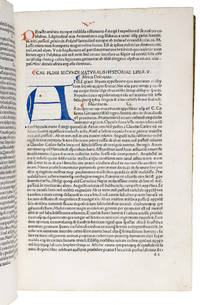
1483ABC_50159Venice 1483. Small folio. Reynaldus de Noviomago 17th-century blind-tooled sheepskin sewn on 3 supports with the corresponding raised bands on the spine red sprinkled edges. With the initials and book numbers alternatingly painted in red and blue. 355 ll. Beautifully rubricated 1483 edition of Plinys encyclopaedia of all knowledge in the ancient world PMM edited by the Italian humanist Philippus Beroaldus 1453-1505. Divided into 37 books the text is one of the largest works to survive from the Roman Empire encompassing botany zoology astronomy geology geography mineralogy and art. First published in Venice in 1469 by Johannes de Spira it marked the first appearance in print of any scientific text. The present work is the 11th edition overall and the first and only by Reynaldus de Noviomago dates unknown originally from Nijmegen in the Netherlands.The Historia Naturalis aims to cover the full scope of ancient knowledge drawing on the most authoritative sources available to Pliny. It remains a key reference for understanding Roman science technology and natural phenomena. The work preserves unique accounts of technical innovations such as mining techniques and the use of water mills for grinding and many of its observations have been confirmed by archaeology. Pliny also provides rare descriptions of contemporary artists making the work an invaluable source for art history. As the Dictionary of Scientific Biography notes Pliny holds a place of exceptional importance in the tradition and diffusion of Western culture.Widely read and highly influential in the 15th century Historia Naturalis saw 18 early printed editions from 1469 to 1500 all produced in Italy. Despite occasional inaccuracies or lapses in citing sources Plinys compilation of facts is unique for its breadth and ambition. By quoting numerous classical authorities and including all material uncritically he provides a comprehensive overview of ancient knowledge. Even the errors in his work offer modern scholars insight into both the understanding and misunderstanding of the natural world in antiquity.Gaius Plinius Secundus 23/24-79 CE better known as Pliny the Elder was a Roman author naturalist and natural philosopher as well as a commander in the Roman army and navy and a friend of the emperor Vespasian. Devoting much of his life to observation study and travel he produced this encyclopaedic work which became a model for all subsequent encyclopaedias in its scope meticulous referencing of sources and detailed indexing leaving a lasting legacy for the study of natural history in both the Renaissance and beyond.With a shelfmark label mounted on the front pastedown several 16th-century annotations in the text. The outer layer of the sheepskin has been rubbed off leaving the suede layer the work has been rebacked with the original spine laid down. The first and last few leaves are slightly soiled water stains in the margins of some of the leaves sometimes slightly affecting the text lacking the first blank leaf. Otherwise in good condition.l Goff P794; GW M34329; Hain-Copinger 13095; IDL 3731; ISTC ip00794000; Klebs 786.9; Oates 1783 lacks first blank; Proctor 4445; cf. DSB 11 pp. 38-40; E. Ghareeb & I. Al Abed United Arab Emirates: A New Perspective London 2001 pp. 54-58; Printing and the mind of man 5. hardcover
1979mon0000031013The Pennsylvania State Universit 1979. Paperback. Good. in x in x in. The Pennsylvania State Universit paperback
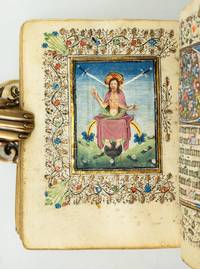
1450ST20835Flanders ca. 1450. 109 x 81 mm. 4 1/4 x 3 1/8". Single column 14 lines in a gothic book hand. 161 leaves. COMPLETE. Contents: Calendar f. 1r; Mass of the Holy Spirit f. 14r; Mass of the Holy Cross f. 23r; Requiem Mass f. 30r; Prayer on the Seven Last Words of Christ by the Venerable Bede f. 36v; Passion according to John f. 40v; blank f. 53; Hours of the Holy Cross f. 55r; Mass of the Virgin Mary f. 60r; Gospel Lessons f. 66v; Hours of the Virgin f. 73r; Penitential Psalms f. 126r; Litany f. 138r; Office of the Dead f. 144r. <br/> PLEASING NEAR-CONTEMPORARY BLIND-ROLLED CALF apparently with some old skilled restoration to joints spine and corners covers with rolled vine border surrounding a panel of three columns bearing a roll with parts of the inscription "AVE MARIA GRACIA PLENA" each word separated by one of four small motifs a flower a human profile the lamb of god and a sitting animal--perhaps a lion raised bands compartments with part of the same inscription roll. Lacking the original ties. Housed in a very attractive custom-made brown calf folding case with blind-stamped lettering on the spine interior lined in suede the whole within a calf-lipped suede-lined matching slipcase. Rubrics in red numerous one-line initials in blue with red penwork or gold with dark blue penwork many two-line initials in burnished gold on pink and blue ground with white embellishments several larger "I" initials between four and 11 lines in burnished gold on pink and blue ground with white embellishments 12 six- to seven-line initials some painted pink or blue with white embellishments and filled with flowers and tendrils on a gold ground or the initial in burnished gold on pink and blue ground with white embellishments EIGHT LARGE MINIATURES each inside a thin gold frame and with a three-quarter border of gilt leaves hairline vines and floral spays each facing page with a similar three-quarter border the subjects of the miniatures being: the Holy Spirit in the form of a dove f. 13v; St. Helena and the True Cross f. 22v; Raising of Lazarus f. 29v; Crucifixion f. 54v; Virgin and Child Enthroned f. 59v; Annunciation f. 72v; Last Judgment f. 125v; Funeral Mass f. 143v. Prickings visible in fore margins. See: Defoer et. al "The Golden Age of Dutch Manuscript Illumination" pp. 75-86. Just minor wear to the solid very pleasing early binding. A little chipping almost always mild to four of the miniatures with square frames the fifth the Annunciation somewhat rubbed and faded the three domed miniatures perfectly intact vellum with minor soiling and thumbing in places especially in lower corners of leaves in second half other trivial imperfections but overall a very well-preserved manuscript with no major issues.<br/> <br/> This enchanting little prayer book features eight attractive miniatures large gleaming burnished gold initials and a pleasing period binding--all in an excellent state of preservation. The miniature program here can be attributed to the so-called Masters of Otto van Moerdrecht the name given to a variety of Dutch artists active in the 1430s and '40s all working in a similar mode rather than to a specific master or workshop. According to Defoer et al. the work of these miniaturists "exhibit varied compositional formulas and bright highly contrasting colors . . . . The small somewhat doll-like figures appear rather wooden but their expressive gestures give the scenes a varied and vivid character." Two artistic hands are responsible for the present miniatures. The artist behind the first three miniatures all set within domed gilt frames the Holy Spirit St. Helena and Raising of Lazarus shows particular skill with a very smooth application of color figures with long eloquent hands and faces with subtle white highlighting. A second artist was responsible for the remaining five miniatures set within square golden frames Crucifixion Virgin and Child Enthroned Annunciation Last Judgment and Funeral Mass. Though this hand is less polished and the miniatures slightly smaller in size the scenes are all quite charming and attractively colored with vivid splashes of bright orange bubblegum pink sky blue and pale green. It is worth noting that the miniatures differ not only because of the artists' degree of success but also because of their condition: whereas the five are generally well preserved the other three are in a virtually perfect state. In addition to the central text of the Hours of the Virgin this manuscript contains several Masses each of which is preceded by a miniature. Perhaps the most interesting of these is the Mass of the Holy Cross which is paired with a miniature of St. Helena mother of Constantine the Great. According to Christian tradition Helena found the wooden cross used in the Crucifixion while she was travelling in Jerusalem in the fourth century. Constantine built the Basilica of the Holy Sepulchre in its honor and installed the relic there to be venerated. Britannica says that the adoration of the True Cross led to wide-spread sale of its fragments sought after as objects of devotion. It is unusual to find St. Helena depicted in a Book of Hours and this image is especially appealing with Helena in a beautiful red robe crown and halo embracing a large wooden cross in the center of the composition. The background is reminiscent of the work of the Gold Scrolls group with small swirls of liquid gold swimming in a scarlet sky the same scrolling motif graces the Holy Dove miniature. There is no indication of former ownership in this manuscript although the Calendar presents a few unusual saints that confirm a Flanders connection. These include St. Amandus in red known as the "Apostle of Flanders" on 2 February; St. Guido known as the "Poor Man of Anderlecht" on 9 September; St. Bavo in red patron saint of Ghent where a Cathedral is named in his honor on 10 October; and St. Eligius patron saint of goldsmiths and metalworkers on 1 December. The binding here is very close to contemporary and probably dates to the late 15th century. Neither the floral roll nor the "Ave Maria" roll seems to appear in EBDB. Similar rolls include r001954 r000623 and r000670 but ours is the only one with four different and charming tools one of each used between every "Ave" and "Maria." For a manuscript only slightly bigger than the palm of one’s hand this Book of Hours has a great deal to offer. In addition to its early binding and lovely illumination by an influential group of artists great care has been put into its preservation so that it resolutely endures for our pleasure and for owners in the centuries to come. unknown
NYBF15<p>Amsterdam Nicolas Visscher 1660.</p><p>Large folio 535 x 358 mm of 9 double-pages with 36 engravings bound in 18th century paperboards.</p><p><b>Complete copy printed on large paper in sumptuous contemporary colouring of the baroque atlas of the Netherlands. </b></p><p>In the last 60 years auction records mention only 2 copies of the standard issue one from the first edition of 1657 the other one from the present edition of 1660. A third copy which was incomplete was sold in 1987.</p><p><b>The present compilation contains</b><b> 36 engravings</b> printed by groups of 4 on the recto of double folio<b>s that illustrate baroque architecture of the Netherlands in the middle of the 17th century.</b></p><p>The prints not only depict towns canals ports village scenes mains monuments but also precarious housing return from the market hunting scenes sailing castles churches convents wind mills as well as ornamental gardens the whole entirely enhanced with warm contemporary colouring.</p><p>Hollstein Schut 32; Hollstein Publ. Clae Claesz Visscher I 7</p><p><b>The present copy printed on large-paper is the only one recorded from this de luxe edition. </b>In the posterior editions the Ottens ones for instance engravings were cut and presented separately and so printed in a 4to format.</p><p>The <i>Visscher</i> family is famous in the history of printing Atlases in the Netherlands in the 17th century. <i>Nicolas Visscher I</i> the editor of the present atlas was born in Amsterdam in 1618. Only son of <i>Claes Jansz</i> <i>Visscher</i> he got married in 1643. When his father died in 1652 he carried on the activity and settled in the Kalverstraat in Amsterdam until his passing in 1679.</p><p><br /></p><p><u>Français</u><br /></p><p>Amsterdam Nicolas Visscher 1660.</p><p>Grand in-folio de 9 double-pages regroupant 36 estampes cartonnage du XVIIIè siècle.</p><p>535 x 358 mm.</p><p><b>Exemplaire complet imprimé sur grand papier en somptueux coloris de l'époque de l'Atlas baroque des pays bas.</b></p><p>Depuis 60 ans le répertoire des ventes publiques ne mentionne que 2 exemplaires en tirage normal l'un de la première édition de 1657 l'autre de la présente édition de 1660 un troisième incomplet fut vendu en 1987.</p><p><b>Ce recueil présente 36 estampes gravées</b> groupées par 4 vues imprimées au recto d'un double folio -<b>illustrant l'architecture baroque des Pays Bas au milieu du XVIIè siècle</b><b>.</b></p><p>Sont dessinés et peints avec bonheur les villes canaux ports scènes villageoises les principaux monuments mais aussi l'habitat précaire le retour du marché les scènes de chasse la navigation les châteaux églises couvents moulins ainsi que les jardins d'agrément le tout rehaussé en chaleureux coloris de l'époque. Hollstein Schut 32 ; Hollstein Publ. Clae Claesz Visscher I 7</p><p><b>Le présent exemplaire imprimé sur grand papier est le seul répertorié dans ce tirage de luxe. </b>Dans les éditions postérieures par exemple les éditions Ottens les gravures furent coupées et présentées séparément et donc imprimées au format in-4.</p><p>La famille <i>Visscher</i>est célèbre dans l'histoire de l'imprimerie des Atlas aux Pays Bas au XVIIè siècle. <i>Nicolas Visscher I</i> l'éditeur du présent atlas est né à Amsterdam en 1618. Fils unique de <i>Claes Jansz</i> <i>Visscher</i> il se maria en 1643. A la mort de son père en 1652 il poursuivit l'activité et s'établit sur la Kalverstraat jusqu'à sa mort survenue en 1679.</p> hardcover
000195<p>16x11 cm. Contemporary Ottoman binding tooled in gold with Shamsa on each board and flap. Surah headings in gold and colors golden durations between verses and all pages out-ruled in gold. 16th c. Signed Hamdullah el Amasi. The signature due to the Era of the calligrapher and the writing character is same of the calligrapher's. Sheikh Hamdullah was born in Amasya a north-central town in Anatolia. His father Mustafa Dede was a Sheik of the Suhrawardi order and had migrated from Bukhara in present-day Uzbekistan to Anatolia. In Amasya he studied the six scripts under the tutelage of Hayreddin Mar'asi. He learned the traditional method of the old masters but struggled to reproduce it. While studying he met Bâyezïd the son of Sultan Mehmed the Conqueror who was a fellow student and the pair became friends. When Bâyezïd assumed the throne in 1481 following his father's death he invited his friend Sheikh Hamdullah to the capital Istanbul. Hamdullah went on to become a master calligrapher at the Imperial Palace. In 1485 Bâyezïd II acquired seven works by the great calligrapher Yaqut al-Musta'simi. Bâyezïd then encouraged his court calligrapher Hamdullah to devise a new script inspired by the acquisition. Hamdullah regarded al-Musta'simi's work as unsurpassable but at Bâyezïd's insistence Hamdullah reluctantly agreed. Scholars have suggested that Bâyezïd's enthusiasm for a new script was symbolic of his desire to establish a new empire and a new dynasty. Hamdullah underwent a period of reclusion during which time he claimed that a prophet taught him the new scripts in a vision. He ultimately recodified and refined the nashk style of calligraphy originally developed by Yaqut al-Musta'simi. Hamdullah's scripts were more elegant balanced and legible. From 1500 the majority of Q'rans adopted Hamdallah's new style which became known as the Ottoman style or "Seyh's manner'. For this he is often considered to be the "father of Ottoman calligraphy". His many students spread his style throughout the Ottoman Empire. His style endured for 150 years making him one of the greatest Ottoman calligraphers of all time. As much as two centuries later students of calligraphy such as Hâfiz Osman continued to copy his works assiduously as part of their training. He devoted his whole life to the art of calligraphy continuing to produce works well into his 80s. He produced 47 Mus'hafs book of Quran and innumerable En'ams Evrads and Juz' a number of which are held in the collection of the Topkapi Palace.12 His inscriptions also decorate the Bâyezïd Firuzaga and Davud Mosques in Istanbul and the Bâyezïd Mosque in Erdine. His son Mawlana Dede Chalabi became a calligrapher after studying with Hamdallah his father and Hamdallah's daughter whose name is unknown married a calligrapher by the name of Shukrullah Halife of Amasya who had also been one of her father's pupils. Hamdullah's grandsons also became calligraphers; Pir Muhammad Dede d. 986/1580 son of Hamdallah's daughter and Dervish Muhammad d. 888/1483 son of Mawlana Dede. As his reputation grew many myths to his abilities outside calligraphy sprang up. It was said that he was a great archer falconer swimmer and even an extraordinary tailor. He died in Istanbul in 1520 and was buried at Karacaahmet Cemetery in the district of Üsküdar at Istanbul. Surviving examples of his works are held in the Topkapi Collection.</p> hardcover
TM 796<p>MEDIEVAL ILLUMINATED MANUSCRIPT IN ITALIAN ON PAPER Northeastern Italy Veneto Venice c. 1474. Dimensions 328-332 x 230 mm. 188 folios missing at least three leaves written in brown ink in an Italian cursiva libraria script EIGHT ILLUMINATED INITIALS of seven lines one-line paraphs in red or blue<i> </i>simple two- to four-line in red or blue initials. BINDING: re-cased using original binding materials of brown half leather over bevelled wooden boards with three double bands remains of four straps present. TEXT: Italian translation of Gregory the Great's <i>Moralia in Job</i> one of the most important and widely copied texts of the Middle Ages. Though forty copies of this translation survive this volume is unusual in its incorporation of Venetian dialectal forms. All other copies are in European institutions and have not been on the market for the last century. PROVENANCE: scribal colophon on f. 190v provides a date for this manuscript's completion and helps localize its production within Italy: "Scripto per mi zuane de zane zoielier condam per simon et chi li lezeranno priegi dio per lo scriptore. MCCCCLXXIIII" Written by me Zuane de Zane jeweler once for Simon and may whoever will read it pray to God for the writer. 1474. There is no Zuane de Zane on record elsewhere as a scribe; the name itself is Venetian and evidence of the manuscript's watermark and decoration also suggest an origin in the region of Veneto and possibly Venice specifically. The manuscript was later acquired by a private European collection. CONDITION: slight tears in the lower margin of f. 25 and upper margin of ff. 37 and 160 from f. 161 to the end there is a slight loss to the upper outer corner<i> </i>slight water staining visible parchment reinforcement present prickings visible. Full description and images available. TM 796</p> Northeastern Italy, Veneto (Venice?), dated 1474
5611"Hishu" today Saga Prefecture: 1841-45. A very rare Japanese manuscript sea chart of the sea routes from Saga Prefecture a major trading area in the west to Osaka through the Inland Sea which is more than 400 km. long and includes in excess of 3000 islands. The Inland Sea one of the main trade routes for the Japanese in the Edo period has numerous areas of turbulence and navigating through the numerous islands and rocky outcroppings presented enormous problems in the era before modern navigation systems. In the early 1840s the central government in Edo ordered each fiefdom to prepare maps of coastal routes to facilitate trade and shipping. Our manuscript was prepared by Tsugihei Miyachi a high level sea pilot "mite kako" in the Saga Prefecture shipping office as an employee of the Nabeshima Clan. The map were it to be unbound is about 11340 mm. long about 37 feet depicting Saga in the west to Osaka in the east. It is finely drawn in black ink heightened with wash in green purple blue grey and red. Five of the openings have folding extension sections pasted onto the lower margins of the leaves. Blue lines depict safe sailing routes for smaller ships. The map depicts in very great detail areas of turbulence there are famous whirlpools in the Inland Sea numerous islands rock formations and landscapes for orientation anchorages harbors and fishing areas. Each section of the map has been annotated by the compiler with notes on distances characteristics of rivers landmarks for navigation tidal activities the route to Nagasaki etc. The first map opening depicts Saga and the final opening Osaka. The sea chart is prepared with considerable local knowledge of castles and temples. A series of notable castles each is labeled with name of the lord assets etc. are depicted along the shores and Miyachi describes harbors for anchoring and to get fresh water. The routes are drawn from a "bird's-eye view" perspective with lovely vistas of mountains and islands and villages and towns. The two leaves of manuscript text at the beginning in the style of a dedicatory letter to the fiefdom lord describes the compiler's efforts over a five-year period to prepare the map. He writes that it is based on his own personal experiences as a sea pilot. He states that purple denotes routes he has taken red denotes shallows blue lines denote the routes for large ships grey for land and green for mountains and forests. The eleven pages of text at the end provide details on prevailing weather patterns and how to prepare for inclement weather how to navigate by landmarks and the stars wind and tidal patterns and the history of the preparation of this map "it took me five years of daily observation to prepare this work". He provides a list of his voyages to different cities on this route. On the final page the author states that three copies were made: the first for the fiefdom lord the second for a cabinet member and the third for Miyachi's divisional chief. A modern scholar has laid-in a note describing this sea chart as one of those three. Japanese sea charts are rare survivals and we know of no other similar example outside of Japan. ❧ The sea pilot Miyachi's log books are preserved in the Nabeshima clan's archives see the Saga kenritsu toshokan database. unknown books