122 150 résultats
2025BIBLB0009805912025. Leather Bound. New. Size: 14.60 x 22.86 cms This book is available in 5 different Leather color without any extra cost. Explore More Options by Clicking on 'More Images' and Notify Us of Your Choice via Email within 24 hours of placing the order. Presenting an Exquisite Leather-Bound Edition expertly crafted by the prestigious organization Rare Biblio with Original Natural Leather that gracefully adorns the spine and corners. The allure continues with Golden Leaf Printing that adds a touch of elegance while Hand Embossing on the rounded spine lends an artistic flair. This masterpiece has been meticulously reprinted in 2025 utilizing the invaluable guidance of the original edition published many years ago in 1900. The contents of this book are presented in classic black and white. Its durability is ensured through a meticulous sewing binding technique enhancing its longevity. Imprinted on top-tier quality paper. A team of professionals has expertly processed each page delicately preserving its content without alteration. Due to the vintage nature of these books every page has been manually restored for legibility. However in certain instances occasional blurriness missing segments or faint black spots might persist. We sincerely hope for your understanding of the challenges we faced with these books. Recognizing their significance for readers seeking insight into our historical treasure we've diligently restored and reissued them. Our intention is to offer this valuable resource once again. We eagerly await your feedback hoping that you'll find it appealing and will generously share your thoughts and recommendations. Lang: - eng Vol:- Pages:- 38 If it is a multi-volume set then it is only a single volume. Product Disclaimer: Kindly be informed that owing to the inherent nature of leather as a natural material minor discolorations or textural variations may be perceptible. Explore the FOLIO EDITION 12x19 Inches: Available Upon Request. hardcover
1922003951Tamassee South Carolina: By the authors 1922. Near fine. Two circulars; 11 x 8 1/2 and 8 1/2 x 5 1/2; single sheets text to rectos only; faint crease lines else very minor wear - in very good to near fine condition. Two circulars from the then fairly-new institution both implored people to pledge money and donate for its continued operation. The Tamassee School was founded by the Daughters of the American Revolution in 1919 - to serve the underprivileged "mountain" children of Appalachia. It boarded girls but had both boys and girls as day pupils and offered night and summer classes for adults. The school thrives to this day. One of the two papers titled: "Why Tamassee" outlined the specific projects the school board was attempting to accomplish and the necessary funds ie. $6000 for a cottage dormitory $1500 for lighting system etc. The second specifically advocated for raising money for the Arts and Crafts Department. By the authors unknown
1949005925Esquire Inc. Condition: small chip to each of upper and lower outer narrow spine edges; two short light corner creases to front cover; light outer edge wear in places. Contents include: short story "We Were Just Having Fun" by F. Hugh Herbert; a fight story "A Glass of Orange Juice" by Quentin Reynolds; article "That Young Al Jolson" by Maurice Zolotow "In case you haven't heard - from juke box screen or radio - the amazing Al Jolson is back in action and at 64 showing the youngsters how it should be done"; a "Roaring Western Story" entitled "Hell's Broke Loose in Dakota" by Frank Bonham; short entry "The Prophet Honored in His Country" with photos: "Amazing Frank Lloyd Wright has never doubted nor failed to proclaim - as well as to prove - his architectural genius"; article "Sucker's Night Out" by Jimmy Cannon "December 31st brings out the worst in people and floor shows but normally staid Americans still feel they must cut capers into the New Year and brag about it"; artwork fold-out "The Esquire Girl" painted by Al Moore; short story "Juror Number Three" by Ira Wallach; article "Hitting the Line" by James W. Poling "Mother wore tights once and Father elaborately twirled his old handle-bar when the girls in the line moved onstage. Things are different today and the old-time chorus girls have gone through show business evolution to become ladies even as thine and mine"; short story "My Comrade Igor and I" by Mel Matison; sports article "For the Sake of the Sport" by Eddie Finlay; short story "Uncle Bud's Bloodhound" by John Watson; article "Let's Cook It on the Piano" by Horace McCoy "Presenting the greatest boon to the barbeque enthusiast since sirloin steak was invented: the indoor-outdoor all-electric Barbeque Rotisserie"; article "Want a Drink See Your Lawyer!" by Paul Kearney "There are more laws about when to drink and when not to drink than there are bottles on the shelf and it adds to the enjoyment to know that your elbow bending is legal"; bedside mystery "The Copeland Caper" by William Francis; article "The Fabulous Mr. Farrell" by Peter Lisagor "Hockey and the Chicago Black Hawks owe a lot to 73-year old Joseph Chesterfield Farrell the lusty fabled press agent"; special section "Esquire's Big 10 Vacation Guide". . Very Good. Magazine. 1st Edition. 1949. Esquire, Inc. unknown

1977N3539Jerusalem: American Acadenmy for Jewish Research. 1977. Hardcover. Very Good. 8vo. 170pp Hebrew text. Upper edge with foxingOtherwise a very good copy. Inscribed by the author on f.e.p. <br/> <br/> American Acadenmy for Jewish Research. hardcover
1959373280London: Rider & Company 1959. Hardcover. Fine/Very Good. Revised edition. 271pp. Translated with the collaboration of Violet Sydney. Foreword by Sylvain Lévi. A fine copy in a very good price-clipped dustwrapper with minor soiling on the spine. Rider & Company hardcover
8743DAVIS T.E. comp. From New Jersey to California '97: A History of the Journey of the New Jersey Christian Endeavors' Special to the Sixteenth International C.E. Convention at San Francisco July 6-12 1897. Somerville N.J. 1897. 1st ed. 150pp. Near fine in orig. cloth. A detailed itinerary of the group's trip west in 14 Pullman cars. unknown
18-5627Cambridge England: Cambridge University Press 1979. . 8vo. 52 pp 70 pp. of plates. Green cloth-covered boards with gilt spine and beige and green illustrated wraps. Very good with marginal soiling along dust jacket. Mostly black and white plates. Catalogue created on occasion of exhibition held at the Fitzwilliam University in Cambridge England in 1979. First edition. Cambridge, England: Cambridge University Press, 1979. paperback
198028607New York: October 14 1980. 1980. Very good. - sc Quarto 11 inches high by 8-3/8 inches high. 201 words typed on a sheet of cream paper with her address typed at the top. Signed "Constance DeJong". The left edge of the paper is darkened & there is a light paper-clip mark to the top left corner with a small light stain just below the body of the letter. Very good. <p>DeJong writes to Gary Wilkie of Contexts in Seattle to ask if she could present her new work there as part of a tour that will take her to Portland Oregon. She encloses a photo and resume: "It's not very up to date in terms of the new work I'd be presenting or the recently completed book and opera I wrote with Philip Glass." A publicity sheet from Art Performances New York states: "Constance DeJong is one of the young post-modern writers who has made performance a natural extension of her work as a writer. By blending some of the traditional techniques of theatre - lighting movement music - performances extend her work beyond the written word into an almost tactile presence a context where the narrative can come to life. New York: October 14, 1980. unknown
30566Steinbach: Crossway Publications 1993. As new! Paper bound in dark blue wrappers first edition Pp932. Includes index. Spine gently splayed else a tight and unmarked copy in new condition. Scarce. 1.26 kilograms unpacked - depending on destination additional postage may be requested. We welcome all reasonable offers on our books and also offer local curbside pick-up. All books in stock and available for immediate shipment from Winnipeg Manitoba. Steinbach: Crossway Publications, 1993 unknown
19418835Stanford California: James Ladd Delkin Stanford University. Very Good. 1941. First Edition. Hardcover. 207 pp.; 8vo; green cloth; illustrated with black & white photographs by: Howard Hoffman Brett Weston Sibyl Anikeyev Robert Kerrigan. Remnant of James Ladd Delkin ownership plate front and rear endpapers; cloth a bit mottled along bottom rear edge and rear leading edge. . James Ladd Delkin Stanford University hardcover
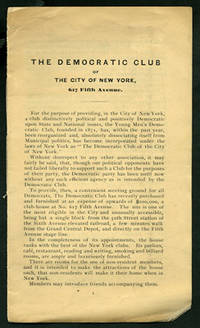
189127339New York: n.p. 1891. First edition. Stitched paper self-wrappers. A good or better copy with small chips on the corners. 16 pp. Sm. 8vo. The Democratic Club had recently reorganized to set it apart from municipal politics as well as to attract nonresident members to its new building. Contains a list of members and their addresses both resident and nonresident. n.p. unknown
63-5216Northirdge CA: Dena Harman 1983. Typed letter signed on Wallace Stevens Journal letterhead 8.5" x 5.5" Single Leaf recto & verso Very Good.Provenance: Herb Yellin 1935-2014 was the highly respected publisher and founder of Lord John Press considered by many to be one of the most important small presses of the 20th century. Northirdge, CA: Dena Harman, 1983. unknown
1912013306Berlin: Koniglich Preußischen Geologischen Landesanstalt 1912. Very Good condition. Tight unmarked copy. Flat spine. 18cm x 26cm. No underlining. No highlighting. No margin notes. "Mit 10 Textfiguren und einer geologischen Übersichtskarte. Original printed wraps. This book is from the library of scientist and author Robert B. Sosman with his tiny ink stamp. Sosman was Assistant Director of the Geo-Physical Laboratory of the Carnegie Institution. Later he was Assistant Director of Research of the United States Steel Corporation and Visiting Professor of Ceramics at Rutgers University. . First Edition 1. Auflage. Softcover. Very Good condition. vi 66pp . Koniglich Preußischen Geologischen Landesanstalt Paperback
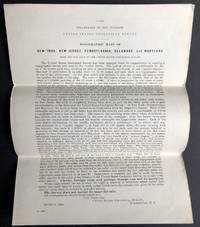
1904H21146Washington DC: United States Geological Survey 1904. Very Good. 11 x 8.5 inches or slightly shorter bi-folded for envelope mailing all very good. The New England one is 4 pp with double-page map showing which maps of New England were available. The Geological Folios is 4 pp. with text only including prices. The Appalachian Region folds out to 19 x 16 inch map showing squares of what individual maps are available -- covers a good bit of the south. New York etc. is 4 pp. with doublepage map. United States Geological Survey unknown
1900119109Washington DC: Government Printing Office 1900. Cloth. Very good. 608 xi p. 30 cm. 3 folding colour maps in rear pocket. Cloth hardcover. Rear hinge cracking internally. Spot on top edge of text block. <br/><br/>Includes forest reserves mines and mining geology in various regions paleontology hydrography obituary of Othniel Charles Marsh etc. Government Printing Office hardcover
1977325338Washington DC: Headquarters Department of the Army 1977. paperback. very good/no dustjacket. 4to. unpaginated. approx 55 pages. sticker residue at top right corner of front cover. Headquarters Department of the Army paperback
1950341175Washington DC: United States of America War Office 1950. paperback. good/no dustjacket. 8vo. pp.404. Paper covers. Covers lightly soiled. Moderate wear and creasing to front and back cover. Spine significantly creased and worn with chipping at head and tail. United States of America War Office paperback
198478997Washington DC: Department of the Army Headquarters 1984. Presumed First Edition First printing thus. This Manual Supersedes FM 1-88 7 July 1980. Wraps. Good. Various paginations approximately 400 pages. Illustrations. Appendixes on training information a conversion chart and tactical vehicle identification gaming device. Glossary. References. Index. When issues the distribution was restricted for official Government use only. Given the passage of time and the introduction of information into the public domain this restriction is understood to no longer apply. Book has small creases to a few text pages. Cover is somewhat worn and soiled. The purpose of this manual is to familiarize aircrews with modern combat equipment provide a reference for aircrew field use and provide a guide for commanders conducting unit training in equipment recognition. The equipment shown in this manual is grouped by type: rotary-wing aircraft fixed-wing aircraft antiaircraft guns surface-to-air missiles armor artillery light armored vehicles and miscellaneous equipment. This manual provides information on current operational combat vehicle guns and aircraft of the United States allied western powers and threat countries which reasonable can be expected to be observed from the air during hostilities. Included in this manual are the best photographs available at writing time. The tactical vehicle identification gaming device depicted in Appendix C can be used as an instructional tool for increasing knowledge of combat equipment and for proficiency testing. The device also may be effectively used in class instruction or for self-testing. Aircraft recognition is a visual skill taught to military personnel and civilian auxiliaries since the introduction of military aircraft in World War I. It is important for air defense and military intelligence gathering. Aircraft recognition generally depends on learning the external appearance of the aircraft both friendly and hostile most likely to be encountered. Techniques used to teach this information have included scale models printed silhouette charts slide projectors computer aided instruction and even specially-printed playing cards. In the United Kingdom The Royal Observer Corps ROC was formed as a defence warning organization with civilians trained in aircraft recognition and operated primarily as such between 1925 and 1957. Aircraft recognition was first developed between the First and Second World wars when aerial warfare was first recognized as a future threat after 208 Zeppelin and 435 aircraft raids over London during the First World War. In 1917 Germany had started using fixed-wing bombers and the number of airship raids diminished rapidly. To answer this new threat Major General Edward Bailey Ashmore a First World War pilot who had later been in command of an artillery division in Belgium was appointed to devise improved systems of detection communication and control. The Metropolitan Observation Service was created covering the London area known as the London Air Defence Area and was soon extended to the coasts of Kent and Essex. This led to the establishment of the Observer Corps in 1925. In September 1942 the government recognized the usefulness and effectiveness of the systems developed by volunteer observers and first published Aircraft Recognition The Inter-services Recognition Journal. With official recognition by HQ Royal Observer Corps and the Air Ministry that accurate recognition of aircraft was achievable the systems developed by the volunteers were adopted as official training. In the US during World War II civilians were enlisted into a Ground Observer Corps to support air defense operations receiving training in aircraft identification. The US military continues to use "WEFT" as a mnemonic for the major features of an aircraft: Wings or rotors to provide lift Engines to provide power a Fuselage to carry the payload and pilot and a Tail assembly which controls the direction of flight. These elements differ in shape size number and position. The differences distinguish one aircraft type from another. The individual components can be taught as separate recognition and identification features but it is the composite of these features that must be learned to recognize and identify an aircraft. Department of the Army, Headquarters paperback
196176738Washington DC: U. S. Government Printing Office 1961. Presumed First Edition presumed reprint as date of issue was 1960. Wraps. Good. 198 2 pages. Illustrations including fold-outs. Appendix I. References. Appendix II. Abbreviations and Symbols. Appendix III. Paints. Appendix IV. Construction Rates. Glossary. Index. Cover has some wear and soiling. This manual supersedes TM 5-226 6 May 1943 including C 1 20 May 1944. This manual reflects the state of the art the state of knowledge and the state of practice at the time the United States increased its military activity in Vietnam. This manual provides instruction and guidance for military personnel engaged in or responsible for carpentry and building construction. It is applicable for both training and field use. Carpentry. The functions of and the methods used by the carpenter in maintaining repairing and constructing buildings and other wooden structures. Building construction. In addition to information on standard theater of operations building construction this manual gives information on prefabricated buildings including proper erection crew organization erection time rates and recommended procedures. U. S. Government Printing Office paperback
195959212Department of the Army 1959. Paperback. Used very good. Very Good condition. Large tan softcover1959 edition 295pp sewn binding for long life. Cover has almost no wear but is lightly soiled by use; interior as new except pages a little tanned due to age. Nice condition. We provide professional service and individual attention to your order daily shipments and sturdy packaging. FREE TRACKING ON ALL SHIPMENTS WITHIN USA. . Department of the Army, paperback
1963336924Washington DC 1963. paperback. very good/no dustjacket. 4to. pp.101. Contains two fold-out charts at rear. Paper covers marked and grubby from handling. ""Training room"" and unit designation penned to front cover. paperback
200381280Washington DC: Presumed First Edition First issuance thus expanded and revised version of 1991 predecessor document 2003. Presumed First Edition First issuance thus expanded and revised version of 1991 predecessor document. CD. Very good. Compact Disk in plastic container. xxix 1 210 pages. Illustrations. Acronyms. General Terms and Definitions. List of relevant documents. Marked For Official Use Only but this marking no longer applies per a letter from DOD Nuclear Matters dated December 13 2017. See DoD Directives 5400.7-R and 5200.1-R. For Official Use Only FOUO And Similar Designations. For Official Use Only FOUO is a document designation not a classification. There is no national policy governing use of the For Official Use Only designation. DoD Directive 5400.7 defines For Official Use Only information as unclassified information that may be exempt from mandatory release to the public under the Freedom of Information Act FOIA. It is believed this older publication has in effect been voluntarily released. Similar documents have subsequently been issued by the Defense Department with no control markings. The Nuclear Weapons Council was established in law see 10 U.S. Code § 179 . The Nuclear Weapons Council is operated as a joint activity of the Department of Defense and the Department of Energy. The membership of the Council is comprised of the following officers of those departments: 1 The Under Secretary of Defense for Acquisition Technology and Logistics. 2 The Vice Chairman of the Joint Chiefs of Staff. 3 The Under Secretary for Nuclear Security of the Department of Energy. 4 The Under Secretary of Defense for Policy. 5 The Commander of the United States Strategic Command. CD version better suited to extracting information electronically for reuse in other materials. This Handbook is intended to be an unofficial reference that explains the meaning of stockpile management identifies the organizations individuals and facilities involved in the management of the stockpile and describes the activities and processes by which this task is accomplished. It was designed to be useful but it is neither authoritative nor directive. The content of the Nuclear Weapons Stockpile Management Handbook is the sole responsibility of the Office of the Deputy Assistant to the Secretary of Defense for Nuclear Matters. Presumed First Edition, First issuance thus (expanded and revised version of 1991 predecessor document) unknown
200381282Washington DC: Department of Defense Office of the Secretary of Defense Office of the Assistant to the Secretary of Defense for Nuclear Matters 2003. Presumed First Edition First issuance thus expanded and revised version of 1991 predecessor document. CD. Very good. Compact Disk in rectangular format approx. 3.5. by 2.5 inches in plastic pouch. xxix 1 210 pages. Illustrations. Acronyms. General Terms and Definitions. List of relevant documents. Marked For Official Use Only but this marking no longer applies per a letter from DOD Nuclear Matters dated December 13 2017. See DoD Directives 5400.7-R and 5200.1-R. For Official Use Only FOUO And Similar Designations. For Official Use Only FOUO is a document designation not a classification. There is no national policy governing use of the For Official Use Only designation. DoD Directive 5400.7 defines For Official Use Only information as unclassified information that may be exempt from mandatory release to the public under the Freedom of Information Act FOIA. It is believed this older publication has in effect been voluntarily released. Similar documents have subsequently been issued by the Defense Department with no control markings. The Nuclear Weapons Council was established in law see 10 U.S. Code § 179 . The Nuclear Weapons Council is operated as a joint activity of the Department of Defense and the Department of Energy. The membership of the Council is comprised of the following officers of those departments: 1 The Under Secretary of Defense for Acquisition Technology and Logistics. 2 The Vice Chairman of the Joint Chiefs of Staff. 3 The Under Secretary for Nuclear Security of the Department of Energy. 4 The Under Secretary of Defense for Policy. 5 The Commander of the United States Strategic Command. CD better suited to extracting information for reuse in other materials. This Handbook is intended to be an unofficial reference that explains the meaning of stockpile management identifies the organizations individuals and facilities involved in the management of the stockpile and describes the activities and processes by which this task is accomplished. It was designed to be useful but it is neither authoritative nor directive. The content of the Nuclear Weapons Stockpile Management Handbook is the sole responsibility of the Office of the Deputy Assistant to the Secretary of Defense for Nuclear Matters. Department of Defense, Office of the Secretary of Defense, Office of the Assistant to the Secretary of Defense for Nuclear Matte unknown
198573401Washington DC: U. S. Government Printing Office 1985. Presumed First Edition First printing thus. Wraps. Very good. Various Paginations approximately 80 pages. Illustrations. References. Index. Two hole punched. Staple-bound. Cover has some wear and soiling. The Beretta M9 officially the Pistol Semiautomatic 9mm M9 is a 9×19mm Parabellum pistol adopted by the United States Armed Forces in 1985. It is essentially a military specification Beretta 92FS. The M9 won a competition in the 1980s to replace the M1911A1 as the primary sidearm of the U.S. military beating many other contenders and only narrowly defeating the SIG P226 for cost reasons. It officially entered service in 1990. Some other models have been adopted to a lesser extent namely the M11 pistol and other models remain in use in certain niches. The M9 was scheduled to be replaced under a United States Army program the Future Handgun System FHS which was merged with the SOF Combat Pistol program to create the Joint Combat Pistol JCP. The JCP was renamed Combat Pistol CP and the number of pistols to be bought was drastically cut back. The U.S. Army and Air Force are seeking to replace their M9s through the Modular Handgun System program. In the 1970s every branch of the U.S. Armed Forces except the U.S. Air Force carried the .45 ACP M1911 pistol. USAF opted to use .38 special revolvers which were also carried by some criminal investigation/military police organizations USAF strategic missile ICBM officer crews and by military flight crewmembers across all the services when serving in combat zones or when engaged in nuclear weapons duties. The Department of Defense then decided to synchronize the weapons of all five branches of U.S. forces. The ground combat branches of the services found this decision highly contentious but was meant to eliminate the need to buy replacements for worn out M1911 frames and to establish a common NATO pistol round to simplify logistics in case of war with the Soviet Union in Europe. In 1979 the Joint Service Small Arms Program began searching for a replacement for the venerable M1911 and the 9×19mm Parabellum round was selected for compliance with the NATO Standardization Agreement STANAG. In 1980 the Beretta 92S-1 design was chosen over entries from Colt Smith & Wesson Walther the Star M28 and various Fabrique Nationale and Heckler & Koch models. The result however was challenged by the US Army and new tests were done by the Army. In 1984 the trials started again with updated entries from Smith & Wesson Beretta SIG Sauer Heckler & Koch Walther Steyr and Fabrique Nationale. Beretta won this competition but there was a new trial the XM10 competition in 1988. This resulted in two different trials that were more limited but resulted in the Beretta being chosen albeit with an updated design. Concurrent to the pistol selection process beginning in 1979 the Bianchi International holster company began its development of a multi-function military holster to be ready for the issuance of a new pistol. This holster - designed by John Bianchi and Richard Nichols - has served the U.S. Armed Forces well for decades designated the M12 was adopted simultaneously with the adoption of the Beretta 92F in 1985. The Beretta 92F survived exposure to temperatures from 40 to 140 °F 40 to 60 °C being soaked in salt water being dropped repeatedly on concrete and being buried in sand mud and snow. Additionally the 92F proved a MRBF mean rounds before failure of 35000 rounds. That number is often touted as the equivalent to five or six times the pistol's service life. While this is normally true in European militaries armed forces of the United States normally subject sidearms to much more extensive use. The Iraq War which featured frequent urban and room-to-room combat has required American soldiers to rely more heavily on their pistols. The M9 is a short recoil semi-automatic single-action / double-action pistol that uses a 15-round staggered box magazine with a reversible magazine release button that can be positioned for either right- or left-handed shooters. The M9 is used with the Bianchi M12 Holster though other holsters are often used. The specific modifications made from the Beretta 92 includes: · Design of all the parts to make them 100% interchangeable to simplify maintenance for large government organizations. · Modified the front of the trigger guard so that one could use finger support for easier aiming. · Recurved the forward base of the grip to aid aiming. · Hard chromed the barrel bore to protect it from corrosion and to reduce wear. · New surface coating on the slide called Bruniton which allegedly provides better corrosion resistance than the previous plain blued finish. It also has an enlarged hammer pin that fits into a groove on the underside of the slide. The main purpose is to stop the slide from flying off the frame to the rear if it cracks. This was in response to reported defective slides during U.S. Military testing. The M9 features multiple internal safeties including a firing pin block that prevents the firing pin from moving without the trigger being pulled and a firing pin striker that rotates when the safety lever is engaged preventing the firing pin from being hit even if the hammer falls. The M9 also has an ambidextrous external safety lever allowing both left and right handed people to engage or disengage the safety mechanism. U. S. Government Printing Office paperback
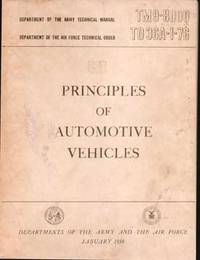
73-3836Washington: Department of the Army; Department of the Air Force 1956. 4to. Black and white plates. Soft cover. Good. Oil staining. 571 pp. Washington: Department of the Army; Department of the Air Force, 1956 paperback