The Wayzgoose Press; Janaczewska, NoelleBiblio.com

122 150 résultats
134535Katoomba NSW: The Wayzgoose Press 2006. Eleven gate-folded pages bound concertina-style illustrated with coloured linocuts by Mike Hudson; demy folio; within floral patterned purple cloth box with printed paper title label inlaid on the lid purple ribbon tie and yellow cloth sides; The Wayzgoose Press Katoomba NSW 2006. Edition limited to 30 numbered copies 25 are for sale signed by the author and publishers Mike Hudson and Jadwiga Jarvis; this being copy number 17 of 21 thus bound. With the original prospectus slightly marked loosely inserted. Conceived designed and illustrated with multi-coloured linocuts by Mike Hudson and hand set in a variety of types by Jadwiga Jarvis. The linocuts were extra coloured by hand making each copy in the edition unique. The pages unfold to a total length of 5 metres. Loosely inserted is a printed instruction sheet: Some helpful hints on how best to read/view Dorothy Lamour's life as a phrase book. The book is a typographic rendition of Janaczewska's play of the same title in which the screen actress 'finds herself in a poem instead of a movie' Introduction. Jadwiga Jarvis The Wayzgoose Affair page 175 explained the format: 'In order to maintain the spirit of a performance we gave the book a theatrical setting: the hotel room which appears on every one of the 11 gate-fold pages was Dorothy's stage. Onto this stage various scenarios obliquely suggested by the text were introduced . . . a chessboard a maze a giant pineapple a clapperboard and an overweight Ronald McDonald. The introduction and colophon pages featured the same room/stage but on these the set was empty and shown as if unlit alluding to the characteristic hiatus of a theatrical presentation before curtain-up and after the final curtain'. The Wayzgoose Press unknown
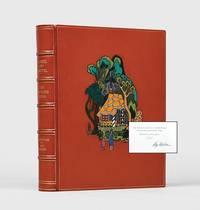
1925146530London: Hodder and Stoughton 1925. A handsomely bound copy Signed limited edition number 434 of 600 copies signed by the illustrator. An advertisement issued by the publishers appeared in the Times Literary Supplement on 3 December 1925 which stated "there is only one edition of Hansel and Gretel which is limited to 500 copies". Evidently demand increased the limitation but with no trade edition this is a scarce book. The publishers noted "the art of Kay Nielsen has never been shown to greater advantage than in these truly wonderful illustrations to Grimm's Fairy Stories. The draughtsmanship the decorative skill and the fairy imagination are unique and place Mr Kay Nielsen as one of the greatest of illustrators and decorative artists. This magnificent volume is also a fine example of the engraver's and bookmaker's art". "Nielsen is a brilliant colourist and a highly decorative illustrator his works formed into frieze-like patterns are closest to Persian or Middle-Eastern designs and therefore akin to Leon Bakst or Edmund Dulac" Houfe p. 401. Quarto 300 x 237 mm. With 12 tipped-in colour plates captioned tissues and 10 full page monochrome plates. Finely bound by the Chelsea Bindery in terracotta morocco spine lettered and decorated in gilt single rule to boards gilt pictorial onlay of the gingerbread house to the front board inner dentelles gilt dark green endpapers top edge gilt others untrimmed. Some minor light damp staining to the fore-edge of 15 pages else an excellent copy in a fine binding. Times Literary Supplement 3 December 1925 p. 823; Simon Houfe The Dictionary of British Book Illustrators and Caricaturists 1800-1914 1981. hardcover
189724<i>This book is over 122 years old. <br />"The Raven"</i> in particular—Poe investigates the loss of ideal beauty and the difficulty in regaining it. These pieces are usually narrated by a young man who laments the untimely death of his beloved. <i>"To Helen"</i> is a three stanza lyric that has been called one of the most beautiful love poems in the English language. The subject of the work is a woman who becomes in the eyes of the narrator a personification of the classical beauty of ancient Greece and Rome. <i>"Lenore"</i> presents ways in which the dead are best remembered either by mourning or celebrating life beyond earthly boundaries. In <i>"The Raven"</i> Poe successfully unites his philosophical and aesthetic ideals. In this psychological piece a young scholar is emotionally tormented by a raven's ominous repetition of "Nevermore" in answer to his question about the probability of an afterlife with his deceased lover. Charles Baudelaire noted in his introduction to the French edition of <i>"The Raven"</i>: "It is indeed the poem of the sleeplessness of despair; it lacks nothing: neither the fever of ideas nor the violence of colors nor sickly reasoning nor drivelling terror nor even the bizarre gaiety of suffering which makes it more terrible." Poe also wrote poems that were intended to be read aloud. Experimenting with combinations of sound and rhythm he employed such technical devices as repetition parallelism internal rhyme alliteration and assonance to produce works that are unique in American poetry for their haunting musical quality. In <i>"The Bells"</i> for example the repetition of the word "bells" in various structures accentuates the unique tonality of the different types of bells described in the poem.Poe's stature as a major figure in world literature is primarily based on his ingenious and profound short stories poems and critical theories which established a highly influential rationale for the short form in both poetry and fiction. Regarded in literary histories and handbooks as the architect of the modern short story Poe was also the principal forerunner of the "art for art's sake" movement in nineteenth-century European literature. Whereas earlier critics predominantly concerned themselves with moral or ideological generalities Poe focused his criticism on the specifics of style and construction that contributed to a work's effectiveness or failure. In his own work he demonstrated a brilliant command of language and technique as well as an inspired and original imagination. Poe's poetry and short stories greatly influenced the French Symbolists of the late nineteenth century who in turn altered the direction of modern literature. It is this philosophical and artistic transaction that accounts for much of Poe's importance in literary history.<br /><br />This book contains the first collection of Poems Poems and Tales. See Pictures Houghton Mifflin Company hardcover
23041<p>HARDBACK NO DUSTJACKET STATED 1ST EDITION 1957 LITE RUB WEAR & Oblong MATTED in black PAPER SIGNED BY WALT DISNEY 5 1/2 X 3 1/2 in . Creasing Tears to some Portions not Affecting Signature of Disney or other ARTWORK Signature Guaranteed Authentic Verso of Paper is White TAPE which Adheres it to MATTING on BACKside & Mends some Tears SOLD AS-IS Overall VERY NICE This is a GREAT MATTED PIECE</p><p>Oblong MATTED in black PAPER SIGNED BY WALT DISNEY 5 1/2 X 3 1/2 in . WALT DISNEY SIGNS THE PAPER with Mickey artwork drawn by Disney Artist AT BOTTOMCreasing Tears to some Portions not Affecting Signature of Disney or other ARTWORK Signature Guaranteed Authentic Verso of Paper is White TAPE which Adheres it to MATTING on BACKside & Mends some Tears SOLD AS-IS Overall VERY NICE SIGNED Matted Piece of PAPER BY WALT DISNEY The Drawing of Mickey & Best Wishes Mickey Mouse are by DISNEY ARTIST. Signed by Author. First Edition. Unbound.</p> Disney Editions NY hardcover
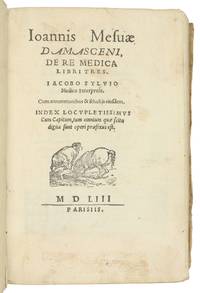
1553L7NA2E7L5WJBParis = Venice: Girolamo Scotto 1553. Contemporary vellum traces of ties. 8vo. With Scottos woodcut device on the title page showing what are probably two of the wild mares of King Abderus being devoured by the mares of King Diomedes of Thrace devouring either Abderos or Diomedes himself and about 22 woodcut decorated nearly all pictorial initials 7 series plus a few repeats. Rare Venetian edition with a false Paris imprint of Mesues three seminal pharmacological works including his great pharmacological handbook the principal model for the European pharmacopoeias translated into Latin by Jacques Dubois/Jacobus Sylvius 1478-1555 who taught anatomy at Paris his students including Vesalius and Gesner. Dubois first published it in a Paris folio edition in 1542. As far as we know the present edition has not previously been recognised as a false imprint but Girolamo Scotto in Venice used the woodcut device on the title-page in 1543 Bernstein Music printing p. 88 & fig. 3.16: much more artistic than most publishers devices so perhaps made to illustrate an unidentified book and the woodcut pictorial initial on r8r also appears in Lippomano Espositioni volgare Venice Girolamo Scotto 1554 A4r where some of the types match as well. Moreover the 2 initials in the largest series A on l2v and H on e2v show respectively: another Scotto device anchor with S O S and the motto in tenebris fulget: see Scottos 1554 Lippomano 1555 Aquinas and his heirs 1585 Monte Madrigali and the coat of arms of the Medici Grand Dukes of Tuscany dexter impaled with a tree atop six mounts sinister.De Vos calls Mesues present works a conduit for the Arabic contributions to that epistemology and its subsequent development and impact describing them as the most dominant source of pharmaceutical writings and by far the most influential in the subsequent development of European pharmacy with Duboiss new Latin translation of particular note pp. 668 670 673. Though these Mesue works had been printed already in 1471 Duboiss translation became the standard De Vos counting 17 editions in less than a century. The preliminaries include the title-page Duboiss 7-page dedicatory epistle addressed to Etienne de Poncher 1446-1529 Bishop of Bayonne and chancellor of the University of Paris and an 8-page contents covering all three works. The three Mesue works follow: Methodus medicamenta purgantia simplicissima deligendi & castigandi theorematis quatuor absolutus = Canones universales ll. 1r-33v 13 chapters; De singulis medicamentis purgantibus deligendis & castigandis = De simplicibus ll. 34r-82v 30 chapters; and De antidotis = Antidotarium or Grabadin ll. 82v-239r 12 sections; followed by definitions of the technical words ll. 239v-248r and a 9-page table of contents for all three works. Duboiss version of the first work differs considerably from earlier editions where it bore the title Canones universales. It describes general techniques in the preparation of medicines and was originally closely associated with the simples in the following work but it was given a much broader application. The De simplicibus originally gave information on 49 simples mostly purgatives here expanded to 53. Although it includes many known since classical antiquity more than a fourth are additions made by the mediaeval Arabic physicians. The bulk of the book is devoted to the Antidotarium also called Garbadin after the Arabic for dispensary. It is by far the most detailed and extensive mediaeval book of pharmacological recipes far surpassing the 12th-century Antidotarium Nicolai which had been the standard work in Europe. Not only does it include 432 recipes for compound medications compared with Nicolais 85 it arranges them by the kind of medicine rather than alphabetically and unlike Nicolai it gives detailed instructions for their preparation. It largely superseded Nicolai in Europe in the late 1300s and early 1400s. Although Mesue and his present works have fallen into undeserved obscurity in the general public they went through more editions than Ibn Sina Avicenna Galen or Discorides.If the attribution to Joannis Mesuae Damasceni is correct the author must be Yahya = Yuhanna ibn Masawaih al-Mardini ca. 925-1015 known in the West as Mesue the younger. He is said to have been a Syrian Jacobite/Nestorian Christian physician from Mardin in upper Mesopotamia now on the Turkish-Syrian border who worked in Damascas may have headed the Baghdad hospital served as personal physician to caliphs in Cairo and wrote in Arabic. His present principal works are now known however from Latin translations the earliest from 1281 and De Vos even suggests they may have been compiled in Bologna after 1260 adapting several unidentified Arabic medical works of the 10th and 11th centuries to 13th-century European needs. She notes that Dubois published a new Latin translation in 1542 and emphasises its importance but she does not discuss his sources he was well-versed in Greek and Hebrew but apparently not in Arabic. In any case the writings attributed to Mesue the younger clearly derive from the mediaeval Islamic world and contain many innovations that provided the basis for the theory and practice of pharmacology for centuries and perfectly met the demands of the developing medical marketplace of mediaeval Europe. The early Paris folio editions of Duboiss translation would have been out of reach of most students and country or small town physicians or apothecaries so Lyon printers introduced 8vo editions in 1548. The present 8vo edition appears to be the first outside Lyon and Scotto may have thought a false Paris imprint would make it seem more authentic than the Lyon competitors.With faint brown stains some marginal worming near the end of the text and the corner of Aa3 lost not affecting the text.l Durling 3145; ICCU NAPE 006561 8 copies; USTC 151259 2 copies; WorldCat 9 copies in 7 entries; cf. Brockelmann GAL I 232; Hirsch I 171f; not in Adams; BM STC French; EDIT 16; Wellcome; for Mesue and the present works: Paula De Vos The Prince of Medicine: Yuhanna ibn Masawayh and the foundations of the Western pharmaceutical tradition in: Isis 104 2013 pp. 667-712; Prioreschi History of medicine IV Byzantine and Islamic pp. 290-291. [Girolamo Scotto], hardcover
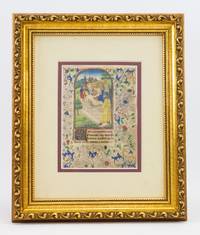
ST19540bSouthern Netherlands Bruges third quarter of 15th century. Matted leaf: 150 x 150 mm. 5 7/8 x 4 3/8". Frame: 307 x 258 mm. 12 x 10 1/4". Single column with four lines below the miniature and the obverse with 17 lines in a batarde hand. <br/> Attractively matted and framed the leaf slightly shifted in the mat revealing top and side edges but in no danger of damage. Rubrics in red four one-line initials and three three-line initials all but one in burnished gold on blue and red ground with white tracery the initial beneath the miniature painted pink on a burnished gold ground and filled with painted ivy vines AN ARCH-TOPPED LARGE MINIATURE DEPICTING THE ENTOMBMENT the body of Christ surrounded by seven other people depicted in an outdoor setting with the turrets of a walled city in the background the miniature in a double frame of gold and pink surrounded by A FULL BORDER composed of hairline vines acanthus colorful flowers and gilt bezants and inhabited by a small bird. Minor soiling and a faint thumb print to borders but IN VERY FINE CONDITION THE MINIATURE BEAUTIFULLY PRESERVED.<br/> <br/> This is a beautifully rendered and deeply touching scene depicting the entombment of the crucified Christ and the pathos experienced by those at his side. Holding the sheet on which the body is lowered into the sarcophagus are on the far left the richly clothed Joseph of Arimathea and on the far right Nicodemus who dons an especially lovely yellow garment with delicate embroidery. Between the two men in the foreground but behind the body are the Virgin Mary who presses the hand of her deceased son to her lips; John the Evangelist whose body is turned toward the Virgin in a gesture of support but whose gaze is focused on the Savior; and Mary Magdalene who holds a small ointment jar. Two other women with halos stand closely behind them consoling one another. The artist has done a masterful job at creating a composition that captures the emotional gravity of the scene: Christ's body gently cradled in a white sheet is on full display with blood still trickling from the wounds on his head and side. Despite there being seven people crowded around him our attention is drawn to the action between Christ and the Virgin who gently grasps his hand with motherly affection and bids him a final farewell. Flickers of different emotions appear on the faces of his followers including pity sorrow stoicism and disbelief--echoing perhaps the viewer's own range of feelings upon viewing this image. The level of detail excellence of composition care seen in the molded bodies and faces and the convincing setting suggest that the artist was quite practiced and that the original manuscript from which the leaf comes was of very high quality. unknown
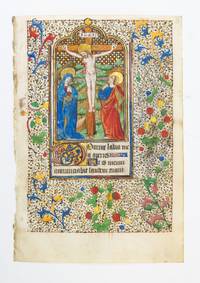
ST17060ZFrance probably Besançon 3rd quarter of 15th century. 239 x 165 mm. 9 3/8 x 6 1/2". Single column 15 lines in an elegant gothic book hand. <br/> Rubrics in dark pink line-enders in dark pink and blue highlighted with a gilt bezant several one-line initials and one two-line initial in burnished gold on dark pink and blue ground with white tracery one three-line initial in pink with white tracery filled with trefoils painted red or blue all on a gold ground verso with panel border of delicate hairline vines terminating in gilt bezants and ivy and with acanthus and flowers recto with A HALF-PAGE MINIATURE OF THE CRUCIFIXION in an arch-topped gilt frame Christ in the center of the composition with the mocking inscription "I N R I" "Iesus Nazarenus Rex Iudaeorum" on a banner above him the Virgin standing on the left and St. John on the right the landscape behind them filled with hills and trees under a tessellated sky SURROUNDED BY A FULL BORDER consisting of hairline vines terminating in gold bezants and ivy colorful acanthus strawberries and flowers the text and image further framed by a "U"-shaped bar of gold pink and blue extending the full height of the miniature. ◆Virgin's robe a little mottled and chipped minor chipping elsewhere borders with slight smudging to some of the hairline vines small marginal stain but in all in excellent condition with wide margins with the colors very bright and the miniature well preserved.<br/> <br/> Opening the Hours of the Cross a shorter text that is sometimes found in addition to the Hours of the Virgin this touching miniature of the Crucifixion is richly painted and features a particularly emotional depiction of Christ his head slightly bowed with an expression of pain. Blood flows freely from his wounds partly merging with the orange in the sky and partly forming rivulets at the base of the cross. This exsanguination stands in contrast to the more typically restrained indications in other Crucifixion scenes and serves to emphasize the cruel suffering of the execution. His mother stands to the left in a blue cloak hands knitted together and with a look of weary resignation on her face; to the right stands St. John whose lips are slightly parted as he looks directly at the crucified Christ as if searching his face for signs of life. Our artist has made an unusual choice for the background with the lower two thirds devoted to a naturalistic landscape with many hills and trees and the sky entirely tessellated with squares of red blue and gold. While the Virgin and St. John are both firmly situated within the earthy realm the body of Christ occupies both spaces perhaps emphasizing his dual nature as both human and divine. Stylistically this leaf can be localized to the Franche-Comté region in eastern France and is closely related if not directly attributable to an atelier specializing in Books of Hours made for the Use of Besançon and most likely situated in that city see Avril and Reynaud p. 197. The similarities are especially apparent in the figures' faces which are slightly puffy in appearance and have distinct slit-like eyes. As noted by Avril and Reynaud the unnamed master of this atelier was deeply indebted to the Master of Morgan 293 a talented Burgundian illuminator active in the second quarter of the 15th century whose name derives from a particularly lovely Book of Hours made for the Use of Besançon. In fact there are certain consonant details between this miniature and the Crucifixion in the Morgan manuscript: Christ's position and physicality are nearly identical as is the pattern of blood as it moves down the cross and both artists create a division in the landscape with the Morgan artist using gold rather than tessellation for his sky. Whoever the artist responsible for the present miniature the work here is clearly accomplished both quietly powerful and an excellent representation of a distinct regional style. unknown
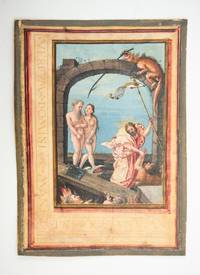
1540ST20622Germany ca. 1540. 183 x 133 mm. 7 1/8 x 5 1/4". <br/> WITH A FULL-PAGE MINIATURE DEPICTING THE HARROWING OF HELL featuring a naked Adam and Eve on the left and on the right Christ bending down to rescue John the Baptist the figures framed by a stone archway supporting a hairy creature who aims the point of a spear directly at Adam and Eve the miniature in a thin brown frame with gilt lines surrounded on two sides by the words "VERBUM DOMINI MANET IN ETERNUM" in gilt all framed in gray and red washes with double rules of black and gilt. Light soiling to frame a little flaking to the gray border and a couple of small scuffs and smudges elsewhere verso with spotting but the miniature vibrant and well preserved with only very trivial imperfections.<br/> <br/> A close copy of an early 16th century engraving by Albrecht Dürer this powerful miniature depicting the Harrowing of Hell is an intriguing artifact that ties together manuscript art print culture and the Reformation. The image depicts an apocryphal tale in the Gospel of Nicodemus in which Christ following his death but before his Resurrection descends into Limbo in order to save righteous souls who had passed away before him particularly figures from the Old Testament. Christ appears here in pale pink robes carrying a long staff with a cross and banner adorning the top. Having just brought down the gates of Hell he stoops to rescue John the Baptist here dressed in furs from its depths. A naked Adam and Eve covering their loins stand at the left of the composition--Adam now a gray-bearded old man as a reflection of sin and mortality but Eve still as she was at the Expulsion in keeping with the period's inclination to retain the classically idealized youthful feminine form. Above them is a stone arch upon which a dog-like demon perches stealthily aiming a spear directly at the oblivious couple. Another demon snaps its jaws at the feet of Christ and we can see a lick of flames below the broken gate as more captive souls clamor to escape. The painting is skillfully done showing the artist's facility with anatomy proportion and foreshortening. The bodies of Adam and Eve are particularly excellent with lovely skin tones and convincing molding. The composition is clearly based on an engraving by Dürer published in 1513 as part of a major series of 16 images known as the "Engraved Passion." In translating a black & white print into a full-color painting the artist here dispensed with a few details seen in Dürer's work such as the shadowy figure behind Adam and Eve and the stigmata on Christ's hand; however the overall composition deviates little from the original suggesting that the artist may have been working from an actual engraving. Although this leaf contains just a few words in the form of a border inscription--"Verbum Domini manet eternum" "the Word of the Lord endures forever"--they are monumentally important. This line from Isaiah 40:8 and 1 Peter 1:25 became the motto of the Lutheran Reformation appearing on art clothing coins and even armor of the 16th century. The Schmalkaldic League an influential group of allied Lutheran principalities in the Holy Roman Empire at the time also adopted it as their motto. Given the dominance of print materials during the Reformation period our hand-painted miniature--possibly produced as a frontispiece--must have been a very special commission. It is also an object that is prime for further study touching on aspects of book production religious art and the transmission of images and ideas in the early modern period. unknown
140947151San Francisco CA: The Arion Press 1982. Limited Edition. Near Fine. Limited edition. From an edition of 165 this is one of 15 hors de commerce copies signed by Jim Dine on the title page and Andrew Hoyem at the colophon. Bound in publisher's quarter-inch laminated oak boards stained with a lightning-bolt over white pigskin with spine lettered in blind; prospectus laid-in. Near Fine with tanning and light rubbing to spine light offsetting from plates. A striking production that marked the beginning of Dine's numerous books with this fine press publisher. The Arion Press unknown
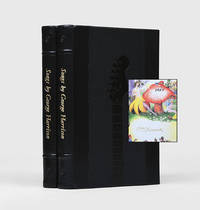
70298UK: Genesis Publications 1987 1992. Rock SIGNED LIMITED EDITION with RARE RECORD. 2 volumes folio 28 x 20 x 12cm. With additional text by Ringo Starr Elton John Harry Nilsson and Jeff Lynne. Quarto with colour plates and illustrations by Keith West. Photographs by Gered Mankowitz Brian Roylance Richard Young John Carter Terry O'Neill and Astrid Kirchherr. Original black half-morocco boards gilt edges with limited edition 7-inch vinyl record 'Songs' and CD recording 'Songs 2' the whole contained in custom-made clamshell boxes with a card tray. Each limited to 2500 copies being matching nos. 558 both books signed by the former Beatle and the illustrator the first title additionally signed by Beatles drummer Pete Best not called for with a Polaroid of the signing session. Also present is a Christmas card from Genesis Publications signed by founder Brian Roylance plus early flyer of forthcoming publications including an Elton John book and a Duane Eddy set which never went into production. Boxes lightly handled contents fine. The 'Songs' contained within are illustrated by talented New Zealand botanical artist Keith West who impressed Harrison with his wealth of fantastical imagery. The music included here was exclusive to this edition.A very early pop title from Genesis who have published well in excess of 80 music books; preceded only by I Me Mine 1980 Fifty Years Adrift 1984 and Twenty Years Ago Today 1987. Songs contains the more elusive record the majority were CDs; very few records were even made for Songs 2 as vinyl was virtually phased out by then. UK: Genesis Publications, 1987, 1992 unknown
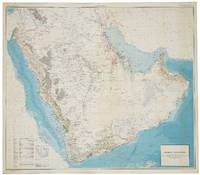
56801Washington D.C.: Department of the Interior United States Geological Survey and the Kingdom of Saudi Arabia Ministry of Finance 1963. SECOND EDITION ENGLISH ISSUE. Large chromolithohraphed map 122 x 139 cm of the Arabian peninsula shown with topographic relief and marked with water pipelines oases oil fields oil pipelines ports and harbours oil wells natural gas fields quarries and mines. Key lower left. The map includes the territories of modern day Kuwait Qatar Bahrain United Arab Emirates Oman and Yemen and was the work of a team lead by the distinguished geologist Glen F. Brown whose pioneering work on surface geology with its emphasis on water resources minerals and oil pertains to this day. Minor light spotting lower right generally in excellent condition. Issued simultaneously in an English and Arabic versions. Originally conceived in 1953 this second edition shows significant additional topographical detail and noticeably showing the growth in oil fields and accompanying infrastructure. Brown 1911-2001 began his career conducting coal investigations in South China and the Philippines and ground water investigations in Mississippi and Colorado the latter mostly concerned with supplying water to military installations. In response to a request from Ibn Sa'ud for assistance from the United States Geological Survey USGS Brown was selected in 1944 to investigate water supplies in the Saudi Arabian desert. Brown "arrived in Saudi Arabia early in 1945 and joined a mission sponsored by the US Foreign Economic Administration to study possibilities for agricultural development in central Arabia. As part of the mission he carried out a detailed investigation of the geologic formations in the Al Kharj district and identified substantial ground-water resources in buried aquifers. His report on the results of that investigation was very enthusiastically received by Saudi officials. Brown returned to Saudi Arabia at the request of Ibn Saud to conduct reconnaissance geologic mapping mineral evaluation and water-resource studies in the western and central parts of the kingdom. The mapping was carried forward from 1950 to 1958 by Brown with USGS and Saudi associates and extended to the entire Arabian Peninsula in cooperation with the Arabian American Oil Company Aramco as well as to organizations and companies of other countries in the peninsula. This resulted in a remarkable series of bilingual geologic and geographic maps of Saudi Arabia at a scale of 1:500000 and a geologic and geographic map of the entire Arabian Peninsula at a scale of 1:2000000 all of which were published by the USGS. These maps together with reports on the geology mineral deposits and water resources prepared by Brown and his associates providing the basis for Saudi Arabia to undertake a major national resource exploration and development program" obituary Geological Society of America. The map includes the territories of modern day Kuwait Qatar Bahrain United Arab Emirates Oman and Yemen. Although the hunt for oil gas and minerals ultimately drove geological survey work across the region in its early years it was the need for continual water sources which was the catalyst for Saudi Arabia's resource exploration. In 1944 King 'Abd al-'Aziz approached the United States for a technical expert who could assist with the identification and plotting of the kingdom's natural resources particularly its groundwater reserves. Glen F. Brown who undertook the task and is responsible for this map was one of the pioneers of a partnership between the United States Geological Survey USGS and the government of Saudi Arabia. This collaboration was one of international importance spanning the next five decades and influencing the development of the kingdom significantly. By 1954 the Saudi Ministry of Finance United States Geological Survey USGS and Aramco were working together to produce the first full series of geographic and geologic maps of the country. The first of their type in the Peninsula were published between the late 1950s and early 1960s in both Arabic and English copies. The information these maps contained formed the basis of subsequent Saudi national development plans. To this day all modern maps of the kingdom trace their roots back to these publications. Washington D.C.: Department of the Interior, United States Geological Survey and the Kingdom of Saudi Arabia Ministry of Finance unknown
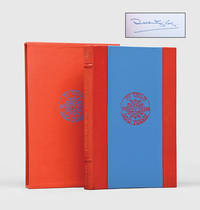
170909Guildford New York London Toronto Sydney Auckland: Genesis Publications Limited & Bantam Press 1987. One of several associates to earn the moniker "the Fifth Beatle" First edition signed limited issue number 38 of 100 copies signed by Taylor. The journalist writer publicist and record producer Derek Taylor was the press officer for the Beatles in 1964 and then from 1968-70. During his four years away from the UK he also worked as the publicist for California-based bands such as the Byrds the Beach Boys and the Mamas and the Papas. Octavo. Photographic illustrations throughout. Original red three-quarter morocco spine lettered in gilt and blue buckram boards titles to front cover in red all edges gilt. Housed in publisher's red slipcase with titles to front in blue. Fine in fine slipcase. hardcover
170355Guildford: Genesis Press 1987-92. First editions first impressions both number 1959 of 2500 copies each signed by the former Beatle and the illustrator. The CD inserted into Volume I contains the following tracks: Sat Singing recorded March 1980; Lay His Head recorded April 1980; For You Blue recorded live in Washington DC December 1974; and Flying Hour recorded March 1978. The Volume II CD includes Life Itself; Hottest Gong in Town; Tears of the World; and Hari's on Tour Express recorded live in Washington DC December 1974. 2 vols quarto. Illustrated throughout by Keith West together with photographs by Gered Mankowitz Brian Roylance Richard Young John Carter Terry O'Neill and Astrid Kirchherr. Original black half morocco boards gilt edges lettering to spines gilt with limited edition CDs titled Songs each contained in the original clamshell box with card tray lettering to labels on front covers and spines gilt. Boxes lightly rubbed books fine. hardcover
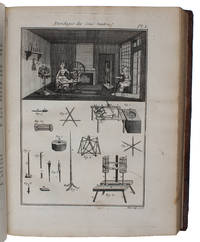
177156289Neuchatel L'Imprimerie de la Société Typographique 1771-83. 4to. Bound in 19 contemp. uniform full mottled calf. Raised bands. Gilt spines. Title-and tomelabels with gilt lettering. Spine-ends on nearly all volumes strenghtened. Stamp on title-pages. Each volume around 650 pp. With 508 fine engraved plates. <br/><br/><em>Second edition and the first 4to-edition was published in 19 volumes plus an additional volume by Jean Elie Bertrand where vol. 20 is an additional volume published much later 1799 - not present here - dealing with the art of printing. This importent collection of books on crafts was published by between 1761 and 1788. The full series comprises 113 parts cahiers in 27 folio volumes along with three supplements and "provide detailed accounts of a wide range of handcraft and manufacturing processes carried out in France at that time. The volumes are well-illustrated with precise engravings by Jean Elie Bertrand 1737-1779 a noted typographer from Neuchâtel where the printing was done. Many of them provide the background for shorter articles in Diderot's Encyclopedia which was appearing at much the same time. The project had its origin in request from Colbert in 1675 to the Academy Royal des Sciences for detailed accounts of various mechanic arts to be prepared and for new machines to be reported upon. This led to the formation of the Bignon Commission under Abbé Bignon. René-Antoine Ferchault de Réaumur 1683-1757 became editor soon after he joined the Academy. He inherited number of drawings the earliest prepared in 1693 and an illustrated manuscript on printing type and book binding which had been prepared in 1704. It was left to Réaumur's successor Duhamel du Monceau to bring about the publication of the series probably as the result of the competition from the Encyclopedia." Wikipedia.Brunet II618 ff. - Graesse II 367. </em> hardcover
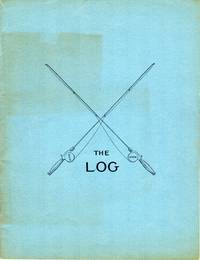
194129370n.p. n.d.: privately printed 1941. Only edition 4to pp. 8 20; photographic frontispiece; original blue printed wrappers with crossed fishing-poles; saddle-stitch binding; slight shadow on front cover else near fine. Inscribed "For Chief Boatswain's Mate W.A. Bartos USN from Franklin D. Roosevelt." "Having had a desire for some time to get away from Washington for a few days of restful diversion including some hoped for fishing in southern waters the President had previously instructed Captain Callaghan his Naval Aide to have the Potomac available at Port Everglades Florida for a projected cruise to the Bahamas." A working vacation affording the President fine fishing opportunities along the coast of Florida and the Bahamas. The President on the first day alone caught a tuna a skipjack and a mackerel. Bartos to whom the book is inscribed was an enlisted sailor attached to the President's party. Also attached to the President's party were the Attorney General Robert H. Jackson; Harold Ickes the Secretary of the Interior; and a young William J. McNamara. Included with the pamphlet are two 10" x 7½" photographs of Bartos sporting his rod and reel. [privately printed unknown
19932080502106501880Meiji Map Publishing 1993. Soft Cover. Fine. Number of books: 40 Meiji Map Publishing paperback
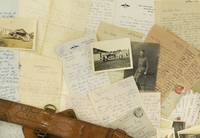
121325Powell enlisted in Melbourne in August 1914 service number 187 and was deployed to Gallipoli with the 2nd Field Ambulance A.I.F. After the evacuation he was promoted to corporal and then sergeant while with the 1st Divisional Headquarters seeing action on the Western Front before training as a pilot and being commissioned as an officer with the Royal Flying Corps in March 1917. Deployed once again to France with No. 84 Squadron R.F.C. in late September 1917 he was reported missing near Menin Menen Belgium on 31 October likely shot down by a German fighter. The archive comprises: <p>1 Approximately 75 autograph letters sent by Powell to his mother Clara and twin sister Mary in East Prahran Melbourne running to some 235 octavo or quarto pages. They date from soon after his enlistment to shortly before his death. Six were written on the Gallipoli Peninsula with others from Egypt the Western Front and the United Kingdom mainly during pilot training. While many of the letters are routine and others are guarded at numerous occasions Powell allows himself to reflect candidly on his experience of the war see examples below. <p>2 Approximately 90 closely-written postcards also addressed to Clara and Mary mainly from Egypt while on active service. The postcards are often written in numbered series most of which are complete. <p>3 Approximately 15 Field Service postcards signed by Powell several with Gallipoli postmarks. <p>4 Approximately 45 vintage gelatin silver photographs most relating to Powell's war service. The most interesting are 17 small snapshots approximately 45 × 65 mm most likely taken by Powell himself his letters suggest he was a keen amateur photographer showing gullies and ridges at Gallipoli 2; Australian servicemen and encampments in the Middle East with captions on the versos identifying several 7; R.F.C. aircraft apparently Farman reconnaissance biplanes in the snow at Netheravon Airfield 3 all captioned; and five others taken during pilot training in Britain. There are also five larger images approximately 80 × 110 mm showing military aircraft two possibly also showing Powell and two showing an airship. There are ten portrait photographs of Powell five in uniform one in a small cut glass and mother-of-pearl frame probably purchased in Egypt as well as three in which he is shown with a young woman likely Mary apparently taken shortly after he enlisted. A further nine photographs show friends and relatives some identified. <p>5 Approximately 60 pieces of ephemera and personal documents relating to Powell's service mainly mess bills receipts and other financial documents but also Christmas cards cinema programmes and city maps. A few relate to his life before the war including a reference from an employer. There are also several interesting documents relating to First World War aviation including the 'Royal Flying Corps Communiqué No. 58' 22 October 1916 giving details of R.F.C. actions in France bombing aerial photography casualties hostile aircraft flying conditions etc. for the preceding week. <p>6 Approximately 30 letters addressed to Powell mostly from his aunt Emma. Many of the letters are dated 1917 suggesting they may have been among his effects when he died. One particularly engaging three-page letter from a fellow R.F.C. officer Nugget and addressing Powell also as Nugget a few words censored gives a very detailed account of a dog-fight with German aircraft over the Western Front. Dated 16 September 1917 shortly before Powell's deployment to France it also includes much practical advice on flying in combat. <p>7 29 postcards addressed to Powell from two young French women Jeanne and Renée whom he may have met in Marseille in early 1916: '. je suis inquiète de ne plus reçevoir de vos nouvelles. Ne m'oubliez pas. I love you' etc. There is also a small photograph of Jeanne clipped from a postcard-format photograph. These items may have been forwarded to his sister as part of their running joke about him bringing home a foreign bride. <p>8 Some 40 official documents and family correspondence subsequent to Powell's death including the official telegram announcing his disappearance. <p>9 Approximately 60 envelopes and other items of postal stationery most retaining the postmarks and stamps if used. The postmarks include numerous field post offices including Gallipoli Egypt Greece and the Western Front. <p>10 A Sam Browne belt and leather notebook case purchased with the archive and with Powell's name in black ink on the inside surface. <p>11 A group of 7 postcards from Mary's fiancé Harold while on service in Egypt and the Western Front. <p>12 Eighteen reproductions of other photographs relating to Powell's war service showing Egypt Gallipoli and apparently an airfield in Britain. Several show Powell alongside other Australian soldiers. <p>A few highlights of the collection include: <p>A letter to his mother from Gallipoli on 20 May 1915: 'The infantry have done marvellous work here as you will read in the press. It needs seeing the cliffs & then you could appreciate it. It was wonderful. Poor Lou Matthews died yesterday I believe shot though the head but Arthur Clayfield was all right yesterday at any rate. Keith McIlwraith . died the first day bullet in head. I am not in love with this war game & in fact I think that after 3 more wars I will retire from the game & let someone else get all the glory &c out of it'. <p>In another letter to his mother from Gallipoli on 16 June 1915 Powell asks her to tell his sister that the dances in fashion in the trenches are the 'Shrapnel slide' the 'Shell shivers' and the 'Howitzer hug' and 'I may tell you baseball was a good training inasmuch as the sliding into a hole is concerned'. <p>A lengthy letter from the Western Front to 'Ma chere Mere' is dated '8 Mai 1916': he has been granted furlough to England and asks for £20 to be cabled to his account. 'Our 2/- per day wont allow for any saving-up as although we are fighting for their country the Northern French people put the weight in to the Australians just the same as the Egyptians did'. Later he writes 'We are in the fighting line again but it is nothing to Gallipoli - take it from me Gallipoli from Apl 25th to about 20th August was some go & after seeing that through I reckon a chap will die of old age. Well I am glad that I came with the 1st Division as we have some choice names for the chaps arriving now & they get rather a rough time when they start to talk to fellows about Gallipoli & were never there in their lives. It is rather annoying but the ones who were not on the Penin. at all or who were there for about 5 minutes that is after August do all the talking'. <p>A fortnight later on 21 May 1916 he tells his mother about a thank-you letter he receives for his 'acknowledging letter to the billy which I received while at Lemnos after Gallipoli. The funny part about those billies was the way they were pasted round with a kangaroo on the map of Gallipoli & on it - "WHAT WE HAVE WE'LL HOLD". We got them just after being withdrawn from what we had won from them. It seemed like a bit of a rub from "JACKO" the Turks'. <p>In a letter from the Central Flying School Upavon on 21 April 1917 Powell reflects that 'as usual the poor old Australians are doing more than their share. The Huns recently claimed to have cut off 750 of them you can guess it was the poor old 1st Div. going on ahead & not being supported on the flanks at Lagnicourt. It is only history repeating itself the same as Gallipoli the English troops letting them down & then some people over here pretend to think them "not nice" because when they get a little leave from France or hospital they play up a little. I wonder how they would get on without the Australians New Zealanders & Canadians - anyway I know to whom they give the hardest fighting & whom they welcome with open arms to the R.F.C. - nuf sed'. <p>Over 520 items. unknown
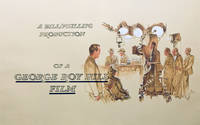
2316951973. Pen and ink watercolor and pencil heightened with white on cream paper. 27 x 42 inches. Framed. Fine. Pen and ink watercolor and pencil heightened with white on cream paper. 27 x 42 inches. The original illustration for the second of four title cards used in the opening credits of the classic 1973 motion picture "The Sting" Provenance: Estate of George Roy Hill unknown
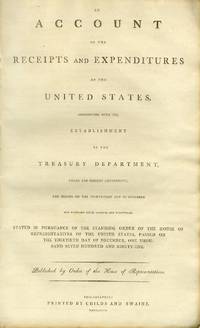
179032820355<p>Three volumes. Folio. Generally in very good condition details below.</p><p>Three rare Treasury reports as follows:</p><p>1. <i>An Account of the Receipts and Expenditures of the United States commencing with the establishment of the Treasury Department . . . ending on the thirty-first Day of December One Thousand Seven Hundred and Ninety-one.</i> Philadelphia: Childs and Swaine 1793. Folio 61 pp. folding table. Removed. Very good.</p><p>FIRST EDITION. This is a highly detailed report of the federal government's receipts and expenditures during the crucial first two years of the new government 1790-91. Locations: AAS Library Company Brown Harvard Yale and Princeton. Evans 26341. </p><p>2. <i>The Treasurer of the United States' Accounts of Payments and Receipts of Public Monies from 1st October 1790 to 30th June 1791</i>. Philadelphia: Childs and Swaine 1791. Folio. Original front wrapper. First few leaves stained. 52 pp. </p><p>FIRST EDITION. Samuel Meredith was first Treasurer of the United States. This is a detailed report of the expenditures and receipts of the federal government in 1790-1. Evans 23923. </p><p>3. <i>The Treasurer of the United States' Accounts of Payments and Receipts of Public Monies from 1st of January to the 30th of September 1792</i>. Philadelphia: Childs and Swaine 1793. Folio. Removed. Untrimmed. 67 pp. Very good.</p><p>FIRST EDITION. This is a detailed report of the expenditures and receipts of the federal government in 1792. Evans 24939.</p><br /> Childs and Swaine
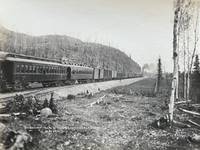
161959078Anchorage & Seward A.T.: Alaska Engineering Commission AEC Phinney S. Hunt ca. 1916-1917. 4to. 86 silver print photographs sized 6.25 x 8.25 in. nearly all w/ photographer’s imprint w/in negative at lower fore-edge as well as caption negative number and AEC some w/ occasional pencil annotations on verso all preserved in mylar sleeves occasional creasing at corners a couple w/ slight loss at corners in the small blank margin. Recent 3-ring clamshell binder an excellent set of photos with all retaining bright strong contrast. This outstanding photo archive provides not only some of the earliest photographs of Anchorage Alaska Territory but also this immense railroad project first authorized by the US Congress in 1912. The few existing privately-run railroads operating in Alaska at the time including the Alaska Northern Railway and the Tanana Valley Railroad primarily fulfilled the needs of the mining companies carrying resources to sea ports and very little allowance was made for passenger traffic and it was impossible to travel by rail from Ship’s Creek at the Cook Inlet north to Fairbanks. Through an April 1915 executive order President Wilson directed that the newly created Alaska Engineering Commission construct a railroad along the surveyed “Western Route†from Seward or Portage Bay along the Turnagain & Knik Arms of Cook Inlet North through the Suitna Valley and then follow the Nenana River until it joined the Tanana with the intent it would connect eventually to Fairbanks. Employing discarded surplus railroad equipment from the Panama Canal Railroad project and under the direction of engineer Mears who had worked on both the Panama Canal and Great Northern Railroads the tiny tent city of Ship’s Creek swelled to 5500 people within two years and was officially labeled by the Post Office as “Anchorage.†Photos included here reveal the barren original landscape of Ship’s Creek with one of the photos showing the steam launches “Alaska†& “Seagull†who carried cargo and passengers from ships offshore. In addition there are views of the construction of the immense AEC Railway machine shop by Sept. 1916 as well as the newly completed first Railroad Depot in Anchorage with the progression of buildings erected beyond. These early views of the fast developing project portray the Commissary Hospital Bunkhouses finished machine shop interiors of the powder house for blasting along with a view of the AEC’s photo studio and the completed electrical power house. Early street views of the nascent city are quite scarce and one of particular interest shows Fourth Ave. looking East with newly built stores and homes built along both sides of the roadway stretching into the distance. Brutal working conditions continually interfered with the pace of the project with one of the images showing the AEC’s “Electric Thawing Machine†on a sled whie others depict piles of snow work camps in snow and even sternwheeler and docks trapped in an ice flow in March 1917. A couple of the photographs feature the sternwheeler SS Omineca underway which had been originally constructed in 1909 for the Grand Trunk Railway running the Skeena River from 1909-1912 and powered by the original SS Caledonia’s engines. By the end of 1916 60 miles of track had been laid 100 miles were graded and right-of-way cleared for 230 miles with photos in this archive showing AEC Construction camps at various mile markers blasting activity and track laying. At the same time they rehabilitated the bankrupt Alaska Northern Railroad tracks and by Oct. 24 1917 the first AEC Railway train reached the Chickaloon coal mines 74 miles North of Anchorage. The railroad would actually not be finished until 1923 when the Tanana River Bridge was completed and last 57 miles of track to Fairbank converted to standard gauge. Photos also show the Anchorage Baseball Field which featured games for the Cook Inlet Baseball League composed at the time of Matanuska Anchorage and Turnagain Arm teams. There’s also a very fine series of the Decoration Day parade held May 30 1917 depicting many of the main streets and businesses in the background. In addition several photographs show the ocean docks completed which allowed ships to directly dock at Anchorage rather than lightering passengers and cargo to shore prior to 1917. Hunt 1866-1917 originally worked as a California optician before trekking to Valdez Alaska as a gold rush prospector but quickly established himself as a photographer opening his studio and documenting Valdez and development of the region. He would bring his wife and children to Alaska by 1907. He later secured work as one of the AEC’s official photographers shooting some of the early survey work by 1914 and through the project until suffering a heart attack Oct. 14 1917 in Seward AK. Hunt’s son A.O. Hunt also worked as an assistant photographer for the AEC. A few of these images appear as negatives in the Alaska State Library Historical Collections with a couple shown in their Digital Archives and some appear in the Alaska Engineering Commission archive at the U of W Collect. No. PH0495 but the bulk of that collection features photographs by James McPherson H.G. Kaiser and A.J. Johnson who were the other official photographers on the project; See: Phinney S. Hunt Photographs of Alaska 1902-1909 Photographs in and around Valdez and Sitka Alaska University of Washington Special Collections; Phinney S. Hunt Obituary Alaska Railroad Record Vol. I No. 49 Oct. 16 1917 p. 389. Alaska Engineering Commission, AEC, Phinney S. Hunt, unknown
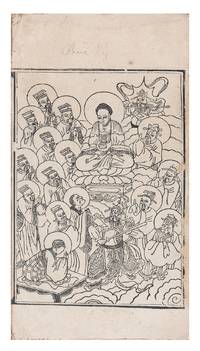
10902Two full-page frontis. woodcuts printed on each side of first leaf of Vol. I & one full-page woodcut on final leaf of Vol. II. 61.5; 107 folding leaves. Three parts in two vols. 8vo 287 x 171 mm. orig. wrappers Vol. I & modern wrappers Vol. II stitched orig. stitching in Vol. I. Quần phÆ°Æ¡ng hạ xã: Anh quang tá»± 1928.<br /> <BR> <BR> First edition of this very rare Vietnamese edition of the story of MaudgalyÄyana. The journey of MaudgalyÄyana rendered in Chinese as mulian 目連 one of the Buddha’s earliest disciples into the most abysmal and gruesome of Buddhist hells in his quest to rescue the soul of his mother was perhaps the single most important story in Chinese popular Buddhism since medieval times. The detailed depictions of tortures inflicted upon sinners relayed in MaudgalyÄyana’s story made Buddhist cosmology and morality vividly graspable to the laity and since the 12th century at the latest staged performances of his underworld travel have accompanied the Ghost Festival held at the full moon of the seventh month attended by masses of people across social strata. These theatrical retellings of MaudgalyÄyana’s travels remained highly popular until the early 20th century and are still sometimes staged today. The tale’s popularity and influence since medieval times had been so immense that David Johnson a historian of Chinese popular culture writes that “among the tens of thousands of Chinese operas none had deeper religious significance or was watched with greater excitement or was integrated into a more complex ritual matrix than MaudgalyÄyana†“Actions Speak Louder than Words: The Cultural Significance of Chinese Ritual Opera†in Ritual Opera Operatic Ritual IEAS Publications: 1989 p. 2.<br /> <BR> <BR> Unsurprisingly then there was wide dissemination of MaudgalyÄyana narratives and rituals not only in China but throughout East Asia in local and vernacular retellings of his story in a large range of religious and literary genres. Our copy of Penitence at the Compassionate Ritual Grounds of MaudgalyÄyana printed in northern Vietnam in 1928 is one such example. It opens with two illustrations from the canonical narrative of MaudgalyÄyana: the assembly of disciples attentively surrounding the Buddha and MaudgalyÄyana entering AvÄ«ci Hell riding a cloud holding the Buddha’s magical staff. The book itself is simultaneously a narrative account of MaudgalyÄyana’s travels and a Buddhist ritual of penitence opening as it does with prayers of refuge and devotion to “Shakyamuni the benevolent father†ThÃch-ca từ phụ 釋迦慈父 an interesting appellation. The prayer sections also make use of the placeholding name giáp má»— ç”²æŸ which during ritual readings of the text was probably to be replaced with one’s own name.<br /> <BR> <BR> Despite sharing the same title as a canonical Buddhist scripture T. 1909 composed in the Liang dynasty a comparison of contents suggests that ours is a related but substantially different text. The first Preface makes it clear that this text is indeed based on an original in the “northern country†— i.e. China — and an earlier domestic edition was made possible by the secular and ritual offerings of the monk Trà Giác 智覺. For some time the woodblocks had been stored in the Trác Ä‘iá»n temple å“田寺 in Bình Lục 平陸 Hà Nam province and did not circulate widely. As a result a reprint was made in Tá»± Äức 9 1856 by a monk named Thanh Tuyá»n Bhiká¹£u 清泉比丘. His Preface also dated 1856 is found in the first volume.<br /> <BR> <BR> By the 1920s however there was another problem: there were too many variants of the text in circulation which became a source of confusion. The monk Thanh Hưởng 清亨 using the earlier woodblocks stored at the Anh quang temple 英光寺 Quần phÆ°Æ¡ng hạ 羣芳下 commune Nam Äịnh province and with the guidance of Phổ Tụ æ™®èš collated various editions in circulation and created a new edition. This editorial history might explain why our copy does not correspond to known Chinese versions of the text as it probably has incorporated local Vietnamese elements. The woodblocks were carved by two craftsmen named Phó Dung 付瑢 and Phó Huênh 付轟 from the Liá»…u choà ng xã 柳幢社 with monetary offerings from monks and laypeople across many temples and communes listed towards the end of the second volume. The carving began in Bảo Äại 1 1926 and concluded two years later in 1928; the completed woodblocks were kept at the Anh quang temple.<br /> <BR> <BR> Despite the country’s long history of Buddhist and Confucian learning woodblock-printed books published within Vietnam itself are far fewer in number today than their Chinese or Japanese counterparts. This scarcity of extant Vietnamese books is due to a variety of factors including the cost of local printing a humid climate that makes preservation difficult as well as the country’s recent war-torn past. Outside of Buddhist texts kept by individual temples in Vietnam whose collections are difficult to access the bulk of these books are now kept at a handful of institutions such as the Institute of Sino-Nôm Studies in Hanoi and l’École française d’Extrême-Orient in Paris. The catalogue of these collections shows two items with the same title as ours Viện nghiên cứu Hán nôm AC.607 and AC.647 but there is insufficient detail to determine their editions. We find no Vietnamese woodblock-printed copy by this title on WorldCat.<br /> <BR> <BR> Very good set. Final three leaves of the second volume are carefully repaired. The full-page woodcut on the final leaf is partially defective at the borders but the main image is completely intact.<br /> <BR> <BR> ⧠Rostislav Berezkin Many Faces of Mulian: The Precious Scrolls of Late Imperial China Univ. of Washington: 2017; Beata Grant and Wilt Idema Escape from Blood Pond Hell: The Tales of Mulian and Woman Huang Univ. of Washington: 2011; David Johnson ed. Ritual Opera Operatic Ritual IEAS Publications: 1989; Stephen F. Teiser The Ghost Festival in Medieval China Princeton: 1988; Yuenan Hannan wenxian ziliaoku 越å—漢喃文ç»è³‡æ–™åº« Academia Sinica. unknown
178341192Bath 1783. Watercolour on laid paper with manuscript description on verso of the fine gold-leaf frame. Image size: 13 1/2 x 8 3/4 inches. Framed size: 22 1/4 x 18 inches. Thomas Robins a native of Bath was an enigmatic artist known for his watercolors. A small number of signed watercolors in the Broughton Collection at Cambridge University have been attributed to him particularly in an album inscribed as 'Drawings of Flowers Ehret and Robins.' In 1967 the Bath and West Agricultural Society sold a collection of 'Pictures of Exotic Plants and Insects' by Thomas Robins the Younger who was the son and pupil of the first Thomas Robins. Though there have been debates about differentiating their artistic styles the exhibition Gardens of Delight curated by John Harris at the R.I.B.A. in 1976 not only established the importance of the elder Robins' work in 18th-century English Topographical drawing but also shed light on the distinctive style of his son. Thomas Robins the Younger followed in his father's footsteps focusing on capturing grand residences gardens and the natural world. He drew inspiration from his father both in the subjects he chose and his artistic approach. Robins the Elder's views and landscapes are often noted for exuding the charm and freshness of a personal discovery and the similar joy of a chance encounter manifests here in the watercolour's dynamic scene. The image captures a split-second moment when a butterfly and a bee hovering into the scene from different directions about to land on the plant already blissfully occupied by their fellow creatures. By choosing to depict this moment Robins the Younger suspends the viewer in a state of anticipation that intense delicious but ultimately fleeting moment that can only be re-lived through memory or masterly depictions; the present's work ability to captivate and delight makes it an exquisite example of an especially fine decorative watercolour. The Linnaean and common English names of the plants and insects along with their classification and order are noted on a sheet of paper accompanying this watercolour. Depicted plants include: "shrubby rose colour'd periwinkle" "greater Indian cress or Nasturtium" and "double strip'd stock Gilliflower." The insects shown descending upon the petals are "Marmoris or Half Mourner Butterfly" "East Indian Bee Tyger Moth" and "English Bee Tyger Moth or Death's Head."<br/> <br/> The Fitzwilliam Museum University of Cambridge exhibition catalogue: British Flower Drawings: An Eight Selection Principally from the Broughton Collection 1 July - 18 October 1981. unknown
108981 p.l. 38 folding leaves. 8vo 280 x 174 mm. orig. wrappers with cover wrappers old stitching. Thần Xá: An Thái French colonial period.<br /> <BR> <BR> An extremely rare woodcut book printed by nuns in a rural monastery in northern Vietnam. “An eponymous MahÄyÄna sutra that recounts the qualities vows and pure land of the buddha Bhaiá¹£ajyaguru — the Master of Healing also known as the Medicine Buddha or the TathÄgata of Lapis-Lazuli Light. The scripture was most likely written in northern India during the early centuries of the Common Era. In this sutra Bhaiá¹£ajyaguru vowed that his name if merely uttered would cure diseases free prisoners secure food and clothing for the impoverished and produce other similar benefits. He also vowed that his body would be as resplendent as lapis lazuli itself so that it might illuminate the world†Donald Lopez & Robert Buswell The Princeton Dictionary of Buddhism “Bhaiá¹£ajyagurusÅ«traâ€.<br /> <BR> <BR> The Scripture of the Medicine Buddha T. 450 translated from Sanskrit into Chinese by Xuanzang 602–664 in the year 650 C.E. has been a popular text in East Asian and Tibetan Buddhist traditions. In our copy the sutra itself is bookended by a liturgical opening including the “Incense Praise†praises for the Buddha and a “sutra-opening gÄthĆand a final homage to the Medicine Buddha. According to the colophon bound at the beginning of the volume the scripture was printed for a specific occasion by three bhikkhuni or ordained Buddhist nuns affiliated with the An Thái temple 安泰寺 in the Thần Xá village 神èˆæ‘ of the An Lại commune 安賴社 in the Thanh Khê canton 清溪 Äại An district 大安縣 Nam Äịnh province å—å®šçœ of northern Vietnam. <br /> <BR> <BR> Only the names of two of them are fully legible: they are Quảng Thuáºn å»£é † and Quảng Thà nh 廣æˆ. They printed and disseminated this Scripture of the Medicine Buddha with a sincere mind when the statues of three of their masters were completed and placed into stupas. In their colophon they traced the lineage of themselves and their masters to the bhikkhuni An DÆ°Æ¡ng Tháp 安陽塔 dharma name Nguồn Hạnh æºå¹¸ and pseudonym Minh Lâm 明ç³. <br /> <BR> <BR> Despite the country’s long history of Buddhist and Confucian learning woodblock-printed books published within Vietnam itself are far fewer in number than their Chinese or Japanese counterparts. This scarcity is owed to the high cost of domestic production: according to the estimate of Kathlene Baldanza as late as the 19th century “the labor cost of printing in Vietnam was five to ten times higher than in China. Even ink and brushes were more expensive to produce in Vietnam.†Extensive international trade between northern Vietnam and southern China — where plentiful books were printed at very low costs — meant that “it was generally cheaper to purchase books from China than to buy them locally†“Publishing Book Culture and Reading Practices in Vietnam†Journal of Vietnamese Studies 13.3 2018 pp. 10–11. <br /> <BR> <BR> Beyond the limited cases of official and temple-based publishing Vietnamese publishers were pushed toward niche genres such as Sino-Vietnamese dictionaries ritual manuals or morality books. Regardless of genre woodblock-printed books from Vietnam are very difficult to find today outside a few major collections such as the Institute of Sino-Nôm Studies in Hanoi and l’École française d’Extrême-Orient in Paris. We will not focus on the humid climate of the country or the massive destruction of the nation’s cultural heritage during its long war of independence in the post World War II period.<br /> <BR> <BR> The catalogue of materials kept at the Institute of Sino-Nôm Studies mentions two copies VHv.1071 AC.116 of the Scripture of the Medicine Buddha printed in 1911 and it is unclear if those were printed with the same woodblocks as ours. We know for certain however that no material at the Institute of Sino-Nôm Studies gives the An Thái temple as the place of publication despite the large numbers of temples and monasteries listed. This copy being an example of Vietnamese women’s printing in a rural monastery is extremely rare.<br /> <BR> <BR> Fine copy. First leaf a little frayed and the outer wrappers are quite frayed.<br /> <BR> <BR> ⧠Li Guimin æŽè²´æ°‘ “Zaizhi yu bianyi: Yuenan hanchuan fojiao dianji de zhuanhua å†è£½èˆ‡è®Šç•°â€”—越å—漢傳佛教典ç±çš„轉化†Foguang xuebao 佛光å¸å ± 7 No. 1 2021: pp. 111–37. Yuenan Hannan wenxian ziliaoku 越å—漢喃文ç»è³‡æ–™åº« Academia Sinica. unknown
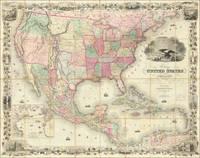
1849NL-02377<p>This map is among the earliest printed maps to reference the California Gold Rush issued just months after the 1848 discovery of gold and shortly after the Treaty of Guadalupe Hidalgo which ended the Mexican-American War and transferred a vast swath of territory from Mexico to the United States.</p><p>It offers a snapshot of the United States at a pivotal moment featuring newly annexed western lands an oversized Texas shown at its maximum claimed extent and a fascinating depiction of the West before the creation of the Utah New Mexico Washington and Kansas Territories.</p><p><em>Texas at Its Maximum Claimed Extent</em></p><ul><li>Texas is depicted with <strong>its boldest territorial claims</strong> reflecting the boundaries asserted during its years as an independent republic and carried into early U.S. statehood 1845–1849.</li><li><strong>Northern "stovepipe" panhandle</strong> stretches far into present-day Wyoming and Colorado an area Texas claimed based on historical Spanish and Mexican precedent.</li><li>The w<strong>estern boundary</strong> extends to the <strong>Rio Grande</strong> including parts of modern-day New Mexico—territory that has been hotly contested between Texas and the federal government.</li><li>These expansive claims were largely rolled back in the <strong>Compromise of 1850</strong> when Texas ceded land to the U.S. in exchange for debt relief.</li></ul><p><em>The Western United States: Undefined & Expansive</em></p><ul><li><strong>California</strong> appears as a single vast entity—still undefined as a state it would join the Union in 1850 but newly American after the Mexican War. The <strong>"Gold Region"</strong> is labeled near the Sacramento River though modestly.</li><li><strong>Oregon Territory</strong> stretches from the Pacific to the Continental Divide including all of present-day Oregon Washington Idaho and parts of Montana and Wyoming.</li><li><strong>Nebraska Territory</strong> occupies a huge central swath encompassing the Great Plains but with minimal internal detail. It predates its 1854 formal organization.</li><li>No sign yet of <strong>Utah or New Mexico Territories</strong> which would be organized in 1850.</li><li>Native American lands and major overland routes like the <strong>Oregon Trail</strong> are marked but the interior West is largely unmapped described only in vague geographic strokes.</li></ul><p><em>Other Notable Boundary Details</em></p><ul><li><strong>Florida</strong> is a state admitted 1845 but much of the Southeast is still recovering from earlier Native displacement and territorial reorganization.</li><li>The <strong>Mississippi River</strong> still functions as a crucial east–west boundary between developed states and the expanding frontier.</li><li><strong>Great Basin and interior California</strong> remain largely uncharted—there is no depiction of the Sierra Nevada range or detailed hydrography beyond a few major rivers.</li></ul><p><em>Summary</em></p><p>Colton's 1849 map presents a <strong>liminal geographic vision</strong>: the United States in the immediate aftermath of war on the edge of gold fever and before Congress imposed structure on the new western lands. It captures:</p><ul><li><strong>Texas at its most ambitious</strong>—a vision quickly curtailed.</li><li>A <strong>California that is American but not yet a state</strong> already drawing attention for its gold.</li><li>A <strong>vast western void</strong> soon to be filled by settlers railroads and legal boundaries.</li></ul><p>As a historical artifact this map offers a <strong>pre-legislative snapshot</strong> of U.S. expansion—what the country looked like before federal compromises surveys and sectional battles remapped it.</p> The Colton Mapmaking Company
196817042JBurbank: Warner Brothers - Seven Arts February 7 1968. Original 128 page shooting script with blue and pink re-write pages. Bradbound in printed yellow studio wrappers. This script belonged to distinguished Mexican actor Alfonso Arau who played Herrera the Lieutenant of General Malpache Emilio Fernandez. Arau has boldly written “ALFONSO ARAU - HERRERA in large letters at the top of the front cover in black ink. In the lower right hand corner of the front wrapper Arau has written in red ink the name of “Lonnie Becker†who was the film’s casting director in Mexico. Very good set used script. Enclosed in a custom morocco and cloth clamshell box. Sam Peckinpah’s masterpiece The Wild Bunch is considered by many to be among the greatest of western films. The picture contains career highlight performances by William Holden Ernest Borgnine Robert Ryan Edmond O'Brien Warren Oates Jaime Sanchez Ben Johnson Emilio Fernandez Strother Martin L. Q. Jones Albert Dekker Bo Hopkins Dub Taylor Jorge Russek and Alfonso Arau. This screenplay was nominated for an Academy Award. The finished film has been chosen by the American Film Institute as one of the 100 outstanding American films. Warner Brothers - Seven Arts hardcover