Bede, the VenerableBiblio.com
99 résultats
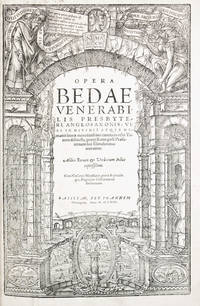
1563254015Basileae i.e. Basle: Per Joannem Hervagium 1563. First collected edition. Title within architectural border with device of Johann Herwagen. Profusely illustrated with iwoodcut maps music tables diagrams. Text in two columns; with Index. 4 vols. Folio. Contemporary calf rebacked new leather spine labels labels misnumbered later endpapers; covers worn but sound one joint starting but firm. Text show various degrees of slight worming and scattered light foxing but overall a very good sound set of this massive collected edition complete except for the final blank leaf of Volume VI. First collected edition. Title within architectural border with device of Johann Herwagen. Profusely illustrated with iwoodcut maps music tables diagrams. Text in two columns; with Index. 4 vols. Folio. This is the first of three continental editions of the works of Bede the others being from Cologne in 1612 and 1688. Johann Herwage a printer originally from Strassburg married the widow of the great Basel printer Johann Froben and for a while collaborated with his stepson Hieronymus Froben. From 1532 however he again started printing under his own name.<br /> <br /> RARE ON THE MARKET. Adams B-477 Per Joannem Hervagium unknown
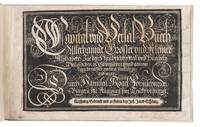
156821281Augsburg: Johann Jacob Schönig 1568. Vellum ca. 1985 with each leaf attached to a stub and the stubs side stitched in a cloth slipcase. Oblong folio 21 x 34 cm. With a richly calligraphic woodcut title-page 18 x 28 cm with text in white fraktur lettering on black with a white panel at the foot with the letterpress imprint in a fraktur type; and 9 of 10 full-page woodcuts about 17 x 25.5 cm showing alphabets in white on black one dated 1568: 8 with decorated gothic capitals versals: 22-150 mm and 1 with textura capitals textura lowercase and roman capitals all versos blank. Lacking 1 leaf. With a small and perhaps fragmentary manuscript on parchment 2 ll. 11.5 x 13.5 cm written on both sides: a Protestant copybook written soon after 1557 probably in Basle or vicinity with 7 writing samples including alphabets of capitals and minuscules the first two pages in fraktur gothic styles and the last two in humanistic styles. Sixth known copy of Johann Jacob Schönig's edition of a stunningly decorative Augsburg writing master's woodcut copybook devoted primarily to decorated gothic capitals versals printed in the period 1680-1694 from the original woodblocks of the first edition of 1568. Hans Rogel the elder 1532-1592 writing master school teacher poet wood-block cutter engraver printer and publisher at Augsburg cut the woodblocks and probably executed the lettering himself. All the lettering examples and the title-page are printed from large richly calligraphic woodcuts with their lettering in white on black. Nine of the ten examples display versals the missing leaf supplied in reproduction including complete alphabets in three sizes. The final leaf displays alphabets of textura capitals textura minuscules and roman capitals. As early as 1779 Paul von Stetten described Rogel's Capital und Versal Buech as "besonders fein geschnitten" and said that if Rogel executed the lettering himself he "ist er billig den zierlichsten Schreibmeistern beyzuzählen". He thought it good enough to be the work of Caspar Brinner 1565-1610 the greatest Augsburg writing master of the second half of the century apparently not knowing Brinner was only about three years old in 1568.All editions should apparently contain 11 leaves but many contain only 10 and some fewer. Some have also been bound with additional leaves that do not belong to the edition. There appear to be only 3 complete copies of the present edition.An early owner skilfully wrote out alphabets in the fore-edge margins of 2 leaves and phrases at the foot of one. It seems likely to be the copy owned by Jan Willem Six van Vromade 1872-1936. Lacking leaf "2" as noted professionally and unobtrusively restored in 1984 and probably rebound soon after: the tattered fore-edge margins of several leaves were restored and a couple gaps in the right border of the title-page filled in with black ink. A small brown smudge in the unnumbered first page of versals 22 mm slightly affects small bits of 4 letters but in general the woodcuts remain in good condition.l Berlin Kat. 4799; Bonacini 1548 Berlin copy; Doede 21 note; Hollstein German 34 KVK & WorldCat 4 copies: 2 lacking 1 leaf; Van Stockum Cat. bibl. J.W. Six de Vromade part 1 16-21 November 1925 lot 407 the present copy; cf. Paul von Stetten Kunstgewerbe und Handwerksgeschichte . Augsburg 1779 vol. 1 p. 23 1655/68 ed. Johann Jacob Schönig, hardcover
1596F75BBB01U79OBrescia 1596. Small 8vo 14.5 x 10 cm. Pietro Maria Marchetti Contemporary limp sheepskin parchment sewn on 3 alum-tawed thongs with manuscript title on smooth spine. With Marchetti's woodcut anchor and dolphin device imitating Aldus's on the title-page 16 numbered engraved emblematic illustrations plate size 8.5 x 6.5 cm woodcut headpieces tailpieces and decorated initials 3 series and decorations built up from cast fleurons. With the Latin text set in italic and the Italian translation in roman. 106 6 blank pp. First edition of the so-called Oracles of Leo the Wise with a bilingual Latin an Italian text and 16 lovely and rather surreal engravings: an emblematic book of prophecies traditionally attributed to Leo VI 866-911/12 Emperor of Byzantium from 866 to his death and at least here also to Antonius Severus 188-217 sole Emperor of Rome from his murder of his brother in December 211 to his death the book does not indicate which Severus is intended but the preface notes that he reigned from 212. The Latin text was circulated already attributed to Leo the Wise in the 12th century but Christians revived it in the 16th century and interpreted it as a prophecy that the Ottoman Empire would fall in 1622. These oracles remained popular in the 17th century when they were presented as having predicted the setbacks that the Ottomans suffered in Europe in that period.Owner's inscriptions on the title-page further with a bookplate. With a water stain in the first quire but otherwise in very good condition with only very minor foxing. The sewing supports have broken at the back hinge the thong ties are lost and the vellum is slightly wrinkled but the binding is still in good condition.l BMC STC Italian p. 622; Caillet 11042; Edit16/ICCU CNCE 28586; Mortimer Italian 254. hardcover
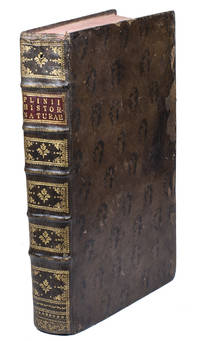
1532K7GAXLMCHM25Paris 1532. Folio. Jean Parvum index: Jean Petit 18th-century cat's paw calf richly gold-tooled spine with red title-label red edges. With a woodcut printer's device on the individual title-page for the index. 36 671 188 pp. Praised 1532 edition of Pliny's Naturalis historia: "Cette édition citée avec éloge par Ernesti et par Rezzonico." Brunet. Pliny's Natural history is one of the largest single works to have survived from the Roman Empire and purports to cover the entire field of ancient knowledge based on the best authorities available at the time. It encompasses the fields of botany zoology astronomy geology and mineralogy as well as the exploitation of those resources. It remains a standard work for the Roman period and the advances in technology and understanding of natural phenomena at the time. ''We know from Pliny that there were important pearl fisheries in the Gulf Pliny identifies Tylos Bahrain as a place famous for its pearls He attests that pearls were the most highly rated valuable in Roman society and that those from the Gulf were specially praised The pearl related finds at the site of El-Dur indicate the site was integrated into the maritime trade routes linking the Roman Empire the Persian Empire India and South Arabia'' Carter.With bookplate on paste-down some ink notes on the title-page the first page and occasionally in the margins; title-page a bit soiled; some wormholes near the end of the book mostly in the margins. Binding slightly worn along the extremities. Overall in good condition.l Brunet IV col. 715; Carter ''The history and prehistory of pearling in the Persian Gulf'' in: Journal of the economic and social history of the orient 48 2005 pp.139-209; Graesse V p. 339 "Excellente édition"; for Pliny: DSB XI pp. 38-40. unknown
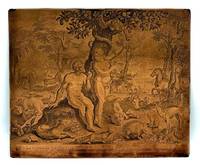
16001745Original printing plate: Johannes Galle. c.1600-1650. Engraved copper printing plate depicting Adam and Eve in the Garden of Eden surrounded by all manner of creatures with Adam sitting at the foot of the tree of knowledge about to take a bite from an apple whilst Eve takes another from the hand of a serpentine creature coiling around the branches above. 22.7 x 19.1cm. The plate incorporating text to the foot from Genesis 3. Signed at the foot "M. de Vos invenit / Corn. Galle Sculp. / Io. Galle excudit". The plate with some old fine scratches is otherwise in very good order. WITH: A later mid nineteeth-century and somewhat weak impression of the plate on paper. This laid down to board with manuscript French labels dated 1851 to the reverse apparently gifting the item from Mademoiselle C. Thyes of Brussels to "Monsieur Delpy"; the print with two pin holes to the blank lower margin and a few spots of faint foxing. A beautifully-executed original engraved copper printing plate by the Flemish engraver Cornelis Galle the Elder 1576-1650 forming a typically busy depiction of the Garden of Eden with Adam and Eve sealing their fate amidst a varied menagerie of peaceable beasts including an elephant camel bear porcupine ostrich and rearing unicorn amongst others.</p><p>Cornelis Galle was first taught engraving by his father the engraver and publisher Philip Galle 1537-1612. He subsequently resided in Rome for several years where he acquired an accuracy of design and freedom of style which marked him out as a master of his art form. Following his return to Antwerp he continued to engrave numerous plates after the works of his countrymen as well as his own designs becoming a master of the Antwerp Guild of St Luke in 1610.</p><p>The present engraving was made after an original painting by the prominent Flemish artist Maerten de Vos 1532-1603. A prolific draughtsman de Vos produced numerous designs for the engravers of Antwerp the resulting prints of which circulated widely in Europe and the Spanish colonies significantly contributing to his international reputation and influence.</p><p>Hollstein XLIV.61.243. [Original printing plate]: Johannes Galle. unknown
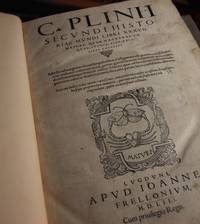
155328<p>C. Plinii Secundi Historiae mundi libri XXXVII majore quam hactenus unquam studio fide religione emedati adjectis ad marginem succinctis . . . una cum indice totius operis copiosissimo.<em> Lugduni Apvd Ioannem Frellonivm. M.D.L.III.</em></p><p>Pliny's <em>Natural History</em> is Shakespeare's source for the famous description in <em>Othello</em> of "men whose heads grow beneath their shoulders." See Kenneth Muir <em>Shakespeare's Sources </em>London 1957 p. 127.</p><p>Although there were translations of Pliny into French and English some scholars have argued that Shakespeare read Pliny in Latin. See T. W. Baldwin "A Note upon William Shakespeare's Use of Pliny" in <em>Essays in Dramatic Literature </em>London 1935 pp. 157-82.</p><p>Folio. 3 parts in one vols. A2-A4 B-C4 a-z5 A-Z5 AA-ZZ4 Con2 m4; l.; 34 679 236 p. Title-page vignette. Medium brown calf blindtooled border on both boards.</p><p>Provenance: Inverchapel bookplate.</p><p>The <em>National Union Catalog of Pre-1956 Imprints</em> lists only two known copies not including the present one.</p><p>References: NUC: 461 671-90 NP 0424260. Not in USTC.</p> John Frellonium
157656695Colophon: Kiøbenhaffn Copenhagen Matz Wingaardt 1576. 4to. Pragtfuldt samtidigt hellæderbind af kalveskind over træ med skråtskårne kanter og 2 lukkestroppe med messingbeslag det ene hængsel løst antageligt udført af en dansk bogbinder. 3 ophøjede ægte bind på ryggen og med blindtrykte stregbordurer. Permer med dobbelte stregrammer og 2 brede rammer udført med ruller og stempler. Midtfelterne med stort pladetrykt billede af Justitia på bagpermen et billede af Justinian . Kapitæler med mindre reparationer. Titelbladet med en træsnit illustration af den danske konge med rigsvåbnet. Kolofon med Gotfred af Ghemens trykkermærke i træsnit. 111 unummerede blade. Indersiden af forpermen har notater i gl. hænder vedrørende bogens indhold. Fra Oscar Wandels bogsamling med hans exlibris. Da bogen ikke er ombundet foreligger den her i dens opsrindelige størrelse med pænt brede marginer. Få spredte brunpletter. Nogle blade med en svag skjold nederst på siderne. De første 6 blade incl. titelbladet er noget restaurerede med senere omkantning. Titelbladet har en smule tab af stregrammen omkring kongen blad 2 recto har tab af et ord i nederste linie tagher. Trykt på svært papir. <br/><br/><em>Extremely rare first printing of what is arguably the world's first facsimile namely Mads Vingaard's 1576 reproduction of the first printing of the Law of Sealand originally printed by Ghemen in 1505 and here re-issued in exact reproduction. This wonderful print is not merely a "line to line word to word"-reproduction but a facsimile making use of the same types and exact reproductions of the woodcuts. It is generally believed that "the first facsimile in the history of the book was a manuscript of Austrian provenance - the Goldene Bulle - reproduced in 1697 by the Frankfurt law historian Heinrich Günther Thülemeyer and Johann Friedrich Fleischer" from "Imagination Almanach" 1986-1993 Sammelheft. 1993; 2006. The present reproduction predates that work otherwise hailed as the first "facsimile" in the history of the book by more than a century!Some credit Plantin in the 17th century with being the first to produce a facsimile. This is also about a century after Mats Vingaard's facsimile of the Law of Sealand. Like the laws of Sealand and The Law of Scania The Law of Jutland" constitutes a law book "Rechtsbuch" in German in the sense of a private collection of those common laws pertaining to inheritance ownership marriage measurement of land murder theft vandalism etc. that were commonly applicable in the region.The medieval Danish regional laws possess an immense importance both linguistically and legally and the influence is evident even today both in the development of our legal system and of our written language. At the time of their foundation the Danish kingdom was divided into jurisdictional areas lands that in turn were divided into townships. Each land had a county council which also served as a judicial court. It quite quickly became standard for the township court to be able to refer verdicts and rulings to the county/land council. In the 13th century there were three main lands namely Jutland Sealand and Skåne. With time these three lands came to rule over all townships and thus we find three ruling legal books from the 13th century namely the three earliest Danish law books - Jyske Lov the Sealandic Laws and Skånske Lov. They were all printed for the first time in 1505 and 1505 respectively. It is not until 1683 with "Danske Lov" that Denmark gets a law that covers the entire kingdom. The 1576 facsimile is scarce and Thesaurus estimates that only ab. 10 copies still exist on private hands. </em> unknown
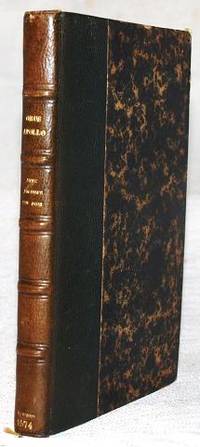
15741412080047Parisiis : Apud Galeotum a Prato & Ioannem Ruellium 1574-01-01. Hardcover. Very Good. 12mo. 8 107 frontis 196 ill. Parallel Latin and French. Quarter bound in fine early 20th century quarter green Moroccan. Gilt spine. 5 raised bands. Speckled boards. Marbled end pages. Silk ribbon. Printers device on final blank. Clean unmarked pages with minimal tanning. Inlaid auctions slips from 1936 and 1940 of this book at auction and the 1551 edition. Harvard Mortimer French 316; Brunet III 343; Adams H852. <br><br> Hieroglyphica is a text extant from the early medieval period ascribed to Horapollo Horus Apollo but it may be a pseudepigraph. The text of the Hieroglyphica consists of two books containing a total of 189 explanations of Egyptian hieroglyphs. The books profess to be a translation from an Egyptian original into Greek by a certain Philippus of whom nothing is known. The text was discovered in 1419 on the island of Andros and by the end of the 15th century the text became immensely popular among humanists. <Br>The Greek text is not in this edition which reproduces the engravings from the 1551 edition with some additions and a nice frontispiece Brunet. The frontispiece is attributed by Didot in his essay on the woodcut gives it as the most elegant woodcut that surrounds the title page and attributes the work to Jean Cousin. Papillion adds further that all the figures of this book are from the same artist. from auction slip. Parisiis : Apud Galeotum a Prato, & Ioannem Ruellium hardcover
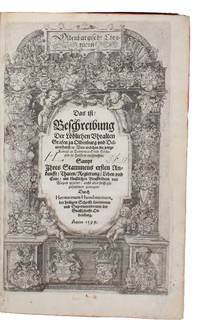
159950394Oldenburg Warner Berendts Erben 1599. Folio. Contemp. full calf. Richly gilt spine. Titlelabel gone. Engraved ornamental title-page. 8649418 incl. 2 blank. Profusely textillustrated with engravings and woodcuts among them the full-page portrait of the author a full-page view of Oldenburg 3 folded genealogical tables and the double-page engraved elevated plan of Oldenburg. Internally clean and fine. <br/><br/><em>First edition. Hamelmann's Chronicon is the first book to be printed in Oldenburg Brunet and it is the historical source work for the "House of Oldenburg" whose descendents became kings of Denmark and emperors of Russia. -Adams H 30. </em> unknown
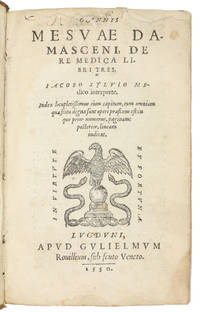
1550L7NAYKM7EWW1Lyon: Guillaume Rouillé colophon: printed by Philibert Rollet 1550. 19th-century marbled boards manuscript spine label. 8vo. With Rouillés woodcut device on the title-page eagle on a globe flanked by 2 snakes numerous woodcut decorated initials and an arabesque decoration below the colophon. Well-made but popularly priced Lyon 8vo edition of Mesues three seminal pharmacological works including his great pharmacological handbook the principal model for the European pharmacopoeias translated into Latin by Jacques Dubois/Jacobus Sylvius 1478-1555 who taught anatomy at Paris his students including Vesalius and Gesner. Dubois first published it in a Paris folio edition in 1542. Speaking of the artisanal epistemology crucial to the European scientific revolution De Vos calls Mesues present works a conduit for the Arabic contributions to that epistemology and its subsequent development and impact describing them as the most dominant source of pharmaceutical writings and by far the most influential in the subsequent development of European pharmacy with Duboiss new Latin translation of particular note pp. 668 670 673. It is by far the most detailed and extensive mediaeval book of pharmacological recipes far surpassing the 12th-century Antidotarium Nicolai which had been the standard work in Europe. Not only does it include 432 recipes for compound medications compared with Nicolais 85 it arranges them by the kind of medicine rather than alphabetically and unlike Nicolai it gives detailed instructions for their preparation. It largely superseded Nicolai in Europe in the late 1300s and early 1400s. Although Mesue and his present works have fallen into undeserved obscurity in the general public they went through more editions than Ibn Sina Avicenna Galen or Discorides.If the attribution to Joannis Mesuae Damasceni is correct the author must be Yahya = Yuhanna ibn Masawaih al-Mardini ca. 925-1015 known in the West as Mesue the younger.Provenance: 1 owners inscription in ink dated 1636 struck through and difficult to decipher on front paste-down; 2 another dated 21 August 1818 on back paste-down also difficult to read; 3 19th-century ink owners inscription of Arthur Rénaux on front paste-down. Occasional browning; an owners inscription erased on the title-page with slight loss to authors name. Binding rubbed; hinges cracked and minor chips in the spine.l Baudrier IX 176; Durling 3144; USTC 150499; Wellcome 4280; cf. Hirsch I 171f; not in BMC STC French; for Mesue and the present works: Paula De Vos The Prince of Medicine: Yuhanna ibn Masawayh and the foundations of the Western pharmaceutical tradition in: Isis 104 2013 pp. 667-712; Prioreschi History of medicine IV Byzantine and Islamic pp. 290-291. Guillaume Rouillé (colophon: printed by Philibert Rollet), hardcover
1503723<p>Post incunable: publisher not identified or Venezia: Albertino da Lessona 1502. 1503. It is bound in full seventeenth century vellum with spine label. . The first printing of the Margarita Poetica was printed by Johannes Sensenschmidt in1472 between 1472 and 1503 there appeared at least a dozen editions In this edition the marginal index letters correspond to those of 1493 Venice edition. <br />¶ Eyb went to Italy and devoted himself to humanistic study at the Universities of Pavia and Bologna. He returned to Germany in 1451 having been appointed Canon at Eichstätt and Bamberg. From 1452 to 1459 he was again a student at Bologna gaining the degree of doctor in 1459. The Margarita is named after Eyb's mother and was written in 1459.<br /><br />Fabriccius observed the "Eyb stressed two things throughout the Margarita: to be able to write well and to be disposed to live properly."<br /><br />¶ In a contrast to "Ars Dictaminis" perhaps the Middle Ages version of TEXTING von Eyb uses this work to re-Introduce Cicero's Vetera Rhetorica. While certainly there are many late medieval texts on letter writing Eyb as can be seen in the structure of this book<br /><br />The Content are in three parts the first Epistola five Prologus is a revised and augmented version OF M.T.C. CICERO with excerpts taken from classical authors and Italian humanists and formulas for letter-writing. The first part offers style samples of Roman rhetoric poetry and epistolography. <br />¶The second part the AUCTORITATES consists of an a Florilegium Roman writer and with its third part extracts from Petrarca Terence Plautus and SenecaCicero Lactantius Macrobuius Plutarchus etc finally 30 speeches as models of humanistic eloquence.<br />¶ The third part ORATIONES: contains selections from Petrarch dramatic poets Terence <br />Seneca Plautus and a variety of humanist speeches by Renaissance copyists letter-writers and philosophers including Johannes Lamola Poggius Florentinus Galeatius Sforza and the author himself. Folio a8 B-X8 Y8 this copy is lacking the final gathering signed with numbers 1-4 only comprising a Materiarum-tabula which is not present. Gatherings a-I have printed decorated intitials; K-X have blanks some with printed guides for manuscript initials not filled in.<br /><br /><br />Panzer IX 107 4; Rare: Not in Adams VD 16 BM Geman or Italian.</p> [publisher not identified] or [Venezia: Albertino da Lessona, 1502]. Â hardcover
1572EE4911Haeredum Iohannis Quentel / Viduam Mauricii a Porta / et al 1572. ~DATE RANGE: 1547-1572 ~FULL TITLES: D. Dionysii Carthusiani Enarrationes piae ac eruditae in quatuor prophetas quos vocant maiores. Imprint: Coloniae : Ex Officina Haeredum Iohannis Quentel. M.D. LVII. BOUND WITH: D. Dionysii Carthusiani Enarrationes piae ac eruditae in duodecim prophetas quos vocant minores. IMPRINT: Coloniae Apud Geruuinum Calenium & haeredes Iohannis Quentel. M. D. LXVIII. 2 VOLS IN 1. / D. Dionysii Carthusiani Insigne commentariorum opus in Psalmos omnes Davidicos. Imprint: Parisiis Apud Dionysiam & Hieronymum de Marnes viduam spectabilis viri Ambrosii Girault. M.D. XLVII. BOUND WITH: D. Dionysii Carthusiani Enarrationes piae ac eruditae in quinque libros Sapientiales. IMPRINT: Coloniae ex officina Haeredum Ioannis Quentel. M. D. LV. 2 VOLS IN 1. / D. Dionysii Carthusiani Enarrationes piæ ac eruditæ in quinque Mosaicæ legis libros. Imprint: Coloniae : Apud haeredes Joannis Quentel et Geruuinum Calenium M.D. LXVI. / D. Dionysii Carthusiani enarrationes piae ac eruditae in libros Iosue Iudicum Ruth Regum Primum secundum tertium & quartum item Paralipomenon primum & secundum . Coloniae Ex Officina Haeredum Ioannis Quentel. M.D.LII. BOUND WITH: D. Dionysii Carthusiani eruditae ac piae enarrationes in Librum Iob Tobiae Iudith Hester Nehemiae Machabaeorum primum & II. IMPRINT: Coloniae. Impensis Geruini Calenii & haeredum Iohannis Quentel. Anno M. D. LXXII. 2 VOLS IN 1. / D. Dionysii Carthusiani in quatuor Evangelistas enarrationes. Paris. Apud Viduam Mauricii a Porta. M.D.LII. BOUND WITH: D. Dionysii Carthusiani in omnes B. Pauli epistolas commentaria. IMPRINT: Parisiis Apud spectabilem viduam Maruicii a Porta. 1548. BOUND WITH: D. Dionysii Carthusiani in Catholicas septem epistolas piae ac eruditae admodum enarrationes. Eiusdem Commentarii doctissimi in Acta Apostolorum Apocalypsim ac Hymnos ecclesiasticos. IMPRINT: Parisiis. Apud Viduam Maruitii a Porta. 1548. 3 VOLS IN 1. ~PAGINATION: 16 814 2 12 358pp. 12 327ff. 28 593 2pp. 12 1015pp. 12 611 4 501pp. 10 348 4 130 5 170ff. ~Full uniform 18th-century mottled calf bindings raised bands to spines. Spines decorated in gilt with small tools. Blind triple fillets to boards. Gilt decor to board edges much rubbed. Two brown gilt labels per spine intact only on 'libros Iosue .'. Other vols have single label remaining or none 'Prophetas'. All edges red. Endpapers marbled in Placard pattern. Folios 21 x 31.5cm. Library markings to prelims including Pusey Library markings to all vols. Owner's signature of E. B. Pusey to vols I & II. Loss to spines of 'Prophetas' & 'Pentateuch'. Headbands loose. Splitting over all outer hinges but all hinges holding. Decorated initials throughout to all vols. Publisher's devices to all title pages. Dedicatory epistle to Henry VIII dated 1532 to 'in quatuor Evangelistas enarrationes'. A little sidelining and annotation in old hand especially to final vol. with some more recent pencil sidelining throughout. Text printed in double columns. Some age-browning and foxing mostly to vol. I & 'enarrationes in Librum Iob .'. Tiny amount of worm damage to inside front board of 'Psalmi'. Tear 7cm to p. 1015 of 'Pentateuch' minor effect to text. With tickets from 2005 Christie's sale. 19th-century bookmarks to vols I & II one with Pusey's name on part of ironmonger's bill. 5 striking identical woodcuts 12.5 x 16.2cm of Denis with the Virgin and Child to verso of some tps in vols I-IV. Woodcut of Denis triumphing over devil 12.7 x 17cm to final page of vol. I. All woodcuts signed with monogram 'A W' i.e. Anton Woensam c.1493/1496 - c.1541 a frequent collaborator with the Quentel publishing house. Denis the Carthusian 1402-1471 theologian and mystic. Collection of 16th century editions of his influential Biblical commentaries with close association with E. B. Pusey 1800-1882 leading figure in Oxford Movement. ~Robust packaging. All UK orders trackable others on request. Used books are exempt from USA tariffs. Hardback. Hardback. Good/Fine. c. 500pp. per vol. Haeredum Iohannis Quentel / Viduam Mauricii a Porta / et al Hardcover
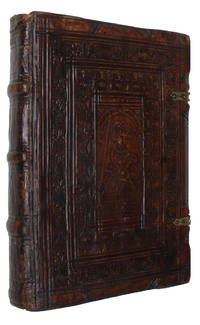
1552V48030Basel: H. Froben 1501-1563 1552. Hardcover. Very Good. Large Froben printer's device on titlepage historiated woodcut initials throughout. . Four Volumes in One large folio bound in blind-stamped pigskin dated 1564 with initials I.D.F.H. on bevelled wooden boards with metal clasps lacking one clasp each board has 16 small marginal panels of biblical scenes and four larger central stamps of Justice Fortitude etc with legends under each spine on four raised double bands with MS title and shelf mark "Basilius 39" some small worm holes tips worn. Title page catalogue 6 787pp with colophon "Basiliae apud Hier. Frobenium et Nic. Episcopium anno M.D.LI" 1551 21pp index 3pp blank with large Froben device on last page. Bookplate with coronet initials dated 1913 inscription "Ex bibliotheca Johannis Mathon Lugd. Bat." with MS devices on free endpaper & another inscription on titlepage. Collated complete &4 a-z A-M6 N8 O-Z Aa-Ss6 Tt8 Vv-Xx6 with pagination continuous each of 4 vols has divisional titlepage see Adams B340. Crisp and clean throughout but with quite extensive worming of pages near front and back of book. NB large heavy book so extra shipping/postage costs. H. Froben (1501-1563) hardcover
1591BOSTONVB11<br />MOREA OTTOMAN GREEK TURKISH PRISONERS Entire Letter writen from Chlonmontsi to "Lord David di Bembo Lord of Cephelonia" acknowledging receipt of nine Turkish Prisoners who are listed sent by the Lord of Cephalonia to "our Lord Bairakbasha Governor of the Morea". A very interesting and early letter during the period that Morea was under Ottoman rule expressing gratitude for the lenient treatment of Turkish prisoners. Surviving Ottoman letters in Greek are extremely rare. in commerce. A full translation and transcription is included.
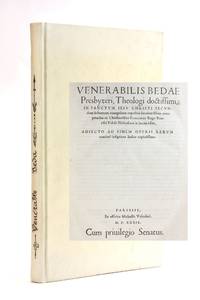
1539505317Michaelis Vascosani Michel Vascosan 1539. Leather. NEAR FINE. 4 218pp. 9 Index. Folio in 6's collation complete: 2 A3-T6 2. Vulgate text printed in larger font with woodcut drop caps marginal references. Nicely bound in recent vellum with hand-written spine title in a convincing antiquarian hand. Some light staining to the edges small wormhole to top margin toward the gutter not affecting text; else FINE internally; a nice fresh copy. Bede the Venerable was one of the greatest minds of the Middle Ages and his immense learning is on full display in this commentary on the Fourth Gospel drawing on the church fathers as well as interlocating Old Testament and intertextual references. Bede had a particular devotion to the Johnannine gospel; his translation of the Vulgate into Old English is held as the first vernacular translation. The value of this particular edition is due to its significance in the history of printing. Vascosan set up his press 1530 under the banner of his father in law the famed printer Badius and adorned his title pages with the Badius printer's device through the decade. For reasons unclear possibly a dispute with relatives sharing an interest in the firm in 1539 Vascosan stopped using the Badius device. Rather than cut his own device Vascosan simply printed his title pages without one remarkably becoming the first printer to forego this branding tool that was so essential to printer differentiation in an age when books were sold without bindings. While his motivations at the outset are unclear it may have been simply needing to sell some books before a proper device could be cut he took a liking to it and maintained this style throughout his career. Today he is remembered as a pioneer of this 'unadorned elegance of his editions' Oxford Companion to the Book p. 1238. His text-only title pages were 'a harbinger of a new approach to title pages. Vascosan’s decision flew in the face of the Parisian and more generally European book-trade where printers’ devices had played a vital role in the identification and marketing of printers’ and booksellers’ output. He was trail-blazing a new method of promoting his works – a minimalist style which would challenge the use of ornate devices so popular among the first generation of Parisian printers and booksellers. Coupled with his rejection of a printer’s device was what one might call his ‘purification’ of the title page for his title pages are incredibly simple in style the whiteness of the paper dominating. Henri-Jean Martin wittily calls this ‘the graphic mode’ of ‘solemnization of the title page’ as opposed to the second ‘monumental mode’ which by the end of the sixteenth century became saturated with symbols and architectural motifs.' Exhibition Catalog 'Printing in Sixteenth-Century France at the Edward Worth Library.' While we cannot speculate on the priority of printings within the year 1539 we can say that no other copies of a 1539 Vascosan imprint are available in trade at this time and only one appears in auction records. OCLC 60698411 listes 8 copies. Michaelis Vascosani [Michel Vascosan] unknown
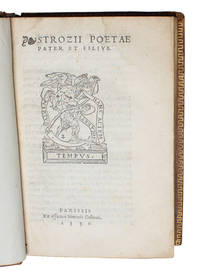
153045363Parisiis Ex officina Simonis Colinaei 1530. 8vo. Bound in a very fine later full calf around 1700 profusely gilt spine titlelabel in leather with gilt lettering broad gilt borders on covers edges of covers gilt edges of leaves gilt. A very small nick to top of spine. 8 lvs. 1-2563 lvs. 1 blank. A small and very faint dampstain to upper inner margins of the first 8 lvs. Otherwise very clean throughout. A beautifull printed and wide-margined copy 17x115 cm. <br/><br/><em>Scarce second edition of the "opera" of the poetical works of both father and son. Their collected opere were first published by Aldus Manutius in 1513 together with works of his son under the title Strozii poëtae pater et filius. The offered edition is copied from this Aldus-edition. They were both members of the famous Strozzi-family exiled from Florence.Adams S 1957. - Graesse VI: 512. </em> hardcover
1548227758Venice: Alessandro Brucioli & i Frategli 1548. First Antonio Brucioli translation. Full vellum skiver leather title and date spine labels. Deaccession library stamps title page; marginalia p. 544; .5" chip lower corner p. 768 no loss; period ink mark affecting text p.980; pps. 950-1068 faint water stain lower corners & corners curled chipped frayed with some loss to margins and one part of marginal annotation. Octavo. xvi; 24; 1-1068 numbered in roman numerals. Gathering "O" misbound out of order but complete pp. 490-490 mispaginated as 494-495. The succession of translations of Pliny's Historia Naturale from the earliest printed incunables to Cinquecento Italian editions is a complex study of the collaborative process among humanist intellectual peers. Renaissance translators of early Greek thought worked with previously published translations offering emendations and alterations to improve or correct an earlier text. Antonio Brucioli edited Cristoforo Landino's well-received translation in 1543 which he then sought to improve upon with his own edition in 1548 making corrections to the table of contents offering an extended preface and including a “Life of Pliny.†Ultimately Landino's translation was the preferred text supplanting this Brucioli edition making it the only edition of this version of Pliny's Historia Naturale. Alessandro Brucioli & i Frategli unknown
158041650Antwerp 1580. Print. 3 1/2 x 2 2/3 inches. Engraved portrait on laid paper. Latin text around oval vignette with caption below. Stamp on verso of Frederic R. Halsey. Image: 3 2/5 x 2 3/4 inches. Matted: 18 x 14 inches. Provenance: Frederic R. Halsey collection.<br/> <br/> One of the earliest portaits of one of the greatest figures in maritime history Sir Francis Drake.<br/> <br/> Sir Francis Drake c.1540-1596 was an English explorer pirate and politician best known for his circumnavigation of the world in a single expedition in his galleon the Golden Hind. Drake left England with five ships in December of 1577 as is noted in the present print. He returned three years later having challenged Spain's hegemony over the Atlantic Ocean and the New World. Drake would go on to help defeat the Spanish Armada in 1588. Drake is pictured half-length in an oval vignette which is lettered in Latin text meaning: "Most Noble English Knight Very Experienced in All Things Nautical and Military." Wierix captures Drake around the age of 43 with signs of age. He engraved this image after a portrait purportedly painted from life by Jean Rabel the Elder; it is said to be a credible likeness of the famed navigator. Drake is in a three-quarter view looking to his right wearing etched armor with a sash a lace collar over his gorget and holding a shield on his right arm which is decorated with two ships. The legend beneath the portrait indicates the date of Drake's circumnavigation and reads: "Hic est qui toto terrarum Orbe duorum annor. Spatio et mensium to circumducto Angliam patriam revisit 1577 id Dece." This is the one known throughout the world. He circumnavigated England and returned 1577 December. "Drake's voyage of 1577-80 had two purposes - to discover trading bases in the legendary "Terra Australis" and the Moluccas and to raid the west coast of South America. Sailing up the coasts of Chile Peru and Mexico Drake sacked towns and plundered shipping. He reached California which he named New Albion and claimed for England in the name of Queen Elizabeth. Returning to England via the Pacific and Indian Oceans Drake was the first Englishman to circumnavigate the world." Hill The printmaker Hieronymus Wierix was one of three brothers who were all engravers. Hieronymus was a child prodigy who went to work for the legendary printer Christophe Plantin in 1570. There he learned to engrave copper engraving his first plate for Plantin at the age of seventeen. Wierix made over 120 engravings for Plantin from 1569 to 1576. He became a master printer known for his "very delicate religious prints on a very small scale" and lived in Antwerp the remainder of his life. It is unclear if Plantin had a hand in the publication of the present print but he did live in Antwerp until 1589 and he was a close associate of Wierix's. Wierix's portrait of Drake is the basis for later derivative images by other printmakers including Jodocus Hondius and Crispin van de Passe. In those other prints of Drake the image and his face are in reverse orientation and most are inaccurate copies of copies presenting a Drake far afield from his actual appearance. This print from the esteemed Frederic R. Halsey print collection with Halsey's stamp on its verso has impeccable provenance to match its quality. Halsey was a notable book and print collector attorney member of the council of the Grolier Club and trustee of the New York Public Library. His collection of prints was estimated to hold about ten thousand items the scale and scope of which would be near to impossible to replicate. Halsey collected Americana and prints of sporting Napoleonia and etchings by old and modern masters. His collection was sold through Anderson Galleries in New York November-December 1916 and its catalog remains an essential reference.<br/> <br/> Graesse V: 154. Grivel "Au Sieur Rabel Parangon du la 'Pourtraicture'" in Renaissance en France pp. 227-92. Hill p.86. Hollstein Dutch and Flemish Etchings XV.709. Kraus Drake 59. O'Donoghue Catalog of Engraved British Portraits O8.88. Sabin 58995. unknown
1518elala713Colophon on kk7r: Venice: In Aedib. Aldi Et Andreae Asulani Soceri June 1518. 1518. 8vo. pp. 26 p.l. 525 1 leaf. Aldine anchor device on title & at end. 19th century red morocco Aldine anchor device in gilt on covers all edges gilt rubbed title lightly toned & with small paper repair in lower margin x in colophon date erased with tiny hole. probably from the Syston Park Library of Sir John Thorold. Second Aldine Edition. The letters of the consul and Governor of Biyhinia friend of Tacitus and Suetonius provide an interesting view of the varied interests of a cultivated Roman gentleman. "The etiquette of the imperial circle scenes from the law-courts and the recitation-room the reunions of dilettanti and philosophers the busy life of the capital or of the municipal town the recreations of the seaside and of the country all these he brings vividly before our eyes". Encyc. Britan. 11th Edn. Topics range from his Tuscan villa happy memories of Lake Como love for his wife Calpurnia dreams ghost-stories the beauties of the Clitumnus and the floating islands of the Vadimonian lake the eruption of Vesuvius in connection with the last days and death of Pliny the Elder the deaths of Silius Italicus and Martial the principles that should guide a Roman governor in Greece the government of Bithynia and the relations between the governor and the Emperor. "The Letters are models of graceful thought and refined expression each of them dealing with a single topic and generally ending with an epigrammatic point." Ibid. The whole of Book 8 was first published in its proper place by Aldus Manutius in 1508. Adams P1538. BM STC Italian p. 525. Renouard I 195.4. Dibdin 4th Edn. II p. 330. Moss II pp. 493-94. Hardcover. Very Good. [Colophon on kk7r:] Venice: In Aedib. Aldi, Et Andreae Asulani Soceri, June 1518. Hardcover
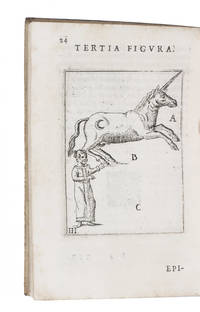
1570801Basel: Eusebius Episcopius 1570. Hardcover. Poor. Heinrich Vogtherr the Elder. Rich provenance adorns this wonderful renaissance work capturing the myths geometry and observational data of the ancient world's heavens adorned with 48 beautiful illustrations of the constellations. Although the illustrator wasn't named scholars generally attribute the 48 woodcuts of constellations to Heinrich Vogtherr the Elder who was active in Basel at the time and shared a similar style. These blocks reflect a more modern 16th century approach to the constellations in comparison the 15th century Ratdolt illustrations of the same work. Provenance - A Latin scholar likely circa 16-17th century wrote witty Latin phrases at the front and rear. The title page has an inscription warning that roughly translated ""a fat belly does not produce subtle thoughts"". At the colophon is a lengthy indictment of the Roman Church drawing from phrases found in Graecimus by Eberhard of Bethune 13th century and Albertus de Rosate 14th century. Adding more context this book was printed in Basel at the height of the reformation. The large front ex libris plate is of Sir William Stirling-Maxwell. The book is listed in his 1860 library catalogue and he wrote page 197 "".useful collection of ancient mythologists. Included here for the curious fragments of ancient lore and table-talk ana preserved in the Fabulae and the astrological traditions."" At the rear pastedown is a ticket from Stirling-Maxwell's library assigning it to the ""Ana"" section. The ex libris on the FEP is that of the noted Harvard astronomer historian bibliophile and author Owen Gingerich. Bibliographic Details - Universal Short Title Catalogue USTC number 617529 41 copies recorded in the world's finest libraries. Physical Attributes - Measures approx. 30.5 x 20.5 x 2.5 cm. Old repair to even older leather binding. Boards with faint blind fillets forming double borders with corner florets. Spine with five raised bands author/title/date/Basel in gilt in compartments/at base. Edges mostly red but along fore-edge also in green sections. USTC calls it a folio but it might be a large quarto but regardless gatherings of 6. Printer's device on title page. Some initials. 48 in-text illustrations. Pages - viii 251 1 - blank 26 - Index Collation - a4 a-y6 z7. The z7 is odd but the 13 leaves of y6 and z7 index equal the 26 pages of the USTC catalogue entry so it appears complete and not missing a blank z8. Condition - See pictures. Old repair of even older leather binding with a new spine and corners but the corners are worn through exposing and wearing on pasteboard. Original leather dried and crazed little cracks newer repairs worn through and worn also. Some rubs to binding and spine bands also and a light bump on the front board. Large ex libris applied to pastedown small ex libris ticked applied to FEP. Gutter cracked. A moisture mark occasionally from edge throughout possibly from the application of text block edge coloring. Text block with toning occasional thumbing dog-eared or chipped corner page edge chip fox mark candle ember mark errant annotation/ink mark/doodle etc. throughout. Title page with a handful of inscriptions ink and graphite; trimmed slightly different from following page. 4th leaf Index trimmed tight at top edge. Several ink smudges on b6. Moisture mark bottom corner g and h gathering. Ink drop btm margin l3. No blank z8 if ever. Writing on colophon. More ex libris marks/tickets on rear binder's endpaper. Eusebius Episcopius
159355259Slesvig Nicolai Wegener 1593. 4to. Helpergamentsbind fra 1600-taller. Ved ombindingen er bagerst indsat ca. 100 blanke blade. Forgyldt titeletiket i skind på ryg. Etiketten med lidt tab. Gl. ejernavn Bille Brahe Hvedholm. 129 blade. På titelbladet er 2 linier som var trykt med rødt overskrevet med sort. Blad 1b med stort træsnit af Danmarks våben. Blad 2a med helsides træsnit Christian IV's portræt. Gl. ejernavn på titelbladet. Rent eksemplar trykt på kraftigt skrivepapir og med talrige samtidige tilskrifter i en net hånd. <br/><br/><em>Yderst sjældent forekommende anden udgave den første trykt af Brandis 1486 af den plattyske oversættelse af Jyske Lov ved Blasius Eckenberger. Der eksisterer kun en lille håndfuld bevarede eksemplarer i privat ejerskab. Det foreliggende eksemplar er en af varianteksemplarerne som er beskrevet af Lauritz Nielsen Dansk Bibliografi p.348 no.1072 og som gør sig bemærket ved flere udeladelser. Således er udeladt oversætterens eneretsprivilegium dedikationen fra oversætteren Chr. IV's autorisation m.v. = læg 2 og 3. I dette eksemplar starter teksten med "Vörrede" som har arksignatur D og slutter med blad 139 b som er et helsides træsnit af oversætterens bomærke. Repertoriet som Eckenberger udgav 1594 sammen med loven er heller ikke tilstede.Lauritz Nielsen 1072. - Thesaurus I 167. </em> unknown
158326929Paris 1583. Engraved portrait oval with surrounding legend and text beneath on laid paper 6 7/8 x 4 1/4 inches. Cut to just within platemark and inlaid into later wove paper sheet. Later ink inscription on verso reading "from Holland / 1809." Minor wear and soiling. Very good. A very early engraved portrait of Sir Francis Drake.<br/> <br/> A clean impression of the second state of this famous portrait of Sir Francis Drake at age forty-three shortly after he returned from circumnavigating the globe the basis for most of the later images of him. The image is taken from a portrait purportedly painted from life by Jean Rabel the Elder and is said to be a credible likeness of the famed navigator. The legend beneath the portrait indicates the dates of Drake's circumnavigation listing Rabel as the painter and Thomas de Leu as the engraver. Thomas de Leu 1560-1612 a pupil of Rabel's moved to Paris around 1576 and became one of the most noted portrait engravers of his time. This engraving of Drake was the basis for many later images of him including the well-known engravings by Jodocus Hondius and Crispin van de Passe. The earliest graphic image of one of the greatest figures in maritime history.<br/> <br/> Marianne Grivel "Au Sieur Rabel Parangon du la 'pourtraicture'." in H. Zerner and M. Bayard's RENAISSANCE EN FRANCE Paris 2009 pp. 227-92 2d state. unknown