122 150 résultats
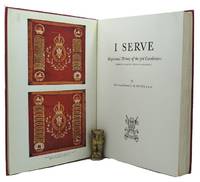
1966152402Chester: 3rd Carabiniers 1966. Pp. xiv334last blank 16 plates 5 coloured 11 folding maps appendices index; cr. 4to; red cloth spine lettered in gilt gilt insignia to upper board edges and fore-corners lightly worn; book label of David Levine Sydney on upper pastedown margins of plates lightly browned; 3rd Carabiniers Chester 1966. First edition. White p. 267; Sutcliffe 2/p. 19. Includes the Somme. 3rd Carabiniers unknown
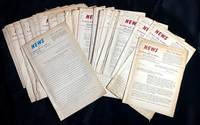
195142943New York American Council for Judaism 1951. 1st edition. Original stapled pages. "News" is 8.5"x11" and generally 4 single sided leaves. Press releases are legal size 8.5"x14" 2-4 single sided leaves each. Approximately 160 leaves total. <br> News is subtitled "Highlights of the Yiddish and Hebrew Press. A weekly Digest prepared by the Publicity and Research Departments American Council for Judaism." Maurice Spector is listed as Publicity Directory though the OCLC listing indicates Bill Gottlieb as editor perhaps for earlier or later issues <br> Each issue of the NEWS is headed with the warning "This is not for release - for your information only." <br> <br> Some headlines from the NEWS often quoting the Zionist press when it shines poorly on Zionism include: <br> -Nationalist-Zionist Education Endangers Judaism<br> - To the Rescue of Yiddish<br> - The Sin of the Histadrut<br> - Treatment of the Arab Minority in Israel<br> - And Now it is Israel's Turn to Use the Hostage Weapon.<br> - The Religious Bloc is Powerful for Reasons that aren't Religious<br> - We Want Peace Unity Discipline-But on our Own Terms.<br> - Israel's Election Campaign Opens.Here in America<br> <br> Some headlines from the press releases include: American council for Judaism Calls NCRAC Action Partisan: <br> -Declares Zionism and Jewish Nationalism Responsible for Creating 'Dual Loyalties' Issue<br> - Carroll Binder Warns Minority Pressure Blocs Endanger U.S. National Interests<br> - President Truman Say American Council for Judaism Deeply Rooted in U.S. Traditions of Individual Rights<br> - Zionist Pressure Seek Change of Judaism Values from Universal Religion to Status of Tribal Cult Rabbi Charges<br> - Dorothy Thompson Warns Zionism's Viewing All Jews as Members of a Jewish Nation" Seeking Privileged Minority Status in U.S. Gives Aid to Antisemitism<br> - Cause of DP's Pleaded at American Council for Judaism's Annual Meeting: Leading Social Workers Charges Pro-Israel Pressures Deprived Many Thousands of Sanctuary<br> - U. S. Culture Infiltration Seen as world Zionism Aim<br> - Israel has No Rights Authority Over Lives of U.S. Jews Rosenwald Says: Assumptions in Ben-Gurion's Knesset Speech Rejected by Head of American Council for Judaism<br> <br> "The American Council for Judaism ACJ is an organization of American Jews committed to the proposition that Jews are not a national but a religious group adhering to the original stated principles of Reform Judaism as articulated in the 1885 Pittsburgh Platform. In particular it is notable for its historical opposition to Zionism. Although it has since moderated its stance on the issue it still advocates that American Jews distance themselves from Israel politically and does not view Israel as a universal Jewish homeland.<br> The rabbis of Reform Judaism had opposed Zionism prior to World War I supporting freedom democracy and equal rights for Jews in the countries where they lived. The influential American Jewish Committee was also anti-Zionist until 1918 when it shifted to a non-Zionist platform until the 1967 Six-Day War. The Central Conference of American Rabbis of the Reform movement declared itself officially neutral on Zionism in 1937.<br> In 1942 a split within the Reform movement occurred due to the passage of a resolution by some rabbis endorsing the raising of a 'Jewish Army' in Palestine to fight alongside the Allies of World War II. The American and British general staffs opposed placing Jews in segregated armed forces.The founders of the American Council for Judaism regarded the potential segregation of Jews to be a highly regressive and harmful measure.<br> The ACJ was founded in June 1942 by a group of leading Reform rabbis including six former presidents of the Central Conference of American Rabbis and the president of the Hebrew Union College as well as laymen who opposed the creation of a religiously segregated Jewish Army to fight alongside the Allies and the new political direction of some in their movement including but not limited to on the issue of Zionism as redefined by the Biltmore Program in May 1942.The leading rabbis included Louis Wolsey Morris Lazaron Abraham Cronbach David Philipson and Henry Cohen but their most vocal representative for a time became Elmer Berger who became the council's Executive Director.<br> The ACJ described itself as anti-nationalist and followed a universalist interpretation of Jewish history and destiny. According to its statement of principles the ACJ supported the 'rehabilitation' of Palestine and did not support political Zionism. It also declared that 'Jewish nationalism tends to confuse our fellowmen about our place and function in society and diverts our own attention from our historic role to live as a religious community wherever we may dwell.' The ACJ's leaders felt that they represented the views of a majority of American Jews and began a large membership drive. By 1946 it had numerous local chapters throughout the United States and regional offices in Richmond Chicago Dallas and San Francisco.<br> During World War II the council was active in opposing Zionism. In 1944 it protested the formation of the Jewish Brigade by the British Army which was composed of Palestinian Jews led by British-Jewish officers.it stated that.'Americans of the Jewish faith are and always have been in the American armed forces. The flag of Americans of the Jewish faith is the Stars and Stripes.'<br> While protesting the White Paper of 1939 which imposed strict limits on Jewish immigration to Palestine and land purchases in the country it also opposed 'Zionist nationalism' and urged American Jews to 'organize in strength out of deep concern for oppressed Jews everywhere behind a non-nationalistic program to deal with the total Jewish problem.' <br> It declared that 'Beyond the abrogation of the White Paper lies the need for a basic solution. That solution we believe can come only when there is world wide recognition of the rights of Jews to full equality. It can come in Palestine only when the pretensions to Jewish Statehood are abandoned and we seek instead freedom of migration opportunity based on incontestable rights and not on special privilege.<br> We look forward to the ultimate establishment of a democratic autonomous government in Palestine wherein Jews Moslems and Christians shall be justly represented; every man enjoying equal rights and sharing equal responsibilities; a democratic government in which our fellow Jews shall be free Palestinians whose religion is Judaism even as we are Americans whose religion is Judaism.'<br> Following World War II with the question of Palestine's future being considered the ACJ continued to support a joint Jewish-Arab state rather than a Jewish state in Palestine and opposed dispossessing the Arabs who were then living in Palestine.<br> The presidency of the ACJ was accepted by the well-known philanthropist Lessing J. Rosenwald who took the lead in urging the creation of a unitary democratic state in Mandatory Palestine in American policy-making circles. Rosenwald testified before the Anglo-American Committee of Inquiry in 1946 urged the creation of a unitary Jewish-Arab state in Palestine and allowing Jewish immigration to Palestine to continue only upon 'renunciation of the claim that Jews possess unlimited national right to the land and that the country shall take the form of a racial or theocratic state' and said that the United States and other UN member states should allow more Jewish immigration to solve the European-Jewish refugee problem.<br> It later endorsed the Committee of Inquiry's recommendations including that Palestine become neither a Jewish or Arab state and the admittance of 100000 Jewish refugees into Palestine. In addition it opposed the establishment of a Jewish state anywhere else in the world not just in Palestine. The ACJ's official position was that European Jews should be rehabilitated by restoring their civil political and economic security. <br> During the Jewish insurgency in Palestine a campaign against the British by Jewish underground groups in Palestine the Haganah Irgun and Lehi the ACJ opposed what it viewed as Jewish terrorism. Following the King David Hotel bombing it issued a statement calling for American Jews to 'repudiate the perpetrators of those outrages and those leaders of Jews in and out of Palestine whose incitement is equally responsible.' In a statement Lessing Rosenwald called for the American Jewish community to condition any further assistance to the Yishuv Palestinian Jewry on the end of violence.<br> After the State of Israel declared independence in 1948 the ACJ continued its anti-Zionist campaign.<br> Its position was that to American Jews Israel was not the state or homeland of the Jewish people but merely a foreign country. In December 1948 Lessing Rosenwald urged that the US condition friendship with Israel on Israel building an inclusive Israeli nationalism confined to its own borders and inclusive of its Muslim and Christian citizens rather than Jewish nationalism.<br> The ACJ switched its focus to battling what it viewed as its primary foe-the political influence of Zionism upon American Jewry. In addition to supporting a network of religious schools committed to Classical Reform Judaism the Council fought American-Jewish fundraising for Israel and agitated against the merging of Zionist fund-raising organizations with local Jewish community boards provided financial aid to Jews emigrating from Israel and to Palestinian refugees and enjoyed friendly relations with the Eisenhower State Department under John Foster Dulles. <br> The ACJ also vocally supported the efforts of William Fulbright to have the lobbyists for Israel in the United States legally registered as foreign agents. In 1955 the ACJ's head Elmer Berger advocated the complete assimilation of Jews into American life by switching the Jewish Sabbath from Saturday to Sunday creating a new menorah to 'reflect the appreciation of American Jews of the freedom of life in the United States' and for the interpretation of the holiday of Sukkot 'to be broadened to take on meaning to all citizens of an industrial society.'<br> In 1957 the Union of American Hebrew Congregations now known as the Union for Reform Judaism denounced the American Council for Judaism. In a statement the UAHC alleged that the ACJ misrepresented classical Reform Judaism undermined the unity of the Reform movement questioned the national loyalty of Jews who supported Zionism aided antisemites and 'played directly into the hands of Arab propagandists'.<br> Jewish intellectuals who at one time or another passed through the Council included David Riesman Hans Kohn Erich Fromm Hannah Arendt Will Herberg Morrie Ryskind Frank Chodorov and Murray Rothbard. Among the notable gentile friends of the council were Dorothy Thompson Norman Thomas Freda Utley Arnold J. Toynbee and Dwight Macdonald. The ACJ was particularly influential in San Francisco Philadelphia Houston Chicago Baltimore Washington D.C. Atlanta and Dallas" Wikipedia.<br> SUBJECTS: Zionism and Judaism -- Periodicals. Jews -- United States -- Sionisme -- Aspect religieux -- Judai¨sme -- Pe´riodiques. Juifs -- E´tats-Unis. OCLC: 12373966. OCLC lists only 3 holdings worldwide HUC UTexas Wisc Hist all in the midwest and none at any Ivy League institution.<br> Toning to edges pencilled institutional numbers to cover corner margins some original corner staples removed paper strong Good Condition solid. Rare and important especially as much of Liberal Progressive and Secular American Jewry rethinks its relationship to Israel and Zionism in light of the present Israel-Gaza war. B Zion2-3-5-'l. New York, American Council for Judaism unknown
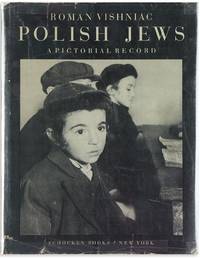
194743029New York Schocken 1947. First Edition. Original Cloth with Dust Jacket Small folio 17 33 pages. BOLDLY SIGNED BY VISHNIAC ON THE HALF TITLE. With an introductory essay by Abraham Joshua Heschel. <br> A depiction of vibrant Jewish life in the years immediately prior to the Holocaust in such Polish centers as Cracow Vilna and Warsaw; as well as Munkacevo Munkatsch Carpathian Ruthenia. The moving introductory essay by Abraham Joshua Heschel is in affect an elegy for vanquished East European Jewry. The 31 photos included in this volume were selected from the two thousand taken by Vishniac on the eve of the Holocaust in 1938; many are now iconic images of Eastern European Jewish life. Roman Vishniac was born in St. Petersburg in 1898 and died in New York in 1990. This exact copy sold at auction in 2020 for $1250.00 with commission. Very Good Condition in Very Good- Jacket with a touch of edgewear. Gorgeous signed copy B EE-3-20-XX-. New York, Schocken unknown
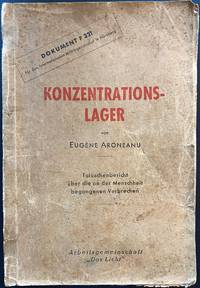
194543099No Place Baden-Baden: Arbeitsgemeinschaft "Das Licht 1945. Paperback. No Date 1945 1st edition original printed paper wrappers. Large 8vo 130 pages plus 56 unnumbered pages of photo plates. 27 cm. In German. Title translates as “Concentration Camps: Factual Report on the Crimes Committed Against Humanity. Document F 321 for the International Military Tribunal in Nuremberg.â€<br> Compiled by Eugène Aroneanu the creator of the concept of “Crimes Against Humanity under International Law†with the first prosecution under this concept taking place during the Nuremberg trials against defeated leaders of Nazi Germany as outlined in this work. <br> Includes 17-page list of camps and prisons on pages 113-130 listing the name location and type of each camp.<br> This report provides the evidentiary material given to each participant of the Nuremberg Military Tribunal to become acquainted with the evidence to be presented. The report recounts the German crimes against humanity detailing deportation detention concentration camps tortures medical experimentation execution gassing and incineration.<br> It also delineates the web of procedures and complex organizational structure of concentration and extermination camps set up by the Germans during the course of Nazi rule. With an appendix of dozens of unimaginably gruesome photographs.<br> <br> Table of contents translated:<br> - Foreword<br> - List of witnesses reports and documents <br> - The four main Nazi accusations - Deportation departure / arrival<br> - Internment admission / theft / clothing / housing / food / hygiene<br> - Administration and camp regulations distinction between prisoners<br> - Camp life discipline / customs / religion / everyday scenes / roll call / punishments and torture<br> - Work men's work / women's work<br> - Sanitary conditions illnesses / medical examinations / hospital accommodation / sick conditions / nursing and treatment of the sick / abortions / childbirths / sterilization of women / sterilization and castration of men / the German medical corps<br> - Medical experiments and vivisection<br> - Various executions<br> - Repercussions on the prisoners revolt escape suicide<br> - Extermination selection in the camp / selection upon arrival / gassing and cremation<br> - Liberation<br> - Number of deaths percentage / balance<br> - Before the war<br> - Appendix<br> - List of the camps commandos and prisons used for incarceration<br> - Illustrations<br> <br> Eugène Aroneanu “was a Romanian lawyer resistance fighter and author of several works on international law.<br> In the mid-1930s he emigrated to Paris. When World War II broke out in September 1939 he conducted radio broadcasts to Romania. When France was occupied in 1940 he joined the French Resistance operating underground under the name Aréne. In 1943 he managed to escape to Switzerland .<br> Aroneanu authored 58 publications. In 1945 he was tasked with compiling a documentation of Nazi wartime atrocities for the Nuremberg Trials. He also drafted a corresponding legal plea intending to expand the prosecution beyond the treatment of the extermination of the Jews as merely a crime against peace and war crimes as desired primarily by the British to include the new territory of crimes against humanity under international law†Wikipedia <br> SUBJECTS: World War 1939-1945 -- Concentration camps. Holocaust Jewish 1939-1945 -- Personal narratives. -- Atrocities. Guerre mondiale 1939-1945 -- Camps d'internement. Holocauste 1939-1945 -- Re´cits personnels. -- Atrocite´s. Internment camps. Crimes against humanity -- Germany. OCLC: 37149416.<br> Light wear to wrappers toning to paper Very Good Condition overall. BK5 Holo2-162-39XX-EGGACC-'l. No Place [Baden-Baden]: Arbeitsgemeinschaft "Das Licht paperback
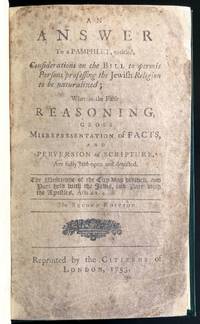
175343176London: “Reprinted by the Citizens of London†1753. Second edition. Modern attractive green cloth with title in gilt on spine. Small 8vo 8 5-67 pages. Roth Bibliotheca Anglo-Judaica p. 222 no. 102; Hyamson Bibliography of Pamphlets Relating to the Jew Bill of 1753 in: TJHSE Vol. VI 1908-1910 p. 181 no. 24.Halkett and Laing I 95.An example of the backlash to the short-lived Jew Bill of 1753. In the year 1609 the naturalization of any foreigner settled in England was made contingent on receiving the Sacrament. Although this act was deliberately directed against Catholics it incidentally would later affect Jews following the Re-Admission of 1653. This disability was lifted by the Whig Government of Henry Pelham in the Act of 1753 to permit persons professing the Jewish religion to be naturalized by Parliament. The bill was at best a limited advantage to the Jews since only the wealthy would have been able to set in motion the machinery necessary to obtain naturalization. Although the measure was accepted unanimously by the House of Lords it became a pawn in the upcoming general election campaign that resulted in its eventual repeal by the House of Commons. Taking full advantage of the prejudices and fears that the grant of naturalization to Jews had aroused the Tory opposition fueled the unpopularity of the Act with a pamphlet and broadsheet campaign that warned of an England overrun with Jews. The Whig government was forced by public opinion to give way and the pro-Jewish legislation was duly repealed in the same year that it was enacted. The present pamphlet is a response to the pro-Jewish pamphlet Considerations on the Bill to permit persons professing the Jewish religion to be naturalized by Parliament London 1753 by the pseudonymous “Philo-Patriae†Roth p. 221 no. 95. The present author makes the claim that the Jews employed an unnamed non-Jew to write that pamphlet. Summoning various passages from the New Testament our pamphleteer argues that the naturalization of the Jews would be in violation of “these Divine Laws†pp. 14-15.“In 1752-53 Romaine became nationally known for opposing a bill before Parliament relating to 'the naturalisation of those professing the Jewish religion'. He produced an opposing pamphlet and preached a sermon in which he took the ill-chosen text ‘These people being Jews do exceedingly trouble our city Acts 16:20'†John Crosby Evangelical Times. <br> This is his antisemitic pamphlet responding to Considerations on the Bill to permit persons professing the Jewish religion to be naturalized by Parliament 1753 attributed to “Philo-Patriae†Roth 221:95. Romaine issued it in the context of the fierce public backlash against the Whig-sponsored Jewish Naturalization Act of 1753 which temporarily lifted a 144-year-old requirement barring non-Christians from naturalization. <br> Though passed unanimously in the House of Lords the Act was quickly weaponized by Tory opposition ahead of the general election igniting a pamphlet and broadsheet campaign warning of a supposed Jewish inundation. Public pressure forced the Act’s repeal within the same year.The present pamphlet asserts that “Philo-Patriae†the author of the original pro-reform pamphlet was merely a gentile mouthpiece for Jewish interests. Citing the New Testament the anonymous author William Romaine argues that Jewish naturalization contravenes “Divine Laws†pp. 14–15. A stark example of 18th-century Anglican Antisemitism.<br> See: J. Picciotto Sketches of Anglo-Jewish History 1956 pp. 73-86; A. M. Hyamsonâ€The Jew Bill of 1753†in: TJHSE Vol. VI 1908-1910 pp. 156-188<br> A copy sold at auction for almost $1200 with commissions in 2023. <br> OCLC: 65524788<br> Title page and several leaves edgeworn no loss to text and reinforced with transparent Japanese tissue light shelf wear to boards good attractive condition. B BRIT-2-10-MV. London: “Reprinted by the Citizens of London†unknown
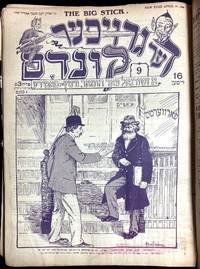
190942930New York: Ferlag "Kibets 1909. 1st Edition. Original publisher’s binding Folio newspaper. Complete first volume Starting with Vol I Nr 1 of “Der Kibitser†Dec. 15 1908 renamed and renumbered first as Vol I Nr 1 Jan 22 1909 of “Der Groyser Kibetser The big kibetzer†with the following issue of Feb 5 numbered as "3" to correctly follow from the first issue and then with Vol I Nr 6 March 19 1909 onward as “Der Groyser Kundes The Big Stick†or “The Big Prankster.†Incidentally the other set of this volume we examined also did not have a Nr 2 so we are confident this is complete as issued. <br> One centerfold cartoon by Zuni Maud see image features "Der Kaptialistisher Tayfel"--the Capitalist Devil–holding back a "mother" by the hair to stop her from interfering as "baby's milk-bottle" is drained off by the "milk-trust" cat. <br> The caption reads "The Capitalist Devil: - to the mother: Never mind madam all in English in Hebrew letters you go to the factory the milk-trust will take good care of your baby."<br> This cartoon-laden periodical was a New York City Yiddish language satirical bi- weekly which ran from 1908 until 1927.<br> The humor paper was issued biweekly this volume for its first 20 months and then weekly after that. OCLC also references another Vol I Nr 1 from April 15 1908 a special S´imhes` Toyreh Simchas Torah issue but this may have been a one-off. <br> Founded by the humorist Yosef Tunkel or Der Tunkeler his pen name meaning 'The Dark One' the paper was taken on by Jacob Marinoff when Tunkel left to work for an established paper in Warsaw. The paper consciously set itself up in opposition to the serious Yiddish-language press of the time such as the socialist Forverts.Naturally more traditional religious Judaism did not escape its satire: The later 1915 "Christmas" edition included a parodic conversation between Jesus and the prophet Elijah. <br> Despite its irreverent attitude to everything it also published poetry by Di Yunge "The Young Ones" poets such as Moyshe-Leyb Halpern and Zuni Maud. At its height it had a circulation of 35000 but folded in 1927 due to flagging sales. Der Groyer Kunds is highlighted in this recent talk by Yiddish comics scholar Eddie Portnoy on the reactions in the Yiddish press to restrictions on Jewish immigration to the US: https://www.yiddishbookcenter.org/collections/archival-recordings/recorded- programs/ybcr-nybc-ybcr-1048/door-slams-shut-reactions-yiddish-press-immigr ation .<br> SUBJECTS: Yiddish wit and humor -- Periodicals. OCLC: 28297536. Most holdings appear to be fragmentary and do not include these issues. Issue 18 with torn cover. In final issue the bottom margin suffers some loss to the final leaves none to the dramatic front cover though. Damaged boards are loose and most issues are coming loose though the quality paper used has remaind strong and bright much better than standard newsprint would have. Important graphic Yiddish humor from the great migration period. Dramatic and displayable! BK5 YID-43-9A-LEX. [New York]: Ferlag "Kibets unknown
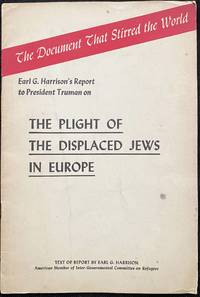
194542376New York Reprinted By United Jewish Appeal For Refugees Overseas Needs And Palestine On Behalf Of Joint Distribution Committee United Palestine Appeal National Refugee Service 1945. Paperback. 1st edition thus. Softcover 15 pages portrait 8vo 23 cm. "The Document that Stirred the World." Listed by the US Holocaust Museum in Washington as a "Primary Source and Documentation" title on Displaced Persons. Commissioned by President Harry S Truman the report documented and described the health and living conditions of the DPs their long- and short term needs how these needs were not being being met--and how Jewish survivors were being housed side by side with their former torturers. <br> CUNY Prof. David Nasaw wrote that "Such inhumane forced gatherings of victim and victimizer would not be remedied until the fall of 1945 and then only after a scathing report by Earl Harrison dean of the University of Pennsylvania Law Scholl and a special adviser to President Truman who charged that the Jews in the refugee camps were being treated 'as the Nazis treated them except that we do not exterminate them'" The Nation p. 6. <br> For a discussion of the significance of this report see UPenn's exhibit focussed on this very publication titled "The Document That Stirred the World" https://www.law.upenn.edu/live/news/5823-on-exhibit-in-the-biddle-law-libr ary-gateway-the. <br> The US Holocaust Museum keeps their copy in their Rare Book Room. <br> SUBJECT S : World War 1939-1945 -- Refugees. World War 1939-1945 -- Jews. Released by The White House on September 29 1945. OCLC: 306276. Light rubbing to wrappers about Very Good- Condition a nice copy. Important. Holo2-119-21C-MMABP-'lx B. New York, Reprinted By United Jewish Appeal For Refugees, Overseas Needs And Palestine On Behalf Of Joint Distribution Committee paperback
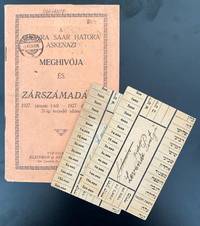
192843241Satu-Mare Szatmar/Satmar Romania: No Publisher The Chevra Sa’ar HaTorah Ashkenazi; printed by Tipográfia Kleinman si Heimlich 1928. 1st edition. Original orange printed paper wrappers 8vo 10 pages. Primarily in Hungarian with 2-page statement & closing speech also in Yiddish. <br> <br> WITH LAID IN: Two aliyah to the Torah Ark pledge cards one for Ephraim Lavii and one for Levende Pinty<br> <br> Title translates roughly as “The Saar Hatora Ashkenazi Society Financial Statement and Closing Speech. For The Period From January 1 1927 To December 31 1927.â€<br> <br> From the strife-ridden year of 1928 in Satu Mare see below a budget report including tables and lists for the Chevra Sa’ar HaTorah Ashkenazi with heartfelt call to action by the President Yosef Chaim Mayer asking the community to support its efforts to raise funds to build a new Beit HaMidrash. The plea is also undersigned by Eli Mandelbaum and by the two gabbais David Spiegel and Yona Weiss. <br> <br> A total of 11 names of leaders of the society are named. <br> <br> Society members are asked for their support in the upcoming election; presumably this is the controversial election of a new chief rabbi which famously split the community and resulted in the appointment of Hasidic Joel Teitelbaum and the creation of the Satmar Dynasty under him. <br> <br> In 1715 when Sathmar became a royal town the Jews were expelled but they began to resettle in the 1820s."In 1841 several Jews obtained the permission to settle permanently in Sathmar; the first Jewish community was formally established in 1849 and in 1857 a synagogue was built. After a great number of traditional Ashkenazic Jews had settled in the town the Jewish community split in 1898 when a supporter of the Hasidic movement was elected chief rabbi into an Orthodox and a Status Quo community led by a Zionist rabbi which erected a synagogue in 1904.<br> <br> In the 1920s there were several Zionist organizations in Satu Mare and the yeshiva one of the largest in the region was attended by 400 students. In 1930 the city had five large synagogues and about 20 shtiebels. In 1928 a conflict within the Orthodox community broke out over the election of a new chief rabbi lasting six years and ending in 1934 with the appointment of the Hasidic rabbi Joel Teitelbaum a traditionalist and anti-Zionist who later re-founded the Satmar Hasidic dynasty in Williamsburg New York. Another Hasidic rabbi Aharon Roth the founder of the Shomrei Emunim and Toldot Aharon communities in Jerusalem was also active in Satu Mare†Wikipedia.<br> <br> We could not locate another copy of this publication anywhere not in OCLC not in KVK not in the Hungarian National Library not in the Romanian National Library and not with a google search. Perhaps a unique surviving copy.<br> <br> Adressee’s name and “Satu Mare†penned on rear cover for mailing stamp clipped out of corner of blank rear wrapper no text loss. Postal cancellation stamp “Satu Mare 5. Feb 1928†on front cover as well as some other ink notations. Paper remains bright and strong about Very Good Condition. Exceedingly Rare with important connection to Satmar Hasidism. B Holo2-163-11-'LG. Satu-Mare [Szatmar/Satmar, Romania]: No Publisher [The Chevra Sa’ar HaTorah Ashkenazi; printed by Tipográfia Kleinman si Heim unknown
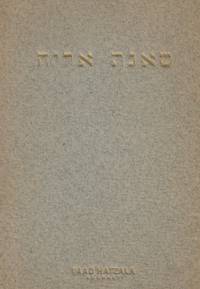
194734140Munich; Ha-Va'ad Le-Hotsa'ot Sefarim Etsel Va'ad Ha-Hatsalah 1947. Hardcover. 1st edition thus. Original Boards. 8vo. 90 Leaves. 25 cm. In Hebrew. The first book printed for Jewish survivors by the Va'ad Hatzalah in Germany after the War.<br> The preface notes: "The lack of books of the Nation of the Book in Germany encouraged us to print works necessary for yeshiva students.this is the first book that we successfully.published this valuable Sha'agas Aryeh."<br> Sha'agat Aryeh published for survivors and refugees in Europe; with prefatory printed dedication from Rabbi Nathan Baruch of Vaad Hatzala. <br> Following the end of the Second World War the Vaad's activities centered in Germany and France consisted of distributing funds and shipments of food and religious books to Displaced Persons camps in Germany and newly established yeshivot. It provided spiritual rehabilitation to remnants of Jewish communities destroyed during the Holocaust. <br> Aryeh Leib ben Asher Gunzberg’s 1695-1785 responsa titled Sha’agat Aryeh The Roar of the Lion; first published 1755 “brought him lasting recognition and has been republished at least 40 times since; it is still considered to be an essential text of rabbinic learning. Sha’agat Aryeh rejected the use of pilpul he had once indulged in and insisted on a direct approach of the Talmudic text with no special attention given to the contributions of the sixteenth–eighteenth-century authors†YIVO Encyclopedia. <br> Subjects: Responsa - 1600-1800. Responsa. 1600 – 1800. Vaad Hatzala. OCLC: 19160226. <br> Spine rebacked as often found. Edgewear paper toning but solid. Good condition. B HOLO2-117-54. Munich; Ha-Va'ad Le-Hotsa'ot Sefarim Etsel Va'ad Ha-Hatsalah hardcover
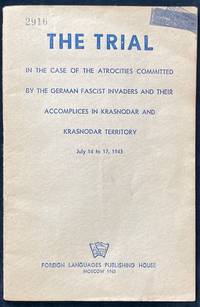
194342274Moscow Foreign Languages Pub. House 1943. Paperback. 1st English Language Edition. Original Wrappers. 8vo. 40 pages; 19 cm. Koppel Pinson's copy with gift bookplate. Contemporary account published in 1943 of the very first war crimes trial against Nazi defendants held following the Russians’ recapturing of Krasnodar From the Germans who had occupied it. SS-sonderkommando units massacred thousands of Russian citizens Jews and communists. The trials were held immediately in the summer of 1943 while the war against Hitler was ongoing. Includes transcript from the trial and gruesome photographs of the victims of the atrocities. SUBJECT S : War crimes -- Soviet Union. OCLC: 11136869. Small donation bookplate number on margin of final leaf otherwise Very Good condition excellent copy. Very important. B holo2-135-10-LWWEV-'mmacc. Moscow, Foreign Languages Pub. House paperback
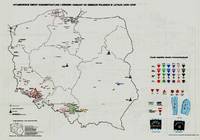
197941929Warszawa Warsaw: Pan´stw. Wydawn. Naukowe 1979. 1st Edition. Original black printed portfolio 8vo. Portfolio of seven large folding maps on on 4 sheets of heavy paper 3 are double sided 1 is singled sided. Primarily black and white with some color. Text in Polish. <br> Title translates to “Nazi camps in Poland 1939 - 1945. An Encyclopaedic Reference Book: Maps." Collection of 7 maps each 84 cm x 60 cm 33 x 24 inches produced by Jan Laskowski at the Main Commission for the Investigation of Nazi Crimes in Poland. The maps comprise Volume II of the work; Volume I is a heavily illustrated 676-page book of the same title which we offer separately. <br> The Seven maps all present are: <br> - Map 1 Single Sided: Hitlerowskie obozy na ziemiach polskich w latach 1939 - 1945. “Nazi camps in Poland in the years 1939 - 1945â€. Showing: concentration and extermination camps sub-camps of concentration camps extermination centers POW camps more important sub-camps working divisions commandos and temporary POW camps penal labor camps major labor camps prisons transit camps & ghettos. <br> - Map 2A: Getta na ziemiach polskich w okresie okupacji hitlerowskiej w latach 1939 - 1945 “Ghettos in Poland during the Nazi occupation in 1939 - 1945â€. <br> - Map 2B: Hitlerowskie obozy przejsciowe na ziemiach polskich w latach 1939 - 1945 “Nazi transit camps in Poland in 1939-1945â€. <br> - Map 3A: Hitlerowskie wiezienia i areszty na ziemiach polskich w latach 1939 - 1945 “Nazi prisons and arrests in Poland in 1939 - 1945â€. <br> - Map 3B: Hitlerowskie obozy pracy na ziemiach polskich w latach 1939 - 1945 “Nazi labor camps in Poland in the years 1939 - 1945â€. <br> - Map 4A: Hitlerowskie obozy jenieckie na ziemiach polskich w latach 1939 - 1945 “Nazi POW camps in Poland in 1939 - 1945â€. <br> - Map 4B: Hitlerowskie obozy koncentracyjne i osrodki zaglady na ziemiach polskich w latach 1939 - 1945 “Nazi concentration camps and extermination centers in Poland in 1939 - 1945â€. <br> Maps 2A & 2B have been described as a “Terrifying pair of maps showing the locations of German POW and internment camps in Poland during World War II highlighting the widespread locations of these establishments. In some parts of the map the information becomes so dense that three inset maps are shown. This map was designed by Jan Laskowski and printed in 1979 as part of a work on the Nazi extermination machine produced by PWN Warsaw a state-owned research-focused publishing house in Poland.<br> The map on the front is particularly interesting for its depiction of symbols used to classify internees in German camps. The uppermost of these depictions shows the combinations that can be made for different types of prisoners of different levels of importance. The armbands that would have been worn by these prisoners is shown as well as the prison uniforms. Other details are also shown. <br> The map lists hundreds of sites run by Nazi operators throughout the country. These include concentration camps death camps transitional camps and ghettos. The map is divided according to Poland's voivodeships with a key in the lower left. Names of cities too long to spell are also provided in the lower left. <br> This map was produced during a point in Poland's history during which it was actively revisiting the period during the Second World War. Leading social scientists devoted their time to trying to gather all the living as well as the recorded history of the events of the Holocaust and related atrocities before this information vanished. Leading these efforts particularly during the 1960s and 1970s was the Glówna Komisja Scigania Zbrodni przeciwko Narodowi Polskiemu known as the Chief Commission for the Prosecution of Crimes against the Polish Nation. They were active in publishing maps both for domestic educational purposes and for international remembrance and diplomatic efforts regarding the Holocaust. Jan Laskowski was a leading cartographer who produced a number of maps in this field. <br> These maps were produced as part of a series of maps that purported to combine to form an atlas of all of Hitler's crimes in Poland. Many of the large wall maps produced during this period could only show a fraction of the crimes or only the atrocities committed in one region. Thus a series of maps was needed to show all the points necessary which this present work contributes to. <br> Polish Reinterpretations of the Holocaust: Studying the effects of German occupation in Poland is a delicate subject. While it is certain that Poland suffered at least as badly as any other European nation during the Second World War reinterpretations of the Holocaust in the country have also been used to satisfy nationalistic tendencies. It has become evident to Western observers in the last several years that there is a strong nationalist movement in Poland that seeks to place blame for the Holocaust solely on the shoulders of non-Polish actors a movement originally fostered under Soviet rule. This movement has gone so far as to limit freedom of speech criminalizing with a three-year sentence the suggestion that Poland or its citizens in any form participated in the murders committed by Nazis. As such the term ‘Polish concentration camps’ has been deemed unacceptable with the government-approved term being ‘concentration camps on Polish territory.’ <br> All lines of evidence show that this map 2A & 2B was produced using the most accurate and impartial historical sources. The language on the map is simple naming only ‘Hitler's Atrocities’ and there is no evidence of a clear anti-German bias. However it is impossible to separate this map one of the most important productions of the remembrance movement during this period from the social situation in which it was produced. Maps like these can easily be converted into propaganda instruments and today's Polish leaders most of whom grew up during Soviet occupation will have formed their understanding of the Holocaust through maps like these. <br> Soviet Censorship: While the content of the map appears to have been produced free from bias the map still had to go through Soviet censorship. Mentioning prisoner of war camps in which primarily Soviet troops were interned would have been a prerequisite condition upon which the publication of the map rested. Further the lack of mention of any Soviet killings or camps requires no explanation….The map unlike many later maps makes no differentiation between the populations who suffered at the various camps. This represents the Soviet agenda that all nations suffered fought and won equally which sought to limit divisions in this post-identity state†Ruderman 2022. <br> SUBJECTS: World War 1939-1945 -- Prisoners and prisons German. -- Concentration camps -- Poland. Guerre mondiale 1939-1945 -- Prisonniers et prisons des Allemands. -- Camps d'internement -- Pologne. Obozy koncentracyjne -- Polska -- 1900-1945. OCLC: 830885973. <br> Light shelf wear to portfolio as expected. All maps in pristine condition with normal folds as issued. Very Good Condition. Complete and dramatic BR5 holo2-147-19-'cc. Warszawa (Warsaw): Pan´stw. Wydawn. Naukowe unknown
185940801San Francisco: Towne & Bacon 1859. 1st edition. Original gilt-stamped publisher’s cloth 12mo 187 pages. Greenwood California Imprints 1089; Singerman 1577. <br> Rare early San Francisco imprint for use in Synagogues and Jewish schools appearing just following the California Gold Rush. <br> The author was the "Rabbi Preacher of Congregation Sherith Israel San Francisco; Author of Class Book of Discourses on the principles of the belief of Israel &c. &c. " The work concludes with a three-page "Prayer in Behalf of the United States of America" which the author had initially delivered in Cincinnati. Scarce. <br> Congregation Sherith Israel was the first Jewish Congregation in San Francisco and the author Henry A. Henry was Congregation Sherith Israel's first rabbi.<br> A copy sold at auction in 2019 for $750 with buyer's commission. <br> OCLC: 1031393843. <br> Wear to base of spine otherwise Very Good Condition. B/1 KH-9-7-X. San Francisco: Towne & Bacon unknown
19832111902156002180Ethnological Society of Japan 1983. Soft Cover. Fine. The book is in fine condition. Ethnological Society of Japan paperback
19792111902156002142Ethnological Society of Japan 1979. Soft Cover. Fine. The book is in fine condition. Ethnological Society of Japan paperback
19972082702114607533Regular 26000 Yen Yoshikawa Kobunkan 1997. Soft Cover. Fine. The book is in fine condition. Regular 26,000 Yen Yoshikawa Kobunkan paperback
19982082702114607534Fixed 17000 Yen Yoshikawa Kobunkan 1998. Soft Cover. Fine. Number of books: 1 Fixed 17,000 Yen Yoshikawa Kobunkan paperback
19972082702114607530Fixed 26000 Yen Yoshikawa Kobunkan 1997. Soft Cover. Fine. The book is in fine condition. Fixed 26,000 Yen Yoshikawa Kobunkan paperback
19822111902156002145Ethnological Society of Japan 1982. Soft Cover. Fine. The book is in fine condition. Ethnological Society of Japan paperback
19892111902156002027Ethnological Society of Japan 1989. Soft Cover. Fine. The book is in fine condition. Ethnological Society of Japan paperback
19692111902156002171Ethnological Society of Japan 1969. Soft Cover. Fine. The book is in fine condition. Ethnological Society of Japan paperback
19872082702114603297Fixed three thousand yen 1987. Soft Cover. Fine. Number of books: 1 Fixed three thousand yen paperback
19802111902156002174Ethnological Society of Japan 1980. Soft Cover. Fine. The book is in fine condition. Ethnological Society of Japan paperback
2090202120400550Not Available N.A. Soft Cover. Fine. Number of books: 1 Not Available paperback
19872090502113716658Not Available 1987. Soft Cover. Fine. The book is in fine condition. Not Available paperback
19892090502113716524Not Available 1989. Soft Cover. Fine. The book is in fine condition. Not Available paperback