122 150 résultats
19952090502113715537Not Available 1995. Soft Cover. Fine. The book is in fine condition. Not Available paperback
19622092902141504422Tateyama Development Railway 1962. Soft Cover. Fine. Size: A5 size Tateyama Development Railway paperback
19572090202118202635Hiroshima Association of Towns and Villages 1957. Soft Cover. Fine. The book is in fine condition. Hiroshima Association of Towns and Villages paperback
19692090202118204803Executive Committee for the 10th Anniversary of the Enforcement of the Cooks Act 1969. Soft Cover. Fine. The book is in fine condition. Executive Committee for the 10th Anniversary of the Enforcement of the Cooks Act paperback
19932110502150407061Not Available 1993. Soft Cover. Fine. Volume: 1 Not Available paperback
19712082702114606618Tenrikyo Doyusha 1971. Soft Cover. Fine. Number of books: 1 Tenrikyo Doyusha paperback
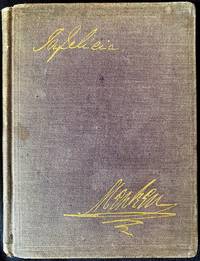
186843442Philadelphia; New York; Boston; J.B Lippincott 1868. Hardcover. 1st edition first printing of Author's only book. Original Publisher's Cloth Brown cloth cover stamped in gold 16mo 7-124 pages; 15 cm. Singerman 2085 for the 126 page edition. <br> Singerman notes that he the "compiler saw the rarer 124 page edition without the publisher's statement about Dickens. " <br> This is that true rarer first printing dedicated to Charles Dickens but without reproducing his warm letter thanking her as appeared in later printings. <br> The success of this book meant that later editions appeared the same year in London as well as in the US published by Lippincott but with more pages 141 & 126 respectively and with the Dickens letter reproduced. <br> Includes some poems with Jewish themes such as "Judith 'Oh forget not that I am Judith! /And I know where sleeps Holofernes' " "Hear O Israel 'The God of Jacob is our Shield' " etc. <br> <br> Menken 1835-1868 was "Internationally famous for her starring role in the equestrian melodrama Mazeppa in which she was stripped on stage to a flesh-colored body stocking lashed to the back of the 'wild horse of Tartary' and sent flying on a narrow ramp above the theater. Adah Isaacs Menken consistently defied social mores. She cropped her black hair and smoked cigarettes and publicly disparaged conventional married life. Menken represented an early example of the cult of personality blurring her private life with her public persona. <br> She married four times in the course of seven years. Her second marriage in 1859 was to the heavyweight boxing champion of the world John C. Heenan. <br> One of the most glamorous celebrities of the 1860s Menken also cultivated a literary following. She wrote poetry and developed relationships with the likes of Walt Whitman Charles Dickens Dante Gabriel Rossetti Alexandre Dumas and Algernon Swinburne. George Sand was a close friend to the actor and was godmother to Menken's second child. <br> A major bone of contention to this day is the authenticity of her Jewishness. Though scholars have some evidence that Menken was raised a Catholic and converted to Judaism only after marrying her first husband Menken herself once publicly rebuked a journalist who labeled her a convert by announcing that she was 'born in that faith Judaism and have adhered to it through all my erratic career. Through that pure and simple religion I have found greatest comfort and blessing.'<br> Whatever her origins it is clear that Menken was fervently Jewish in her adult life. <br> After moving to Cincinnati with her first and only Jewish husband Alexander Isaacs Menken Adah learned Hebrew fluently studied classical Jewish texts and contributed many poems and essays to The Israelite a weekly founded by Rabbi Isaac M. Wise. Her poems indicate a passionate temperament deeply committed to a kind of proto-Zionism and even messianism. Many are collected in the posthumously published volume Infelicia this volume. <br> Menken viewed herself as a modern Deborah calling on Jews to rise up against persecution in Turkey and protesting the kidnapping of a six-year-old Jewish boy in Bologna by representatives of the Catholic Church. She was one of the few Jews in America to protest when Lionel Nathan was denied the seat in the English Parliament to which he had been elected. And at the height of her acting career she refused to perform on Jewish High Holidays. On her deathbed at age thirty-three suffering from what may have been peritonitis or tuberculosis or both and treated by the personal doctor of Napoleon III Menken was visited by a rabbi. <br> Adah Isaacs Menken died on August 10 1868 in Paris. She is buried in the Jewish section of Montparnasse Cemetery" Ackerman 2014. <br> <br> The book is cited in Podeschi J. B. Dickens & Dickensiana B2952; Wolff R. L. 19th cent. Fiction 4738. <br> <br> For more on this important work see "Infelicia and Other Writings: Adah Isaacs Menken" review by Deka Mayuri. In Legacy Amherst Mass. 2003 Vol.20 1 p.204-205; as well as "ADAH ISAACS MENKEN'S 'INFELICIA.'" In Notes and queries 1922-06 Vol.s12-X 217. <br> <br> OCLC: 2581404. Lacks blank endpapers Light wear to cloth about Very Good- Condition. B AMR-45-45-DLB. Philadelphia; New York; Boston; J.B Lippincott hardcover
20072090202118201341Japan Society of Naval Architects and Ocean Engineers 2007. Soft Cover. Fine. The book is in fine condition. Japan Society of Naval Architects and Ocean Engineers paperback
19952090202118203897Tatara Study Group 1995. Soft Cover. Fine. The book is in fine condition. Tatara Study Group paperback
0428178650.Gpaperback. Good. Access codes and supplements are not guaranteed with used items. May be an ex-library book. paperback
19672092902140901713Iwanamishoten 1967. Soft Cover. Fine. Number of books: 3 Iwanamishoten paperback
19612082702114607280paper binding 1961. Soft Cover. Fine. Number of books: 1 paper binding paperback
1390409775.Gpaperback. Good. Access codes and supplements are not guaranteed with used items. May be an ex-library book. paperback
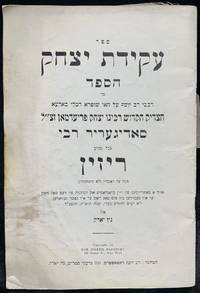
192543154Nyu York New York: Yosef Rapaport 1925. First edition. Original paper wrappers. 8vo 64 pages. Includes portrait 22 cm. In Yiddish. Title translates as “The Binding of Isaac: Eulogies in Honor of Yitzhak Friedman.â€<br> Book of eulogies published by Joseph Rapaport for his friend Rabbi Yitzhak Friedman. Includes portrait of Rabbi Yitzhak Friedman. <br> “Rabbi Isaac Friedman famous Rabbi of SadiGora Chassidic leader of many thousands of followers died yesterday morning at the age of 89. The Rabbi of Sadigora who was a descendant of one of the Rabbinical families which exercised great influence on the life of the Jewish masses in Galicia and Russia arrived in the United States for a short visit on June 12th. <br> Fifteen thousand Jews attended the funeral of Rabbi Isaac Friedman on Monday afternoon. Rabbi Friedman the Rabbi of Sadigora who came to the United States at the invitation of his many Chassidic followers died just before his planned return to Europe….<br> The throng grew so dense in front of the house where the Rabbi died that traffic had to be diverted and even street cars were unable to get through for half an hour before the coffin was borne to the street on the shoulders of eight Rabbis….<br> Several hours before the burial a Din Torah arbitration court proceedings were sicheld…<br> Two congregations the Roumanian Synagogue of Brooklyn and the Tifereth Israel Congregation demanded the Rabbi be buried on their plots. The Roumanian synagogue offered $5000 in cash for the family of the dead Rabbi and a reservation of eighty plots around the grave in order that it might be assured that no one unworthy should be buried near the Rabbi. The congregation Tifereth Israel undertook to insure support for the family and to make a reservation of thirty-two graves. The demand of the latter congregation was supported by its claim that they were the actual Sadigora Chassidim who invited the Rabbi to America. The Rabbinical court decided that Rabbi Friedman should be buried on the grounds of the Tifereth Israel Congregation….<br> Before the body was interred the Rabbis declared that this was being done on the condition that should his family so desire the body will be exhumed and transferred to Europe.†Jewish Telegraphic Agency.<br> SUBJECTS: Jewish funeral sermons. Eulogies. Death and burial of a person. OCLC: 43741121. OCLC locates only 5 copies worldwide NYPL YU JTSA YIVO AJHS none outside New York City. Spine repaired otherwise excellent Very Good condition. YID-48-30-L. Nyu York [New York]: Yosef Rapaport unknown
19622092902141301956Fushimi Inori Taisha Shrine 1962. Soft Cover. Fine. Number of books: 1 Fushimi Inori Taisha Shrine paperback
194829513New York; YKUF 1948. Paperback. Original Wrappers. 12mo. 79 pages. 17 cm. Undated edition. In Yiddish. <br> Includes introduction by Miriam Novitch as well as "Vi Yitshak Katsnelson hat geshribn zayne klog-lider" also by Miriam Novitsh on pages 15-16.<br> “Song of the Murdered Jewish People" by Itzhak Katzenelson 1885–1944 a Hebrew and Yiddish poet. â€Katzenelson’s world fell apart when in August 1942 his wife Hanna and two younger sons Ben-Tsiyon and Binyamin were deported to Treblinka. From then on his literary creativity was piercingly shaped by lamentations over the loss of his family. Nonetheless with his oldest son Tsevi he found the strength to join the Jewish Fighting Organization and took part in the first uprising of January 1943. <br> After the ghetto was destroyed in April and May 1943 he escaped to the Aryan section of Warsaw and obtained a Honduran identity document. Nevertheless he was sent to a German detention camp for foreign subjects in Vittel France. He was imprisoned there until April 1944 and devoted most of his time to writing. <br> Two important works were produced during that period: Pinkas Vitel The Vittel Diary a Hebrew composition that uses the language of an incensed diarist and reconstructs the days of terror in Warsaw during the mass deportations; and Dos lid fun oysgehargetn yidishn folk The Poem about the Murdered Jewish People a pathos-filled Yiddish poem that laments the destruction of the Jewish people and of the poet himself who has been become bitterly angry with humankind and God. These two works are among the boldest and most lofty literary expressions to emerge from the Holocaust.…<br> All of Katzenelson’s works from his Vittel period were either buried in hiding places or were given to people he trusted; consequently they were saved and published shortly after the end of the war. <br> In the middle of April 1944 Katzenelson and his son Tsevi were sent to the Drancy transit camp and from there one month later to Auschwitz where they were murdered. In 1950 the Ghetto Fighters kibbutz built a museum and an institute for research about the Holocaust that bear Yitshak Katzenelson’s name†YIVO Encyclopedia. <br> Subjects: Holocaust Jewish 1939-1945 -- Poetry. OCLC: 12260367. <br> Half Dollar size chip to cover no text loss institutional stamp on title page taped spine otherwise Good Condition. BK5 B HOLO2-97-33-XX-ELABCC. New York; YKUF paperback
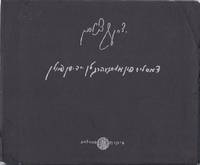
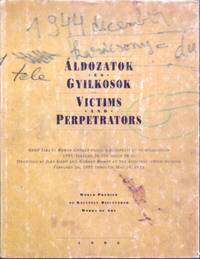
199539266Budapest: Cultural Exchange Foundation 1995. Paperback. 1st edition. Original stiff paper wrappers with illustrated dust jacket 4to 122 pages. Includes llustrations and portraits ; 28 cm. Filled with drawings. Collection of 36 sketches drawn by Ilka Gedo in the Budapest Ghetto during Nazi occupation and sketches by Gyorgy Roman of defendants at war crimes trials held in Hungary after the war. <br> OCLC: 34942605. <br> Text is by several authors and is in English and Hungarian. Light edgewear and library marks to dust jacket otherwise Very Good condition with card pocket at rear no other markings. BK5 HOLO2-136-37--'e. [Budapest]: Cultural Exchange Foundation paperback
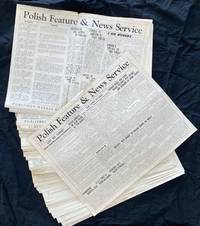
194243230No Place New York: Polish Information Center 1942. ; 1st edition. Large double-sided single sheets broadsides 17x 12 inches. <br> Weekly English-language updates from the early years of the exiled Polish government information and propaganda agency from prior to its massive expansion in 1943. Reports cover German atrocities and Polish resistance to the Nazis including news about Polish contributions to the international Allied effort. There are occasional mentions of conditions in the Warsaw ghetto.<br> <br> Checking institutional holdings we could locate no copy later than Nr. 83 from 1943; we presume that to be the final issue in the series. <br> <br> This format would have been convenient for posting on walls etc. <br> <br> “The Polish Information Center was founded in 1940 and remained active until 1945…. its first director Stefan Gotfryd Ropp…. remained in his post for the first three years of the center's existence and was a major force in the creation of a Polish lobby influential in U.S. military financial and political circles particularly to counter American isolationism before the United States entered the war.<br> <br> Originally called Centrum Informacji Prasowej the center at first was funded with the proceeds from the sale of objects that couldn't be returned to war torn Poland. In its first year it operated unofficially but with the declaration of war by the United States it had to fulfill certain requirements from the Justice Department. Later the center became a branch of the Ministry of Information and Documentation. The center's main offices were located on Fifth Avenue in the heart of New York City but it eventually had representatives in Chicago Detroit Los Angeles and Pittsburgh.<br> br>The center had a well-educated and skilled staff involved in the collecting and dissemination of information on Poland and on matters relevant to Polish interests in the United States. Ropp himself wrote regular reports for the Polish Ministry of Foreign Affairs which are excellent examples of his visionary ideas….<br> <br> In 1943 the center's structure underwent significant changes and its budget was increased. The broadening of operations found immediate reflection in the way materials were collected: for instance specialized firms were hired to deliver clippings from hundreds of American newspapers….<br> <br> Also in 1943 Ropp was moved to London to head the Biuro Prac Kongresowych responsible for planning the peace conference and a new post-war Poland. Still the office grew steadily gradually attracting some of the best minds working for the Polish cause on American soil: from 35 experts in 1943 it employed 51 in 1944.<br> <br> In 1944 at the peak of its activities the center had at its disposal a budget of a million dollars….<br> <br> The year 1945 brought big budget cuts and half of the employees were laid off. The center shared the fate of many other Polish diplomatic posts as the loss of diplomatic recognition of the London government by the Western Allies resulted in the termination of its operations. By decree of Poland's President Wladyslaw Raczkiewicz on July 3 1945 the center was officially shut down†Hoover Institution. <br> <br> OCLC: 37937357. All holdings which could be checked are incomplete; some holdings are for as few as 3 or 4 issues total.<br> <br> All issues have a vertical fold crease; many have light foxing stains or crinkling. Paper remains bright and strong and was clearly stored in dry clean conditions for the past 80 years. Very Good Condition overall. A fascinating nearly consecutive weekly look at official Polish reporting on Nazi atrocities and war crimes in real time over a one-year key period of the Holocaust. B Holo2-163-9-LMM%-’cce. No Place [New York]: Polish Information Center unknown
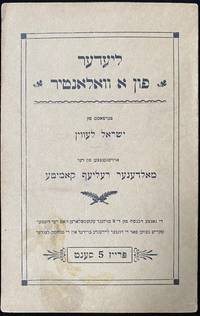
191942896No Place Malden MA: Maldener Relief Komite 1919. No Date 1919. 1st Edition. Original printed paper wrappers 8vo 14 pages. 21 cm. In Yiddish. Title translates as “Verses of a Volunteer.†No city or date listed but clearly published during or immediately after WW I with the Leksikon suggesting Malden MA 1919 OCLC suggests Boston the location of the printer and a clearly incorrect date of 1900 perhaps intending "1900s". Malden the poet’s home town just outside of Boston and clearly the home of the "Maldener Relief Komite" makes much more sense making this is the first documented yiddish publication in Malden MA north of Boston.<br> "The poet dedicated the entire income of 5 thousand copies to the brothers suffering from hunger in the countries at war†Translated from the front cover. Includes 4 poems: Der Volontir; Ikh Zukh a Vort; Nach der Milhome; Hazkharot Neshimot. The final poem is “in memory of the fallen Jewish heroes in all the war-torn lands.â€<br> Israel Levine 1878-1970 “was born in a village in Minsk district Byelorussia. In 1895 he arrived in the United States lived in various cities worked as a teacher in Talmud Torahs and was secretary for Mizrachi in the town in which he lived Malden Massachusetts. <br> He debuted in print in 1904 in Fraye arbeter-shtime Free voice of labor in New York with a poem entitled ‘Funken shpritsn’ Sparks fly and from that point he went on to contribute poetry and translations from Tanakh and from ethical books to: Yidishes tageblat Jewish daily newspaper Forverts Forward Dos yudishe folk The Jewish people Di varheyt The truth and Idisher kemfer Jewish fighter—in New York; Idishe shtime Jewish voice in Boston; and more. He published in book form: Lider fun a volontir Poems of a volunteer Malden 1919 16 pp.; Sefer naim zemirot tehilim Naim Zemirot on Psalms translated into a poetic form with short prefaces by Dr. Meir Vaksman and Aharon Kaminska Jerusalem 1934 19 pp†Khayim Leyb Fuks in Leksikon Fun Der Nayer Yidisher Literatur<br> OCLC: 19307496. OCLC lists 4 copies worldwide YIVO Brandeis Harvard NYBC none outside the northeast. A few stains & discoloring Very Good Condition an excellent copy. Scarce. B YID-45-9XX-LE-’. No Place [Malden, MA]: Maldener Relief Komite unknown
20122080502106503790Kumamoto Modern History Society 2012. Soft Cover. Fine. Volume: 1 Kumamoto Modern History Society paperback
19172110502150412338Not Available 1917. Soft Cover. Fine. Volume: 1 Not Available paperback
18922604120009Woman's temperance Pub. Association Chicago 1892. First Edition. Hardcover. Acceptable. Civil War Regimental 13th Illinois Vols Bound in publisher's cloth. Hardcover. 672 pages : illustrations maps portraits ; 24 cm. Lacks title page. Sold with all faults. Refs: Dornbusch I IL-109. Nevins I p.110. This unit fought in the trans-Mississippi theater in the Civil War. Woman's temperance Pub. Association, Chicago hardcover
18926205Chicago: Women's Temperance Publishing Association 1892. First edition. Hardcover. Fair. 8vo 672 pages embossed cloth hinges cracked edgeworn <br/><br/>The "Old Thirteenth" was raised at Dixon Illinois in May 1861. It took 25 years after the War before the comrades organized to collect letters and diaries and oral accounts for this work. Plates portraits maps. Women's Temperance Publishing Association hardcover
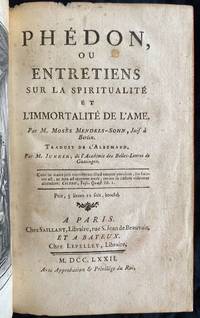
177243257Paris et Bayeux chez Saillant et Lepelley 1772. 1st French-language edition. Period full leather binding with gilt spine and red edges with original marbled endpapers 8vo. Includes frontis copperplate etching. XXIV 342 1 pages. “Traduit de l’Allemand par M. Junker de l’Académie des Belles-Lettres de Goettingen.â€<br> This first French edition appeared 5 years after the first German edition of 1767<br> <br> "Phaedon or On the Immortality of the Soul" Phaedon Oder Ueber Die Unsterblichkeit Der Seele In Drey Gespraechen is one of Mendelssohn's 1729-1786 most famous publications establishing his reputation as the "German Socrates of Berlin." It is a philosophical interpretation of the Platonic dialogue "Phaedo" and is preceded by a biography on "The Life and Character of Socrates." The important German-Jewish philosopher was one of the most important representatives of the Enlightenment in Prussia and throughout Germany.<br> <br> Mendelssohn's Phaedon is a “classic of rational psychology on the immortality of the human soul a defining work by this leading enlightenment philosopher who launched the Jewish thinking of the modern age" with his tribute to Socrates modeled on Plato's dialogue the Phaedo.<br> Mendelssohn used Plato's famous dialogue the Phaedo as a model to publish Phädon oder über die Unsterblichkeit der Seele. With this seminal work "he reached the heights of fame" Wigoder Dictionary of Jewish Biography 342. <br> The work unites Mendelssohn's "paean to Socrates with an elaboration of the dreadful personal moral and political implications if a person's life is her 'highest good'… <br> This 'classic of rational psychology' as Dilthey put it also contains an argument for the simplicity and immortality of the human soul explicitly singled out for criticism by Kant in the 2nd edition of the Critique of Pure Reason. Mendelssohn supports the notion that the soul is simple and thus indestructible by noting that certain features of the soul namely the unifying character of consciousness and the identity of self-consciousness cannot be derived from anything composite whether those composite parts be capable or not of thinking… <br> As for the human soul's fate after death Mendelssohn appeals to divine goodness and providence which perhaps explains why following the publication of the Phaedo he finds himself needing to revisit the proofs for God's existence" Stanford Encyclopedia.<br> According to Mendelssohn’s modern biographer Alexander Altmann “The work that would establish Mendelssohn's world-wide renown and win him the title 'the German Socrates' was the dialogue Phaedon which was published in 1767. In this work he presented Socratic wisdom from the mouth of the ancient philosopher but in the language of the Enlightenment that is in his own words as a modern philosopher. <br> The work drew both praise and criticism but was on the whole popular in intellectual circles. It demonstrates Mendelssohn's unique ability as a Jew to be comfortable in the realm of both classical and enlightened philosophy not to mention languages. David Sorkin remarks ‘What is ironic is that Mendelssohn was known and revered as much for the quality of his prose as for his thought.†<br> Mendelssohn was himself often referred to as the German Plato or the German Socrates. <br> And “As a Jew living in Germany Moses Mendelssohn 1729-1786 stands at a pivotal point in the history of Jewish emancipation in Europe. There were Jews before him who had access to the corridors of power in Germany and elsewhere in Europe but Mendelssohn represents the first to be socially accepted to a significant extent within enlightened German culture without converting. <br> He not only conformed to the culture of the German Enlightenment in many ways but also helped shape the culture through his philosophical contributions. At the same time Mendelssohn refused to turn away from traditional Judaism. He attempted to become a full- fledged member of society during the emergence of modern Europe while remaining a proponent of Judaism as a revealed religion. Moreover he sought to use his place of influence to encourage Jewish acculturation in Germany and to speak on behalf of the emancipation of Jewish people…. <br> The traditional mentality of the European Jews prior to Mendelssohn's time included a kind of resignation to the incompatibility of Jewish learning and 'worldly' philosophy. This resignation contributed to Jewish cultural isolation. Alfred Jospe describes the conundrum in which a Jew found himself if he wished to enter the culture of the non-Jewish world: The Jew could gain access to the culture of the world only by rebelling against the traditional repudiation of all mundane wisdom. <br> It is just at this point that Mendelssohn broke the mold. He not only acquired modern German culture but did so by means of his understanding of and contributions to the philosophy that shaped that culture. In his monumental biographical study Alexander Altmann focuses as much on Mendelssohn's philosophy and his answers to contemporary critics as he does on the details of the events and influences of his life. Altmann states with appropriate admiration that “Considering the state of degradation in which the Jewish population lived in eighteenth-century Germany. Mendelssohn's rise to fame and his acceptance into the republic of letters was an amazing feat of personal achievement.†<br> The amazing feature of Mendelssohn's achievement is that he accomplished it as an avowedly traditional Jew. Mendelssohn has been rightly described as a rabbinic scholar but he made his reputation in non-Jewish intellectual circles as a literary critic and philosopher….with the help of both Gotthold Lessing and the Berlin publisher Friedrich Nicolai he was accepted into the inner circle of the Berlin Aufklärung. <br> His essays reviews and translations earned him tremendous status among German intellectuals. <br> The favorable comparison made by Lessing between the quintessential German poet Goethe and Mendelssohn is a mark of the esteem in which he was held. ‘Lessing told Friedrich Heinrich Jacobi that once Goethe regained his reason he would be hardly more than an ordinary man. At the very same time he said of Mendelssohn that he was the most lucid thinker the most excellent philosopher and the best literary critic of the century’" Clark 2005. P. 57-58. <br> OCLC: 19939219. <br> Very light edgewear to front endpapers touch of spotting a gorgeous copy in the original leather binding with tooled gilt spine with raised bands and leather label. Beautiful and scarce. B KH-10-30-RLB-’e. Paris et Bayeux, chez Saillant et Lepelley unknown
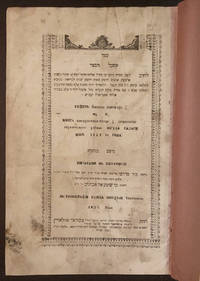
183641374Gozleve Gozeleve Yevpatoriya Ukraine Printing Press of Merchant Mordechai Tirishken son of Yitzchak HaZaken Kefli 1836. Hardcover. 1st edition. 19th Century quarter-leather and boards 4to large 2 155 leaves 33 cm. <br> “Explaining the commandments… written in the Torah… as far as the human intellect is capable of comprehending…†<br> Treatise regarding the tenets of the Karaite faith arranged according to the Ten Commandments and in alphabetical order written in poetic Hebrew. Lays out the the fundamentals of the Karaite faith and includes a harsh attack against rabbinic Judaism and its rabbis.Yehudah Hadassi son of Eliyahu Hadassi nicknamed "Ha-Avel" lived in Constantinople in the 12th century. This is his primary work.<br> "This work was printed at Eupatoria 1836 with an introduction by Caleb Afendopolo entitled 'Nahal Eshkol.' Alphabets 99-100 and part of 98 were excluded from this edition by the censor but have been published by Bacher in 'J. Q. R.' viii. 431 et seq.<br> Hadassi mentions a previously written work of his entitled 'Sefer Teren bi-Teren' a collection of homonyms which he says was an addition to the eighty pairs of Ben Asher alphabets 163 168 173. There exists also a fragment which Firkovich Cat. No. 619 St. Petersburg entitled 'Sefer ha-Yalkut' and attributed to Hadassi while Pinsker regarded it as an extract from Tobiah's 'Sefer ha-Mizwot.' P. F. Frankl however agreed with Firkovich in regarding it as a part of the 'Eshkol ha-Kofer' which Hadassi had previously written in prose. In the Karaite Siddur there are four piyyutim by Hadassi" Kaufmann Kolher & M. Seligsohn in EJ. <br> A number of Karaite works were printed in Gozleve and they are all rare. A damaged copy sold at auction in 2015 for $900 with commissions. <br> SUBJECTS: Karaites. Karaitic literature. Ten commandments. <br> OCLC: 37960603.<br> Library marks on spine and blank endpapers stamps on reverse of title page otherwise clean. Generous wide margins. Early 19th Century paper has held up very well a very nice copy better than usually found. About Very Good Condition. BRAB-66-22-BFL-'xv. Gozleve [Gozeleve, Yevpatoriya, Ukraine], Printing Press of Merchant Mordechai Tirishken, son of Yitzchak HaZaken Kefli hardcover