6 502 résultats
1878266691878. WOOLMAN AND ROSE ATLAS OF THE NEW JERSEY COAST. ATLANTIC CITY 1878. HADDON HOUSE. An 11.5-inch by 14-inch print which is devided into three sections. The upper section depicts a view of the Haddon House Lippincott & Stokes Propr's foot of N. Carolina Ave Atlantic City. The lower half depicts the Cottage Residence of Robt. Kaughn Atlantic City & the Residence of Eliza P. Gurney in Atlantic City. $45.00. <br/><br/> unknown books
1878266681878. WOOLMAN AND ROSE ATLAS OF THE NEW JERSEY COAST. ATLANTIC CITY SEADISE HOUSE 1878. An 11.5-inch by 14-inch print with the bottom half depicting a frontal view of the Sea Side House Atlantic City Chas. Evans Pror. The top half of the print is devoted to the Mongrief House in Jacksonville Florida. $45.00. <br/><br/> unknown books
198821723NY: Times Books 1988. Seventh Comprehensive Edition. Folio pp. 123 228 A fine copy in dj. 8 Color maps large format. The Times even liked it: The Times Atlas of the World is the best most comprehensive accurate and up to date single volume atlas available in English. Times Books unknown books
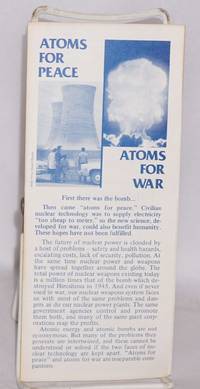
1979175384Philadelphia: organization 1979. Six-panel brochure very good condition. Makes the case for nuclear non-proliferation; organization is a project of the American Friends Service Committee. organization unknown books
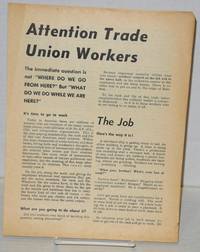
36037Chicago: One Big Union Job Committee 194-. 4p. brochure 8 x 10.5 inches paper evenly browned else very good condition. "Craft unionists should join an industrial union and take action 'on the job' as well as in the union hall." Miles 3964. One Big Union Job Committee unknown books
3149THE ROWFANT CLUB. AUCTION PRICES OF AMERICAN BOOK-CLUB PUBLICATIONS 1857-19 Cleveland: The Club 1904. 8vo. Quarter-leather. vi 72 pages. One of 125 copies. Printed for The Rowfant Club by the The Marion Press. Lower tips and extremit of spine show wear else very good. Scarce. Information not easily found elsewhere. unknown books
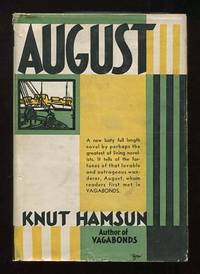
193119747New York: Coward-McCann Inc. Near Fine in Very Good dj. 1931. First American Edition. Hardcover. good solid book with minimal shelfwear to bottom edge vintage bookseller's label Paul Elder & Co. San Francisco on rear pastedown; jacket a bit edgeworn and lightly soiled with a handful of tiny nicks and edge-tears. First American edition of this late work by the great Norwegian writer recipient of the 1920 Nobel Prize for Literature. It's a continuation of the saga of the title character introduced in Hamsun's 1927 novel "Wayfarers" published in America as "Vagabonds"; his next book "The Road Leads On" 1933 completed what's known as "the Wayfarers trilogy" or "the August trilogy." In this one August "the wild and unscrupulous yet ever generous wanderer returns after twenty years to his home in northern Norway." Jacketed copies of the American editions of Hamsun's books are surprisingly uncommon. . Coward-McCann, Inc. hardcover books
201322224ELos Angeles: The Weinstein Company 2013. First Edition. Small format paperbound 5 1/2†x 8 1/2†136 pages. This is first appearance in book form of this screenplay specially printed for distribution to members of the Academy of Motion Pictures Arts & Sciences in consideration for nomination of the Best Adapted Screenplay for August: Osage County written by Tracy Letts based on her play directed by John Wells starring Meryl Streep Dermot Mulroney Julia Roberts Chris Cooper Ewan McGregor Margo Martindale Same Shepard Juliette Lewis Abigail Breslin and Benedict Cumberbatch. A perfectbound book looking like a trade paperback. Fine copy in printed wrappers. The film was nominated for Best Actress Oscars and Golden Globes for Meryl Streep and Best Supporting Actress for Julia Roberts. The Weinstein Company paperback books
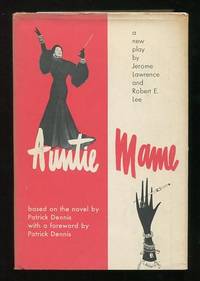
195726837New York: The Vanguard Press. Near Fine in Very Good dj. c.1957. Fireside Theatre BCE. Hardcover. nice tight copy minor wear to spine ends; jacket shows a little wear along top edge spine slightly sunned. B&W photographs photographic endpapers Stage adaptation of the "Patrick Dennis" Edward Everett Tanner III novel about a young boy's life as the ward of his wacky aunt following the death of his father. The original Broadway production starring Rosalind Russell was a hit running two full seasons 639 performances; Russell was replaced near the end of the run by first Greer Garson and then Beatrice Lillie primarily so she could move on to star in the movie adaptation released in December 1958 thereby assuring her perpetual identification with the role. A musical version "Mame" followed in 1966 and a film version of that in 1974. . The Vanguard Press hardcover books
1840283806London: Chapman and Hall 1840. unbound. very good. J. & C. Walker. Map. Engraving. Sheet measures 16" x 13.5". Some light foxing and staining. In very good condition.<br/><br/> This detailed map by the Society for the Diffusion of Useful Knowledge or SDUK depicts the entire continent of Australia in 1839 including Van Diemen's Land or Tasmania. Incredibly detailed along the coastlines the interiors are relatively unmapped reflecting the lack of knowledge of the region. The colony of South Australia which was established in 1834 is the only colony showing a border though other colonies are identified along with dates of establishment. Several notations also identify the names of explorers who discovered these lands along with the dates of discoveries.<br><br>Copyrighted in 1840 and published by Chapman and Hall for the SDUK's. The map is in good condition with minor foxing and minor edge wear.<br><br>The Society for the Diffusion of Useful Knowledge was formed in 1826 and published low cost maps with the goal of reaching a large market while still maintaining high quality and precision.<br/><br/> Chapman and Hall unknown books
19461334874New York: Stein and Day Publishers 1946. First U.S. Edition. Hardcover. Octavo; pp 464; VG-/G; black/ivory pictorial spine with ivory text; dust jacket shows some rubbing to joints and fore edges; minor edge wear; light damp staining inside dj at spine; price clipped front flap; cloth has mild shelf wear; strong boards; text block has slight toning to exterior edges; deckled fore edge; gift inscription to half title page; interior clean; deckled fore edge; tight binding. 1334874. FP New Rockville Stock. Stein and Day, Publishers hardcover books
178507935Lebanon 1785. Autograph Document Signed "Wm. Williams" one page 9" x 13" dated April 4 1785. The present legal document is regarding common land: "We the subscribers bring by the proprietors of the comon sic undivided lands in Lebanon appointed a committee and agents to sue and prosecute to final judgement and execution all persons who have committed any trespass on such common land."Light stain in lower left not affecting signature or the text of the document; wear at folds; very good with a fine bold signature. William Williams 1731-1811 graduated Harvard in 1751 was businessman partiot and Signer of the Declaration of Independence from Connecticut. <br/><br/> unknown books
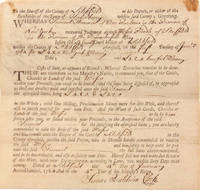
1764316301Litchfield CT 1764. 1p. partially printed and accomplished docketed and signed by Wolcott on the verso. 6-1/4 x 6 inches. Very good. 1p. partially printed and accomplished docketed and signed by Wolcott on the verso. 6-1/4 x 6 inches. 'COMMIT UNTO THE KEEPER OF THE GAOL'. A court writ for the recovery of a judgement against Moses Prindle. Reading in part: "To the Sheriff of the County of Litchfield or his Deputy or either of the Constables of the Town of Salisbury within said County; Greeting. Whereas Samuel Thomson of Nine Partners in the Province of New York recovered judgement against Moses Prindle of Sheffield in the Province of Massachusetts Bay before the adj. County Court Holden at Litchfield within the County of Litchfield aforesaid on the first Tuesday of January 1764 for £ 4-8.0 New York Money and £ 1.2.0 lawful Money. Whereof Execution remains to be done. These are therefore in his Majesty's Name to command you that of the Goods Chattles or Lands of said Moses within your Precincts you cause to be levied and the same being disposed of or appraised as the Law directs paid unto the said Samuel. And for want of such Goods. you are hereby commanded to take the Body of the said Moses and him commit unto the Keeper of the Gaol in Litchfield ."<br/><br/>Oliver Wolcott 1726-1797 was a signer of the Declaration of Independence and the Articles of Confederation as a representative from his home state of Connecticut where he also served as the Nutmeg State's 19th Governor and as a major general of Connecticut militia during the American Revolution. Born in Windsor Wolcott graduated at the top of his Yale class in 1747. After graduation he raised and lead a militia company in the French and Indian War and afterward settled in Goshen CT where he studied medicine before moving to Litchfield to become a merchant. He was appointed sheriff of the county and served from 1751-1771. According to a "Historical Note" in the Connecticut State Library ".when viewed through the lens of the county court files Wolcott was an incompetent sheriff who allowed the vagrant thief Joseph Negro to escape from jail in 1754. Wolcott was also sued by a neighbor for his cruel and tyrannical treatment of Wolcott's servant Lidia Collis. The girl had fled to the neighbors for protection only to be dragged home by her master." <br/><br/>Isaac Baldwin 1715-1805 was born in Milford Connecticut to David and Abigail Wilkinson Baldwin. A licensed preacher he gave up the pulpit for the plow moving to Litchfield where he ws a representative to General Assembly served as Town Clerk Clerk of the County Court and Clerk of the Probate Court. He was married to Anna Collins and had three daughters and four sons. unknown books
1769315321Rockingham County NH 1769. 1 p. pen and ink on paper blank on verso. 4.5 x 7.75 inches. Old folds dog-eared corner else fine. 1 p. pen and ink on paper blank on verso. 4.5 x 7.75 inches. A memo written during Bartlett's tenure as justice of the Peace for Rockingham County recording an agreement for the transfer of a deed from Joseph Chandler to Josiah Judkins upon payment of a note. <br/><br/>American physician statesman and jurist Josiah Bartlett 1729-1795 was born in Amesbury in the Province of Massachusetts Bay and moved to the frontier settlement of Kingston in Rockingham County New Hampshire in 1751 where he opened his practice as the county's sole physician. Bartlett was elected to the New Hampshire colonial assembly in 1765 served as colonel of the Rockingham County militia and was appointed justice of the peace. From 1775-1776 and in 1778 and 1788 Barteltt was New Hampshire's delegate to the Continental Congress where as the representative of the northern most colony he was the first delegate to vote for independence from Great Britain. Bartlett was a signer of the Declaration of Independence served on the committee that drafted the Articles of Confederation and helped ratify the Constitution. He later served as a judge in the Court of Common Pleas and despite not being a lawyer was appointed Chief Justice of the New Hampshire Supreme Court and in 1792 he became New Hampshire's fourth Governor. <br/><br/>Two-hundred years after his death Josiah Bartlett entered the chronicles of American pop culture when despite a difference in the spelling of his last name he became the fictional direct ancestor of "President Josiah Bartlet" a leading character played by actor Martin Sheen in NBC's drama The West Wing. Bartlett is also a character in both the stage and motion picture adaptation of the musical 1776. Photo unknown books
17727530Poplin 1772. Docketed on April 19 1776; a promissory note signed within the text one page 7 1/2" x 5" written on July 9 1772. Promissory note reads in part: "I Nicholas Gorden.promise to pay to Josiah Bartlett on order Twenty one shillings & three pence.with interest till paid for value received." Very good to fine. Josiah Bartlett 1729 - 1795 First Governor of New Hampshire Revolutionary patriot member of the Continental Congress Jurist and the SECOND Signer of the Declaration of Independence from NH. <br/><br/> unknown books
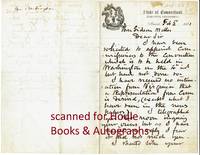
1861605660<p>"W.A. Buckingham" in black ink on bifold pictorial leaf State of Connecticut Executive Department Norwich letterhead February 5 1861. 5 1/4" x 8" 2 pages. Very good. To Gideon Welles: In part: ". . .I have been solicited to appoint commissioners to the convention which is to be held in Washington on the 4th inst but have not done so. . .I have received no intimation from Virginia that a representation from Conn. is desired except what I have seen in the newspapers. I telegraphed you this noon inquiring your views but as I have received no reply. . ." Welles 1802-1878 born July 1 1802; died February 11 1878; was the United States Secretary of the Navy from 1861 to 1869 under Lincoln and Johnson. A proposed convention of all states to try and adjust differences between the north and the south. Seven states had declared their secession from the Union and established the Confederated States of America on February 4 1861 the day before this letter was written.</p> unknown books
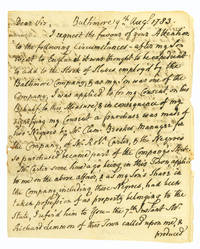
1783261600Baltimore 1783. 2 pp. pen and ink on bifolium docketed. 8vo. Toning some wear to margins hole from removal of seal not affecting text. 2 pp. pen and ink on bifolium docketed. 8vo. Royalist Maryland politician Daniel Dulany the Younger 1722-1797 writes to Daniel of St. Thomas Jenifer 1723-1790 concerning the loss of his son's shares in the Baltimore Company. ". after my son went to England it was thought to be expedient to add to the stock of slaves employ'd by the Baltimore Company . a purchase was made of two Negroes by W. Clem. Brookes Manager for the Company of W. Rov. Carter & the Negroes so purchased became part of the Company's stock . my Son's share in the Company including these Negroes had been taken possession of as property belonging to the State ." The Baltimore Company was an iron works founded in 1732 by Daniel Dulany the Elder and four other partners - a tax list from 1783 lists the Company as having 35 slaves. Dulany a member of one Maryland's most prominent families and a moderate Loyalist during the American Revolution lost much of his property after the war. unknown books
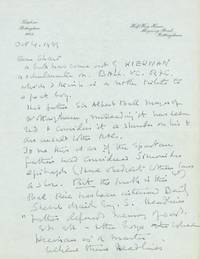
1933211411Half-Way House / Steyning Road Rottingdean 1933. 2 pp in ink on personal letterhead. 1 vols. 4to. Very good. 2 pp in ink on personal letterhead. 1 vols. 4to. A Plea to TE Lawrence re the Memory of Albert Ball. Baring discusses the recent appearance of and furor over a new book on the WW I flying ace Albert Ball CAPTAIN ALBERT BALL VC DS by RH Kiernan which Baring considers "a noble tribute to a great boy. His father Sir Albert Ball Mayor of Nottingham misreading it has seen red & considers it a slander on his son and an insult to the RAF."<br/><br/>Baring continues "To me this is as if the Spartan fathers had considered Simonides' epitaph on the fallen Spartans at the Battle of Thermopylae . a slur . " Noting that Ball had spoken critically to the press about the book Baring asks Lawrence if he might consider reading it and giving his opinion. unknown books
37285Single leaf written in ink on recto and verso. First page with engraved illustration and printed letterhead of "The Cloister Sea Island Georgia." Stone has crossed out "The Cloister" and written above it "Cottage 71." Signed in ink "Harlan F. Stone" at bottom of the verso. Very Good.<br/><br/> "Dear Tinker It was good to have your letter which followed us when we came here a week ago Sunday. They took me to the train in a wheelchair but now thanks to the balmy climate I am walking. I walked two miles. We shall unwind probably until late Jan and then return to my sadly interrupted job.<br/> "Sorry you could not make your trip to Pasadena. It would have been a pleasant change for you both. I enjoyed your tale of Mr. Pal and Shaw. Have you heard of the elderly spinster who attended a party when each guest was to dress so as to indicate the title of a book. Across her lower front was a placard ------ . The answer of course was It Cant Happen Here. Our best regards to you and Frances. Let us hope that the new year will be a better one for all of us and that we shall meet soon.<br/> As ever your friend<br/> Harlan F. Stone" <br/><br/> Harlan Fiske Stone 1872-1946 was appointed to the Supreme Court as an Associate Justice by Calvin Coolidge and served as such from 1925 to1941 when Franklin Roosevelt appointed him Chief Justice a position he occupied until his death in 1946. Stone had been ill sometime around December1936 and had traveled to Sea Island Georgia to recuperate. A report in January 30 1937 stated that he had returned to Washington fully recovered. His correspondent was Edward Larocque Tinker 1881-1968 a writer concentrating on Latin American culture. Both men were graduates of Columbia Law School Stone in 1898 and Tinker in 1902. After Stone graduated the school asked him to remain as a teacher; he did so while maintaining a private law firm. In 1910 the law school named Stone its Dean a position he held for fourteen years. Tinker likely knew Stone both as a student and fellow teacher. "It Can't Happen Here" mentioned in this Letter refers to the 1935 novel by Sinclair Lewis. "Harlan Fiske Stone Society" website of Columbia Law School. unknown books
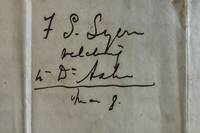
37118Folio sheet folded to 7-1/2" x 9-3/4." Written in neat ink manuscript on first two pages. Third page blank docketed on page 4. Very Good.<br/><br/> Francis Strother Lyon 1800-1882 an Alabama lawyer and Democratic politician wrote this letter to Governor Moore. Lyon had been a Whig Congressman in the 1830s and having chaired the State Delegation to the 1860 Democratic Presidential Convention remained a power in Alabama public affairs. Dr. William Cincinnatus Ashe 1815-1867 a Demopolis physician received his appointment as Surgeon to the 11th Alabama Infantry on July 4 1861 and acted in that capacity until he was relieved on June 21 1862. On August 1 1862 he became Surgeon-- and then Surgeon-in-Charge-- of the 1st Alabama Hospital in Richmond; and then Surgeon in Charge of Fort Morgan Hospital in Mobile Bay.<br/> Lyon reminds Moore that "The Act of Congress for the establishment and organization of a general staff for the Army of the Confederate state authorizes the appointment of four surgeons with the rank of Major. You will remember that the friends of Dr. William C. Ashe of this place recommended him to you for the appointment of Surgeon to the Regiment to be raised under the Ordinance of this State. Now I am not informed as to your final determination. His friends feel a good deal of anxiety for his appointment as surgeon in the regular army either by the President or yourself."<br/> "In this part of the State we have not been clamorous for office- but we have been ardent and active in support of the cause of the South and you will concur with me in opinion that no portion of the State has been more unanimous in sustaining the measures which now promise so well to protect us against further inroads upon our rights on the part of the North. I think therefore we are not asking too much in requesting the appointment of Dr. Ashe. unknown books
30457<p>small quarto two pages a damp-stain has faded several words in the text some archival tissue repairs else in good legible condition. Very likely a retained copy. The intended recipient may well have been William Woodford 1734-1780 American revolutionary war general from Virginia.</p><p> The letter reads:</p><p> "My dear Sir</p><p> I am just inform'd that a letter was yesterday read in Convention from T. Hepburn to you mentioning amongst other matters his having left in Norfolk some articles of my property which from your usual goodness I must request the favor of you to secure for me. A conveyance by water will be I suppose impracticable but as the Flour Waggons are frequently returning one of them possibly may be spar'd for that purpose or perhaps they may be got part of the way to some pace of safety. As I now am asking favors I will venture another which as it will prove a means two unintelligible words …ing that humanity which has rendered your name dear to your Country-men will I flatter myself meet with success. Matt Phripp before this late unhappy affair was deservedly esteemed by most people in this country his affairs he informs me his affairs upon a better footing. Be pleased to excuse the liberty I have taken & accept my sincere congratulations upon your late victories & the honorable testimonies your conduct has justly merited from our country.</p><p> May you be happy & continue to conquer is the sincere wish of Dear Sir </p><p> yr most obedient</p><p> Ben Harrison</p><p> Wms burg 2d January 1775" i.e.1776</p><p> An intriguing letter for many reasons. The letter is evidently mis-dated Harrison dated it January 2 1775 instead of 1776 a common enough mistake early in January. The only Convention to meet in January was the one that met in Williamsburg from December 1 1775 to January 20 1776. Matthew Phripp mentioned by Harrison was a prominent merchant of Norfolk who was charged with disloyalty to Virginia in December 1775. After weighing the evidence the Convention on January 4 1776 adopted a resolution exonerating him.</p><p> The identity of the recipient who was in or near Norfolk can probably be deduced as William Woodford. Harrison congratulates his correspondent upon his "late victories". Woodford was a delegate to the Third Virginia Convention and there was appointed colonel in command of the 2nd Virginia Regiment of the Virginia provisional forces. He had just driven the royal governor Lord Dunmore and British forces from the Norfolk peninsula after the Battle of Great Bridge on December 9 1775 the first significant battle of the Revolution on Virginia soil.</p><p> Benjamin Harrison 1726-1791 Virginia planter legislator governor and signer of the Declaration of Independence was born on his family's estate in Virginia the fifth in line to bear the name and the scion of one of the most prominent planter families in the colony. He attended the College of William and Mary in Williamsburg but when his father died Harrison left before graduating to assume management of his family's estates. He was one of the more conservative patriots in Virginia and had been only lukewarm in supporting the more vigorous rebels such as Patrick Henry during the Stamp Act crisis. However as the time of decision drew closer Harrison threw his considerable weight to the side of the patriots. </p><p> He was one of the most powerful members of the House of Burgesses serving frequently as speaker and when he began to take part in committees of correspondence and provincial congresses in 1774 the anti-crown forces in Virginia gained strength. He was selected as one of Virginia's delegates to the first Continental Congress in 1774 and continued to represent the state until 1777. In November 1775 he was named chair of a committee to correspond "with our friends in Great Britain Ireland and other parts of the world" Congress's first venture into foreign affairs. The following year Harrison's committee sent Silas Deane and Benjamin Franklin to France as its diplomatic agents. His prestige in the House was such that he consistently was placed in the chair when Congress went into committee of the whole to debate the question of independence in June 1776. As committee chair he had the honor of reporting the approved Declaration of Independence to the Congress on the Fourth of July. Afterward he signed along with the other members of the Virginia delegation. He served in Congress until 1777 and then took a seat in Virginia's newly constituted House of Delegates. He served as speaker from 1781 to 1784. In 1781 when Banastre Tarleton General Charles Cornwallis's hard-riding lieutenant descended on Charlottesville in an effort to capture the Virginia Legislature Speaker Harrison fled across the Blue Ridge Mountains with Patrick Henry and John Tyler encountering difficulties that have long enriched Virginia folklore. </p><p> Harrison objected to the new federal constitution on account of the lack of a bill of rights but he proved a supporter of the new government when it was approved. His son William Henry Harrison and his great-grandson Benjamin Harrison became presidents of the United States.</p><p><br /></p><p> See <i>Virginia Magazine of History and Biography</i> XV 1908 148; XCIII 1910 402-408. </p><p> <i>American National Biography</i> volume 10 pp. 197-198</p> books
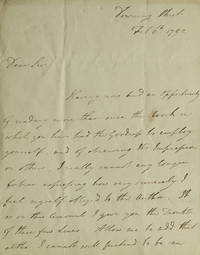
1792305549London: Downing Street 1792. With Mackenzie's docket "From Mr. Pitt 6 Feby. 1792. His opinion of my pamphlet.". 4to. Old folds. With Mackenzie's docket "From Mr. Pitt 6 Feby. 1792. His opinion of my pamphlet.". 4to. Reading in part:<br/>".I really cannot forbear expressing how very sincerely I feel myself obliged to the author.if its political tendency were out of the question.it would. afford me more pleasure than almost any publication I ever remember to have read."<br/>MacKenzie was known as the "Addison of the North. Downing Street unknown books
19080011781908. Mason A. E. W. AUTOGRAPH LETTER SIGNED "Yours A. E. W. Mason" 17 Stratton Street London 1908. Single sheet of high quality water-marked paper folded once. In NEAR FINE crisp condition written in black ink. The letter is an apology for having to cancel a meeting. A good example of Mason's autograph. Mason wrote several dozen turn-of-the-century novels the best known being THE FOUR FEATHERS written in 1902 a classic adventure tale which has been filmed four times. Signed by Author. Near Fine. unknown books
1859620331859. Oblong folio sheet 7 1/4 x 14 in. staff ruled by hand in red ink. Music notation with corrected lyrics on recto additional verses on verso.<br/>An extremely rare complete vocal score with accompanying dance entirely in Emmett's hand. Emmett joined Dan Bryant's minstrel troupe in 1859 when the company introduced his "Dixie" on the New York stage as well as the present composition for which sheet music evidently was published in 1860 although locating a recorded copy has proved unsuccessful. <br/>Virtually all of Emmett's manuscripts were deposited early on in the Ohio State Library and are now in the archives of the Ohio History Connection. There are three drafts of the 'John Come Down de Hollow' there: a pencil ms. of words only entirely different from the finished version about a slave pursued by a bulldog in the rain; a fragment of Emmett's walk around in a different key a variant setting and the first two lines of lyrics only dated 1860; and a fair copy dated 1859 comparable to ours with full score and extra verses on the verso. Ours contains a textual revision not in the OHC copy. The lyrics of Emmett's song involve the dandy John's courtship advice to the ladies on how to avoid ending up an old maid the dandy John and the efforts of the singer to avoid marriage. Written in dialect with the usual stereotypical transgressions such lyrics are now generally accepted as having been appropriated and adapted from African-American sources. Intriguingly William Cullen Bryant collected the lyrics of a work-song version of 'John Come Down de Hollow' from slave sources during a visit in 1843 to a plantation in South Carolina. There "he witnessed a corn-shucking arranged for his benefit by the obliging proprietor unnamed but it may have been William Gilmore Simms. See Norris Yates "Four Plantation Songs Noted by William Cullen Bryant" in Southern Folklore Quarterly v. 15 1951. As described by Bryant "The negroes began to strip the husks from the ears.keeping time to the music.the songs were generally of a comic character but one of them was set to a singularly wild and plaintive air which some of our musicians would do well to reduce to notation." The differences between Bryant's 'plaintive' version and Emmett's provides a rare documentation of the typical way in which African-American sources were changed into comic minstrel repertoire.<br/>At the conclusion of the vocal score is a "Dance" in ten measures which would have been the 'walk round' element of the song mentioned in the title a minstrel dance which Emmett introduced in 1859 to the Bryant's Minstrels' performance routine one which typically closed the first half of the show. It is generally thought to have its origins in African circle shouts brought over by slaves and typically included a competitive element in which each dancer gets a chance to display his best moves while others clap or 'pat Juba' on their bodies. All stops were pulled out for these boisterous minstrel finales which were soon adopted by other bands and Emmett's walk-'rounds defined the type and are considered his most significant contribution to minstrelsy. Hans Nathan devotes an entire chapter to the walk-'rounds in his definitive biography of Emmett and closes with particular mention of "John Come Down de Hollow." As previously mentioned the song was evidently published as sheet music but Nathan could not locate a copy nor have we succeeded.<br/>Although he is today remembered chiefly as the composer of "Dixie" Emmett's importance to minstrelsy the overwhelmingly dominant American musical entertainment of the 19th century can hardly be underestimated. He was a founding member in 1843 of the Virginia Minstrels generally accepted as the first black face Negro minstrel troupe with what would become the full complement of banjo fiddle bones and tambourine. Their popularity and influence quickly spawned the genre with numerous imitators on both sides of the Atlantic and the devoted following of both white and black audiences. He was an accomplished banjoist and his many compositions were central to the repertoire. Hollywood produced a movie of his life starring Bing Crosby in 1940 and he was inducted into the Song Writer's Hall of Fame in 1970. For the definitive study of Emmett and his music with an entire chapter on Emmett's walk-rounds see Hans Nathan's "Dan Emmett and the Rise of Early Negro Minstrelsy." Apart from later transcriptions and quotes from "I Wish I was In Dixie's Land" and a transcription of seven verses of "Old Dan Tucker" which sold at auction in 1978 the present manuscript is the only strictly contemporary full draft of any of Emmett's numerous other compositions to appear in the auction records of the past fifty years this copy in 1964 to 2016. <br/><br/> unknown books