Sermones de sanctis et de commune sanctorum Sermons for the Sanctorale and for the Common of SaintsABAA

6 502 résultats
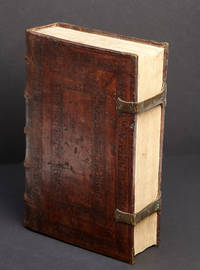
TM 767MEDIEVAL SERMON MANUSCRIPT IN A FIFTEENTH-CENTURY CHAINED BINDING CHAIN INTACT decorated manuscript on parchment in Latin Austria Vienna or Southern Germany c. 1275-1300. 182 x 127 mm. 190 folios complete written in a rapid Gothic hand with cursive influence in two columns of thirty-two to thirty-seven lines justification 141-143 x 96-100 mm. parchment ruled in brown ink quire signatures guide notes for rubrication red rubrics capitals and names of cited authorities stroked in red rhymed phrases underlined in red red paraphs two- to three-line plain red initials two-line red initial with pen flourishing in red f. 131v occasional scribal corrections and marginalia. BINDING: Fifteenth-century blind-tooled and -stamped red calf with eight engraved and bossed cornerpieces intact fore-edge clasp and chain hasp with intact chain with two manuscript fragments serving as front flyleaf and lower pastedown. Chained libraries were a late medieval solution to the problem of providing access to needed books in an institution while at the same time preventing theft and we can assume many late medieval volumes were once chained. Most however have been rebound or survive without the chain and other metalwork and intact chained bindings such as this one are uncommon. TEXT: This extensive collection includes more than one hundred sermons from the <i>Sermones de sanctis et de communi sanctorum</i> of the early Franciscan writer Conrad of Saxony d. 1279 together with his very popular text the <i>Speculum beatae Mariae virginis</i> all copied not long after their composition. This is however not simply a copy of Conrad's sermon cycle since some of his sermons are omitted and six sermons by contemporary Dominican authors Martinus Polonus Aldobrandinus de Calvacantibus and Antonius Azaro de Parma as well as eight sermons by unidentified authors were also included. It seems likely this is an example of a re-working of Conrad's texts for a Dominican audience who would have prized it as a preaching aid and for its pronounced Marian focus. Marginal annotations attest to the early use of these sermons most likely by preachers. PROVENANCE: Written in Southern Germany or Austria at the end of the thirteenth century as suggested by evidence of spelling script and decoration. Belonged to the Dominican house attached to the Church of St. Maria Rotunda in Vienna as indicated by two fifteenth-century inscriptions; here it was probably part of the house's chained library. Belonged to a Dominican convent at KosiÄe in present-day Slovakia as indicated by a sixteenth-century inscription. Belonged to Maurice Burrus 1882-1959 Alsatian philatelist; his ex libris on the front pastedown. CONDITION: Slight rust stains and corrosion in the outer margins of ff. 184-188 margins trimmed away overall in good condition. Full description and photographs available TM 767. books
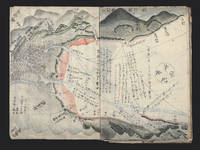
5611"Hishu" today Saga Prefecture: 1841-45. A very rare Japanese manuscript sea chart of the sea routes from Saga Prefecture a major trading area in the west to Osaka through the Inland Sea which is more than 400 km. long and includes in excess of 3000 islands. The Inland Sea one of the main trade routes for the Japanese in the Edo period has numerous areas of turbulence and navigating through the numerous islands and rocky outcroppings presented enormous problems in the era before modern navigation systems. In the early 1840s the central government in Edo ordered each fiefdom to prepare maps of coastal routes to facilitate trade and shipping. Our manuscript was prepared by Tsugihei Miyachi a high level sea pilot "mite kako" in the Saga Prefecture shipping office as an employee of the Nabeshima Clan. The map were it to be unbound is about 11340 mm. long about 37 feet depicting Saga in the west to Osaka in the east. It is finely drawn in black ink heightened with wash in green purple blue grey and red. Five of the openings have folding extension sections pasted onto the lower margins of the leaves. Blue lines depict safe sailing routes for smaller ships. The map depicts in very great detail areas of turbulence there are famous whirlpools in the Inland Sea numerous islands rock formations and landscapes for orientation anchorages harbors and fishing areas. Each section of the map has been annotated by the compiler with notes on distances characteristics of rivers landmarks for navigation tidal activities the route to Nagasaki etc. The first map opening depicts Saga and the final opening Osaka. The sea chart is prepared with considerable local knowledge of castles and temples. A series of notable castles each is labeled with name of the lord assets etc. are depicted along the shores and Miyachi describes harbors for anchoring and to get fresh water. The routes are drawn from a "bird's-eye view" perspective with lovely vistas of mountains and islands and villages and towns. The two leaves of manuscript text at the beginning in the style of a dedicatory letter to the fiefdom lord describes the compiler's efforts over a five-year period to prepare the map. He writes that it is based on his own personal experiences as a sea pilot. He states that purple denotes routes he has taken red denotes shallows blue lines denote the routes for large ships grey for land and green for mountains and forests. The eleven pages of text at the end provide details on prevailing weather patterns and how to prepare for inclement weather how to navigate by landmarks and the stars wind and tidal patterns and the history of the preparation of this map "it took me five years of daily observation to prepare this work". He provides a list of his voyages to different cities on this route. On the final page the author states that three copies were made: the first for the fiefdom lord the second for a cabinet member and the third for Miyachi's divisional chief. A modern scholar has laid-in a note describing this sea chart as one of those three. Japanese sea charts are rare survivals and we know of no other similar example outside of Japan. ❧ The sea pilot Miyachi's log books are preserved in the Nabeshima clan's archives see the Saga kenritsu toshokan database. unknown books
193816060JBurbank: Warner Brothers Pictures 1938. Original 322 page private in-studio conductor’s score printed in purple ink used by Erich Wolfgang Korngold in recording his musical score for the classic film Robin Hood. With occasional annotations and markings by Korngold in pencil. Additionally each musical sequence is marked with red pencil for recording. This score was presented to Hal Wallis the producer of the film with a large remarkable two page Korngold written inscription: “To Hal Wallis with many thanks in friendship and admiration Erich Wolfgang Korngold Hollywood 4.18.1938â€. On the facing second page Korngold has written out the first bars of music for six of the film’s musical themes “Robin Hood†“Robin Hood’s Companyâ€â€Lady Marian†Lionheart England†“Sir Guy†“Love Themeâ€. Beneath which Korngold has written “One minute - one page†--â€One hour - a million of notes†The genning of each sequence is marked in print CONDUCTOR. Beautifully bound in dark green Niger leather with gilt-stamping. The volume measures 10 1/2 inches wide by 12 1/2 inches tall. It is enclosed in a custom clamshell full linen cloth box. Hal B. Wallis 1899-1986 was one of Hollywood’s greatest film producers whose additional accomplishments include the films Casablanca The Maltese Falcon Yankee Doodle Dandy Dark Victory and many others. The resulting film has come down to us as one of Hollywood’s greatest classics and stars Errol Flynn Olivia de Havilland Claude Rains and Basil Rathbone. Korngold won the Academy Ward for Best Original Score for The Adventures of Robin Hood. The American Film Institute chose Robin Hood as number eleven in its list of the top 25 best American film scores. This score is included in any of the serious lists of the greatest film scores of all time. Warner Brothers Pictures hardcover books
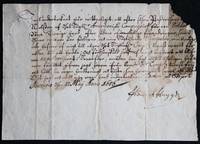
03009040 items 47 pages various sizes ranging from small sheets to folio in Dutch both High and Low Swedish and English the documents have various condition issues damp-stains old tape stains soiling tears and loss associated with over three hundred years of neglect but they are generally legible. <br /><p>The collection of documents and papers offered here pertain to the earliest European settlers on the Delaware River – the colony of New Sweden and one family of settlers in particular the Nilsson family- Jonas Nilsson and his children. These settlers Swedes Finns and Dutch constituted the majority of the population on the South River as they called the Delaware before the Quaker "invasion" that began with John Fenwick's group in 1675 and culminated with William Penn's 23 ships in 1681-1682. The bulk of the papers in this collection date from two periods when the colony was in transition: first from Swedish to Dutch control and then from Dutch to English control. Paper and documents from New Sweden are exceedingly rare many of the records generated by the colony simply did not survive. Most of the materials which did survive have been housed in institutions for generations if not centuries. Collections such as this one essentially the three hundred plus year old Nilsson family papers simply do not appear in the market. </p><p> The collection contains the signatures and marks of many "ancient Swedes." The collection contains a document bearing what is only the second known signature of one of them: "Laurentius Caroli Lutheran minister" Pastor Lars Carlsson Lock. The collection also includes documents signed by Hendrick Coleman one of the leaders of the "Long Finn Rebellion" the first armed insurrection against the English in America. </p><p> For many historians the colony of New Sweden 1638-1655 is perceived as an insignificant blip in American colonial history. One of the reasons is that few records have survived in America for the Swedes Finns and Dutch who were the first permanent European settlers in the region. Between 1637 and 1656 Sweden equipped thirteen passenger voyages for the South Delaware River which departed with about 800 prospective settlers. Eleven vessels and some 600 passengers reached their intended destination. </p><p> The present collection of documents relates to one of those settlers Joen Jonas Nilsson and his family. Nilsson arrived in the New World on the fourth ship in 1643. Nilsson like many of his fellow settlers was illiterate so while there is no correspondence the collection contains the sort of documents and papers that deal with aspects of everyday life legal matters land disputes and other matters mainly involving his neighbors in Kingsessing in what is now present day Philadelphia. The collection documents what daily life was like over 300 years ago in the lost colony of New Sweden and gives a picture of conditions and domestic life facing the first settlers in the mid-Atlantic over 300 years ago. </p><p> <b>Biographical Sketch of Joen Jonas Nilsson 1620-1693 </b> </p><p>"Jonas Nilsson from Skaraborg County Sweden came to New Sweden as a soldier in 1643 and married Gertrude daughter of Sven Gunnarsson. His seven sons used the patronymic Jonasson which evolved into Jones. Their family in 1671 included Nils b. 1655 Judith b. 1658 Gunilla b. 1661 Måns b. 1663 Anders b.c. 1666 Christina b. 1668 and John b.1670. Subsequent children were Peter Jonas Brigitta and Jonathan. Jonas Nilsson died in October 1693 at the age of 73. Lovelace's patent to Jonas Nilsson dated 18 May 1672 named Hans Månsson Peter Andersson widow Dalbo Anders Boon and Mr. Otto Ernest Cock as owners of land adjoining his several parcels." </p><p>Craig Peter Stebbins "<i>1671 Census of the Delaware</i>" page 21 Philadelphia: Genealogical Society of Pennsylvania 1999 </p><p>Joen Nilsson was one of the many soldiers accompanying Governor Printz on the Fourth Expedition to New Sweden. Nilsson of Skåning hundred Skaraborg län would later become better known under the name of Jonas Nilsson. Born in 1621 Jonas was a tailor by trade. He was an imposing character reported to be six and a half feet tall. He began his voyage to New Sweden from Stockholm in September 1642. After arriving at Fort Christina 15 February 1643 he was one of many men assigned to help build Fort Elsborg where he was subsequently stationed. Nilsson served governor Printz faithfully as a soldier and also served the colony as a tailor for eleven years until 1653. But when Printz returned to Sweden in 1653 Nilsson did not go with him. He obtained his discharge and became a Freeman. After Governor Rising arrived in 1654 Nilsson was able to secure passage to Sweden to collect the moneys due him. New Sweden was essentially a barter economy where the currency consisted of beaver skins half-beaver skins and sewant. To collect real money for one's services it was necessary to go to Sweden. Most of the settlers in New Sweden owed money to the New Sweden Company and had no incentive to return. Before he left Nilsson signed the Freemen's Loyalty Oath on June 9 1654 and married Gertrude Svensdotter in 1654. She was the daughter of Sven Gunnarson and was born in 1636 in Sweden she immigrated to New Sweden in 1639 on the ship <i>Kalmar Nyckel</i>. Jonas left his young bride in mid-July 1654 to return to Sweden on the ship <i>Eagle</i>. He collected the back wages due him and returned to New Sweden on the <i>Mercurius </i>which arrived in March 1656.Meeting the ship were his wife Gertrude and his eldest son Nils who was born during his absence. Nilsson then became one of the first settlers in Kingsessing where he established an Indian trading post on Kingsessing Creek southwest of the Schuylkill River in present day West Philadelphia. Kingsessing was a Swedish village on the north bank of a creek known as Minqua Kill or Kingsessing there were four households in this village when the 1671 census was taken- one was Nilsson's. </p><p> Nilsson was a friend protector and business advisor of Armegot Printz daughter of the former governor Johan Printz Jonas was a witness to her sale of a church bell to the Swedish church on 24 May 1673. </p><p> In Philadelphia near the present day 77th and Laycock streets stood a house built by Jonas Nilsson c. 1650s. Nilsson for some years before building this house had dwelt in a cave the site of which is still preserved in the side of the hill which slopes from the front door of the cottage to what was originally the bank of a navigable creek. Ships from the Delaware brought up merchandise to the front door of the cottage and the cave the first home of Jonas Nilsson where he reared his eleven children became a storehouse for the goods brought up for his trade with the Indians. The old house with its two rooms and garret was hardly larger than a packing box. The ground floor room had an immense fireplace walled up which extended almost the entire width of the room and nearly to the ceiling which was scarcely more than seven feet high. George Washington later sat in front of that fireplace. Sessions of court were held wherever a building was available and the old Jonas Nilsson cottage was one of the earliest places in America where trial by jury was held. A trail that led to the house from the direction of Tinicum Island has appeared on maps of the city from the very beginning as Jones's Lane. Nilsson's home and trading post was the center of trade with the Minquas Indians arriving from the west via the Great Minquas trail. Nilsson made his fortune by bartering and trading goods for furs with the Minquas. </p><p> Jonas Nilsson lived for his entire married life in Kingsessing West Philadelphia where he raised his family of eleven children. Besides his trade with the Indians he was a successful farmer on his tract of 200 acres. He also acquired an additional 270 acres of land at nearby Aronameck from Peter Yocum land which he divided among his three eldest sons. Each of Nilsson's sons took the patronymic Jonasson which evolved into Jones. </p><p> Jonas's wife Gertrude was a formidable woman. Her outspoken criticism of defamatory remarks by the English against the Swedes was at least once the subject of court notice. Her father Sven Gunnarson and her brothers – the Svenson's which later evolved into Swanson- were later to play a unique role in the early history of both Philadelphia and Pennsylvania. </p><p> In August 1639 the Swedish government needing settlers for its New Sweden colony sent word to the governors of Elfsborg Dalsland and Varmland to capture deserted soldiers and others who had committed some slight misdemeanor and to send them to America. Among the "convicts" rounded up in this effort was Sven Gunnarsson. When the Swedish War Ship the <i>Kalmar Nyckel</i> left Goteborg in September 1639 he was aboard with his pregnant wife and two small children. Initially in New Sweden Sven was stationed at the Fort Christina plantation where he was found in 1644 working on the New Sweden tobacco farm and his son Sven still a boy was herding cattle at the same location. By 1654 Sven Gunnarsson and his family had moved to Kingsessing. In October 1654 he was finally granted freedom from his servitude and joined other freemen residing at Kingsessing now West Philadelphia Here he was known as Sven the Miller as he operated the first gristmill built in New Sweden on the present Cobbs Creek. </p><p> Being a freeman in New Sweden was like being a peasant under the tyrannical rule of Governor Johan Printz. Like other freemen Sven was required to work without pay at Printz's Printzhof plantation whenever the Governor demanded was prohibited from trading with the Indians and forced to buy all necessities at the company store. Like other freemen he fell heavily into debt. Another such freeman Lasse Svensson the Finn and his wife Carin had their plantation seized by Printz who renamed it Printztorp Both Lasse the Finn and his wife were forced to live without shelter in the woods. Both perished leaving several impoverished children. </p><p> It was not surprising; therefore that Sven Gunnarsson was one of the 22 freemen who signed a petition of grievances that they submitted to Governor Printz in the summer of 1653. Printz called it a "mutiny" and returned to Sweden. </p><p> Sven the Miller fared better under Governor Rising 1654-1655. He even volunteered to help defend Fort Christina against the Dutch invasion on August 31 1655. A pitched battle was averted when Rising decided to surrender the colony. Conditions proved to be even better under Dutch rule. Stuyvesant allowed the Swedes living north of the Christina River to organize their own government. That government known as the Upland Court treated Sven Gunnarsson well. </p><p> After the Dutch takeover of New Sweden Sven Gunnarsson moved with his family across the Schuylkill to Wicaco a former Indian settlement where Sven's 1125-acre plantation embraced what would become the future City of Philadelphia. On May 5 1664 the Dutch Governor Alexander D'Hinoyossa granted him and his three sons' acres at Wicaco which was confirmed 31 May 1671 by a grant from Governor Francis Lovelace after the territory came under English rule. Here on his land the first log church at Wicaco now Gloria Dei Church was built by 1677. The last known reference to Sven occurs in the Upland Court minutes of 13 November 1677 where he withdrew a lawsuit after the defendant settled out of court. And he appeared on the list of tydables in the court's jurisdiction as living with his son Anders. Sven Gunnarsson died about 1678 and probably was one of the first to be buried at the Wicaco church. </p><p>In the spring of 1683 Sven's three sons agreed to provide the northern part of Wicaco for William Penn's planned new city to be called Philadelphia. The sons who had adopted the patronymic Svensson which evolved into the anglicized Swanson were left with 230 acres apiece. Sven Svensson Swanson was the eldest son of Sven Gunnarsson he was born in Sweden. He was a Wicaco Church warden and a justice on the Upland court in 1681-82 and was elected to the Pennsylvania Assembly in 1683. They sold William Penn the land upon which the city of Philadelphia was laid out. </p><p>"Having promised in July 1681 to lay out a "large town or city in Pennsylvania" William Penn drew up his specifications for his town. He named his cousin William Crispin 1627-1681 and Nathaniel Allen d. 1692 and John Bezar d. 1684 two Quakers from the western part of England as his commissioners and instructed them to set aside 10000 acres on the best site for a port along the Delaware… William Penn's commissioners however were not able to acquire enough land to carry out many of Penn's plans because the Swedish Dutch and English inhabitant's had already taken up most of the river frontage along the west bank of the Delaware from New Castle to the Falls opposite present day Trenton New Jersey. The commissioners concluded that the best site for William Penn's town was a few miles north of the mouth of the Schuylkill River on land patented by the Swanson family and in the spring of 1682 they obtained 300 acres of river frontage from the Swansons … in which to lay out his capital city."1 </p><p>"One of William Penn's most important and most difficult tasks was to lay out his capital city. Originally he wanted to set aside 10000 acres for Philadelphia but since all of the choicest riverfront property along the western bank of the Delaware was already patented William Penn's commissioner's had to settle for a much smaller site. In early 1682 they bought a tract extending a mile along the Delaware River from three Swedes the Swanson brothers of Wicaco. Dissatisfied with this cramped area William Penn acquired a mile of river frontage on the Schuylkill from two other Swedes Peter Cock and Peter Rambo parallel to his frontage on the Delaware. This gave him a rectangle of 1200 acres stretching two miles in length from east to west between the two rivers and one mile in width from north to south. Within this rectangle Surveyor-General Thomas Holme plotted his famous grid plan of the city."2 </p><p>Records prove that Sven also had two daughters including Gertrude Svensdottar who was born in Sweden in 1638 and who married Jonas Nilsson in 1654 she died in Kingsessing in 1695 survived by eleven children. </p><p>Jonas Nilsson died October 23 1693 and is buried at Gloria Dei Old Swedes Church Burial Ground in Philadelphia. </p><p><b> Brief History of New Sweden</b> </p><p> In March 1638 two ships <i>Kalmar Nyckel</i> and <i>Fogel Grip</i> brought to the Delaware River twenty-three Swedish soldiers and two officers to establish the first and only Swedish colony in the New World. They built a fort on the shore of a small river emptying into the Delaware which stream they named Christina Kill after their queen. The site was the first permanent settlement in the entire Delaware River Valley including Delaware New Jersey and Pennsylvania and is now within the boundaries of the present city of Wilmington Delaware. Having bought from the Indians a tract of land on the western side of the Delaware extending from Sanikan Trenton New Jersey to Cape Henlopen at the mouth of Delaware Bay they claimed this territory for their country calling it New Sweden. </p><p> In 1640 a second expedition arrived with supplies and new colonists their first governor Peter Hollandaer and the first clergyman Rev. Reorus Torkillus. Another expedition arrived in 1641 and a fourth in 1643 bringing a new governor Johan Printz. </p><p> Printz started at once to extend his domain building small forts on the eastern or New Jersey side of the Delaware at Tinicum near the present site of Philadelphia at Upland Chester Pennsylvania and at the mouth of the Schuylkill River. More ships came and more colonists the forests were cleared farms cultivated a village Christinahamn was laid out behind Fort Christina their first establishment. </p><p> Johan Printz ruled New Sweden with despotic power. Military leader as well as civil governor lawgiver chief judge and head of all the colony's activities he was supreme over the whole Delaware Valley south of Sanikan. He was "a man of brave size weighing over 400 pounds" headstrong tyrannical rough violent overbearing arrogant and arbitrary but an intelligent man a brave soldier a strict disciplinarian an able administrator. In all he was a colonial governor whose achievements have been overshadowed by aspects of his character and conduct. He monopolized the fur trade driving out English who came from New Haven and Dutch who came from New Amsterdam seeking to establish trading posts and settlements. By successive expeditions the colony increased to nearly 400 people. </p><p> Pieter Stuyvesant Dutch governor of New Amsterdam built a fort at Sandhook New Castle Delaware called Casimir. Printz's successor Johan Rising in 1653 captured it and again gave Sweden the control of the whole valley. This so angered the Dutch in Holland that in 1655 they sent a warship to New Amsterdam where it was joined by six others. With 300 fighting men Stuyvesant came down from Manhattan took his fort back again and after a ten days' bloodless siege captured Fort Christina as well. Thus New Sweden disappeared from the map and a Dutch province took its place. </p><p> The collection consists of documents bills receipts legal documents pertaining to Joen Jonas Nilsson. </p><p> The earliest dated documents in the collection date from 1656 when Nilsson returned to New Sweden aboard the <i>Mercurius</i>. Traveling aboard along with the 130 colonists was Hendrick Huygen the Dutch supercargo of the Swedish expedition. Huygen was the nephew of Peter Minuit the legendary early director of New Netherland and purchaser of Manhattan who had also offered his services to the Swedish government and had guided the first Swedish expedition in 1637 and had decided where to plant the Swedish flag. Huygen had served as commissary to the colony of New Sweden and had earlier left the colony briefly his return on the <i>Mercurius</i> resulted in one of the first rifts between the Dutch and the Swedes after the Dutch takeover of the colony. The collection includes a document pertaining to Nilsson dated May 17 1656 signed by Huygen while aboard the <i>Mercurius.</i> </p><p>The rift began in March 1656: "…A shipload of 130 Swedes and Finns arrived on the South River expecting to join the Swedish colony. Dutch authorities decided that the settlers "for grave reasons" were an unwelcome addition and ordered the ship the <i>Mercurius</i> to return to Sweden. Meanwhile the commander of the river reported that some of the remnant Swedes had proved "troublesome or very dangerous" namely by holding "secret intelligence with the savages." To prevent more unrest the council ordered the troublemakers to New Amsterdam twelve soldiers on the Delaware and any Swedes who had not taken the oath to do so or face deportation. Hendrick Huygen … had helped the Swedes many times before. Although he tried to resolve the dispute in "a friendly conference" the Dutch commander detained him as "a traitor and enemy of his state." Huygen appealed to the council for permission to settle the colonists temporarily at an uninhabited place until a resolution could be obtained from the home governments. He did not wish them to be dispersed through the Dutch colony for fear that families would be separated and that "they must altogether be deprived of their worship of God and live under a foreign nation whose language and manners are not known to them." </p><p> While Huygen negotiated at Manhattan and Stuyvesant's council continued to insist that the Swedes leave after a stop at New Amsterdam for supplies some Swedes Finns and Indians boarded the <i>Mercurius</i> and sailed it past Fort Casimir contrary to orders and landed up river. Whether it was an effort by the Swedes to liberate their country people or just some of the goods on board the Dutch reacted quickly to restore order. They suspected that "some of the principal men of the Swedes were at the bottom of it and that also most of the other Swedes who had taken the oath of loyalty had in their opinion been stirred up or misled." With the additional soldiers and the warship <i>de Waagh</i> the Dutch eventually drove off the Swedish ship and concentrated on resolving the "differences jealousies and dissensions" that flourished along the Delaware between Indians Swedes and Dutch. </p><p> The <i>Mercurius</i> affair heightened Dutch suspicions that the Swedes were not to be trusted. When the council appointed a vice-director to oversee the Delaware region of New Netherland it instructed him to keep the Swedes and Indians out of Fort Casimir as much as possible and to prohibit "the free people especially the Swedes" from spending the night inside without his knowledge and consent. In general "he must look well after the Swedes who still are there" weed out any "who are not well affected towards the Honble Company and our native country" and "with all possible politeness make them leave … to prevent any more dissatisfaction." From the Swedes perspective they were the conquered living among the conquerors. They remained hopeful that the States General would return the colony to Sweden. In the meantime they asserted their rights and remained a close-knit community."3 </p><p>The Dutch were persuaded to grant the Swedes and Finns a measure of self-government north of the Christina River. And in August 1656 the Swedes own law courts were approved. This first court consisted of Olof Stille Mats Hansson Peter Cock and Peter Rambo. The collection includes some very early legal documents before these and other early court members pertaining to legal cases involving Jonas Nilsson when the court was in session at Kingsessing in September 1665 and at Upland. </p><p>The collection includes a document dated 5 September 1665 signed by Laurentius Carels 1624-1688. Carels was one of the first settlers of Delaware County Pennsylvania and one of the first Swedish Lutheran clergymen in New Sweden. As was typical among Swedish ministers he generally used a Latinized version of his name Laurentius Caroli Lockenius. He is listed in historical records under several different names most commonly Lars Carlsson Lock. This document bears only the second known signature of Lock. The only other signature of Lock's appears on a 1662 letter to Peter Stuyvesant. </p><p> Lars Carlsson was born in Sweden in 1624. In September 1647 at the age of 23 Lars Carlsson sailed from Göteborg to New Sweden arriving in early 1648. He subsequently adopted the surname Lock from his place of origin Lockerud near Mariestad in Skaraborg County Sweden. In the colony he replaced the veteran minister John Campanius. He was based at a church on Tinicum Island built by Johan Printz the governor of New Sweden. At the start of his ministry he served about 200 members. Pastor Lock is believed to have been the author of the July 27 1653 Settlers' Petition to Governor Printz This is because Lock was one of the few settlers who was literate and served as the scrivener he is also believed to have composed the July 7 1654 Settlers' Supplemental Complaint against Printz. These complaints lead to the return of Printz to Sweden. The Swedish colony of New Sweden ended during the summer of 1655. The Swedish settlement was incorporated into Dutch New Netherland on September 15 1655. The Swedish settlers were allowed to retain a pastor of their confession. Reverend Lars Lock remained but the other pastors returned to Sweden. His congregation was widely scattered extending from the Schuylkill River on the north to the Christina River on the south. </p><p>His role as the only minister on the Delaware River did not end until 1677 when the Swedish settlers living northeast of Darby Creek built a new log church at Wicaco present day Philadelphia now Gloria Dei Old Swedes' Church and invited Jacob Fabritius to be their pastor. Jacob Fabritius a native of Grosglogau in Silesia had arrived in New York in 1669 to serve the Dutch Lutheran churches along the Hudson River. Lars Carlsson Lock continued to serve in the pulpits of both the Tinicum church and the Crane Hook church until his death at Upland Creek in September 1688. </p><p>There are a series of documents from 1673 which seem to involve legal questions involving land. Various Swedes are mentioned in these documents including Peter Jegoe Jan Claasen and Anders Svensson Bonde Bonde was one of Nilsson's Kingsessing neighbors he lived on Boon's Island. Anders Svensson born in 1620 in Sweden came to New Sweden in 1639-40 on the <i>Kalmar Nyckel</i> having been hired in Gothenburg as laborer at a wage of five guilders per month. Later adopting the surname of Bonde "farmer" in Swedish he was promoted on 1 May 1643 to the position of gunner. He would have served alongside Jonas Nilsson who was also a soldier. In 1653 he returned to Sweden with Governor Printz only to return to America again on the <i>Mercurius</i> in 1656. Nilsson sailed along with him on the return voyage. By 1660 he had married a woman named Anna parents not identified who had been born in Nya Kopparberget Ljusnarsberg parish Örebro län. Under English rule the second syllable of his surname was dropped so that the surname became "Boon" in most civil records. </p><p>The collection also includes a document dated 1677 which comprise accounts for Jonas Nilsson's services assisting William Tom the High Sheriff for the Delaware in making peace with the Indians: </p><p>"Mr. William Tom Debt </p><p>To Jonas Nielson </p><p>For expenses of wyne & beare by yr order att ye time when the Indians had killed 2 Christians and you made peace wth them att Kingsess…" </p><p>The document lists the various amounts and the costs of brandy and other spirits as well as gun powder and one canoe Nilsson seeks payment of the amount from the estate of William Tom deceased. </p><p>Dated 9 13th 1677. </p><p> William Tom came to New Castle in 1664 with John Carr's company. In 1671 he was the High Sheriff for the Delaware and owned considerable property. While under house arrest for debt he wrote his will 3 January 1677/8 and died that month leaving his entire estate after payment of debts to his godson Richard Cantwell. When the estate was finally settled 22 February 1682/3 nothing was left for Richard. </p><p>There is a document in the collection dated Wikako May 7 1680 concerning Jonas Nilsson and the church at Wicaco now Gloria Dei Old Swedes Church in present day Philadelphia. The document is signed by Jacob Fabritius the minister of the Wicaco Church and also by Sven Gunnarsson and his son Sven Svensson with their "marks". Gunnarsson and Svensson were respectively Nilsson's father and brother in law. These two men owned the land upon which present day center city Philadelphia is located. Their last name was anglicized to Swanson with the arrival of the English. Sven Svensson Swanson sold 300 acres of land to William Penn. </p><p>Sven Gunnarsson who was sent to America for punishment arrived in New Sweden with his wife and several small children on the Kalmar Nyckel in 1640. After becoming a freeman he settled in Kingsessing and was one of the freemen signing the 1653 complaint against Governor Printz. Before 1664 he moved with his three sons to Wicaco where according to Peter Stebbins Craig he died "circa 1678." But Gunnarsson was still alive in May of 1680 as evidenced by this document. He had two known daughters Gertrude who married Jonas Nilsson and a daughter who married Peter Månsson son of Måns Svensson Lom and moved to Cecil County Maryland. His three sons were Sven Svensson born in Sweden Olle Svensson born on the Kalmar Nyckel in 1640 and Anders Svensson born in New Sweden in 1644. </p>Sven Svensson Swanson was a Wicaco church warden Sven Svensson was the eldest and sole surviving son of Sven Gunnarsson in 1693 when the Census of Swedes on the Delaware was taken. He was born in Sweden and his wife Catherine parents not identified was born near Stockholm. Svensson was a justice on the Upland court in 1681-82 and was elected to the Pennsylvania Assembly in 1683. His will of 21 July 1696 proved 8 October 1696 named four daughters: Birgitta who in 1693 was married to Sven Bonde; Margaret born 1671; Barbara 1674; and Catharine 1682. His only known son Lars Svensson died unmarried by 1693. Sven's widow Catharine was allegedly 92 years old when she was buried 19 August 1720. <p>The collection also includes a copy of a portion of Jonas Nilsson's will the sheet has been trimmed along the left edge. Peter Stebbins Craig states in his 1693 Census of the Swedes on the Delaware that: "Jonas Nilsson being "very sick of body" signed his will on 14 Jan. 1691 and died in October 1693." In it Nilsson notes how his lands in Kingsessing and in Aronameck were to be divided amongst his wife and children. The text is in English and likely dates from January 1691 Nilsson indicates in the first sentence that he was "verie sick and weak of bodie" the document was signed and sealed in the presence of Robert Longshore. </p><p>Robert Longshore who was one of Nilsson's Kingsessing neighbors was an Englishman and deputy surveyor for William Penn. Robert Longshore became part of the Swedish community when he married Margaret Cock born 1667 the daughter of Peter Larsson Cock. In 1693 their household of four included two children: Euclid and Alice Elsa. Longshore died intestate and letters of administration were issued to his widow Margaret on 12 March 1694/5. </p><p>There are two copies of an undated document circa 1670-1671 concerning Jonas Nilsson signed by Hendrick Coleman with his mark Jan Gustafsson and one other individual. Hendrick Andersson Coleman was a Finn of Swedish ancestry. He gained considerable notoriety as one of the principal figures accused in the Long Finn Rebellion. Coleman was the principal accomplice of Marcus Jacobson the "Long Finn" who urged the Swedes and Finns to take up arms against the English. The Long Finn rebellion was the first insurrection against the English in America. On August 2 1669 the governor issued an order for his arrest noting that Henry Coleman well versed in the Indian language had abandoned his plantation including cattle and corn and was hiding in the woods with the Indians. He was arrested and fined 930 guilders. Coleman is reputed to have married the daughter of an Indian chief. In 1671 he resided at Carkoen's Hook Kingsessinga but moved in 1675 with Peter Larsson alias Putcan to a 100 acre tract on the northwest side of Mill Darby Creek opposite Carkoen's Hook. After the death of his brother Lars Hendrick moved to Gloucester County to live on the farm he inherited. He died about 1697 survived by his wife Anna and one daughter also named Anna. </p><p>a. Coleman is found in Kingsessing on: "A 1671 List of the Inhabitants from Matiniconk Island to New Castle. New York Historical Manuscripts Dutch Volumes XX-XXI Delaware Papers English Period p. 306 </p><p>Johan Gustafsson was from the Kinnekulle area Skaraborg lan came to New Sweden in 1643 as a soldier under Governor Printz. on the same ship as Jonas Nilsson. Printz' successor Governor Rising promoted him to the position of a gunner and as such he was stationed at Fort Trinity New Castle in 1655 when Captain Sven Skute surrendered the fort to the Dutch. </p><p>Another undated document is signed by Anders Homman the trumpeter of New Sweden and Carl Anderson for whom no information can be found. </p><p>Anders Andersson Hommann was born December 1620 in Sollentuna parish Stockholm lan Anders Hommann came to New Sweden on the <i>Swan</i> in 1643 as a soldier. Effective march 1 1648 he was promoted to the position of trumpeter. After the surrender of New Sweden he chose to remain in America and married Catharine parents unknown who was born in Finland. He was one of the original patentees of Carkoens Hook in Kingsessing and served as constable of the Upland court 1678-80. On 26 March 1684 Anders Anderson of "Carkas Hook" was granted 150 acres on Repaupo Creek in Gloucester County New Jersey. Frequently thereafter this creek was called Trumpeter's Creek or Hoeman's Creek after its first resident. He had eight known children: Matthias Lars Rebecca Olof Peter Anders Michael and Birgitta most of whom were living at home in 1693 when the census was taken. Anders was buried in the old Glebe burial ground at Upland Chester on 9 September 1700. His will left his entire estate to his son Matthias who was charged with the duty of maintaining his mother Catharine during the remainder of her life. Carl Anderson may have been a son of Anders. </p><p>There is an undated document circa 1656-1679 concerning Jonas Nilsson Kingsessing and one of his neighbor's there Peter Andersson. Peter Andersson came to New Sweden as a farm hand in 1640. In 1671 his family included his wife Gunilla a son Anders Petersson b. 1657 and probably daughters not yet identified. Peter died circa 1679 after which his son adopted the surname Longacre Långåker in Swedish meaning long field. Peter Andersson's patent issued by Governor Nicolls on 1 Jan. 1667/8 mentioned that Peter Andersson's land obtained from Peter Rambo adjoined lands owned by Sven Gunarsson Anders Dalbo and Jonas "Sweer" which must be an alias for Jonas Nilsson. The document is signed by Nilsson and Andersson with their marks. The document may also bear the signature of Andersson's wife Gunilla. </p><p>There is an undated document in the collection signed by Olle Svensson and mentioning two individuals for whom I can find no information Hakan Jenk and Hendrick Andris Dalbo. John Olleson Svensson Swanson was one of the sons of Sven Gunarsson. Although Olle Svensson "Wolla Swanson" was still carried on the 1693 tax list he had died in the summer of 1692. Born on the <i>Kalmar Nyckel</i> in 1640 Olle had married Lydia Ashman daughter of Robert Ashman and sister of Lasse Cock's wife. Olle served as justice on the Upland court 1673-1680. In 1693 all of his children still lived at home with their mother Lydia: John 1668; Swan; Maria; Birgitta; Lydia 1680; Catharine; and Judith 1688. </p><p>The collection contains an undated document concerning Jonas Nilsson and two of the most venerable of the "ancient Swedes": Peter Rambo and Peter Cock. It is signed at the end by Jonas Nilsson with his mark. </p><p>Peter Gunnarsson Rambo heads the list of the 1693 Census of the Swedes on the Delaware. Peter Rambo a revered citizen of New Sweden was from Hisingen near Gothenburg and had arrived in New Sweden on the second voyage of the <i>Kalmar Nyckel</i> in 1639-40. Employed initially as a farm hand at ten guilders a month Peter sent part of his wages home to his father Gunnar Petrsson. On 1 November 1644 Peter Rambo became a freeman and settled in Kingsessing. In 1653 he joined other freemen in signing the complaint against Governor Printz. Under Governor Rising's rule he served on the Council of New Sweden. He also served on the court under Swedish Dutch and English rule for 29 years. On April 7 1647 Peter Rambo married Brita Mattsdotter from Vasa. By 1669 they had moved to a 300 acre plantation at Passyunk. They had four sons and four daughters one of whom died at the age of eight. Two other daughters married Anders Bengtsson and Peter Mattson. The third married daughter has not been identified; she died by August 1694. Peter Rambo's wife died 12 October 1693 and Peter himself was buried on 29 January 1698 at the age of 85. </p><p>Peter Larsson Cock was born at Bångsta Turinge parish Stockholm län in 1610 and adopted the surname of Kock meaning "cook" in Swedish in 1641 when having been sent as an imprisoned soldier to New Sweden he became the cook on the ship. On the same voyage was Måns Svensson Lom with his wife two "almost grown up daughters" and a small son. Peter's wife Margaret whom he married in 1643 was likely one of these daughters. They had thirteen children one of whom died young. There were six sons. Three daughters married sons of Peter Rambo three others married Anders Petersson Longacre Robert Longshore and Bengt Bengtsson. After becoming a freeman Peter Cock settled on an island at the mouth of the Schuylkill River. In July 1651 he witnessed two Indian affidavits confirming that the Swedes were owners of the land on which Stuyvesant had built Fort Casimir his name being erroneously copied as Peter Bock instead of Kock. Governor Printz accused him of illegally trading guns with the Indians and after Cock had been exonerated by the jury sentenced him to three months of hard labor anyway. This incident was one of the grievances in the freeman's 1653 complaint against Printz which Peter Cock signed. Under Governor Rising Cock served as a judge on the court a position that he retained under Dutch and English rule until succeeded by his eldest son Lars in 1680. Frequently called upon to handle negotiations with the Indians Peter Cock also won favor with the English by capturing Marcus Jacobsson the instigator of the "Long Finn Rebellion" of 1669. Peter Cock died at his island which he called "Kipha" 10 November 1687. His widow Margaret who had been born in Roslagen Sweden was buried 13 February 1703 at the age of 77. During the 18th century the family surname evolved into Cox. </p><p>The collection has an undated document likely circa 1690-93 in English headed: <i>"An accompt of what goods and moneys that Jonas Nielsons children have taken from him at severall times as followeth</i>:" The document lists silver and pieces of Spanish Gold various textiles a silver spoon livestock and two guns as well as their respective values which Nilsson's children Gunilla Andrew Jones and John Jones had "taken" at "severall times." </p><p>And lastly there is a small manuscript note dating from circa 1693 headed: <i>A List of papers belonging to ye Executors of Jonus Nelson</i> </p><p>It is an inventory likely including many of the papers in the present collection of Jonas Nilsson's papers at the time of his decease. </p><p>"15 – papers in duch or sweads & some English out of use </p><p> One deed of peeter yocom for land 130 acres </p><p> On pattin from York </p><p> On will of Jonus Nelson & administration </p><p> One deed of 270 acres of Land sind & delivered to Neils Jones </p><p> 2 inventory paper </p><p> On ragod note of som goods took </p><p> One noat in ye custody of Margrot Longshor ordered to deposit by Jonas Nelson of som goods took from Kingsesing now dd to Justa Gustison </p><p>A noat of part of ye occupants mony dd to gustevso </p><p>A petition to ye …ward one </p><p>A paper of survey of Lands </p><p>On pass in sweads suposod </p><p>Two tax receipts </p><p>Two quitrent receipts </p><p>Two papers in dutz or swead </p><p>On atzon in demand one paper" </p> <p>1. Soderland Jean R. ed. William Penn and the Founding of Pennsylvania: A Documentary History </p><p>Philadelphia: University of Pennsylvania 1983 p. 82 </p><p>2. Soderland Jean R. ed. William Penn and the Founding of Pennsylvania: A Documentary History </p><p>Philadelphia: University of Pennsylvania 1983 p. 204 </p><p>3. Williams James H. The Fall of New Sweden: Political Takeovers Cultural Makeovers 2004 http://www.mceas.org/Williams.pdf </p> <p>References: </p><p>Craig Peter Stebbins 1671 Census of the Delaware </p><p>Philadelphia: Genealogical Society of Pennsylvania 1999 </p><p>Craig Peter Stebbins The 1693 Census of the Swedes on the Delaware Family Histories of the Swedish Lutheran Church Members Residing in Pennsylvania Delaware West New Jersey & Cecil County Md. 1638-1693 </p><p>Winter Park Florida: SAG Publications Studies in Swedish American Genealogy 3 1993 </p><p>Craig Peter Stebbins and Williams Kim-Eric eds. Colonial Records of the Swedish Churches in Pennsylvania Volume 1 The Log Churches at Tinicum Island and Wicaco 1646-1696 </p><p>Philadelphia: Swedish Colonial Society 2006 </p><p>Gehring Cahrles T. trans. And ed. New York Historical Manuscripts Dutch Columes XVIII-XIX Delaware Papers Dutch Period A Collection of Documents Pertaining to the Regulation of Affairs on the South River of New Netherland 1648-1664 </p><p>Baltimore: Clearfield Company 2000 </p> <p>Gehring Charles T. ed. New York Historical Manuscripts Dutch Volumes XX-XXI Delaware Papers English Period A Collection of Documents Pertaining to the Regulation of Affairs on the Delaware 1664-1682 </p><p>Baltimore: Genealogical Publishing Co. Inc. 1977 </p> books
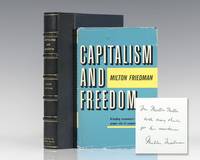
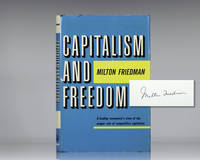
196287436Chicago: University of Chicago Press 1962. First edition of Friedman's magnum opus. Octavo original blue cloth. Association copy inscribed by the author on the front free endpaper to colleague and friend "For Merton Miller with many thanks for his assistance Milton Friedman." Fine in a very good dust jacket with light rubbing. Housed in a custom half morocco clamshell box. An exceptional association linking these two Nobel Prize-winning economists and giants in the field as Friedman revolutionized economic theory with his free-market free-from-government principles and Miller changing the way markets assess a company's value. "Friedman a laissez-faire economist and professor at the University of Chicago is considered one of the leading modern exponents of liberalism in the 19th-century European sense. In Capitalism and Freedom he argued for a negative income tax or guaranteed income to supersede centralized bureaucratized social welfare services which in his view are inimical to the traditional values of individualism and useful work" Britannica. Selected by the Times Literary Supplement as one of the "hundred most influential books since the war". It also placed tenth on the list of the 100 best non-fiction books of the twentieth century compiled by National Review and on Time Magazine's top 100 non-fiction books written in English since 1923. University of Chicago Press hardcover books
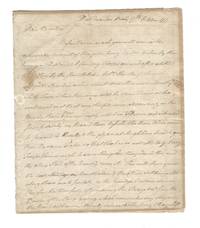
1777BB002<p>CLINTON George First Governor of New York State 1777-1795 1801-1804; also 4th Vice-President of the United States 1805-1812 under Thomas Jefferson and James Madison.<br /></p><p>"Kingston laid in ashes by the Enemy" . <br /></p><p>8vo 7-3/4 x 6-1/2 inches 1-1/2 pages on laid paper with integral address leaf remnants of wax seal some fading to text and signature scattered minor<br /></p><p>It should be noted that Clinton was sworn in as New York's first governor on 9th July 1777 shortly after Kingston was established as its first capitol 20th April 1777. Thus the burning of Kingston and change of capitol to eventually Albany was a consequence of the War for Independence. <br /></p><p>Remarkable handwritten manuscript explaining that the British troops arrived at Kingston before his own re-enforcements whereupon 1000 men burned the town and immediately returned to their ships warning that a similar fate awaits the settlements along the shore and that forage and property should be moved from the path of the enemy reminding him to take the sleigh from the barn as it is all the personal property that remains to him after the destruction in Kingston noting that the enemy is advancing up the river to Saugerties with Tryon commanding on the east side and Vaughn on the west.<br /></p><p>Transcript</p><p><i>Head Quarters Hurley 17th October 1777</i></p><p><i>Dear Brother</i></p><p><i>"Before this can reach you you will receive the – disagreeable account of Kingston being laid in ashes by the Enemy. They landed before my troops arrived after a little opposition by the few militia Cols Pawling & Snyder could collect and marched about 1000 Men immediately up to Town - where they were told by some Tories who continued in it that my People were advancing on the Hurley Road & they immediately set it in Flames and extracted precipitately on Board their Vessels tho their Orders were to proceed to Hurley & the adjacent Neighborhoods to give them the same Fate so that tho I was not able to get my Troops Time enough to save Kingston they saved this and the other Parts of the Country near it. This will show you the Fate New Windsor & the other settlements along shore are to partake on the Enemy's Return down. Therefore the Necessity of removing the Forage &c from the Banks of the River among which remember my Slay in the Barn as it is now the only moveable Property I have left the Best being removed to Kingston shared its Fate tho indeed a great share of Property has been saved out of Town. The enemy sailed up the River this Morning as high as Saghertyes burning along Shore as they go. When they go a little higher I will follow them. They have Parties on both Sides of the River. Tryon commands those on the East & Vaughan on the West Side of the River.</i></p><p><i>Yours Sincerely</i></p><p><i>Geo Clinton</i></p><p>On Friday evening 16 October 1777 a British fleet commandeered by James Wallace and John Vaughn the latter on board the 'Friendship' which had anchored near Easopus Island the day before came into the mouth of Rondout Creek and engaged the gallery "Lady Washington". Shortly after noon the British landed on Rondout Creek and the Cove above Columbus Point. Vaughn personally led the march capturing and forcing a negro to lead them into town without meeting resistance. The troops went through the streets in parties led by Tories setting the whole place on fire in response to the occasional resistance lodged by residents from within their houses. There was looting and vandalism. Meanwhile part of the fleet went a bit up the River and creek to destroy landings and sloops. By the time George Clinton arrived into Kingston the whole town was ablaze and the British party had set out to return to their ships.</p><p>In a letter on 18 October penned at Little Britain NY in response to this letter his brother B. Genl. James Clinton writes:</p><p><i>D'r Brother</i></p><p><i>Yours of yesterday's Date I have just received. I am sorry for the Loss of Kingston &c. </i><i>Five of the Enemy's Shipping Returned Down the River last night without Doing any Damage Except fireing Some Cannon and small arms at our men and wounding one of ours on Board of a Ferry Boat…"</i></p><p>The war became personal for the governor specially after what had happened to Kingston. In a letter to William Smith @ 31 October 1777 his sentiments and commitment are laid bare:</p><p><i>"The Cruelties as well Cowardice with which this Warr has been conducted ag't us must I think be sufficient at this late Hour to convince every Man that all connection with Great Britain is at an End…"</i></p><p>Reference: <b><i>Public Paper of George Clinton</i></b> First Governor of New York War of the Revolution Series. New York: Wynkoop Hallenbeck Crawford Co. 1900. Volume II pp. 457-459. Our letter of 17 October 1777 appears to be unknown to the editors of the Clinton papers although they do list and transcribe the 18th October response by his brother James. Consequently our letter appears to be the only firsthand account by the governor of New York on the actual burning of Kingston an event historically reenacted locally each year within Ulster County.</p> Autograph Letter Signed, “Geo Clintonâ€, written to his brother Gen. James Clinton in New Windsor (“Dear Brotherâ€), from books
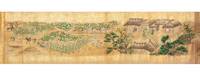
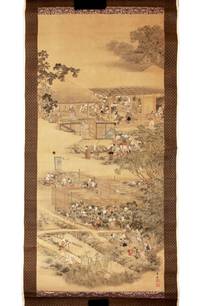
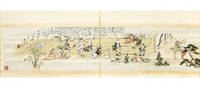
6984Japan: early mid-Edo. The theme of the four seasons of rice cultivation has had an extensive presence within Japanese art and literature. These two luxury festive scrolls beautifully depict the year-long cycle of rice growing in Japan along with the ancillary activities that took place during the year in the countryside including falconry growing vegetables and fruits seasonal festivals ways of relaxation and the annual tribute of rice to the fiefdom lord. The activities shown on these scrolls have much in common with Brueghel paintings and vividly depict country life. We learn from the labels and handwriting on the original box protecting these two scrolls that they were once owned by two prominent women members of the famous Nabeshima family. The first owner was Teiju in 1699-1752 wife of Muneshige Nabeshima 1687-1755 fifth lord of the Hizen Kashima han Hizen Kashima fiefdom. The later owner was Tokusei in or Kashioka 1798-1877 widow of Naonori Nabeshima 1793-1826 ninth lord of the same fiefdom. Tokusei in was particularly interested in the development of agriculture of the fiefdom and invented the form of brocading known as Saga nishiki. An educated woman she was also a book collector and her library is now kept intact in the Yutoku Inari Shrine in Kashima City in Saga Prefecture. Written on one of the old labels on the box is: "Shiki no kosaku" "Rice Cultivation through the Four Seasons". This type of scroll was oftentimes produced as part of a wealthy bride's dowery as a symbol of a good harvest and therefore good fortune to the new couple. Another label on the original box states in trans.: "scroll of images of our territory." The scrolls are very richly painted with copious clouds of gold flakes at top and bottom throughout. On both scrolls the actual images of the ground and background have gold-heightened effects kinsunago or "golden sand" or have been painted with gold. The folds and borders of the figures' clothes are heightened with gold and silver giving extra nuance. The coloring and detail of each person's face and clothing is quite refined and subtle with very delicate and highly detailed tiny brush strokes. We also note that the crowns of the trees have been carefully painted to depict every individual leaf. Clearly the artist was highly accomplished and went to great lengths to create these scrolls. SCROLL ONE: The first scroll covers all aspects of spring and summer activities. The first scene is clearly early spring with the plum trees in blossom. The farmers are preparing the unhulled grains of "seed rice" from last year's harvest to germinate in preparation for planting this year's crop. Everyone from the very young to old is participating. Many animals including horses and cows are in evidence. The next scene shows farmers "waking up" the dry paddies by tilling the soil. The following scene later in the spring with cherry blossoms in full bloom shows the farmers removing the weeds from the dry field and in an adjacent flooded paddy planting the rice seeds in the now-prepared seed beds. In the magnificent landscape shown behind we see a waterfall demonstrating the freshness of the water soon to flood the fields. Next we see the farmers planting the seedlings in another paddy now flooded. The farmers are supported by a band of musicians who are standing in the adjacent paddy celebrating the all-important transplantation ritual. During the summer water must be continually added to the fields. In the next extended scene we see a farmer using a hand-cranked hydraulic device to lift water to the paddies and other farmers tending and weeding the fields during a wind-driven rainstorm. The way the artist subtly depicts the rain reveals his great skills. The following scene shows a number of farmers and locals celebrating the summer growing period by dancing and playing musical instruments in front of a shrine. They have offered mochi to the shrine praying for rain and hoping for a good harvest. The next several scenes show the farmers growing and harvesting vegetables and beans and picking fruit from large orchards. We see a samurai passing through with his entourage en route to visit the fiefdom lords. SCROLL TWO: The second scroll begins by showing more of country life. Farmers are shown delivering vegetables and a group of samurai are engaged in falconry accompanied by a considerable entourage. Geese attracted by the now harvested fields fly by clearly intended as the prey of the falcons. There are several farmers fishing by the river and another group is resting after the day's work drinking water. We can sense they are all waiting for the crucial rice harvest. Now the autumnal harvest season arrives with a wonderful and complex scene of farmers cutting the rice stalks in the drained fields with sickles. The gathered stalks are bundled into tight sheaves and hung upside-down to dry. Now we see the dried sheaves loaded onto boats for transport. The now-empty paddies are filled with birds picking at the remaining rice kernels. We also see two fishermen catching fish in the river. In the next scene the sheaves are stacked before being transported by horse human and oxen to another area where the sheaves are further dried. In the following scene quite complex we see the rice stalks being processed to separate the rice grains from the shells and then dehusked. The next scene shows the grains of rice laid out on mats to dry. Samurai and farmers are having their own separate picnics celebrating the harvest. We also see a blind musician being escorted by two friends a fish monger and a firewood merchant going to the celebration shown next. The next scene depicts an elaborate harvest festival with farmers proceeding to a shrine to give thanks. They are observed by many spectators. The maple trees have turned color to brilliant reds and oranges. Finally we see farmers carrying their share of taxable rice to the warehouse where they will present the rice to the heads of the village who are recording the farmers' annual tributes in a ledger book. Many rice bales are in evidence. In fine and fresh condition. There is a minor loss of image at the end of the second scroll where two sheets of paper are joined. Occasional minor worming and discoloration. hardcover books
178063128Head Quarters Bergen County NJ 1780. Folio one page approximately 125 words in part: "I perceive . that you had collected about two hundred Cattle more and that a further number might be obtained . I cannot of right command the services of the militia . let the commanding officers know how distressed the Army has been and is likely to be for provisions and that it will be rendering splendid service to us and distressing the enemy to remove the Cattle from those parts of the Coast which furnish the New York Markets." Very good. Browned one small piece detached one word of text easily repaired. After Washington's victory at Monmouth June 1778 during which battle Forman had served as an advisor to Charles Lee the war settled into stalemate with Washington's army in New Jersey and the British forces content to remain in New York both sides keeping an eye on each other while trying to provide for their soldiers the American forces suffering deprivation similar to that of Valley Forge. Meanwhile on the day this letter was written word reached Washington of the complete rout of Horatio Gates and his troops at Camden South Carolina opening Virginia to British invasion from the South. Bolstered by American victories at Kings Mountain Oct. 1780 and Cowpens Jan. 1781 and the depletion of Cornwallis's army at its victory over Nathaniel Green at Guilford Court House Washington in conjunction with his French allies moved south to envelop Yorktown earning the British surrender in October 1781 effectively ending the war. General David Forman 1745-1797 born and raised in Monmouth County New Jersey was appointed colonel of a New Jersey regiment that reinforced Washington at New York in June 1776. After suppressing a loyalist uprising later that year during which time he earned the nickname "Devil David" he was chosen to lead a regiment in the Continental army and in 1777 was commissioned brigadier general to lead the New Jersey militia commanding that force in the battle of Germantown Oct. 1777. Disagreements with the New Jersey legislature led to his resignation from that command and he spent the rest of the war running listening posts especially along the coast of New Jersey providing Washington with intelligence on the movements of the British fleet and army a service he was providing at the time of this letter. see DAB Tench Tilghman 1744-1786 born and raised in Talbot County Maryland graduated from the precursor to the University of Pennsylvania in 1761 taking up a mercantile business until the outbreak of the revolution. After serving briefly as a captain in the army he joined Washington as a volunteer and served continuously as an aide-de-camp to the general for the balance of the war. "The amount of secretarial work in addition to military duties that he performed for Washington was prodigious" DAB and he was granted a regular commission of lieutenant-colonel in 1781. After the victory at Yorktown Tilghman was chosen by Washington to carry the announcement of the surrender of Cornwallis to the Continental Congress. Provenance: When recently purchased the letter was in an old frame and removal revealed an autograph note inside the backing included here as follows: "This letter was bought by me about 1860 of Miss Brown residing at 92 Columbus Street Albany New York. She was a sister of an old minister of St. Peters Church. This Miss Brown was a client of Orlando Meads and myself and found this letter in a barrel in the garret of the home occupied by her sister at Manalapan New Jersey formerly owned by General David Forman. signed Dexter Reynolds / Albany Sept. 7 1902. Presented to my son Marcus T. Reynolds." A newly discovered Washington letter shedding light on the general's relationship to state militias and his concerns for providing for his troops while disrupting the supply lines of the British. Not in Fitzgerald or the Founders Online from the National Archives which lists 57 other Washington letters to Forman 1777-1782 showing a gap from 24 July 1780 to 17 May 1781 and two others post-war. 9836. <br/><br/> unknown books
6951Japan: ca. 1840-50. Two large and fine paintings in hanging scroll format depicting all the steps in the production of the finest Uji tea by the Kanbayashi family to be sent to the Tokugawa shogun in Edo. These scrolls are of very great beauty and complexity and were surely painted by a master artist see below. The production and drinking of tea in Japan has a long and rich history extending back to the Nara period 710-94 when tea was brought back by diplomatic missions from China. Emperor Saga was served tea in 815 and afterwards ordered the establishment of several tea plantations near the capital of Kyoto. It was soon discovered that Uji a village located south of Kyoto was the ideal location to produce excellent tea leaves due to its rich soil and high-quality water. It became Japan's first major tea-producing region and has maintained its reputation for superior tea. In the 15th century the cultivation and production of tea in Uji underwent several transformations: the technique was introduced of covering young tea buds shielding them from the sun during the last weeks before plucking to improve their flavor ooishita saibai; and the quality of the tea was steadily improved through careful processing. Various shoguns including Hideyoshi Toyotomi 1536-98 and Ieyasu Tokugawa 1543-1616 supported the tea growers and processors in Uji. By the early 17th century an annual procession to celebrate the Shogunate's acquisition of its annual stocks of tea from Uji - Ochatsubo dochu "Travelling of the Shogun's Tea Jar" - was formalized as an official ritual event akin to political theater and thereby reinforcing Tokugawa authority. A delegation - Uji saichashi "Uji tea-picking envoy" including a "Tea Specialist" sukiya gashira and two subordinate "Tea Monks" chabozu - was sent with empty jars by the shogun each spring to observe the harvest and participate in the processing and selection of the tea leaves for the shogun. After many laborious steps of processing and selection as we shall see the tea leaves were placed in large jars. A few of these jars were sent as an offering to the Imperial Court Chatsubo shinken in Kyoto and the remainder were carried to Edo Castle in the autumn. The round-trip procession was a highly elaborate and publicized event. When the envoys returned to Edo the leaves were ground and made into powdered green tea for consumption at formal events at Edo Castle. During the last part of the 16th century and early years of the 17th century members of the Kanbayashi or Kamibayashi family found favor with several shoguns and eventually served as exclusive suppliers to the shoguns and the great daimyo the company established in 1558 still exists as Kanbayashi Shunsho honten and is affiliated with Coca-Cola. The family was given the honorific title of On cha todori "president of the Uji tea industry" and was also known as On mono chashi or Omono chashi "tea suppliers to the imperial family and shogun and leading nobility". They were allowed to wear samurai clothing and carry swords. Our scrolls beautifully depict all the steps of harvesting processing selecting and packing the tea leaves for transportation to the shogun in Edo. SCROLL ONE: This is composed of five different scenes. The first depicts two men erecting poles at the sides of a tea field preparing to cover the tea bushes shielding them with netting from the sun. Across the river the second image shows a member of the Kanbayashi family with sword at hip discussing the current crop with an employee who has a ledger book in front of him. They are being served tea while another employee is showing the just-harvested leaves. Behind them we see several women picking through the plucked leaves searching for impurities. The next scene is splendid: it shows many women harvesting the young tea leaves from the bushes which have been covered by netting supported by poles. It is a "beehive" of activity with about ten women working assisted by young men carrying the leaves away in buckets. A woman in the background is taking a break and nursing her child. The fourth scene shows another member of the Kanbayshi family leading a group of workers to the fields. A senior assistant is carrying a flag with the Kanbayashi family symbol. The final scene offers valuable information regarding the steps of processing. We see a large roofed building and on the right side is the heating room where steam is produced to heat the harvested leaves. To the left is a room where the actual steaming of the leaves is taking place. The leaves are then spread out in bins and cooled by women using fans. Further to the left we see men sifting to separate the smallest and finest leaves from stems and larger leaves. The final product is being weighed on a scale and placed into fine wooden boxes. The "story" of this first scroll with five scenes has been artfully constructed starting at the bottom and weaving its way upwards. The brushwork is highly refined and detailed: the faces showing a wide range of expression the leaves individually painted and the coloring extremely subtle. SCROLL TWO: This is also composed of five scenes. The first at bottom shows Kanbayashi employees further drying the leaves and placing them into large flat baskets which are carried to the next room. On top of the basket is a piece of paper describing the quality of the leaves. Yet another sifting and inspection of leaves takes place. The next scene upstairs shows a group of women spreading the leaves over a large table and picking through the leaves by hand again removing any impurities. These leaves are then passed to two inspectors for further review. The third scene shows several women yet again examining the leaves and removing further impurities this time with chopsticks. They turn and present the trays holding the leaves to a high-level Kanbayashi employee for approval. In turn the trays are then presented to the representatives from the shogun who are carrying swords and wearing masks and official attire. They use chopsticks to further cull undesirable leaves. In the background are large jars holding tea in a storage room. The fourth scene is that of a tea ceremony room where members of the Kanbayashi family and government officials are meeting and conducting a tasting. The final scene at the top of the scroll shows a formal room with government officials observed by other members of the delegation presumably the "Tea Specialist" and the two "Tea Monks" packing the tea in small envelopes and placing them in large jars. In the back is a beautiful garden. We can attribute with some confidence these hanging picture scrolls to Kagaku Ozawa fl. 1840-50 painter draftsman and poet in Kyoto. He was a follower of Kazan Yokoyama 1781-1837. The two scrolls are in fine and fresh condition preserved in a wooden box. The second scroll suffers from minor worming. ❧ Much of our description is based on the wonderful article by Prof. Taka Oshkiri "The Shogun's Tea Jar: Ritual Material Culture and Political Authority in Early Modern Japan" in The Historical Journal Cambridge Univ. Press 59 2016 pp. 927-45. hardcover books
196223005Chicago: University of Chicago Press 1962. First edition of Friedman's magnum opus. Octavo original blue cloth. Signed by Milton Friedman on the front free endpaper in a contemporary hand. Fine in a very good dust jacket with light rubbing. Housed in a custom half morocco clamshell box. Rare signed. "Friedman a laissez-faire economist and professor at the University of Chicago is considered one of the leading modern exponents of liberalism in the 19th-century European sense. In Capitalism and Freedom he argued for a negative income tax or guaranteed income to supersede centralized bureaucratized social welfare services which in his view are inimical to the traditional values of individualism and useful work" Britannica. Selected by the Times Literary Supplement as one of the "hundred most influential books since the war". It also placed tenth on the list of the 100 best non-fiction books of the twentieth century compiled by National Review and on Time Magazine's top 100 non-fiction books written in English since 1923. University of Chicago Press hardcover books
1970123601New York: Cinnamon Press 1970. Rare Bag One lithograph signed by Beatles icon John Lennon. One page the title page from Lennon's Bag One Portfolio. Signed by him beneath the image. One of 300 numbered copies this is number 172. In near fine condition. Matted and framed. Rare and desirable. In 1969 as a wedding gift for Yoko John drew the 'Bag One Portfolio'--a chronicle of their wedding ceremony honeymoon and their plea for world peace in the Bed-In. The following year the artwork was produced in a series of three hundred portfolios of fifteen signed prints each. The majority depict John and Yoko's most intimate private moments--upon their first exhibition in London more than half were deemed 'indecent' and confiscated by Scotland Yard. The rare title page features perhaps the most famous and recognizable print of the suite. Cinnamon Press unknown books
16013078London:: Impensis G. Bishop 1601. FIRST EDITION second issue with cancel title page. Folio:. 33 x 22 cm. Ï€6 par.4 a-b6 A8 B-3I6 3K4; A-3G6 3H4 3I-3O6 3P8 lacking blank leaves Ï€1 and 3P8 Complete in two parts; with a divisional title page to the second tome and the errata/colophon on leaf 3P7 Bound in contemporary English calfskin ruled in blind rebacked and recornered in morocco. An excellent crisp bright copy with very minor faults: repaired clean tear with no loss leaf P4. A few signatures with very light marginal dampstains. Occasional rust spots marginal tears or marginal natural paper flaws no loss whatsoever. Title pages to both volumes. The first with an elaborate architectural border with Solomonic columns. The second with a large woodcut device. An impressive book. “The ‘Natural History’ of Pliny the Elder is more than a natural history: it is an encyclopaedia of all the knowledge of the ancient world… It comprises 37 books with mathematics and physics geography and astronomy medicine and zoology anthropology and physiology philosophy and history agriculture and mineralogy the arts and letters… The ‘Historia’ soon became a standard book of reference; abstracts and abridgements appeared by the third century. Bede owned a copy Alcuin sent the early books to Charlemagne and Dicuil the Irish geographer quotes him in the ninth century. It was the basis of Isidore's Etymologiae and such medieval encyclopedias as the Speculum Majus of Vincent of Beauvais and the Catholicon of Balbus. One of the earliest books to be printed at Venice the centre from which so much of classical literature was first dispensed it was later translated into English by Philemon Holland in 1601 and twice reprinted a notable achievement for so vast a text… Over and over again it will be found that the source of some ancient piece of knowledge is Pliny.†PMM 5 “Holland's first book the first complete rendering of Livy into English was published in 1600 when he was nearly fifty. It was a work of great importance presented in a grand folio volume of 1458 pages and dedicated to the queen. … “The Livy was followed in the next year by an equally huge translation of the elder Pliny: The Historie of the World Commonly called the Naturall Historie. This encyclopaedia of ancient knowledge about the natural world had already had a great indirect influence in England as elsewhere in Europe but had not been translated into English before and would not be again for 250 years.â€ODNB Pforzheimer 496; STC 2nd ed. 20029 Impensis G. Bishop, unknown books
16154007Ávila and La Horcajada 1615. Manuscript on parchment 380 x 270 mm. 18. Complete. Contents: ff. 1r-4v: Regla in Spanish in 30 numbered sections inconsistent numbering on ff. 3v-4v in a rounded script in brown ink the first page slightly larger up to 27 lines. F. 1r: incipit first four lines in large lettering with very large calligraphic initial: En el nombre de dios todo poderoso padre y hijo y espiritu sancto tres personas y una esencia. Section 30 f. 4v added in a slightly later hand. The word Cruz symbolized by a red Maltese cross. Text on ff. 2r-2v underlined in red. Calligraphic initials some with marginal extensions in brown purple or red. Marginal drawings of prickly foliage some in the shapes of fantastic animals. Later marginal notes opposite many sections. Ff. 5r-5v: Heading: Este es traslado de un testimonio followed by two notarial subscriptions on f. 5v one partially in cursive signed and dated Ávila 11 May 1527 the other in italic partly faded including the date 1615. F. 6r: A cerca de la procession de la Resurrection. After an introductory portion in a small round early 16th-century hand in brown ink the text continues from f. 4v with sections 32-37 of the Regla of which sections 33-37 are in a later sixteenth-century hand; these sections ruled through with light diagonal lines. Signatures or notes in lower margin. F. 6v: blank except for five lines heavily cancelled in red. Ff. 7r-7v: five paragraphs in a fine upright italic hand the first and third with headings in red La orden que han de tener en la procession de la Resurxection sic en la faded and illegible.; La orden que sea de tener en la procession de la Resurretion sic en el domingo de pascua es la siguente. Followed on f. 7v by a note in a different hand dated from La Horcajada 21 May 1550. Ff. 7v-8v and back inner cover: later additions some quite faded. A few later marginal annotations throughout.Rubrication and decoration: headings and line fillers in red a few ornamented line fillers or borders some passages underlined in red or light purple else ruled in dry point numerous calligraphic initials in red or brown ink opening initial with purple filigree extension filling left margin numerous foliate vegetable and zoomorphic ornamental designs in the margins in red purple and brown ink.Binding: stitched into the original parchment cover with title "Regla de la Pasion" in large letters the R with decorative extensions above a large cross in green ink entwined with the snake and in the margins apparently the instruments of the Passion.Condition: rubbing and staining vertical crease from folding causing occasional erasure of text outer edge of first page somewhat rubbed affecting legibility of text some words at line ends helpfully written over in a later hand the inks used in the last two leaves quite faded; wrapper worn and darkened with tears at top and 3 small holes in lower cover.Provenance: Confraternity of the Holy Cross of Horcajada; purchased in France with export license. An early Spanish confraternity manuscript containing the rules and statutes that governed the Confraternity of the Holy Cross referred to as the Cofradía or Hermandad de la Cruz the word Cruz being supplied by a Maltese cross in red of La Horcajada a town located in Castile y León in the province of Ávila. As in other Roman Catholic countries confraternities or lay brotherhoods played a vital role in community life in Spain functioning as mutual aid societies and venues for laypeople to express their piety and perform charitable acts. Vernacular manuscript confraternity statutes from the Iberian peninsula surface much more rarely than for example their Italian counterparts although it appears that Spain had a larger number of confraternities proportional to the population especially in Castile y Leon than the other Catholic lands. Virtually every community including small villages had at least one confraternity. While exact numbers of confraternities in sixteenth-century Spain are unknown "studies carried out for a number of cities suggest that the number of confraternities and brotherhoods in the Hispanic kingdoms was larger than elsewhere in Catholic Europe. The reasons behind the extraordinary popularity of confraternities and brotherhoods in the Hispanic kingdoms cannot yet be established however in view of the current state of research on the topic. There has been a tendency for scholars to emphasize the confraternity as a primarily urban phenomenon a reflection perhaps of their early development in Italy where they formed an essential part of civic and urban life. In the Hispanic kingdoms however these institutions were equally important in the religious and social life of the small village. Pastoral visitations carried out by the bishops of Cuenca during the sixteenth century found that `nearly every community had at least one brotherhood' even small villages of 500 inhabitants. A similar pattern prevailed in villages around Toledo during the late sixteenth century" Callahan pp. 18-19.In his article on Spanish confraternities William Callahan further points out their popular nature which "arose from the initiative of the laity rather than the clergy prime examples of the lay piety that began to flourish in late medieval Europe. This piety developed largely on its own uncontrolled by either local bishops or the pope both of whom regarded its manifestations with some suspicion. The resiliency of traditional confraternities and brotherhoods developed from their connection to local religious cultures. It also reflected a fact noted by scholars who have studied specific cities and regions the strongly popular character of membership. There were of course some associations that limited membership to the nobility or clergy but in most cases members were recruited from the popular classes. This was obviously true in the case of peasant villages where only one or two confraternities existed." pp. 22-23. In spite of the centrality of confraternities to early modern religious life in Spain there is comparatively little modern scholarly literature especially on the rural confraternities. Note the absence for example of any articles on Spain or Portugal in Brill's recently published Companion to Medieval and Early Modern Confraternities edited by Konrad Eisenbichler.This working manuscript bears witness to this central but understudied aspect of Spanish popular religious culture before the restrictions placed on confraternities by the Council of Trent and succeeding Popes. Consulted frequently and contributed to by members of the confraternity the manuscript includes abundant interlinear and marginal additions and corrections and half- or full-page later additions. The town of La Horcajada is identified in the opening page. Ff. 1r to 5v contain the introduction the first 30 statutes and a notarized testimony with heading "Este es traslado de un testimonio" which relates to the apparently recent establishment of the confraternity. The statutes cover admission of new members general rules of comportment requirements of prayer and confession for feast days and for the canonical hours charity for poorer members of the confraternity chants etc. Several paragraphs relate to processions including required habits and admission of non-members into the processions. On f. 6r a paragraph on the procession de la Resurrection is followed by six entries numbered 32 to 37 of which paragraphs 33 to 37 are in a later 16th-century hand. Several light diagonal lines through these five paragraphs may indicate that they were cancelled. The verso f.6v contains only five lines heavily cancelled in red ink and f. 7r continues discussion of the procession of the Resurrection on a feast day the name of the saint is smudged and on Easter Sunday in a different 16th-century upright cursive. This second section of which portions are difficult to read because of fading ends on f. 7v and is followed by a note in a larger hand dated from La Horcajada 21 May 1550. The final leaf and inner back cover contain later additions some quite faded. One late addition in the lower margin of f. 5v is dated 1615.The manuscript is decorated in a popular style. Some of the leafy plant designs have a thorny look that may reflect local vegetation. Animals and grotesques include a scorpion-like creature birds and possibly imaginary mammals. A witness to the central role played by religious confraternities in early modern Spain bearing the marks of its use and in original condition it is a rare survival and would repay further study.Cf. William Callahan "Confraternities and Brotherhoods in Spain 1500-1800" Confraternitas: The Newsletter of the Society for Confraternity Studies 12:1 2001 17-25. See also William A. Christian Local Religion in Sixteenth Century Spain Princeton 1981; Maureen Flynn Sacred Charity: Confraternities and Social Welfare in Spain 1400-1800 Basingstoke 1989. unknown books
195968003Government of the Dalai Lama 1959. First edition of this important document which details the historical relationship between Tibet and China from the 7th century to the 1950s and presents arguments supporting Tibet's claim for sovereignty. Octavo original printed flexible board wrappers with the title and date printed in red letters. Boldly signed by His Holiness the Dalai Lama on the front panel. Table of contents and 63 pages of text. In 1959 the Dalai Lama sought support from the U.S. and other nations to recognize their government in exile and to bring their case for Tibetan sovereignty and against Chinese aggression before the United Nations. It is necessary to distinguish between two 1959 publications under the same title. The more common today appears to be an octavo volume of 49 pages which several sources attribute to the Central Electric Press in Delhi India. The British Library and Harvard University each has a copy in that smaller format; WorldCat details 10 locations of the 49 p. 8vo edition under two OCLC numbers. Our publication a mimeographic duplication from a document produced on a typewriter printed on rectos only of quarto sized sheets has 63 leaves and an un-numbered first leaf "Table of Contents". Technical limitations mean that our publication in quarto mimeographed format is both more fragile by nature and less likely to have been issued in a large number of copies. Considering that the 14th Dalai Lama spent all but the first 90 days of 1959 residing in exile in Dharamshala in the state of Himachal Pradesh in northern India it is likely that our publication was produced there. Historical Context: In 1959 within days of the rapidly devolving March uprising in Lhasa the Dalai Lama and his retinue fled Tibet with the help of the CIA's Special Activities Division. They crossed the border into India on 30 March 1959 and soon afterward the Dalai Lama set up the Government of Tibet in Exile in Dharamshala receiving support from the CIA including a personal annual stipend of $180000 and other material support from at least 1959 until about 1974. CIA support for the Government of the Dalai Lama in Exile and other potential Tibetan assets reportedly totalled about $1.7 million per annum. In April 1959 the Dalai Lama sent a message to the U.S. Government requesting that the U.S. formally recognize the Free Tibetan Government and that he encourage other nations to do so. Under Secretary of State C. Douglas Dillon advised President Eisenhower that the U.S. should "avoid taking any position which might encourage the Dalai Lama to seek international recognition." Despite considerable U.S. covert support of the Tibetans' efforts to oust the Chinese the official U.S. position held that Tibet was an autonomous country under Chinese suzerainty. The State Department believed this position better served America's broader foreign policy interest viz. China and India. In fact the Eisenhower administration both the State Department and the CIA restrained the Tibetans from presenting their case against Chinese aggression instead skirting the political issues and treading the softer line of human rights violations and cultural oppression. The Tibetans finally enlisted Ireland and Malaya to request "The Question of Tibet" to be added to the U.N. agenda for its 14th session. Consequently the United Nations' Resolution 1353 XIV on Tibet was passed in October 1959. This first U.N. resolution on Tibet did not address the sovereignty issue but voiced their "grave concern at the continued violation of the fundamental rights and freedoms of Tibetans" and calling for "respect of the fundamental human rights of the Tibetan people and for their distinctive cultural and religious life." For an interesting exposition of this era of Tibetan diplomacy see "Tibet Issue at the UN: a case study in informal diplomacy 1950-65" by Kalzang Diki Bhutia. Either directly or indirectly this publication was made possible by support from the CIA; it is a fascination sidelight of history that the official US government position was not in alignment with this text and also that no copy of our rare publication seems to have survived in any institutional library in the United States. Housed in a custom half morocco clamshell box. Government of the Dalai Lama unknown books
6222Many finely drawn illustrations in brush ink & colors. Scroll 285 x 9310 mm. 23 joined sheets some inoffensive worming carefully repaired. Japan: copied before 1857. A finely illustrated scroll created in the witty and refined realistic style of Yamato-e and Ukiyo-e brush work depicting the route taken - a distance of about 4 km. - by pleasure-seekers from Ryogoku Bridge to Shin Yoshiwara the center of prostitution in the city of Edo. By the 18th century it was the home to some 1750 women. This was an extremely busy section with a strong commercial tradition in what is today's central Tokyo. Our scroll is an early copy of the original scroll; we do not know if that earlier scroll still exists. It was created by Bunyo Tozaka 1783-1852 a prominent Nanga-style artist who studied with Buncho Tani and specialized in kachoga pictures of flowers and butterflies. The author of the notes was Hirokata Yashiro 1758-1841 the influential historian of Japan and great book collector he had more than 50000 Chinese and Japanese books housed in a series of three buildings in Ueno known at the Shinobazu Bunko. The beginning of our copied scroll depicts several boats holding men including samurai and women making their way along the Sumida River from Ryogoku Bridge to Shin Yoshiwara. They disembark at Kumagatado adjacent to Asakusa Bridge. From there the men - clearly samurai - mount rented horses Daiden Horse Co. with very inadequate saddles and continue their journey. There are images of high-ranking men with their faces hidden by large hats in order to conceal themselves. Their family crests on their kimono are also hidden. They pass through Raijin Gate today's Kaminarimon which belongs to Tokyo's oldest temple Senso-ji. There is a merchant depicted along the side of the road selling dumplings the famous Yone manju. Finally the samurai dismount and board small boats at an embankment to cross some wetlands at the Nihon zutsumi. They arrive at a commercial area called Doromachi "Mud Town" where the travellers wash their feet and tidy themselves before entering Shin Yoshiwara and all its pleasures. Then we see several samurai "interviewing" prostitutes. Heading north there is a gate through which the samurai enter Shin Yoshiwara. Women are standing waiting to meet their customers. Some women are serving tea there is a man carrying a portable lending library on his back and we see men with hidden faces entering buildings with women waiting inside. There is another building with women sitting being "showcased" to passing potential clients. Next we have a scene of women entertaining with musical instruments; men are standing outside making their selections. The following scene shows men upstairs being entertained by dancers and musicians with food and drinks being served. A garden is shown. Women are seen on the street aggressively soliciting men. There are always suggestions of rooms behind rooms ready for the clients and their women. The next scene is the kitchen with men preparing octopus lobsters and shrimp. Another man is cutting up fish. Women carry the prepared food to another room where men are being served and entertained. At the end we see a man taking a nap. At the end there are notes - collector's thoughts - regarding the manuscript: he tells who the original artist and author were and that this is a detailed description of a past time painted in a style similar to Morunobu Hishikawa and Iccho Hanabusa. The collector considered our scroll to be "finely done" and he has signed his name "Choton Kishi" with his seal which might be painted not stamped. Throughout the artist's sense of perspective and design is extremely fluid and imaginative. Many of the figures and landscapes have been heightened with lacquer gold silver and mica. As we move through the scroll there is also a sense of the day passing to evening. With the seal of the founder of the Kishi Library Choton Kishi d. 1857 the distinguished book collector and natural historian. This fine scroll was offered for sale by the great bookseller Shigeo Sorimachi in 1977 in his 50th anniversary catalogue. The scroll has been carefully backed in the past century. Preserved in a box with Mr. Sorimachi's handwriting on the upper cover. unknown books
24054401China ca.1900-1901. 3/4 Gilt-stamped leather over buff cloth very good 25 x 29 cm. 30p. 26p. with photos 2 per side = total of 104 photographs16 x 11 cm. all very clean albumen type bit of fading but clear strong images. RARE! . . . . ORIGINAL PHOTOGRAPHS OF THE BOXER REBELLION 1900 . . THE GERMAN RECORD OF THEIR ACTION IN PEKING . . This is a wonderful quite rare original period photo album. . It shows the German contingent sent to China to join in the defense of foreign embassies in Peking during the 1900 uprising of the siege of the Boxers. . The work begins with the group aboard the S.S. Strassburg from Bremen and their landing in the German colony of Tsingtao Tsingtau. From there it was a long trek down to Peking in the snowy winter. . Classic photos posed for the camera & history 4 in all. Arrival in China with more classic poses of the German troops before Chinese sights and in a temple where they were stationed. . One shows large wooden cases of their supplies stacked up in the temple garden with the commanders posing for a lovely memorial photos. Well taken photographs by the group's photographic officer nicely composed and carefully taken these are NOT tourist snap shots ! These average two photos per page. . A group of German military men pose before a wide variety of Chinese pagodas and sights some in long capes spiked helmets with Chinese officials ! Their arrival in Peking during a heavy snowfall in 1900 is documented by a series of superb & rare photographs from the Summer Palace where the lake is frozen ! Magnificent but frozen Peking sights architectural views palaces Germans on the move with horse and carts through the snow as they deployment on orders to defend the foreign legations. . Inside a legation taking lunch tiffin; outside two or three Chinese Boxers were executed hands bound they lay face down in the snow. More photos of travel along the way wonderful Chinese scenery & buildings architecture snowed in barracks their visit to the Great Wall in the dead of winter with snow sprinkled all over. . A passage through Chinese villages and towns with long columns of German troops. One comic and lovely image of a German dressed in Chinese clothes another in a Chinese garden. . A German celebration Chinese and German open-air trial where the accused Chinese are on their knees before a magistrate Germans playing badminton leisure time in a garden soldiers packing medical supplies on horses and German headquarters &c. . PEKING: A lovely series of photos showing the great sites of Peking and the Imperial Palace large battalion of German soldiers on parade another shows them marching to a great hall destruction of Chinese buildings superb views of fine Chinese architecture lakes bridges & bas-reliefs. . The Great Buddha with soldiers taking a memorial snap shot. A fascinating photo of "Coal Hill" and stunning panoramic bird's eye view of the Forbidden City. Interiors of the Forbidden city Temple of Heaven Emperor's throne & the great walled city. Germans guarding Chinese buildings Japanese Embassy Chinese gates and walls showing Chinese children saluting a German officer. . Magnificent temples with Fu-dogs Germans playing tourists taking commemorative photos before many great sights. . Fascinating photographs of ordinary Chinese who pose for the German camera with a German officer standing in the background and pagodas. Chinese officials and photos of the German cemetery with tribute paid to fallen comrades. Huge temple guardians stone bride & others. . A final pair of photos grace the last page the upper shows a large contingent of Germans on parade as they are reviewed by their officers on horse-back the lower shows them aboard a train in preparations for departure back to Germany thus ending the album. The remaining five pages are blank. . This album is an excellent example of the German contingent in China during the historic Boxer Rebellion 1900-1901. It is also a primary record of what they did where they went acting as tourists during free moments. Recording photos of the great and small wonders in China the people and their exotic culture. . This excellent album is in remarkable condition with tissue guards over each page intact all are photos neatly laid down and centered their condition is flawless. While the images have some degree of fading they are nevertheless still clear and sharp photographs taken by an officer with an excellent Leila German camera. . This bright officer had the great foresight to record this great adventure showing himself and his comrades-in-arms on their sojourn through China to Peking. We thank him for leaving this superb album for posterity. . . hardcover books
1937004544Tokyo: Kokusai Bunka Shinkokai The Society for International Cultural Relations 1937. First edition. Leporello. Hardcover boards paper pastedown. Very Good. The Japanese photobook equivalent of a Leni Riefenstahl movie! Deemed "arguably the high point of both the Japanese propaganda and the modernist photo book" by Parr and Badger in "The Photobook: A History". Oblong folio 27 by 30 cm. 64 pp. or 32 double-page back-to-back photomontages configured as an accordion fold-out and a deliberate attempt to adapt the traditional Japanese pillow book to a more modern usage. Text captions in English French and German. The photographers involved were also staff photographers of the Japanese photo magazine "Nippon". The black and white photos have an extraordinary dynamism and three dimensionality achieved by the artful juxtapositions and there is a cumulative power to the whole enterprise. Just as the photos themselves are able to convey movement the message of the whole is that Japan itself was on the march forward into a new dawn! And virtually every aspect of Japanese life is presented -- economic religious cultural architectural artisanal rural urban etc. Only two of the montages relate to the military -- one the army one the navy -- and this is in sharp contrast to similar publications emanating from Germany and Italy at the time. Japan had by then actually embarked on its program of foreign aggression and conquest whereas for the other Fascist regimes that still lay in the future. The scarce book was probably never for sale but rather was given as a gift to foreign dignitaries. Scarce with the only known institutional copies at the British Museum the Library of Congress. Two folds professionally and discreetly repaired with very minor loss a very thin sliver along those joints. A quarter sized infill to where there was a corner chip to the silver Japanese paper pastedown on the front cover. The front blue blank or endpaper does not have a title label pastedown which has been seen in other copies but it is obvious that there never was such a label pasted into this copy. <br/><br/> Kokusai Bunka Shinkokai (The Society for International Cultural Relations) hardcover books
179890506a<p>ChÅ Gessho 張月樵 and Kazaore YÅ«jo 風折有丈 artists.<b> Zoku Koya Bunko 続姑射文庫 5 vols.</b> Nagoya Kansei 寛政 10 1798. 5 volumes 27 X 18cm string-bound Japanese-style fukuro-toji. Original format with original covers and title labels housed in a modern striped chitsu with clasps 27.3 x 19cm. Original monochrome woodblock prints many double page with Japanese text. Edited by BÅkŠ暮雨巷. A sequel to Koya Bunko 姑射文庫 done in 1768.</p><p>The "Sequel to the Koya Library" done by principal artist ChÅ Gessho 張月樵 1765-1832 and Kazaore YÅ«jo 風折有丈 is a remarkable rarity that captures the vibrant world of art and poetry centered on haikai and haiga in Nagoya. It is justly celebrated by critics from Brown to Hillier and was featured in the Library of Congress' major Japanese art exhibition "The Floating World of Ukiyo-e: Shadows Dreams and Substance." With hundreds of full-page black and white woodblock images it is probably the most extensive original example of the Haiga aesthetic in existence. Vol 1 has 52 cho Vol 2 has 50 cho Vol 3 has 53 cho Vol 4 has 53 cho and Vol 5 has 56 cho including colophon. Identical to Volumes held in ARC Koten Seki portal database online Ritsumeikan University ç«‹å‘½é¤¨å¤§å¦ with the exception of an added modern page to their introduction in Vol 1.</p><p>In very good condition throughout worn original covers and title labels worming on rear wrapper of vol 5 very good impressions. Mitchell 564</p><p><br /></p> books
6759Numerous fine woodcut initials diagrams tables & maps in the text. Woodcut printer's device at end. 14 p.l. 18 leaves 6 leaves 30 xxxi-cxxvi leaves 4 leaves. Folio cont. Flemish blindstamped calf binding over wooden boards rather well rebacked a few unimportant stains rolls of medallion heads & foliage forming a double panel orig. clasps and catches metal corner guards. Cologne: J. Prael for P. Quentel 1537. bound after: ANSELM ARCHBISHOP OF CANTERBURY. In Omnes Pauli Apostili Epistolas enarrationes. Title within fine woodcut border by Anton Woensam of Worms. Some fine large woodcut initials. 8 p.l. 531 pp. Folio. Cologne: E. Cervicornus for G. Hittorp 1533. A most attractive sammelband of two well-illustrated books in an attractive contemporary blind-stamped binding probably made at the Stavelot monastery in Belgium. I. First collected and illustrated edition of the scientific writings of the Venerable Bede including De Natura Rerum dealing with cosmology and natural history and De Temporum Ratione a work on chronology that still exercises a considerable influence over our daily life today. This edition was edited and commented upon by Joannes Noviomagus i.e. Jan van Bronchorst of Nijmegen 1494-1570 philosopher and mathematician then a professor of philosophy at the Collegium Montanum in Cologne. It would appear that he used the manuscript at the Dombibliothek no. 103 of Cologne to prepare this edition. The De Temporum Ratione is a significant book in several ways. Most notably "this book helped to establish the custom of counting years from the birth of Christ. When we say that Queen Elizabeth II was born in 1926 not 'in the 16th year of the reign of George V' or 'in the year 2678 after the foundation of Rome' or in the '2nd year of the 481st Olympiad' we are indebted to the Venerable Bede."-Printing & the Mind of Man 16n. "Bede's greatest practical effect was on the Western calendar. His decisions beginning the year calculation of Easter names of days and months calculations of eras and so forth in most instances finally determined usage that was only refined not changed by Gregorian reform."-D.S.B. I p. 565. "The De Ratione Temporum first published in 1505 is particularly important. It contains a remarkable theory of tides based upon Pliny but also upon personal observation; first mention of the establishment of a port i.e. the mean interval between the moon's meridian passage and high water following; this interval is different in different ports."-Sarton I p. 511. Pierre Duhem described Bede's establishment of a port as the only original formulation of nature to be made in the West for some eight centuries. Also contained here is the De Natura Rerum 1st printing: 1529 which contains such physical science as was then known. It collects the wisdom of the ancient world on these subjects and has the special merit of referring phenomena to natural causes. It contains a particularly important section - the "De Comptu vel Loquela digitorum" - which is "our main almost our only source for the study of mediaeval finger reckoning or symbolism."-Sarton I pp. 510-11. See also Smith History of Mathematics II p. 200. The rest of the book contains further treatises by Bede on arithmetic astronomy and the calendar and chronology. II. Very rare. PROVENANCE: Early inscription of "Antonius abbatis a Sancto Remaclo" on front flyleaf; Benedictine monastery of Stavelot Belgium inscription "Liber Monasterii Stabulensis" on title-page of Anselm; auction sale of the monastery library Catalogue d'une belle Collection de Livres et Manuscrits précieux sur vélin du VIIIe et du IXe siècle Ghent 26 April 1847 lot 42; Michel Chasles 1793-1880 the mathematician with bookplate his sale Paris 27 June-18 July 1881 lot 28; Robert B. Honeyman 1897-1987 his sale Sotheby's 30 October 1978 lot 265. BINDING: Stavelot had its own bindery at this time and it is quite likely that this binding was executed there see Goldschmidt Gothic & Renaissance Bookbindings no. 90. Fine large copies preserved in a box. ❧ I. Adams B448-calling for two additional preliminary leaves but no other collation calls for them. Smith Rara Arithmetica p. 159n. Zinner 1657. II. Adams A1174. hardcover books
04421New Rochelle New York: The Elston Press 1901. Early Twentieth Century American Designer Bookbinding at its Very Best<br/>Shakespeare's Sonnets Bound by Henry Blackwell of New York<br/><br/>BLACKWELL Henry binder. SHAKESPEARE William. The Sonnets of Shakespeare now newly imprinted from the first edition of 1609 by Clarke Conwell at the Elston Press. New Rochelle New York: The Elston Press 1901.<br/><br/>Large octavo 9 1/8 x 6 1/4 inches; 232 x 159 mm. iv blank iv 1-126 1 127-154 1 limitation 5 blank pp.<br/><br/>".The Sonnets of Shakespeare newly imprinted by Clarke Conwell at The Elston Press from the first edition of 1609 with initial letters designed by H.M. O'Kane. Sold by Clarke Conwell at The Elston Press Pelham Road New Rochelle New York. Two hundred and ten copies have been printed: Finished this twelfth day of December MDCCCI."<br/>Limitation leaf. <br/><br/>Superbly bound ca. 1901 by Henry Blackwell stamp-signed in black "Bound by Blackwell" on verso of front end-paper. Full teal crushed levant morocco covers with triple-ruled borders surrounding an inlaid border of maroon morocco in turn surrounding a highly elaborate gilt and inlaid morocco design featuring 'Cobden-Sanderson' style gilt leaves and inlaid red morocco flowers. Each cover with four circles of inlaid maroon morocco. Spine with five raised bands decoratively tooled and inlaid in the same style lettered in gilt in the second compartment. Gilt ruled board edges and highly elaborate gilt decorated wide turn-ins. Doublures of orange morocco with a very intricate and pleasing geometric design. Lilac purple and cream decorated silk end-papers all edges gilt. A truly amazing example. Early twentieth century designer bookbinding at its very best.<br/><br/>Henry Blackwell 1851-1928 bookbinder and bookseller bibliographer and biographer was the son of bookbinder Richard Blackwell of Liverpool whose bindery appeared in the Liverpool & Birkenhead Trades Directory in 1870.<br/><br/>Henry emigrated to New York in 1877 where he supervised a large bindery. In 1892 he established his own shop in New York City. Blackwell played a prominent part in the Welsh-American life of his adopted country. He was a scholar of Welsh literature as well as binding his 1899 essay Notes on Bookbinding was a memorable contribution. He had the largest Welsh Collection of books on this side of the Atlantic and wrote articles books and bibliographies about Welsh-American books. In 1893 he commissioned H.T. Sears to engrave a Welsh bookplate for his Welsh books.<br/><br/>He also wrote articles about bookplates. He was a member of ex libris societies in America England France and Germany. He wrote the Introduction and a chapter on the study and arrangement of bookplates for W.G Bowdoin's book The Rise Of The Book-Plate New York 1901. His Private Library was sold at The Collectors Club in November 1915.<br/><br/>"A New Book on Bookbinding. In the coming fall the Briggs Brothers of Plymouth Mass. will publish under the title of "Twentieth Century Cover Designs." an elaborate volume devoted almost exclusively to the work of American binders and artists. Engravings of bindings by Toof & Co. Stikeman Dudley & Hodge F.J. Pfister Henry Blackwell Emily Preston Schleuning & Adams the Club Bindery and a few of the leading foreign binders will illustrate the text." The American Bookbinder Volume VI No. 4 November 1895 p.127. <br/><br/>"Among the binders who now have notable shops in New York City Henry Blackwell is one." The Outlook. Volume LXXI May-August 1902 p. 258.<br/><br/>"The most important of the New York private presses was in a suburb. The Elston Press began in Manhattan in 1900 but its owner Clark Conwell moved it to New Rochelle in 1901. Conwell with the aid of his designer and wife Helen Marguerite O'Kane was one of the most brilliant of the Kelmscott disciples. His books exemplify the best in the private press spirit: with traditional models as a point of departure they achieve freshness of their own. They were printed by handpress in limited editions on handmade paper and Japan vellum bound in boards or cloth or vellum with ties." Susan Otis Thompson. American Book Design and William Morris.<br/><br/>While Thompson compares the Elston Press books to those of the Kelmscott Press many of the Elston books are closer in style to the books of the Vale Press of Charles Ricketts. Either way the books of the Elston Press are some of the finest examples of printing and book design ever done in America. <br/><br/>Herbert H. Johnson. Notes on The Elston Press #7; Will Ransom. Private Presses and Their Books p. 260 #6. New Rochelle, New York: The Elston Press, 1901 unknown books
6429Woodcut port. of the author on verso of title & several woodcuts in the text. Title within typographical border. 12 p.l. last leaf a blank 348 4 pp. Small thick 8vo cont. vellum over boards stamped in blind on upper cover "M N H L" & "1613." Wittenberg: W. Meisner at the expense of C. Berger date of Foreword "1612". bound with: MATENESIUS Johann Friedrich. Critices Christianae Libri Duo de Ritu Bibendi super Sanitate Pontificum Caesarum Principum Ducum Magnatum Amicorum Amicarum &c. Woodcut printer's vignette on title. 8 p.l. 189 pp. one blank leaf. Small 8vo tear to first leaf of text in blank portion of gutter lacking folding plate as is often the case. Cologne: C. Butgen 1611. bound with: - De Luxu et Abusu Vestium nostri temporis Discursus quadraginta ex Sacrarum Scripturarum grauissimorumque Auctorum fontibus deducti. Woodcut printer's vignette on title. 6 p.l. 120 i.e. 121 one blank leaf. Small 8vo. Cologne: J. Crith 1612. bound with: VIDA Marco Girolamo. Schachia.Ludus ingenii virtutis et honestae voluptatis.in quibus de eius Usu Origine et Autore nec non latrunculis.agitur: adeo ut omni difficultate.obscuritate & ambiguitate sublata.Opera & Studio Lucae Wielii Ligio-Silesii. Small woodcut printer's vignette on title & one large folding sheet with two plates one of letterpress & another of a chessboard. 39 unnumbered leaves. Small 8vo. Strasbourg: P. Ledertz from a chronogram on title: "1604". A wonderful sammelband containing four very interesting books. I. First edition of a rare book. WorldCat wrongly attributes this to Balthasar Menz the elder 1500-85; it was written by his son also Balthasar 1537-1617 historian and dean of the University of Wittenberg who specialized in writing about the Saxon nobility. This is an account of several Saxon dukes and princes - including Albrecht III 1443-1500 Ernst 1441-86 Friedrich III the Wise 1463-1525 Heinrich IV the Pious 1473-1541 and Johann Georg I Elector of Saxony 1585-1656 - and their tours of Palestine and Rome. Menz has provided detailed descriptions of Jerusalem and Rome as recorded by the Saxon noblemen in their diaries. II & III. First editions. Matenesius d. 1621 was professor of history and Greek at the University of Cologne. The first work is on alcohol its uses in various religions and therapeutic values. "A catalogue of the greatest drinkers known to the author."-Simon Bibliotheca Gastronomica 1024. Like most copies ours lacks the folding woodcut "Catechismus M. Luther". The second work which is rare is concerned with the nature of luxury and its abuses especially regarding the wardrobes of the wealthy and ecclesiastics. IV. A valuable edition edited by Lucas Wielius of Vida's Scacchia ludus one of the most popular works on chess ever written. Vida 1485-1566 first published this work in 1525 and it was widely reprinted and translated for 300 years afterward. The chief historical interest of the work lies in its influence upon the names of pieces: the use of "castle" for rook still survives. Fine copies. hardcover books
00654London: Printed by T. Ilive for Edward Brewster 1701. Early English Edition of the Reynard Fables<br/><br/>REYNARD THE FOX. The Most Delectable History of Reynard the Fox. Newly Corrected and Purged from all grossness in Phrase and Matter. Augmented and Enlarged with sundry Excellent Morals and Expositions upon every several Chapter. To which may now be added a Second Part of the said History: As also the Shifts of Reynardine the Son of Reynard the Fox Together with his Life and Death &c. London: Printed by T. Ilive for Edward Brewster 1701.<br/><br/>Bound together with:<br/><br/>REYNARD THE FOX. The Most Pleasant and Delightful History of Reynard the Fox. The Second Part. Containing Much Matter of Pleasure and Content. Written For the Delight of young Men Pleasure of the Aged and Profit of all. To which is added many Excellent Morals. London: Printed by A.M. and R.R. for Edward Brewster 1681.<br/><br/>And:<br/><br/>REYNARD THE FOX. The Shifts of Reynardine The Son of Reynard the Fox Or a Pleasant History of His Life and Death. Full of Variety &c. And may fitly be applied to the Late Times. Now Published for the Reformation of Mens Manners. London: Printed by T.J. for Edward Brewster and Thomas Passenger 1684.<br/><br/>Three parts in one small quarto volume 7 5/16 x 5 9/16 inches; 186 x 141 mm. 156 2 table of contents 2 publisher's advertisements; 111 1 publisher's advertisements; 8 160 pp. Mostly black letter with titles and side notes in roman letter. Sixty-two woodcuts in the first part printed from thirty-nine blocks and fifteen woodcuts in the second part five repeated all repeats from the first part. Most cuts signed "E.B." Edward Brewster. Woodcut on C1 recto Part I printed upside down.<br/><br/>Contemporary sprinkled sheep. Covers ruled and decoratively tooled in blind spine decoratively tooled in gilt in compartments with two red morocco gilt lettering labels. Minor restoration to covers. Some browning occasional light dampstaining and soiling. Part I with tiny puncture marks in the lower blank margin through gathering I just touching one letter in the imprint on the title-page six small holes in I3 and one tiny hole in I4 causing loss of a couple of letters. Part III with paper flaw in the upper blank corner of A3 and A4 tiny tear 1/4 inch in the lower blank margin of F4 and paper flaw in the lower blank corner of I2 none affecting text. Armorial bookplate of Gloucester on front free endpaper. Bookplate of Hugh Cecil Lowther 5th Earl of Lonsdale 1857-1944 on front pastedown his sale 12 July 1937 lot 445. An excellent copy. Housed in a quarter morocco clamshell box.<br/><br/>Reynard the Fox "hero of several medieval European cycles of versified animal tales that satirize contemporary human society. Though Reynard is sly amoral cowardly and self-seeking he is still a sympathetic hero whose cunning is a necessity for survival. He symbolizes the triumph of craft over brute strength usually personified by Isengrim the greedy and dull-witted wolf. Some of cyclic stories collected around him such as those telling of the wolf or bear fishing with his tail through a hole in the ice are found throughout the world; others like that of the sick lion cured by the wolf's skin are derived from Greco-Roman sources. The cycle arose in the area between Flanders and Germany in the 10th and 11th centuries when clerks began to forge Latin beast epics out of popular tales. The main literary tradition of Reynard the Fox descends from the extant French ‘branches' of the Roman de Renart about 30 in number nearly 40000 lines of verse. The facetious portrayal of rustic life the camel as a papal legate speaking broken French the animals riding on horses and recounting elaborate dreams all suggest the atmosphere of 13th-century France" Merriam-Webster's Encyclopedia of Literature.<br/><br/>"Caxton's immediate successors as printers of the Historye of Reynart the Foxe Wynkyn de Worde and Richard Pynson both published illustrated editions using the same woodcuts. Although neither a de Worde nor a Pynson edition survives intact there are fragments and there is circumstantial evidence to show that a Wynkyn de Worde edition of about 1495 or earlier was illustrated by a series of 43 woodcuts.apparently newly made for that edition.The earliest nearly complete fully illustrated History of Reynard the Fox to come down to us probably dates from the period 1560-1586. It survives in a unique copy.sometimes described as the ‘Anonymous' edition because it lacks the first few and the last few pages were we would expect to find the name of the printer and the place of publication. It contains 39 of the 43 Wynkyn de Worde cuts. To judge by their worn state.they had been much used since they were first made. This Anonymous edition also contains a series of 19 smaller artistically inferior pictures.They too are quite worn and may date from soon after the earliest illustrated editions.I have ascribed this Anonymous edition to the period 1560-1586. It is therefore just possible that it is either the lost William Powell edition of 1560-1561 or the lost Edward Allde edition of 1586 for both of these are mentioned in the Stationer's Register but neither survives" Kenneth Varty Reynard Renart Reinaert and Other Foxes in Medieval England: The Iconographic Evidence Amsterdam: 1999 pp. 98-99.<br/><br/>"From William Caxton's first edition 1481 to Thomas Gaultier's only edition 1550 the story is divided into 43 chapters. This may explain why the Wynkyn de Worde picture cycle contained 43 vertical cuts though in fact some chapters were not illustrated and some were illustrated with more than one picture. In the period before the appearance of the Anonymous edition we know.of only three illustrated editions: the one by Wynkyn de Worde sometime before or in 1495 and the other by him c. 1515; and the one by Richard Pynson somewhere between 1501 and 155. In the Anonymous edition between 1560 and 1585 the story is divided into 58 chapters. This may account for the frequent repetition of the vertical cuts as space-fillers and even for the introduction and occasional repetition of the smaller horizontal cuts. For most of the seventeenth century the story now short-titled The Most Delectable History of Reynard the Fox is divided into 25 chapters but this does not result in any noticeable reduction in the number of cuts used of either the vertical or the horizontal kind nor in the introduction of new illustrative material. In short the same cuts go on in much the same order apart from space-filler repetitions illustrating the same episodes. The first seventeenth-century edition to continue this picture cycle tradition is Edward Allde's 1620 followed by Elizabeth Allde's 1629. It continues in the two editions published in 1640 by Richard Oulton one for John Slater and the other for John Wright; also in the editions published by Jane Bell in 1650 1654 and 1656; and in the first edition published by Edward Brewster in 1662. By this date the Wynkyn de Worde blocks had become so worn and damaged that it is not surprising to discover a totally new set closely modelled on them and on the sixteenth-century horizontals and that this set should appear in an edition made for the publisher who last owned the de Worde blocks; that is in Edward Brewster's second edition in 1671 of The most Delectable History of Reynard the Fox.The forty different cuts which illustrate this edition all prominently display his initials EB. He published further illustrated editions in 1676 1681 1694 and 1701. In 1671 Brewster gave a new lease of life to the old picture cycle and in 1672 he grafted new life onto the old story with A Continuation Or Second Part Of The Most Pleasant and Delightful History of Reynard the Fox.In due course this new story about Reynard was to attract new illustrations but in this volume Brewster makes do with a sprinkling of fifteen cuts from his new cycle bearing the initials EB and he uses them again in his 1676 edition of the old story now called Part One and in his 1681 edition of both Part One and Part Two.In 1684 Brewster marketed a further sequel to this Continuation. Since Reynard was dead the chief role in this new story is given to one of his sons the one called Reynardine. It is entitled The Shifts of Renardine The Son of Reynard the Fox.Edward Brewster was not the only late seventeenth-century publisher of the Beast Epic to feel the need to renew it. His contemporary John Shurley sometimes spelled Shirley also felt that need and in 1681 he published his Most Delightful History of Reynard the Fox in Heroic Verse.Unlike other earlier renovations of the story it was never reprinted perhaps because the verse form was unpopular and because the illustrations were poor and few" Varty pp. 254-257.<br/><br/>Brunet IV cols. 1228-1229. Lowndes p. 2076. Varty Appendix Three: "A Short-Title List of All Extant Illustrated Histories of Reynard the Fox from Wynkyn de Worde c. 1495 to A. Soulby c. 1800 which are kept in United Kingdom libraries based on H. Menke Bibliotheca Reinardiana" 24 18 and 21. Wing S3512 Part II and S3436 Part III. London: Printed by T. Ilive, for Edward Brewster, 1701 unknown books
1838291492New Orleans 1838. unbound. very good. Rare autograph document signed: The Citizens Bank of Louisiana trades shares in the capitol stock of the bank for parcels of land and slaves. Folio 4 pages City and Parish of New Orleans Louisiana September 8th 1838 whereby Demey Kemp and wife who are wealthy land owners with many slaves enters into a contract with Victorin Patin President of the Citizens Bank of Louisiana to secure the sum of fifteen-hundred dollars the amount equal to fifteen shares in the Capital Stock of said bank with fifteen shares in an additional allowance of stock for the following described property to wit as adjudicated by Judge Samuel Leonard and certified by Theodore Seghers notary public in small part: ".that including four tracts or parcels of land in the Parish of St. Helena containing two-thousand and forty acres; a tract of land situated on the River Licksaw containing six-hundred acres. Likewise further: Demey Kemp declares that one of the Slaves therein mentioned and named Adelin aged nine years has died since appraisement; and he referred to the title papers in the possession of the said Bank to show from when the appraised property is derived; with the exception of twenty-eight slaves who were born on the property. A mortgage is granted by the said Demey Kemp . to secure fifteen additional shares allowerd on his subscription in the Capital Stock of the Citizens Bank of Louisiana. According to the Judge's certificate there is no mortgage in this office on the different described properties except the mortgage granted in the sum of two-hundred schares in the Capital Stock of said Bank . then this said . Demey Kemp will be recognized as a stockholder of the Citizens Bank of Louisiana for fifteen additional shares." This document has been certified by Justice Samuel Leonard on verso with his signature and embossed seal October 6th 1938. Condition: usual folds with light soiling and minor toning on the Court Filing page: Very good.<br/><br/> Between 1831 and 1866 Citizens Bank of Louisiana currently owned by J.P. Morgan Chase & Co. accepted 13000 slaves as collateral on loans and repossessed 1250 enslaved individuals on loans that plantation owners defaulted on. Though this information is readily available through extensive historical research much of it financed by J.P. Morgan Chase and personally authorized by Jamie Dimon 2003-2005 this is the first document we have ever encountered whereby Citizens Bank of Louisiana is knowingly trading stock in their bank for slaves to shareholders.<br/><br/> unknown books
194129370n.p. n.d.: privately printed 1941. Only edition 4to pp. 8 20; photographic frontispiece; original blue printed wrappers with crossed fishing-poles; saddle-stitch binding; slight shadow on front cover else near fine. Inscribed "For Chief Boatswain's Mate W.A. Bartos USN from Franklin D. Roosevelt." "Having had a desire for some time to get away from Washington for a few days of restful diversion including some hoped for fishing in southern waters the President had previously instructed Captain Callaghan his Naval Aide to have the Potomac available at Port Everglades Florida for a projected cruise to the Bahamas." A working vacation affording the President fine fishing opportunities along the coast of Florida and the Bahamas. The President on the first day alone caught a tuna a skipjack and a mackerel. Bartos to whom the book is inscribed was an enlisted sailor attached to the President's party. Also attached to the President's party were the Attorney General Robert H. Jackson; Harold Ickes the Secretary of the Interior; and a young William J. McNamara. Included with the pamphlet are two 10" x 7½" photographs of Bartos sporting his rod and reel. <br/><br/> [privately printed unknown books
1569673671569. London 1569. First edition. London 1569. First edition. Printing and the Mind of Man 89: The "Crown and Flower of Medieval Jurisprudence" Bracton Henry de d. 1268. De Legibus et Consuetudinibus Angliae Libri Quinq; In Varios Tractatus Distincti ad Diversorum et Vetustissimorum Codicum Collationem Ingenti Cura Nunc Primu Typis Vulgati; Quorum Quid Cuiq; Insit Proxima Pagina Demonstrabit. London: Apud Richardum Tottellum 1569. xvi 444 i.e. 442 ff. Folio 11-1/4" x 7-3/4". Nineteenth-century diced calf gilt rules to boards gilt fillets ornaments and title to spine gilt rules to board edges gilt inside rules marbled endpapers ribbon marker. Light rubbing to boards faint dampstain to front board moderate rubbing to extremities front joint just starting at head corners bumped and somewhat worn armorial bookplate to front pastedown. Attractive large woodcut decorated initials. Light toning to text somewhat heavier in places light foxing and finger smudges to some leaves some fading to text of ff. 1 and 2. A handsome copy of a landmark work. $10000. First edition. Written between 1250 and 1256 De Legibus et Consuetudinibus Angliae The Laws and Customs of England is the first treatise on English law. A systematic work it emphasizes the separation of procedural and substantive matters and also cites cases as sources of at least intellectual if not formal authority. The principles formulated in this work and its use of precedents determined the development of English law and established the method adopted by Littleton and Coke. In Maitland's words it is "the crown and flower of English medieval jurisprudence" and "by far the greatest of our medieval law books.": Maitland Collected Papers II:43. Beale Bibliography of Early English Law Books T323. Printing and the Mind of Man 89. English Short-Title Catalogue S122159. unknown books