46 446 résultats
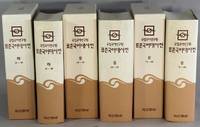
199966114Seoul: National Institute of the Korean Language 1999. 4to 3 large volumes; text in triple column limp tan boards; spines of dust jackets soiled else fine/very good in original slip cases. The official dictionary of the Korean language produced by the state regulator of language. National Institute of the Korean Language unknown
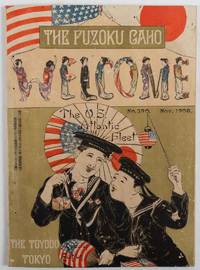
1908178293東京. Tokyo.: 東陽堂. Tōyōdō. Meiji 41 1908. Four double page colour plates a double page and a full page illustration in green ink black and white photographic illustrations. 25.5 x 18.5cm illustrations 23pp text: 50 13 36pp captions and text in Japanese and English. Original colour illustrated wrappers. Text evenly browned upper wrapper and first leaves a little insect damaged but still a very attractive souvenir issue. This fascinating magazine special issue was published to commemorate the Atlantic Fleet's the Great White Fleet visit to Japan in October 1908. The issue was published in November 1908 and reports all the activities of welcoming the fleet in Yokohama. Fuzoku Gaho was the first illustrated magazine which covered Japanese culture and was published between between 1889 and 1916. This special issue shows the enthusiasm Japanese government and the public displayed to the visiting US naval officers and sailors. <br> <br>The US Atlantic Fleet which consisted with 16 war ships went around the world between 1908 and 1909. As the ships were painted in white the fleet was also known as the Great White Fleet. In Japan they were called white ships 白船 in contrast to the black ships of Matthew Perry. This US naval exercise was to show off the American naval power to the world particularly in the Pacific after the Russo-Japanese War. The Japanese government decided to invite the fleet to Japan and welcome the ships with heightened enthusiasm. The contemporary social atmosphere and details of numerous events are covered extensively in this issue. Text is both in Japanese and English. The issue includes some pages of cartoon illustrations of American sailors on shore leave in Yokohama. With a title of "Jackass in Yokohama" and "U.S Jackies on the Spree" the sailors' experiences in Yokohama are illustrated with humour. . 東陽堂. [Tōyōdō]. unknown
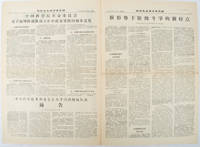
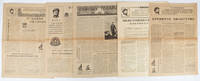
1968173190Beijing.: 中国科学院革命委員会.Zhongguo ke xue yuan ge ming wei yuan hui. 1968. Issue no.125 of this Cultural Revolution newspaper issued on 5th March 1968 by a Red Guards organisation within the Chinese Academy of Sciences. 4 pages single sheet printed on both sides minor signs of wear overall good. Text in Chinese. Sheet measures 39.5 x 54.3cm. Front page features a mobilisation assembly held on the 3rd July 1968 at the Chinese Academy of Sciences to complete the cleansing the class ranks and the official notice issued on the same day by the Academy can be found on page 2. . 中国科学院革命委員会.[Zhongguo ke xue yuan ge ming wei yuan hui]. unknown
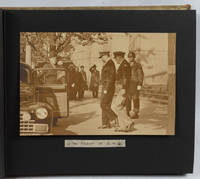
1946224036Tokyo.: 新世界通信社. Shinsekai Tsūshinsha. Circa 1946. Twenty three black and white fine photographs tipped in on twenty thick black card sheets each captioned in English and presented in a silk covered album with tassel ties. Fifteen of the photographs measure13.5 x 20cm with the rest 7.5 x 13cm approximately. Some light silvering on photographs but overall both the photographs and album are in very good condition. A handsome rare example of a album apparently issued by a Japanese company for US forces in Occupied Japan. This rare photographic album was published by Shinsekai Tsushin Sha 新世界通信社 soon after the Allied Occupation of Japan began. The scenes depicted are mainly from Tokyo where the occupation headquarters were located and American troops were concentrated but the album also includes photographs of scenic spots popular with the occupation forces including Nikko the Great Buddha of Kamakura and the ski resort of Zao in midwinter. There are also photographs of traditional Japanese cultural events including a tea ceremony flower arrangement and a Noh theatre performance. <br> <br>One image captioned “Shopping” depicts a young man in Allied forces uniform who appears to be one of the many Japanese American servicemen who took part in the occupation. He is shown examining items for sale in an ornately decorated Japanese souvenir store while a young Japanese woman reflected in a mirror looks on from behind. <br> <br>The album opens with an image of the Sacred Heart Cathedral in Yokohama also known as Yamate Catholic Church in the morning light captioned “Morning Meditation”. Other photographs feature major buildings connected with the Allied presence in Tokyo including the General Headquarters site in Marunouchi the JOAK Radio Tokyo and WVTR the American Armed Forces Radio building and St Luke’s Hospital. <br> <br>Interesting details in the Tokyo photographs include a view of central Ginza showing the Mitsukoshi Department Store under reconstruction following wartime bomb damage and the Tokyo Takarazuka Theatre at night vividly emblazoned in neon lights with the words “Ernie Pyle”. During the occupation US authorities requisitioned the theatre and renamed it the Ernie Pyle Theatre in commemoration of the Pulitzer Prize-winning war journalist who had been killed on 18 April 1945 during the Battle of Okinawa. It became the main venue for theatre and cabaret performances attended by members of the occupation forces before being returned to Japanese ownership and reverting to its original name in 1955. <br> <br>Other signs of Western cultural influence include two photographs of a performance of Shakespeare’s A Midsummer Night’s Dream at the Imperial Theatre Teikoku Gekijo in Tokyo. American Army jeeps also feature prominently in some photographs. <br> <br>The mood of the album is resolutely upbeat focusing on images of peace and reconstruction. One photograph shows American and Japanese children playing together captioned “Kids: ‘What’s going on’” suggesting hope for a peaceful future. <br> <br>Shinsekai Tsushin Sha was a publishing company founded during the Occupation period. It produced maps guidebooks and other material aimed particularly at the Allied military and civilian personnel who came to Japan during these years. The photographs in this volume are captioned in English and were clearly taken by a skilled professional photographer although the photographer is not named. . 新世界通信社. [Shinsekai Tsūshinsha]. unknown
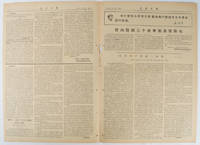
1967169753Beijing.: 首都中学紅代会朝阳区委員会.Shou du zhong xue hong dai hui Chaoyang Qu wei yuan hui. July1967. Issue no.4 of this Cultural Revolution newspaper published on 11th July 1967 by a Red Guards organisation in Beijing Chaoyang District. 4pp complete browned some holes where likely was bound at some stage margin otherwise good. Text in Chinese. 37.7 x 52.4cm. The front page features an article which reveals Liu Shaoqi's counter-revolutionary crime back in April 1936 when Liu published an article titled "On A Letter of The Communist Party". . 首都中学紅代会朝阳区委員会.[Shou du zhong xue hong unknown
1968173277上海.Shanghai.: 上海市出版系统革命造反联合指挥部.Shanghai shi chu ban xi tong ge ming zao fan lian she zhi hui bu. June to August1968. Issue numbers 48 to 53 of this Cultural Revolution newspapers issued from June to August 1968 by a Red Guard organisation within the Shanghai publishing system. Issue no. 51/52 is a combined special issue. 4 pages each issue 8 pages for combined issues no. 51/52 some browning closed tears along edges and folds a few neat mends with archival tape overall good. Text in Chinese. Sheet measures 38.7 x 52.1cm. This newspaper series exposes 100 titles featured as "100 poisonous weeds Lianhuanhua". Each issue exposes some fiction titles accompanied by political cartoons. The special issue no. 51/52 criticises the novelist 陈登科 Chen Dengke as a Chinese Khrushchev and his novel 风雷 “Wind and Thunder" as a poisonous weed. . 上海市出版系统革命造反联合指挥部 unknown
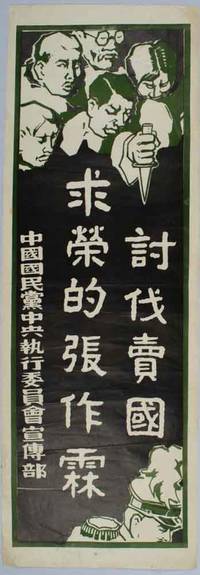
1926170239China.: 中國國民黨中央執行委員會宣傳部. Zhongguo guo min dang zhong yang zhi xing wei yuan hui xuan chuan bu. circa 1926 -1928. Colour Kuomintang poster featuring five angry people at the top of the poster one with a sharp knife at the ready gazing down at the warlord 張作霖 Zhang Zuolin lower edge. Some creasing two small spots on reverse one of which is visible on the left margin very minor light soiling and wear good. Text in traditional Chinese. Sheet measures 79 x 27.2cm. Zhang Zuolin 1875-1928 the founder of the Fengtian Clique of the Beiyang Army opposed all other warlord military factions. In the years between 1916 and 1928 his Fengtian Army controlled Manchuria now Heilongjiang Jilin and Liaoning Provinces. In November 1926 an alliance between the Fengtian and Zhili factions was formed to counter the advances of the National Revolutionary Army's Northern Expedition. Zhang was appointed as the Generalissimo of the last Beiyang Peiyang government in 1927. During the Northern Expedition the Kuomintang publicly accused Zhang as a national traitor in league with Japan. Ironically Zhang was assassinated by the Japanese army in 皇姑屯 Huanggutun on 4 June 1928. . 中國國民黨中央執行委員會宣傳部. [Zhong unknown
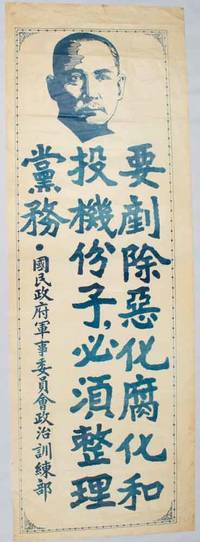
1926170202China.: 國民政府軍事委員會政治訓練部. Guo min zheng fu jun shi wei yuan hui zheng zhi xun lian bu. 1926. Chinese Kuomintang KMT propaganda poster in printed in blue folded. Issued by the Political Training Department of the Military Affairs Commission a head portrait of Sun Yat-sen is featured at the top of the poster. Creasing some minor tears along margins have been neatly repaired with archival tape. A little light staining at margins. Text in traditional Chinese. Sheet measures 78.6 x 27.3cm. The text reads "In order to eliminate the evil and corrupt force and speculators within the party we must rectify the party affairs." Chiang Kai-shek 谭延闿 Tan Yankai and 7 other KMT party leaders presented "Resolutions on the Rectification of Party Affairs" to the 2nd KMT National Congress in May 1926 with the aim of purging communists and pro-communist left wing members from the KMT. <br> <br>軍事委員會政治訓練部 "The Political Training Department of the Military Affairs Commission" a very short-lived yet powerful department was established in March 1926 by 2nd Central Executive Committee of the KMT. At this time the《军事委员会政治训练部组织大纲》"Organisation Outline for the Political Training Department of the Military Affairs Commission" states that the department was not only in charge of directing the party and political and cultural affairs within the National Revolutionary Army NRA but was also responsible for political appointments within the NRA. In order to improve the military development and prepare for the Northern Expedition the Political Training Department was replaced by the Office of Politics of NRA Headquarters on 18 June 1926. . 國民政府軍事委員會政治訓練部. [Guo min zheng unknown
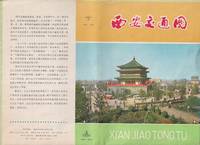
1978221488西安 Xi'an.: 陕西人民出版社 Shanxi Renmin Chuban She. Reprint. 1978. Full-page colour map of Xi'an with particular attention given to its transportation links; on reverse are nine smaller maps of locales within the city plus a further map showing the city's connections with the surrounding area. Single leaf unfolds to measure 38 x 52cm. Little creased in places though overall a very good copy. An attractive map of Xi'an replete with a period-appropriate propagandistic overview of the city's history noting its revolutionary tradition its pivotal role in rehabilitating the Communist Party during the Second Sino-Japanese War its restoration since liberation from the Kuomintang and its progress under the tutelage of Chairman Mao. . 陕西人民出版社 [Shanxi Renmin Chuban She]. unknown
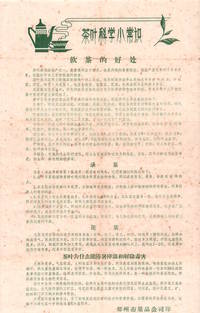
1954215555Zhengzhou.: 郑州市果品公司印. Zhengzhou City Produce Fruit Company. Circa1954. Small informative folded poster about tea printed in green ink with illustrations. Scattered foxing middle section on reverse browned stamped with postage mark dated 1954. In good condition. Text in Chinese. 44.4 x 27cm. The benefits of tea are listed including green tea and flower tea as well as an explanation about how tea can eliminate toxins. . 郑州市果品公司印. Zhengzhou City Produce (Fruit) Company. unknown
1925219969Shanghai.: The Commercial Press. Second Edition. 1925. Folding table of the proposed cirriculum black and white illustration 13 22 20 12 8 iii 36 18 17 36 24 21 19 8 40 21 iii 54pp. 19.2 x 13.2cm. A little light foxing first and last leaves stamp of a capital <br>M front endpapers original hardback covers glazed and a little insect damaged and lightly worn otherwise a clean sound copy. . The Commercial Press. hardcover
192941261上海市 Shanghai: æ£è—社 Zheng yi she 1929. Second edition. Softcover. poor to vg-. Folios. Approx. 15x10". Unpaginated. "Modern" volume with 3 preliminary pages of index and 8 pages of prologue. "Ancient" volume with 2 pages of prologue and 1 page of index at the front. Grey patterned cloth portfolio with black lettering over a white label on the front cover. Light blue-grey silk wrappers with light blue string-tied bindings. Red lettering in English and Chinese over a tan silk label on the front covers. This is the "November 1929" printing.<br /> <br /> The work is an exhibition catalog from The National Fine Arts Exhibition held in Shanghai in April of 1929 which was organized by the Ministry of Education of the Republic of China headed at the time by Cai Yuanpei. It is considered the first Chinese fine arts exhibition in modern history. The exhibition was a monumental retrospective with more than 2000 pieces of art from throughout Chinese history starting from the Five Dynasties period the 10th century up through the contemporary period. The event brought together the work of countless Chinese artists photographers and architects and also included the work of six Japanese artists. <br /> <br /> The catalog includes some 400 pieces of the artwork featured in the exhibition divided into a "modern" volume and an "ancient" volume. The artwork is printed in b/w offset photographic reproductions and collotypes. Also included in the "ancient" volume are seven works in color with both Chinese and English language titles on protective tissue guards a few of which are beautifully printed color lithographs. The "modern" volume contains a printed calligraphic prologue written in by Cai Yuanpei. The "ancient" volume includes works from some artists as The Four Wangs Wu and Yun from Qing Dynasty Four Monks of the Early Qing Dynasty Bada Shanren Shitao Hong Ren and Kun Can Lan Ying and Gong Xian. The "modern" volume contains works from Zhang Daqian Qi Baishi Wu Hufan Liu Haisu and Lin Fengmian among many others. Both volumes contains extensive indexes of the artwork. Text in Chinese.<br /> <br /> Portfolio with boards broken but present. Wrappers with some light smudges and scratches and a few minor creases. Some sunning along the top and bottom edges of the covers. Interiors with sunning to the edges and a few sporadic minor smudges. Images mostly unaffected. Portfolio in poor wrappers in good interiors in very good- condition overall. æ£è—社 (Zheng yi she) unknown
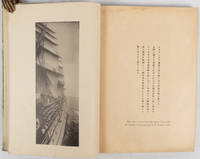
1911216037横浜. Yokohama.: 商船学校. Shosen Gakko. Meiji 44 1911. Map plan of the ship fold-out chart black and white photographic images throughout between 1 and 3 images per plate recording life aboard ship and places visited 57pp 26.5 x 19cm. Two personal letters with envelopes a black and white photograph and eight film negatives in an envelope loosely inserted. <br>Covers in particular the upper cover considerably damp damaged with some staining to lower edge of leaves and endpapers cord ties broken but the binding is still firm covers worn at edges with a little loss. The contents are otherwise clean. 26 x 19cm. This rare photographic album commemorates a training cruise around the world undertaken by the Taisei Maru between October 1910 and August 1911. The Taisei Maru a training ship of the National Merchant Marine School embarked on its maiden voyage in 1904 and this 1910 cruise marked its sixth training mission and first circumnavigation of the globe traveling through the southern hemisphere. The ship made stops in Tahiti Stanley on the Falkland Islands and Melbourne. <br> <br>During their stay in Melbourne from June 24 to July 5 1911 the crew visited notable sites including the Victorian Racing Club the Victorian Mission of Seamen in Port Melbourne and Ballarat.<br><br>The album includes a fold-out chart detailing information about the ports visited. The Melbourne section features photographs of various streetscapes scenes from the ship's open day and the crew's training visit to the Botanical Garden. The album's title printed on the front cover reads 雲涛 Unto which means "the horizon beyond clouds and waves." <br> <br>It appears this album belonged to a member of the Kato family as indicated by a name card on the front free endpaper bearing the name of Toshiko possibly a daughter or granddaughter. Included in the album are two private letters belonging to Toshiko and her husband Anpo Kenji along with a group photo and eight film negatives labeled "wedding." One of the letters was sent by Anpo Kenji to Toshiko before their marriage. Anpo later became a well-known artist specializing in paintings of the sea and ships. Both Toshiko and Kenji were deeply involved in artistic activities before their marriage. . 商船学校. [Shosen Gakko]. unknown
1972155429Beijing.: 文物出版社.Wen wu chu ban she. 1972. Colour plates some full page showing 66 historical examples of textiles that have been unearthed beautifully embossed flower pattern on upper cover hardback includes loosely inserted booklet with notes and a brief history of Chinese silk and brocade in Chinese title gilted upper cover and spine very light browning at margins of booklet very good copy. Text in Chinese 35.6 x 26.4cm. The brocade relics showed in this were all discovered along the "Silk Road" in China. This work gives readers a brief insight on how Chinese silk and brocade appeared in different time periods from Eastern Han Dynasty to Tang Dynasty and at which excavation sites they have been found. . 文物出版社.[Wen wu chu ban she]. hardcover
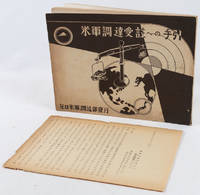
1952219162Japan.: 在日米軍調達部. Zainichi Beigun Chōtatsubu. 1952. 137pp 20.5 x 26.7cm one double sided mimeographed covering letter loosely inserted original pictorial wrappers. Light foxing and browning first and last leaves and on wrappers quite browned on lower wrapper paper spine trifle worn with a small chip at tail. Still a very good copy. This scarce 1952 publication by the US Forces Procurement Department explains in the Japanese language how to engage in business dealings with the US Forces in Japan. A cover letter also printed in Japanese signed by Edward W. Sawyer is loosely inserted in the publication. Sawyer was the commanding officer of the Japan Procurement Agency at the time. During his military career he had received an MBA from Harvard and was knowledgeable in handling business. In his cover letter Edward Sawyer emphasises that it is not necessary to engage an agent in order to obtain contracts from the US Force as long as business processes are followed properly. <br> <br>The occupation of Japan formally ended when the San Francisco Peace Treaty became effective in April 1952. However by that time the Korean War had broken out and some 250000 US troops remained stationed in Japan. During the Korean War US procuments in Japan totalled over $3.5 million in value and had a major impact in stimulating the revival of the postwar Japanese economy. Many thousands of Japanese workers were also recruited to play auxiliary roles with the US military in Japan and Korea. This volume gives a fascinating insight into the way in which the system operated on the ground. <br> <br>The opening section describes the structure and operations of the US military procurement process. The text then goes on to explain the steps involved in signing a contract with the US military and the inspection and payment process which will occur when the work is complete. This is followed by a "question and answer" section taking potential suppliers through such things as the details of the process of bidding for contracts the raising of finance to complete contracted work and payment arrangements. The explanations are evidently designed to help agents recruiting labour for work with the US forces as well as for suppliers of raw materials and manufactured goods. The volume includes a sample contract inspection report and invoice all in English as well as Japanese. <br> <br>The striking cover design shows a pair of scales balancing military equipment on one side and documents contracts on the other poised on top of a map of Asia and America. The image seems aimed to reassure suppliers of the fairness of the US military's dealings with with business. An image of Mt. Fuji is on the upper left. <br> <br>We have not been able to locate a library holding this important work. . 在日米軍調達部. [Zainichi Beigun Chōtatsubu]. unknown
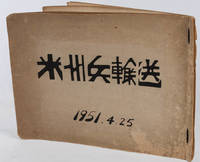
1951218840Japan. 1951. Eight black and white photographs 20.5 x 25.5cm each captioned in Japanese the handmade album is titled and dated in ink 23.5 x 32.8cm 9pp cord ties. One photograph has been removed card leaves and covers are browned surface of upper cover abraded in places some other minor wear but the photographs are in very good condition. A private album containing eight high-quality large-format photographs showing US forces being welcomed to the northern Japanese city of Muroran Hokkaido on 25 April 1951 - at the height of the Korean War. The first two photos show the US forces being welcomed by a local brass band. There is then a shot of US officers and Japanese officials standing under a large sign saying "Welcome Thunderbirds - Muroran City" indicating that the troops being welcomed are from the 45th Infantry Division nicknamed the Thunderbirds one of two US Army National Guard units engaged in the Korean War and recruited largely from the state of Oklahoma. <br> <br>The 45th Infantry Division received their initial training for combat in Korea in the US itself in 1950 and then sailed from New Orleans to Japan in early 1951 arriving at the ports of Otaru and Muroran in Hokkaido April of that year. From there they were sent for further training at Camp Crawford a US military base on the outskirts of the city of Sapporo and at a newly created camp south of Chitose before being transfered to Korea in December 1951. The album also contains two photos of the ships "General C.G. Morton" and "General William Weigel" which were built during World War II and used as a troop transport ship during the Korean War and were presumably among the ships which brought the 45th Infantry Division to Japan. Other images show local officials explaining the geography of the region to US officers as they peruse a large map and a Japanese woman beign presented with a badge by an American officer. <br> <br>Muroran was one of many Japanese ports whose life was transformed by the mass arrival of UN mostly American forces during the Korean War although the town's role in the war is less well documented than the roles of ports like Yokohama Kobe and Sasebo. These pictures give a vivid impression of the Korean war journeys of US troops and of Hokkaido during the Korean War. . unknown
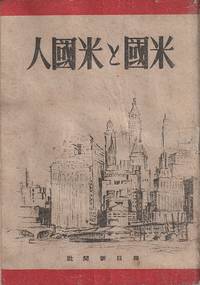
1945215692大阪. Osaka.: 每日新聞社. Mainichi Shinbusha. Showa 20 1945. 64pp 18 x 12.6cm black and white line illustration upper cover original wrappers slightly soiled wrappers neatly strengthened with washi on reverse closed tears neatly mended. This book on the United States and the Americans was published in November 1945 by Mainichi Newspaper only a few months after the end of the Pacific War. Kagawa Toyohiko a Christian evangelical pacifist writes on the origin of American morality. Other essays by various authors cover American politics labour movements literature culture and art. In its forewords the editor states that it is very important to understand the United States and its people for Japan. . 每日新聞社. [Mainichi Shinbusha]. unknown
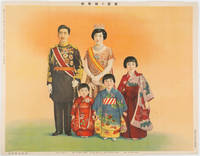
1933180273東京. Tokyo.: 主婦の友社. Shufunotomo-sha. Showa 8 1933. Colour print of Emperor Showa and his family 38 x 48cm. Two vertical folds edges a trifle worn otherwise very good. This colour portrait print of the Emperor Showa and his family was published in 1933 as a January issue supplement of "Shufu no Tomo" Housewives' Companion magazine. The magazine was founded in 1917 and remained very popular throughout the Showa Era. <br> <br>The portrait by Matsuda Tomitaka who was a magazine's resident arfist features Emperor Hirohito and Empress Nagako in western clothes while their three daughters Princess Shigeko Princess Kazuko and Princess Atsuko are in kimono. The royal couple had two sons and a daughter later. . 主婦の友社. [Shufunotomo-sha]. hardcover
1964222288China. 1964. A long black and white photograph of the central leadership of China flanked by several hundred PLA personnel at a troop review outside Beijing. Captions in Chinese naming the first row of sitters. 30 x 260cm. Some foxing and browning visible in the background of the photograph and on the reverse overall in good condition. A dense snapshot of a critical time in China's political history. The technical feat of composing this photograph demonstrates a high level of professionalism - both on the part of the artists and subjects. All of the sitters are clearly visible with not a single face visibly blurred chopped or otherwise obscured. <br> <br>Some key figures among the nearly 700 faces include Mao Zedong Liu Shaoqi Zhou Enlai Zhu De Deng Xiaoping Jiang Qing Deng Yingchao He Long Dong Biwu Peng Zhen Yang Shangkun Ulanhu Nie Rongzhen Bo Yibo and Chen Yi. <br> <br>The 8th Politburo of which a core selection are shown here is renowned for its longevity and extreme dysfunction having been elected in 1956 and lasting until 1969. Under its aegis the Hundred Flowers Campaign Great Leap Forward and Cultural Revolution were all launched rendering untold carnage and death. The posed statesmanlike quality of the subjects in this carefully composed image quietly contradicts the chaos unleashed by them in reality. . unknown
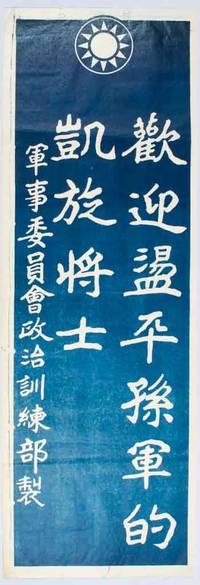
1926170205China.: 國民政府軍事委員會政治訓練部. Guo min zheng fu jun shi wei yuan hui zheng zhi xun lian bu. circa 1926-1928. Chinese Kuomintang propaganda poster screen print in blue. Issued by the Political Training Department of the Military Affairs Commission party emblem "Blue Sky with a White Sun" of the Kuomintang at upper edge text in Traditional Chinese. Some light creasing a little offsetting of ink at margins very good. Text in traditional Chinese. Sheet measures 78.6 x 27.3cm. The reference to Sun's Army in the title of this poster refers to the army of Chinese warlord 孙传芳 Sun Chuanfang whose strong military presence was felt in Zhejiang Jiangsu Anhui Fujian and Jiangxi in the years between 1922 and 1926. Sun together with other major warlords 冯国璋 Feng Guozhang 曹锟 Cao Kun 吴佩孚 Wu Peifu and 齐燮元 Qi Xieyuan were part of the Zhili Clique. Sun had been Chiang Kai-shek’s second military target when the National Revolutionary Army NRA took over Hunan from Wu Peifu’s control. The official confrontation between the NRA and Sun's army began in August 1926 in Jiangxi Province later another battlefield opened between them in Fujian Province in September of the same year. The wars between Sun's Army and NRA lasted until April 1928 when Sun faced complete defeat. <br> <br>The text on this poster reads "Welcome the Returning Triumphant Troops Who Crushed Sun's Army." The text suggests that the poster was probably issued after Sun's defeat in 1928. However 國民政府軍事委員會政治訓練部 "Political Training Department Military Affairs Commission of the Nationalist Government" only existed for only three months between March - June 1926. Possible explanations for the contradictory dates are that the slogans were published prior to the defeat in an effort to wish military success against Sun; or possibly given the chaotic situation in China at the time the publication details were not updated to reflect the new agency in charge. . 國民政府軍事委員會政治訓練部. [Guo min zheng unknown
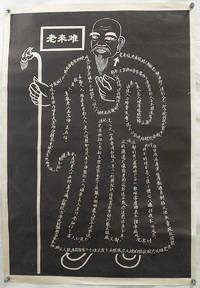
1980223104Unknown.: No publication details. circa1980. A poster with the image of an old man Lao Lai Zi outlined with white characters on a black background text in simplified Chinese characters 77 x 52.5cm small 1cm closed tear right edge and lower left corner repaired. In good condition with clear and well defined characters making the text easy to read. Lao Lai Zi a symbol of aging and filial piety is here represented in what appears to be a white line drawing on a black background. On closer inspection however the lines are made up of poignant and occasionally amusing rhyming verses listing the indignities of old age imploring the young not to look down on the elderly. <br> <br>The original stele carved with a similar image titled “Lao Lai Nan” Growing Old is Hard is located at the Temple of the Medicine King in Beipo village in Shaanxi Province. It isn’t known exactly when the Beipo stele was carved but it is said to be related to a Mrs Li who lived in the temple and wanted it carved to teach her unfilial children a lesson. The use of simplified characters and catchy verse written in modern Chinese indicate that it is a 20th century artefact. The Beipo stele includes smaller carvings of eight old people using sticks along the vertical edges. <br> <br>This poster is a modern artistic stone rubbing interpretation of the main visual feature on the Beipo stele i.e. the central figure outlined in characters in a pose and design similar to the original. A well known educational Chinese folk illustration “Lao Lai Nan” is a moral lesson on respect for the elderly. <br> <br>老来难, 老来难,劝人别把老人嫌, 当初嫌别人老,如今轮到我头前,千般苦, 万般难,听我从头说一番。耳聋难与人说话, 差七差八惹人嫌. … <br> <br>Getting old is hard it’s hard I urge you not to look down on the elderly. Earlier I despised others for being old but now that I’m facing it head on with a thousand kinds of troubles and difficulties listen to everything I say. <br>Being hard of hearing makes it difficult to communicate if you miss this or that you annoy people… <br> <br>… …痛苦难言聆,明不明睡不着, 一夜小便七八遍,怕夜长, 怕风寒, 时常受风病来缠 年老肺虚常咳嗽, 一口一口吐粘痰,儿女们都恨咱说,我邋遢不像前,老的这样还不死,你还想活多少年… … <br> <br>… It’s hard to explain all the difficulties one can’t sleep and every night one gets up to urinate seven or eight times. I hate long nights cold breezes and I get sick from being in draughts. My lungs are weak and I cough and cough and cough up phlegm so my children dislike talking to me. They seem to think I’m unkempt and don’t look like my former self. So old and still not dead how much longer am I planning to live . No publication details. unknown
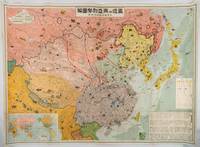
1937194318大阪. Osaka.: 大阪毎日新聞社. Osaka Mainichi Shimbunsha. Showa 12 1937. Large colourful folding map of East Asia measuring 79 x 109cm. Small holes at folding points and closed tears on the verso now neatly repaired with Japanese washi. Some light general wear but overall a bright and clean copy of this interesting map. Published in late 1937 this colourful pictorial map shows the dynamic military situation in East Asia from the Japanese point of view. Showing somewhat inaccurate information with incomplete conclusions this map provides a better understanding of why Japan made the ill-informed decision to escalate its invasion of China following the Marco Polo Bridge incident. The area covered includes Japan Taiwan China and the Soviet Union and attempts to show tensions along real and imagined zones of control. Information about Soviet and Chinese military power is also included on the map. <br> <br>These propaganda maps conveyed the extent of the Japanese government's ambition to the Japanese population with the charming cartoon-style images of wildlife and other natural resources industries and historical landmarks indicating the anticipated gains of Japanese foreign policy. Interestingly positions of military forces transport routes defence structures and radio transmission stations are also marked on the map though many of these appear phantasmic and out of step with reality. An inset world map at lower left shows the area within a global context. <br> <br>Offering a glimpse into the incomplete information at the hands of the Japanese authorities and perhaps in part understood by the mapmakers in the context of Chinese Communist and Soviet successes in Yan'an and Xinjiang large sections of Qinghai Gansu and Ningxia are marked as under Soviet influence. At this stage this region was largely under the control of Kuomintang-aligned warlords and although the region was implicitly threatened by underground Communist insurgents so too was the rest of China. The focussed attention given to Communist influence and China's internal political divisions is indicative of the failure of Japanese planners to anticipate the cooperation of Communist and Nationalist forces in the face of Japanese aggression. <br> <br>The text box at right translated reads "Current State of Affairs in East Asia." In the legend the coloured boxes indicate the following areas: reading right to left: <br>Dark yellow: Japan <br>Pale yellow: Manchukuo <br>Red: Soviet Union Russia <br>Pink: Sovietised area <br>Purple: Republic of China China <br>Grey: China North China Buffer State where a special relationship with Japan is emerging <br>Green: East Hebei Autonomous Government . 大阪毎日新聞社. [Osaka Mainichi Shimbunsha]. unknown
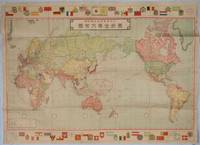
1931216820東京. Tokyo.: 大日本雄弁会講談社. Dainihon Yūbenkai Kōdansha. Showa 6 1931. Large colour folding map of the world with attractive border of some curiously chosen merchant ensigns and coats of arms along the upper and lower margins 78 x 110 cm. Neat repairs along some folds on reverse a little toning on map but still a good attractive copy. This large map of the world was issued as the new year supplement for a boys' magazine Shonen Kurabu 少年倶楽部 in January 1931. Japan and its territories in red are positioned in the centre of the map. The vastness of Russia and the British Empire stand out and the Irish Free State is still indicated as being part of the UK. Interestingly Russia is still shown in its customary Imperial green rather than the more common red that was typically adopted for the Soviet Union. . 大日本雄弁会講談社. [Dainihon Yūbenkai Kōdansha]. unknown
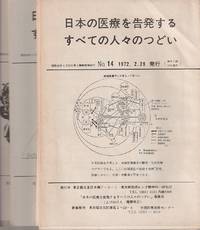
1972214333東京. Tokyo.: 日本の医療を告発するすべての人々のつどい事務局. Nihon no Iryō o kokuhatsu suru subete no hitobito no tsudoi Jimukyoku. 1972- 1974. Periodical 18 issues: Nos.14 15 18 19 20 21 22/23 25 26 27 28/29 30 31 33 34 35/36 37 43 charts diagrams graphs approximately 20pp per issue 25 x 17cm orginal wrappers. Occasional browning overall very good. This compelling periodical collection Nihon no iryō o kokuhatsu suru subete no hitobito no tsudoi highlights significant issues related to healthcare services and medical practices in Japan during the 1970s. At that time while Japan experienced rapid economic growth serious problems in the health sector were emerging such as air pollution illnesses caused by medication and cases of medical negligence. However openly addressing these issues was difficult due to internal pressures. Contributors to the journal were health industry professionals aiming to inform the broader public about the realities within the sector. The topics covered are diverse but remain crucial for both healthcare practitioners and consumers. The periodical's publisher was based at the Department of Psychiatry at Tokyo University a focal point of the 1960s student movement. . 日本の医療を告発するすべての人々 unknown
1972157270文物出版社.Wen wu chu ban she. 1st Edition 1st Printing. 1972. Tipped in colour plates photographic illustrations in black and white 152pp hardback in cloth protected by plastic cover as issued housed in its original slipcase booklet in Chinese with notes for each cultural relic and a brief introduction of the development of archaeology work during the Chinese Cultural Revolution loosely inserted. 36 x 27cm. The cultural relics showed in this book were discovered in many regions of China during Cultural Revolution with a wide range such as ceramics lacquerware costume bronzes. The discovery is very much important in the modern Chinese archaeology history. . 文物出版社.[Wen wu chu ban she]. hardcover