116 résultats
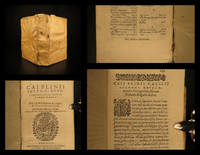
1569D11176Venice: Hieronymus Scotum Scotus 1569. Hardcover. Very Good. Folio 315 x 215mm. 2 150pp. 2. Signatures: A-I 8 K4. Io. Grammatici in cartouche at head of title page. Woodcut profile bust of Aristotle on title with dedication Peripateticae Disciplina Principis Vera Aristotelis Stagiritae Effigies. Final leaf with woodcut printers device of Scotus of griffin in animated cartouche head-pieces and initials throughout. Text printed in double columns. Italic and Roman type. Original limp vellum vertically ruled in brown ink to front cover; edges slightly curled minor marginal dampstaining at beginning and end otherwise clean. Near contemporary ownership inscriptions in Latin on front flyleaf mostly faded but name and order of at least two young men Salvatoris and Bartolomei are given. 19th century stamp of the Seminario Vescovile of Volterra on title. The Tuscan Jesuit Seminary dedicated to Saint Andrew employed student novices throughout its history and one would have likely used this copy. Interestingly the seminary is still active today and maintains lodgings for travelers. This copy is further enhanced by a full-page pencil doodle of a mythological composition muses putti and foliate boughs on the rear flyleaf probably completed in the seventeenth century. <br/><br/>The last 1569 Scotus edition of Philoponuss commentary on the Posterior Analytics of Aristotle; an example-laden investigatory explanation on the classification of scientific knowledge Byzantine-era Philoponuss comments on the Posterior Analytics of Aristotle are interesting especially for their metaphysical analysis of the universal idea his account revealed his beliefs in Platonic forms as inherently part of the Divine Intellect. In his further reading of the Posterior Analytics Philoponus aimed to share his understanding of the concept of subordinate sciences which are sciences that can be classified by genus and species. A notion he supported was the idea that some sciences depended on higher ones for some of their principles Philoponus even goes as far to suggest formulating a taxonomy of the sciences. He maintains that philosophy dialectic and all the sciences employ common axioms regarding philosophy in particular it discovers and demonstrates the very principles of every science. Importantly Philoponus decided to take on this work because he thought that Aristotles concepts were too difficult and needed explanation. It was not the first he was indebted to the earlier work of Theophrastus and Galen but Philoponuss work is the earliest to survive. Philoponuss train of thought is frequently obscure and much of the discussion being carried out chooses investigatory examples over blatant argument. He wished to expound the meaning of the Aristotelian text rather than raising objections. It is clear Philoponus engages vigorously with the earlier commentators on the Posterior Analytics thus like most ancient commentaries this one maintains certain importance for the constitution of the text on which it comments. Scotus a prominent Venetian printer and elegant producer of texts was actively publishing a line of these philosophical treatises which were frequently revised and reprinted. The first Latin translation by Theodosius was published in 1539 and was reprinted frequently until 1569. This work remains important to the evolving tradition of early sixteenth century Italian university logic. Rare in North America OCLC lists holdings for this edition only at University of Oklahoma as part of the History of Science Collection. Hieronymus Scotum (Scotus) hardcover books
1559D11175Venice: apud Hieronymus Scotum Scotus 1559. Hardcover. Very Good. Folio 315 x 215mm. 2 137pp. 1. Signatures: A-Q4 R6. Woodcut profile bust of Aristotle on title with dedication Peripateticae Disciplina Principis Vera Aristotelis Stagiritae Effigies. Final leaf with woodcut printers device of Scotus classical muse atop star sphere with motto Fiat pax in virtute tua Let there be peace in your walls. Latin translation by Girolamo Bagolino of Verona c. 1470-1535 professor of philosophy at Padua. Text in double column. Italic and Roman type. 18th-century marbled boards modeled to resemble tree-calf; hole through opening leaves causing some text loss title with minor stains hinges starting p. 135 folded corner repaired clean tear in blank portion of last leaf. The clipped booklabel of Seminarium Mutinense pasted on the title fittingly connects this copy to the Jesuit Seminary library in Modena in the Provincia Veneta which was also a center for study popularly called a Collegium. Sixteenth-century editions of Philoponuss Aristotelian explanations have a major place in the commentarial tradition and philosophy of the Renaissance. <br/><br/>1559 Scotus edition of Philoponuss commentary on the De Generatione et Corruptione of Aristotle; a beautifully produced Venetian work still in good form. John Philoponus also known as John the Grammarian was a Byzantine-era Aristotelian commentator and author of several philosophical treatises. The first Latin translation of Philoponuss commentary on Aristotles treatise De Generatione et Corruptione seems to be the one made by Hieronymus Bagolinus from the Aldine edition of 1527 first published in Venice by Hieronymus Scotus in 1540; the second made by Andrea Silviuis was published by Valgrisius in 1564. This is Scotuss fourth edition of 1559 in which he states errors of the first and the second edition are purged thus repeating the title found in the third. It precedes a fifth and final edition of 1568. Philoponus presents his commentary as notes taken from the seminars of Procluss student Ammonius c. 435-526 AD together with certain remarks of my own; Philoponuss is an elaborate exposition of Aristotelian theory followed by several criticisms which are answered with sophistication. To history this commentary has always been received as a school work but it was an interesting book to early scholars for it was supposed to have been written before 529 terminus post quem - hence before Philoponuss writings became entrenched in Christianity and creationist views. Like most ancient commentaries this one maintains certain importance for the constitution of the text on which it comments. Scotuss publications were widely regarded as elegant productions; wide-format and designed with attractive typeface this refined style was typical on the Venetian marketplace at this time. apud Hieronymus Scotum (Scotus) hardcover books
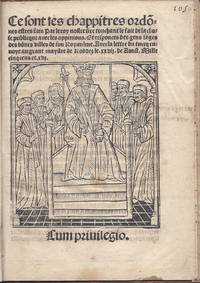
15161704S.l.: s.n. 1516. First edition. Title page with large woodcut illustration showing the King on his throne surrounded by the delegates. In Bastarda type with two floral woodcut initials. In later hard paper. Gilt title vignette on spine damaged. Concise marginal notes and page-numbers in ink by a contemporary hand throughout. Trimming of the leaves slightly affects the glosses with no effect to legibility otherwise the margins are wide. Title page crinkled at the upper right corner with a small tear that only affects the margin. Narrow inkblot to the lower margin throughout. B4 with two light brown stains C1 crinkled at lower corner. Bookplates on the inner front panel G. J. Arvanitidi; Antoine Mouradian. Overall in very good condition. First edition. Title page with large woodcut illustration showing the King on his throne surrounded by the delegates. In Bastarda type with two floral woodcut initials. In later hard paper. Gilt title vignette on spine damaged. 20 p. <p><br /> A bibliographically unrecorded early sixteenth-century French book about royal ordinances regarding the commonwealth along with the French translation of Sultan Selim I's letter of conquest fethname addressed to the Grand Master of Rhodes. <br /> <p><p><br /> The first and major part of the book presents nine concepts of orders of Francis I 1494-1547 King of France from 1515 until his death regarding the commonwealth chose publique. The drafts concern such topics as the commerce of spices and drugs wool cloth and other goods chapter 1-4 the weights and equivalents of coins and the recognized foreign currencies chapter 5 the recognized units of measures chapter 6 the regulation of the extravagance of clothing chapter 7 the inn trade chapter 8 and the money that goes to Rome for obtaining Bulls chapter 9. <br /> <p><p><br /> The second section comprises the responses to the aforementioned concepts of the representatives of the Good Cities Bonnes Villes Provence and Dauphiné who had been previously assembled in Paris by the order of the King in March 1516. In most cases they requested a delay of reply to discuss the matters with those who they were representing.<br /> <p><p><br /> The third section presents the grievances and requests delivered to the King by the delegates regarding the provincial councils conciles provinciaux the prolixity of the trials the tariffs the public officers the superior courts cours souveraines the land taxes tailles and the abuse and plunder by the soldiers crossing the kingdom. <br /> <p><p><br /> These sections were recorded and written down by the court clerk Jean Hesselin Seigneur of Girodon. Hesselin mentions himself twice p. 14 and 17 once by name p. 14 within the text.<br /> <p><p><br /> The final part is the French translation of the Ottoman Sultan Selim I's fethname letter of conquest sent on 27 August 1516 from Aleppo to Fabrizio del Carretto 1455-1521 Grand Master Magnus Magister of the Knights Hospitaller in Rhodes between 1513 and 1521. The fethname accordingly to its genre details Selim's expedition and the conquest and emphasizes the power and grandeur of the Sultan and his army. <br /> <p><p><br /> Selim I 1470-1520 ascended the throne as the Sultan of the Ottoman Empire in 1512. He is remembered for the enormous expansion of the Empire during his reign thus raise the Ottomans to the leaders of the Muslim world. Selim's most notable deed was the conquer of the Mamluk Sultanate which included Levant Hejaz and Egypt in 1516 and 1517 at the Battles of Marj Dabiq and Ridaniya.<br /> <p><p><br /> The Battle of Marj Dabiq near Aleppo took place on August 24 1516 where Selim defeated the Mamluk Sultan Al-Ashraf Qansuh al-Ghuri. This was a decisive victory of the war between the Ottoman Empire and the Mamluk Sultanate which ended in the conquest of much of the Middle East. Such an expansion of the Ottoman territory was a clear threat to Rhodes which was the nearest Christian possession to the coast of Asia halfway between Constantinople and Egypt. At the time the Grand Master in Rhodes was the Italian admiral Fabrizio del Carretto 1455-1521; Grand Master from 1513 to 1521 for a short interlude of a course of fifty-five years of Frenchmen serving as the supreme heads of the Order. Selim announced his victory and forecasted his threat to del Carretto in a fethname presented here in French translation however eventually he did not have the time to conduct the campaign against Rhodes. It was his successor Suleiman I who conquered the island in 1522 thus gained control over the eastern Mediterranean for the next centuries. By the time of the siege the commander of the Order was again a Frenchman Grand Master Philippe Villiers de L'Isle-Adam 1464-1534. Suleiman allowed him and the surviving knights to leave unmolested and eventually the Hospitallers were quartered permanently on Malta in 1530.<br /> <p><p><br /> To the best of our knowledge the original fethname has not survived and we could not trance any other printed version or edition of the French translation. We could find one surviving copy of a Spanish translation of Selim's letter which was addressed to Pope Leo X titled Carta de nuevas grandes buenas y ciertas embiada a nuestro s. padre Leon X de las cosas que han passado en Levante entre el gran turcho y el gran solda Valencia Juan Viñao 1517; Norton 1256 IB 11215 USTC 344377 kept at Cambridge University Library F151.d.8.12.<br /> <p><p><br /> Provenance: Bookplate of Georgios Arvanitidis 1876-1953 a noted Constantinopolitan collector of books on Turkish and Greek history. Bookplate with the motto "On abuse du vrai" of Antoine Mouradian.<br /> <p><p><br /> Ref.: Bibliographically unrecorded.<br /> <p><p><br /> Bibl.: Setton K. M. Hazard H. W. ed.: A History of the Crusades. Vol. 3. Wisconsin: The University of Wisconsin Press 1975. pp. 332-335. Pedani-Fabris M. P.: Ottoman Fetihnames. The Imperial letters announcing a Victory. In: Tarih İncelemeleri Dergisi 13 1998. 181-192. <br /> <p>. [s.n.] unknown
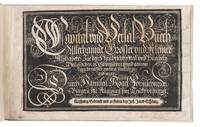
156821281Augsburg: Johann Jacob Schönig 1568. Vellum ca. 1985 with each leaf attached to a stub and the stubs side stitched in a cloth slipcase. Oblong folio 21 x 34 cm. With a richly calligraphic woodcut title-page 18 x 28 cm with text in white fraktur lettering on black with a white panel at the foot with the letterpress imprint in a fraktur type; and 9 of 10 full-page woodcuts about 17 x 25.5 cm showing alphabets in white on black one dated 1568: 8 with decorated gothic capitals versals: 22-150 mm and 1 with textura capitals textura lowercase and roman capitals all versos blank. Lacking 1 leaf. With a small and perhaps fragmentary manuscript on parchment 2 ll. 11.5 x 13.5 cm written on both sides: a Protestant copybook written soon after 1557 probably in Basle or vicinity with 7 writing samples including alphabets of capitals and minuscules the first two pages in fraktur gothic styles and the last two in humanistic styles. Sixth known copy of Johann Jacob Schönig's edition of a stunningly decorative Augsburg writing master's woodcut copybook devoted primarily to decorated gothic capitals versals printed in the period 1680-1694 from the original woodblocks of the first edition of 1568. Hans Rogel the elder 1532-1592 writing master school teacher poet wood-block cutter engraver printer and publisher at Augsburg cut the woodblocks and probably executed the lettering himself. All the lettering examples and the title-page are printed from large richly calligraphic woodcuts with their lettering in white on black. Nine of the ten examples display versals the missing leaf supplied in reproduction including complete alphabets in three sizes. The final leaf displays alphabets of textura capitals textura minuscules and roman capitals. As early as 1779 Paul von Stetten described Rogel's Capital und Versal Buech as "besonders fein geschnitten" and said that if Rogel executed the lettering himself he "ist er billig den zierlichsten Schreibmeistern beyzuzählen". He thought it good enough to be the work of Caspar Brinner 1565-1610 the greatest Augsburg writing master of the second half of the century apparently not knowing Brinner was only about three years old in 1568.All editions should apparently contain 11 leaves but many contain only 10 and some fewer. Some have also been bound with additional leaves that do not belong to the edition. There appear to be only 3 complete copies of the present edition.An early owner skilfully wrote out alphabets in the fore-edge margins of 2 leaves and phrases at the foot of one. It seems likely to be the copy owned by Jan Willem Six van Vromade 1872-1936. Lacking leaf "2" as noted professionally and unobtrusively restored in 1984 and probably rebound soon after: the tattered fore-edge margins of several leaves were restored and a couple gaps in the right border of the title-page filled in with black ink. A small brown smudge in the unnumbered first page of versals 22 mm slightly affects small bits of 4 letters but in general the woodcuts remain in good condition.l Berlin Kat. 4799; Bonacini 1548 Berlin copy; Doede 21 note; Hollstein German 34 KVK & WorldCat 4 copies: 2 lacking 1 leaf; Van Stockum Cat. bibl. J.W. Six de Vromade part 1 16-21 November 1925 lot 407 the present copy; cf. Paul von Stetten Kunstgewerbe und Handwerksgeschichte . Augsburg 1779 vol. 1 p. 23 1655/68 ed. Johann Jacob Schönig, hardcover
15889875<p>1588 1st ed Pliny the Younger Epistles Panegyricus Vesuvius ROME Early Church<br />Pliny the Younger one of the most notable 1st-century historians is best remembered for his written works and orations. His best-known and still widely popular work is his 'Epistles' which was a series of personal letters to other Roman figures. They give an important view of Roman everyday life as well as an interesting perspective on Pliny's views against Christianity. <br />However the most important epistles concern Pliny's account of the Mount Vesuvius eruption. Tacitus a friend of Pliny wanted to know more about the death of his uncle Pliny the Elder and the eruption itself.<br />This 1588 first edition was published by Jean Richer and includes a dedicatory epistle from Claude Mignault<br />Item number: #9875Price: $599<br />PLINY the Younger<br />Cai Plinii Secundi Novocomensis Epistolarum libri decem. Notæ & observationes auctore Claudio Minoe jurisc. Cum indicibus amplißimis & certißimis.<br />Parisiis apud Joannem Richerium via D. Joannis Lateranensis sub Arbore virescente. 1588. First edition.<br />Details: • Collation: Complete with all pageso 10 287 19• References: USTC 170912• Language: Latin • Binding: Vellum; secure• Size: ~6in X 3.75in 15cm x 9.5cm<br />Our Guarantee:Very Fast. Very Safe. Free Shipping Worldwide.Customer satisfaction is our priority! Notify us with 7 days of receiving and we will offer a full refund without reservation!<br /><br />9875<br />Photos available upon request.</p> Joannem Richerium, via D. Joannis Lateranensis, sub Arbore virescente hardcover
154719486Lugduni: Apud Seb. Gryphium Sébastien Gryphius 1547. EARLY GRYPHIUS EDITION. Printer’s device on title historiated capitals. Contemporary vellum speckled edges; a few wormholes on the final leaves and back board otherwise an excellent copy with ownership signatures on the title page. Early edition of the works of Pliny the Younger. This edition is a reprint of a 1508 Aldine edition by the notable Lyon-based printer Sébastien Gryphius who published editions in 1531 1539 and 1542. Pliny the Younger was one of the best-known first century historians and his written works were very popular. This series of personal letters to Roman figures provide a detailed view of everyday life within the Roman empire especially Pliny’s views on Christianity. Indeed the tenth letter treats situations in which people are accused of being Christians and how to deal with their interrogation. Also included is Pliny’s panegyric on Trajan and short treatises by Suetonius and Julius Obsequens. This edition includes an introductory note by Gryphius and a preface by Aldus Manutius.<br /> <br /> Caius Plinius Caecilius Secundus nephew and son of the elder Pliny was born at Novum Comum in 62 CE. After studying rhetoric under Quintilian he began his career as advocate at the age of nineteen. He subsequently served in Syria as a military tribune was a quaestor under Domitian and consul under the emperor Trajan. About the year 112 he governed Bithynia as imperial legate his death occurring shortly after in the year 114. He was more or less of a dilettante painstaking very desirous of making a literary reputation and amiable but lacking in force of character and original thought. His panegyric on Trajan delivered to express his gratitude to the emperor who had recently appointed him consul is his only speech which really possessed vitality and his letters which exhibit his self-complacency form entertaining reading. <br /> <br /> German-born Gryphius 1493-1556 was one of the most successful printers in sixteenth-century Lyon. He specialized in popular small-format editions of classical texts and actively competed with Italian printers like Aldus Manutius. <br /> <br /> See Baudrier Bibliographie lyonnaise 8 pp. 211; on the 1508 Aldine Press edition see Renuoard pp. 53-54. Apud Seb. Gryphium [Sébastien Gryphius] unknown
1519ZB393224Macmillan Co. 1915-1937. Volumes 15-39 lacking vol. 26#6; partly bound minor ownership markings else texts clean and bindings tight. - If you are reading this this item is actually physically in our stock and ready for shipment once ordered. We are not bookjackers. Buyer is responsible for any additional duties taxes or fees required by recipient's country. Photos available upon request. Macmillan Co. unknown
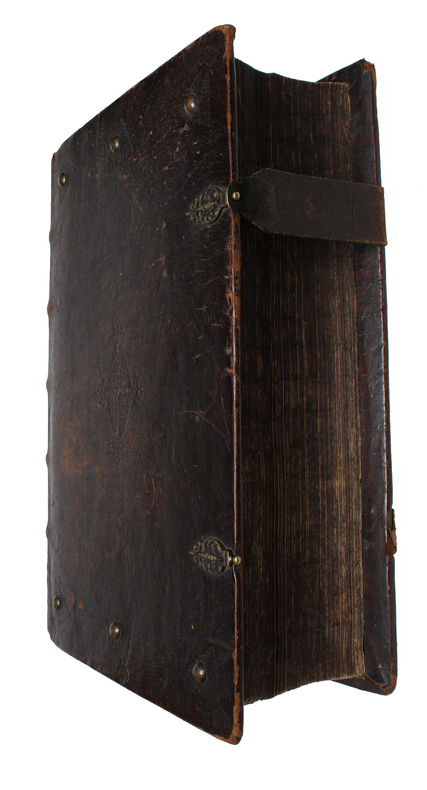
158857770Kiøbenhaffn, (Matz Vingaard), (1588-)89. Folio. (39 x 27 cm.). Samtidigt hellæderbind i brunt kalveskind over svært træ og med kanter i smig. Lettere ophøjede bind på ryg. Håndsyede kapitælbånd. Lille hak i skindet på nederste rygfelt. Med de 4 originale hængselsbeslag i støbt messing bevarede, men den ene strop fornyet og den anden mangler. Permerne har begge blindtrykte arabesker, i midterfeltet en stor arabesk og i hjørner og kanter 6 pyramideformede arabesker, som alle er med en blindtrykt krone i pyramidens top. Permerne har mindre messingstifter med store hoveder til beskyttelse af bindet ved opslag. Marmoreret snit. Bindet er ganske velbevaret med kun lidt kantslid og let slid på de ophøjede rygbind. (22),353(i.e.354),226,159 blade. Komplet, men uden de 3 blanke blade. Træskåret titelblad med tekst trykt i rødt i midterfeltet. Titelbladsvarianten med kongens kobberstukne portræt (af Goltzius) opklæbet på bagsiden (en del eksemplarer udkom uden portrættet). Blad 2 med rigsvåbnet, bladet er kantrepareret. 2 træskårne deltitelblade. Registerbladene med svag skjold i ydre marginer. De sidste 35 blade delvist omkantede, for det meste i ydre marginer. Ganske få spredte brunpletter. Iøvrigt ganske lette brugsspor. Et udmærket velbevaret og komplet eksemplar (bortset fra de 3 blanke).På forreste friblad er anført lidt af eksemplarets ejerhistorie fra 1819, - erhvervet af Mikkel Johannesson Fladebøe som her delvist klausulerer dens ejerskab til fremtidige ejere af gården (Fladebøe ?). Senere synes den overgået til andre i slægten bosat i U.S.A. (Olaf Albertsen, Axel Albertsen, Stanley Albertsen, Sidney Albertsen). Folio. (39 x 27 cm.). Contemporary brown full calf over heavy wooden boards with oblique edges. Sloghtly raised bands to spine. Hand-stitched capital bands. A small notch to the leather of bottom compartment of spine. With the four original brass clasps preserved, but one strap has been renewed and the other is missing. Boards with large blindstamped centre-arabesque and six pyramid shaped arabesques to corners and edges, all with a blindstamped crown on top. Large-headed bras spins to boards, to protect the boards when open. Marbled edges. A bit of wear to edges and light wear to the raised bands. (22), 353(i.e.354), 226, 159 ff. Complete, save for the three blank leaves. Woodcut title-page with centre-text printed in red. The title-page variant with the engraved portrait of the king (by Goltzius) mounted on verso. Several copies were issued without portrait, and some were issued, as here, with the title-page mounted on verso. F. 2 with the royal arms, restored at edges. Two woodcut helf-titles. The index-leaves with a vague damp stain to the outer margins. The last 35 leaves have been partly re-edged, mostly at the very outer margins. A bit of light scattered brownspotting. Light signs of wear. An overall well preserved copy in- as well as externally. Front free end-paper with handwritten notes on provenance from 1819 onward – bought by Mikkel Johannesson Fladebøe, who partly clauses the ownership of the copy to the future owners of the estate (Fladebøe?). It seems to have then passed to other generations of the same lineage located in The United States (Olaf Albertsen, Axel Albertsen, Stanley Albertsen, Sidney Albertsen).
158857770Kiøbenhaffn Matz Vingaard 1588-89. Folio. 39 x 27 cm. Samtidigt hellæderbind i brunt kalveskind over svært træ og med kanter i smig. Lettere ophøjede bind på ryg. Håndsyede kapitælbånd. Lille hak i skindet på nederste rygfelt. Med de 4 originale hængselsbeslag i støbt messing bevarede men den ene strop fornyet og den anden mangler. Permerne har begge blindtrykte arabesker i midterfeltet en stor arabesk og i hjørner og kanter 6 pyramideformede arabesker som alle er med en blindtrykt krone i pyramidens top. Permerne har mindre messingstifter med store hoveder til beskyttelse af bindet ved opslag. Marmoreret snit. Bindet er ganske velbevaret med kun lidt kantslid og let slid på de ophøjede rygbind. 22353i.e.354226159 blade. Komplet men uden de 3 blanke blade. Træskåret titelblad med tekst trykt i rødt i midterfeltet. Titelbladsvarianten med kongens kobberstukne portræt af Goltzius opklæbet på bagsiden en del eksemplarer udkom uden portrættet. Blad 2 med rigsvåbnet bladet er kantrepareret. 2 træskårne deltitelblade. Registerbladene med svag skjold i ydre marginer. De sidste 35 blade delvist omkantede for det meste i ydre marginer. Ganske få spredte brunpletter. Iøvrigt ganske lette brugsspor. Et udmærket velbevaret og komplet eksemplar bortset fra de 3 blanke.På forreste friblad er anført lidt af eksemplarets ejerhistorie fra 1819 - erhvervet af Mikkel Johannesson Fladebøe som her delvist klausulerer dens ejerskab til fremtidige ejere af gården Fladebøe . Senere synes den overgået til andre i slægten bosat i U.S.A. Olaf Albertsen Axel Albertsen Stanley Albertsen Sidney Albertsen. Folio. 39 x 27 cm. Contemporary brown full calf over heavy wooden boards with oblique edges. Sloghtly raised bands to spine. Hand-stitched capital bands. A small notch to the leather of bottom compartment of spine. With the four original brass clasps preserved but one strap has been renewed and the other is missing. Boards with large blindstamped centre-arabesque and six pyramid shaped arabesques to corners and edges all with a blindstamped crown on top. Large-headed bras spins to boards to protect the boards when open. Marbled edges. A bit of wear to edges and light wear to the raised bands. 22 353i.e.354 226 159 ff. Complete save for the three blank leaves. Woodcut title-page with centre-text printed in red. The title-page variant with the engraved portrait of the king by Goltzius mounted on verso. Several copies were issued without portrait and some were issued as here with the title-page mounted on verso. F. 2 with the royal arms restored at edges. Two woodcut helf-titles. The index-leaves with a vague damp stain to the outer margins. The last 35 leaves have been partly re-edged mostly at the very outer margins. A bit of light scattered brownspotting. Light signs of wear. An overall well preserved copy in- as well as externally. Front free end-paper with handwritten notes on provenance from 1819 onward – bought by Mikkel Johannesson Fladebøe who partly clauses the ownership of the copy to the future owners of the estate Fladebøe. It seems to have then passed to other generations of the same lineage located in The United States Olaf Albertsen Axel Albertsen Stanley Albertsen Sidney Albertsen. <br/><br/><em>The magnificent first printing of the second Danish-Norwegian Bible in folio. This the second Danish Bible in folio is also the first to be printed by a Dane. The scarce and famous "Frederik II-Bible" constitutes the magnum opus of the famed book printer Mads Vingaard "and the most extensive work of printing undertaken in Denmark during the sixteenth century. The book is profusely illustrated with woodcuts copied from a german Bible issued by Sigmund Feyerabend in Frankfurt a. M. 1560. The original woodcuts were made by the artist and craftsman Virgil Solis. Wide woodcut borders together with pictures using themes from the Scriptures surround the title pages and the illustrations. On the reverse of the first title page many copies have pasted in a portrait of Frederich II engraved by the Dutch artist Hendrick Goltzius. However this portrait may also be found on a separate leaf." Thesaurus I.Lauritz Nielsen 405. - Thesaurus I 129. - Birkelund 34. </em> hardcover
1502M250727114Crypt Records 2015-02-17. audioCD. Very Good. 5x0x4. Gently used includes case cover art inserts and CD. Ships Next Business Day. Crypt Records unknown
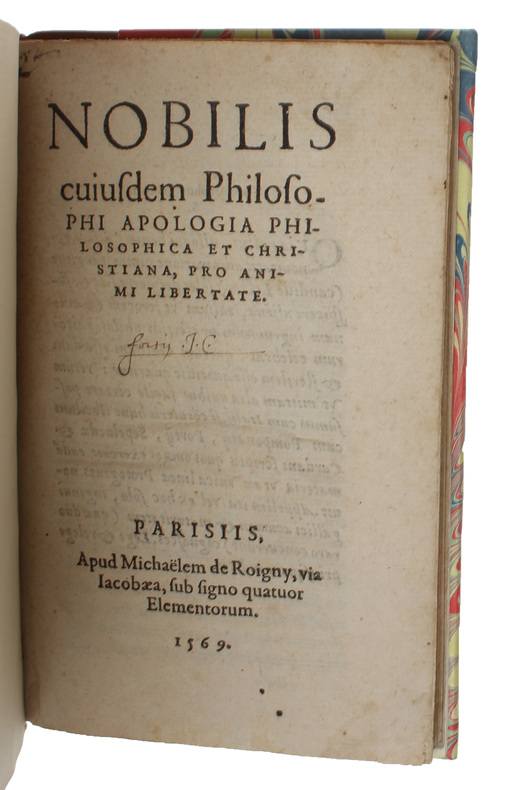
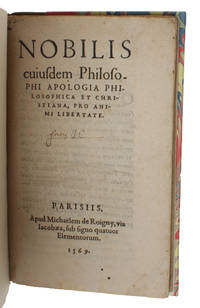
156941451Paris, Apud Michaëlum de Roigny, 1569. Small 8vo. Very nice recent half calf with five raised bands and gilt title to spine. Old owner's name to title-page (discreet). A nice and clean copy with only minor, very light soiling. Nice woodcut initials. 51 ff.
156941451Paris Apud Michaëlum de Roigny 1569. Small 8vo. Very nice recent half calf with five raised bands and gilt title to spine. Old owner's name to title-page discreet. A nice and clean copy with only minor very light soiling. Nice woodcut initials. 51 ff. <br/><br/><em>Very rare first edition of this work on the freedom and immortality of the soul by the father of the famous physicist and anatomist Jean Riolan the Younger. Jean Riolan the Elder 1539-1605 was also himself a noted French anatomist and a leading member of the medical faculty of Paris. He fought against the novelties that entered the faculty due to Paracelsus and authored a number of works attacking the most famous of the scientists who were in favour of chemical means. Works by him are of great scarcity.The work which is divided into three parts attacks the theories on the soul of Pomponazzi Portius Sepulveda and Cardano and as such it is an important document in the seminal controversy about the immortality odf the soul which dominated most philosohical thought of the Renaissance.We have been unable to find the work in any bibliographies. </em> hardcover
152629791Venetiis: Per Joan. Antoniu et fratres de Sabio 1526. First Edition. Hardcover. 4 64 numbered leaves. Later half vellum over marbled boards. Engraved title page initials woodcut printer's device of Lorenzo Lorio and Battista Putelletto at end featuring Saint Catherine of Alexandria a breaking wheel and the palm of martyrdom. Text block is faintly stained throughout. Old inscription on title a couple of old annotations on the margins tiny hole and mend to title page old mends to the last two leaves two small tears to printer's device. A very good copy. Uncommon. There are no auction records for the first edition and only a handful for later editions. ; Small octavo. Per Joan. Antoniu et fratres de Sabio hardcover
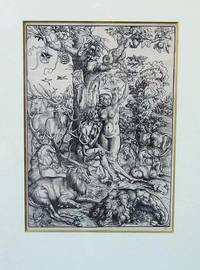
15092751509. Woodcut. <b>Hollstein VI.10.1; Bartsch XI.319.1; Dodgson II.294.57. </b>Later impression. Provenance: King Friedrich August II of Saxony Lugt 971. 13 5/8 x 9 3/4. Trimmed just outside the platemark. With some minor repairs. books
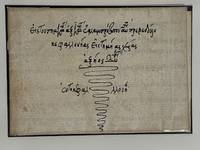
1591BOSTONVB11<br />MOREA OTTOMAN GREEK TURKISH PRISONERS Entire Letter writen from Chlonmontsi to "Lord David di Bembo Lord of Cephelonia" acknowledging receipt of nine Turkish Prisoners who are listed sent by the Lord of Cephalonia to "our Lord Bairakbasha Governor of the Morea". A very interesting and early letter during the period that Morea was under Ottoman rule expressing gratitude for the lenient treatment of Turkish prisoners. Surviving Ottoman letters in Greek are extremely rare. in commerce. A full translation and transcription is included.
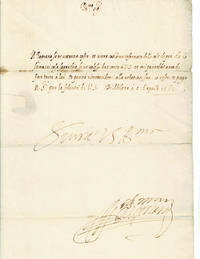
156298780Milan 1562. 1562. - Folio 12 inches high by 8-1/2 inches wide. 1-page on bifolium with a red paper seal. On the 4th leaf with the seal the letter is addressed "APRmo 5 Mons : Vescovo di Cremona". The letter realized in a secretarial hand is dated April 5 1562 from Milan and is boldly signed by Francesco Fernando dÁvalos d'Aquino d'Aragona.<p>Philip II King of Spain and Duke of Milan chose Francesco Fernando dÁvalos to be his envoy at the Council of Trent. He arrived in Trent on March 14 1562 and attended the sessions of the council. He pressed the Spaniards to not offer up anything against the interests of the Holy See. Upon his return to Milan he charged his secretary Ercole Pagnano with the task of generating a report. As the Governor's agent Pagnano had defended the privileges of the Sicilian monarchy and worked with the Spaniards to quell the controversy regarding the jurisdiction of bishops. In this letter to the Bishop of Cremona the Governor is offering Pagnano's report to him. Loosely translated he states that Pagnano is well informed about these things and that "V.S." Your Excellency should be given his account.<p>The letter was once folded into 4 panels and there very minor breaks along 3 of the folds. There is some minor browning especially to one of the folds. <p>An advisor to King Philip II of Spain Francesco Fernando dÁvalos c.1530-1571 took command of the Spanish army in Lombardy and Piedmont succeeding the 3rd Duke of Alba who had become the Governor of Milan. From 1560 to 1563 Francesco Fernando served as the Governor of the Duchy of Milan. He was the viceroy of Sicily from 1568 to 1571.<p>The Bishop of Cremona was born Niccolo Sfondrati in 1535 in the Duchy of Milan. Philip II of Spain appointed him to be a senator in Milan in 1552 and at the urging of the Spanish government the Pope appointed him Bishop of Cremona in 1560. He participated in some of the sessions of the Council of Trent from 1561 to 1563. In 1590 he was one of seven cardinals that were acceptable to be pope by Philip II of Spain. He was elected Pope and took the name Gregory XIV. He died less than a year later in October 1591. Milan, 1562. unknown