6 502 résultats
1867279850Leipzig: Bernhard Tauchnitz 1867. Quarter Leather. Very Good binding. Better known these days and then for her John Halifax Gentleman it is not surprising the Tauchnitz determined to promote her as its author. One of many novels by Craik as well as children's books The Little Lame Prince by the . This Tauchnitz edition in the publisher's black pebbled cloth backed in green leather. A sturdy copy. Very Good binding. Bernhard Tauchnitz unknown books
1857136Two Maine Bank Notes from the Atlantic Bank. One showing women Textile Workers 1857. Edges worn creasing and cancelled with a hole in each bill. A rare pair of Maine bank notes. books
198742947New York: Farrar Straus Giroux 1987. Hardcover. 245p. very good first US editon first printing stated in quarter-cloth boards and unclipped dj. Farrar Straus Giroux hardcover books
2007215264Berkeley: the Coalition; RCP 2007. Two 8.5x11 inch leaflets one from the Bay Area chapter of the October 22 Coalition an RCP affiliate the other in the name of the RCP itself calling for protests against the incarceration of six Black high school students who had beaten up a white student in the midst of a racial conflict at a school in Jena Louisiana. Critics held that the charges against the defendants which initially included attempted second-degree murder were excessive and racially discriminatory. the Coalition; RCP unknown books
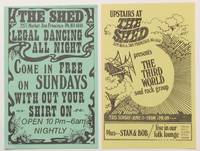
254487San Francisco: The Shed 197-. Two 5.5x8.5 inch leaflets one from the 2277 Market Street location which was used until 1977 the other announcing an appearance by "The Third World soul rock group" from 1978 after its move to 16th Street. The Shed which is often found on lists of historical gay bars even though it did not serve alcohol had legal all-night dancing until 6 AM. During the fight against the Briggs Initiative in 1978 the 16th Street location was used as an organizing headquarters. The Shed unknown books
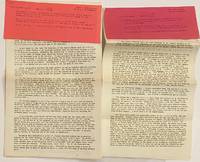
1966261578Seattle: The Group 1966. Two issues of the mimeographed bulletin 7 and 8 pages respectively mimeographed 8.5x14 inch sheets stapled at upper left folded for mailing with a red sheet affixed to the page sheet giving the issue number and stating that "the only concurrence we solicit is that which the Devil asked of Wicked John: 'Here-Take a Chunk of Fire and Start Your Own Hell.'" Issues present are 29 "The Last Indian War Part I" by Janet Mccloud and Robert Casey on recent Native American activism and 34 by Louise Crowley consisting of the edited text of an oral report to a "Women in Society" class at the Free University of Seattle critiquing a Freedom Socialist Party presentation. The latter issue has a crinkled closed tear at one fold. The Group unknown books
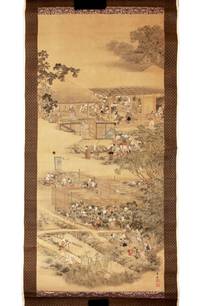
6951Japan: ca. 1840-50. Two large and fine paintings in hanging scroll format depicting all the steps in the production of the finest Uji tea by the Kanbayashi family to be sent to the Tokugawa shogun in Edo. These scrolls are of very great beauty and complexity and were surely painted by a master artist see below. The production and drinking of tea in Japan has a long and rich history extending back to the Nara period 710-94 when tea was brought back by diplomatic missions from China. Emperor Saga was served tea in 815 and afterwards ordered the establishment of several tea plantations near the capital of Kyoto. It was soon discovered that Uji a village located south of Kyoto was the ideal location to produce excellent tea leaves due to its rich soil and high-quality water. It became Japan's first major tea-producing region and has maintained its reputation for superior tea. In the 15th century the cultivation and production of tea in Uji underwent several transformations: the technique was introduced of covering young tea buds shielding them from the sun during the last weeks before plucking to improve their flavor ooishita saibai; and the quality of the tea was steadily improved through careful processing. Various shoguns including Hideyoshi Toyotomi 1536-98 and Ieyasu Tokugawa 1543-1616 supported the tea growers and processors in Uji. By the early 17th century an annual procession to celebrate the Shogunate's acquisition of its annual stocks of tea from Uji - Ochatsubo dochu "Travelling of the Shogun's Tea Jar" - was formalized as an official ritual event akin to political theater and thereby reinforcing Tokugawa authority. A delegation - Uji saichashi "Uji tea-picking envoy" including a "Tea Specialist" sukiya gashira and two subordinate "Tea Monks" chabozu - was sent with empty jars by the shogun each spring to observe the harvest and participate in the processing and selection of the tea leaves for the shogun. After many laborious steps of processing and selection as we shall see the tea leaves were placed in large jars. A few of these jars were sent as an offering to the Imperial Court Chatsubo shinken in Kyoto and the remainder were carried to Edo Castle in the autumn. The round-trip procession was a highly elaborate and publicized event. When the envoys returned to Edo the leaves were ground and made into powdered green tea for consumption at formal events at Edo Castle. During the last part of the 16th century and early years of the 17th century members of the Kanbayashi or Kamibayashi family found favor with several shoguns and eventually served as exclusive suppliers to the shoguns and the great daimyo the company established in 1558 still exists as Kanbayashi Shunsho honten and is affiliated with Coca-Cola. The family was given the honorific title of On cha todori "president of the Uji tea industry" and was also known as On mono chashi or Omono chashi "tea suppliers to the imperial family and shogun and leading nobility". They were allowed to wear samurai clothing and carry swords. Our scrolls beautifully depict all the steps of harvesting processing selecting and packing the tea leaves for transportation to the shogun in Edo. SCROLL ONE: This is composed of five different scenes. The first depicts two men erecting poles at the sides of a tea field preparing to cover the tea bushes shielding them with netting from the sun. Across the river the second image shows a member of the Kanbayashi family with sword at hip discussing the current crop with an employee who has a ledger book in front of him. They are being served tea while another employee is showing the just-harvested leaves. Behind them we see several women picking through the plucked leaves searching for impurities. The next scene is splendid: it shows many women harvesting the young tea leaves from the bushes which have been covered by netting supported by poles. It is a "beehive" of activity with about ten women working assisted by young men carrying the leaves away in buckets. A woman in the background is taking a break and nursing her child. The fourth scene shows another member of the Kanbayshi family leading a group of workers to the fields. A senior assistant is carrying a flag with the Kanbayashi family symbol. The final scene offers valuable information regarding the steps of processing. We see a large roofed building and on the right side is the heating room where steam is produced to heat the harvested leaves. To the left is a room where the actual steaming of the leaves is taking place. The leaves are then spread out in bins and cooled by women using fans. Further to the left we see men sifting to separate the smallest and finest leaves from stems and larger leaves. The final product is being weighed on a scale and placed into fine wooden boxes. The "story" of this first scroll with five scenes has been artfully constructed starting at the bottom and weaving its way upwards. The brushwork is highly refined and detailed: the faces showing a wide range of expression the leaves individually painted and the coloring extremely subtle. SCROLL TWO: This is also composed of five scenes. The first at bottom shows Kanbayashi employees further drying the leaves and placing them into large flat baskets which are carried to the next room. On top of the basket is a piece of paper describing the quality of the leaves. Yet another sifting and inspection of leaves takes place. The next scene upstairs shows a group of women spreading the leaves over a large table and picking through the leaves by hand again removing any impurities. These leaves are then passed to two inspectors for further review. The third scene shows several women yet again examining the leaves and removing further impurities this time with chopsticks. They turn and present the trays holding the leaves to a high-level Kanbayashi employee for approval. In turn the trays are then presented to the representatives from the shogun who are carrying swords and wearing masks and official attire. They use chopsticks to further cull undesirable leaves. In the background are large jars holding tea in a storage room. The fourth scene is that of a tea ceremony room where members of the Kanbayashi family and government officials are meeting and conducting a tasting. The final scene at the top of the scroll shows a formal room with government officials observed by other members of the delegation presumably the "Tea Specialist" and the two "Tea Monks" packing the tea in small envelopes and placing them in large jars. In the back is a beautiful garden. We can attribute with some confidence these hanging picture scrolls to Kagaku Ozawa fl. 1840-50 painter draftsman and poet in Kyoto. He was a follower of Kazan Yokoyama 1781-1837. The two scrolls are in fine and fresh condition preserved in a wooden box. The second scroll suffers from minor worming. ❧ Much of our description is based on the wonderful article by Prof. Taka Oshkiri "The Shogun's Tea Jar: Ritual Material Culture and Political Authority in Early Modern Japan" in The Historical Journal Cambridge Univ. Press 59 2016 pp. 927-45. hardcover books
195916795New York: The Living Theatre 1959. Near fine. 8.5" x 11" approx. offset printed recto only in black and red. 6.75" x 13.25" approx. Minor toning to both. Very near fine. <br/><br/>Flyers for Jack Gelber's THE CONNECTION directed by Judith Malina and designed by Julian Beck. A hit production of The Living Theatre and one that helped cement its reputation as the premier company for avant-garde theater. The play centered on Jazz musicians and junkies waiting on their dealer was an early realistic portrayal of heroin addiction at the end of a decade beset by drug hysteria. The Living Theatre unknown books
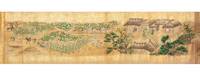
6984Japan: early mid-Edo. The theme of the four seasons of rice cultivation has had an extensive presence within Japanese art and literature. These two luxury festive scrolls beautifully depict the year-long cycle of rice growing in Japan along with the ancillary activities that took place during the year in the countryside including falconry growing vegetables and fruits seasonal festivals ways of relaxation and the annual tribute of rice to the fiefdom lord. The activities shown on these scrolls have much in common with Brueghel paintings and vividly depict country life. We learn from the labels and handwriting on the original box protecting these two scrolls that they were once owned by two prominent women members of the famous Nabeshima family. The first owner was Teiju in 1699-1752 wife of Muneshige Nabeshima 1687-1755 fifth lord of the Hizen Kashima han Hizen Kashima fiefdom. The later owner was Tokusei in or Kashioka 1798-1877 widow of Naonori Nabeshima 1793-1826 ninth lord of the same fiefdom. Tokusei in was particularly interested in the development of agriculture of the fiefdom and invented the form of brocading known as Saga nishiki. An educated woman she was also a book collector and her library is now kept intact in the Yutoku Inari Shrine in Kashima City in Saga Prefecture. Written on one of the old labels on the box is: "Shiki no kosaku" "Rice Cultivation through the Four Seasons". This type of scroll was oftentimes produced as part of a wealthy bride's dowery as a symbol of a good harvest and therefore good fortune to the new couple. Another label on the original box states in trans.: "scroll of images of our territory." The scrolls are very richly painted with copious clouds of gold flakes at top and bottom throughout. On both scrolls the actual images of the ground and background have gold-heightened effects kinsunago or "golden sand" or have been painted with gold. The folds and borders of the figures' clothes are heightened with gold and silver giving extra nuance. The coloring and detail of each person's face and clothing is quite refined and subtle with very delicate and highly detailed tiny brush strokes. We also note that the crowns of the trees have been carefully painted to depict every individual leaf. Clearly the artist was highly accomplished and went to great lengths to create these scrolls. SCROLL ONE: The first scroll covers all aspects of spring and summer activities. The first scene is clearly early spring with the plum trees in blossom. The farmers are preparing the unhulled grains of "seed rice" from last year's harvest to germinate in preparation for planting this year's crop. Everyone from the very young to old is participating. Many animals including horses and cows are in evidence. The next scene shows farmers "waking up" the dry paddies by tilling the soil. The following scene later in the spring with cherry blossoms in full bloom shows the farmers removing the weeds from the dry field and in an adjacent flooded paddy planting the rice seeds in the now-prepared seed beds. In the magnificent landscape shown behind we see a waterfall demonstrating the freshness of the water soon to flood the fields. Next we see the farmers planting the seedlings in another paddy now flooded. The farmers are supported by a band of musicians who are standing in the adjacent paddy celebrating the all-important transplantation ritual. During the summer water must be continually added to the fields. In the next extended scene we see a farmer using a hand-cranked hydraulic device to lift water to the paddies and other farmers tending and weeding the fields during a wind-driven rainstorm. The way the artist subtly depicts the rain reveals his great skills. The following scene shows a number of farmers and locals celebrating the summer growing period by dancing and playing musical instruments in front of a shrine. They have offered mochi to the shrine praying for rain and hoping for a good harvest. The next several scenes show the farmers growing and harvesting vegetables and beans and picking fruit from large orchards. We see a samurai passing through with his entourage en route to visit the fiefdom lords. SCROLL TWO: The second scroll begins by showing more of country life. Farmers are shown delivering vegetables and a group of samurai are engaged in falconry accompanied by a considerable entourage. Geese attracted by the now harvested fields fly by clearly intended as the prey of the falcons. There are several farmers fishing by the river and another group is resting after the day's work drinking water. We can sense they are all waiting for the crucial rice harvest. Now the autumnal harvest season arrives with a wonderful and complex scene of farmers cutting the rice stalks in the drained fields with sickles. The gathered stalks are bundled into tight sheaves and hung upside-down to dry. Now we see the dried sheaves loaded onto boats for transport. The now-empty paddies are filled with birds picking at the remaining rice kernels. We also see two fishermen catching fish in the river. In the next scene the sheaves are stacked before being transported by horse human and oxen to another area where the sheaves are further dried. In the following scene quite complex we see the rice stalks being processed to separate the rice grains from the shells and then dehusked. The next scene shows the grains of rice laid out on mats to dry. Samurai and farmers are having their own separate picnics celebrating the harvest. We also see a blind musician being escorted by two friends a fish monger and a firewood merchant going to the celebration shown next. The next scene depicts an elaborate harvest festival with farmers proceeding to a shrine to give thanks. They are observed by many spectators. The maple trees have turned color to brilliant reds and oranges. Finally we see farmers carrying their share of taxable rice to the warehouse where they will present the rice to the heads of the village who are recording the farmers' annual tributes in a ledger book. Many rice bales are in evidence. In fine and fresh condition. There is a minor loss of image at the end of the second scroll where two sheets of paper are joined. Occasional minor worming and discoloration. hardcover books
177536879Moscow: Meisto Pechati first piece 1775. 2; 6 2 blank. 1 vols. Folio. The two pieces loosely stitched together. Some stains not affecting legibility stitchmarks light soiling else very good. 2; 6 2 blank. 1 vols. Folio. Decrees relating to the military issued by Catherine II. These were issued the year following the end of the Russo-Turkish wars and the treaty of Kuchuk Kainarji signed the 21st July 1774 and after the Cossack rebellion lead by Ymelyan Pugachev who claimed to be Peter III and who was finally captured and executed at Moscow the 11th of January 1775. As a result of the wars and the rebellion in 1775 Catherine seriously reformed the provincial and urban administrations giving greater control to the central government. The first decree lists eight numbered points perhaps officers for promotion or commendation it has the Royal titles as a caption title and commences citing the decree of 3 August 1744. The second piece bears no caption title or heading but lists 47 separately numbered points each a short paragraph imprint on final leaf of text. Meisto Pechati [first piece] unknown books
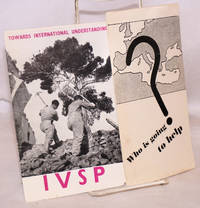
1956223306Leeds: I.V.S.P. 1956. Two folded brochures or leaflets: 1. Who is going to help six panels folded to 4.25x8 inches b&w photos two inserts to be mailed back with donation mildly-worn canceled stamp on rear dated London 11 Feb 1944 with Birmingham address printed below. 2. Towards International Understanding. Single sheet folded twice to 4.75x7.5 inches photographs two inserted leaflets one to return with donation and the other an open letter from Laurence Houseman 1956/57 printing states 26 years since the founding which was in 1931Very good. I.V.S.P. unknown books
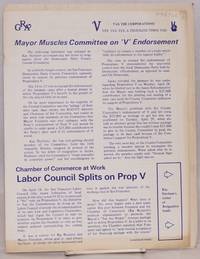
1980146732San Francisco: Committee to Tax the Corporations 1980. Two brochures both about 8.5x11 inches one a four-panel piece while the other folds out into a poster with the full text of the proposition; some crinkling and yellowing. The proposition would have required Big Business to pay at least 60% of all tax revenue generated in San Francisco while the city's budget would have to allocate a minimum of 80% for city services. The four-panel brochure includes material reprinted from Rebel Worker News Journal published by Marlene Dixon's group. Committee to Tax the Corporations unknown books
608367not signed from the 1955 film "The Rains of Ranchipur." 1. Full length scene shot of Joan Caulfield wearing a robe with her sexy legs showing. Note the unidentified actress 2. 1/2 length portrait of Richard Burton as Rama Safti. Photographs are on single weight stock; 8" x 10"; very good minor signs of handling; 1955. No Binding. Very Good. unknown books
608358not signed from the 1956 film "The Solid Gold Cadillac." 1. 3/4 length shot of Judy Holliday and Paul Douglas with Arthur O'Connell and two unidentified actresses. 2. 3/4 length shot of Judy Holliday pointing her finger at Paul Douglas at a board meeting with five men and one woman. Photographs are on single weight stock; 10" x 8"; very good minor signs of handling; few small pin holes and corner tear photo #1; few soft creases; 1956. No Binding. Very Good. unknown books
607062not signed of Machiko Kyo from the 1956 film "The Teahouse of the August Moon." Test photos are rare and probably one of a kind! 1. Full length sexy shot of Machiko Kyo in costume as Lotus Blossom. 2. Full length sexy shot of Machiko Kyo in costume as Lotus Blossom in the middle of a Japanese dance with Marlon Brando as Sakini Glenn Ford as Capt. Fisby and Eddie Albert as Capt. McLean looking on. Photographs are on single weight stock; 4 1/4" x 5"; very good tape on the upper margin of both photos; minor signs of handling; 1956. No Binding. Very Good. unknown books
606057not signed of Jane Powell and Vic Damone from the 1955 film "Hit the Deck." Test photos are all rare and probably one of a kind! 1. Full length sexy shot of Jane Powell in the arms of Vic Damone wearing a Sailor's uniform. 2. Full length sexy shot of Jane Powell seated on a park bench with Vic Damone wearing a Sailor's uniform. Photographs are on single weight stock; 4" x 5"; very good staple holes in the margins; photos are probably one of a kind; minor signs of handling; 1954. No Binding. Very Good. unknown books
19166049271916. not signed from the first motion picture serial "The Adventures of Kathlyn" 1916. 1. Full length action shot of Kathlyn Williams and others riding on a large elephant being guided by Charles Clary The Hindu . 2. Full length street scene of Kathlyn Williams and others. Photographs are on single weight stock; 4 1/2" x 6". Very good minor signs of handling; creases upper margin on photo #2. 1913. "The Adventures of Kathlyn" was released in 1916 directed by Francis J. Grandon story by Harold McGrath and written by Gilson Willets. Starring: Kathlyn Williams; Charles Clary; William Carpenter; Lafe McKee; Tom Santschi; Goldie Colwell; Franklin Hall; Effie Sackville; Roy Watson; Charles Courtwright; Charles Murphy; Harry Huckins; Edmund Cobb; Edwin Wallock and Hirri Tsingh. This was a ten reel re-edited version of a twenty-seven reel serial whose first part was released on December 29 1913. "The Adventures of Kathlyn" is considered by film historians to be the first motion picture serial as distinguished from films released in a series. See AFI Catalog of Feature Films 1911-1920 p. 6 for more details. No Binding. Very Good/No Jacket. unknown books
606817not signed from the 1974 film "The Vampires Night Orgy." 1. 3/4 length shot of an unidentified woman screaming as she is touched on the shoulder by a woman's hand. 2. 3/4 length shot of an unidentified Vampire with another unidentified woman next to her. Photographs are on single weight stock; 8" x 10"; very good minor signs of handling; 1974. No Binding. Very Good. unknown books
608469not signed from the 1955 film "The Shrike". 1. Full length shot of June Allyson and Jose Ferrer in a romantic embrace. 2. 3/4 length shot of June Allyson talking with Jose Ferrer resting in bed. Photographs are on single weight stock; 10" x 8"; very good minor signs of handling. No Binding. Very Good. unknown books
607476not signed from the 1955 film "The Shrike". 1. Full length shot of June Allyson and Jose Ferrer in front of an Italian Restaurant. 2. 3/4 length shot of June Allyson and Jose Ferrer inside a telephone booth. Photographs are on single weight stock; 10" x 8"; very good minor signs of handling. No Binding. Very Good. unknown books
606270not signed from the 1929 film "The Mighty." 1. 3/4 length shot of Raymond Hatton as Dogey Franks wearing a sport coat polka-dot bow tie and bowler hat confronting George Bancroft as Blake Greeson wearing a military uniform. 2. 3/4 length shot of Raymond Hatton dapperly dressed in a pin striped suit vest polka-dot bow tie and bowler hat with a cigarette in the mouth. Photographs are on heavy weight stock; linen backed; 10" x 8"; very good minor signs of handling. No Binding. Very Good. unknown books
607895not signed from the 1960 film "The Gallant Hours" the pair $22.50 1. 3/4 length pose of Cagney with three unidentified actors. 2. 3/4 length pose of Cagney as Fleet Adm. William. F. 'Bull' Halsey Jr. receiving an award from the admiral with five other military admirals in the background. Photographs are on single stock; 10" x 8"; very good minor signs of handling. No Binding. Very Good. unknown books
607712not signed 1. 3/4 length pose of Judy Canova Ross Hunter Ted Richmond and his wife at the completion party for "Hit the Hay." 2. 3/4 length variant pose of Ross Hunter Spike Wallace President of the Musicians Union at the completion party for "Hit the Hay." Information slips on the back of both photos. Photographs are on single stock; 8" x 10"; very good; 1945. No Binding. Very Good. unknown books
606353not signed from the 1955 film "The Glass Slipper." 1. Full length shot of Leslie Caron dancing with two chefs in tights. 2. Full length shot of Leslie Caron dancing with a chef in front of a large fantasy kitchen with open oven filled with roasting birds and ribs. Photographs are on single weight stock; 10" x 8"; very good minor signs of handling. 1955. Information slip on the back. No Binding. Very Good. unknown books
606665not signed from the 1947 20th Century-Fox film "The Late George Apley." 1. Full length shot of Ronald Colman as George Apley with Vanessa Brown as Agnes Willing and Peggy Cummins as Eleanor "Ellie" Appley. 2. 3/4 length shot of Kathleen Howard as Margaret the maid giving Ronald Colman help by spraying a vine inside the living room. Photographs are on single weight stock; 10" x 8"; very good minor signs of handling. No Binding. Very Good. unknown books