1 544 résultats
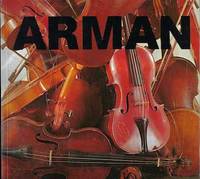
200764Barcelona Ediciones Poligrafa Konemann 1999. 528pp. Square 4to. Original cloth in pictorial dustwrapper.in slipcase Profusely illustrated with colour and b&w plates. A fine copy. First edition in English. Barcelona, Ediciones Poligrafa ? Konemann 1999. hardcover
194789033New York: Philosophical Library 1947. First American Edition. Quarto. Red cloth hardcover; 168pp. Numerous halftone illustrations accompanied by Eluard's verse commentary. Typical sun-fading to board edges else a tight Near Fine copy. In the original dustwrapper sunned at margins foxed on rear panel with a few chips and closed tears; Very Good. Philosophical Library unknown
154New York: Museum of Modern Art 1967. . Large 4to gray paper-covered boards cloth spine; dust jacket with a few closed tears New York: Museum of Modern Art, 1967. hardcover
199657513San Francisco: Alan Wofsy Fine Arts 1996. First US edition. 4to. xxii 225 pp. Fine in very near fine dust jacket. A volume in the “Paintings Watercolors Drawings and Sculpture: A Comprehensive Illustrated Catalogue 1885-1973.†San Francisco: Alan Wofsy Fine Arts, unknown
1980002309Montclair: Allanheld & Schram 1980. First Edition. . Cloth. Fine/Fine. Cloth in mylar protected dust-jacket. 334 pages w/ figure list notes and index; illustrated. A definitive study exploring the background and sources of the mural its structure and symbolic and aesthetic concerns. A clean tight copy Size: Quarto <br/> <br/> Allanheld & Schram hardcover
2014x-3319107046Springer 2014. Hardcover. New. 2015 edition. 802 pages. 9.25x6.25x2.00 inches. Springer hardcover
2016x-3319383833Springer-Verlag New York Inc 2016. Paperback. New. reprint edition. 828 pages. 9.25x6.10x1.64 inches. Springer-Verlag New York Inc paperback
51-2890New York: Harry N. Abrams circa 1980. 4to. 4 pp. Lists original graphic works with prices by Agam Albers Alechinsky Appel Berarden Frankenthaler Motherwell Picasso Indiana Rauschenberg Newman et al. New York: Harry N. Abrams, circa 1980 unknown
1971N4875Paris: Cercle D'Art 1971. Original Cloth. Very Good. Folio. 239pp RICHLY ILLUSTRATED IN COLOUR. Truly insignificant outside markings. A VERY GOOD CLEAN AND FRESH COPY. <br/> <br/> Cercle D'Art hardcover
1996BN207500Parkstone / Aurora Publishers 1996. 1996. Hardcover. Pablo Picasso: The Creative Eye From 1881 to 19140 Great Painters Series <br/><br/>Pablo Picasso: The Creative Eye From 1881 to 19140 Great Painters Series Anatoly Podoksik Autor; Pablo Picasso Illustration Parkstone / Aurora Publishers hardcover
59402Paris; Editions Albert Skira 1934 1934 1935. Issues 5 6 and 7 bound together in one hardback volume. 4to 31cm x 25cm iv 33pp 68pp 69pp plus plates and adverts. Bound in plain brown cloth with the original cover of issue number 5 a design by F Bores pasted to the front board. The binding is defective - a substantial section of the spine is missing but the text block remains tightly bound. There are some signs of wear to the contents - the endpapers are foxsed a few of the plates have some creasing of the corners and there is a tear to one page. This book includes originals of issues 5 6 and 7 of the avant-garde surrealist magazine. Please note that the covers of issues 6 and 7 have not been bound in. Text in French. Paris; Editions Albert Skira, 1934, 1934, 1935. hardcover
58981Adagp - Spadem Paris 1975 In-folio 45 cm trois chemises rouges contenant: Cinq dessins reproduits en noir d'André Masson - Quatre gravures de Picasso - Sept affiches républicaines de la guerre d'Espagne en couleurs 61 x 86 cm ensemble sous chemise Portfolio pleine toile percaline illustree grand dessin de Picasso sur le premier plat Nb-0306 unknown
1956N - 2026 - 8<p>Au Vent d'Arles Paris 1956. Foreword by Antonina Vallentin. Limited numbered edition of 200 copies 26 H.C on Richard de Bas paper. Portfolio with 12 pochoirs of drawings after Picasso Guarded in the original pictorial cloth folder.</p> Au Vent d'Arles
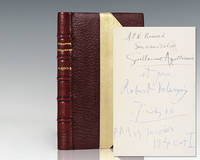
1913128083Paris: Mercure de France 1913. First edition of Apollinaire's first collection of poems signed by him and Pablo Picasso. Octavo bound in three quarter morocco with gilt titles and raised bands to the spine patterned endpapers frontispiece portrait of the poet by Pablo Picasso. Association copy inscribed by both Apollinaire and Pablo Picasso on front free endpaper "A A P.N. Roinard son admirateur Guillaume Apollinaire" and "et pour Robert Valançay Picasso Paris Janvier 1940 et I." Apollinaire has also made five corrections to the text in ink on pages 71 77 92 110 and 189. The recipient of Apollinaire's inscription Paul-Napoléon Roinard was a French libertarian painter and poet whom Apollinaire befriended in 1903 and considered "one of the most powerful precursors of the new poetry." Apollinaire dedicated his poem Le Brasier included in the present volume on p. 129 to Roinard. The recipient of Picasso's inscription Robert Valançay was a poet translator and literary critic who worked with and admired many of the artists and poets of the surrealist group. He published two major volumes of poetry but was most appreciated and sought after for his translations. He was considered the official translator of Max Ernst and Hans Arp. In near fine condition. Original wrappers bound in. A remarkable association copy linking four major figures of the literary and artistic avant-gardes of the 20th century. French poet playwright short story writer novelist and art critic Guillaume Apollinaire is considered one of the foremost poets of the early 20th century as well as one of the most impassioned defenders of Cubism and a forefather of Surrealism. At the turn of the 20th century he became one of the most popular members of the artistic community of Paris both in Montmartre and Montparnasse. His friends and collaborators in that period included Pablo Picasso Henri Rousseau Gertrude Stein Max Jacob André Salmon André Breton André Derain Faik Konitza Blaise Cendrars Giuseppe Ungaretti Pierre Reverdy Alexandra Exter Jean Cocteau Erik Satie Ossip Zadkine Marc Chagall Marcel Duchamp and Jean Metzinger. He is credited with coining the term "Cubism" in 1911 to describe the emerging art movement the term Orphism in 1912 and the term "Surrealism" in 1917 to describe the works of Erik Satie. Mercure de France hardcover
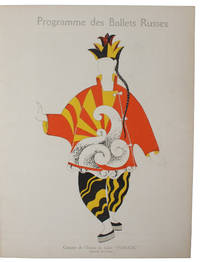
191760103Paris Mai 1917. Folio. Original illustrated extra wrappers with a picture by Picasso on the front and the décor for "Baba Iaga" on the back; original illustrated wrappers for "Théatre du Chatelet" drawing by André Marty on front and advertisements on back in grey and red; original illustrated coloured wrappers for "Programme des Ballets Russes" front wrapper illustrated by Picasso with the Chinaman-costume from "Parade". A bit of soiling to the extra-wrappers and small professional restorations to upper front cover and top of spine this barely noticeable as well as to blank margin of back wrapper. Apart from that an excellent and very well perserved copy with only slight browning to some leaves. Apart from the described wrappers and extra-wrappers there are in all 24 leaves with -mostly photographic- illustrations four of them with original hand-colouring on top and 6 leaves of text.With the original errata-leaf laid in loose stating also that the illustrations "Femmes de bonne humeaur" and "Parade" have been hand-painted by Carlos Socrate after the designs of Bakst and Picasso and that the front wrapper for "Parade" the Chinaman has been handpainted by Picasso himself. <br/><br/><em>Scarce original printing of this seminal avantgarde-publication the May 1917 "Théatre du Chatelet"- publication that presents Diaghilev's "Ballets Russes" in Paris - here containing the entire separate publication mainly devoted to Jean Cocteau's groundbreaking ballet "Parade" - being one of the most important publications in the history of modern art. It is here in his presentation-article to "Parade" that Apollinaire coins the term "surrealism" and thus lays the foundation for the seminal cultural movement that Bréton came to lead. Furthermore the ballet "Parade" represents a historical collaboration between several of the leading artistic minds of the early twentieth century: Erik Satie Jean Cocteau Pablo Picasso Léonide Massine and Serge Diaghilev and is famous not only for its contents and its music but also for its magnificent costumes designed by Picasso the drawings of which are presented in the present publication for the first time - most famously the front cover for the "Parade"-programme which depicts the "Costume de Chinois du ballet "PARADE"/ Aquarelle de Picasso" an etching with original stunning pochoir-colouring hand-painted by Picasso himself!.It is the 1917 ballet "Parade" - the first of the modern ballets - originally presented for the first time in the present publication that marks Picasso's entry into the public and bourgeois institutions of ballet and theatre and presents Cubism on the stage for the first time. The present publication constitutes an outright revolution in the history of art theatre and ballet.Several variants of this spectacular publication exist but the one we have here is as original and complete as it comes containing the entire contents of the different variants. We not only have the extremely scarce and fragile dust-wrapper and the equally scarce illustrated coloured double-wrappers front: "Peinture de Picasso"; back: Décor de Larionow pour le ballet "BABA IAGA"" but also the entire 1917 "Théatre du Chatelet"-programme in original illustrated wrappers with the entire separate "parade"-issue -also entitled "Programme des Ballets Russes"- also in original illustrated wrappers with more than 20 leaves of photographic illustrations containing pictures of the actors and actresses also in their spectacular avant-garde-costumes Bakst's portrait of Leonide Massine Picasso's portrait of Stavinski Bakst's portrait of Picasso Picasso and Massine in the ruins of Pompei Picasso's drawings of a scene from "Parade" and of Massine as well as several mostly humorous advertisements. But more importantly we have apart from the above-mentioned famous Chinaman by Picasso in original pochoir-colouring the other famous etching by Picasso "Costume d'acrobate du ballet "Parade"/ Aquarelle de Picasso" also in original pochoir-colouring bright blue the seminal presentation-article by Apollinaire which coins the term "surrealism" see bottom of description for full translation of this groundbreaking preface the two "Les Femmes de Bonne Humeur"-figures by Bakst Constanza and Battista printed and heightened in gold pochoir the printed costume by Larionow "Les contes russes" which is with original bright red and blue pochoir-colouring and the "Le Mendiant"-costume by Bakst for "Parade" and of course the texts by Bakst on choreography and décor Georges-Michel Ballets Russes after the War as well as the texts for the various ballets listing the actors and their rôles as well as a resume of the plot. " "Tact in audacity consists in knowing how far we may go too far." Jean Cocteau poet writer and arts advocate made this statement in his 1918 manifesto The Cock and Harlequin. Cocteau in collaboration with Erik Satie and Pablo Picasso discovered "how far" to "go too far" in the circus-like ballet Parade-one of the most revolutionary works of the twentieth century. Parade incorporates elements of popular entertainment and uses extra-musical sounds such as the typewriter lottery wheel and pistol combining them with the art of ballet. Cocteau wrote the scenario for the one-act ballet and contracted the other artists. Satie wrote the score to the ballet first in a piano four-hands version and then in full orchestration while Picasso designed the curtain set and costumes. Later Léonide Massine a dancer with the Ballet Russes was brought in as the choreographer. Serge Diaghilev's Ballet Russes premiered the ballet Parade on May 18 1917. The program notes for the ballet were written by the poet Apollinaire. They became a manifesto of l'esprit nouveau or "the new spirit" which was taking hold in Paris during the early twentieth-century. Apollinaire described the ballet Parade as "surrealistic" and in doing so created a term which would develop into an important artistic school." Tracy A. Doyle Erik Satie's ballet PARADE p. 1.When the French poet and army officer Guillaume Apollinaire wrote the program notes For "Parade" he created the manifesto of the "l'esprit nouveau" - "the new spirit". Cocteau had called the ballet "realistic" but Apollinaire took it an important step further and described it as "surrealistic" thus coining a term that would soon develop into an important artistic movement. With Picasso Apollinaire had established the aesthetic principals of Cubism and was considered a leader in the European avant-garde. ENGLISH TRANSLATION OF APOLLINAIRE'S PROGRAMME NOTES TO "PARADE": "Definitions of Parade are blossoming everywhere like the lilac bushes of this tardy spring.It is a scenic poem transposed by the innovative musician Erik Satie into astonishingly expressive music so clear and simple that it seems to reflect the marvelously lucid spirit of France. The cubist painter Picasso and the most daring of today's choreographers Léonide Massine have here consummately achieved for the first time that alliance between painting and dance between the plastic and mimetic arts that is a herald of the more comprehensive art to come. There is nothing paradoxical about this. The Ancients in whose lives music played such an important role were totally unaware of harmony which constitutes the very basis of modern music. This new alliance - I say new because until now scenery and costumes were linked only by factitious bonds - has given rise in Parade to a kind of surrealism which I consider to be the point of departure for a whole series of Manifestations of the New Spirit that is making itself felt today and that will certainly appeal to our best minds. We may expect it to bring about profound changes in our arts and manners through universal joyfulness for it is only natural after all that they keep pace with scientific and industrial progress. Having broken with the choreographic tradition cherished by those who used to be known in Russia under the strange name 'balletomanes' Massine has been careful not to yield to the temptation of pantomime. He has produced something totally new-a marvelously appealing kind of dance so true so lyrical so human and so joyful that it would even be capable if it were worth the trouble of illuminating the terrible black sun of Dürer's Melancholy. Jean Cocteau has called this a realistic ballet. Picasso's cubist costumes and scenery bear witness to the realism of his art. This realism - or this cubism if you will - is the influence that has most stirred the arts over the past ten years. The costumes and scenery in Parade show clearly that its chief aim has been to draw the greatest possible amount of aesthetic emotion from objects. Attempts have often been made to return painting to its barest elements. In most of the Dutch painters in Chardin in the impressionists one finds hardly anything but painting. Picasso goes further than any of them. This is clearly evident in Parade a work in which one's initial astonishment is soon replaced by admiration. Here the aim is above all to express reality. However the motif is not reproduced but represented-more precisely it is not represented but rather suggested by means of an analytic synthesis that embraces all the visible elements of an object and if possible something else as well: an integral schematization that aims to reconcile contradictions by deliberately renouncing any attempt to render the immediate appearance of an object. Massine has Adapted himself astonishingly well to the discipline of Picasso's art. He has identified himself with it and his art has become enriched with delightful inventions such as the realistic steps of the horse in Parade Formed by two dancers one of whom does the steps of the forelegs and the other those of the hind legs. The fantastic constructions representing the gigantic and surprising features of The Managers far from presenting an obstacle to Massine's imagination have one might say served to give it a liberating impetus. All in all Parade will change the ideas of a great many spectators. They will be surprised that is certain; but in a most agreeable way and charmed as well; Parade will reveal to them all the gracefulness of the Modern movements a gracefulness they never suspected. A magnificent vaudeville Chinaman will make their imaginations soar; the American Girl cranking up her imaginary car will express the magic of their daily lives whose wordless rites are celebrated with exquisite and astonishing agility by the acrobatin blue and white tights." </em> unknown
63-5365Verviers Belgium: Society Royale des Beaux-Arts 1950. 8vo. 39 pp. Soft covers with Dust Jacket Good with minor losses tears minor staining to DJ & end papers covers detached. Black and white plates. Text in French.From The Library of Herschel Chipp. Verviers, Belgium: Society Royale des Beaux-Arts, 1950. paperback
200784754George Braziller. New. 2007. Hardcover. 0807615862 . FREE UPGRADE to Courier/Priority Shipping Upon Request - IN STOCK AND IMMEDIATELY AVAILABLE FOR SHIPMENT - Flawless copy brand new pristine never opened -- Text in Spanish and English. 176 pages; 4to. -- with a bonus offer-- . George Braziller hardcover
200784755George Braziller. New. 2007. Paperback. 0807615854 . FREE UPGRADE to Courier/Priority Shipping Upon Request - IN STOCK AND IMMEDIATELY AVAILABLE FOR SHIPMENT - Flawless copy brand new pristine never opened -- Text in Spanish and English. 176 pages; 4to. -- with a bonus offer-- . George Braziller paperback
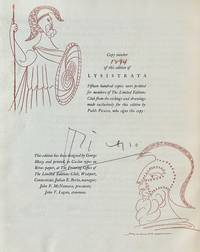
19346237New York: The Limited Editions Club 1934. Signed Limited Edition. Signed by Pablo Picasso at the rear of the book on the limitation page. Number 984 of only 1500 copies. Lacking all 6 original etchings. Measuring approximately 12" x 9.5" with 117 numbered pages. Comes with its original slipcase. <br /> <br /> The book is in very good minus condition. Minor sun fading to the spine. Both hinges cracked. Interior pages are moderately foxed. Slipcase is in good minus condition. Heavy chipping and wear. <br /> <br /> Please view the many other rare titles available for purchase at our store. We are always interested in purchasing individual or collections of fine books.<br /> <br /> Inventory #O6-143. The Limited Editions Club unknown
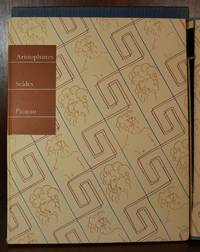
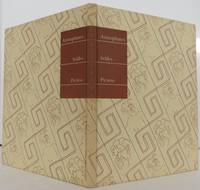
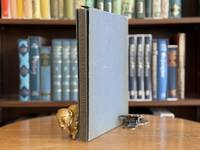
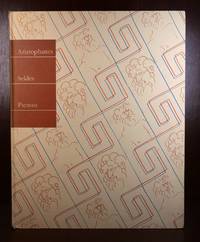
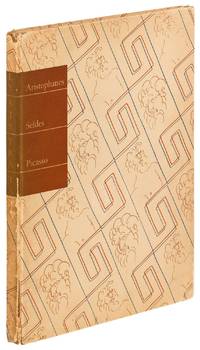
19349675<p>A modern rendering of Aristophanes' classic with numerous illustrations by Picasso. Copy number 1294 of 1500 copies. Decorative paper-covered boards housed in a custom clam shell box. BFK Rives watermark. Some wear to head and tail of spine and corners see images. The six original etchings removed long ago. Otherwise a nice clean copy. Exuberantly signed by Picasso.</p> The Limited Editions Club hardcover
19342502007The Limited Editions Club 1934. signed limited. hardcover. fine. SIGNED Limited edition 1/1500. This being #316. Signed by Picasso. Book fine stiff cover near fine with two small teats to bottom of spine. In very good slipcase partial tears to bottom part. The Limited Editions Club unknown
19340101403New York: The Limited Editions Club 1934. Limited edition. Hardcover. 4to. In decorated paper over boards retaining the original glassine jacket blue chemise lined with decorated paper and blue slipcase. With six original etchings in black and illustrations throughout. Very good condition; glassine is age-toned and shows a long tear to the rear panel from the top center across to the rear flap. Chemise shows age-toning to the spine; slipcase is age-toned scuffed with loss to corners and upper seams splitting. Limited edition this copy numbered 612 of 1500; SIGNED by Picasso. The Limited Editions Club hardcover
19347220New York: The Limited Editions Club 1934. Signed Limited Edition. Signed by Pablo Picasso at the rear of the book on the limitation page. Number 1386 of only 1500 copies. Lacking all 6 original etchings. Measuring approximately 12" x 9.5" with 117 numbered pages. <br /> <br /> The book is in very good condition. Minor surface wear and staining to the boards. Some paper loss at the corners and spine ends. Interior pages are clean and well preserved. Lacking the original slipcase. <br /> <br /> Please view the many other rare titles available for purchase at our store. We are always interested in purchasing individual or collections of fine books.<br /> <br /> Inventory #P5-34. The Limited Editions Club unknown
1934419893New York: Limited Editions Club 1934. Hardcover. Near Fine/Near Fine. First edition of this translation. Illustrated by Pablo Picasso with six original etchings in black and 30 lithographs. Tall quarto. Illustrated paper over boards. Light chipping at the spine ends wear at the corners and bottom of the front joint mild offsetting on front endpapers from clippings an about very good copy lacking the original glassine chemise and slipcase. One of 1500 numbered copies Signed by Picasso this is the translator Gilbert Seldes' own copy hand noted as copy number "G.S." Provenance on request. The Artist and The Book 226. Limited Editions Club hardcover
74-0585Antibes France : Musee Picasso Chateau Grimaldi 1983. 4to. 40 pp. Soft covers. Mostly color plates. Minor creasing. Light signs of shelf wear. Very Good. Text in French.Provenance: From the Collection of Art Historian Peter Selz 1919-2019. Antibes [France] : Musee Picasso, Chateau Grimaldi, 1983. paperback