132 résultats
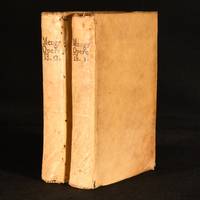
1787935P23Roma: Stamperia Pagliarini 1787. Vellum. Good Only. 8" by 5". Various. A scarce two volume edition collecting together the artistic writings of Neoclassical painter Anton Raphael Mengs. Complete in two volumes the scacer edition by Pagliarini who also published an edition in one volume.Illustrated with a frontispiece to each volume. In Italian.The collected writings by the noted eighteenth century Neoclassical painter Anton Raphael Mengs.Mengs' writings were all on the theory of art and on the lives of eminent painters throughout history. This includes his 1762 'Reflections on Beauty and Taste in Painting' an influential treatise which inspired the artistic society of his day. His other writings includes 'Reflections on the Three Great Painters Raphael Correggio and Titian and on the Ancients' 'Practical Painting Lessons' 'Reflection on the Academy of Fine Arts in Madrid' a selection of letters written to Antonio Ponz 'Dreams on Beauty' and more. As an artist Mengs painted many of the important figures of his day such as Charles IV of Spain Maria Luisa of Spain and Johann Joachim Winckelmann as well as striking religious and mythological scenes of figures such as Helios and St. John the Baptist. Including a life of Mengs by Jose Nicolas d'Azara edited by Carlo Fea.Collated complete. In the original vellum binding. Externally generally smart. Vellum is discoloured as is usual to see heavier to the spines. Minor marks to the boards and spine. Light bumping to the head and tail of the spines and to the extremities. Chip and lifting to the fore edge of the rear board of Volume I. Heavier patch of discolouration to the rear board of Volume II. A few small chips to the vellum mostly to the spines and joints. Hinges are tender. Front endpapers are detached and edge worn. Lacking the paper to the rear paste downs. Internally generally firmly bound. Pages are lightly age-toned and generally clean with scattered spots. Dampstain to the first few pages of Volume I with amateur repairs from the half-tile to page xvi. Frontispiece and page xxix of Volume I are detached but present as if the half-title frontispiece and title of Volume II. Mark to the bottom edge of the first half of the text and final few pages of Volume II. Good Only Stamperia Pagliarini hardcover
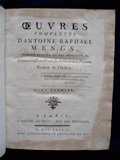
17867634A l'hôtel de Thou | à Paris 1786 | 25.50 x 20 cm | deux volumes reliés
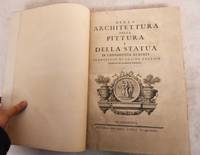
1782189785Bologna: In the Institute os Science 1782. Hardcover. Very Good Cover has general wear Leather peeling corner/edge damage. Spine has damage to top/bottom. Bookblock has age toning. Interior pages have age toning and foxing. Brown cloth boards with gilt highlights Black leather corners and spine. Gilt lettering and design elements on 5 raised band spine. xiii 3 341 pages 69 leaves of plates some folded : illustrations plans. Title vignette tail-pieces and plates engraved by Pio Panfili. In the Institute os Science hardcover
17035770Rome: Gaetano Zenobi 1703. First edition. Octavo 23 cm; 114 2 pages. Vignette with arms of Pope Clement XI flanked by putti on title page. LACKS FRONTISPIECE PORTRAIT. Decorated letters and ornaments in text. Bound in mottled calf weak at joints and worn at extremities. Early inscription abraded at base of title page. Pages lightly toned with occasional stains. References: Cicognara 2404; Anthony Blunt "Don Vincenzo Vittoria" in The Burlington Magazine 109:766 1967 31-32. <br /><br />The author was a Spanish engraver and printer who lived and worked in Rome for part of his life. The text is a defense of Raphael and others from some dismissive remarks made by Carlo Cesare Malvasia in his promotion of the Carracci and of the Bolognese school "La Felsina Pittrice" 1678. Vittoria wrote the material probably in Spanish while still living in Valencia. In the preface he apologizes for his Italian which "lacks purity." The significance of the book according to the art historian Anthony Blunt lies in the author's descriptions of several drawings by Raphael and his contemporaries which are either lost or known only in engraved copies. Condition noted. Gaetano Zenobi unknown
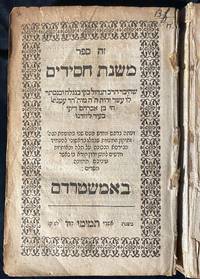
174042573Amsterdam: No Publisher Listed 1740. Hardback. 2nd edition. Period Vellum binding 12mo 132 leaves; 17 cm. In Hebrew. Mayer Sulzberger's copy with his bookplate. Like the Mishnah Mishnat Hasidim is arranged in "Sedarim" which are divided into "massechtot" and subdivided into "perakim." With an introduction entitled: Olam Katan. Includes index. Title-page has ornamental border. <br> Raphael Immanuel ben Abraham Hai Ricchi 1688-1743 was an "Italian rabbi cabalist and poet.After having studied Talmud under Nathan Pinkerle rabbi of Alessandria della Paglia Ricchi became tutor in the houses of several wealthy Jews. He was thus successively employed at Göritz Fiorenzuola Finale in Modena and Venice; in the last-named place he opened a school. He then went to Triest where he was ordained rabbi in 1717 by Hillel Ashkenazi rabbi of Canea after which he was invited to the rabbinate of Görz.<br> Owing to his great love for cabalistic studies and to his ascetic tendencies Ricchi resolved to settle in Palestine. He arrived at Safed in 1718 and during his stay there of two years he occupied himself with the study of the works of Isaac Luria and Hayyim Vital. He was also reordained rabbi by Hayim Abulafia. In 1720 an epidemic broke out in Palestine and Ricchi was compelled to return to Europe. <br> On the voyage he and all his fellow passengers were captured by pirates and brought to Tripolitza whence through the efforts of Abraham Halfon Ricchi and his family were allowed to return to Italy. He then occupied the rabbinate of Florence till 1723 in which year he removed to Leghorn where for twelve years he engaged in business as a merchant. He spent twenty months in travel visiting Smyrna Salonica Constantinople Amsterdam and London and in 1735 set out for Palestine spending two years at Aleppo and three at Jerusalem. In 1741 he returned to Leghorn and in 1743 while traveling in Italy for the purpose of selling his works he was killed by robbers who buried his body by the shore of the Reno. Six days later some Modena Jews discovered the remains and brought them to Cento for burial.<br> Ricchi's most important work is the above-cited 'Mishnat Hasidim' a cabalistic work begun in 1726 at Leghorn. <br> Like the Mishnah it is arranged in orders 'sedarim' which are divided into treatises 'massektot' and subdivided into chapters 'peraim' the names of the six Mishnah orders being taken in a cabalistic sense. But the chief divisions of the work are three termed 'mafteot' besides the introduction entitled ''Olam Kaon' = 'microcosmos' in which Ricchi endeavors to popularize the Cabala. <br> The first main division is the 'Maftea ha-'Olamot' in which the worlds are treated. It contains: 1 the order of Zera'im treating of the cabalistic cosmology and of metaphysics and divided into seven massektot and eighteen chapters; 2 the order Kodashim treating of the realm of emanation 'olam ha-azilut' which is styled 'the holy of holies' and containing twenty massektot and seventy-eight chapters; 3 the order ohorot treating of the three other realms namely those of creative ideas 'beri'ah' creative formations 'yezirah' and creative matter 'asiyah' and divided into nine massektot and twenty-seven chapters; and 4 the order Nezikin treating of the demons and 'kelifot' and divided into six massektot and seventeen chapters. <br> The second main division entitled 'Maftea ha-Neshamot' contains the order Nashim treating of souls in twelve massektot and forty-eight chapters. The third main division entitled 'Mafteah ha-Kawwanot' contains the order Mo'ed divided into fifty-eight massektot and 371 chapters and treating of the Kawwanah. It will be seen that the number of massektot in this work is 112 corresponding to the numerical value of the sacred name ; and the number of chapters 547 equal to the numerical value of Ricchi's name plus twelve the number of its letters. <br> The sources for this work besides the Zohar are mostly Isaac Luria's and Hayyim Vital's writings of which the 'Sefer ha-Gilgulim' 'Kanfe Yonah' and 'Shulhan 'Aruk' may be particularly mentioned. Ricchi drew also from other cabalists" M. Seligsohn in JE 1905.<br> NYU houses their copy in the Mitchell M. Kaplan Collection of Rare Judaica and Hebraica. Aviva Ben-Ur's Ladino catalog list #14. Judge Mayer Sulzberger "was closely associated with Isaac Leeser and assisted that scholar in editing The Occident contributing to it a partial translation of Maimonides' "Moreh Nebukim." After Leeser's death Sulzberger edited vol. xxvi. of The Occident. He was one of the founders of the Young Men's Hebrew Association which he served as president; and he has taken great interest in the Jewish Hospital of Philadelphia of which he has been vice-president since 1880. He was from the beginning in 1888 chairman of the publication committee of the Jewish Publication Society of America; was one of the original trustees of the Baron de Hirsch fund; and interested himself in the establishment of agricultural colonies at Woodbine N. J. and in Connecticut.Sulzberger had one of the best private libraries in America; it contained a very large number of Hebraica and Judaica" WIkipedia. SUBJECTS: Cabala -- Early works to 1800. Siddurim -- Texts. Judaism -- Ari rite -- Liturgy -- Kabbale -- Ouvrages avant 1800. Siddour -- Textes. Cabala. OCLC: 904949349. OCLC lists only 2 copies of this 1740 2nd edition worldwide NYU & Cambridge and only 3 copies of the first edition of 1727.<br> Boards slightly bowed with front hinge starting. Remains of 19th Century paper label on spine. Lacks front blank pastedown. Jewish institutional bookplate in addition to that of Sulzberger. Paper toning but strong. About Very Good- Condition. Attractive copy of early edition of an important cabalistic text. RAB-67-7. Amsterdam: [No Publisher Listed] unknown
1777120471Lettera di Don Antonio Raffaele Mengz : primo pittor di camera di S.M.C. a Don Antonio Ponz / tradotta dall'originale Spagnuolo manualemente scritto. Turin: Nella stamperia Reale, 1777. 56 pages. bound in period paper wrappers. 23x17.5cms. Text in Italian.
1777120471Lettera di Don Antonio Raffaele Mengz : primo pittor di camera di S.M.C. a Don Antonio Ponz / tradotta dall'originale Spagnuolo manualemente scritto. Turin: Nella stamperia Reale, 1777. 56 pages. bound in period paper wrappers. 23x17.5cms. Text in Italian.