Raphael (Raffaello) SavonarolaBiblio.com
132 résultats
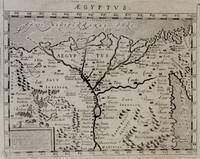
1713M8141Italy c.1713. Very Good. Notes: Savonarola used the pseudonym Alphonsus Lasor a Varea. Monk of Theatine order who worked in the monastery library in Padua. He was also Professor of Holy Scripture. Universes Terrarum Orbis Scriptorum. Size : 135x175 mm 5.31x6.89 Inches Coloring: Black & White Reference: Mickwitz A.M. Miekkavaara L. and Rantenen T. The A.E. Nordenskiold Collection in the Helsinki University Library Volume 2 1981 pp. 269- 276 Category: Maps Africa North Egypt; unknown
177420163Rome 1774. Copper engraving on two joined sheets by Ottaviani after drawings by Savorelli and Camporesi printed in light brown coloured ink with contemporary hand-colouring. Some marginal restoration at corners and margins. A stunning plate from "Logge di Rafaele nel Vaticano": with contemporary colouring of the highest quality from the golden age of the hand-coloured print.<br/> <br/> A very fine image from the second part of a work titled "Loggie di Rafaele nel Vaticano" depicting the decorative work executed by Raphael and his assistants between 1518-1519 in the Vatican. They were drawn by Gaetano Savorelli a Roman painter and draughtsman best known for his Raphael drawings and Pietro Camporesi a Roman architect who worked for Pope Clemens XIII and Pius VI on rooms for the Vatican Museum. The first to illustrate the famous frescoes these beautiful plates were probably planned as early as 1760 but were not executed until 1772 to 1776. The plate is remarkable not only as the first important visual record of Raphael's work but also for the quality of the hand-colouring - the work on this image is in our opinion some of the greatest to be produced in Europe during the whole of the eighteenth century: the golden age of the hand-coloured print. They were remarkable not just for their size and magnificent colouring but also because of the influence they had on contemporary taste. The decision was made to "borrow" elements from Raphael's Vatican tapestries and insert them where the original frescoes were in too poor a state to be legible. The finished plates therefore represented an amalgam of design elements presented with a crisp freshness of colour that held enormous appeal and did much to stimulate the taste for the "grotesque" in the Neo-classical period. A year after the death of his principal patron Julius II Raphael succeeded Donato Bramante in 1514 as the official Vatican architect. Having previously adorned the "Stanze" or chambers of Julius on the second floor of the papal apartments in the Vatican palace he was commissioned by Leo X in 1517 to decorate the adjacent Logge. He designed an elaborate cycle of ornamental frescoes for the room's ceiling vaults doors and auxiliary pillars which were executed by his assistants Giulio Romano and Giovanni da Udine. Twelve of the quadrilateral ceiling vaults were adorned with murals of familiar Old Testament scenes and one with a scene from the New Testament while the more decorative frescoes painted on the pilasters by Udine were covered with imaginative compositions of 'grotesque' motifs like foliage fruit and chimerical beasts. The biblical scene depicted shows the infant brothers Cain and Abel vying for their mother's attention. Adam is sowing nearby.<br/> <br/> Cf. Brunet IV 1110 & 1111; cf. Berlin Katalog 4068 & 4066; "Raphael Invenit: Stampe da Rafaello" 1985 Ottaviano 22; cf. "Raphael: Reproduktions-graphik aus vier Jahrhunderten" Coburg 1984 104 & no. 245. unknown
179731882Salzburg 1797. Eingebunden in: Kleinsorg R.; Abriss der Geographie Zweyter Band Dritte Aufl. Neu gebunden neue Vorsatzbl. Duyle 8°. Hldr. Oesterreich unknown
1776352771776. Wien gedruckt bey Johann Thomas Edl. v. Trattnern K.K. Hofbuchdruckern und Buchändlern 1776 8° 4 Bl. 145 pp. Titelkupferstichvignette zwei weitere im Text 2 geflt. Kupferstichtafeln Interimsbrochur; unbeschnitenes Exemplar. Rahphel J. Steidele 1737-1821 from Innsbruck the predecessor of Boer was professor of theoreticl midwifery in Vienna and author of a number of books in his field. The present treatise on bleeding is nicely illustrtated wiht rather pittoresque engraved title-vognette which depicts the cuase of blleding to death on the battle field. The two large engraved plates illustrate tourniquets and instruments the auhor invented himselfe. Blake sTC 18th Century 431 unknown
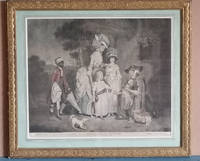
17846627London: Published by J. Birchall 1784. Mezzotint. In excellent condition with the exception that the lower margin is trimmed along the plate mark. A beautiful mezzotint after the sentimental genre painting by William Redmore Bigg.<br/> <br/>William Redmore Bigg 1755-1828 was a popular London genre painter who is best known for his family tableaux depicting acts of charity. Of these this scene in which an aristocratic lady attended by her daughters young black servant and dog visit a poor "cottager" is one of the best. The original painting 1781 is in the Philadelphia Museum of Art. John Raphael Smith 1752-1812 engraved the mezzotint for John Boydell the leading London printseller which tells the story admirably. It is a sentiment expressed without irony though we now consider the black servant boy in livery and turban politically insensitive. He too looks on the poor woman and her sleeping child with pity. Nor are the silk dressesextragant hats lap dog and silk parasol that the Lord's family sport intended for criticism: this is an idealised version of recommended behavior. The littlest girl overcome by this encounter with poverty cries as she hands over the money and we understand that this is part of her moral education. The composition is appealing and successful. The Lady whose fine country house can be seen in the distance forms the apex of the pyramidal group just as her generous act is the apex of a good and stable society. At this time virtually all "welfare" was local and critical to the large portion of the English population lived in want. Nevertheless it was only beginning to be thought that the wealthy had any obligation to the poor and it was generally accepted that acts like these were and ought to be wholly voluntary. This is an ideal example of the print clearly an early impression in which silks and satins gleam curls and ribbons swirl. Published by J. Birchall unknown books
1784154<p>Coloured Mezzotint Appears to be in good condition although unexamined out of the frame. The top and side margins are not shown and so are presumed absent. Otherwise in good condition well framed and mounted. Of particular note is the page boy</p>
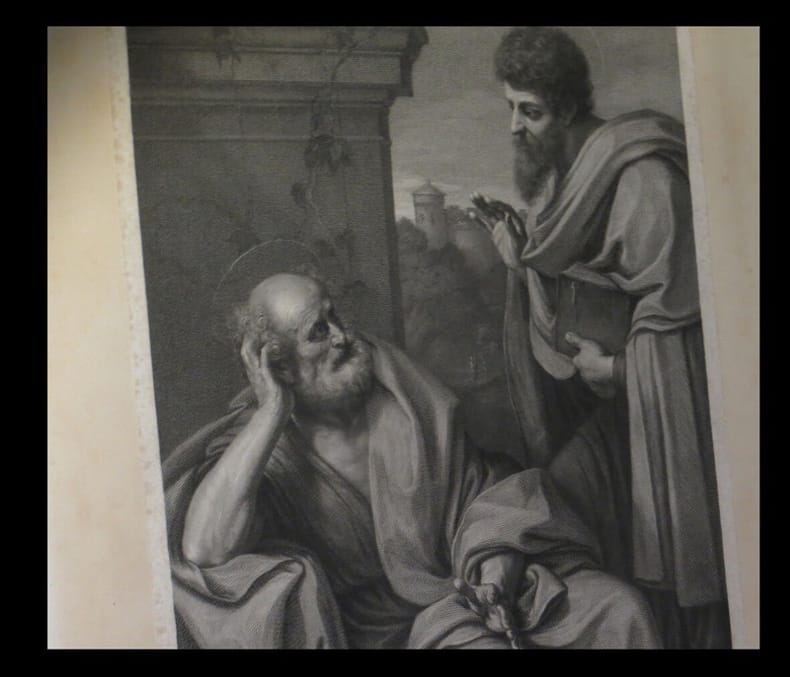
179517979Rome, s.é., 1795. Dimensions (à vue) : 488 x 372 mm.