HOLBEIN, Hans - by Edmund LodgeBiblio.com
89 résultats
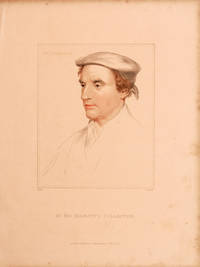
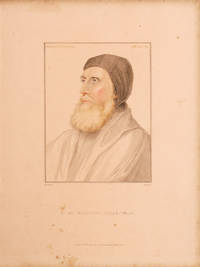
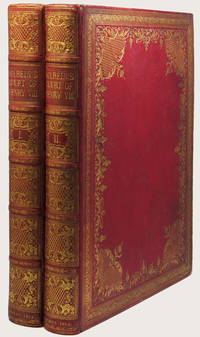
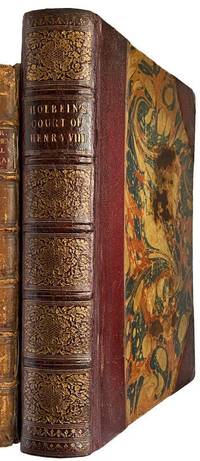
182843911London: Printed by William Bulmer and Co. Shakspeare Printing Office 1828. folio 35x 25cm The Second Edition not paginated WITH: 84 hand-coloured portrait engravings with tissue guards 80 listed biography following each portrait plate In contemporary half dark crimson morocco gilt ruled raised bands full gilt decorations in the panels gilt block titles marbled boards and end papers early rebacked with inner linen hinges top edge gilt some slight shelf wear on the boards and some wear on the marble board edges the first two plates are foxed several other plates have slight occasion foxing. Very Good to Fine. Hans Holbein the Younger served in England for two periods the first 1526 to 1528 under the patronage of Thomas More and Anne Boleyn and the second period 1532 to 1540 becoming King's Painter to Henry VIII. This massive tome displays 84 Holbein portraits painted during this period including Anne Boleyn Anne of Cleeve Catherine Howard Sir Thomas More Jane Seymour Thomas Cromwell Edward Prince of Wales Queen Mary William Warham Archbishop of Canterbury and many other courtiers and nobles. 80 portraits are listed but also included are a self-portrait of Holbein and another of his wife as frontispieces and two miniatures of Charles and Henry sons of Charles Brandon Earl of Suffolk. The portraits are remarkable for their precision with many of the portraits being fixed images for posterity. Note this first twelve plates do not have the biographical plate text. Printed by William Bulmer and Co., Shakspeare Printing Office unknown
181273601London: John Chamberlaine 1812. Bartolozzi developed his style to imitate the subtleties of renaissance and baroque chalk drawings and became deservedly famous for his stipple engraving. The portraits in this collection show how effective this technique was in reproducing with such incredible fidelity Holbein's original designs. Engraved by BARTOLOZZI Francesco in IMITATIONS OF ORIGINAL DRAWINGS BY HANS HOLBEIN IN THE COLLECTION OF HIS MAJESTY FOR THE PORTRAITS OF ILLUSTRIOUS PERSONS OF THE COURT OF HENRY VIII. WITH BIOGRAPHICAL TRACTS. Stipple engraving. Printed colour. Size: 333 x 250 mm Fine condition. unknown
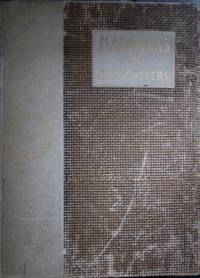
1890021220New York: Frederick A. Stokes and Brother 1890. First Edition. Cloth. Good. Folio. First edition #430 of 1000 clothbound books issued. Signed by the publisher on the copyright page. White cloth with extensive gilt decorations along with gridded cloth. Large folio. Unpaginated. 10 photogravures of paintings throughout. A look at various depictions of the Madonna by Old Masters accompanied by critical and historical commentary. GOOD condition. Moderate scuffing and toning to the covers with some soiling and staining. A few small wormholes in the front cover. Text block weak with some pages slightly loose in the binding. One plate rather foxed. Text block toned. Frederick A. Stokes and Brother unknown
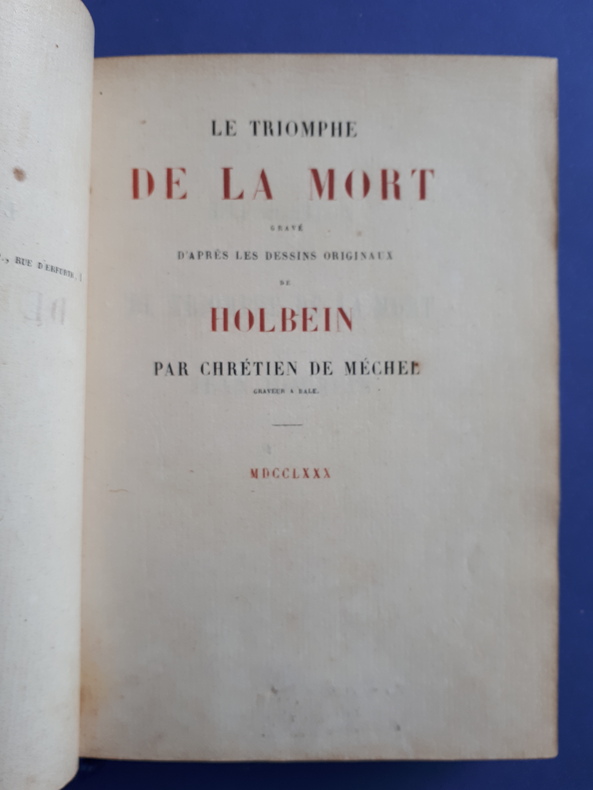
1854BB174[Paris, Imprimerie Simon Raçon et Comp.,]. Petit in-4°, maroquin aubergine, double filet et des plats richement décorés, fleuronnés, dos orné de compartiments fleuronnés, roulette et filets intérieurs, tranches dorées (Bardisser). 47 planches gravées sur cuivre par Chrétien de Méchel d'après Holbein, numérotées 1-47, et une planche non numérotée représentant la Faucheuse menaçant la Terre. Chacune d'entre elles, hormis la dernière figure, est accompagnée d'un texte imprimé en regard sur un papier vergé fin.
188021434Stuttgart, Wittwer, o. J. (um 1880). 47 gestochenen Tafeln von Josef Niederbühl (inkl. Titel). 8°. HLdr. der Zeit mit Rückenvergoldung und Rückenschild (gebeleicht und etw. bestoßen). [5 Warenabbildungen]
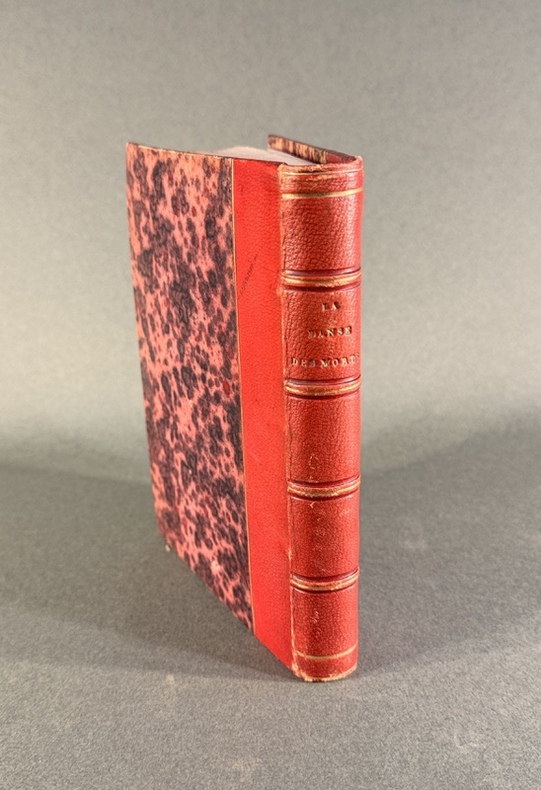
18423384Paris P. Labitte, s.d. 1842 Exemplaire non ébarbé. Relié en demi maroquin rouge. In-12, 252 p., 1 feuillet errata. La réimpression des Simulachres de la Mort est d'après la première édition donnée à Lyon en 1538. Dos à quatre nerfs. Étude érudité et très complète sur les danses des morts. Il reprend les origines européennes du thème et les recontextualise :- De la critique en matière de beaux-arts- Première idée de la danse des morts- Triofo della morte par Orcagna et Pétraque- La danza generale de la muerta, Rabbi Santo- De la danse- Les danses ecclésiastiques- La danse macabre- Les peintures gothiques de la danse macabre- Édition gothique de la danse macabre- Hans Holbein le jeune- les Simulachres de la Mort Illustrée de remarquables et très fidèles reprises des estampes de Hanz Holbein, tirées sur chine, montées sur papier teinté.
187734413Paris, Arnaud & Labat 1877.
1856129341856 un volume, reliure demi-vélin blanc grand in-octavo (half binding white vellum in-octavo), dos muet (spine without title), dos long (spine without raised band), papier peigné aux plats (cover with painting paper), toutes tranches lisses (all smooth edges) jaspées (all marbled edges), couverture illustrée conservée (cover illustrated of the preserved paperback edition), Bel exemplaire, tel que paru, sur papier vergé. Texte encadré des gravures sur bois en noir (engraving woods in black) reproduisant les dessins d' Hans Holbein ayant pour théme la danse des morts (Très belle impression de Firmin Didot), 48 feuillets non paginés, 1856 Paris Edwin Tross Editeur,
185621788Paris Edwin Tross 1856 in-8 pleine percale un volume, reliure pleine percaline vert-foncé grand in-octavo Editeur (binding full percale in-octavo Editor)(22,6 x 14,2 cm), dos long (spine without raised band), titre frappé "or" verticalement au centre du dos avec des fers spéciaux "or" de part et d'autre du titre, plats ornés à froid (plaques spéciales Editeur) d'un cadre central ovale à froid dans un encadrement à triple filets à froid avec coins en enchevêtrement, titre frappé "or" au milieu du cadre ovale à froid, au centre du 1er plat, toutes tranches lisses (all smooth edges), Bel exemplaire, tel que paru, sur papier vergé. Texte en vieux françois et Latin encadré des gravures sur bois en noir (engraving woods in black) reproduisant les dessins d' Hans Holbein ayant pour théme la danse des morts (Très belle impression de Firmin Didot), 48 feuillets non paginés, 1856 Paris Edwin Tross Editeur,
185618766Paris, Tross, 1856. Titel mit Druckermarke, 2 weiße Blatt, 30 Blatt, davon die Hälfte beidseitig bedruckt nach Holbein, die anderen weiß. 8°, Pappband mit hübschem Kleisterpapierbezug des frühen 20. Jahrhunderts, ca. 1910, zum Rücken hin mit Ockerfarbe "ausgebessert". Einband wohl gefertigt von der Buchbinderei H. Böhm, Mannheim (Etikett am hinteren Spiegel).
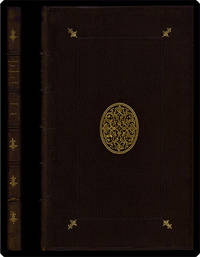
185637923Paris: Edwin Tross 1856. 8vo 21.8 cm 8.625". 96 pp.; illus. <br><br>Tross's careful and elegant 19th-century edition: The Dance of Death concept experienced a revival in French Romantic literature of the era and the main text here in French and Latin is prefaced by Anatole de Montaiglon's introduction in French. The reproductions of Holbein's initials were done by Heinrich Loedel and each page is given an => exquisite death-themed wood-engraved border by Léon le Maire after designs from a Book of Hours printed by Simon Vostre. The alphabet is represented excluding J and U by magnificent engraved historiated letters five of which are repeated.<br>Â Â Â Â Binding: Chocolate brown morocco covers framed and panelled in blind with gilt-tooled corner fleurons and gilt strapwork central medallions; spine with blind-ruled raised bands and gilt-stamped title and date and cover fleurons repeated in compartments; turn-ins with wide composite gilt rolls. All edges gilt; striking and distinctive marbled endpapers. => Signed by binder L. Claessens with tiny stamp in roll on lower front turn-in.<br>Â Â Â Â Provenance: From the library of American collector Albert A. Howard small booklabel "AHA" at rear. Bound as above and in lovely condition; extremely minor spots of rubbing and scraping to boards one raised band with a short cut and a sliver of leather lost. => An overall wonderful copy of this beautiful reprint. Edwin Tross hardcover books
1856GF323881856 Paris - Imprimé pour Edwin Tross - 1856 - 1 volume in8 broché de 96 pages - dos passé - menus défauts à la couverture - belle édition sur beau papier partiellement non coupé -
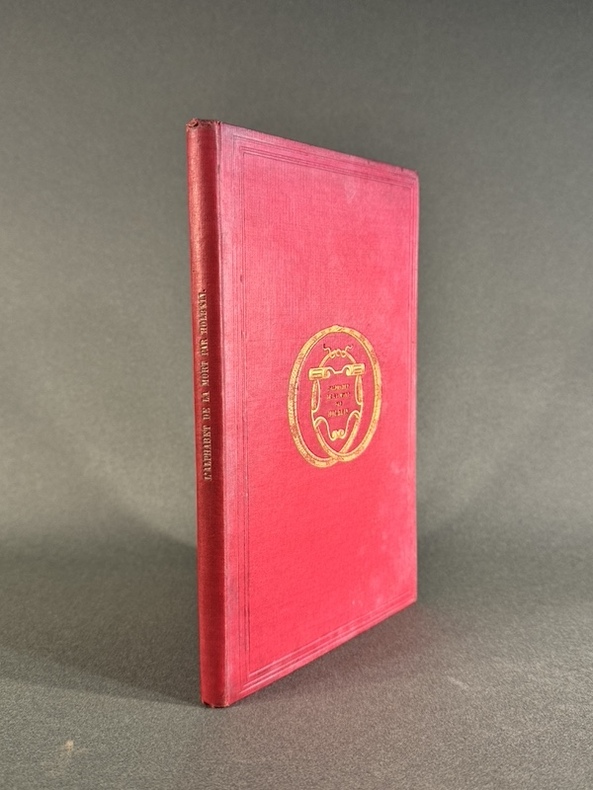
185671073Entouré de bordures du XVIe siècle, poèmes français publiés d'après les manuscrits par Anatole de Montaiglon, 1 vol. in-8 reliure de l'époque cartonnage pleine percaline rouge imprimée en ors, Imprimé pour Edwin Tross, Paris, 1856, 96 pp.
18562974Paris, Edwin Tross, 1856 In-8, n.p., cart. toile rouge, titre doré au dos et au 1er plat (cartonnage légèrement sali, petit manque à la coiffe supérieure).
1856014556Paris: Edwin Tross 1856. Original front wrapper bound-in. Quite a clean copy. Text bordered by engravings of illustrations from "The Dance of Death". Blank pages follow the text block to allow for a better size for binding. Purple cloth covers. Spine lettered in gilt. . French Edition. 1/4 Brown Leather. Light General Cover Wear/No Dust Jacket. Thin Octavo. Edwin Tross hardcover books
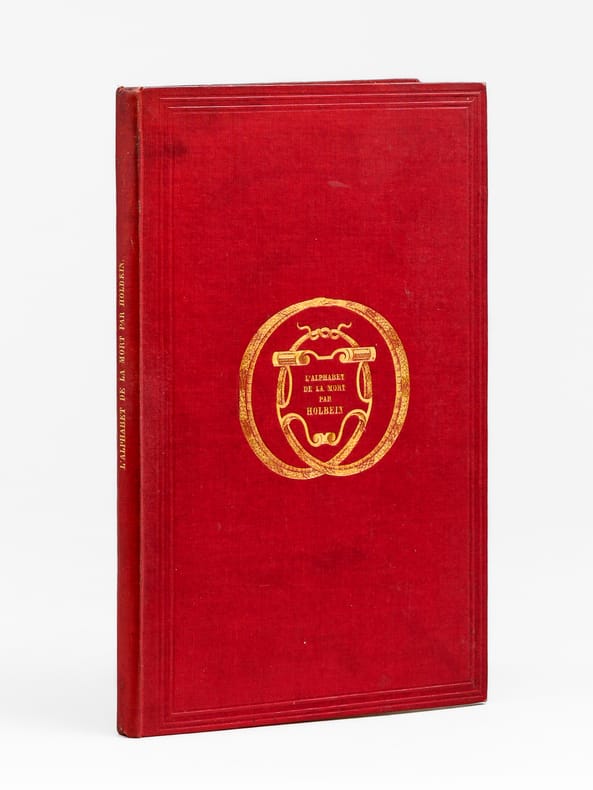
18563385Paris Firmin-Didot 1856 Percaline rouge, superlibros sur premier plat frappé or, deux serpents formant un double cercle en encadrement du titre. In-8, beau papier velin filigrané, non ébarbé.Les reproductions du livre d'heures de Simon Vostre ont été gravées, comme nous le précise la préface, par un habile artiste Monsieur Léon Lemaire de la ville de Paris. L'origine de l'Alphabet par Hans Holbein reste fort obscure. Le premier ouvrage dans lequel on signale cet alphabet est une Bible grecque publiée à Strasbourg en 1526. D'autres lettres de la même source se retrouvent utilisées de façon éparse dans plusieurs autres ouvrages. Les lettres sont entremêlées avec d'autres Danses des Morts, mais aussi avec des lettres ornées de toutes sortesLa préface érudite d'Anatole de Montaiglon fait part de ses recherches sur ces prouesses typographiques utilisées ici pour la première fois de manière continue. L'entreprise éditoriale ambitieuse a nécessité la mise en oeuvre la mise en chantier de gravures sur bois reproduisant au plus près les ornements typographiques de Simon Vostre, mais aussi de Hans Holbein. Imprimé pour Edwin Tross, libraire-antiquaire.
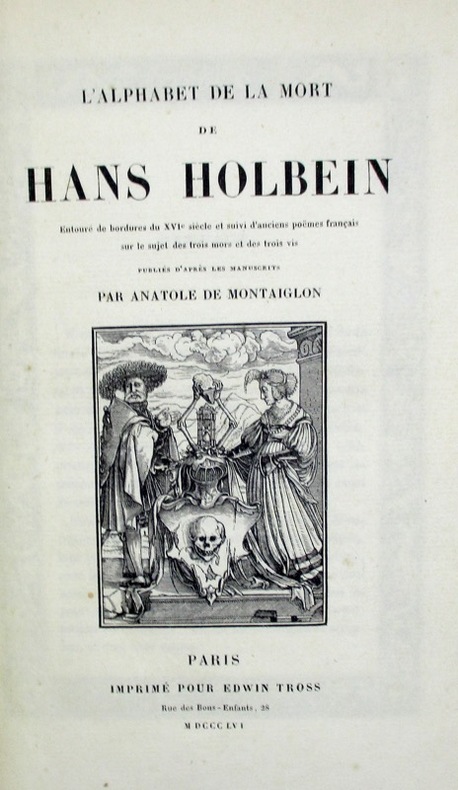
1856vd1464Edwin Tross Cartonné 1856 Alphabet de la mort (L’). Entouré de bordures du XVIe siècle et suivi d’anciens poëmes français sur le sujet des trois mors et des trois vis [sic]. Publiés d’après les manuscrits par Anatole de Montaiglon. Imprimé pour Edwin Tross. Paris. Rue des Bons-Enfants, 28. 1856. (22,5 x 14,4 cm). (96) pp. : cartonnage de l’éditeur de percaline rouge, triple filet d’encadrement estampé à froid sur les deux plats, titre doré dans un double cercle de serpent sur le premier. Vingt-quatre lettrines gravées, dans des encadrements également illustrés figurant les acteurs de la Danse des Morts dessinées par Hans Holbein (1497?-1543). Les premières lettres suivent la hiérarchie habituelle de ceux qui marchent en tête : après les funèbres musiciens, le pape, l’empereur, le roi, le cardinal.... mais à partir du M, Holbein illustre l’initiale avec le nom latin de la figure représentée, Medicus, médecin, pour le M, Numérarius, changeur ou banquier, pour le N etc... Préface explicative de l’archiviste paléographe Anatole de Montaiglon (1824-1895) sur ce rare écrit dont on ne sait ni la date exacte de réalisation ni pour quel ouvrage il était destiné. On le trouve pour la première fois dans une Bible publiée à Strasbourg en 1526. Le dessin original de Holbein avait été gravé par Hans Lutzeburger, notre exemplaire de 1856 par Léon Le Maire, de Paris qui en réalisa toutes les bordures et les gravures. A la suite de l’alphabet sont ajoutés les différents dits des Trois Mors et des Trois Vis. Quelques traces sur les plats, intérieur frais, bon état général. Livraison a domicile (La Poste) ou en Mondial Relay sur simple demande.
185617837Paris: Edwin Tross. Very Good. 1856. First Edition Thus. Hardcover. Bright clean red cloth binding with gilt decoration & lettering. Text tight & intact: binding solid. Unpaginated. Written in Latin & French. Various scenes illustrating the universality of death no matter one's station in life are engraved in the historiated woodcut borders & letters. Hans Holbein 1497-1543 created his Alphabet of Death at a time when the Latin alphabet did not distinguish between I and J or U and V. The separation into vowels and consonants came after the Renaissance. De Montaiglon's preface notes that Holbein's alphabet has only twenty-four letters. Early owner's bookplate. Toning on endpapers only. Poetry Art; Large 8vo 9" - 10" tall . Edwin Tross hardcover
181273585London: John Chamberlaine 1812. Bartolozzi developed his style to imitate the subtleties of renaissance and baroque chalk drawings and became deservedly famous for his stipple engraving. The portraits in this collection show how effective this technique was in reproducing with such incredible fidelity Holbein's original designs. Engraved by BARTOLOZZI Francesco in IMITATIONS OF ORIGINAL DRAWINGS BY HANS HOLBEIN IN THE COLLECTION OF HIS MAJESTY FOR THE PORTRAITS OF ILLUSTRIOUS PERSONS OF THE COURT OF HENRY VIII. WITH BIOGRAPHICAL TRACTS. Stipple engraving. Printed colour. Size: 333 x 250 mm Fine condition. unknown
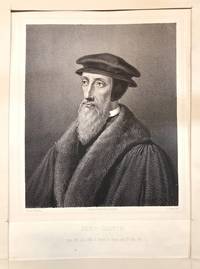
1830P5455Edinburgh : Schenck & Ghemar c.1830. Very Good. Notes: John Calvin 10 July 1509–27 May 1564 was a French theologian pastor and reformer in Geneva during the Protestant Reformation. He was the principal figure in the development of the system of Christian theology later called Calvinism. He was a Religious reformer. Image Size : 268x223 mm 10.55x8.78 Inches Platemark Size : Paper Size : 392x283 mm 15.43x11.14 Inches Coloring: Black & White Medium: Lithograph Categories: Portraits Others; Schenck & Ghemar unknown
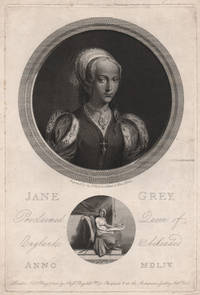
180229701802. Copper-line engraving. 300mm by 200mm platemark 355mm by 240mm sheet. Lady Jane Grey 1536/1537-1554 was an English noblewoman who was de facto monarch of England from 10 July until 19 July 1553 and was subsequently executed. One mark to right of the ciircle. A few light creases outside the platemark.<br /> unknown
190033920Straßburg, J. H. Ed. Heitz (Heitz & Mündel), 1900. 4°. Mit zahlr. Abbildungen auf 104 Tafeln. 14 S., 2 Bll., HLwd. d. Zt. m. goldgepr. Rückentitel u. eingeb. OUmschlag.
181234168London: Published by John Chamberlaine the Keeper of the King's Drawings and Medals. Printed by William Bulmer and Co. Shakespeare Printing Office 1812. 2 volumes. First Edition of the century First Issue the second edition overall. A RARE EXAMPLE WITH THE PLATES BOTH IN COLOURED AND UNCOLOURED STATE THUS WITH DOUBLE THE NUMBER OF PLATES NORMALLY ENCOUNTERED. With 84 hand-coloured plates and 84 plates uncoloured all separately printed on India paper and tipped onto full-page leaves each facing the other the plates with protective leaf separating the two each image with two variations mezzotint portraits of Holbein and his wife a total of 168 illustrations on full-page plates four plates dated from the first printing in 1792 the other 164 dated 1812 as with the publishing date. The plates are printed on a variety of papers slightly different from one another--grey buff white lavender and pink. Folio 34.5 x 2 beautifully bound in full red morocco gilt extra the spines with gilt tooled raised bands separating the compartments which are elaborately gilt decorated within triple gilt filleted frames gilt stippling to the borders of the frames lettered in gilt in one compartment the covers beautifully gilt decorated in all-over designs the borders with gilt stippled lines enclosing three gilt filleted borders surrounding an elaborate gilt inner border of floral tooling bordered again by a stippled and multi-filleted gilt frame the whole surrounding elaborate and large gilt tooled decorations at the inner corners and along the rules the edges gilt ruled the turnovers gilt rolled marbled endleaves all edges gilt very elaborate and beautifully preserved binding work. unpaginated. Fine copies beautifully preserved very light wear or age evidence to the bindings which remain strong the pages and plates all in good order some very occasional light foxing to the papers as is typical the colours remain vibrant and as printed the giltwork on the bindings is in very pleasing condition a very handsome set indeed. FIRST EDITION AND AN UNUSUALLY SPECIAL COPY BOUND IN FULL RED MOROCCO GILT EXTRA WITH THE PLATES PRINTED ON INDIA PAPER IN BOTH COLOURS AND BLACK AND WHITE A COPY WITH DOUBLE THE NUMBER OF PLATES USUALLY ENCOUNTERED. Hans Holbein the Younger; c. 1497 – between 7 October and 29 November 1543 was a German-Swiss painter and printmaker who worked in a Northern Renaissance style and is considered one of the greatest portraitists of the 16th century. He also produced religious art satire and Reformation propaganda and he made a significant contribution to the history of book design. He is called "the Younger" to distinguish him from his father Hans Holbein the Elder an accomplished painter of the Late Gothic school.<br> Holbein was born in Augsburg but worked mainly in Basel as a young artist. At first he painted murals and religious works and designed stained glass windows and illustrations for books from the printer Johann Froben. He also painted an occasional portrait making his international mark with portraits of humanist Desiderius Erasmus of Rotterdam.<br> Holbein travelled to England in 1526 in search of work with a recommendation from Erasmus. He was welcomed into the humanist circle of Thomas More where he quickly built a high reputation. He returned to Basel for four years then resumed his career in England in 1532 under the patronage of Anne Boleyn and Thomas Cromwell. By 1535 he was King's Painter to Henry VIII. In this role he produced portraits and festive decorations as well as designs for jewellery plate and other precious objects. His portraits of the royal family and nobles are a record of the court in the years when Henry was asserting his supremacy over the Church of England.<br> Holbein's art has sometimes been called realist since he drew and painted with a rare precision. His portraits were renowned in their time for their likeness and it is through his eyes that many famous figures of his day are pictured today such as Erasmus and More. He was never content with outward appearance however; he embedded layers of symbolism allusion and paradox in his art to the lasting fascination of scholars. In the view of art historian Ellis Waterhouse his portraiture "remains unsurpassed for sureness and economy of statement penetration into character and a combined richness and purity of style."<br> For Holbein "everything began with a drawing". A gifted draughtsman he was heir to a German tradition of line drawing and precise preparatory design. Holbein's chalk and ink portraits demonstrate his mastery of outline. He always made preparatory portraits of his sitters though many drawings survive for which no painted version is known suggesting that some were drawn for their own sake.<br> Ellis Waterhouse wrote that "modern" painting in England may be said to have begun with Holbein. That later artists were aware of his work is evident in their own sometimes explicitly. Hans Eworth for example painted two full-length copies in the 1560s of Holbein's Henry VIII derived from the Whitehall pattern and included a Holbein in the background of his Mary Neville Lady Dacre. The influence of Holbein's "monumentality and attention to texture" has been detected in Eworths' work. According to art historian Erna Auerbach: "Holbein's influence on the style of English portraiture was undoubtedly immense. Thanks to his genius a portrait type was created which both served the requirements of the sitter and raised portraiture in England to a European level. It became the prototype of the English Court portrait of the Renaissance period".<br> Holbein worked for Thomas Cromwell as he masterminded Henry VIII's reformation. Cromwell commissioned Holbein to produce reformist and royalist images including anti-clerical woodcuts and the title page to Myles Coverdale's English translation of the Bible. Henry VIII had embarked on a grandiose programme of artistic patronage. His efforts to glorify his new status as Supreme Head of the Church culminated in the building of Nonsuch Palace which started in 1538. By 1536 Holbein was employed as the King's Painter on an annual salary of 30 pounds—though he was never the highest-paid artist on the royal payroll. see C. Müller et al.<br> This striving for perfection is very evident in his portrait drawings where he searches with his brush for just the right line for the sitter's profile. The critical faculty in making this choice and his perception of its potency in communicating decisively the sitter's character is a true measure of Holbein's supreme greatness as a portrait painter. Nobody has ever surpassed the revealing profile and stance in his portraits: through their telling use Holbein still conveys across the centuries the character and likeness of his sitters with unrivalled mastery. see J. Rowlands Hans Holbein the Younger 1985 Published by John Chamberlaine, the Keeper of the King's Drawings and Medals. Printed by William Bulmer and Co., Shakespeare Pri hardcover
18301260367London: William Pickering 1830. 8vo unpaginated; VG; paneled black spine with gilt tooling and lettering; some wear on edges head and tail of spine; 90 engravings; paneled gilt tooling on border of boards; gilt tooling on board edges and turn-ins; textclear; text block gilt; red ribbon; translations into 5 languages of passages; marbled endpapers; some shelfwear; GP consignment; shelved case 7. 1260367. Shelved Dupont Bookstore. William Pickering unknown books
183014624London: William Pickering 1830 Contemporary straight-grained brown morocco over marbled boards. . Octavo. Woodcut printer's device on title and colophon. Illustrations engraved by John and Mary Byfield. Extremites a bit rubbed extremities of spine darkened. A very good copy. William Pickering, hardcover