Mandeville DavidABAA
548 résultats
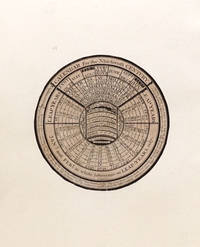
1801319639Philadelphia 1801. Small circular engraved broadside engraved by Draper. Approx. 3 1/2 inches in diameter. Inlaid into a larger sheet at a later date. Small circular engraved broadside engraved by Draper. Approx. 3 1/2 inches in diameter. America Looks to the Future: An Unusual Early American Perpetual Calendar. The Explanation running arount the outer border of the lower portion of the Calendar details its use: "Intersect the Column of the Month by the circle in which the Year stands & the Day you there find look for under October which day of the week with those on the right hand will stand over such Days of the Month as falls on them." The Explanation continues with how to determine days of the month using the calendar in the previous century and into the 20th century.<br/><br/>A January 14 1802 review in the Philadelphia Gazette extolls its virtues: ".I am induced to think that sufficient justice can hardly be done to the ingenuity of this little production: The Author has modestly called it a Calendar for the 19th Century while it is in fact a Calendar for twenty-one centuries . It will shew sic in what day of the week an event in history occurred . This Calendar is handsomely executed on copperplate . when framed its figure and beauty will entitle it to a station in the parlour as well as counting house." The review further reveals that the Calendar was being sold for $.25 and was also being marketed as a hat maker's label. <br/><br/>Just a few days prior to that review Mandeville had taken the liberty of sending his Calendar to President Thomas Jefferson writing to him on January 9 1802: "Permit me the honor to present to you . a Calendar for the Nineteenth Century to which I have recently given publicity -- Should I learn that in your estimation I have combined usefulness with originality and comeliness I shall be highly gratified.". According to Philadelphia Directories from the period David Mandeville lived at North Sixth Street in Philadelphia in 1801 and 1802 and worked as an "accomptant" and clerk in the Bank of the United States. The broadside is engraved by John Draper; a former apprentice to Robert Scot he engraved for Dobson's Encyclopedia and was an early American banknote engraver. <br/> <br/>Very rare with only three examples recorded by Shaw and Shoemaker American Antiquarian Society New York Public Library and Massachusetts Historical Society. The AAS example with a variant spelling of the word Calendar "Calender" and with the engraver's name below the outer circle suggesting two issues. Shaw-Shoemaker 269 unknown books
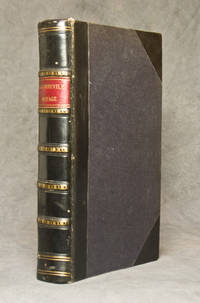
1727244219London: Woodman Lyon and C. Davis 1727. Reissue of the 1725 edition with cancel title-page. xvi 8 384 8 pp. 1 vols. 8vo. Half dark brown polished calf and cloth red leather spine label. Title and final leaf backed title page a little toned otherwise a clean crisp copy. Reissue of the 1725 edition with cancel title-page. xvi 8 384 8 pp. 1 vols. 8vo. Translation of a French manuscript of Mandeville's Itinerarium. and for centuries a standard book for travellers. "Mandeville is said to have set out on his travels in 1322 and after visiting Egypt Palestine Tartary India the Indian isles etc. returned home in 1355. His death is set at 1371." Cox I 319. This is the second issue of the "best English edition" Lowndes and "the completest edition up to date" Cox. Woodman, Lyon and C. Davis unknown books
2314A Londres. Aux dépens de la Compagnie. 1740. 4 tomes en 3 volumes 100 x 165 mm. Reliure d'époque en plein veau blond, dos à cinq nerfs ornés de motifs dorés, pièces de titre en maroquin rouge, tranches rouges. XXII + 333 pp. & 267 pp. & XLVIII + 282 pp. & 270 pp. Les coins et dos des reliures sont un peu frottés, sans manque, sans gravité. Quelques inscriptions anciennes sur les gardes du premier volume. Bon exemplaire, très propre intérieurement.
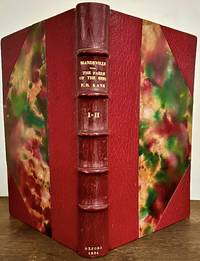
192423783Oxford: The Clarendon Press 1924. Hardcover. Three quarter red levant and marbled boards. Teg. Near fine. 481 pages. 21 x 15 cm. Limited edition copy 20 of 25 on India Paper "has been printed for presentation to friends." Title page in red and black several engraved facsimiles including frontispiece and captioned tissue guards. Originally published 1705 as satire on economic orthodoxy and a seminal text of libertarian thought. Mandeville argues that the basest and vilest behaviors produce positive economic effects. His philosophy gave great offence at the time and was stigmatized as false cynical and degrading. He was also an early describer of the division of labour and Adam Smith used of some of his examples. Two volumes in one. Raised bands spine lettered in gilt marbled endpapers spine slightly darkened. The Clarendon Press hardcover
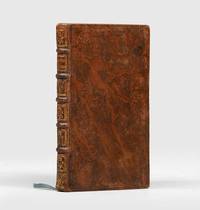
1732158851London: Printed for John Brotherton 1732. First edition of the author's last book. The final instalment of a long string of incendiary treatises which so incensed his contemporaries following his tracts attacking Christian ethics defending brothels and opposing charity schools Mandeville here turns to the readiness with which Christianity can be perverted to militarism and asserts that honour is no more than pride. As with his Fable of the Bees Part II 1729 an entirely different work to the first part the treatise takes the form of a dialogue between two interlocutors Cleomenes and Horatio. "Mandeville repeated his view that the passions of pride and shame are both forms of self-liking. Honour and worldly religion are treated as devices that are useful for socializing humans. Honour is discovered to be even less demanding than virtue or the artificial courage discussed in the Fable of the Bees. The work again reveals Mandeville's anti-clericalism in his account of how a perverted version of the truly peaceful doctrine of Christianity can be used to motivate soldiers" ODNB. Octavo 197 X 123 mm. Contemporary panelled speckled calf red morocco label sprinkled edges. Ownership inscription of J. Arscott dated 1732 to title engraved armorial bookplate of Sir William Molesworth to front pastedown. Small chip to head of spine joints and corners a little rubbed; a crisp clean copy. ESTC T59021; Kaye pp. 440ff. unknown
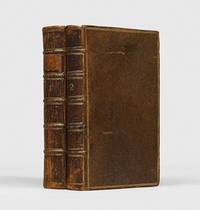
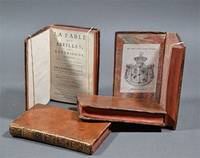
1732158464London: Printed for J. Tonson 1732 & 1733. Private vices as public virtues Seventh edition stated sixth of the first part second edition of the second part of Mandeville's best-known work demonstrating through a parable of bees renouncing all luxury and seeing their hive collapse that the Christian ascetic philosophy cannot lead to a prosperous economy and social system and consequently that individual vices of vanity and greed are virtues for the community. The work originated in 1705 as a poem titled The Grumbling Hive expanded into the first book-length edition in 1714 and revised by Mandeville in further editions. Part II first published in 1729 matches the length of the first part and comprises six dialogues in which Cleomenes instructs Horatio as to the Fable's true meaning. Mandeville's implication that religion was damaging to social welfare was contentious and in 1723 the work was declared a public nuisance by the grand jury of Middlesex and Mandeville himself accused of blasphemy. Undeterred he addressed his accusers in the London Journal and published a pamphlet defending himself against such charges; the contents of this "Vindication" are included in the present edition of Part I along with Mandeville's Essay on Charity Schools claiming that educating the poor above their station was in nobody's interest and his Search into the Nature of Society further espousing the Fable's themes. Mandeville would spend the rest of his life justifying his work to its many critics yet it was still characterized well after his death as "the wickedest cleverest book in the English language" in the diary of Henry Crabb Robinson June 1812. The book had an enduring influence on the science of economics in pointing out what was self-evident to many but never before put so boldly - that expenditure on luxuries the incentives created by the desire for social betterment and the need for profit all form the basis of the economic system and social order around it. Adam Smith though denouncing Mandeville in his Theory of Moral Sentiments followed his central thesis that the individual's self-interest works to the good of the whole. Keynes was influenced by Mandeville in his notion of the "paradox of thrift" that withholding spending reduces demand and harms the economy. Friedrich Hayek in a lecture of 1966 to the British Academy called Mandeville a "Master Mind" in recognising that individuals seeking to advance their own interests create a "spontaneous order" which can form a society without the need for a controlling state. 2 vols octavo 191 x 121 mm. Contemporary calf ruled in gilt with vol. numbers to third compartments vol. I with manuscript label in second compartment. Contemporary ownership signature of one Alexander Duff to title pages. Light rubbing and slight chip at head of spine of vol. II small loss bottom fore corner of Part I leaf L1 2D7. Very good copies. ESTC N8073 & T77578. unknown
19249022351Oxford: Clarendon Press 1924. Hardcover. Very good. One of 25 presentation copies printed on India paper and bound in the publisher's original green cloth over boards as two volumes in one spine and cover stamped in gilt. Spine is slightly faded but legible. Lightly rubbed at the edges and extremities. All edges gilt. Facsimile illustrations. With a commentary critical historical and explanatory by F. B. Kaye. From the library of R.S. Crane with a signed and dated presentation to him by the author on the ffep. <br/><br/> Clarendon Press hardcover
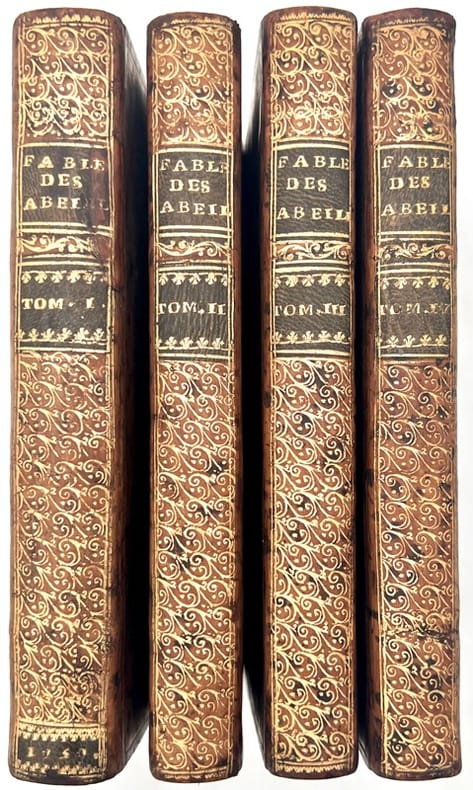
1750CLL-647Londres, Jean Nourse, 1750 "4 volumes n-12 de (1) f., XXXIII, 396 pp. ;(2) ff., 362 pp. ; (1) f., LXVI pp., 1 fb., 339 pp. ; (2) ff., 361, (1) pp., veau moucheté, filet à froid en encadrement sur les plats, dos à nerfs ornés de caissons de fleurons dorés, pièces de titre et de tomaison de maroquin rouge et vert, armes dorées en pied, filet doré sur les coupes, bordures dorées, tranches rouges (reliure de l'époque)."
175042931A Londres, chez Jean Nourse, 1750. 4 vol. in-12 de (2)-XXXIII-(1)-396 pp. ; (4)-362 pp. ; (2)-LXVI-(2)-339 pp. ; (4)-361-(1) pp., veau moucheté, dos lisse orné à la grotesque, double filet d'encadrement doré sur les plats, pièces de titre et de tomaison en maroquin vert, tranches dorées (reliure de l'époque).
19249022351Oxford: Clarendon Press 1924. Hardcover. Very good. One of 25 presentation copies printed on India paper and bound in the publisher's original green cloth over boards as two volumes in one spine and cover stamped in gilt. Spine is slightly faded but legible. Lightly rubbed at the edges and extremities. All edges gilt. Facsimile illustrations. With a commentary critical historical and explanatory by F. B. Kaye. From the library of R.S. Crane with a signed and dated presentation to him by the author on the ffep. <br/><br/> Clarendon Press hardcover books
200112913Somerset New Jersey U.S.A.: Transaction Publishers. New. 2001. Hardcover. 0765800292 . FREE UPGRADE to Courier/Priority Shipping Upon Request - IN STOCK AND IMMEDIATELY AVAILABLE FOR SHIPMENT - Flawless -- with a bonus offer-- . Transaction Publishers hardcover
23496Indianapolis IN: Liberty Fund Inc. As New. Two 2 Volume Set. Paperback. FREE UPGRADE to Courier/Priority Shipping Upon Request - IN STOCK AND IMMEDIATELY AVAILABLE FOR SHIPMENT - AS NEW THE TEXT BLOCK IS PRISTINE CLEAN UNMARKED AND IN EXCELLENT CONDITION - -- clean and crisp tight and bright pages with no writing or markings to the text. F. B. Kaye Edition -- with a bonus offer-- . Liberty Fund, Inc. paperback
192847001New York: Random House 1928. First edition thus. Hardcover. Very good. 157p folio illustrated with beautifully executed hand illuminated decorative initials in red gold and blue and illustrations re-drawn from earlier editions by Angelo Valenti. A very good copy in original brown morocco backed wooden boards spine lettered in blind. No 13 of 150 issued. Printed at the Grabhorn Press and initially planned to be offered for sale by them Random House was so impressed they bought the entire run and published it themselves. <br/><br/> Random House hardcover
51-5870Londres Amsterdam: aux dépens de la Compagnie 1740. . 4 volumes in-12 de 2-22-333-2-267 et 2-282-2-270 pages basane fauve dos lisses ornés tranches rouges reliure de l'époque. Coiffes et coins rapés ressaut d'un feuillet au tome 1. Only the later 1750 edition is in OCLC.Edition originale de la traduction française par Jean Bertrand de l'ouvrage le plus célèbre de Mandeville. Ce dernier soutient que la guerre le vol la prostitution l'alcool et les drogues la cupidité etc. contribuent finalement « à l'avantage de la société civile ».Ex-libris Princ Alladro Kastriotit. Juan Pedro Aladro y Kastriota 1845-1914 dit Aladro Kastrioti par les Albanais né Juan de Aladro de Perez y Valasco noble espagnol diplomate et prétendant au trône d'Albanie. Il a revendiqué la descendance de la famille Kastrioti par l'intermédiaire de sa grand-mère paternelle une noble qui vivait à l'époque de Charles III.Bernard Mandeville or Bernard de Mandeville was an Anglo-Dutch philosopher political economist satirist writer and physician. Born in Rotterdam he lived most of his life in England and used English for most of his published works. He became famous for "The Fable of the Bees.".Provenance: Estate of Joaquin Romero Maura. Mr Maura great-grandson of a five-time prime minister of Spain lived in the UK for most of his life and co-directed the Iberian Centre with the illustrious historian Sir Raymond Carr. Joaquín Romero Maura – died lin June 2022 at the age of 81 at a senior home in Zaragoza Spain. The historian – who held a PhD from Oxford University – was widowed and childless. He had been a confidante of the former Spanish king.Joaquín Romero Maura Niza 1940-Zaragoza 5 de junio de 2022 fue un historiador español. Destacó por su obra La rosa de fuego un estudio sobre el obrerismo barcelonés de la primera década del siglo xx. Londres, (Amsterdam): aux dépens de la Compagnie, 1740 unknown
1729r029F.023GB: J Roberts 1729. DISBOUND TEXT No covers. Text commences at title page and ends on last index page with FINIS at base. Last numbered page is 432. 2 and 32 and 432 and index. Library stamps on title page and last page. Title page deatched and slight damage at inner margin. Else a very good clean tight text most suitable to rebind. . 1st Edition. Hardback. Good/No DW. J Roberts Hardcover
1727133505London: A. Moore 1727. First edition in French of Mandeville's A modest Defence of publick stews or an essay upon whoring as it is now practis'd in these kingdoms a treatise against prostitution being an expansion of his pragmatic approach to morality first espoused in The Fable of the Bees. Octavo 161 x 95 mm. Contemporary mottled calf boards with blindstamp double rule border spine decorated gilt in compartments red morocco label gilt rule to board edges marbled endpapers red edges. Small chip at head of spine extremities lightly rubbed occasional light spotting; a very good copy. hardcover
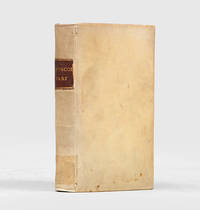
1767130765Cosmopoli: All'Insegna della Riforma. Nel secolo della dissolutezza. 1767. First edition in Italian of Mandeville's A modest Defence of publick stews or an essay upon whoring as it is now practis'd in these kingdoms a treatise against prostitution being an expansion of his pragmatic approach to morality first espoused in the Fable of the Bees. Octavo 170 x 110 mm. Contemporary vellum red morocco label lettered gilt "Opuscoli vari". Spine label chipped occasional light foxing paper unevenly browned. Kaye I p. xxxi. OCLC locates 3 copies only at the Clark Library UCLA New York Public Library and the Bibliothèque nationale. hardcover
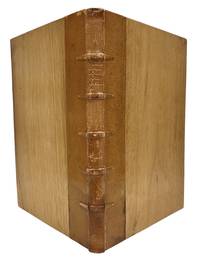
1727431G0236London: Woodman Lyon and C. Davis 1727. Book. Good. Hardcover. Reprint. 8vo - over 7¾" - 9¾" tall. xxiv 384 viii pp. Recased in leather. Raised bands and periphery of boards decorated with gilt. Title page printed in red and black. Bookplate inside front board. Several incidents of peeling and sticker remnant to decorated front endpaper. Small faint numeric ink stamp at bottom of title page. Call numbers on backstrip scarcely visible. Moderate wear. Binding firm. Woodman, Lyon and C. Davis Hardcover
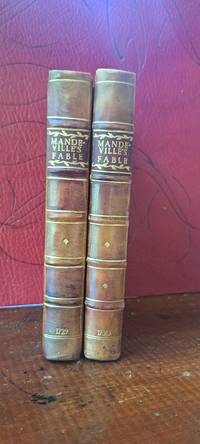
172911<p>Barnard Mandeville published a pamphlet on "the Grumbling Hive" in 1705. This was then included in "The Fable of the Bees" in 1714 which itself went through six editions and important additions</p><p>A second volume was published in 1729 in the form of a dialogue between Horatio and Cleomenes and presents a proposed history of civil society based upon Mandeville's views of human nature.</p><p>Mandeville was a leading public intellectual of the early 1700's. His influence continues as an a icon of Libertarianism Hayek himself a follower. In the eighteenth century his respondents and critics is a long list including Adam Smiith and Rousseau.</p><p>His thesis that Vice was a productive force in the economic wellbeing of a comunnity seems harmless on its face but Mandeville presented his view while critiqueing his own society both in its moral hypocricy and the failure to produce results</p><p>Vol. of this set isthe sixth and last edtion wih all the added essays etc from the precedin geds.</p><p>Then in 1729 Maneville published Fable of the Bees Part II. These six dialogue were quickly reprinted. This is Vol ii of this set and completes Mandevilles authorized text.</p><p>This set is the final definitive edition of Mandevilles unfolding editions of the Fable</p> vol 1, Tonson; vol 2.Roberts hardcover
1928236765New York: Printed by Edwin and Robert Grabhorn for Random House 1928. No. 56 of 150 copies SIGNED by Angelo. With 34 decorative initials hand-illuminated in red gold and blue and 31 illustrations by Valenti Angelo redrawn from early editions and manuscripts. 1 vols. Folio 362 x 235 mm. Original Philippine mahogany boards brown morocco back spine tooled in blind by William Wheeler; very slight wear to spine ends else Fine. Angelo Valenti. No. 56 of 150 copies SIGNED by Angelo. With 34 decorative initials hand-illuminated in red gold and blue and 31 illustrations by Valenti Angelo redrawn from early editions and manuscripts. 1 vols. Folio 362 x 235 mm. A superb example of the Grabhorn expertise one of the Fifty Books of the Year; Rudolph Koch's Gothic type Bibel Gotisch is used here for the first time in America. The Grabhorns intended to offer the book for direct sale but after viewing proofs Bennett Cerf bought the entire edition for Random House. One can see why. Heller & Magee 107 Printed by Edwin and Robert Grabhorn for Random House unknown books
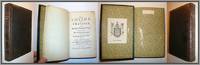
17251299141725. First Edition. MANDEVILLE John. The Voiage and Travaile of Sir John Maundevile Kt. Which Treateth of the Way to Hierusalem; and of Marvayles of Inde with Other Ilands and Countryes. London: Printed for J. Woodman and D. Lyon and C. Davis 1725. Octavo contemporary calf sympathetically rebacked raised bands. $5000.First edition first issue large paper copy one of only 350 copies printed of the definitive English translation of a fantastical medieval travel narrative that helped shape European thought on the Near Middle and Far East. One of the most popular travelogues of the Middle Ages Mandeville's Travels describes a 34-year-long voyage by a pseudonymous 14th-century English knight who allegedly journeyed from St. Albans to the Holy Land Egypt Arabia India Cathay Tartary and the realm of Prester John. The text is largely fictitious drawn from a variety of unreliable sources and the actual compiler is still unidentifiedbut ""the book remains and is none the less delightful for the mystery which attaches to it and in the history of English literature it stands as the first or almost the first attempt to bring secular subjects within the domain of English prose and that is enough to make it mark an epoch"" Pollard Travels ""Bibliographical Note"". The text was originally known via French and Latin manuscripts and first appeared in print in Dutch circa 1470; the present edition marks the first printed appearance of this English translation ""publish'd entire from an Original MS. in the Cotton Library"" which established itself as the most authoritative version. With tipped-in title page printed in red and black. ESTC notes that the work was ""printed by William Bowyer; his records show 350 copies printed."" ESTC T100822. Howgego I M39. Catalogue of the Interesting Contents of Walton Hall Property of the Late Edward Hailstone 1294. Elaborate black and gilt leather armorial bookplate of Edward Hailstone 1818-1890.Minor foxing; slight wear to original leather. A handsome copy. hardcover
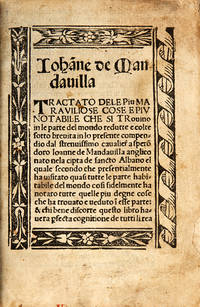
112964Venice Manfredo Bonelli 26 January 1505. . 8vo; title within decorative woodcut border 4-line decorative woodcut initial to A2 2-line initials elsewhere some toning and soiling small repair to fore-edge of title bookplate to front pastedown; later full vellum gilt lettering to spine on brown morocco title-piece minor worming to extremities and endpapers; collation: A-EE4; ff. 112.<br /> Rare 16th-century Italian edition of the world's first best-selling travel book. <br /><br />Although largely fictitious the journeys are based upon travellers' tales extant in the fourteenth century and as such are of considerable interest. Purchas considered Sir John Mandeville to be akin to Marco Polo in terms of importance 'the greatest Asian Traveller that ever the World had' Pilgrimes III p65. His travels take the reader through Turkey Armenia Persia Tartary Arabia India and China and gave many Europeans their first taste of the Near and Middle East as well as the East Indies. <br /><br />Little is known of Mandeville himself however he claims to be an English Knight who travelled between 1322 and 1356 serving under both the Sultan of Egypt and the Great Khan. Although traditionally attributed to Mandeville in reality the work was an English version of a text known as Itinerarium of which the original ascribed to Jean d'Outremeuse was probably written in Anglo-Norman French. All pre-1725 editions of Mandeville are scarce and editions such as this in a vernacular language particularly so. We have been able to locate just one other copy held at the British Library in London.<br /> USTC 839970. Venice, Manfredo Bonelli, 26 January 1505. hardcover
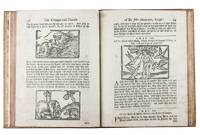
1696H2NF22FJOYPMLondon: Richard Chiswell Benjamin Walford Matthew Wotton George Conyers printing probably shared by 2 printers one possibly Samuel Roycroft 1696. Gold-tooled red goatskin morocco by Robert Riviere in London ca. 1875/80 with 5 false bands on the spine each board with a double frame of double and triple fillets and 2 different sets of 4 corner pieces author and title in gold in 2nd and 3rd of 6 spine compartments the others with gold-tooled decorations and the date and place of publication at the foot gold-tooled turn-ins gold fillets on board edges straight-combed endpapers gilt edges stamped on the back of the free marbled endleaf in sans-serif capitals: "Bound by Riviere". 4to 19.5 x 15.5 cm. With a woodcut ship on the title-page with a griffin on the sail and about 60 woodcut illustrations in the text mostly about 5.5 x 8 cm plus about 10 repeats each with a thick-thin border. Set in textura types with incidental roman and italic. A rare 17th-century English edition with about 60 different woodcut illustrations of a classic and partly fictional 14th-century account of travels presented as voyages of Sir John Mandeville through Turkey Egypt Ethiopia Syria Persia Arabia India and the East Indies. It was originally written in French and is thought to have been compiled from various sources by Jehan d'Outremeuse 1338-1400 of Liege. It includes many well-known stories and illustrations of monstrous people and animals in exotic lands: a man with only one enormous foot that he can use as a parasol a dog-headed man a man with his face in his chest a girl who turns into a dragon griffins nine-meter giants ants that gather gold diamonds that mate and give birth to baby diamonds and much more that spoke to the imagination. The book also includes genuine descriptions of the regions covered and gave many Europeans their first notions of the Near East Middle East India and East Indies. The part on Arabia includes an account of the birth of Mohammed.With early owner's inscription and bookplates along with a loosely inserted signed autograph letter ca. 1900. 8 leaves with their margins extended at the fore-edge and foot the title-page and last page somewhat worn and dirty but further in good condition with a few minor fedects. The spine is slightly faded but the binding is still very good.l Arber Term catalogues II p. 593 item 8; ESTC R217088 5 copies; J.O. Halliwell ed. Voiage and travaile of Sir John Maundevile 1866 p. xvi item 2 from the Grenville library; Wing M417 same 5 copies; cf. for the story in general: Cambridge history of English literature 1976 pp. 78-87. Richard Chiswell, Benjamin Walford, Matthew Wotton, George Conyers, [printing probably shared by 2 printers, one possibly Samuel unknown