10 867 résultats
Small folio (287 x 377 mm). (6), 134, (24) pp. With 31 leaves plates (sugar aquatints, etchings and drypoints). In unbound sheets as issued, stored in publisher's original cardboard covers, portfolio and slipcase (some slight wear to the latter). Two unique and wholly original brush drawings, adorning a signed and inscribed first edition of this famous suite by Picasso, in perfect condition. - Limited edition of 226 copies: this is number 155, one of 135 on Vidalon vélin. This copy was presented by Picasso to his friend, the painter André Marchand (1907-98), with an autograph inscription and two original drawings, each one full page. The two drawings are executed in Indian ink, pen and brush, heightened with black ink wash. They occupy the verso of the half-title bifolium and the first section title ("Le Cheval"). The first drawing shows a tomato plant in a pot, probably a reference to the still lifes for which Marchand was known. The second presents two different figures of a horse: in the upper half of the sheet, a white horse, seen in profile; in the lower half, a powerful horse's head, also in profile, against a stark dark background. Both are dated by the artist "7 August 44"; the first drawing also bears in the lower right-hand corner the signed dedication: "Pour André Marchand / Picasso". - In 1936 Ambroise Vollard commissioned illustrations by Picasso for the comte de Buffon’s 18th century encyclopedia, "Histoire naturelle". The book was published in 1942 with Picasso’s 31 prints. The delightful images of the animal kingdom, rendered with exquisite technique, must have surely brought joy to those who viewed it during the dark days of the war. Printed in a relatively small edition of 226, several copies went to friends with unique drawings such as these. - Includes an additional print of the "Mère poule" plate. Provenance: André Marchand; Jean A. Bonna (his bookplate to the portfolio's pastedown). With a certificate from Picasso's daughter Maya, dated 10 October 2002. S. Goeppert, Picasso (1983), p. 104-107. The Artist and the Book, 231. OCLC 78845813.
1550ABC_49514Italy 1550. 17th-century gold-tooled brown calf sewn on 6 supports with the corresponding raised bands on the spine a red morocco title label on the spine with the title "Novissima urbis Romae descriptio" lettered in gold gold-tooled board edges. Large oblong folio ca. 59 x 42.3 cm. With 76 full-page engravings and 12 full-page etchings. Remarkable album with 77 beautiful examples of 16th-century Italian cartography all in very fine dark impressions. The collection includes plans of important Italian towns such as Rome Venice Genoa Naples Milan Florence Palermo Siena Bologna and Pisa as well as detailed views of individual buildings and monuments in Rome. They are engraved by several cartographers from the school of Antonio Lafreri 1512-1577 primarily Claudio Duchetti d. 1585 Matteo Florimi d. 1613 and Lafreri himself. Florimi's works are among the rarest of the Lafreri school map makers especially his Siena imprints of which several have here been included.In the middle of the 16th century Italy was the centre of map production and distribution in Europe. This industry primarily took place in Venice and Rome. The most notable of the publishers in Rome was Lafreri. His most important and most popular work is the Speculum Romanae magnificentiae a collection of plans an views of Rome's monuments; no two copies of the Speculum are the same. The present collection contains more than thirty plates from the Speculum. When Lafreri died his nephew Claudio Duchetti inherited the company. He continued to produce the Speculum plates but often made small adjustments and signed his own name at the bottom. Most of the Speculum plates in the present album are by Duchetti. After his death the copperplates were sold to other publishers such as Giovanni Orlandi before 1590-after 1640 who reissued them. The majority of the plates in the present album were printed by Orlandi in 1602.The album further contains 32 engraved city plans mostly of Italian towns although a few foreign cities are also included; one of the rarest is the view of Moscow which is also included here. The collection ends with a incomplete series of 11 etchings of landscapes and biblical scenes.A list of contents is available upon request.With the bookplate of Louis Routy de Charodon seigneur de Grésigny and Charodon 1710-1794 on the front pastedown and remnants of another bookplate above. The boards are somewhat scratched and stained the spine shows traces of use the edges of the boards have been professionally restored and the boards have been lengthened to fit the maps. The maps are slightly browned some are slightly foxed the first few maps have been mounted onto 17th-century leaves the longer maps are somewhat soiled on the fore edge three maps are restored at the fore edge and one at the bottom edge some maps have been cut slightly short. Otherwise in good condition.l Cf. Parshall P. "Antonio Lafreri's "Speculum Romanae magnificentiae"" in: Print Quarterly vol. 23 1 2006 pp. 3-28. hardcover
1790ST19326Amsterdam: H. Keyzer H. Gartman en W. Vermandel 1790. 555 x 345 mm. 21 7/8 x 13 3/4". 2 p.l. 62 folding plates. <br/> Attractive late 19th or early 20th century retrospective polished brown calf by L. Guétant stamp-signed in gilt on tail of spine double gilt-ruled border floral cornerpieces raised bands spine panels with scrolling floral borders and central flower ornament gilt titling. With title vignette and 62 ENGRAVED FOLDING PLATES ALL WITH BEAUTIFUL HAND COLORING AND HIGHLIGHTED WITH GOLD depicting Bible scenes from the Old and New Testament 61 of which are by Jan Luyken. A Large Paper Copy. For earlier editions: Graesse IV p. 308; Brunet III 1245-46; Klaversma & Hannema 159-164. Light rubbing to joints and edges boards just a little marked trivial foxing and faint spots here and there but A REMARKABLY FINE COPY the binding lustrous and showing little wear the paper extremely bright and fresh the margins immense and the paint and gold unusually vibrant.<br/> <br/> The marvelous illustrations of Dutch engraver and poet Jan Luyken comprise this collection of "remarkable stories" from the Bible each depicted with panoramic grandeur and enhanced with a wide range of finely applied colors and gold. Luyken 1649-1712 had written and illustrated erotic poetry as a young man but later became a devout Pietist after reading the works of German mystic Jakob Böhme. He became a member of the Baptist Church in 1673 and thereafter devoted his talents to producing religious works. The vast scenes here are notable in their scale detail and animation. There are a number of battle scenes from the Old Testament as well as dramatic depictions of the plagues and a fascinating episode from the histories of Josephus depicting Herod's soldiers being lowered down the side of a cliff in large boxes suspended from chains in order to attack the thieves hiding in caverns on the cliffside. There is a majestic portrayal of the Queen of Sheba arriving at the court of Solomon a peaceful scene of Adam naming the beasts in the Garden of Eden and a festive celebration of the Feast of Tabernacles. New Testament scenes include a terrifying final judgment a blinding conversion of St. Paul and scenes from that Apostle's travels. The engravings have one common trait: they are heavily populated whether by men or beasts and one of Luyken's special gifts is to render every person in the crowd as an individual with his own concerns and reactions to the events at hand. The engravings while already greatly pleasing in black and white are even more stirring and memorable when seen in the full color and gold used here. Expansive tableaus are given greater definition and clarity and events such as Noah’s flood and the destruction of Sodom and Gomorrah are rendered even more successful in expressing the awesome powers of the Almighty. The illustrations are quite definitely Protestant in point of view: there are no depictions of the Virgin Mary not even a Nativity scene. Except for engravings of the Annunciation to the Shepherds and the Massacre of the Holy Innocents the illustrations focus on Jesus as an adult and on the work of his Apostles spreading the gospel. There were earlier editions containing Luyken's 62 large plates which originally appeared without text as here in 1708 and they appeared again with a text in Dutch in 1729 and in French in 1732. Copies of these editions appear with some regularity in the marketplace but are usually not colored and are often found incomplete or with other major condition issues. We can trace no record in RBH or OCLC of a copy of our 1790 edition and we can find nothing that compares with the quality of coloring and grand height attained by the monumental margins seen here. H. Keyzer, H. Gartman en W. Vermandel unknown
Folio (280 x 440 mm). 2 parts in one volume. 20, 24, (2) pp.; 17, (1), 20, (2) pp. With engraved sanguine frontispiece, engraved sanguine title-page, engraved vignette in the text, and 127 hand-coloured engraved plates. Modern full calf, bound to style, in custom slipcase. First edition of Ridingers' last great suite of plates, posthumously completed and edited by his sons Johann Jakob and Martin Elias Ridinger. One of only two series of engravings that Ridinger published with coloured plates; very rarely encountered complete, as in the present specimen. - As always, part I has only a sanguine frontispiece with Ridinger's medallion portrait but no title proper. This is followed by a preface in French and German (with a biography of the artist); the title of the work is not announced until page 9 of the German introduction. Part II has a separate engraved title-page, also printed in sanguine. - Occasional light fingerstaining to the lower margins of some plates, otherwise very clean. Some occasional light foxing to text leaves. Spine a little sunned, front hinge professionally restored. From the collection of the Hessian chemist Waldemar Schwalbe (1882-1943) with his pretty silhouette bookplate, dated 1937. Nissen 3408. Thienemann/Schwarz 974-1102.
Folio. (6), 133, (3) pp. With 19 (including frontispiece; 1 double-page-sized) coloured aquatints by or after Albrisetti, Bonatti, Bramati, Bottigelli, Bussi, Fumagalli, Gallina, Palagi, Raineri, and Sanquirico. Contemporary ruby-red morocco, elaborately gilt with giltstamped arms to both covers. Green moirée silk endpapers. Only edition. Of all of Gironi's publications, all of which are of a similar nature, the present work on ladies' ablutions and private habits in Greek antiquity as well as in modern Greece would appear to be the rarest. Illlustrated with particular care and printed in no more than eighty copies, it is dedicated to the 20-year-old Archduchess of Austria, Sophie (1805-72), daughter of the Bavarian King Maximilian I Joseph, later aunt and mother-in-law to Empress Elisabeth of Austria ("Sisi"). Our copy is that from the library of the Archduchess herself, printed on strong, very wide-margined wove paper and sumptuously bound. Slight foxing to endpapers and edges, otherwise in perfect condition. Sophie's monogram (her entwined, crowned initials) stamped to reverse of title. Not in British Library, Atabey, Blackmer, Brunet, Cicognara, Colas, Graesse, Hiler, Lipperheide, or Rothschild.
Folio (320 x 250 mm). 150 leaves with 140 drawings. Various media: felt-tip marker, India ink, pen, graphite, coloured pencil, gouache, etc. Contemporary leatherette album, upper cover giltstamped "Livre d'Or", covers reinforced with metal applications. Marbled endpapers. All edges gilt. A splendid album of original artwork by some of the foremost artists of the Franco-Belgian comics scene active during the early 1990s. The contributions, some of which are located and dated, would seem to have been collected at various comics fairs or events. Virtually all are inscribed to "Jean-Michel", also variously spelt "Yann Mikael" or similarly, suggesting - as do the frequent maritime subjects - that the collector hailed from Brittany, probably from Saint-Malo, where numerous entries were acquired. - Among the still-active luminaries of the medium's Golden Age are Morris (with a portrait of Lucky Luke) and Tabary (who draws Calife Haroun el Poussah, known in English as Haroun El Plassid). Jidéhem draws Gaston (on which strip he long collaborated with Franquin), and Albert Weinberg draws his character Dan Cooper. Marcel Uderzo, Albert's younger brother and sometime collaborator on the original Asterix albums, draws his own character Mathias. Others have taken over the torch from famous predecessors: Al Coutelis draws a spoof of Tanguy and Laverdure, a famous strip he inherited from Albert Uderzo; Jean-Claude Fournier draws Spirou, which character Franquin handed over to him as early as 1970. A portrait in fineliner and broad felt-tip is contributed by André Juillard, who would later take over Edgar P. Jacobs's Blake and Mortimer - a series in which Didier Convard, seen in another entry, would also have a hand, in collaboration with Juillard. Jacobs himself is obliquely present in the portrait of his villain Olrik, drawn by an unidentified contributor, while Jean-Charles Kraehn represents Saint-Malo's very own "bande dessinée" scene. - A few double-page spreads (21, 114). Occasional light offsetting to opposite page or bleeding to next, especially from felt-tip drawings, but on the whole perfectly preserved. A few blank pages serve as protective tissue guards. A complete list of contributors, all but a dozen identified, is available upon request.
Royal folio. In later years mounted onto uniform backing boards by Geyling himself and laid into two simple portfolios, both of which contain his autogr. table of portraits. All leaves numbered throughout by the artist (1-24; Schnitzler's letters on their own backing are no. 23) and captioned with the name and dates of the person portrayed. The earliest portrait dates from 1897, the year in which the Vienna Secession and the artistic periodical "Ver Sacrum" were founded. According to his inscription, it was for the latter that Geyling drew the present portrait of the Secessionist sculptor Rudolf Bacher. Many of the pictures collected in these two portfolios were created several years later, in 1905, during the heyday of the Wiener Werkstätte (for which Geyling designed postcards) and a year after Geyling and his partner Otto Prutscher closed their joint studio for furnishings and décor. "Although a member of the conservative 'Künstlerhaus', Geyling always was close to the Vienna Secession" (cf. AKL LII, 462). For Geyling, "Klimt, Hoffmann, Roller, Olbrich were not only my colleagues, but also my friends, and many a night did we debate about the 'new and pure art'" (cf. Remigius Geyling erzählt, aufgezeichnet von Gerald Szyszkowitz. In: Nebehay/Krug, pp. 5-8, here: p. 7). These nights apparently offered numerous opportunities for Geyling's portrait studies: apart from the portraits of the aforesaid, the present collection contains a picture of the frequent Tivoli patron Egon Schiele (from the year of his death) as well as a portrait of Adolf Loos, drawn in the famous Café Museum. It was probably here where also Karl Kraus (entitled "Fackl-Kraus" by the artist) sat for Geyling. The great painter enjoyed an especially close relationship to Gustav Klimt: for many years he belonged to the circle of those who shared breakfast with Klimt at the Tivoli (cf. Nebehay/Krug, p. 3). In that legendary restaurant at the Green Hill in Vienna's Meidling district, he drew the two portraits of Klimt in May 1905. Together with Peter Altenberg and Otto Wagner, Klimt is one of the few persons whom Geyling sketched in more than one portrait only (all on a single page). It was upon Klimt's recommendation that Geyling was hired as head of decorations at the "Neue Wiener Bühnen" in 1910; his first production was the premiere of Schnitzler's "Undiscovered Country". It was during the rehearsals for this production, on 14 October 1911, that Geyling produced the present portrait of Schnitzler. Schnitzler's two letters to Geyling concern their joint project of a "Medardus movie". Geyling had worked as decorator for the most important Austrian film productions. So successfully had he transferred the stylistic devices of the Wiener Werkstätte into historical tragedy that in 1924 Fritz Lang used Geyling's designs for his great silent "Nibelungen" series (cf. AKL LII, 462). - Provenance: From a Viennese private collection, to which the artist himself sold both portfolios. Nos. 6-8 and 18, 21 and 22 are each illustrated in full-page size in: Ch. M. Nebehay & H. Krug (eds.). Remigius Geyling. Künstler und Literaten. Gezeichnet in Wien um 1900. Wien 1974. (= Jahresgabe der Wiener Bibliophilengesellschaft). This work does not describe the present collection; all other drawings are unpublished.
271 x 208 mm. Blue ballpoint on laid paper. Portrait of the Swiss publisher Albert Skira (1904-76), dated and inscribed with the dedication: "Pour ces 25 ans d'éditions et 30 Ans d'Amitié. Picasso". The expressive profile of Skira, including parts of his shoulders and one arm, is representative of Picasso's sketchy and graphic art oriented late style. It is the last of seven numbered portraits of the publisher that Picasso drew on the evening of 16 September 1953 in the booth of a restaurant in Golfe-Juan. - Skira "played an important role in Picasso's life in that in the fall of 1930 he commissioned him to illustrate Ovid's Metamorphoses. Picasso achieved surrealist transformations in an admirably classical graphic style [...]. This was one of the reasons that led Vollard to commission him to produce what was to become the Vollard Suite. Skira subsequently offered him another opportunity by creating, in 1933, the splendid magazine 'Minotaure': for the cover of the first issue, Picasso created a virtuoso collage" (cf. Pierre Daix, Dictionnaire Picasso). - With original fold mark and insignificant tears in the fold. An unrelated note in ink on the verso reads: "Vauthier baryton".
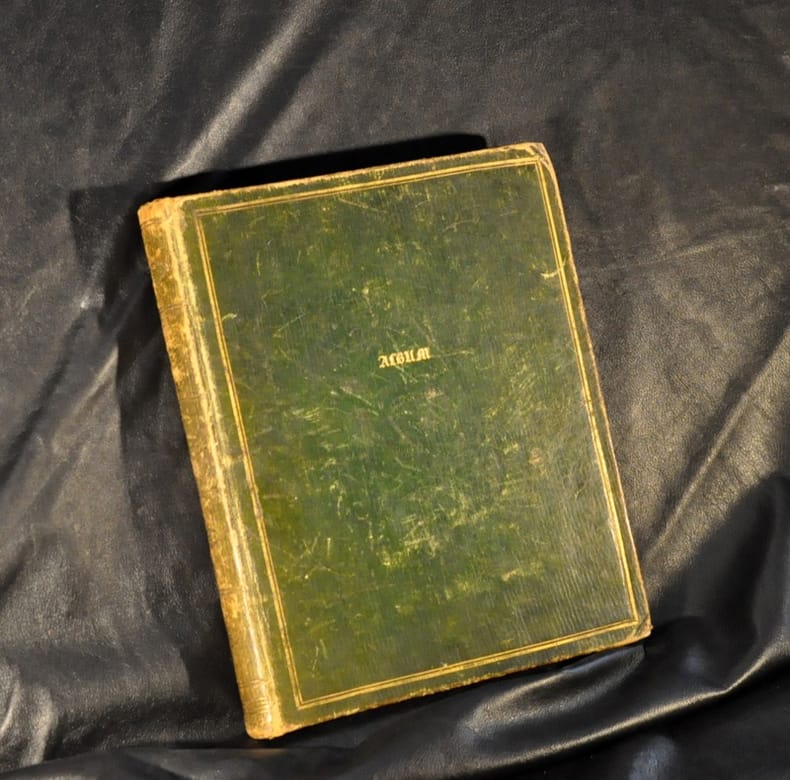
2998Album romantique de 205x260 mm, relie en basane maroquinee verte portant en super- libros sur le premier plat « Album ». Il se compose de feuillets de papier fort bleu montes sur onglets. Sur le verso de la premiere page, une table des matieres manuscrite.Les dessins au nombre de 39 sont colles a pleine page et certains d’entre eux sont decoupes, amputant une partie du dessin, ou sommairement replies en haut ou en bas. Certains dessins decoupes dans leur partie inferieure laissent deviner des ecritures au crayon qui ont ete otees. Un seul dessin, celui d’Anthony Thouret comporte une legende manuscrite.Le papier utilise est un papier fin, hativement decoupe. La plupart des dessins ont ete plies en deux ou en quatre. Certains semblent avoir ete mis sous enveloppe , certains ont ete dechires en tout ou partie puis recolles avec une bande en papier.
Folio (290 x 388 mm). 12 matted portrait etchings, individually numbered and signed by the artists as well as the sitters. Stored in publisher's original portfolio with vellum spine and gilt title to papered boards. Number 33 of 50 copies of the deluxe issue (entire press run: 150), each portrait bearing the additional signature of the sitter. The sitters are Lovis Corinth, Albert Einstein, Sigmund Freud, Gerhart Hauptmann, Wolfgang Heine, Ludwig von Hofmann, Arno Holz, Arthur Nikisch, Wilhelm Ostwald, Max Reinhardt, Richard Strauss, and August von Wassermann; the artists were Eduard Einschlag, Friedrich (Bedrich) Feigl, Ivo Hauptmann, Ernst Oppler, Robert Friedrich Karl Scholtz, and Walter Zeising (one etching each) as well as Hermann Struck (six etchings). Gerhart Hauptmann's portrait is by his son Ivo. - Upper cover of the portfolio very slightly warped. Light browning or foxing to versos of mattes; rectos and etchings all nearly perfectly clean and crisp. Extremely rare: libraries record a single copy of the sequel ("Köpfe 1921"), a series of only nine portraits that the publisher issued the following year (National Library of Israel).
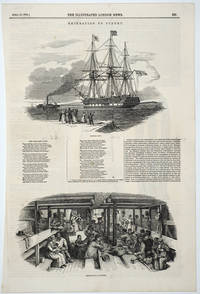
28182A valuable reference collection of images and articles that shaped perceptions of Australia to the wider world in the 19th century. This is a collection of over 800 woodcut illustrations and articles from the 19th century from the Illustrated London News The Graphic and The Illustrated Times & other less successful periodicals. The images of the ILN and Graphic are a comprehensive and systematic collection of Australian related images and articles from 1842 ILN and 1870 Graphic through the end of 1899. This collection was started in London in the late 1970s. It was our intention to create a comprehensive reference of every woodcut image of Australian interest in the two major British periodicals from their start date to 1900. We were living in North London not too far from Omniphil Limited a company based in Chesham Bucks. They were the preeminent dealers in woodcut images from British periodicals in the 1970s and 80s. We visited their premises repeatedly and sat and turned the pages of every single volume of their reference set noting the images related to Australia and purchasing a copy of those images. Another component of the collection is an assemblage of Australian images from lesser-known periodicals such as the Illustrated Times the Pictorial Times The Illustrated News of the World Gleason's Pictorial Drawing Room Companion Harper's Weekly Canadian Illustrated News and a few singletons from the Illustrated Family Paper l'Opinion Publique and the Australasian Sketcher. <br /> <br /> An important component of this collection is the associated Excel listing of the prints & text. These are indexed by year month & day image title print size associated text and folder number. <br /> <br /> The total collection is housed in nine A3 folders with fixed sleeves. Early years have 2 sheets per sleeve; later years are sometimes grouped together to fit into the available room in the album. The folders are approx. 12 ½" x 17" x 1". They were manufactured in England by Rexel Nyrex with the following label in the back inside cover "Rexel / Nyrex / PFV / A3 / 24 Made in Gt. Britain." The company still manufactures plastic products. We have not been able to ascertain if these are archival but the prints have been in the folders for at least 43 years and there has been no degradation. <br /> <br /> The only exception to the completeness of the collection is ship prints which were quite expensive at the time we assembled the collection. <br /> <br /> The collection is organized in three parts: <br /> Part I - The Illustrated London News 1842-1899; Part II - The Graphic 1870-1899; Part III - The Illustrated Times the Pictorial Times and other British & North American periodicals 1845-1883.<br /> <br /> Combined these original woodblock prints and articles are a valuable reference collection that shaped perceptions of Australia to the wider world in the 19th century a collection which would now be all but impossible to assemble. <br /> <br /> Part I<br /> Australian images from The Illustrated London News British periodical from its start in 1842 thru 1899. A comprehensive collection of Australian related images & articles from this groundbreaking periodical - the world's first illustrated weekly news magazine; the first periodical to employ special war correspondents and illustrators; the first to publish color supplements. The Australian material begins in the first publication on May 14 1842 and runs through the last article in the century in June 1899 and has approximately 467 images and 29 substantial articles. <br /> <br /> Australia is mentioned in the text of the first issue with an article "Sheep Farming in Australia" on p.15 about 4 column inches from the Inverness Courier. On the verso is an amusing illustration of a publicity stunt of the publishers. The founder Herbert Ingram paid hundreds of men to carry large sign boards in the streets reading "The Illustrated London News 30 Engravings Price 6D." The highly exaggerated drawing shows the sign bearers stretching as far as the eye can see on London footpaths. The caption reads "The 'Illustrated London News' Published Every Saturday. Thirty Engravings. Price Sixpence. The above engraving represents the public announcement of this paper on Friday last. Two hundred men paraded the streets of London to proclaim the advent of this important publication." Below the rule is printed "London: Printed by R. Palmer at the Office of Palmer & Clayton 10 Crane-court; and published by J. Clayton at 320 Strand. - Saturday May 14 1842." The first image of an Australian subject is in the December 23 1843 issue "New Government House Sydney" with text. The revenue stamp appears at the bottom left of the page. The discovery of gold in Australia is announced in a long article on the cover on Sept. 6 1851 entitled "Another El Dorado" in an article 15 column inches long. The last image is from June 1899 the Australian cricketeers in London- "The Australian Cricket Team / The Team up-river: leaving Boulter's Lock / The Test match at Lords Between England and Australia: Trumper and Hill at the Wickets". <br /> <br /> The ILN collection is housed in six A3 folders with fixed sleeves. Early years have 2 sheets per sleeve; later years are sometimes grouped together to fit into the available room in the album.<br /> <br /> Folder 1 - 1842-1852; 68 images & 12 articles<br /> Folder 2 - 1852-1854; 70 images & 13 articles<br /> Folder 3 - 1855-1861; 50 images & 1 article<br /> Folder 4 - 1862-1864; 55 images & 1 article<br /> Folder 5 - 1865-1884; 90 images & 2 articles<br /> Folder 6 - 1886-1899; 135 images<br /> <br /> Although Gale subscription service has a digitized resource titled the "Illustrated London News Historical Archive 1842-2003" this collection is invaluable as it is composed of the actual period woodblock prints and articles accessible in six A 3 folders. <br /> <br /> Part II<br /> Australian images from The Graphic British periodical from its start in 1869 thru 1899. Australian related images from The Graphic the British weekly illustrated newspaper first published on 4 Dec 1869 which was set up as a rival to the Illustrated London News. <br /> <br /> The Australian images begin in March 1870 and runs through 1899 approximately 242 images. There are 13 double page images 2 full weekly issues for the Sydney & Melbourne Exhibitions with the continuing supplements; 1 color Christmas issue; 74 full page and 39 half page illustrations. Highlights include images of bush and settlers' lives Tichborne case cricket Victorian gold the Kelly gang black trackers wool shipping ostriches a shearing dispute. <br /> <br /> The first Australian related image in The Graphic was published on the cover of the March 12th 1870 edition "Picnic in Australia To the Officers of the Flying Squadron." The last image for the 19th century is dated July 1899. The Graphic is housed in two folders are A3 approx. 12 ½" x 17" x 1". <br /> <br /> Part III<br /> Australian images from The Illustrated Times the Pictorial Times and other British periodicals as well as North American periodicals including Gleason's Pictorial Drawing Room Companion Harper's Weekly and others. London; New York; Boston; Canada: Various publishers 1845-1883. A collection of some of the scarcer woodcut images of Australian related images from various shorter-lived illustrated periodicals published in England and North America. These include The Pictorial Times The Illustrated Times The Illustrated News of the World Gleason's Pictorial Drawing Room Companion Harper's Weekly Canadian Illustrated News and a few singletons from the Illustrated Family Paper l'Opinion Publique and the Australasian Sketcher. These are scarcer publications than the market-dominating Illustrated London News & The Graphic. The collection starts in March 1870 and runs through 1899 approximately 107 images. <br /> <br /> Of particular interest is a series in the Illustrated Times entitled "England Versus Australia" illustrated by Florence Claxton. Claxton was an English artist who spent part of her adolescence in Sydney NSW in the 1850s. Throughout 1863 and early 1864 Miss Claxton drew imagined comparisons between the two environments not uniformly biased towards either country. In the first "Daughters Here" has a group of gentlewomen sitting in a lovely drawing room making lace playing piano or gazing in the mirror. "Sons There" shows the men doing the laundry mending and cooking. "Governesses Here" shows a gaggle of governesses seemingly subject to the whims of a butler; "Want of Governesses There" shows a home with the mother distraught the children causing absolute pandemonium & the father sitting and reading the paper. In another "Needlewomen Here" the seamstresses work themselves to exhaustion in a dark room with one light; "A Modiste There" shows a prosperous woman with many customers. <br /> <br /> We did not have access to a reference set for these smaller publications so these images are an assemblage not a comprehensive and consistent collection. <br /> <br /> The Pictorial Times. 1843-1848 Opened by Henry Vizetelly his brother and Andrew Spottiswoode. Eventually it was purchased by Ingram owner of the ILN and merged with The Lady's Newspaper. Unfortunately this newspaper did not date their issues but sometimes dates are to be found in text.<br /> <br /> The Illustrated Times. 1855-1862. A rival to the ILN edited by Henry Vizetelly who had left the ILN to open it. Vizetelly campaigned in the 1850s for the repeal of the Stamp Act. Its eventual repeal was a great boon allowing the new paper to be published at the low price of two pence.<br /> <br /> The Illustrated News of the World 1858-1864. This was published by John Tallis famed for his atlases with maps adorned with views. According to OCLC: 7091980 It started in Feb. 1858 and ceased in Aug. 1864<br /> .<br /> Gleason's Pictorial Drawing-Room Companion was a 19th-century illustrated periodical published in Boston Massachusetts. The magazine was founded by Frederick Gleason in 1851. According to OCLC: 10261386 it ran from 1851 - 1854. The publication name was changed to Ballou's Pictorial Drawing-Room Companion in 1855 after managing editor Maturin Murray Ballou bought out the interest of Gleason. Unfortunately this newspaper did not date their issues but sometimes dates are to be found in text.<br /> <br /> Harper's Weekly A Journal of Civilization was an American political magazine based in New York City. Published by Harper & Brothers from 1857 until 1916 it featured foreign and domestic news fiction essays on many subjects and humor alongside illustrations. It carried extensive coverage of the American Civil War including many illustrations of events from the war. During its most influential period it was the forum of the political cartoonist Thomas Nast. <br /> <br /> This collection is housed in one A3 folder approx. 12 ½ x 17" x 1" with fixed sleeves. The prints & text are indexed by newspaper and thence by year month & day image title print size & associated text including some artists and folder number. <br /> <br /> A collection of primary source documents revealing the perceptions and attitudes towards Australia in the 19th century. hardcover
Oblong folio (400 x 320 mm). 93 pp. A privately compiled album comprising 138 engravings, either full-page or as four smaller engravings to one leaf, mostly hand-coloured. Includes one watercolour, signed "Fedor Comte Karaczay, Wien 1822". All mounted on brown paper with black borders, mostly with manuscript captions in French and watermarks to tissue guards. Contemporary red morocco, finely decorated with gilt borders; gilt title to upper cover, metal clasp fastening with key. Green silk guards. A charming album comprising numerous views of Vienna's grand buildings, palaces, and parks as well as landscapes of the surrounding areas. Notable sites of the Austrian capital are depicted in all their splendour, including Klosterneuburg monastery, the Kohlmarkt, St Stephen's Cathedral, and the Circus Gymnasticus in the Prater park. - Landscape views of Leopoldsberg, the route to Mariazell, and the nearby spa town of Baden are presented in all their idyllic majesty, as are lively social scenes of the Habsburg Empire's carnivals and café culture. The ensemble also includes 13 plates of professions and three military figures, one of which is a watercolour by Fedor Graf Karaczay (1787-1859), an Austrian colonel and dilettante artist, later in Persian services. The occupations include lantern lighter, laundry woman and hawkers selling brushes, apples and honey, straw hats, ribbons, carpets and laurel leaves. - Some minor staining. Tissue guards and covers somewhat worn, but otherwise a fine work.
Ca. 42 Skizzen (3 aquarelliert) und 2 Texte auf 30 Bll. Original marmorierter Pappeinband mit Bleistifthalter. 8vo. Charmantes Skizzenbuch der jungen Herzogin mit zahlreichen Landschafts- und Architekturzeichnungen, Darstellungen von Haustieren sowie Karikaturen und Porträts besonders ihrer Schwestern. Neben den Zeichnungen umfasst das Büchlein ein amüsantes Gedicht ("In Lautenbach habe ich mein Strumpf verloren / Und ohne Strumpf geh ich nicht heim [...]"), eine Art Tagebucheintrag und den Entwurf für eine Glückwunschkarte mit Namenszug "Elisabeth" zum Namenstag ihres jüngeren Bruders Carl Theodor, genannt Gackel. - Das Skizzenbuch erlaubt einen seltenen, oft humorvollen Einblick in Elisabeths Kindheit in Possenhofen. Ihre Liebe zur Natur wird besonders durch die geschickten Skizzen von Bäumen verdeutlicht, die sie an verschiedenen Orten in Bayern anfertigte. Wie eine Sammlernotiz in Bleistift verdeutlicht, stammt das Skizzenbuch aus dem Nachlass der Gräfin Camilla von Otting, die als Erzieherin im herzöglichen Haushalt wirkte: "Kindliches Zeichenbuch der späteren Kaiserin Elisabeth v Oesterreich Herzogin in Bayern stammt aus dem Nachlass der Gräfin Camilla v Otting ihrer Erzieherin und Hofdame". - Einband berieben und bestoßen, Vorderdeckel mit Fehlstellen im Marmorpapier. Einige Bll. lose. Teils leicht fleckig und vereinzelte Einrisse. Durchgehend gebräunt.
Hand-aquatinted copper-plate engraving, printed on J. Whatman Turkey Mill watermarked paper dated 1835. 955 x 640 mm, sumptuously framed and glazed. The famous depiction of a Falcon from the "Birds of America" by the world-famous French-American naturalist and painter John James Audubon (1785-1851), which was purchased at a Christie's auction for $11.5 million in March 2000, setting a world record for the most expensive book ever sold (surpassed only by the 1640 "Psalm Bay Book", sold for $14.2 million in November 2013). Very good colour, with the back of the upper bird a subtle charcoal, beaks and feet of both birds a pale blue wash, slight limited spotting to the background, slight cast on the edge, and minor thumbing, three edges of the sheet gilt from when it was bound.
Folio (270 x 387 mm). (6), 92, (2) pp. With 2 plates of engraved music and 8 (including frontispiece) coloured aquatints by or after Bonatti, Castellini, Gallina, and Pallagi. Contemporary ruby-red morocco, elaborately gilt with gilt inner dentelle and giltstamped arms to both covers. Green moirée silk endpapers. Green silk divider. Only edition. Of all of Gironi's publications, all of which are of a similar nature, the present work on Greek music is one of the rarest, published in only 30 copies and printed on strong, very wide-margined wove paper. This is the dedication copy for Marie Louise, Archduchess of Austria and Duchess of Parma (1791-1847), the wife of Napoleon and daughter of Francis I (1768-1835), first Emperor of Austria, with a printed dedication dated May 1825 and sumptuously bound with the Austrian arms on both covers. - "Cette dissertation n'étant point destinée au commerce, il n'en a été tiré que trente exemplaires, et l'auteur en a fait hommage à une dame à l'occasion de son mariage. Les gravures sont d'après les dessins de peintres célèbres" (Brunet). - The eight hand-coloured aquatints, showing costumes and musical instruments, are blindstamped with Giulio Ferrario's monogram ("Il costume antico e moderno"). An entirely complete copy, showing only some slight spotting and some foxing to margins. Old catalogue description pasted to lower free endpaper. Traces of professional restorations to spine and hinges. Latterly in the collection of the legendary French maître coiffeur Louis Alexandre Raimon (1922-2008), hairdresser to film stars and aristocracy, with his ownership stamp to first free endpaper ("Collection Alexandre de Paris"). Brunet II, 1615. Graesse III, 89. OCLC 13996001.
Engraved and illustrated title-page; 65 plates. [And]: Engraved and illustrated title-page; 64 plates. A total of 131 engravings by Josef Zutz, J. W. Zincke et al. after Sigmund v. Perger, Edward Gurk et al., with text in German and French, image ca. 10 x 14 cm each, all lavishly hand-coloured and with ink-washed borders. Bound in later 19th century black half morocco with gilt spine. Marbled endpapers. Oblong 4to (260 x 187 mm). Two of Mollo's most beautiful and most popular series of Viennese views, lavishly hand-coloured within grey wash passe-partout borders in the manner of the de luxe issue, but on normal paper rather than trimmed and mounted on grey cardboard. As typical of the de luxe issue, both works (showing "Vienna's monuments" and "Vienna's environs") here comprise the first 64 numbered plates only of their respective series (instead of 78 in the first and 66 in the second series); however; the final, unnumbered 79th plate of the "monuments" set, showing a view of the city from the "Spinnerin am Kreuz" south of Vienna, is included as a frontispiece. - Exceedingly rare in all states: a single copy of the de luxe issue is recorded at auction since 1975 (the Rudolf von Gutmann copy, sold at Sotheby's in 1993 and again at Christie's in 2006), and only one other copy of both works is listed. - Occasional spotting, browning or foxing to margins as common. Title-pages transposed, with the "environs" series bound following the "monuments" title and frontispiece, and the "monuments" series following the "environs" title. A very charming, well-preserved set of Austrian colour-plate views. Nebehay/Wagner 428/429.
- Chez Meynal, Paris 1920-1924, 44,5x31cm, en feuilles sous couverture de l'éditeur. - Le Bonheur du jour ou Les Grâces à la Mode Chez Meynal | Paris 1920-1924 | 44,5 x 31 cm loose leaves under publisher's cover and custom slipcase First edition complete with its 21 color copper-engravings and pochoirs by H. Reidel colored after the drawings of George Barbier: one on the cover, one on the title, 3 in the text and 16 plates. The work was printed with 300 copies, all printed on vellum paper. Embossed stamp in the bottom right of the title page. Our copy is presented in a blue calf custom slipcase, fans-pattern paper boards, title piece in blue calf and titled in palladium in the center of the first board; lambskin velvet lining, slipcase signed by Thomas Boichot. Rare and superb copy, complete with all its plates, of this magnificent and monumental Art Deco work that required four years of work. [FRENCH VERSION FOLLOWS] Édition originale bien complète de ses 21 compositions en couleurs gravées sur cuivre par H. Reidel et coloriées au pochoir d'après les dessins de George Barbier?: une sur la couverture, une sur le titre, 3 dans le texte et 16 hors texte. L'ouvrage fut tiré à 300 exemplaires, tous imprimés sur papier vélin. Notre exemplaire est présenté dans un étui en veau bleu, plats de papier à motif d'éventails, pièce de titre en veau bleu et titrée au palladium au centre du premier plat, doublure en velours d'agneau, étui signé Thomas Boichot. Timbre à sec en bas à droite de la page de titre. Rare et superbe exemplaire, complet de toutes ses planches, de ce magnifique et monumental ouvrage Art Déco qui nécessita quatre années de travail.
Royal folio (410 x 605 mm). 2 ff. of text and 25 collotype plates after drawings on matte art paper (7 with colours), each tipped onto thin cream card with a mount as issued. Storedin original half cloth portfolio with Klimt's gilt-printed signature on the upper cover. Number 326 of only 500 numbered and 10 deluxe copies. The twenty-five monochrome and coloured drawings show women in mainly erotic scenes. All were from the collection of the Austrian industrialist August Lederer and his wife Serena (a relative of the U.S. journalist Joseph Pulitzer), who together spent a fortune on compiling the most important Klimt collection of their age. Forcibly expropriated by the National Socialists in 1938, a significant part of the trove was stored at Immendorf Castle in Lower Austria, where it appears to have perished in a fire in May 1945. - From the collection of the Swedish painter and photographer Johan Theodor Jönsson with two stamps of his archive foundation. Several mounts a little waterstained or dust-soiled, but generally in excellent condition. For the history of the Lederer family and their collection see 1) Tina Marie Storkovich, Verbrannte Klimtbilder: Das Puzzle von Immendorf. In: "Die Presse", Print-Ausgabe, 19 Dec. 2015, Spectrum, p. III. 2) Michael Wladika, Egon Schiele, "Die Mutter und die Tochter" 1913. Dossier der Leopold Museum-Privatstiftung zu LM Inv. Nr. 2356.
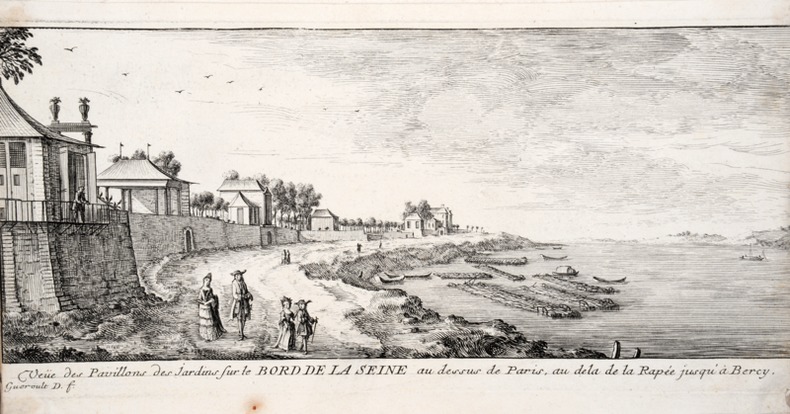
170839636Paris, Giffart, 1708-1710. 137 gravures en 1 album in-4 (18 x 25cm), veau brun, dos orné à nerfs, pièce de titre, tranches jaspées (reliure de l’époque).
4to. Ca 95 pencil drawings (including occasional pen-and-ink drawings and watercolours), as well as entries and drawings by other hands on a total of 187 ff. Contemporary cloth with illustrated vellum title label and spine label. The drawings - some of which are very finely executed, though most constitute mere perfunctory sketches - include numerous portraits. Many depict Leischner's wife Stefanie, née Friedrich, others show caricatures, interiors etc. The several signed full-page watercolours and pencil drawings by Otto Rudolf Schatz (1900-61) deserve special mention: these include a number of decidedly anti-fascist and anticlerical caricatures, but also a full-page pencil drawing and a full-page entry with two illustrations by Franz von Zülow (1883-1963). - Schatz's contributions have been researched and documented for a catalogue raisonné by Dr Cornelia Cabuk, Belvedere, Vienna. - Binding somewhat rubbed and warped. Edges of leaves slightly darkened; occasional slight spots. Cabuk, Schatz (2018), p. 104, illustrated.
1939SPENDERS007080Atelier 17 Paris & New York. March 1939. First edition. Octavo. Spender's poem ''Fall of a City'' and Louis Aragon's translation ''Chute d'une Cit�'' together with nine engravings loose within wrappers. The engravings were printed by Atelier 17 and Henri Hecht and include one with aquatint and roulette one with soft ground etching one drypoint and one etching. All are on Montval handmade paper with deckle-edges. Held within the original plain board chemise but lacking the slipcase which had a Hayter titling-piece pasted onto the front. Stanley Hayter founded Atelier 17 in Paris in 1927 and it continues to this day in Rue Didot albeit with the name changed to Atelier Contrepoint. This production was his contribution to the raising of funds to help children orphaned by the Spanish Civil War.101 numbered copies were printed for sale and 12 for the contributors. This copy is unnumbered and hors commerce marked ''h.c'' on the limitation page. Each copy including this one was signed by Spender and Aragon at their respective contribution and by each artist in the lower margin of the etched sheet.Fine in custom burgundy morocco box with ''FRATERNITY'' in gilt on the lid. Very scarce with all nine loose etchings as most sets have been broken up for piecemeal sale. Atelier 17, Paris & New York. March, unknown
1630ABC_49153Flanders and Paris: various publishers 1630. Several prints are tipped into a 19th-century elaborately gold- and blind-tooled brown morocco album a blind-tooled ornament in the centre of both boards with the crowned initials J.B. on the front surrounded by a double fillet frame with elaborate corner pieces gold-tooled board edges and turn-ins gilt edges white watered silk endpapers. The work is housed in a 19th-century marbled slipcase with a paper label with the name of Countess Julie Visart de Bocarmé mounted on the front. The remaining prints have been tipped onto a sheet of sturdy paper inserted into a clear plastic file folder which are loosely inserted into a 19th-century elaborately gold- and blind-tooled purple morocco album with the word "album" lettered in gold on the front surrounded by a blind-tooled Gothic style border and an elaborate gold-tooled border gilt edges black watered silk end papers. Oblong folio ca. 29 x 42.5 cm; sheet size ca. 12 x 9 to 35 x 23 cm. With 24 contemporary hand-coloured engravings of which some heightened with gold 1 contemporary hand-coloured woodcut illustration 1 chromolithographed print 7 watercolour drawings including 2 on vellum 3 silk embroidered prints in various sizes and 1 image made of paper ornaments glued onto a black netting fabric. Further with a folded alphabetical list of the Antwerp printers and engravers of devotional prints in a 19th-century hand tipped onto the first leaf of the album. 2 volumes. Remarkable collection of 37 devotional prints and drawings including fifteen printed on vellum and two "clad" prints. The majority of the prints and drawings were made in the 17th and 18th centuries but a small number of 19th-century examples is also included. The prints all depicting Catholic saints and scenery are decorated with a wide variety of techniques. Most are hand coloured and heightened with gold but several are clad in fabric embroidered cut out to resemble lace sometimes backed with coloured paper or metal foil to highlight the cut outs and one was made by gluing paper ornaments onto a black netting fabric. The present collection which was owned and probably compiled by the Belgian Countess Julie Alexandrine Marie Josèphe Visart de Bocarmé 1823-1862 not only offers a fascinating sample of popular printing culture in Flanders but also highlights the endless creativity of both the creators and consumers of these prints.Devotional prints were initially used as images for the illiterate replacing written or printed texts. They were intended for private devotion and often bought and decorated by women. The present prints were mainly engraved by 17th-century Flemish printmakers such as Cornelius de Boudt 1660-1738 Michiel Cabbaey 1660-1722 Guillaume Collaert ca. 1595-ca. 1651 Lodewijk Joseph Fruytiers 1713-1782 Jacob de Man ca. 1643-1719 and Theodoor van Merlen III 1661-1749. In contrast to most examples of this genre most of the present engravings are printed on vellum and beautifully coloured by a contemporary hand partly heightened in gold for the halos of the saints. The prints include biblical scenes showing Christ on the Cross Joseph Mary the Apostles and John the Baptist. The majority of the prints depict portraits of Catholic saints such as Anthony of Padua 1195-1231 Apollonia of Alexandria d. 249 Dorothea of Caesarea d. ca. 311 Francis of Assisi ca. 1181-1226 Francis Xavier 1506-1552 Helena of Constantinople ca. 246-330 Peter of Alcántara 1499-1562 and Rosalia of Palermo 1130-1166. A complete list of contents is available upon request.With the initials of Belgian Countess Julie Visart de Bocarmé stamped in gold on the front board and her manuscript ownerships label Julie Visart de Bocarmé Baronesse G.v.Z.v.N. mounted on the front of the slipcase. Further with the printed label of Cabasson Successeur de Terzuolo-Despilly Papetier du Roi Rue de la Chaussée dAntin No. 15 mounted on the verso of the first flyleaf of the brown album all prints and drawings have been tipped onto a white sheet of paper with a manuscript collection number at the top. The boards are slightly rubbed and scratched. The first few leaves of the purple album have been removed to make space for the collection. The prints and drawing show traces of use with some browning and occasional creasing soiling or foxing. The edges and corners of the slipcase are scuffed and the lower right corner of the paper label is torn off. Otherwise in good condition.l K. van den Bergh Bidprentjes in de Zuidelijke Nederlanden 1975; J.A.J.M. Verspaandonk Het hemels prentenboek. Devotie- en bidprentjes vanaf de 17e eeuw tot het begin van de 20e eeuw 1975. various publishers, hardcover
Engraved map in 36 segments on canvas, folded. Fine original hand-colour. Ca. 1450 x 1230 mm. Earliest edition of this wall map, the most accurate map of Asia published at the beginning of the 19th century. It shows significant advancement compared with other maps of the period, incorporating the work of surveyors like James Rennell, to whom the map was dedicated. Rennell was surveyor-general of the East India Company's dominions in Bengal, and the information published in his "Bengal Atlas" in 1779 appears here. Arrowsmith also included remarkable topographical detail such as mountain ranges in regions as remote as Tibet. Remarkably, the region on the shore of the Arabian Gulf is already labelled as "Bani Yas" territory. Arrowsmith has marked the track of Lapérouse's voyage in the Indian Ocean and Far East. - Aaron Arrowsmith (1750-1823) was the finest cartographer of his generation. Although he received little formal education, it is believed that he was provided with some mathematical instruction by William Emerson, an author of several books on the application of mathematics to the area of cartography. Around 1770, Arrowsmith moved to London to seek employment. It is believed that he worked for William Faden before joining John Cary Sr. in the early 1780s. There he provided the measurements for John Cary's early publication detailing the roads from London to Falmouth, his first signed work. Arrowsmith set up on his own in 1790 and over the next thirty years produced some of the most beautiful and elegant maps of the era. "This highly detailed wall map of Asia is probably one of the most accurate maps of the continent before the completion of the Ordnance Survey maps of 1820" (Sweet). - Slightly soiled and browned, but well preserved. Not in Al Ankary or Al-Qasimi. Cf. Sweet 238 (1811 edition only).
166 x 108 mm. Pen and brown ink, brown wash on paper. Minimal foxing. Charming caricature by the Venetian master depicting a liveried gentleman with épée and tricorne in profile, accentuating the figure's implausibly hollow back, grotesquely hooked nose, and impressive prognathism. The drawing can be attributed to Giovanni Domenico Tiepolo, the oldest son and student of Giovanni Battista Tiepolo. - The drawing is very similar to the caricature of a gentleman with walking stick and tricorne that is held at the MET (Inv.: 37.165.68).
Dieci incisioni originali di Asger Jorn a puntasecca, acquaforte e acquatinta, numerate, firmate e datate su carta Giappone: cm 8x6,5 - 11,8x11,3 - 7,2x6,4 - 6x10,5 - 7x6,3 - 5,5x5 - 7x6,4 - 6,7x11 - 18x12 - 8,1x5,7 (Foglio cm 23x15,8) Esemplare 9/15. Cartelletta cm 24x16. . . Ottimo (Fine). . Prima edizione di 15 esemplari numerati (First edition of 15 numbered copies). . La collaborazione tra l'artista danese Asger Jorn (Vejrum 1914 - Aarhus 1973) e l'editore francese Georges Visat (Foce, Corsica 1910 - Arzacq 2001) fu favorita dalla mediazione di Roberto Matta. Infatti Jorn, trovandosi a Parigi alla ricerca di un editore, si rivolse all'amico artista che gli fece il nome di Visat, con l'assicurazione che lo stampatore non avrebbe di sicuro deluso le sue aspettative. Matta aggiunse che per incontrare Visat bastava attenderlo alle 10 di ogni mattina presso il caffè accanto al suo atelier, al numero 13 di rue du Dragon. Una mattina Jorn si recò al caffè, ma non osando avvicinare l'editore, continuò a fissarlo fino a che Visat, sentendosi osservato, si avvicinò per primo all'Artista. Jorn gli affidò una serie di incisioni, parlandogli del suo desiderio di farne un'edizione. Di quella serie di 10 incisioni ne furono stampate solo 15 copie, che Visat raccolse in una cartelletta e propose di chiamare ''Suitesurunjaponpourunlivrequin'existepas''. Il testo infatti sarebbe stato pensato ed organizzato in un incontro successivo presso l'Atelier Visat, appuntamento che si realizzò soltanto un anno dopo. Ne nacque però un libro del tutto nuovo, ''Entrée de secours'', con 9 diverse opere grafiche, stampato in 100 esemplari nel 1971. (informazioni in parte fornite da Yannick Minous Visat).