Sabatier & Bayot, d'après Jugelet.Livre Rare Book
10 867 résultats
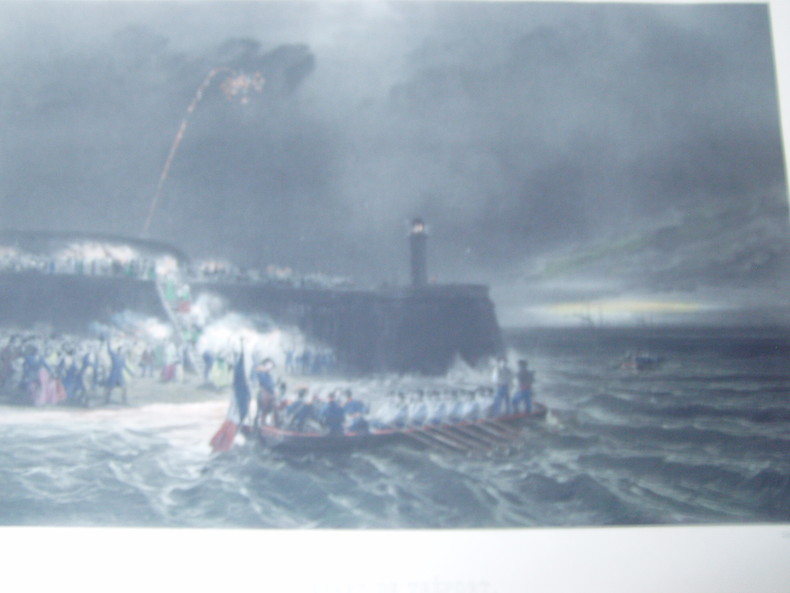
23488SEINE-MARITIME (76) - FEU D'ARTIFICE & MARINE - "Départ de TREPORT". XIXème. Lithographie par Sabatier & Bayot, d'après Jugelet, coloriée et gommée. Papier Chine appliqué sur vélin. Imprimée par Lemercier, à Paris. Marges. (34 x 45,5) - Etat A ,bon état
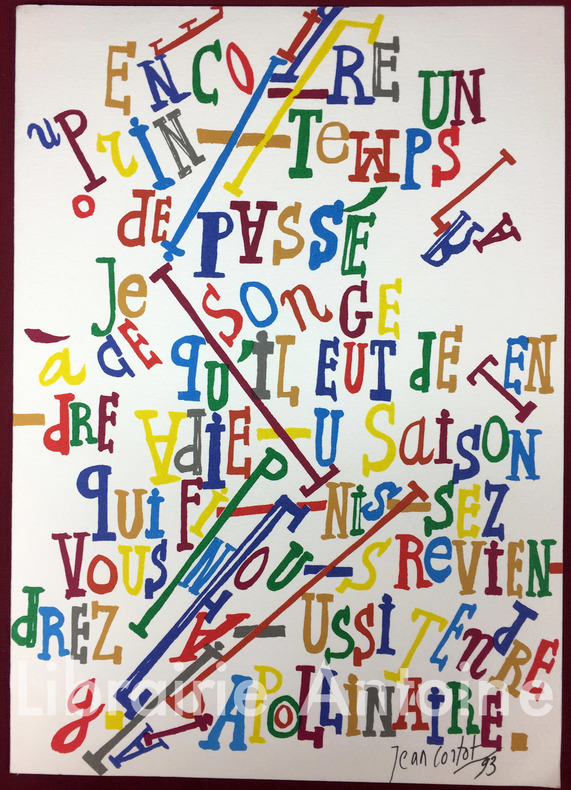
19931906Paris Maeght 1993 Une feuille 31 x 44 cm. pliée en deux, imprimée en huit couleurs et signée sur la pierre. D'une manière quelque peu déstructurée (lettres de taille variable, elle représente un quatrain du poème d'Apollinaire Vitam impendere amori "Encore un printemps de passé / Je songe à ce qu'il eut de tendre / Adieu saison qui finissez / Vous nous reviendrez aussi tendre"
Small folio (260 x 336 mm). Album comprising two lithographic series: 1) H. Lecomte. Unidentified set, "imp. Lith. de Delpech". 37 lithogr. plates (numbered 1-37, complete thus?), monogrammed "H.te L.". 2) H. Bellangé. "Fantaisies par Bellangé". [Paris, Gilhaut, 1829]. 12 lithogr. plates, signed "H.te Bellange". Half calf with printed cover label. A fine collection of two lithographed series: genre scenes with riders, coaches, soldiers, hunting, salons, etc. The lithographer Hippolyte Lecomte (1781-1857) is known for his landscapes and genre and history paintings, "but mainly for his battles and scenes of historical representation" (cf. Thieme/B. XXII, 526). - The French military painter Hippolyte Bellangé (1800-66) "was capable of painting anecdotal scenes and combining the most comical situations with the most serious ones. His style made him extremely popular as a painter of French military success. Apart from his numerous paintings he created a body of some 600 lithographs" (cf. Thieme/B. III, 232). - Edges somewhat rubbed and bumped; margins show some fading. OCLC 830769201 (2nd series only).
191484691Lucien Vogel éditeur | Paris Mars 1914 | 19 x 24.50 cm | une feuille
191489457Paris Mars 1914 | 19 x 24.50 cm | une feuille
18803CBLeipzig, Eigendruck, 2021. je 100 x 70 cm. Diptychon. 2 Blatt. Kartondruck. Die Versandkosten für Kunstwerke und mehrbändige Werke können von den Standard-Versandkosten abweichen. Sehr guter Zustand. Im unteren weißen Rand druckbedingte Farbsspuren.In Bleistift signiert, nummeriert und betitelt.
18952CBLeipzig, Eigendruck, 2021. 80 x 60 cm. Ohne Passepartout. Exemplar II/V Die Versandkosten für Kunstwerke und mehrbändige Werke können von den Standard-Versandkosten abweichen. Sehr guter Zustand. In Bleistift signiert und nummeriert.
197373501Erker Press | 1973 | 55.50 x 76 cm | une feuille
- Erker Press 1973, 55,5x76cm, une feuille. - Xylographie originale imprimée sur vélin BFK de Rives filigrané. Signature de l'artiste et numérotation (1/10) au crayon en bas de la planche. Tampon à sec de l'éditeur Erker Press. [ENGLISH DESCRIPTION ON DEMAND]
4to. Ca 95 pencil drawings (including occasional pen-and-ink drawings and watercolours), as well as entries and drawings by other hands on a total of 187 ff. Contemporary cloth with illustrated vellum title label and spine label. The drawings - some of which are very finely executed, though most constitute mere perfunctory sketches - include numerous portraits. Many depict Leischner's wife Stefanie, née Friedrich, others show caricatures, interiors etc. The several signed full-page watercolours and pencil drawings by Otto Rudolf Schatz (1900-61) deserve special mention: these include a number of decidedly anti-fascist and anticlerical caricatures, but also a full-page pencil drawing and a full-page entry with two illustrations by Franz von Zülow (1883-1963). - Schatz's contributions have been researched and documented for a catalogue raisonné by Dr Cornelia Cabuk, Belvedere, Vienna. - Binding somewhat rubbed and warped. Edges of leaves slightly darkened; occasional slight spots. Cabuk, Schatz (2018), p. 104, illustrated.
GRAV018MFormat : 26 x 34,5 cm sur papier à la Cuve. Cuvette en très bon état.
- Lucien Vogel éditeur, Paris 1920, 18x24cm, une feuille. - Original color print, printed on vergé paper, signed in the plate. An original print used to illustrate the Gazette du bon ton, one of the most attractive and influential 20th century fashion magazines, featuring the talents of French artists and other contributors from the burgeoning Art Deco movement. A celebrated fashion magazine established in 1912 by Lucien Vogel, La Gazette du bon ton appeared until 1925, with a hiatus from 1915 to 1920 due to the war (the editor-in-chief having been called up for service). It consisted of 69 issues printed in only 2,000 copies each and notably illustrated with 573 color plates and 148 sketches of the models of the great designers. Right from the start, this sumptuous publication "was aimed at bibliophiles and fashionable society," (Françoise Tétart-Vittu, "La Gazette du bon ton", in Dictionnaire de la mode, 2016) and was printed on fine vergé paper using a type cut specially for the magazine by Georges Peignot, known as Cochin, later used (in 1946) by Christian Dior. The prints were made using stencils, heightened in colors, some highlighted in gold or palladium. The story began in 1912, when Lucien Vogel, a man of the world involved in fashion (he had already been part of the fashion magazine Femina) decided, with his wife Cosette de Brunhoff - the sister of Jean, creator of Babar - to set up the Gazette du bon ton, subtitled at the time: "Art, fashion, frivolities." Georges Charensol noted the reasoning of the editor-in-chief: "'In 1910,' he observed, 'there was no really artistic fashion magazine, nothing representative of the spirit of the time. My dream was therefore to make a luxury magazine with truly modern artists...I was assured of success, because when it comes to fashion, no country on earth can compete with France.'" ("Un grand éditeur d'art. Lucien Vogel" in Les Nouvelles littéraires, no. 133, May 1925). The magazine was immediately successful, not only in France but also in the United States and Latin America. At first, Vogel put together a team of seven artists: André-Édouard Marty and Pierre Brissaud, followed by Georges Lepape and Dammicourt, as well as eventually his friends from school and the School of Fine Arts, like George Barbier, Bernard Boutet de Monvel and Charles Martin. Other talented people soon came flocking to join the team: Guy Arnoux, Léon Bakst, Benito, Boutet de Monvel, Umberto Brunelleschi, Chas Laborde, Jean-Gabriel Domergue, Raoul Dufy, Édouard Halouze, Alexandre Iacovleff, Jean Émile Laboureur, Charles Loupot, Chalres Martin, Maggie Salcedo. These artist, mostly unknown when Lucien Vogel sought them out, later became emblematic and sought-after artistic figures. It was also they who worked on the advertising drawings for the Gazette. The plates put the spotlight on, and celebrate, dresses by seven designers of the age: Lanvin, Doeuillet, Paquin, Poiret, Worth, Vionnet and Doucet. The designers provided exclusive models for each issue. Nonetheless, some of the illustrations are not based on real models, but simply on the illustrator's conception of the fashion of the day. The Gazette du bon ton was an important step in the history of fashion. Combining aesthetic demands with the physical whole, it brought together - for the first time - the great talents of the artistic, literary, and fashion worlds; and imposed, through this alchemy, a completely new image of women: slender, independent and daring, which was shared by the new generation of designers, including Coco Chanel, Jean Patou, Marcel Rochas, and so on... Taken over in 1920 by Condé Montrose Nast, the Gazette du bon ton was an important influence on the new layout and aesthetics of that "little dying paper" that Nast had bought a few years earlier: Vogue. [FRENCH VERSION FOLLOWS] Estampe originale en couleur, tirée sur papier vergé, signée en bas à gauche de la planche. Gravure originale réalisée pour l'illustrat
192054806Lucien Vogel éditeur | Paris 1920 | 18 x 24 cm | une feuille
RO20228469"Librairie-Imprimeries réunies ancienne Maison Morel. Non daté. In-Plano. En feuillets. Bon état, Livré sans Couverture, Dos satisfaisant, Intérieur frais. Portrait contrecollé. Planche extraite de l'ouvrage ""Musée du Cabinet des Estampes : Portraits"". Légende au verso. Dessin à l'estompe. Dimensions : environ 45 x 32 cm. . . . Classification Dewey : 769-Estampes"
240:348 mm. In Passepartout. Sorgfältig ausgeführtes Aquarell, das den bekannten österreichischen Kurorts Bad Ischl, einst Sommerresidenz der kaiserlichen Familie in einer sehr hübschen Darstellung um 1850 darstellt. - Provenienz: I) Mrs Callow's Collection. II) Mehrfach ausgestellt bei Walker's Galleries, London, April 1927 (vgl. "Walker's Quarterly, April 1927, S. 46). III) The Fine Art Society, London. April 1958 und Oktober 1959 (entsprechende Schildchen auf die Verso-Seite einer Trägerplatte montiert).
- Lucien Vogel éditeur, Paris 1920, 18x24cm, une feuille. - Estampe originale en couleur, tirée sur papier vergé, non signée. Gravure originale réalisée pour l'illustration de La Gazette du bon ton, l'une des plus belles et des plus influentes revues de mode du XXème siècle, célébrant le talent des créateurs et des artistes français en plein essor de l'art déco. Célèbre revue de mode fondée en 1912 par Lucien Vogel, La Gazette du bon ton a paru jusqu'en 1925 avec une interruption durant la Guerre de 1915 à 1920, pour cause de mobilisation de son rédacteur en chef. Elle se constitue de 69 livraisons tirées à seulement 2000 exemplaires et est illustrée notamment de 573 planches en couleurs et de 148 croquis représentant des modèles de grands couturiers. Dès leur parution, ces luxueuses publications « s'adressent aux bibliophiles et aux mondains esthètes » (Françoise Tétart-Vittu « La Gazette du bon ton » in Dictionnaire de la mode, 2016). Imprimées sur beau papier vergé, elles utilisent une police typographique spécialement créée pour la revue par Georges Peignot, le caractère Cochin, repris en 1946 par Christian Dior. Les estampes sont réalisées grâce à la technique du pochoir métallique, rehaussées en couleurs et pour certaines soulignées à l'or ou au palladium. L'aventure commence en 1912 lorsque Lucien Vogel, homme du monde et de la mode - il a déjà participé à la revue Femina - décide de fonder avec sa femme Cosette de Brunhoff (sur de Jean, le père de Babar) la Gazette du bon ton dont le sous-titre est alors « Art, modes et frivolités ». Georges Charensol rapporte les propos du rédacteur en chef : « En 1910, observe-t-il, il n'existait aucun journal de mode véritablement artistique et représentatif de l'esprit de son époque. Je songeais donc à faire un magazine de luxe avec des artistes véritablement modernes [...] J'étais certain du succès car pour la mode aucun pays ne peut rivaliser avec la France. » (« Un grand éditeur d'art. Lucien Vogel » in Les Nouvelles littéraires, n°133, mai 1925). Le succès de la revue est immédiat, non seulement en France, mais aussi aux Etats-Unis et en Amérique du Sud. À l'origine, Vogel réunit donc un groupe de sept artistes : André-Édouard Marty et Pierre Brissaud, suivis de Georges Lepape et Dammicourt ; et enfin ses amis de l'École des beaux-arts que sont George Barbier, Bernard Boutet de Monvel, ou Charles Martin. D'autres talents viennent rapidement rejoindre l'équipée : Guy Arnoux, Léon Bakst, Benito, Boutet de Monvel, Umberto Brunelleschi, Chas Laborde, Jean-Gabriel Domergue, Raoul Dufy, Édouard Halouze, Alexandre Iacovleff, Jean Émile Laboureur, Charles Loupot, Charles Martin, Maggie Salcedo. Ces artistes, inconnus pour la plupart lorsque Lucien Vogel fait appel à eux, deviendront par la suite des figures artistiques emblématiques et recherchées. Ce sont ces mêmes illustrateurs qui réalisent les dessins des publicités de la Gazette. Les planches mettent en lumière et subliment les robes de sept créateurs de l'époque : Lanvin, Doeuillet, Paquin, Poiret, Worth, Vionnet et Doucet. Les couturiers fournissent pour chaque numéro des modèles exclusifs. Néanmoins, certaines des illustrations ne figurent aucun modèle réel, mais seulement l'idée que l'illustrateur se fait de la mode du jour. La Gazette du bon ton est une étape décisive dans l'histoire de la mode. Alliant l'exigence esthétique et l'unité plastique, elle réunit pour la première fois les grands talents du monde des arts, des lettres et de la mode et impose, par cette alchimie, une toute nouvelle image de la femme, élancée, indépendante et audacieuse, également portée par la nouvelle génération de couturiers Coco Chanel, Jean Patou, Marcel Rochas... Reprise en 1920 par Condé Montrose Nast, la Gazette du bon ton inspirera largement la nouvelle composition et les choix esthétiques du « petit journal mourant » que Nast avait racheté quelques années auparavant : le magazine Vogue. [ENGLISH DESCRIPTION ON DEMAND]
Signed "A. Alintor" (?). 205 x 460 mm. An imaginative rendering of the Masjid-i Jahan-Numa (World-reflecting Mosque) in Delhi, shown here in the midst of a desert, with camels and bedouins in the foreground. - Mounted on cardboard; two small tears to lower edge.
18769CBLeipzig, Eigendruck, 2021. 80 x 60 cm. Ohne Passepartout. Exemplar 2/3. Die Versandkosten für Kunstwerke und mehrbändige Werke können von den Standard-Versandkosten abweichen. Sehr guter Zustand. In Bleistift signiert und nummeriert.
18763CBLeipzig, Eigendruck, 2021. 69 x 100 cm Original Kartondruck. Holzdruck, Exemplar 2/3. Die Versandkosten für Kunstwerke und mehrbändige Werke können von den Standard-Versandkosten abweichen. Unregelmässig beschnitten, leichte Flecken im Randbereich, sonst sehr gut erhalten.
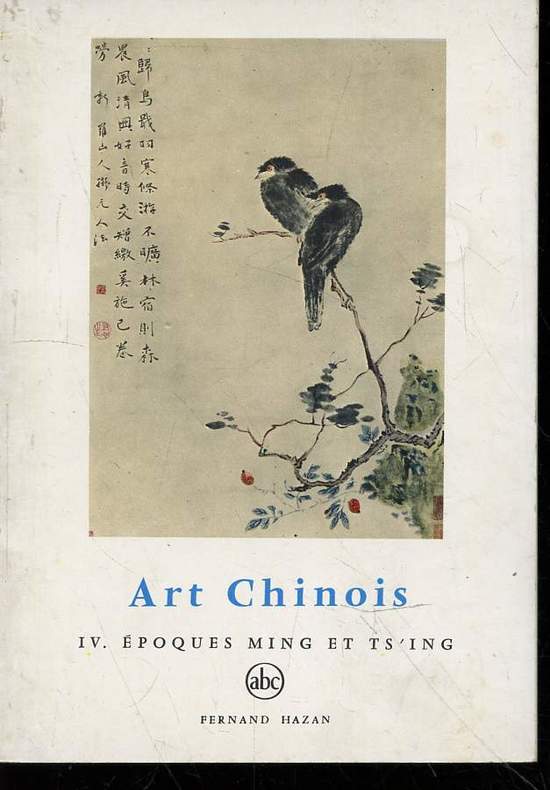
1961RO20212088Fernand Hazan. 1961. In-16. Broché. Etat d'usage, Couv. légèrement passée, Dos satisfaisant, Intérieur frais. 15 pages augmentées de nombreuses estampes en noir et blanc et couleurs dans et hors texte.. . . . Classification Dewey : 769-Estampes
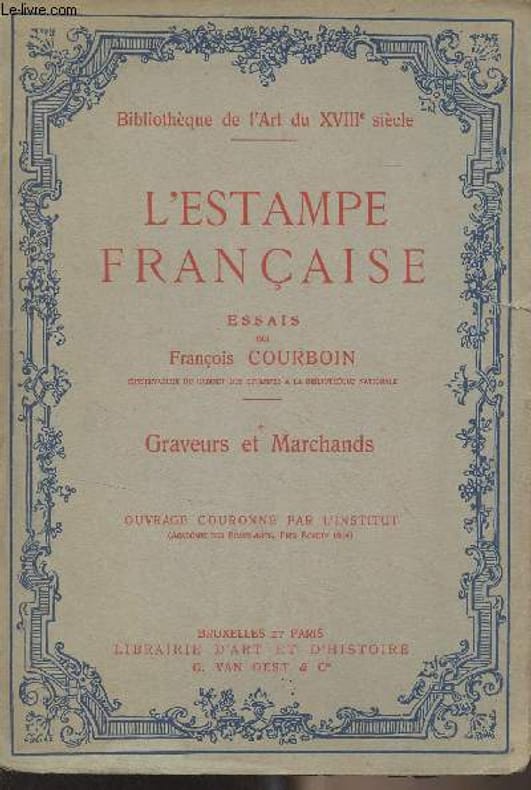
1914R300323176Lib. d'art et d'histoire G. Van Oest & Cie. 1914. In-4. Broché. Etat d'usage, Couv. légèrement passée, Dos plié, Papier jauni. X + 213 pages - nombreuses illustrations en noir et blanc hors texte. Plats très légèrement déchirés. Coiffe de tête déchirée.. . . . Classification Dewey : 769-Estampes
GRAV021MFormat : 26 x 34,5 cm sur papier à la Cuve. Cuvette en très bon état.
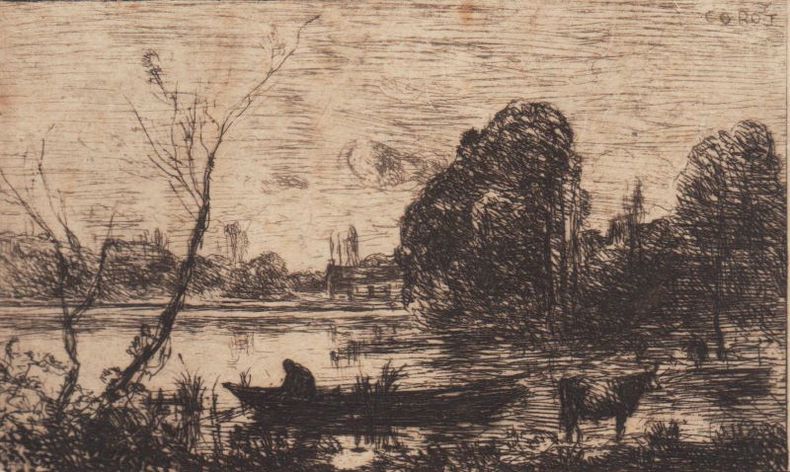
1862212681862 Eau-forte et pointe-sèche sur papier Chine appliqué du deuxième état sur trois à grandes marges, 1862, 7.1 x 12 cm. (format à vue), 21.5 x 28 cm. (format de la feuille), signée dans la planche en haut à droite.
191389437Paris Juillet 1913 | 19 x 24.50 cm | une feuille
GRAV016MFormat : 26 x 34,5 cm sur papier à la Cuve. Cuvette en très bon état. Des rousseurs.