Cham, (Pseud. d' Amédée Charles Henri de Noé)Livre Rare Book
10 867 résultats
17839Paris: Societe des Aqua-fortistes,1 avril 1864 ,eau-forte avec ton de planche sur papier vergé,Imprimé par Auguste Delâtre;35,7 x 52,6 cm; plate: 23,5 x 31,7 cm; image: 21,1 x 29,6 cm
26508Format: 120×160 cm / 47×63 in- PLIEE / Folded - Interprete(s) :Anthony FRANCIOSA, Don MURRAY, Eva MARIE-SAINT, Gerald O'LAUGHLIN, Henry SILVA, Lloyd NOLAN
192455150Lucien Vogel éditeur | Paris 1924-1925 | 24 x 18 cm | une feuille
- Lucien Vogel éditeur, Paris 1924-1925, 24x18cm, une feuille. - Original color print, printed on vergé paper, non signed. An original print used to illustrate the Gazette du bon ton, one of the most attractive and influential 20th century fashion magazines, featuring the talents of French artists and other contributors from the burgeoning Art Deco movement. A celebrated fashion magazine established in 1912 by Lucien Vogel, La Gazette du bon ton appeared until 1925, with a hiatus from 1915 to 1920 due to the war (the editor-in-chief having been called up for service). It consisted of 69 issues printed in only 2,000 copies each and notably illustrated with 573 color plates and 148 sketches of the models of the great designers. Right from the start, this sumptuous publication "was aimed at bibliophiles and fashionable society," (Françoise Tétart-Vittu, "La Gazette du bon ton", in Dictionnaire de la mode, 2016) and was printed on fine vergé paper using a type cut specially for the magazine by Georges Peignot, known as Cochin, later used (in 1946) by Christian Dior. The prints were made using stencils, heightened in colors, some highlighted in gold or palladium. The story began in 1912, when Lucien Vogel, a man of the world involved in fashion (he had already been part of the fashion magazine Femina) decided, with his wife Cosette de Brunhoff - the sister of Jean, creator of Babar - to set up the Gazette du bon ton, subtitled at the time: "Art, fashion, frivolities." Georges Charensol noted the reasoning of the editor-in-chief: "'In 1910,' he observed, 'there was no really artistic fashion magazine, nothing representative of the spirit of the time. My dream was therefore to make a luxury magazine with truly modern artists...I was assured of success, because when it comes to fashion, no country on earth can compete with France.'" ("Un grand éditeur d'art. Lucien Vogel" in Les Nouvelles littéraires, no. 133, May 1925). The magazine was immediately successful, not only in France but also in the United States and Latin America. At first, Vogel put together a team of seven artists: André-Édouard Marty and Pierre Brissaud, followed by Georges Lepape and Dammicourt, as well as eventually his friends from school and the School of Fine Arts, like George Barbier, Bernard Boutet de Monvel and Charles Martin. Other talented people soon came flocking to join the team: Guy Arnoux, Léon Bakst, Benito, Boutet de Monvel, Umberto Brunelleschi, Chas Laborde, Jean-Gabriel Domergue, Raoul Dufy, Édouard Halouze, Alexandre Iacovleff, Jean Émile Laboureur, Charles Loupot, Chalres Martin, Maggie Salcedo. These artist, mostly unknown when Lucien Vogel sought them out, later became emblematic and sought-after artistic figures. It was also they who worked on the advertising drawings for the Gazette. The plates put the spotlight on, and celebrate, dresses by seven designers of the age: Lanvin, Doeuillet, Paquin, Poiret, Worth, Vionnet and Doucet. The designers provided exclusive models for each issue. Nonetheless, some of the illustrations are not based on real models, but simply on the illustrator's conception of the fashion of the day. The Gazette du bon ton was an important step in the history of fashion. Combining aesthetic demands with the physical whole, it brought together - for the first time - the great talents of the artistic, literary, and fashion worlds; and imposed, through this alchemy, a completely new image of women: slender, independent and daring, which was shared by the new generation of designers, including Coco Chanel, Jean Patou, Marcel Rochas, and so on... Taken over in 1920 by Condé Montrose Nast, the Gazette du bon ton was an important influence on the new layout and aesthetics of that "little dying paper" that Nast had bought a few years earlier: Vogue. [FRENCH VERSION FOLLOWS] Estampe originale en couleur, tirée sur papier vergé, non-signée. Gravure originale réalisée pour l'illustration de La Gazette du bon ton
HD-068o.J. (EIN UHR. Spaziergang im Luxembourg Park. Komm her, Nichtsnutz, schluck es! Du wirst schon sehen, was es bedeutet, wenn man von einem Schurken, wie Du einer bist, ins Wasser geworfen wird!..). Lithographie, auf chamoisfarbenem Velin, mit den Adressen: Imp. d?Aubert & Cie., sowie: Au bureau du Charivari rue du Croissant 16. Blattgröße 33,1:24,2 cm. Literatur: Daumier-Register 613; Delteil 613, Blatt 7 (Zahl mit Bleistift hinzugefügt) aus der Serie ?La Journée du Célibataire?, erschienen 17.06.1839 in ?Le Charivari?. ? Sur blanc!
500297409Sans date.
HD-241o.J. EINE ÄRGERLICHE BEGEGNUNG. Ich täusche mich nicht. Dieser Hut stammt aus meinem Geschäft... sieht man, wie er getragen wird, gehe ich jede Wette ein, dass er noch nicht bezahlt ist. Lithographie, auf chamoisfarbenem Velin, mit den Adressen: Maison Martinet r.Vivienne 41 et 11 r.du Coq, sowie: Imp. Ch.Trinocq, Cour des Miracles, 9, Paris. Darstellungsgröße 19,9:26,1 cm, Blattgröße 25,7:33,8 cm. Literatur: Daumier-Register 2565 II (von 2); Delteil 2565 II (von 2), Blatt 4 der Serie ?CROQUIS PARISIENS?, erschienen 31.01.1854 in ?LE CHARIVARI?. ? Sur blanc! Im unteren Rand beschnitten unter Verlust der zweiten Textzeile. Rare!
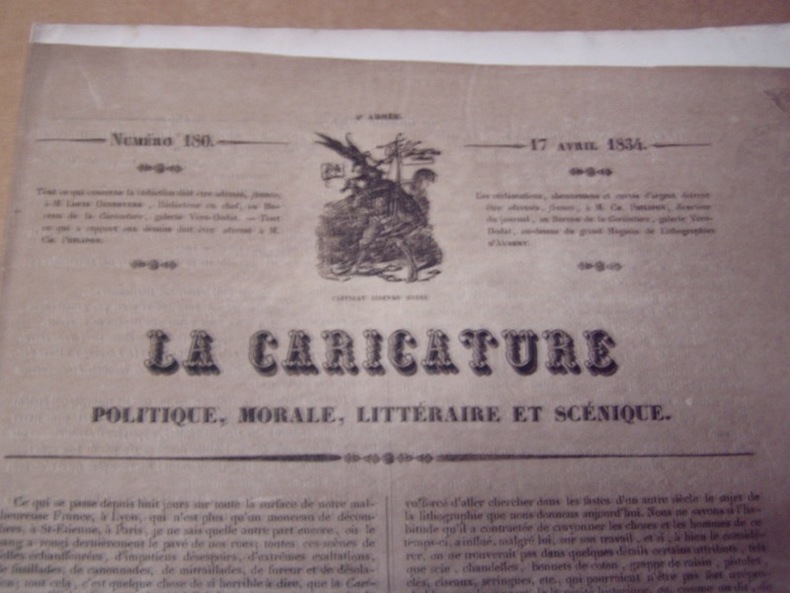
1834244121834 La Caricature. Journal. Morale, Religieuse, Littéraire, Scénique - La Caricature ( Journal) No. 180, planche double -plate 378–9. [Paris] Delaunois for Maison Aubert, 17 April 1834. Lithograph. Overall paper size 32.6 × 40.9 cm. Horizontal and vertical fold.Caricature of the July Monarchy’s repressive measures against workers’ uprisings in Lyon and Paris, the so-called ‘April insurgents’. Louis-Philippe is compared to the late mediaeval king Louis XI, notorious for his cunning and cruelty. The print represents a pseudo- mediaeval execution scene with Liberty in a white dress and red cap standing in front of the gallows flanked by jailors. Louis-Philippe wearing a helmet with chain-mail is shown from behind standing on top of the dungeons of Ste Pelagie giving final instructions. To the left, lecherous monks and gloating courtiers are looking on; to the right a moustachioed Talleyrand dressed as a cardinal is in attendance with other ministers in ancient dress or armour. His surgical shoe is wrongly shown on his left foot. Armed mounted guards and a large fortress in the background complete the scene.
1834259881834 La Caricature. Journal. Morale, Religieuse, Littéraire, Scénique - La Caricature ( Journal) No. 180, planche double -plate 378–9. [Paris] Delaunois for Maison Aubert, 17 April 1834. Lithograph. Overall paper size 32.6 × 40.9 cm. Horizontal and vertical fold.Caricature of the July Monarchy’s repressive measures against workers’ uprisings in Lyon and Paris, the so-called ‘April insurgents’. Louis-Philippe is compared to the late mediaeval king Louis XI, notorious for his cunning and cruelty. The print represents a pseudo- mediaeval execution scene with Liberty in a white dress and red cap standing in front of the gallows flanked by jailors. Louis-Philippe wearing a helmet with chain-mail is shown from behind standing on top of the dungeons of Ste Pelagie giving final instructions. To the left, lecherous monks and gloating courtiers are looking on; to the right a moustachioed Talleyrand dressed as a cardinal is in attendance with other ministers in ancient dress or armour. His surgical shoe is wrongly shown on his left foot. Armed mounted guards and a large fortress in the background complete the scene.
R320100668A COMPTE D'AUTEUR. NON DATE. In-Folio. En feuillets. Bon état, Couv. convenable, Dos satisfaisant, Intérieur frais. UNE ESTAMPE ORIGINALE de dimension 46 Cm X 31 Cm environ incluant les bordures - Dimension hors bordures : 32 C m X 20 Cm environ. // Epreuve signée en bas à gauche, annotée EA à droite , au crayon a papier.. . . . Classification Dewey : 769-Estampes
A COMPTE D'AUTEUR. NON DATE. In-Folio Carré. En feuillets. Bon état. Couv. convenable. Dos satisfaisant. Intérieur frais. UNE ESTAMPE ORIGINALE de dimension 46 Cm X 31 Cm environ incluant les bordures - Dimension hors bordures : 32 C m X 20 Cm environ. // Epreuve signée en bas à gauche, annotée EA à droite , au crayon a papier.
HD-076o.J. (Die Gelüste einer Schwangeren). Lithographie, auf chamoisfarbenem Velin, mit den Adressen: Chez Bauger R du Croissant 16, sowie: Imp. d?Aubert & Cie. Blattgröße 34:26,4 cm. ? Mit Heftspuren am linken Rand, gering fleckig, linke untere Ecke fehlt teilweise. Literatur: Daumier-Register 638; Delteil 638. No.15 der Folge ?Moeurs Conjugales?, erschienen 2./3.11.1839 in ?Le Charivari?. ? Sur blanc!
HD-224o.J. Lithographie, auf chamoisfarbenem Velin, mit den Adressen: Chez Aubert & Cie. Pl. de la Bourse,29 Paris., sowie: Imp. de Me.Ve.Aubert, 5, rue de l'Abbaye,Paris. Darstellungsgröße 24,5:20,8 cm, Blattgröße 36:27,5 cm. Literatur: Daumier-Register 2112 II (von 2); Delteil 2112 II (von 2), Blatt Nr. 139 der Serie ?ACTUALITÉS.?, erschienen 02.06.1851 in ?LE CHARIVARI?. ? Sur blanc!
- Lucien Vogel éditeur, Paris Février 1913, 19x24,5cm, une feuille. - Original color print, printed on vergé paper, signed in the plate. An original print used to illustrate the Gazette du bon ton, one of the most attractive and influential 20th century fashion magazines, featuring the talents of French artists and other contributors from the burgeoning Art Deco movement. A celebrated fashion magazine established in 1912 by Lucien Vogel, La Gazette du bon ton appeared until 1925, with a hiatus from 1915 to 1920 due to the war (the editor-in-chief having been called up for service). It consisted of 69 issues printed in only 2,000 copies each and notably illustrated with 573 color plates and 148 sketches of the models of the great designers. Right from the start, this sumptuous publication "was aimed at bibliophiles and fashionable society," (Françoise Tétart-Vittu, "La Gazette du bon ton", in Dictionnaire de la mode, 2016) and was printed on fine vergé paper using a type cut specially for the magazine by Georges Peignot, known as Cochin, later used (in 1946) by Christian Dior. The prints were made using stencils, heightened in colors, some highlighted in gold or palladium. The story began in 1912, when Lucien Vogel, a man of the world involved in fashion (he had already been part of the fashion magazine Femina) decided, with his wife Cosette de Brunhoff - the sister of Jean, creator of Babar - to set up the Gazette du bon ton, subtitled at the time: "Art, fashion, frivolities." Georges Charensol noted the reasoning of the editor-in-chief: "'In 1910,' he observed, 'there was no really artistic fashion magazine, nothing representative of the spirit of the time. My dream was therefore to make a luxury magazine with truly modern artists...I was assured of success, because when it comes to fashion, no country on earth can compete with France.'" ("Un grand éditeur d'art. Lucien Vogel" in Les Nouvelles littéraires, no. 133, May 1925). The magazine was immediately successful, not only in France but also in the United States and Latin America. At first, Vogel put together a team of seven artists: André-Édouard Marty and Pierre Brissaud, followed by Georges Lepape and Dammicourt, as well as eventually his friends from school and the School of Fine Arts, like George Barbier, Bernard Boutet de Monvel and Charles Martin. Other talented people soon came flocking to join the team: Guy Arnoux, Léon Bakst, Benito, Boutet de Monvel, Umberto Brunelleschi, Chas Laborde, Jean-Gabriel Domergue, Raoul Dufy, Édouard Halouze, Alexandre Iacovleff, Jean Émile Laboureur, Charles Loupot, Chalres Martin, Maggie Salcedo. These artist, mostly unknown when Lucien Vogel sought them out, later became emblematic and sought-after artistic figures. It was also they who worked on the advertising drawings for the Gazette. The plates put the spotlight on, and celebrate, dresses by seven designers of the age: Lanvin, Doeuillet, Paquin, Poiret, Worth, Vionnet and Doucet. The designers provided exclusive models for each issue. Nonetheless, some of the illustrations are not based on real models, but simply on the illustrator's conception of the fashion of the day. The Gazette du bon ton was an important step in the history of fashion. Combining aesthetic demands with the physical whole, it brought together - for the first time - the great talents of the artistic, literary, and fashion worlds; and imposed, through this alchemy, a completely new image of women: slender, independent and daring, which was shared by the new generation of designers, including Coco Chanel, Jean Patou, Marcel Rochas, and so on... Taken over in 1920 by Condé Montrose Nast, the Gazette du bon ton was an important influence on the new layout and aesthetics of that "little dying paper" that Nast had bought a few years earlier: Vogue. [FRENCH VERSION FOLLOWS] Estampe originale en couleur, tirée sur papier vergé et signée en bas à gauche de la planche. Gravure originale réalisée pour
191389475Paris Février 1913 | 19 x 24.50 cm | une feuille
18037Anima Mundi , coll. La chair du temps, 1990, 14.5x18,5 cm , feuillets sous jaquette papier, bon état. Édition originale d'un texte de Lionel Bourg accompagné de deux estampes de Raphaël Kleweta, un des 40 exemplaires sur papier vélin d'Arches 200 g enrichis de deux gravures originales de Kleweta, ex hors commerce. Signatures de l'auteur et du graveur. Bel ouvrage.
HD-244o.J. EINE NÜTZLICHE ANWENDUNG DES MAGNETISIERENDEN DIAMANTEN. Meine Frau ist hypnotisiert... ich kann mich beruhigt zum Opernball begeben.... Schlaf gut meine Liebe! Lithographie, auf chamoisfarbenem Velin, mit den Adressen: Maison Martinet,172 r.Rivoli et 41,r.Vivienne, sowie: Lith. Destouches,28,r.Paradis Pre.Paris. Darstellungsgröße 21:26,6 cm, Blattgröße 26:33 cm. Literatur: Daumier-Register 3230 III (von 3); Delteil 3230 III (von 3), Blatt 140 der Serie ?ACTUALITÉS?, erschienen 24.01.1860 in ?LE CHARIVARI?. Exemplar des ?Album des Charges du Jour? ? Sur blanc!
186513287Charles Jacque 1813-1894. Eau-forte originale sur Chine appliqué parue chez Delâtre. Encadrée Très bon Paris Delâtre 1865 23 x 32 cm
1637325X36 cm.
IN HEBREW AND ENGLISH. 24X17.5 cm. 137 pages. Hardcover. In good condition.
CA06AA-00015Gemor Press. Collectible - Acceptable. New York: Gemor Press 1944. 2nd edition. 8vo Hardcover. 86pp. B/W illustrations. Fair book. Some edgewear. Front hinge cracked. short stories american american fiction Inquire if you need further information. Gemor Press hardcover
19443114833Near Fine with no dust jacket. 1944. Second Edition; Second Printing. Hardcover. Second printing. Though not called for SIGNED by Anais Nin on front end-paper. Close to fine in pictorial boards in supplied chipped un-printed acetate protective cover. Neat book shop sticker at base of rear pastedown. 86pp. One of 800 copies. Nicely preserved copy. ; 4 3/4" x 8 1/2"; 86 pages . hardcover
19691227529München, Prestel, (1969). 4to. 272 S. m. 146 Taf. OLwd m. OUmschl. (Umschl. m. geringen Randläsuren).
63186E-075. Very Good. Hardcover. Hardcover. 4to. Published by Pied Oxen Printers Hopewell NJ 2002. This is copy number 73 of the Limited edition of 125 copies. Illustrated with 2 intaglio plates. Signed by Paul Muldoon on the half title page and Diarmuid Delargy on the intaglio plates and the printer David Sellers on the limitation page. Bound in original green Asahi cloth printed paper labels on spine and upper cover printed on Somerset Book Wove soft white the prints on Somerset Textured. Boards have light shelf-wear present to the extremities. No ownership marks present. Text is clean and free of marks. Binding tight and solid. 'Unapproved Road' is a masterpiece. For one so long and falsely charged with emotional evasiveness Muldoon will survive as one of our laureates of marriage and fatherhood. Paul Muldoon born 20 June 1951 is an Irish poet. He has published more than thirty collections and won a Pulitzer Prize for Poetry and the T. S. Eliot Prize. At Princeton University he is currently both the Howard G. B. Clark '21 University Professor in the Humanities and Founding Chair of the Lewis Center for the Arts. He held the post of Oxford Professor of Poetry from 1999 to 2004 and has also served as president of the Poetry Society UK and Poetry Editor at The New Yorker. EB; 8vo 8" - 9" tall . hardcover