10 867 résultats
Zeichentusche auf Papier (Blattmaß 485:295 mm). Unter Passepartout (615:430 mm). Die schöne Dedikationszeichnung zeigt Apoll, auf eine geborstene Schrifttafel weisend. Auf derselben findet sich ein 21zeiliges kalligraphiertes Festgedicht: "Apollo spielt, die Gegend hört | Den Wunderklang der reinen Leyer; | Mir ist kein gleiches Glück beschert, | Ich lodre nicht in gleichem Feuer, | Nur Ehrfurcht ist's und wahre Treue | Die ich der Grosen Fürstin weyhe | [...]". Der Steinblock, auf dem Apolls Leier ruht, trägt außerdem eine 15zlg. Widmung "Der Durchlauchtigsten Fürstin und Frau, Frau Charlotten Amalien, Herzogin zu Sachsen, Jülich, Cleve und Berg auch Engern und Westphalen, Landgräfin zu Thüringen, Marggräfin zu Meissen, gefürsteten Gräfin zu Henneberg, Gräfin zu der Marck und Ravensberg, Frau zu Ravenstein, gebornen Landgräfin zu Hessen, Fürstin zu Hersfeld, Gräfin zu Katzenelnbogen, Diez, Ziegenhain, Nidda, Schaumburg und Hanau, auch Sayn und Witgenstein [...]"; am Schluß der Widmung vom Gratulanten Heinrich David Trinks in millimeterhoher Schrift signiert. Das Motiv von etwas Pflanzenstaffage eingerahmt; im Hintergrund ein Monopteros. Außerhalb des Rahmens vom sonst nicht nachgewiesenen Zeichner signiert: "Calamo delin." (nicht im AKL). - Charlotte Amalie (1730-1801) war die Tochter des Landgrafen Karl I. von Hessen-Philippsthal und seiner Gemahlin Christine von Sachsen-Eisenach. 1750 heiratete sie 20jährig den 43 Jahre älteren Herzog Anton Ulrich von Sachsen-Meiningen, dem sie in der verbleibenden Zeitspanne seines Lebens noch acht Kinder schenkte. 1763 übernahm sie als Vormund ihrer Söhne die Regentschaft im Herzogtum, das finanziell und wirtschaftlich völlig ruiniert war. Aufgrund ihrer straffen Reformen und Sparmaßnahmen, ihres wirtschaftlichen Wiederaufbaus und ihrer Förderung des geistigen Lebens gilt sie als "Retterin des Herzogtums". Die beliebte und volksverbundene Herzogin wurde nicht in der Fürstengruft, sondern gemäß ihrem Wunsch auf dem städtischen Friedhof begraben. - Hübsche Zeichnung als Jubiläumsgabe, womöglich auch Vorzeichnung für einen Kupferstich.
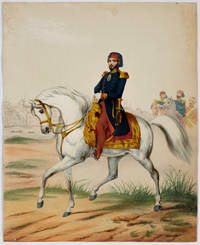
1840177838circa 1840-1850s. Pair of hand-coloured lithographs highlighted with gum arabic 32.2 x 25.1 cm trimmed spotting to the upper corners affecting the sky only paper adhesions on the verso but the images in very good bright condition. Two finely coloured lithographs one of a Turkish Sultan in military costume with the skyline of Constantinople in the background and another of lower rank perhaps issued in the period of the Crimean War. Trimmed and possibly from an album or scrapbook. . unknown
Unsigned, undated. 200 x 140 mm (leaf size: 275 x 215 mm). Pinel de Grandchamp, a student of Dubois and Picot, is counted among the foremost oriental painters of the 19th century. - A slight crease, with insignificant edge tear, at lower edge; slight duststaining. Thieme/Becker XXVII, 56. Bénézit VIII, 344.
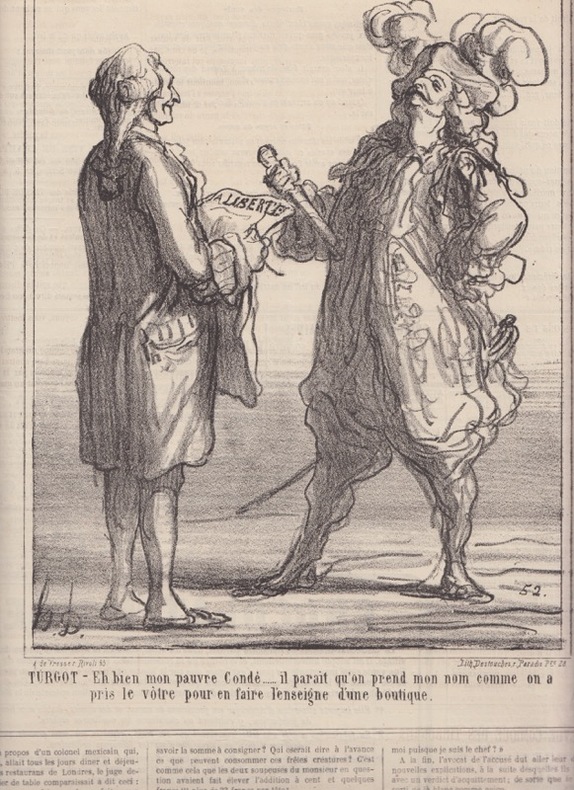
1867256641867 Le Charivari,1867 -Lithographie -- Œuvre: Hauteur: 43.8cmx Largeur: 30.8cm - Trait carré: Hauteur: 26.3cmx Largeur: 20.5cm ; illustration page 3.- Au dessus de l'image, centré : "ACTUALITES" ; et à droite : "214" ; signature en bas de l'image à gauche : "h.D." ; en dessous de l'image à gauche : "A. de Vresse R. Rivoli, 55" ; en dessous de l'image à droite : "Lith. Destouches r Paradis Pre 28" ; en dessous, centré : "TURGOT - Eh bien mon pauvre Condé... il parait qu'on prend mon nom comme on a / pris le vôtre pour en faire l'enseigne d'une boutique"- texte imprime au dos,bon etat.-
270x200 mm. Unpaginated. Hardcover. Pen inscription on rear whitepage. Pages yellowing. In good condition.
445Lithograph from Views of Paris. c. 1840. Lithographs with hand-coloring. With stamp of publishers Goupil & Cie. editeurs. Image: 6¾ x 10¾. Margins: 11 x 16¾. unknown books
445Lithograph from Views of Paris. c. 1840. Lithographs with hand-coloring. With stamp of publishers Goupil & Cie. editeurs. Image: 6¾ x 10¾. Margins: 11 x 16¾. unknown
HD-075o.J. (Du beklagst Dich wirklich immer, nie bist Du zufrieden). Zeitgenöss. aquarellierte Lithographie, auf chamoisfarbenem Velin, mit den Adressen: Chez Bauger R du Croissant 16, sowie: Imp. d?Aubert & Cie. Blattgröße 34,9:26 cm. ? Papier gebräunt. Literatur: Daumier-Register 631; Delteil 631. No. 8 der Folge ?Moeurs Conjugales?, erschienen 22.10.1839 in ?Le Charivari?. ? Sur blanc!
3971897. Lithograph. From the suite "Chansons des femmes" in which there were 15 images of women represented. Crauzat 189. Image: 7 x 5. unknown books
3971897. Lithograph. From the suite "Chansons des femmes" in which there were 15 images of women represented. Crauzat 189. Image: 7 x 5. unknown
- Lucien Vogel éditeur, Paris Mars 1914, 19x24,5cm, une feuille. - Original color print, printed on vergé paper, signed in the plate. An original print used to illustrate the Gazette du bon ton, one of the most attractive and influential 20th century fashion magazines, featuring the talents of French artists and other contributors from the burgeoning Art Deco movement. A celebrated fashion magazine established in 1912 by Lucien Vogel, La Gazette du bon ton appeared until 1925, with a hiatus from 1915 to 1920 due to the war (the editor-in-chief having been called up for service). It consisted of 69 issues printed in only 2,000 copies each and notably illustrated with 573 color plates and 148 sketches of the models of the great designers. Right from the start, this sumptuous publication "was aimed at bibliophiles and fashionable society," (Françoise Tétart-Vittu, "La Gazette du bon ton", in Dictionnaire de la mode, 2016) and was printed on fine vergé paper using a type cut specially for the magazine by Georges Peignot, known as Cochin, later used (in 1946) by Christian Dior. The prints were made using stencils, heightened in colors, some highlighted in gold or palladium. The story began in 1912, when Lucien Vogel, a man of the world involved in fashion (he had already been part of the fashion magazine Femina) decided, with his wife Cosette de Brunhoff - the sister of Jean, creator of Babar - to set up the Gazette du bon ton, subtitled at the time: "Art, fashion, frivolities." Georges Charensol noted the reasoning of the editor-in-chief: "'In 1910,' he observed, 'there was no really artistic fashion magazine, nothing representative of the spirit of the time. My dream was therefore to make a luxury magazine with truly modern artists...I was assured of success, because when it comes to fashion, no country on earth can compete with France.'" ("Un grand éditeur d'art. Lucien Vogel" in Les Nouvelles littéraires, no. 133, May 1925). The magazine was immediately successful, not only in France but also in the United States and Latin America. At first, Vogel put together a team of seven artists: André-Édouard Marty and Pierre Brissaud, followed by Georges Lepape and Dammicourt, as well as eventually his friends from school and the School of Fine Arts, like George Barbier, Bernard Boutet de Monvel and Charles Martin. Other talented people soon came flocking to join the team: Guy Arnoux, Léon Bakst, Benito, Boutet de Monvel, Umberto Brunelleschi, Chas Laborde, Jean-Gabriel Domergue, Raoul Dufy, Édouard Halouze, Alexandre Iacovleff, Jean Émile Laboureur, Charles Loupot, Chalres Martin, Maggie Salcedo. These artist, mostly unknown when Lucien Vogel sought them out, later became emblematic and sought-after artistic figures. It was also they who worked on the advertising drawings for the Gazette. The plates put the spotlight on, and celebrate, dresses by seven designers of the age: Lanvin, Doeuillet, Paquin, Poiret, Worth, Vionnet and Doucet. The designers provided exclusive models for each issue. Nonetheless, some of the illustrations are not based on real models, but simply on the illustrator's conception of the fashion of the day. The Gazette du bon ton was an important step in the history of fashion. Combining aesthetic demands with the physical whole, it brought together - for the first time - the great talents of the artistic, literary, and fashion worlds; and imposed, through this alchemy, a completely new image of women: slender, independent and daring, which was shared by the new generation of designers, including Coco Chanel, Jean Patou, Marcel Rochas, and so on... Taken over in 1920 by Condé Montrose Nast, the Gazette du bon ton was an important influence on the new layout and aesthetics of that "little dying paper" that Nast had bought a few years earlier: Vogue. [FRENCH VERSION FOLLOWS] Estampe originale en couleur, tirée sur papier vergé, signée en bas à droite de la planche. Gravure originale réalisée pour l'il
191454640Lucien Vogel éditeur | Paris Mars 1914 | 19 x 24.50 cm | une feuille
191484756Lucien Vogel éditeur | Paris Mars 1914 | 19 x 24.50 cm | une feuille
191489452Paris Mars 1914 | 19 x 24.50 cm | une feuille
1920900CGLauterbrunnen, F. v. Almen, um 1920. 6 farb. Illustr. von Emil Cardinaux. 6-teiliger Faltprospekt. + Wichtig: Für unsere Kunden in der EU erfolgt der Versand alle 14 Tage verzollt ab Deutschland / Postbank-Konto in Deutschland vorhanden +, Abb.
1920900CGLauterbrunnen, F. v. Almen, um 1920. 6 farb. Illustr. von Emil Cardinaux. 6-teiliger Faltprospekt.
HD-152o.J. Sehr demütige, sehr ergebene, sehr gehorchende... und vor allem sehr gefrässige Untertanen. Lithographie, auf chamoisfarbenem Velin, mit der Adresse: On s'abonne chez Aubert, galerie véro dodat.. Darstellungsgröße 20,6:32,7 cm, Blattgröße 24,8:35 cm. Mit geglätteter vertikaler Falte, im Unterrand beschnitten unter Verlust der zweiten Textzeile. Literatur: Daumier-Register 40 ? (von II); Delteil 40 ?, (von II), Blatt 136, erschienen am 09.02.1832 in ?LA CARICATURE?, Nr. 67. ? Sur blanc.
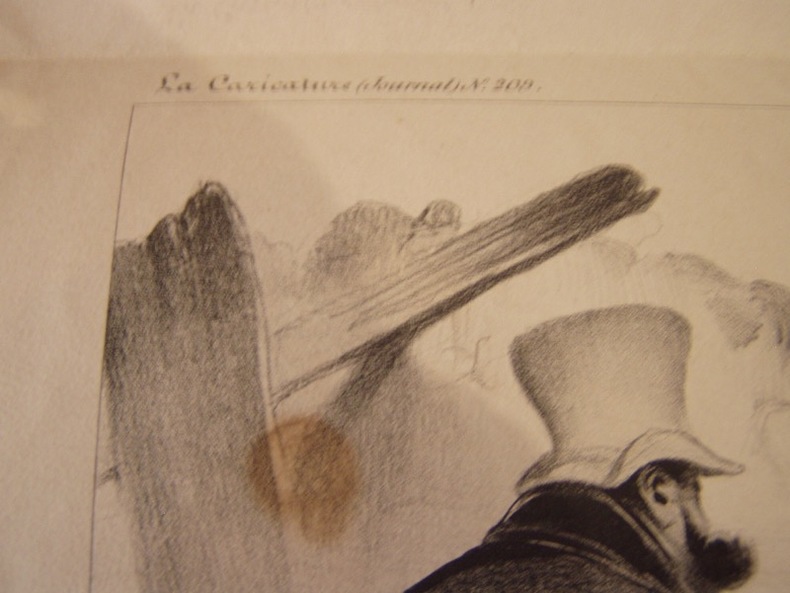
HD-009o.J. (Sehr gut, Sie haben Ihre Arbeit ganz ausgezeichnet getan. Man wird Sie gleich in Ihre neuen Gefängnisse in Beaulieu, Poissy oder Bicêtre überführen.). Lithographie, auf chamoisfarbenem Velin. Blattgröße 27,7:36,4 cm. ? Mit Alters- und Gebrauchsspuren, Einriß im Unterrand hinterlegt. Literatur: Daumier-Register 94; Delteil 94. ? Erschienen in ?La Caricature (Journal)?, 6.11.1834, No. 209, (Planche 437). ? Sur blanc! - Zur Darstellung: Das Blatt stellt politische Gefangene dar, die mitgeholfen hatten, ein Feuer in ihrem Gefängnis Saint-Michel zu löschen. Obwohl eine Amnestie bereits angekündigt war, wurden sie in ein neues Gefängnis verlegt. Zynisch dankt der König den Gefangenen bevor sie abgeführt wurden (siehe auch DR 225).
1834251211834 Planche 437 de La Caricature N° 209.La Caricature, 6 novembrebre 1834. Lithographie originale sur Velin blanc. . Delteil 94. épreuve en noir ; lithographie en noir sur velin blanc pli médian vertical,bon tirage bien noir,petite tache brune en marge - Delteil 94 ,
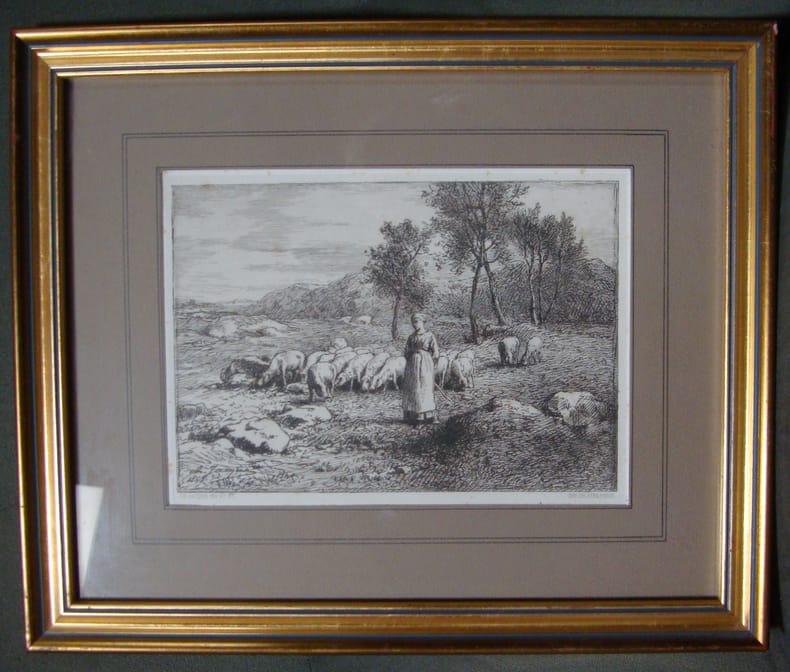
186513291Charles Jacque 1813-1894. Eau-forte originale sur Chine appliqué parue chez Delâtre. Encadrée Très bon Paris Delâtre 1865 23 x 33 cm
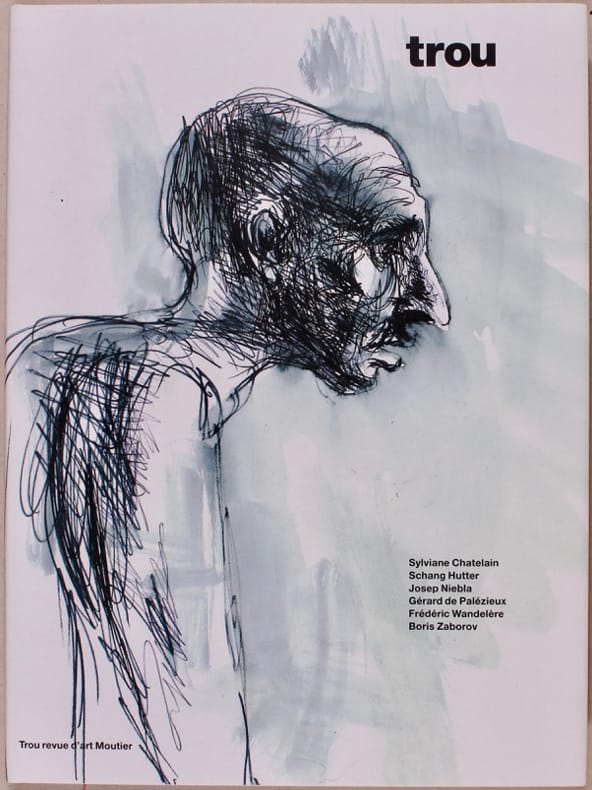
200521825Moutier, Association Trou, 2005. In-4 de 144 pages, relié en toile blanche, titre frappé en creux au premier plat, jaquette illustrée, étui.
UNIQUE single volume featuring only the plates from Pierre François Tissot's popular work "Trophées des Armées Français". The book, published around 1820, described the French victories during the French revolutionary wars, and was accompanied by b&w engravings made by the artist Edme Bovinet and F. L. Couché fils. These engravings, 70 in number, comprise this volume, and depict scenes of famous land and naval battles, sieges and conquests. The volume features no title page. The only text present in the book are the image captions, and the occasional mention of a famous general present in a battle. 150x230mm. Unpaginated (70 plates). Black quarter-cloth Hardocver. Cover and cover edges slightly worn. Cover corners bumped and peeling. Small sticker on front cover. Spine edges and front hinge peeling. Ornate stickers on both endpapers. Binding slightly loose, several plates partly loose from binding. Pages yellowing and age-stained. [SUMMARY]: Save for the aforementioned wear, this one of a kind volume featuring valuable engravings of the Napoleonic wars, is in good condition.
HD-070o.J. (DREI UHR. Monsieur Coquelet bei der Ordnungspolizei: er bewundert diese Einrichtung, die die kühnen Machenschaften korrupter Zeitgenossen ans Licht zerrt). Lithographie, auf chamoisfarbenem Velin, mit den Adressen: Imp. d?Aubert & Cie., sowie: Chez Bauger R du Croissant 16. Blattgröße 33:24 cm. ? Durchgehend stockfleckig, kleine Fehlstelle im Oberrand rechts, Quetschfalte im linken Rand oben. Literatur: Daumier-Register 615; Delteil 615, Blatt 9 (Zahl mit Bleistift hinzugefügt) aus der Serie ?La Journée du Célibataire?, erschienen 20.08.1839 in ?Le Charivari?. ? Sur blanc!
- Lucien Vogel éditeur, Paris 1921, 18x24cm, une feuille. - Original color print, printed on vergé paper, signed in the plate. An original print used to illustrate the Gazette du bon ton, one of the most attractive and influential 20th century fashion magazines, featuring the talents of French artists and other contributors from the burgeoning Art Deco movement. A celebrated fashion magazine established in 1912 by Lucien Vogel, La Gazette du bon ton appeared until 1925, with a hiatus from 1915 to 1920 due to the war (the editor-in-chief having been called up for service). It consisted of 69 issues printed in only 2,000 copies each and notably illustrated with 573 color plates and 148 sketches of the models of the great designers. Right from the start, this sumptuous publication "was aimed at bibliophiles and fashionable society," (Françoise Tétart-Vittu, "La Gazette du bon ton", in Dictionnaire de la mode, 2016) and was printed on fine vergé paper using a type cut specially for the magazine by Georges Peignot, known as Cochin, later used (in 1946) by Christian Dior. The prints were made using stencils, heightened in colors, some highlighted in gold or palladium. The story began in 1912, when Lucien Vogel, a man of the world involved in fashion (he had already been part of the fashion magazine Femina) decided, with his wife Cosette de Brunhoff - the sister of Jean, creator of Babar - to set up the Gazette du bon ton, subtitled at the time: "Art, fashion, frivolities." Georges Charensol noted the reasoning of the editor-in-chief: "'In 1910,' he observed, 'there was no really artistic fashion magazine, nothing representative of the spirit of the time. My dream was therefore to make a luxury magazine with truly modern artists...I was assured of success, because when it comes to fashion, no country on earth can compete with France.'" ("Un grand éditeur d'art. Lucien Vogel" in Les Nouvelles littéraires, no. 133, May 1925). The magazine was immediately successful, not only in France but also in the United States and Latin America. At first, Vogel put together a team of seven artists: André-Édouard Marty and Pierre Brissaud, followed by Georges Lepape and Dammicourt, as well as eventually his friends from school and the School of Fine Arts, like George Barbier, Bernard Boutet de Monvel and Charles Martin. Other talented people soon came flocking to join the team: Guy Arnoux, Léon Bakst, Benito, Boutet de Monvel, Umberto Brunelleschi, Chas Laborde, Jean-Gabriel Domergue, Raoul Dufy, Édouard Halouze, Alexandre Iacovleff, Jean Émile Laboureur, Charles Loupot, Chalres Martin, Maggie Salcedo. These artist, mostly unknown when Lucien Vogel sought them out, later became emblematic and sought-after artistic figures. It was also they who worked on the advertising drawings for the Gazette. The plates put the spotlight on, and celebrate, dresses by seven designers of the age: Lanvin, Doeuillet, Paquin, Poiret, Worth, Vionnet and Doucet. The designers provided exclusive models for each issue. Nonetheless, some of the illustrations are not based on real models, but simply on the illustrator's conception of the fashion of the day. The Gazette du bon ton was an important step in the history of fashion. Combining aesthetic demands with the physical whole, it brought together - for the first time - the great talents of the artistic, literary, and fashion worlds; and imposed, through this alchemy, a completely new image of women: slender, independent and daring, which was shared by the new generation of designers, including Coco Chanel, Jean Patou, Marcel Rochas, and so on... Taken over in 1920 by Condé Montrose Nast, the Gazette du bon ton was an important influence on the new layout and aesthetics of that "little dying paper" that Nast had bought a few years earlier: Vogue. [FRENCH VERSION FOLLOWS] Estampe originale en couleur, tirée sur papier vergé, signée en haut à droite de la planche. Gravure originale réalisée pour l'illustration de La
192154853Lucien Vogel éditeur | Paris 1921 | 18 x 24 cm | une feuille