8 723 résultats
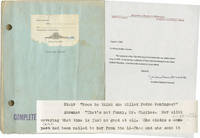
1935124528Beverly Hills CA: Metro-Goldwyn-Mayer MGM 1935. Dashiell Hammett's original submitted Treatment script for the first sequel to "The Thin Man" here referred to only as "Thin Man Sequel" and ultimately titled "After the Thin Man." With a single manuscript correction by Hammett and letter of provenance from Hammett's daughter Josephine Hammett Marshall regarding the discovery of the treatment in the family's estate. <br /> <br /> The first "Thin Man" film released in 1934 and based on Hammett's novel was a smash hit and is today a key film in the American screwball comedy cycle. Five sequels were made between 1936 and 1947 all starring the original acting team of William Powell and Myrna Loy and this previously unknown attempt at a sequel by Hammett was clearly commissioned by MGM but never produced making this script an entire unpublished Hammett work. The story is a completely original one never reworked for the other films very much written in Hammett's trademark style and reading a bit more like a story treatment i.e. a novel than a final screenplay which is likely as far as the story got on the road to production. <br /> <br /> The piece is dated Sept. 17 1935 at the lower right corner of the front panel along with Hammett's name and Hammett's name is noted in pencil next to the title label though not in Hammett's hand. There is only one single-word correction to the entire text at page 83 in Hammett's hand where the word "compact" is replaced with "cigarette case." <br /> <br /> Accompanying the screenplay is a typed letter signed from Hammett's daughter who edited a recently published collection of Hammett's letters on her personal stationery stating that the screenplay was discovered by Hammett's wife in 1980 and that it had been a part of the family's estate until that time. Probably one of only 2-3 copies that could have been produced and very possibly the only copy extant. To our knowledge no other copy of this story in any form has ever been recorded at auction or sold on the market. <br /> <br /> Light blue titled wrappers with the white MGM studio label present manuscript pencil notation of Hammett's name secretarial rubber-stamped COMPLETE dated September 17 1935 with a single credit for Hammett. 115 leaves mimeograph duplication. Pages and wrapper Very Good plus bound with two gold brads. In a custom clamshell box. <br /> <br /> Full pagination available upon request. Metro-Goldwyn-Mayer [MGM] unknown
142842N.p.: N.p. 1981. Handmade vernacular conceptual journal documenting the shooting of Robert Frank's 1981 film "Energy and How to Get It" circa 1980-1981. <br /> <br /> Includes tipped in ephemera drawings business cards and 46 Polaroids of Wurlitzer Robert Frank June Leaf and "Lightning" Bob. Annotations and captions throughout by Wurlitzer. Also included are 4 reference photos all likely unique from the shooting of the film: two showing both Wurlitzer and Frank one showing Wurlitzer and one of the "Enola Gay" aircraft in the film. <br /> <br /> Mead Memo notebook spiral bound. Green wrappers. 4.25 x 6 inches Very Good overall tipped in photos Near Fine. Reference photos 8 x 10 inches Near Fine. N.p. unknown
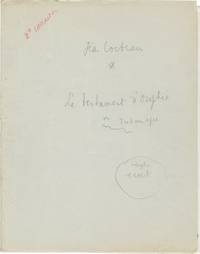
1958167441N.p.: N.p. 1958. Vintage ribbon copy typescript treatment for the 1960 French film. With substantive annotations in director Jean Cocteau's hand throughout noting deletions and amending dialogue. <br /> <br /> Full provenance available. <br /> <br /> The final film in Cocteau's "Orphic" trilogy following "The Blood of a Poet" 1930 and "Orphee" 1950. The only film in the trilogy featuring Cocteau himself as an aging poet who knows he is dying as indeed he was his greatest desire being to experience rebirth so that he can qualify for celestial immortality. <br /> <br /> With cameos by Pablo Picasso Charles Aznavour bullfighter Luis Miguel Dominguen and Yul Brynner. A few seconds of color are spliced in at one point a surreal effect used prior to this film in "Portrait of Jennie" 1948 and later in Samuel Fuller's "Shock Corridor" 1963. <br /> <br /> Having run out of funds in mid-production Cocteau was given money to complete filming by François Truffaut who used the prize money he had won at Cannes for "Les Quatre Cents Coups" 1959. <br /> <br /> Unbound housed in a gray paper folder. Title and Cocteau's name in manuscript pencil on the front of the folder. 31 leaves with last page of text numbered 28. Ribbon copy typescript on onionskin stock rectos only. Pages Fine unbound. N.p. unknown
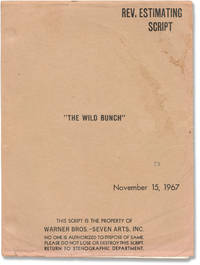
1967160830Burbank CA: Warner Brothers / Seven Arts 1967. Revised Estimating script for the 1969 Western film.<br /> <br /> Sam Peckinpah's classic revisionist Western of nearly inestimable importance and violence made at the peak of his career and which-along with "Straw Dogs" 1971-remains the lasting testament to his vision. A major contributor to the "end of the West" theme so prevalent of the genre in the 1970s and one of the earliest New Hollywood Westerns. <br /> <br /> Set in Mexico shot on location in Mexico and Spain. <br /> <br /> Beige titled Warner Brothers wrappers dated November 15 1967 noted as Rev. Estimating Script and stamped copy No. 75. Title page present dated 11/15/67 with credits for screenwriters Wallen Green and Sam Peckinpah and story credit for Roy Sickner. 125 leaves with last page of text numbered 123. Mimeograph duplication rectos only. Pages about Fine wrapper Very Good plus bound internally with two gold brads. <br /> <br /> National Film Registry. Ebert I. Hardy US. Pitts 4934. Rosenbaum 1000. Schrader Canon Fodder 28. Warner Brothers / Seven Arts unknown
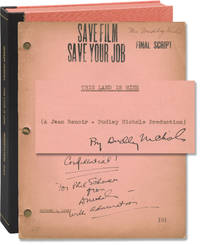
1942151348Santa Ana CA: RKO Radio Pictures 1942. Final Draft screenplay for the 1942 film. Copy belonging to legendary screenwriter Dudley Nichols inscribed by Nichols to Los Angeles Times film critic Phil Scheuer on the title page: "By Dudley Nichols / Confidential! / For Phil Scheuer from D. Nichols-with admiration." Nichols' ownership name is also in manuscript pencil at the top right corner.<br /> <br /> Renoir's second American feature an anti-fascist propaganda film following a meek schoolteacher in a German-occupied European country who is falsely accused of murder and forced to take a stand against the Nazis and their collaborators. <br /> <br /> At the peak of his career Nichols worked with many key Golden Age directors including John Ford George Cukor Howard Hawks Fritz Lang and of course Jean Renoir. He was a founding member of the Screen Writers Guild and is best remembered for "The Informer" 1935 for which Nichols won an Academy Award "Bringing Up Baby" 1938 "Stagecoach" 1939 "For Whom the Bell Tolls" 1943 "Scarlet Street" 1945 "And Then There Were None" 1945 "The Bells of St. Mary's" 1945 and "The Tin Star" 1957. He continued to write prolifically for film up until the time of his death in 1960. <br /> <br /> Housed in a custom quarter-leather clamshell box. <br /> <br /> Pink titled wrappers noted as FINAL on the front wrapper rubber-stamped copy No. 104 dated OCTOBER 2 1942 with credits for director Jean Renoir and screenwriter Dudley Nichols. Distribution page present with receipt removed. Title page integral with the front wrapper. 169 leaves with last page of text numbered 162. Mimeograph duplication rectos only. Pages Near Fine wrapper Near Fine bound with three gold brads. RKO Radio Pictures unknown
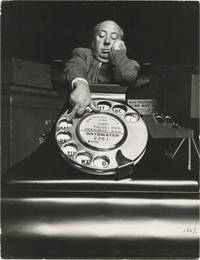
1954153634N.p.: N.p. 1954. Archive of five vintage borderless oversize photographs of director Alfred Hitchcock with various cast and crew members on the set of the 1954 film noir. Manuscript ink and pencil annotations to the verso including layout annotations "FILE" stamps and the stamp of photographer Sanford H. Roth. Four photographs with printed mimeo snipes affixed to the verso and four photographs with manuscript annotations noting their appearance in the May 24 1954 issue of Life magazine. <br /> <br /> Brooklyn-born photojournalist Sanford Roth was best known for his portrait photography capturing intimate and now iconic images of artists and actors throughout his decades-long career including Marc Chagall Joan Crawford Albert Einstein Henri Matisse and Elizabeth Taylor among many others. <br /> <br /> Based on the 1952 play by Frederick Knott who also wrote the screenplay about a tennis player who arranges to have his wife framed for murder after discovering her infidelity. The only Hitchcock film to be shot in 3D although the format would ultimately be discarded for theatrical release and the first of three Hitchcock films to feature actress Grace Kelly followed by "Rear Window" 1954 and "To Catch a Thief" 1955. <br /> <br /> One photograph features Hitchcock leaning over a giant rotary dial a prop made as a result of Warner Brothers' proprietary 3D camera rig. Hitchcock wanted the first shot of the film to feature a finger pressing the letter M on a rotary dial telephone but the specialized 3D camera was unable to focus the close-up correctly leading the director to order a giant finger made from wood and a proportionally large dial in order to achieve the effect. <br /> <br /> Four photographs 10 x 13.5 inches one photograph 9.5 x 13.5 inches. Lightly edgeworn else generally Near Fine. <br /> <br /> Grant US. Selby US. Spicer US. N.p. unknown
1949143058Tokyo: Film Art Association 1949. First Draft script for the 1949 Japanese film noir. Manuscript ink and pencil annotations from production on two leaves. Text in Japanese. <br /> <br /> Generally considered to be the greatest film noir made in Japan and hugely influential on American film noir of the 1950s and 1960s. <br /> <br /> White titled wrappers. 96 leaves with last page of text numbered 96. Mechanical duplication. Toning due to aging throughout wrapper split at spine with mild foxing otherwise Good condition. <br /> <br /> BFI 534. Criterion Collection 233. Grant Japan. Selby Japan. Spicer Japan Classic Noir. Film Art Association unknown