[Western Americana]Biblio.com
4 240 résultats
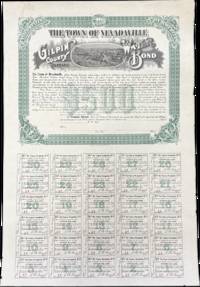
189979680Denver: The Denver Litho Co 1899. Engraved and printed in black green and red on thin cream stock 14 ¾†x 15 ½†this is bond number 54 unsigned. $500 six percent bond issued by the town of Nevadaville in Gilpin County to help fund a “gravity system of water worksâ€. The total issue was $20000 and the bonds’ mature date was 10 years. Includes 30 coupons valued at $15 each.<br /> <br /> Nevadaville was founded in 1859 and is now a gold mining ghost town. It was once one of the most important mining settlements in the area and originally part of the Kansas Territory. It grew to house the miners working the Burroughs lode and the Kansas lode and the population was predominantly Irish. The Denver Litho Co unknown
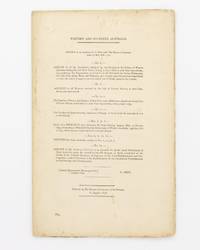
1838131290London: 'Ordered by the House of Commons to be Printed' 1838. Very Good. London 'Ordered by the House of Commons to be Printed' 1838. Foolscap folio 21 1 docket pages with numerous tables. Uncut and sewn as issued; outer pages slightly dusty; light foxing throughout; an excellent copy. Great Britain and Ireland Parliamentary Paper Number 685 of 1838. The bulk of this important paper pages 4-19 is given over to 'Nos. 5 6 7. Copy of a Despatch from Governor Sir James Stirling bearing Date 15 October 1835 forwarding a Memorial from the Inhabitants of Western Australia; together with a Copy of the Answer which has been returned thereto'. It is somewhat more than that. Stirling's covering letter explains that 'The signatures attached to this memorial . belong to about one-third of the adult male population of the settlement and represent also about one third of its property in land and capital. The grievances under which the memorialists consider themselves and their fellow colonists to labour are five in number'. The five grievances are well-aired; all signatories are identified; there are five pages of lists of lands reserved for public purposes individuals or 'Assigned to or Reserved for Civil Naval and Military Officers from commencement of the Colony in June 1829 to 6 October 1835'. The second and third lists provide name rank or situation where applicable number of acres district assigned or reserved - and when and remarks. A sample record for an individual is that pertaining to Robert Ramsay for whom an 'uncertain' number of acres was reserved at Plantagenet on 12 April 1831: 'Master of brig "Britannia". On south shore of Princes Royal Harbour reserved 18 months to form a whaling establishment and then resumed on failure of conditions'. The last four pages in this section contain Lord Glenelg's thoughts on the matter as of 7 March 1837. The limited information relating to the fledgling colony of South Australia occupies only pages 20 and 21. Ferguson 2511. <p>Provenance: the signature 'C.A.S. Hawker' is written in pencil at the head of the first page. Charles Allan Seymour Hawker 1894-1938 politician and pastoralist: his grandfather George Charles Hawker arrived in Adelaide with his brother Charles in September 1840. They settled on land at Bungaree near Clare in December 1841; C.A.S. Hawker he was born there. He was seriously wounded on several occasions at the Western Front losing one eye and 'his legs were in surgical irons to the end of his life'. He was a minister in the Lyons Government from 1932 until he 'was killed on 25 October 1938 when the aircraft "Kyeema" crashed into Mount Dandenong in Victoria. His untimely death was sharply felt. He had been an outstanding and respected figure in the Federal parliament whom some of his own party would have supported as prime minister. John Curtin the Opposition leader believed he had been on the threshold of great achievements' 'Australian Dictionary of Biography'. 'Ordered, by the House of Commons, to be Printed' unknown
182922252London: Baldwin and Cradock 1829. First edition. Hardcover. Good overall. Highly important early Western Australia content with report by Captain Stirling on his expedition to the Swan River undertaken in the year prior to the first settlement. A 7 page report from Captain Stirling's despatches describes the results of his 1827 expedition. <br /> <br /> Other topics include: The Netherlands: Progress of the Insurrection in Java; Russia: Hostilities with Persia renewed; Russia declares War against Turkey; Piracies in the West Indies; Account of Franklin's Second Journey to the shores of the Polar Sea; Present State of the Jews; Steam Boat; American Great Western Canal; and the First English Newspaper established in China.<br /> <br /> Single 8vo volume in two parts. The article appears at pp 510-517. Part I: viii 1 - 267pp 1; Part II: 545pp Index 11. Rebacked with the original leather spine laid down still quite rubbed and worn. Part of the original label loosely inserted inside paper label laid down at top of front board. Text clean and bright. Hard copy not found in Trove. Baldwin and Cradock hardcover
199359804Salem OR: Your Town Press & Edward Gray 1993. 4to. 6 222 pp. Numerous photos text illustrations maps. Embossed & decorated tan sheepskin gilt lettering on front cover & copper lettering on spine w/ brands in black on front cover F copy. First edition 1 of the 31 limited editions in special sheepskin binding but without presentation inscription or numbering of this fascinating work set in the desolate regions of Crook Deschutes Harney and Lake Counties at the end of the 19th century when Bill Brown was known as the Horse King of the Northwest. He owned the largest branded horse herds on the Pacific Coast and was caught between two factions in the Wagontire Mountain Range Feud employing at one time nearly all of the participants. Your Town Press & Edward Gray], unknown
199359803Salem OR: Your Town Press & Edward Gray 1993. 4to. 6 222 pp. Numerous photos text illustrations maps. Embossed & decorated beige cloth copper lettering on front cover & spine w/ brands on front cover F copy. First edition of this fascinating work set in the desolate regions of Crook Deschutes Harney and Lake Counties at the end of the 19th century when Bill Brown was known as the Horse King of the Northwest. He owned the largest branded horse herds on the Pacific Coast and was caught between two factions in the Wagontire Mountain Range Feud employing at one time nearly all of the participants. Your Town Press & Edward Gray], hardcover
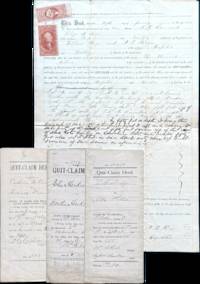
79363Four quit-claim deeds dating from the 1880s involving women in property transfers at a time when women’s property rights were severely restricted nationwide.<br /> <br /> A deed dated September 17 1885 recorded the purchase of a lot in Aspen by Mrs. Rilla Patten who paid $150 to J.C. Dodge for lot “L†in Block 99 in the town of Aspen. The city’s population exploded from 500 to 3500 between 1883 and 1885 reflecting the rapid development driven by the silver boom.<br /> <br /> On January 5 1865 Nanum Howe Rice and Eliza A. Rice husband and wife sold a "planing mill" and all its machinery in Denver Arapahoe County Territory of Colorado for $3000 to another party. He died in 1878.<br /> <br /> The additional deeds appear to show the sale and transfer of properties within families.<br /> <br /> On July 18 1887 another deed records the sale of mining property in Clear Creek County by Catherine M. Cowles for $1000 to Frederick Nelson. According to Ancestry records Nelson married Catherine K. Cowles in 1885. Her mother Catherine M Cowles died in 1884.<br /> <br /> On December 6 1883 John Hardenburgh sold to his wife Martha B. Hardenburgh an interest in several mining claims in Pitkin County Colorado and a lot in the town of Aspen for $1000. The couple was married in 1873 and she preceded him in death.<br /> <br /> Changes in property rights laws for women paved the way for these transactions. While still a territory Colorado adopted the Married Women's Property Act in 1861 which gave married white women the right to own property otherwise given to them. Before this time under coverture an English common law system married women could not own property control their wages be part of contracts and otherwise act autonomously to their husband's authority. Further in 1872 the Colorado Territory allowed any woman while married to “execute any bond bill promissory note or other instrument in writing for the direct payment of money; and if the consideration thereof went to the benefit of her estate.â€<br /> <br /> By 1900 most states allowed married white women to own property but access to credit and mortgages without a male co-signer was a barrier for all women not addressed until the 1970s. unknown
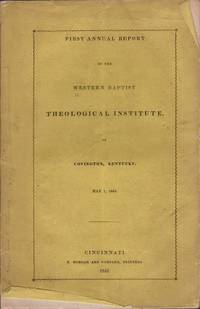
184333589Cincinnati: E. Morgan and Company Printers 1843. First Edition. Wraps. Good. Wraps. 22 pages. Yellow covers with printed title on the front wrap. Ex-institutional copy from the Western Reserve Historical Society with an embossed stamp on the title page. "Withdrawn" written in black over the stamp. Light soiling to the covers. Some margin marks in the text. A good copy. Scarce. 3 copies located in OCLC. Despite an excellent start the Western Baptist Theological Institute proved very fragile. The institute was established to serve western Baptist both those from the north and the south. The issue of slavery however divided the western Baptists from the very founding. Reverend Patterson the institute’s president also served on the National Board of Foreign Missions. This board published a number of articles indicating that slavery should not be tolerated in the Baptist faith. This association between Patterson and abolitionism caused much concern among the institutes southern trustees and students. On May 8 1845 Baptists delegates from the southern states met in Augusta Georgia and formally established the Southern Baptist Convention. This split would have grave consequences for the Western Baptist Theological Institute.<br /> <br /> Several southern members of the board of trustees asked Dr. Patterson to publicly state his opinions on abolitionism. He refused to do so. Instead Patterson left Covington and was replaced by Dr. S.W. Lynd. In 1848 a southern member of the board introduced a resolution that spoke of slavery as divinely inspired. The resolution was defeated. The four southern board members who voted for the resolution were undaunted. These members without consent of the rest of the board lobbied for the passage of a bill at the Kentucky General Assembly in Frankfort. The bill called for the appointment of 16 new members to the Board of the Western Baptist Theological Institute. In addition all future trustees were required to be Kentucky citizens. The bill became law.<br /> <br /> The northern members of the board were stunned by this obvious attempt to take control of the institute. They were particularly angry because most of the funds that had donated to the institute were donated by northerners and because most of the students were from the north. The northern members of the board fought to strike down the new law. Eventually the Kenton Court of Appeals declared the law null and void. The abolitionist controversy and the split between factions on the board took its toll on the institute. Donations plummeted along with the student enrollment. In 1855 the board decided to close the Western Baptist Theological Institute. Both factions agreed to a sale of all the property with the proceeds being divided equally.<br /> <br /> In August 1855 the Main building of the institute was sold to W. Scott. Mr. Scott operated a small female college and preparatory school in the building for several years. During the Civil War the hospital was utilized as a convalescent hospital for wounded Union soldiers. In 1867 the building was purchased by the Sisters of the Poor of St. Francis. The sisters relocated their St. Elizabeth Hospital to the site. St. Elizabeth Hospital occupied the building until 1914 when the current hospital was completed. In 1916 the main building of the Western Baptist Theological Institute was razed and Wadsworth Electric Company was built on the site. Ware Orie S. “Western Baptist Theological Institute†In the Papers of the Christopher Gist Historical Society Vol. I p. 43-49; James W.C. “A History of the Western Baptist Theological Institute†In the Collection of the KCPL; Licking Valley Register May 25 1842 p. 3 June 4 1842 p. 3 May 31 1845 August 23 1845 p. 1; Covington Journal August 24 1849 p. 3 November 22 1851 p. 2 August 12 1854 p. 2; Kentucky Post November 24 1916 p. 1. E. Morgan and Company, Printers unknown
1980016351South Sioux City Nebraska: Western Cartographers 1980. No Binding. Very Good. Large plat map of Cheyenne County Nebraska. Appears to date to 1980. Map is clean and in near fine condition. Affixed to a protective folder. Folder shows some wear and edge tearing not affecting the map. The date of '1980' is handwritten along the bottom edge of the front cover of the folder. The map measures 29 x 42 inches. It shows the property lines and names of owners excluding the city of Sidney and a few villages. No copies located in WorldCat institutions. Western Cartographers unknown
19007934Portage la Prairie Manitoba Canada: Palmer's Elite Studio Proprietor J. Thomas Palmer N.D. Circa 1900-1911. First Edition First Printing. Original Photograph on Mount. Original silver gelatin photograph measuring 14 cm x 7 cm mounted on its original thick textured black card-stock frame and housed within blind-stamped arabesque borders to an overall size of 33.5 cm x 13 cm. An utterly charming and highly uncommon pre-war group portrait capturing five young women most likely sisters arranged side-by-side in order of height. The eldest three sporting characteristic high-collared white blouses typical of the era with delicate lace trim and pin-tucks while the younger girls wear elaborately layered ruffled white dresses with large ribbon bows in their hair. Bears the stylized imprint of the rural Manitoba photography firm of "Palmer's Elite Studio Portage la Prairie Man." imprinted in silver-white cursive script to the lower-left margin of the mount. Captured and produced by the studios of Thomas J. Palmer a local photographer active in the rural locales of Gladstone MacGregor and the then growing City of Portage la Prairie between the years of 1900 and 1911. Exceptionally well-preserved retaining excellent clarity and sharp focus. Original mount remains equally without blemish. Near fine. Thoroughly lovely and charming turn-of-the-century group portrait. <br/><br/> Palmer's Elite Studio (Proprietor, J. Thomas Palmer) unknown
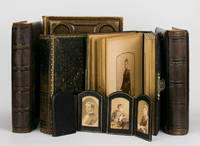
100720The photographs cartes de visite and cabinet cards depict Annie Griffith Roberts her first husband Dr James Hawkins her second husband Dr Edward Bruce Robertson and Oriana one of the children of the second marriage. The Robertsons came to Australia in 1887; Oriana married into the Moodie family of 'Wando Dale' Coleraine Victoria. Of primary importance are the approximately 50 portraits featuring prominent members of pioneering Western District pastoral families: the Camerons of 'Dunan'; the Edgars of Pine Hills; the Gardiners of Nangwary; the McConochies of Konongwootong; and the Trangmars of Burswood. The photographs are contained in five full-leather quarto albums and an attractive arch-topped six-panel folding panoramic frame for cartes de visite in full morocco. 6 items. unknown
191361776Tumalo & Portland OR: Bureau of Reclamation Olaf Laurgaard 1913-1915. Oblong folio. 14 x 9.25 in. 98 pp unpaginated. on thick black paper stock. First 60 pp. with 139 silver gelatin photographs tipped-in w/ black corners or mounted at two corners many w/ negative number w/in negative at lower fore-edge a couple w/ captions w/in negative nearly all w/ bright strong contrast a few w/ creasing from poor storage a couple w/ closed tears. Contemporary limp black cloth Housh Co. post-binder label on rear pastedown punch-sewn at gutter margin w/ black silk braid gilt lettering stamped on lower front cover corner minor edgewear sunning to fore-edges minor bumping to corners a few photos removed by family still a VG bright exemplar. These historic photographs trace the efforts to revive and expand a troubled irrigation system constructed largely by private enterprise from the end of the 19th-Century through to 1905 after the failed Carey Act project was taken over by the US Bureau of Reclamation and the State of Oregon. Unscrupulous land promotion companies and developers such as the Columbia Southern Irrigation Co. had acquired the rights to the Tumalo Creek water flow from the Three Sisters Irrigation Co. and local landowners with the Union Pacific claiming that 18000 acres were tillable but by 1905 less than 1000 acres were supplied with enough water and far too much settlement in the Upper Deschutes River Basin. Within five years Bend is incorporated Laidlaw later Tumalo is platted and unfortunately for the latter the railroad completes to Bend by 1912 bypassing Laidlaw and settlers were incensed. One of the photographs shows a “Good Roads†protest parade by Tumalo residents as they began urging the State of Oregon to improve connections to Tumalo and the roads. The State and Bureau of Reclamation draft noted Civil Engineer Olaf Laurgaard 1880-1945 and transfer him from Okanogan WA where he has been competing roadbuilding and irrigation projects in order to improve and enlarge the Tumalo Project irrigation and canal system as well as build a new reservoir and dam at Wimer Flat. The first part of the album focuses on the survey crews surveying the route the rugged terrain in the area with shots of camp tents hunting mess tents original holding ponds and reservoirs mill wheels falling apart with need for repairs and occasional side trips to the Deschutes River. In addition the Tumalo Project office and Laurgaard’s office building is shown the barn filled with project supplies and other town scenes. These are followed by engineering crews digging and expanding irrigation ditches and canals building wooden water flumes crossing fields and through steep canyons well-digging equipment to reach aquifers and horse teams grading earth with Fresno scrapers. By the close of the album the project is nearing completion wooden flumes stretch across grain fields irritation ditches such as the “Finished Ditch in Howard Canyon†appear in the images and Laurgaard and his crew survey several of the finished areas. Unfortunately even with the newly enlarged canal system and the new well-built dam the new Tumalo Reservoir failed to hold water. By the time this was fully realized Laurgaard had moved onto new projects and become the City of Portland Engineer by 1917. He is perhaps best remembered for construction of the Columbia Slouth drainage channel improving the Ross Island Bridge widening Sandy Blvd. and entirely upgrading and developing the decaying Portland municipal wooden docks and port areas with concrete piers and abutments. In the following decades the Tumalo Irrigation District failed with additional diversion dams and still more canals to the point that it was recommended to the Federal and State Governments to not expend further funds while the City of Bend continued to expand and buy up local Water Rights. Later in the 20th Century the Bureau of Reclamation rebuilt the dam and reservoir at Crescent Lake. The Library of Congress holds copies of 59 prints from the files at the Tumalo Irrigation District offices HAER OR-151 but with only a few overlaps in this album; this cataloguer could find no similar contemporary record; See: McLaughlin Ewing & Powers Report on the Agricultural and Economic Phases of the Deschutes County Municipal Improvement District â€Tumalo Project†1928; Tumalo Irrigation District About Us Our History 2024; Winch Tumalo Irrigation District Oregon Encyclopedia 2024. Bureau of Reclamation, Olaf Laurgaard, hardcover
63-2511Paris: Musee Du Louvre ca. 1890. Glossy Print of Black & White Photograph 27.5 x 22.5 cm. Good with marginal tears & some creasing. [Paris: Musee Du Louvre, ca. 1890?]. unknown
197828136St. Paul:: Minnesota Historical Society Press 1978. First Printing of the First US Edition. A Fine copy in a Very Good plus dust jacket with sunning to the spine and edges of the rear panel. Stephen Long was one of the most prolific explorers of the early 1800s. This volume describes two expeditions: one in 1817 up the Mississippi River to the Falls of St. Anthony; and a second in 1823 westward from Philadelphia to the Red River of the North down the Red and east along the old Canadian canoe route the Great Lakes and portions of the Erie Canal. Long's journals are especially valuable for their firsthand observations of the Midwest and its people in the early 1800s with references to many Indian peoples including the Assiniboine Dakota Iroquois Menominee Ojibway Osage Ottawa Potawatomi Sauk Winnebago and Yanktonai. Includes journals maps and correspondence pertaining to Long�s upper Mississippi explorations. Minnesota Historical Society Press, hardcover
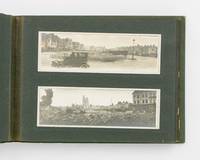
115314Very Good. Green buckram 193 × 253 mm stamped in blind 'Kodak Panorams' sic containing 36 gelatin silver panoramic photographs between 55 × 170 mm and 60 × 180 mm each loosely inserted two-to-a-page behind window mounts in specially-designed album leaves; 14 are captioned in pencil at the head of the print and 7 have a reference number between 67 and 83; many of the earlier photographs not featuring images of war are captioned on the verso in ink. Buckram slightly marked and rubbed; mild silvering-out to some prints; overall both the album and the photographs are in excellent condition. The heart of the album consists of 19 striking images of towns between Lens near Arras and Maurepas near Saint Quentin and the panoramic format of the photographs captures the horrifying extent of artillery damage. The towns identified in pencil on the images are Albert Lens Peronne Roye Villers Carbonnel Moreuil Souchez La Maisonnette Maurepas Bouchevesnes Combles and Hangard with a further identified view of the Canal du Nord. This area saw some of the heaviest fighting on the Western Front. Particularly noteworthy are three uncaptioned views of the destruction to the centre of Arras with these panoramas far more evocative than the ubiquitous snapshots. One image albeit poorly exposed shows a large homemade sign erected on the ruins of a church: 'Lens Veut Renaître' Lens Wants To Be Reborn. <p>Several of the early images in the album are also of interest. One shows a field hospital identified as 'Hôpital de campagne américain' almost certainly one of several run by the American Ambulance Volunteer Field Service present in France from the beginning of the war. Another shows an establishment at Notre Dame de la Mer almost certainly the Ecole nationale belge des mutilés de guerre near Port-Villez. <p> The other photographs are of the French Alps 1913; the baroque Château de Vaux-le-Vicomte near Melun four items 1914; a Paris streetscape 'Ce que l'on voyait en Juin 1915 du balcon de la chambre de Maman à Paris'; the Chateau de Brécourt three items 1915 including one with two women captioned 'Emma et Léonie dans la région de ma tranchée'; the Seine at Vernon two items 1915; and sepia-toned images of Mont Saint Michel and the shrine at Lourdes. unknown
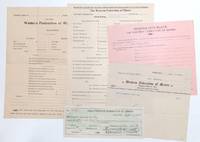
1915253479Denver CO: the Union 1915. Ephemera. Five documents including a blank form for a local's quarterly report 8.5x11 inches fold-creased; note at bottom says "Will send you the password for the ensuing quarter immediately upon receipt of your report ending March 31 1903" an unused form for a monthly report from 1915 a nomination blank for delegates to the AFL convention in 1915 a receipt to the Pony Montana local for purchase of 100 delinquent notices from 1910 and a check from that local to headquarters from 1913 fold-creased. the Union unknown
193912327JLos Angeles: Edward Small Productions 1939. First Edition. Original 165 page mimeographed shooting script with colored re-write pages for the western film starring Jon Hall Dana Andrews Lynn Bari Ward Bond Clayton Moore and Raymond Hatton. Bradbound in printed studio wrappers Very good. Rare. Edward Small Productions unknown
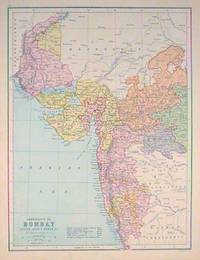
1880187528Edinburgh.: J. Bartholomew. circa1880s. Map 40.2 x 30.4 cms with printed colour and outline hand colour in very good condition. Handsome map with colonial interests attractively coloured. . J. Bartholomew unknown
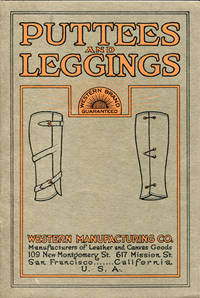
188241933N.P.: Privately printed 1882. 1882. TRADE CATALOG. First edition. 9" x 6" in brown pictorial wrappers showing an illustration of a puttee and legging. Title and border in orange ink. 15pp. Illustrations. Western Leather Company was a US Government Quartermaster's contractor from 1914 thru World Wars 1 & 2 Korean War and into the Vietnam War. During that time they manufactured holsters belts leggings and assorted GI pieces of leather and canvas. This pamphlet offers 15 pages of officer aviator motorcycle women's and civilian canvas leggings & leather puttees. Description colors offered and pricing for each piece. Light soiling to very top edge of all pages else near fine. Privately printed, 1882. hardcover
19642650Rollag Minnesota: Western Minnesota Steam Threshers Reunion Inc. 1964. Eighth Edition. Card Covers. pp. 116. Small 8vo. measuring 15.5 cm x 23 cm. Illustrated yellow thrice stapled card covers. Replete with black-and-white photographs illustrations and many advertisements for a variety of farm machinery goods et al. Comprises of a complete schedule of events a complete listing of the names of Officers Board of Directors Advertising Committee Book Committee Power Committee Entertainmen Committee and much else. No detectable flaws contents remain bright clean and unmarked with tight sound binding; near fine. <br/><br/> [Western Minnesota Steam Threshers Reunion, Inc.] unknown
19054623Pierre S.D. 1905. Very good. 12 leaves illustrated with twenty-nine photographs between 4.5 x 6.5 inches and 7.75 x 9.5 inches with some small format panoramas measuring 3.75 x 9.75 inches. Oblong folio. Contemporary black pebbled cloth gilt titles reading "Photo Views" on front cover. Minor wear to covers. Text block detached minor wear light staining to edges of some leaves otherwise clean internally. An early-20th century collection of mostly large-format photographs featuring scenes in Pierre South Dakota as well as the surrounding plains. Most of the photographs measure around 7 x 9 inches and feature the train depot in Pierre the Hughes County Courthouse a bridge over the Missouri River likely a Chicago and Northwest Railroad bridge and a spectacular image of a pair of Sioux / Crow Indians. Other photographs picture steamboats loaded with passengers ranching farming rock formations one with a lone horseman posed in front fishing a mill some family group images herds of cattle and a few shots of buffalo roaming on the open prairie. One of the latter photographs of a distant herd of buffalo on the plains is titled in the negative "The last one of the kind" and captioned at bottom right "Photo by Christensen." None of the remaining photographs are captioned with identifying information regarding the photographer but they are nonetheless well composed and professionally developed. The photographs are unusually large and more informative than most western photograph albums we have seen. unknown
19423662Various locations mainly Arizona Montana and Illinois 1942. Very good. 77 leaves illustrated with 617 original photographs from about 1.5 x 1 to 4 x 3 inches almost every page profusely annotated in white ink. Oblong folio. Contemporary faux-alligator brown leather string-tied. Edges and joints worn minor rubbing to covers. Compiler's ownership inscription on inside front cover reading "Property of Margaret E. Wells" with her address in Douglas Arizona. Occasional empty mounts minor wear to some photos but overall a very well-preserved collection. A densely-packed collection of annotated vernacular photographs documenting about a decade-and-a-half of an Arizona woman's life in the West and during various travels around the country in the early-20th century. Margaret E. Wells grew up on a ranch near Douglas Arizona which is well-represented in the photographs picturing various family members scenes around the exterior of the ranch house a shot of their school teacher Mrs. Wodham taking care of the livestock and more including Margaret as a younger child. There are also a healthy number of images around Douglas as well as other Arizona locations such as Cave Creek Ajo Grand Canyon National Park and Tombstone.<br /> <br /> As Margaret grows older the album records her travels taking her to numerous locations around the United States such as Yellowstone Park; Virginia City Montana; Bozeman Montana; campus views of Montana State College where she may have been a student for some time; desert scenes near Reno Nevada; the Chicago World's Fair in 1934; Long Beach California; San Francisco; Bryce National Park and Zion National Park in Utah; Washington; and Oregon. Some of the later photos show Margaret working at Spiegel Inc. and some of the last photographs document Margaret and her husband John with presumably their young child. Some of the more interesting images include Margaret and some of her companions dressed in "Mexican Sombreros" in Bozeman in 1927; two elevated shots of the town of Virginia City; a handful of shots of Wells' friend Buster "working on the railroad" in Arizona; and numerous shots of the various characters in a Spring 1939 rodeo in Douglas. A wide-ranging collection of annotated vernacular images recording about fifteen years in the life of a young Arizona woman in her home state as well as several other states before throughout and after the Great Depression. unknown
191642739N.P.: Van Noy Inter-State Co. n.d. ca 1916. 1916. 9" x 12" in colorful pictorial wrappers showing the Golden Gate at sunset on the front wrapper. Two pages of text explaining the subjects that are illustrated in the book followed by beautiful colored 6 1/2" x 8 1/2" full-page illustrations attached to one side of each page. Includes pictures in Utah Nevada and with several in California. Pictures include the Temple Square Saltair Pavillion the Great Salt Beds Feather River Gold Lake Feather River Inn Williams Circle Ben Lomond Peak Arch Rock the Great Western Power Company Plant Blue Gorge etc. Light shadowing to pages of text and with light soiling to wrappers. Very good plus. A very nice presentation. Van Noy Inter-State Co., n.d. [ca 1916]. unknown
19053538Copper River Valley Ak 1905. Very good. Forty-five printing-out paper photographs between 3.25 x 3.25 and 4 x 6 inches plus three real photo postcards. Minor wear a few creases occasional light soiling. A unique collection of almost fifty images capturing scenes in and around Copper Center in the Copper River Valley of Alaska in the years after gold was first found there in 1898. The images document pioneers panning for gold running dog sled teams posed in front of early wooden buildings in a bleak snow-covered landscape and more as well as capturing shots of a riverside mill a wooden bridge scenery on the Copper River and the majesty of the surrounding forests. A handful of the images capture pioneer women and children posed for the camera in winter clothing worn to combat the bitter Alaskan winters. One image pictures three men and two dogs standing outside the Hotel Holman an early Copper Center roadhouse that began in a tent but was opened in a wooden structure in 1899; the present image captures the post-1899 wooden structure. The Holman Hotel was established in July 1898 by Copper Center's first resident Andrew Holman in order to provide shelter for prospectors on their way to the Klondike gold fields. Copper Center is located northeast of Anchorage and served as a brief but important way station for gold prospectors in southeastern Alaska; one image here apparently pictures the early riverside settlement or is perhaps an early view of Anchorage. A rare view of Alaskan life in an uncommonly-seen settlement during the first decade of the 20th century. unknown
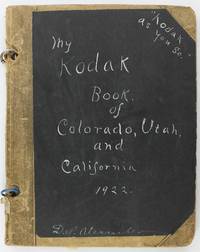
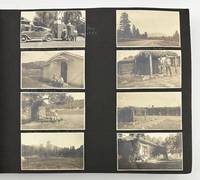
19223405Various locations in the American West 1922. Very good. Seventeen leaves illustrated with ninety-one photographs and four souvenir postcards extensively annotated in white ink on the album pages throughout. Contemporary tan two-ring cardboard wrappers front wrapper with black sheet laid down titles handwritten in white ink. Minor soiling rubbing and edge wear to boards. Minor fraying to some album leaves. A delightful homemade annotated vernacular photograph album compiled by D.S. Alexander memorializing his journey by automobile train and steamship through the American West and down the Pacific coast in August 1922. The album opens with a manuscript title page indicating the locations Alexander visited which included Manitou Peak Denver and Estes Park in Colorado; Salt Lake City and the Great Salt Desert in Utah; and several locations in California namely San Francisco Long Beach Hanford San Joaquin Valley and Sacramento. Manitou is the first location pictured followed by an elevated view and a few others of Denver and the surrounding landscape. He then travels west on the highway stopping in Loveland to visit a large dam and past Big Thompson Canyon on the way to Estes Park. In Utah he visits "Eagle Gate and Beehive House - Brigham Young's official residence" the Utah state house Pioneer Park and includes a couple of "Scenes from the Great Salt Desert in western Utah" on the train to California. In San Francisco he photographs Golden Gate Park and Alcatraz Island from a ferry boat before heading south on the steamship Yale. He includes several images on the shore at Long Beach as well as scenes at Sequoia Lake in Grant Park a vineyard in Kings County the Parker Ranch large trees in Grant Park and on the capitol grounds at Sacramento. Somewhat incongruously the final leaf of the album and the last three photographs pictures Alexander onboard a steamship on the Mississippi River in May 1923 on which he took an "excursion from Davenport to Muscatine Iowa." Ultimately the album is a wonderful and unique photographic snapshot of one young man's journey through Colorado Utah and California in the late summer of 1922. unknown
19353380Various locations in Colorado New Mexico Arizona Wyoming and Utah 1935. Very good plus. Seventy-four leaves illustrated with 485 photographs and picture postcards between 2 x 3 inches and 4.75 x 6.75 inches occasionally annotated in manuscript in white pencil. Oblong folio. Contemporary black textured cloth string tied. Small stain near right edge of front cover. Internally very clean and well organized. A voluminous collection of photographs picturing the lives and travels of Pat and Marge Williams centered on their ranch in Colorado. The images capture the landscape and buildings on the ranch both exterior and interior as well as the livestock grain fields and more. Several photographs capture farming activities including the harvesting of the alfalfa crop and the threshing of the wheat. The album also includes photos of the area around the ranch and within Colorado in places such as North Park Estes Park Cheyenne Plains Grand Lake and Fort Collins with images of Long's Peak Mary's Lake Spanish Peaks Big Fish Lake White River Trapper's Lake and others.<br /> <br /> The album also features locations visited by the compiler in the American West and Southwest with informative photos of Taos Mountain Cimarron Canyon Kit Carson's house the pueblos and ruins in Taos and Puye House Rock Valley Bryce Canyon Zion Canyon and other sites in New Mexico Arizona Wyoming and Utah. Some of the original photographs and postcards feature Native American subjects such as Native American women in Taos "Victoriano Sisneras and Wife" in Puye and Navajo rug weavers at work in Arizona. Other interesting images depict a "Hopi Watch Tower" in the Grand Canyon the Mojave Desert "Old Fort Bridger" in Wyoming "Dinosaur tracks near Tuba City" and the Colorado River Bridge at Lee's Ferry.<br /> <br /> The final eighteen leaves encompassing about ninety-six photos and postcards mostly the latter record numerous scenes in various locations in Mexico. A far-reaching collection of vernacular images and pictorial postcards capturing numerous locations in the American West and Southwest during the mid-1930s. unknown