47 058 résultats
Original Wraps for each issue, all bound into publisher's distinctive illustrated boards. 4to. [approx. 18 pages per issue]. 29 cm. Run of Kinder Zhurnal, Wrappers in various colors, almost always with beautiful period front cover illustrations and, internally, period modernist yiddish illustrations by artists including Aaron Goodelman. "Kinder zhurnal and Farlag Matones were both founded by the Sholem Aleichem Folk Institute, an organization established in New York in 1918 to coordinate a secular Yiddish school system. Kinder zhurnal, a children's magazine, was in existence from 1920 to 1981. Its first editor, Shmuel Niger, served from 1922 to 1948. The magazine published works by writers such as Mani Leib, Aleph Katz, Jacob Glatstein, Kadia Molodowsky. " - Guide to the Yivo Archives. For more, see Naomi Tozman's 1993 masters thesis, :Kinder zhurnal: a microcosm of the Yiddishist philosophy and secular education movement in America," which can be downloaded at https://escholarship.mcgill.ca/downloads/1c18dg573?locale=en. Subjects: Children's literature, Yiddish - Periodicals. Kinder Zhurnal Kinder Journal Kinder Zshurnal Sholem Aleichem Folks Shuln. Sholem Aleichem Folk Institute (New York, N. Y. ) . Yiddish periodicals - New York (State) - New York. Jews - Education - New York (State). OCLC: 179197128. Most libraries which have any issues at all appear to have limited runs, oftentimes only a year or two. Overall very clean and fresh, not aged, and well kept. Some wear to cloth on spine, internally very clean and nice, overall about Very good- condition. (YID-22-51-L-'e)
1st Yiddish edition. Original decorated boards. 8vo. 288, 309, 350, 485, 275, 402 pages [1834 pages total![, 23 cm. Title translates to The Deluge. Yiddish translation of Henryk Sienkiewicz masterpiece historical novel The Deluge. It was originally published as a trilogy in 1886 and tells a story of a fictional Polish-Lithuanian Commonwealth soldier and noble Andrzej Kmicic and shows a panorama of the Commonwealth during its historical period of the Deluge, which was a part of the Northern Wars (Wikipedia, 2019). SUBJECTS: Polish fiction -- Translations into Yiddish. OCLC lists 9 copies worldwide (OCLC:173031593). Ex-library with usual markings. Cloth on all volumes are lightly worn. Pages browning as expected with interwar paper, but not too bad. Overall good condition. (YID-33-52'elx)
899Paris, directeur Jules Brisson - 1883 (tome 1er), 2e semestre; 1884 (tomes 2 et 3), 1885 (tomes 4 et 5), 1886, 1887, 1888, 1889, 1890, 1891, 1892, 1893, 1894, 1895, 1896, 1897, 1898, 1899, 1900, 1901, 1902, 1903, 904, 1905, 1906, 1907, 1908 et 1909, 1er et 2e semestres - coll. complète de 1883 à 1909 - numérotation par tome entre 1883 et 1885; à partir de 1886, numérotation au semestre - in-folio - rel. demi-basane
18551160San Antonio: Adolf Douai 1855. Very good. 4pp. Large folio. Previously folded. Contemporary ownership inscription at head of title. Light foxing and creasing. A scarce December 1855 issue of this socialist abolitionist German Texas newspaper the San Antonio Zeitung "Ein sozial-demokratisches Blatt für die Deutschen in West-Texas." "The San Antonio Zeitung. began weekly publication as San Antonio's first German-language newspaper on July 1 1853 under the editorship of C. D. Adolph Douai a German-born scholar teacher and social reformer. The newspaper written largely in German was aimed at the large German population in San Antonio and the surrounding region. In a prospectus Douai announced that the Zeitung would regard every political question from the viewpoint of social progress. He published the free-soil platform adopted by the Texas State Convention of Germans in 1854 and in a series of editorials attacked the institution of slavery as an evil incompatible with democratic government a form of government that required "free tillers of their own soil. But many merchants fearful of being associated with the abolitionists withdrew their advertisements from the paper and several German communities passed resolutions publicly condemning it. Douai continued doggedly and in the February 9 1855 issue of the Zeitung went so far as to declare that western Texas must be free. In May 1856 with ill-feeling mounting and revenues on the decline he was forced to sell the paper. It was purchased by a member of the opposition Gustav Schleicher who took over the publication and renamed it the San Antonio Staats-Zeitung" - Handbook of Texas Online. The present issue published on December 15 1855 contains an article on the situation of Chinese immigration to California an account of Know-Nothing Party violence in Maine news on sectional and slavery issues from across the country entitled "The Separation of the Union" including reports on the ongoing saga in Kansas as well as several columns on news from Germany and copious advertising for German businesses in San Antonio and the surrounding area. OCLC locates only microfilm and digital holdings of the periodical though the source of the physical holdings appears to be UTSA. We locate no runs or single issues of the paper in archived sales records other than the present issue. A good example of this rare and important anti-slavery Texas newspaper. Adolf Douai unknown books
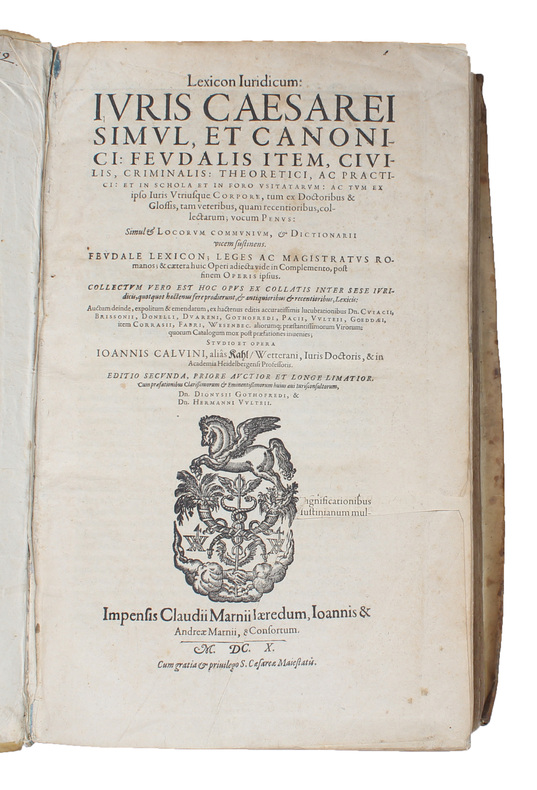
161048609(Franckfurt), Claudii marnii haeredum, Ioannis & Andrae marnii, & Consortum, 1610 Folio. Contemp. full vellum. Spine and covers with some brownspots. Name cut from titlepage, no loss of letters. (6) Ff, 2096,170 Columns. Damp stain to outer margin of last leaves and a few scatered brownspots. Internally clean.
187413085Kaupmannahöfn 1874-93 og Reykjavik 1894-1982. Bd. 1-76 indbundet i 16 smukke ensartede hldrbd.(årg. 1875-79 i optryk fra 1916). Bd. 77-108 i hefter. Med originale omslag.
187235132Kjøbenhavn, 1872-1903. Indbundet i 32 ensartede samtidige hldrbd. med rygforgyldning. Ryge på enkelte af de første bind repareret med tape. 1 kapitæl fornyet, 1 indre fals itu. Alle bind med en papirsetiket nederst på ryg påsat med tape. Foldeplancher til hvert bind. (kort, planer m.v.).
(Franckfurt), Claudii marnii haeredum, Ioannis & Andrae marnii, & Consortum, 1610 Folio. Contemp. full vellum. Spine and covers with some brownspots. Name cut from titlepage, no loss of letters. (6) Ff, 2096,170 Columns. A few scatered brownspots. Internally clean.
Kaupmannahöfn 1874-93 og Reykjavik 1894-1982. Bd. 1-76 indbundet i 16 smukke ensartede hldrbd.(årg. 1875-79 i optryk fra 1916). Bd. 77-108 i hefter. Med originale omslag.
Kjøbenhavn, 1872-1903. Indbundet i 32 ensartede samtidige hldrbd. med rygforgyldning. Ryge på enkelte af de første bind repareret med tape. 1 kapitæl fornyet, 1 indre fals itu. Alle bind med en papirsetiket nederst på ryg påsat med tape. Foldeplancher til hvert bind. (kort, planer m.v.).
49 fascicoli Fascicoli venduti singolarmente. Folio. pp. 8/fasc.. . Buono (Good). . . .
1903216146Kempten u. München, Kösel, 1903-72/73. Lwd., Hlwd. u. in Heften. Teils etwas angeschmutzt u. angerissen. Einige m. Rsign. u. St. a. Vors./Tit.
ORD-16821Nous proposons les années: 1882 (2e semestre), 1883, 1884, 1885, 1886, 1887 (complets) et 1888 (1er semestre). 12 volumes in-f° (275 x 378mm) cartonnages papier jaune imprimé et illustré en noir, dos lisses et muets toile noire (étiquette de date rajoutée), reliure éditeur. Chaque volume de 480 pages environs, nombreuses illustrations dans et hors texte. Non collationnés mais semblent complets. Ensemble en très bon état.
1962206873Berlin, Militärvlg. 1962-89. Es fehlt: Jg. 2 H. 2.
1847359371847 Ensemble de 26 livraisons reliées en un volume petit in-4, demi-vélin de l'époque, dos lisse. (Paris), en vente au bureau de la Revue Nationale (...), 1847-1848.
Ensemble de 26 livraisons reliées en un volume petit in-4, demi-vélin de l'époque, dos lisse. Edition originale de ce périodique bien complet, l'organe officiel des Bucheziens Les 26 livraisons, bien complètes de leur titre, sont précédées d’un faux-titre, d’un titre général et suivies d’une table. Buchez s'assura non seulement de la contribution de Jules Bastide alors directeur du puissant "National", mais aussi de ses disciples rapprochés dont Auguste Ott qui dirigea le journal, Feugueray, Cruveilhier, B. Rampal et Garnier-Pagès. Ce périodique était l’un des fers de lance des socialistes bucheziens de la période. Ils y développent leur projet économique, politique et social de démocratie chrétienne et posent les jalons pour l'organisation de la nouvelle société. D'abord adjoint de Garnier-Pagès à la mairie de Paris pendant la Révolution de 1848, puis élu représentant de la Seine, Buchez a été porté à la présidence de l'Assemblée (du 5 mai-6 juin) mais dut démissionner face à l'arrivée de la réaction politique qui suivit et fut contraint de cesser sa publication dès le 29 juin. (Cuvillier, 'Buchez et les origines du socialisme chrétien', bibliographie, n°25. Hatin, p. 379). Accroc à une des deux pièces de titre, quelques rousseurs. Bon exemplaire.
385645 livraisons réunies en un volume in-8 (209 x 139 mm), broché, couverture de papier marbré, 20 p.; 28 p.; 26 p., (1) p.; 28, (1) p.; (1) f. blanc, 19 p. Paris, Imprimerie Nationale [et l'imprimerie de la Société des jeunes français], l'An II (1793-1794).
Fine English Paperback. Pbo. Fine++. Roy. 8vo. (23 x 16 cm). articles in Turkish, French and German. 19 issues full set published in 4 years (1931-1935). When Kemal Atatürk closed all of masonic lodges in Turkish Republic, this periodical's publishing has ended. Extremely rare.
Very Good Persian Original wrappers. Folio. (33 x 25 cm) and some different sizes. In Persian with bilingual titles in English and Persian. A lot including 124 issues, published between July 30, 1991, to 1999. A lot including 124 issues of this rare Iranian satyric magazine "Gol Agha", which was the first such publication in post-revolutionary Iran, maintaining its dominance for more than two decades after its debut, adding monthly and annual editions as well as producing new generation of satirists and cartoonists. Kioumars Saberi Foumani, (1941-2004), also known by his pen name Gol-Agha, was an Iranian satirist, writer, and teacher. Saberi was born during the Second World War in Souma'eh Sara a city in Gilan Province. His father, originally from Rasht, worked for the Ministry of Economic Affairs and Finance. He was transferred to Souma'eh Sara in 1938 and then to Fuman in 1942 where he died a few months later. His mother, who was the daughter of a respected cleric and one of the few educated women in the city, taught the Quran after the death of her husband. His brother, who was 14 years older, had to leave school at the age of 15 to work to help with the family expenses. Education for Saberi was hard because of his family's poverty and he had to start working in a tailor shop after finishing his elementary education. He also worked in his brother's bicycle repair shop during elementary school and high school. He started high school education at his mother's insistence. At the age of 16, he gained entry to Sari's Agriculture teacher's college which only accepted one student from Fuman each year. He continued his college education and graduated in 1959. He worked as a teacher from 1959-1961. At the age of 20, he took his high school exams and received his high school diploma. He continued his education at the University of Tehran while working as a teacher. He achieved his bachelor of science degree in political science in 1965. He spent most of the 1970s reading and teaching and in 1978 he obtained his master's degree in comparative literature from the University of Tehran. Saberi got married in 1966 and he had a daughter and a son. His son died in a car accident in 1985 but this sad incident did not stop him from reaching his goal, which was to make people smile. Kioumars Saberi Foumani died on April 30, 2004. During his first year at university, Saberi was arrested for participating in student demonstrations and started to write political satire in Towfigh magazine. Towfigh magazine was Iran's most respected pro-democracy political satire magazine, with the highest circulation in Iranian history. Its editor-in-chief was Hossein Towfigh who, along with his brothers Hassan and Abbas, turned Towfigh magazine into the most influential journal in Iranian history. Saberi became one of the many staff writers of Towfigh magazine. After the Iranian Revolution, he became the cultural advisor for Mohammad Ali Rajai. One of his other political posts was as the counselor to the minister of Housing and Urban Development of Iran. Following the Revolution, Saberi worked in different political positions before deciding to leave politics. He was in charge of Roshde-Adabe-Farsi magazine and sometimes he wrote for the Ettelaat newspaper. He started a column called "Do-Kalame-Harfe-Hesab" in Ettelaat in 1984 which was a starting point for political satires after the revolution. He continued writing for this column for six years until he started his own magazine called Gol-Agha in 1990. His courageous and powerful writings were appreciated by many famous authors such as Mohammad Ali Jamalzadeh. Saberi received first prize in the press exhibitions of 1992 and 1994 and second prize in 1993. He stopped writing for Ettelaat in 1993. The main characters in his writings are Gol-Agha, Shagholam, Mamasadegh, Kamineh, The wife of Mamasadegh), Mash-Rajab, and Ghazanfar. In 2003 in his last editorial in Gol-Agha, Saberi announced that publishing Gol-Agha will be stop
- Revue mensuelle d'art et de littérature de N°1 au N°16, Paris Juin 1900 à Novembre 1901, 14,5x22,5cm, 17 volumes agrafés. - A complete set of this review, edited by Ernest Raynaud. The first six copies of this set are part of a de luxe edition printed in only 12 copies on Japan paper for each issue; the subsequent volumes, of which there were no de luxe copies issued by the publisher, are on ordinary paper. This set retains its 8 loose plates hors texte as called for, 7 of which are portraits. N° 14 (August 1901) was a special issue dedicated to the opening of the monument to Arthur Rimbaud at Charleville. Among the principle contributors were: Charles Cros, Francis Jammes, Jean Moréas, Charles Morice, Rachilde and Paul Verlaine. An extremely rare set. [FRENCH VERSION FOLLOWS] Collection complète de cette revue dirigée par Ernest Raynaud. Les six premiers exemplaires de notre série font partie d'une édition de luxe tirée à seulement 12 ex sur Japon pour chacun des volumes, les volumes suivants pour lesquels l'éditeur n'a jamais fait de tirage de luxe sont sur papier courant. Notre série est bien complète des 8 planches volantes hors-texte annoncées, dont 7 portraits. Le n°14 (août 1901), est un numéro spécial consacré à l'inauguration du monument d'Arthur Rimbaud à Charleville. Parmi les principaux collaborateurs : Charles Cros, Francis Jammes, Jean Moréas, Charles Morice, Rachilde et Paul Verlaine. Rarissime ensemble.
- Le sagittaire, Paris Juin 1900 à Novembre 1901, 16 volumes, agrafé. - A complete set of this review, edited by Ernest Raynaud. This set retains its 8 loose plates hors texte as called for, 7 of which are portraits. N° 14 (August 1901) was a special issue dedicated to the opening of the monument to Arthur Rimbaud at Charleville. Among the principle contributors were: Charles Cros, Francis Jammes, Jean Moréas, Charles Morice, Rachilde and Paul Verlaine. Extremely rare. [FRENCH VERSION FOLLOWS] Collection complète de cette revue dirigée par Ernest Raynaud. Notre série est bien complète des 8 planches volantes hors-texte annoncées, dont 7 portraits. Le n° 14 (août 1901), est un numéro spécial consacré à l'inauguration du monument d'Arthur Rimbaud à Charleville. Parmi les principaux collaborateurs : Charles Cros, Francis Jammes, Jean Moréas, Charles Morice, Rachilde et Paul Verlaine. De toute rareté.
- L'Ermitage, Paris Janvier-Juin 1898, relié. - Edition originale des 6 numéros du premier semestre 1898. Reliure en pleine percaline souple et gaufrée, couvertures des 6 fascicules conservées Contributions de René Boylesve, Françis Viélé-Griffin, Françis Jammes, Edouard Ducoté, André Gide, André Lebey, Georges Rodenbach, Henry Ghéon, Marcel Réja, Hugues Rebell, Yvanhoé Rambosson, Fiona Macleod entre autres. Illustrations de Lucien Lévy-Dhurmer, Paul Berthon, Richard Ranft, William Bradley, Henry Detouche, Edouard Münch, Jean Veber, Andhré des Gachons, Paul Andra, Paul Ranson entre autres. [ENGLISH DESCRIPTION ON DEMAND]
1834216265Leipzig, Brockhaus, 1834-42. Pp. Einbde. teils leicht beschabt. Teils St. a. Tit., teils herausgeschn., aber hinterlegter St. a. Tit. Fehlen: 3 Bibl.-Anz. Nr. 24; 11 Bibl.-Anz. Nr. 11; TI Bd. 10; 22 Bibl.-Anz. u. Allgem. Bibliographie.
- Martinon, Paris 1844, 25x32cm, relié. - Édition originale parue en 20 livraisons, illustrée de vignettes gravées sur bois dans le texte d'après Célestin Nanteuil, Français, Karl Girardet, Jules David, etc. et de 20 planches gravées sur cuivre ou lithographiées d'après Diaz, Decamps, Hazé, A. Guignet, E. Hedouin, Théodore Chasseriau, Alophe, Couture, etc. In fine sont reliées les couvertures de toutes les livraisons. Les couvertures des livraisons annoncent fautivement 30 gravures au lieu des 20 qui furent jointes. Reliure postérieure en demi-maroquin rouge de Russie à coins, dos à cinq nerfs richement orné, date dorée en queue, encadrement de filets dorés sur les plats de papier à la colle. Nombreux frottements et coins émoussés. Provenance : de la bibliothèque de Victor Mercier avec son ex-libris Art Nouveau gravé par Adolphe Giraldon. [ENGLISH DESCRIPTION ON DEMAND]
195042686BBBudapest, Publishers: Magyar Tudomanyos Akademia, 1950 - 2006. 52 Years in 43 Volumes. Private Hardcover-Bindings (Title Impression on the Spines), except Volume 50 (original flexible boards). Ex-Library-Copies. Library-Sticker on the Spines. Library-Stamp [dropped out] on Title of each Volume. Inside otherwise good Condition. No Markings in the Text! No Underlinings! No private Owner's Note! Covers on ly with minimal to small Signs of Usage.