Achenbach, J.D.; Norris, A. N. (Editors)Antiquariat.de

47 047 résultats
2012PRZS0285Amsterdam, North-Holland 1979 - 1991 / Elsevier 1991 - 2012. 4°. Pro Band ca. 400 S. m. zahlreichen s/w Abb., 45 priv. Halbleinenbände mit goldener Rückentitelprägung u. 18 OBrosch., ausgeschied. Bibl.-Expl. mit den üblichen Kennzeichnungen, sehr guter Zustand. Wave Motion is devoted to the cross fertilization of ideas, and to stimulating interaction between workers in various research areas in which wave propagation phenomena play a dominant role. The description and analysis of wave propagation phenomena provides a unifying thread connecting diverse areas of engineering and the physical sciences such as acoustics, optics, geophysics, seismology, electromagnetic theory, solid and fluid mechanics. The journal publishes papers on analytical, numerical and experimental methods. Papers that address fundamentally new topics in wave phenomena or develop wave propagation methods for solving direct and inverse problems are of interest to the journal.
- Le Passe-Temps, Ernest Bazard, Paris 1856-1864, 22,5x32cm, 8 volumes reliés. - Edition originale. Reliures en demi basane noire, dos lisses ornés de filets estampés à froid, pages de garde de papier à la cuve, reliures de l'époque. Nombreuses contributions, d'Alexandre Dumas (Le page du Duc de Savoie et Mémoires d'un policeman), de Emile de Nangis, Henry de Kock, Paul de Kock, Jules Janin, Charles Maquet, Luc Chardall, Frank Munzel, Elie Berthet, Louis Chazerain, Léon Beynet, Adrien Robert, Victor Perceval, A. de Gondrécourt, E. Gonzales, E. Bazard, Xavier de Montépin, Mme Ancelot, Léon Beauvallet, E. Capendu, Gustave Aimard, Marquis de Foudras, Edouard Devicque, Louis Digy, Philibert Audebrand, Albert Blanquet, Mortonval, Paul Duplessis. Ce journal prendra fin de 1893. Chaque numéro comporte une belle gravure sur bois en première page et d'autres in texte. A la fin de chaque numéro nous trouvons la rubrique "Contemporains en pantoufles" qui à travers les ans décrit presque toutes les personnalités de l'époque. Tables des matières et index des biographies manuscrits encollés sur les contreplats de chaque volume. Très rare ensemble de ce journal populaire dans un état de conservation remarquable. [ENGLISH DESCRIPTION ON DEMAND]
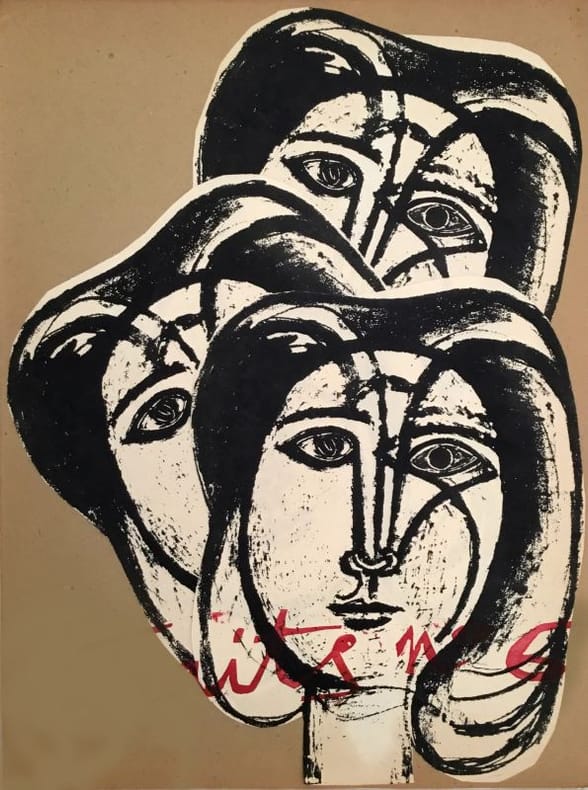
1947104416Paris 1947 10 Paris, Le cercle des arts de l'Union de la jeunesse républicaine de France, 1947-1952, formats et présentations divers.Publication artisanale, dirigée par F.Giusti, entièrement manufacturée par de jeunes artistes et des étudiants en art appartenant à v l'Union de la jeunesse républicaine de France proche du parti communiste français, TRAITS paraît à des dates difficiles à déterminer. Ses huit premiers numéros sont présentés dans des chemises aux couvertures illustrées notamment de bois gravés et de collages. Louis Aragon, Paul Colin, Gimond, Francis Jourdain, Fernand Léger, Marcel Lods, André Marchand, Matisse, Léopoldo Mendez, Henry Moore, Paul Nelson, Richard J. Neutra, Auguste Perret, Paul Eluard, Marcel Gromaire, Le Corbusier, Pablo Picasso, Candido Portinari, Marc Saint-Saëns y collaborèrent. (104416)
Very Good Turkish, Ottoman (1500-1928) Handsome fine contemporary brown half-leather bindings. Six raised bands to spine, title, and issue numbers gilt lettered, floral decorations in compartments. 4to. (30 x 24 cm). In Ottoman script (Old Turkish with Arabic letters) and French. All pages with illustrations in text or full-page illustrations, all numbers with an Islamic numbering system, reversed collation, with two title pages: Ottoman recto and in French verso, numbers 35, 41, 44, 45 with title pages in color. Rare poster is coming with the set inside the volumes as a supplement to the magazine. Extremely rare togetherness of the complete set of 130 issues of the Ottoman Turkish-French satirical magazine "Kalem", richly illustrated with thousands of attractive illustrations and cartoons, started its publication life with the end of Sultan Abdulhamid II's repression regime in 1908. The collection provides an invaluable resource, reflecting the changes in society after the Second Constitutional Revolution in New Ottoman State. The magazine was published weekly in 130 numbers between 21 August 1324 (3 September 1908) and 16 June 1327 (29 June 1911), starting immediately after the Second Ottoman Constitutional Revolution. The magazine was a mixture of satire and a saloon magazine, focusing on politics, social life, and revolution. The only continuously running part of the magazine was Haftalik Dedikodu (Weekly Gossip). The founders of the magazine were Salah (Selah) Cimcoz (1875-1947), a Turkish politician, lawyer, and owner of Kalem Newspaper, and Celal Esat Arseven (1876-1971) a Turkish painter, writer, and parliamentarian. He was the first to introduce the history of art and urbanistic architecture to Turkey. Duman 1080.; Only one complete copy survive in institutions worldwide in OCLC 472569754 (Bibliothèque nationale de France, BnF). (Source: References: Tobias Heinzelmann, Die Balkankrise in der osmanischen Karikatur).
1st edition. Period boards. 8vo. 416 pages, 25 cm. In Yiddish. Issues 1-52. Title translates to Literary Suppliment to the Workers Friend. Arbeter Fraynd was a London-based weekly Yiddish radical paper founded in 1885 by socialist Morris Winchevsky. After the emigration of Saul Yanovsky to the United States in 1894, Woolf Wess became the editor in 1895. In 1898, Rudolf Rocker, a German non-Jewish anarchist who had immersed himself into the Yiddish radical culture of London's East End, became the editor of the paper. The paper was suppressed at numerous times by the British government (Wikipedia, 2018) . Prager p125. Also listed in John Pattens Yiddish Anarchist Bibliography Periodicals. SUBJECTS: Yiddish literature - England - Periodicals. OCLC lists 9 copies worldwide (OCLC: 174120785) . Binding repaired and spine rebacked. Paper brown but solid, occational margin wear, Overall good condition. Important. (YID-40-97)
195097828452169471950-2007, Boxing News, in-4 brochés, Boxing News (divers numéros) lot environ 2000 numéros ou 6Eur pièce, hebdomadaire britannique | Etat : bon état (Ref.: G8692)
1958211195Berlin, Akad.-Vlg. 1958-90. Fehlen: Sachreg. zu Jg. 6 u. 7; TI zu Jg. 28.
Ensemble de 9 volumes in-8 (204 x 125 mm), plein veau fauve moucheté de l'époque, dos lisses ornés de doubles filets dorés, pièces de titre et de tomaison de maroquin rouge, nom de "Boissy d'Anglas" doré en pied, filet à froid en encadrement des plats, roulette à froid sur les coupes. Ensemble complet de ce monumental ouvrage en 9 parties, devenu au fil des événements un périodique publié sur plus de dix années (1814 à 1824). "À l’origine de cet ouvrage, une commande de Bonaparte qui réclame à Montlosier un ouvrage établissant une continuité entre la monarchie, le Consulat et l’Empire, afin de fournir des arguments historiques à une réconciliation nationale. Montlosier retrace l’histoire de la monarchie en expliquant comment la noblesse a été progressivement écartée du pouvoir et dresse, en fait, un véritable réquisitoire contre la monarchie d’Ancien Régime. Napoléon refuse l’imprimatur en 1807 et l’ouvrage ne sera publié qu’en 1814. Seuls les trois premiers tomes composés entre 1804 et 1807 correspondent à la commande de Bonaparte; dans les suivants Montlosier développe l'idée d'une dégradation continue, depuis Hugues Capet de l’ancienne constitution de la France sous l’effet de l’usurpation progressive du pouvoir par le monarque au détriment des 'grands du royaume' (…). Dans ce renversement de perspective et des conséquences qu’il en tire pour analyser les causes profondes de la Révolution, Montlosier se montre novateur et amorce les nouvelles recherches du XIXe siècle, celles de Guizot et d’Augustin Thierry" (M.-F. Piguet, "Contre-révolution (…) Montlosier (1755-1838) penseur du conflit politique moderne", 'Astérion', 6 | 2009). Élu député aux États généraux de la noblesse, le comte de Montlosier (1755-1838) se montra favorable aux débuts de la Révolution avant de basculer dans la contre-révolution, à partir de 1791, aux côtés des monarchiens. S'il défendit toujours le régime monarchique, il était en revanche beaucoup moins fermement attaché au principe de légitimité dynastique. Il tenta un ralliement critique à Louis XVIII, puis à la Monarchie de Juillet qui le nomma Pair de France en 1832. Quelques accrocs à la reliure, sans gravité. Exemplaire de François-Antoine, comte de Boissy d'Anglas (1756-1826) avec son nom doré en pied de chaque volume. L'une des principales personnalités politiques de la période, girondin modéré, il participa à pratiquement tous les gouvernements depuis son élection au Tiers État en 1789, de la Révolution, de la république, de l'Empire puis de la Restauration où, rallié à Louis XVIII, il fut nommé pair de France. Bon exemplaire, frais, très bien conservé.
1950211177Berlin, Akad.-Vlg. 1950-90. Hlwd. u. in Heften. Geb. Bde. teils m. Rsign. u. St. a. Tit. Hefte (meist neu) teils mit etwas gerosteter Klammerheft. Fehlt: Jg. 28 H. 10 (erschienen?).
1966211196Berlin, Akad.-Vlg. 1966-90. Fehlen: Jg. 3 H. 1 u. 2; Titelbl. zu mehr. Jgn. (wahrscheinl. nicht erschienen).
- Le Grand Jeu, Paris Eté 1928 - Automne 1930, 19x24cm, 3 volumes brochés. - First edition for each issue of this Surrealist review, which only ran for three issues Contributions from René Daumal, Robert Desnos, Roger Gilbert-Lecomte, André Rolland de Réneville, Maurice Henry, Georges Ribemont-Dessaignes, Saint-Pol-Roux, Roger Vailland, André Masson, Mayo, Hans Arp, Arthur Rimbaud with unpublished pieces, and so on Covers and spine marginally sunned, one joint cracked at foot, traces of adhesive paper to first and final pages of volumes 1 and 2, small drawing of a fetish in biro to foot of lower cover of second volume, but otherwise a good set considering the fragility of copies of this work A rare complete set of all three numbers of this famous and very rare Surrealist review. [FRENCH VERSION FOLLOWS] Edition originale pour chacun des volumes de cette revue surréaliste qui ne connût que 3 numéros. Contributions de René Daumal, Robert Desnos, Roger Gilbert-Lecomte, André Rolland de Réneville, Maurice Henry, Georges Ribemont-Dessaignes, Saint-Pol-Roux, Roger Vailland, André Masson, Mayo, Hans Arp, Arthur Rimbaud avec des inédits... Dos et plats marginalement insolés, un mors fendu en pied, traces de papier adhésif sur les premières et dernières pages des volumes 1 et 2, un petit gri-gri au stylo bille en pied du deuxième plat du second volume, sinon agréable ensemble au regard de la fragilité des exemplaires. Rare ensemble complet en trois numéros de cette célèbre et très rare revue surréaliste.
Very Good Turkish, Ottoman (1500-1928) Contemporary two-cloth bindings. Folio. (40 x 29 cm). In Ottoman script (Old Turkish with Arabic letters). Extremely rare complete ran of the first episode in Arabic letters, of this richly illustrated pre-Republic Turkish satyric magazine including 90 issues in two folio volumes, published between 2 Kanun-i Sânî 1338 [February 2, 1922] - 9 Ikinci Tesrîn 1339 [November 9, 1923]. The Ottoman Turkish satirical magazine "Aydede" appeared in the first episode from January to November 1922 twice a week in 90 issues. Its founder, owner, and publisher Refik Halit Karay (1888-1965), a well-known poet and journalist, criticized through the published articles, poems, and caricatures not only the social inconveniences and imbalances within the Turkish society but also the young Turkish republic in general. One of the contributors to Aydede was Ratip Tahir Burak, a well-known Turkish cartoonist. Despite the short period of its publication, the magazine influenced the satirical style of many intellectuals and subsequent satirical magazines, including Akbaba. In 1922, the publication of the magazine ceased when Refik Halit was forced by the Turkish Government into exile in Aleppo and Beirut. The reason was Refik Halit's overt opposition to the ongoing Turkish War of Independence. After his return, he published the magazine 1948 and 1949 for another ten months in the second episode in 125 issues, but with little success. (Wikipedia). Duman 0156.
Direttore Giambattista Vicari. Rivista mensile. 98 Fascicoli. Scritti dei principali poeti, narratori e saggisti italiani e stranieri. Fra gli altri: L. Bartolini, F. Fortini, M. Jacob, A. Arbasino, E. Pound, C. J. Cela, G. Parise, E. Zolla, D. Buzzati (Il capitano Pic), V. Sereni, M. Luzi, J. Cortazar, A. Delfini (Poesie della fine del mondo), L. Longanesi, N. Ginzburg, L. Romano, C. Bo, B. Fenoglio (Il padrone paga male), P. Chiara, T. Landolfi, S. Beckett, A. Zanzotto, R. Bilenchi, G. Comisso, C. Pavese (''Congedato'', Racconto inedito), I. Calvino . 8vo. pp. da 64 a 250/fasc.. . Ottimo (Fine). . . . Tutto il pubblicato della nuova serie. Nel corso degli anni la rivista cambia più volte editore, formato, grafica e periodicità (mensile, bimestrale, trimestrale). Dall'anno 1962 vengono introdotte le illustrazioni (disegni originali).
1st editions. Original publisher's boards. 8vo. Each issue is 31 pages. 26 cm. Features years 1921-1923 and 1929-1930 in 3 volumes. Periodical ran from 1920-1951. Features Yiddish literature (generally short stories) , along with illustrations and songs. Edited by Beyle Schaechter-Gottesman (1920-2013) , the well-known American Yiddish poet and songwriter. Schaechter-Gottesman won the 2005 National Heritage Fellowship awarded by the National Endowment of the Arts (the highest honor in the folk and traditional arts) . She was the first Yiddish poet to receive this honor (Wikipedia, 2019) . SUBJECTS: Children's literature, Yiddish -- Periodicals. OCLC lists 29 copies worldwide (OCLC: 10158059) . Boards are lightly worn. 1921-1922 volume is slightly more edge worn with repaired spine. Otherwise very good. Gorgeous rare set of 3 complete volumes. Price per volume. (YID-33-80-L)
2002Phil0488Dordrecht, Reidel 1967 - 2002. Vol. 17 (März 1967) - Vol. 133 (Dez.2002) plus Index zu Vol. 1-17. Insgesamt 321 Hefte. Alle OBrosch., Gebrauchsspuren, einige Rücken rissig und abgerieben, ein Heft ohne Vorderumschlag. Aus der Reihe fehlen die Hefte: Vol. 21/Nr. 1 (1970); Vol. 30/Nr. 1/2 (1975); Vol. 55/Nr. 1/2 (1983); Vol. 61/Nr. 1 (1984); Vol. 106/Nr. 2 (1996). Einige Hefte mit Exlibris-Trockenstempel des Philosophen Werner H. Leinfellner. - Differenzbesteuert
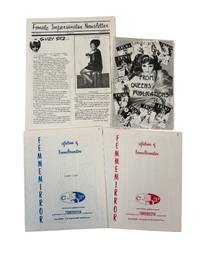
1962235341962. Virginia Prince's Chevalier Publications and allied mail order networks connected cross dressing and female impersonator readers through fiction editorials newsletters product advertising book notices and society formation notices at moments when public gender variance carried social legal and medical risk. This archive preserves two 1962 issues of Femme Mirror both issued by Chevalier Publications alongside a 1970s Female Impersonator Newsletter issue centered on Suzy's U.T.T.S. organization and a Queens Publications catalog advertising gender confirming products such as wigs clothing femme shape-wear informational books and magazines. The group traces a movement from early mimeographed reader fiction and moral instruction to a more developed 1970s market of periodicals social clubs apparel cosmetics and body-form products.<br /> <br /> Trans interest publications archive. Los Angeles and New York: Chevalier Publications Queens Publications and others 1962 to 1975. Archive of 4 publications: Femme Mirror Nos. 3 and 7 Female Impersonator Newsletter Vol. Two No. Eight and From Queens Publications 74-75.<br /> <br /> 1 Prince Virginia ed. Femme Mirror. Number Three. Los Angeles: Chevalier Publications March 1962. Early Chevalier periodical with cover text reading "reflections of FemmePersonators" "publishers of Transvestia magazine" and "Number Three." The issue opens with Prince's "It's March Girls." and includes fiction and personal writing such as "The Living Window" by Joyce Lane "That One Life" by Lee Joyce and "Martha's Path" by Lee Joyce.<br /> <br /> 2 Prince Virginia ed. Femme Mirror. Number Seven. Los Angeles: Chevalier Publications July 1962. Early issue with Prince's editorial "People Who Live in Glass Houses." and fiction including "Good Ole Julienne" with language addressed to "girls" and "F.P.s." Prince's editorial discusses "those heterosexual persons who do enjoy clothing and other expressions of the opposite sex" and argues for tolerance understanding and assimilation while distancing the publication from homosexuality and public scandal.<br /> <br /> 3 Female Impersonator Newsletter. Vol. Two No. Eight. 1970s. Issue priced one dollar with front page columns headed "Suzy Sez." and "T.V. of the Month" naming Karen Rigg. Suzy's column states that the newsletter began in October 1973 refers to the "United Transvestite and Transsexual Society" describes a first group meeting in Minneapolis in September and announces "A New TV/TS Society Formed" with proposed services including a newsletter reviews group listings entertainment notices and commercial listings for clothing hotels photo studios lawyers and related services.<br /> <br /> 4 From Queens Publications 74-75. New York: Queens Publications 1974 to 1975. Mail order catalog advertising Drag magazine and related publications with interior listings for Transvestia issues Man Woman & Girl by Jean Roberts Sex and Gender by Robert J. Stoller M.D. Regiment of Women by Thomas Berger Conundrum by Jan Morris wigs false eyelashes makeup party pants stretch lace lingerie boots and "Treasure Chest" latex forms. The catalog preserves the commercial side of 1970s transvestite and female impersonator culture where reading material appearance products and body-shaping goods circulated through the same mail order channels.<br /> <br /> These four publications record the infrastructure behind mid century and 1970s cross dressing culture aimed at people who often relied on postal exchange for privacy and continuity. The 1962 Femme Mirror issues carry Prince's reflections and observations on gender and sexuality while the other materials add the language of "TV/TS" group meetings catalog shopping and a broader marketplace around gender presentation and popular culture. Light toning fold lines handling wear minor edge wear; overall very good condition. A compact archive linking early Chevalier Publications to the later commercial and social networks that served cross dressing female impersonator and transvestite readers. unknown
18863893Mexico City: Lúcas el Brincón 1886. About very good. 58 issues each 4pp. separately paginated. Contemporary quarter sheep and marbled boards; original Mexican binder's ticket on front pastedown. A rare complete 58-issue run of this semi-comic political weekly published in Mexico City during the mid-1880s. The present set includes the very scarce five issues of volume two and is comprised of almost entirely first issues with the original text and layout which was changed for the more commonly seen bound collection of volume one only. Most of the small number of institutional copies recorded seem to be this bound re-issue of volume one with "segunda edicion" printed in the masthead. The typesetting and content usually varies between editions as well -- the second edition issues for example typically have an advertisement inserted at the foot of the final page whereas the original issues mostly do not have ads. Often the differences are even more significant -- in the second edition of issue seven much of the content has been cut from the final page and placed into issue eight.<br /> <br /> The text itself comprises a liberal satire of Mexican politics under the Porfiriato during the 1880s. The introduction to the first issue states the publication's political stance which is support of the liberal 1857 Mexican constitution. Each issue opens with the publication's main rule "Pagarlo antes de leerlo" or "Pay before reading" then follows an essay stating El Valedor's views on a topic sometimes as a satirical reframing of an article in another periodical. The remaining pages of each four-page issue are given over to political poems comic dialogues and quips on various subjects. Typical of its era the language is slangy filled with nicknames and allusions to politicians and it assumes a lot of knowledge of mid-1880s Mexican politics and newspapers. Porfirio Díaz Romero Rubio and Manuel González are among the politicians mentioned and the editor writing under a pseudonym that might translate as Lucas the Leaper did not think much of them referring to Díaz as "el Perfirito". A rare anti-Diaz periodical from the midst of his reign near the end of the 19th century. Lúcas el Brincón unknown
- Les cahiers du Contadour, Saint-Paul 1936-1939, 16,5x22cm, 8 fascicules brochés en 7 volumes. - First edition. Contributions from J. Giono, L. Jacques, C. Vildrac, R. Rolland, Alain, and the French translation of Moby dick by H. Melville published here before its first edition. Illustrations by L. Jacques, A. Noll, H. Chenet, Kardas, E. Jos, Joset, and others. Very occasional wormholes affecting mostly the endpapers of some volumes, spine and covers of first volume lightly and uniformly faded, a small inkspot to upper cover of second volume, but otherwise a good set. A rare complete set. [FRENCH VERSION FOLLOWS] Edition originale de la revue et pré-originale de la célèbre traduction française de Moby Dick d'Herman Melville par Jean Giono. Contributions de J. Giono, L. Jacques, C. Vildrac, R. Rolland, Alain... Illustrations de L. Jacques, A. Noll, H. Chenet, Kardas, E. Jos, Joset... Rares piqûres affectant essentiellement les gardes de certains volumes, dos et plats du premier volume légèrement et uniformément passés, une petite tache d'encre sur le premier plat du second volume, sinon agréable ensemble. Précieuse collection complète.
180148778Stockholm, Carl Delén och J.G. Forsgren (senere) Nordstedt & Söner, 1801- 1926. 8vo. Indbundet i 92 samtidige, nogenlunde ensartede hldrbd. med rigt forgyldte rygge. Nogle bind med kapitælslid, nogle få med tab af lidt ryglæder og et bind med tab af ryg. Indvendigt udmærkede og velbevarede.
Stockholm, Carl Delén och J.G. Forsgren (senere) Nordstedt & Söner, 1801- 1926. 8vo. Indbundet i 92 samtidige, nogenlunde ensartede hldrbd. med rigt forgyldte rygge. Nogle bind med kapitælslid, nogle få med tab af lidt ryglæder og et bind med tab af ryg. Indvendigt udmærkede og velbevarede.
1834216300Leipzig, Breitkopf u. Härtel, 1812-1834. 4°. In Ppbd. u. Heften. Einbde. teils angeschmutzt u. stärker beschabt u. bestoßen (teils Fehlst. im Papierbezug). Meist m. Rsch. u. Rtit. u. mehr. St. Hefte unbeschn. Umschläge teils stärker angestaubt. Papier teils gebräunt bzw. braunfl.
1st edition. Folio. Newspaper. Illustrated throughout. Includes many advertisements and numerous personal family announcements. Following the Kristallnacht pogroms of November 1938, Jewish life in Germany and Czechoslovakia was even further curtailed and all remaining Jewish newspapers were shut down by the government. In their place, the Nazi Party ordered the creation of a single, new Jewish newspaper, "Das Jüdische Nachrichtenblatt, " that would be directly under Gestapo control. It was published concurrently in Berlin, Vienna and Prague and was occupied to a large extent with announcing the ever-increasing number of anti-Semitic discriminations, orders and exclusions imposed by the Reich government. Over the course of its history, the editors of the Jüdische Nachrichtenblatt were Leo Kreindler (1938-42) and Willi Pless (1942-43) . The Berlin edition ran from the 23rd November, 1938 until the final issue of 4th June 1943. The Prague edition continued until 1945. In a ghoulish twist of Nazi irony, Gentiles were forbidden from reading the Jüdische Nachrichtenblatt yet the newspaper's targeted readership, the Jews, were literally hounded to their deaths by the very authorities who presided over the newspaper's ownership! See Reiner Burger, Von Goebbels Gnaden: "Jüdisches Nachrichtenblatt" 1938-1943 (2001) . A mixed collection of 102 issues from Berlin and Prague sold at auction in 2015 for 9225.00 USD. These issues were at one point bound, but the binding was at some point removed. The newsprint is brown and quite fragile, with edgwear and old dampstains, but there is generally little text loss, except to a few letters on the lower outer margins of the final 10 issues. Now housed in an acid-free sleeved portfolio, with each issue in a separate clear sleeve for easy protected viewing. Fair condition, but very rare, very important, and very powerful. (kh-5-47)
Very Good Turkish, Ottoman (1500-1928) Contemporary cloth bdg. made after the Turkish Letter Revolution, in Latin script. Folio. (38 x 28 cm). In Ottoman script (Old Turkish with Arabic letters). 36 issues complete set. Exceedingly rare complete ran of important illustrated "Bosbogaz ile Güllabi" [i.e. The Gabbler and the Asylum Guard], which is an Ottoman satirical magazine, published twice a week from 6 August to 14 December 1908 in Istanbul by Hüseyin Rahmi Gürpinar (1864-1944) and Ahmet Rasim (1864-1932) in a total of 36 issues. The articles of the magazine contained original and fine jokes and satire. In addition to various writings, it also contained caricatures of famous people of the time and jokes about the magazine Mizan. Among other things the caricatures related to the annexation of Bosnia and Herzegovina. Some of the humorous articles were published in series and the articles were written in simple language and in a linguistic style appropriate to the period. In addition, Bosbogaz ile Güllabi contained daily news and serious articles that appeared under the name "Bosbogazin ciddî makalesi" ("Serious Bosbogaz Articles"). Apart from the signed articles, there were many anonymously written articles in the magazine. It is possible to trace them back to Hüseyin Rahmi because of the same writing style. Due to his critical style, he took over the administration of the magazine, which was published several times by the Ottoman government. Another famous writer besides Gürpinar and Ahmet Rasim was Mithat Cemal Kuntay (1885-1956). (Wikipedia). Duman 262.
Very Good Bulgarian Original blue cloth bdg. with embossing. Slightly stains on boards and toned on pages. Otherwise a very good copy. 12mo. (16,5 x 12 cm). In Bulgarian. 1230, [2] p. [HOLY BOOK IN BULGARIAN PRINTED IN TSARIGRAD (CONSTANTINOPLE)] Bibliia sirech sveshtenoto pisanie na Vetkhiia i Noviia zavet: Viarno i tochno prevedena ot pûrvoobraznoto. [.] In 1840 5,000 copies of the first complete translation of the New Testament were printed in Smyrna by the British and Foreign Bible Society. A second edition which was printed in Smyrna in 1850 was an almost exact reprint of the 1840 edition. A third edition followed in 1853 with 15,000 copies. The fourth edition was published in 1857 in Bucharest, and for the first time civil characters type was used. In 1859, two more editions were published. In 1866, a new "pocket" edition with text revised by Elias Riggs and Dr. Albert Long was printed in Constantinople. The New Testament was revised and reprinted a total of nine times. In the period from 1840 to 1860 the Eastern (Tarnovo) dialect was adopted as literary Bulgarian language and the Macedonian dialect, in which the New Testament had been translated, was widely rejected. By 1858 Neofit Rilski had finished large portion of the Old Testament. Riggs met with Neofit Rilski and discussed a possible revision of the Bulgarian New Testament to remove the Macedonian dialect elements. Neofit objected the revision, so Riggs took the translation and returned to Constantinople. In January 1859 Riggs invited the Bulgarian teacher Hristodul Kostovich to help him with the revision. In 1862 Long and Riggs visited the noted Bulgarian writer and poet Petko Rachov Slaveykov in Tryavna. Slaveykov agreed to help with the translation and began the work on the revising of Neofit's New Testament at once. Long joined the revision of the New Testament into the Eastern dialect in 1863 and later assisted with the translation of the Old Testament. In June 1871, after more than 12 years of revision and translation, 36,000 copies of the complete Bible translation in Bulgarian were published in Constantinople. The translation came to be known as the "Tsarigrad (Constantinople) Edition". Tsarigrad [or; Tsargrad, Tzargrad, Czargrad] Tsargrad is a Slavic name for the city or land of Constantinople, the capital of the Eastern Roman (Byzantine) Empire, and present-day Istanbul in Turkey. A physical copy of this edition is not located in OCLC. For digital register: OCLC 181122059.
Very Good Turkish, Ottoman (1500-1928) Original wrappers. Slightly split on margins. Otherwise a very good copy. Cr. 8vo. (20 x 14,5 cm). In Ottoman script. 212 p. It's written with a legible hand script. Mehmed Tevfik was a 'Hafiz'. Hafiz is a term used by Muslims for someone who has completely memorized the Quran. His name is not figured out in the literature. Manuscript starts with that he describes to started of neighborhood school in Tosya, Kastamonu and his first teacher Ismail Efendi. We learned that his father was professor in Abdurrezzak Madrasa in Tosya which was first and only madrasa in Tosya. After that he mentions his brother Ali, his primary school was in Çankiri. He describes their family journeys from Çankiri to Tosya in a very bright style which was a day and night and eventful journey. They crossed Devrez Baglari by a horse carriage. He gave some examples from Tosya (Kastamonu) local dialect like 'Kadinine' to 'Nine' [i.e. Grandmother]. He cited in very detail that his father's hajj and Hejaz journey with his grandfather. After that he talked about his first special lessons from a hafiz in 1309 [Hegira]. After two years of that, he started to High School in September of 1311 [Hegira]. His daughter's birth (Fatma Hayriye) and he traveled to Istanbul. He describes his military memoirs in Istanbul and when he saw who cursed to Sultan (Abdulhamid II) he was very surprised. After that confusions and difficulties in the last period of the Ottoman Empire, press in the Ottoman Empire, political events, murders and crimes in Istanbul city was told by Tevfik. All kind of events, according to him, a betrayal to the empire and Islamic culture. Based on his memoirs, he was a conservative person. A fine manuscript is not only describing which is an autobiography as well, showing a person who has passion to be an Islamic scholar, but also reflecting thoughts of an anti-revolutionary and the last period of the Ottoman Empire besides events in Istanbul city which was heart of an empire. It's unpublished. Extremely rare.