47 062 résultats
Fine English In modern aesthetic full leather bdg. 4to. (32 x 24 cm). In Turkish. 11 issues set. Many b/w ills. Müzik ve sanat hareketleri. Ayda bir defa çikar mecmuadir. Eylül 1934 - Ikinci tesrin 1935. 11 issues set.
EXTREMELY RARE single volume containing all 1894 issues of the daily Hebrew newspaper "Ha-Tsefira". This influential publication, published in Warsaw and read throughout the Jewish world, featured news in matters of international politics, global economy, science and religion, literature and so forth. The issues were sent by mail, and still feature contemporary Austrian-Hungarian stamps. The publication was edited and most of it written by Nachum Sokolov, and is written in the elevated Hebrew prose typical of that era. 400x275mm. 1262 pages. Bound in black cloth Hardcover. Most page edges slightly torn (no damage to text). Many pages taped and nicely restored - NO damage to text. First and last text pages partly torn and detached from binding; these pages are sold along with the volume, but a photocopied version of them is bound within it. Pages yellowing/browning. [SUMMARY]: In spite of the wear it has sustained, this rare collection of Jewish newspapers is in good reading condition. PLEASE NOTE: This item is overweight. We may ask for extra shipping costs.
Scritti di Orio Vergani, Curzio Malaparte, Francesco Flora, Giacomo Prampolini, Alfredo Panzini et molti altri. Con illustrazioni in bianco e nero. 17 fascicoli Fascicoli venduti singolarmente. Folio. pp. 8/fasc.. . Buono (Good). . . .
Very Good French Paperback. Pbo. 4to. (32 x 24 cm). In French. 31 p., ills. and photos. La Turquie Kamâliste [Kemaliste]. No. No. 1. Juin 1934.
Very Good Turkish, Ottoman (1500-1928) Original newspaper. Folio. (49 x 33 cm). In Ottoman script (Old Turkish with Arabic letters) and imprint details in bilingual in Russian and Turkish. 4 p. An early issue of this extremely rare newspaper published in Tbilisi by Mehemmedaga Sahtahtli between 1903 and 1905 as 392 issues in total, published for all Turks and Islamic groups in Russia, which had a significant position in the modernization history of Azerbaijani and Russian Turks and the political and social changes at the end of the 19th and the early 20th centuries for Islamic minorities in Russia. The articles were included in this issue as follows: Tiflis-Musahabe by Mehemmed Bey Kasimbekov, pp. 1-2 (about the Girls' Schools in the Caucasus.; Türkistan'a Seyahat by Tacir Arif, pp. 2-3 [Voyage into Turkestan], Öz Muhbirlerimizden-Uralsk'dan-Men Garra' Gurra'-Tercüman ve Muharriri, pp. 3 [an article criticizing "Sark-i Rus"' publishing policy]; Kirim, Öz Muhbirlerimizden-Kirim'dan-Akmescid'de Darü'l-Muallimîn, pp. 3-4 [about the school for theachers, which was opened in Akmescit (Simferopol) in 1870 and provides education in Russian, the number of students and the education program and the inadequacy of the Muslim education of the same school]; Öz Muhbirlerimizden-Bakû'dan, pp. 4 [about the Muslims of Baku losing their influence from the commercial life of the city]; etc. The first Turkish newspapers titled "Ziya", "Ziya-yi Kafkasiye" and "Keshkul" published in Tbilisi in the 19th century were closed by the Russian authorities. The newspaper "Sark-i Rus", published in 1891, long after the closure of Keskul, became the first Turkish newspaper published in the Caucasus at the beginning of the 20th century. Mehemmedaga Sahtahtli, or Mammad agha Shahtakhtinski (1846-1931), was an Azerbaijani linguist and public figure. In 1902, Shahtakhtinski returned to Caucasus and settled in Tiflis. Here in March 1903, he founded the Azeri-language newspaper Sharg-i Rus ("The Russian Orient") dedicated to the academic enlightenment of the Muslims of the Caucasus. His articles propagated the necessity of Europeanisation, which he saw as the only possible way to a stable and developed future. He sharply criticised Islamic fanaticism, which in his opinion was a major obstacle in the development of Azeri culture and was incompatible with the idea of progress. He also dismissed Pan-Turkism, a popular theory among Turkic-speaking scholars and political activists of the time, and propagated the use of folk Azeri as a literary language, as opposed to the common practice of using Ottoman Turkish. He was among the peacemakers during the bloody Armenian-Tatar massacres of 1905-1907. In 1907, he was elected to the State Duma of the Russian Empire (second convocation). After dissolution of the duma, he worked for Petersburg-based newspaper "Russia", then edited by Pyotr Stolypin. Between 1908 and 1918, Shahtakhtinski lived in various parts of the Middle East, including Anatolia, Iraq and Persia, meanwhile writing articles for "Turkestan Times" (Russian: Turkestanskie Vedomosti). During this time abroad, he worked at the Russian embassy to the Ottoman Empire as translator between 1909 and 1912. In 1919, he returned to then-independent Azerbaijan to give lectures at the newly established Azerbaijan State University. Shahtakhtinski was among the numerous scholars who had followed Mirza Fatali Akhundov in proposing an alphabet reform for Azeri, suggesting to reform the existing Perso-Arabic script. The unsuitability of the Arabic alphabet to Turkic languages in general was in his opinion a major obstacle to the spread of literacy among Azeris. Between 1879 and 1903, Shahtakhtinski designed several model alphabets for Azeri, some of them Roman-based, however none of them was implemented in practice. He attended Congress of the Peoples of the East, acting as an interpreter for Turkish, French, German, Persian and Arabic in 1920. In 1923, Shahtakhtinski as member of a special four-mem
Very Good Turkish Paperback. Roy. 8vo. (24 x 17 cm). In Turkish. 21 issues set. Metis çeviri 1987-1992 No: 1-21 [FULL SET]. Three institutional sets in OCLC: 1030622369.
Brown octavo, half leather, approx 300 p, (various pagings); 25-30 cm. Scarce. Issues comprising entire year of 1835. Early American imprints. || Periodicals.
185643505Madrid: Imprenta de A. Vincente 1856. First edition. Contemporary quarter red morocco over marbled boards spine with gilt titles and rules marbled endpapers. A very good copy boards rubbed worn at corners contents near fine but for an occasional fold. Approx. 500 pp. Folio. I.a época: Desde 24 de Setiembre de 1854 á 30 de Junio de 1855. IIa época: Desde 5 de setiembre de 1855 a 30 de junio de 1856. Successive imprints were: Imprenta de d. Felipe Saavedra & Imprenta de D. P. Argote. 112 issues most 4 pp. complete with 10 supplements often not all found. A stinging satirical Carlilst newspaper founded by Cándido Nocedal and published six times per month. The supplements running between 2 and 8 pages each contained numerous letters and articles in support of the paper. Palau 208455. Jaime del Burgo: Bibliografía del siglo XIX: 731. Imprenta de A. Vincente hardcover
171934228New York: Schwäbisches Wochenblatt 1917-1919. First Edition. Ninety-one quarto 29.75cm. issues bound together in contemporary reddish-brown cloth; illus. throughout. Textblock quite toned due to poor paper stock light edge wear to cloth extremities else Very Good and sound. Quite possibly complete set the numbering ends after no. 13 misprinted 31 and a few weeks appear to have been skipped. Humor supplement to the weekly Schwabian-American newspaper Schwäbisches Wochenblatt. Though we find no records for the New York-based newspaper or its supplement we do find a newspaper of the same name published by the Social Democratic Party of Germany. This periodical also appears to be anti-capitalist the cartoon on the first page of the first issue shows a worker slicing open the money-bag gut of Mammon. Most significantly this periodical began publication months after the United States entered World War I with much of the content on the plight of the German-born American citizens another cartoon shows an American citizen of German birth in a muzzle. We find no listings in OCLC as of June 2017. Schwäbisches Wochenblatt unknown books
1913800311913. PERIODICALS Trevelyan Francis & Frank Allaben eds. THE JOURNAL OF AMERICAN HISTORY VOLS. I - VII PLUS INDEX I - V. New Haven/Greenfield IN: Associated Publishers of American Records/Frank Allaben Genealogical Company 1907-1913. Quarterly four numbers in each volume Volumes I - VII. 764 14 pp./716 16 pp./652 pp/632 12 pp./640 pp./788 6 pp./789-1271 pp. Index Vols. I - V: 281 xxxx pp. Half leather with raised bands and gilt spine lettering over pebbled paper covered boards. Minor wear to spines else fine with color/gilt plates tipped in plates and thousands of b/w photos and illustrations. A massive compendium of Americana American history reproductions and facsimiles of historical documents. Extra postage required for this substantial set. unknown
1903876851903. PERIODICALS. THE BASKET: THE JOURNAL OF THE BASKET FRATERNITY OR LOVERS OF INDIAN BASKETS AND OTHER GOOD THINGS. Pasadena: George Wharton James 1903. VOL.1 NOS. 1-4 bound as 3. 8vo 6"x 9 1/4". In original printed wrappers. Illustrated throughout. Binding of Nos. 1 & 2 is cracked with about a 1 1/2" chip to tail. Covers are lightly soiled and worn. Interiors clean. No. 4 pagination begins at p. 41 but appears complete. An uninterupted run of the first year of a journal that lasted only two. unknown books
1913800311913. PERIODICALS Trevelyan Francis & Frank Allaben eds. THE JOURNAL OF AMERICAN HISTORY VOLS. I - VII PLUS INDEX I - V. New Haven/Greenfield IN: Associated Publishers of American Records/Frank Allaben Genealogical Company 1907-1913. Quarterly four numbers in each volume Volumes I - VII. 764 14 pp./716 16 pp./652 pp/632 12 pp./640 pp./788 6 pp./789-1271 pp. Index Vols. I - V: 281 xxxx pp. Half leather with raised bands and gilt spine lettering over pebbled paper covered boards. Minor wear to spines else fine with color/gilt plates tipped in plates and thousands of b/w photos and illustrations. A massive compendium of Americana American history reproductions and facsimiles of historical documents. Extra postage required for this substantial set. unknown books
185643505Madrid: Imprenta de A. Vincente 1856. First edition. Contemporary quarter red morocco over marbled boards spine with gilt titles and rules marbled endpapers. A very good copy boards rubbed worn at corners contents near fine but for an occasional fold. Approx. 500 pp. Folio. I.a época: Desde 24 de Setiembre de 1854 á 30 de Junio de 1855. IIa época: Desde 5 de setiembre de 1855 a 30 de junio de 1856. Successive imprints were: Imprenta de d. Felipe Saavedra & Imprenta de D. P. Argote. 112 issues most 4 pp. complete with 10 supplements often not all found. A stinging satirical Carlilst newspaper founded by Cándido Nocedal and published six times per month. The supplements running between 2 and 8 pages each contained numerous letters and articles in support of the paper. Palau 208455. Jaime del Burgo: BibliografÃa del siglo XIX: 731. Imprenta de A. Vincente hardcover books
1982204847Berlin, Deutscher Verlag der Wissenschaften, 1953-1982. M. zahlr. Abb. OLwdbde. Wenige Bde. m. St. bzw. angestaubt.
1981610743Vaduz, Topos Verlag, 1981. Folio. Originalhalbleder (teils leicht fleckig oder angestaubt).
1st edition. Original paper wrappers with modernist typeface, 8vo, 32 pages each. In Yiddish. Semimonthly Yiddish literary periodical which ceased publication in the 1930s. 22 cm. SUBJECT(S) : SUBJECT(S): Jews -- Poland -- Periodicals. Yiddish literature -- Juifs -- Pologne -- Pe´riodiques. Litte´rature yiddish. OCLC: 22650745. OCLC lists 9 libraries with holdings of any issues. Ex-library with usual markings, Paper browning as expected, some staining, Nr 11 is fragile with edgewear and spine repair, all are complete, no loss, Fair condition overall (yid-41-94-ELCC-'x)
198979300(Paris 1789 - 1793), Nachdruck Erlenbach, 1989. 1388 Nummern (Alles Erschienene). 5912 Seiten in 8 Bänden. Ln. Mit einer Einleitung von Jean-Paul Bertaud. (Remittendenexemplar
1941-1944. 1st edition. Very Good Condition; 8vo; 5 issues from the first 3 years of this fascinating bi-weekly support newsletter/magazine started prior to US entry into WWII. Membership and leadership of the Polish Labor Group (later the American Friends of Polish Democracy) was heavily Jewish, and included various American antifascists, Socialists & labor leaders. The masthead includes such names as Robert MacIver (Chairman) , Louis Adamic, David Dubinsky, Algernon Lee, Louis Bromfield, Morris R. Cohen, Fiorello La Guardia, Arthur Garfield Hays, Louis Hollander, Sidney Hook, Max Lerner, Gunnar Myrdal, etc. Some of the articles in this run include: The Underground Struggle; Polish-Jewish Underground Collaboration; German Invaders and Polish Intellectuals; Working people of Poland fights [sic] anti-semitism; Partial destruction of the Ghetto wall; Discussion of Polish Antisemitism; Polish Slavery under Hitler's "New Order"; News from the Ghetto; The Undergroudn Jewish paper against Nazi orders; In a Nazi Concentration Camp [survivor tells about Mauthausen & Dachau]; Jewish Ghetto; The professors of Cracow University in a Concentration Camp; New Criminal Code for Poles & Jews; The Fate of the Polish Intelligensia; The Attitude of the American Jewish Workers; Humor in Occupied Warsaw; The Hell of the Concentration Camp in Oswiecim; Treblinka A Ghetto for Women; Two Jewish Ghettos in One Town; etc. Issues for 1941 are published by American Friends of Polish Democracy. The periodical began June 5, 1941, and ceased publication with vol. 6 no. 87 in June/July of 1946. Vols. 1-2 lack volume numbering, using only the issue number; Volumes 3-6 include volume numbers but continue the issue numbersing scheme from Volumes 1 & 2. (HOLO2-34-74A)
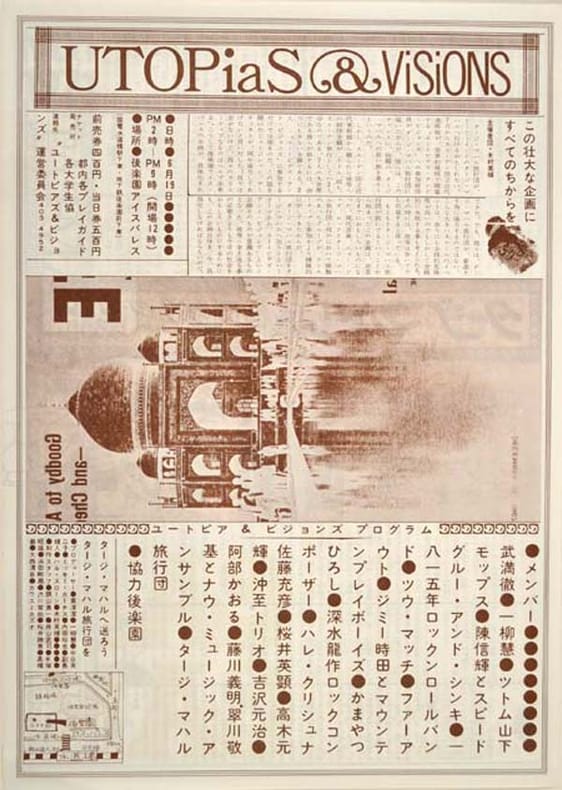
19711032811971 Tokyo, à compte d’auteurs, 1971, 4pp, 365x258mm, en feuille.Journal fondateur du groupe « Taj Mahal Travellers ». Texte et illustrations imprimés en sépia et prune.Numéro promotionnel pour le concert donné au Ice Palace de Kôrakuen (Tokyo, 1972) au profit du Groupe, pour financer son voyage aux Indes en vue de participer à un festival d’Art organisé par le Musée Royal de Suède (Mise en page de Michihiro Kimura.)Takehisa Kosugi a d’abord créé le « Groupe Ongaku » en 1960, ensuite le « Taj Mahal Travellers » en 1972 dont les participants sont : Tokio Hasagawa, Kiyoji Nagai, Ryû Koike, Sachio Tsuchiya, Michihiro Kimura, Kiyoshi Awazu et Hayashi. Interprètes de musique classique ou Jazz, artiste contemporain (Koike) et designers (Kimura, Awazu), ce sont des créateurs de son et de performance improvisées.Musiciens participant au concert :Tôru Takemitsu, Toshi Ichiyanagi, Tsutomu Yamashita Mops, Nobutaru Chin & Gru and Shink ( ?), Rock’n Roll Band en 1815, Too Much, Far Out, Jimmy Tokida & Mountain play boys, Hiroshi Kamayatsu, Ryûsaku Shinsui Rock composer, Mitsuhiko Satô, Mototeru Takagi, Okishi Trio, Motoharu Yoshizawa, Kaoru Abe, Yoshiaki Fujikawa & Now Music Ensemble, Taj Mahal Travellers.(103281)
194611452ABBerlin-Dahlem, Ulenspiegel-Verlag Haueisen & Co, 1946 - 1948. 4° (37 x 27 cm). Je Heft ca. 8-16 S. mit zahlreichen teils farbigen Illustrationen und Karikaturen. Farbig illustrierte Original-Broschuren., 11452ab|11452ab 2|11452ab 3|11452ab 4 65 Hefte. [4 Warenabbildungen]
1st edition. Original boards. 8vo. 32 pages each. 24 cm. In Yiddish with some English. Title translates to The Jewish Workers Voice. Published by one of the two Jewish organizations making up the Farband. The NJWA was founded in 1912 as a Jewish mutual aid program. Its official organ was the Yidishe Kempfer or Jewish Fighter, edited by Baruch Zuckerman (Wikipedia, 2018) . SUBJECTS: Periodicals - Socialism. OCLC lists 6 copies worldwide (OCLC: 36938329) . Light wear to boards. Contents very good. Overall Very Good Condition. (YID-41-10)
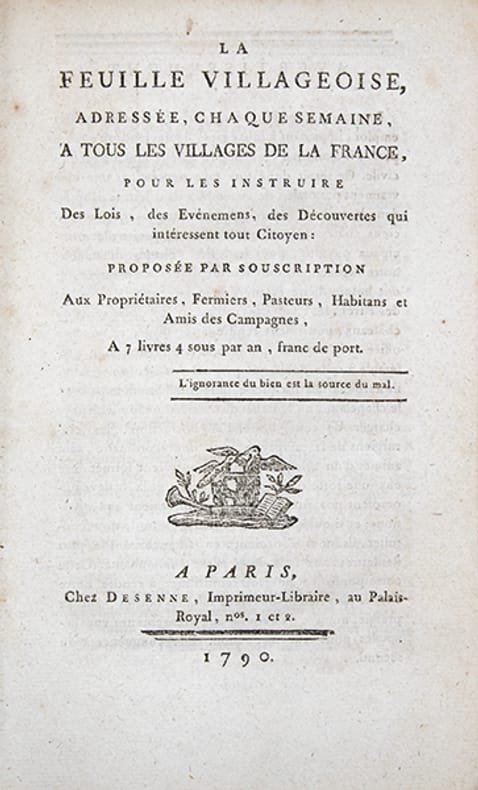
1790382131790 Très fort volume in-8, plein veau de l'époque, dos à nerfs fleuronnés et cloisonné, tranche rouge, 500 p., 11 p. de table et 490 p., 8 p. de table, planche gravée en frontispice. Paris, Desenne, 1790-1791.
Très fort volume in-8, plein veau de l'époque, dos à nerfs fleuronnés et cloisonné, tranche rouge, 500 p., 11 p. de table et 490 p., 8 p. de table, planche gravée en frontispice. Tête de collection et première année complète cette hebdomadaire fondé par Rabaud-Saint-Etienne qui se retira au bout de la première année, Philippe Grouvelle et Joseph Cerutti auquel succéda Pierre-Louis Guinguené. Parmi les collaborateurs figurent notamment Mme de Genlis qui signait "Sillery", Gilbert Romme, Kersaint, Lanthenas, Jacques Boileau et François de Neufchâteau. Planche gravée en frontispice: sous un chêne, un "curé patriote" lit la "Feuille" à haute voix aux villageois, hommes, femmes et enfants réunis. Chaque année est divisée en deux parties, à pagination séparée et table des matières particulière. Le sous-titre explicite l'objectif du périodique et informe sur public auquel il était destiné: de fait "La Feuille villageoise" remporta un très large succès et compta jusqu'à 18.000 lecteurs. (Hatin, 170. Martin & Walter, 'Journaux', V, 469 qui détaille le contenu. Tourneux, II, 10571). Reliure épidermée, coiffes usées, dos frotté. Intérieur très frais.
Raccolta, in ristampa anastatica, della pubblicazione trimestrale uscita dal 1936 al 1943 (quattro numeri per anno e due numeri nel 1943). Intonso. In calce ad ogni volume ''sommario'' con alcune illustrazioni pubblicitarie in b/n. Brochure di presentazione con una nota di Ruggiero Romano. 7 volumi. Tra molti altri, scritti di Luigi Einaudi, Mario Einaudi, Augusto Calabi, Bruno Foà, Stefano Jacini, Achille Loria, Gino Luzzatto, Tristano Codignola, Armando Sapori, Attilio Cabiati, Aldo Mautino, Robert W. Scott, Benedetto Croce, Libero Lenti, Pasquale Jannaccone, Mario Lamberti. . 8vo. pp. 343 (1936) - 382 (1937) - 374 (1938) - 331 (1939) - 288 (1940) - 280 (1941) - 159, 72 (1942/1943). . Molto buono (Very Good). . . .
Interventi di Nanni Balestrini ("Perimetri"), Corrado Costa ("Prove per una messa in italiano" e "L'anguilla e il serpente"), Antonio Porta ("Maladie d'Amour"), Adriano Spatola ("Aviazione/Aviatore"), Pierre Garnier ("Théatre spatialiste"), Giorgio Siribaldi Luso ("L'ultima notte che passano insieme" e "Prolegomoni a un saggio sulla combinatorietà"), Alberto Episcopi (2 sezioni da "Allegro appassionato"), Arturo Fittipaldi ("La variabile dipende da due incognite"), Claudio Baisi ("Scatola cinese"), Felice Piemontese ("Dietro la luna"), Joan Brossa ("Poesie civili"), Giorgio Celli ("L'ebreo negro"), Vincenzo Accame ("Storia e cronistoria di tre a."), Abraham A. Moles ("Manifesto dell'arte permutazionale"), Tomàs Maldonado ("Comunicazione e semiotica"), Haroldo de Campos ("Poesia concreta brasiliana"), Henri Chopin ("Due manifesti") Copertina fustellata. Con fascetta editoriale. 8vo. pp. 88. . Molto buono (Very Good). . Prima ed. di 1200 copie numerate. . Malebolge rivista di letteratura fondata a Reggio Emilia nel 1964 da Corrado Costa, Adriano Spatola e Giorgio Celli, uscì a cadenza irregolare dal 1964 al 1967 in quattro fascicoli: tre numeri ed un quaderno