Grosse Landesloge Sachsen; Br. Rudolf GottschallAntiquariat.de

47 062 résultats
15402BBDresden. Orig.-Broschuren mit den Umschlägen., 15402bb Nur ganz gelegentliche Anstreichungen. Gut erhalten.
500288681Sans date.
500288692Sans date.
- Les éditions de minuit, Paris 1949, 13,5x21cm, agrafé. - Edition originale. Agréable exemplaire malgré le papier inévitablement jauni. Contributions d'Henri Thomas "Poèmes", August Strinberg "Le ciel dans l'oeil", Ernst Jünger "Pages de journal", André Dhôtel "Fragments", Hermann Melville"L'escroc à la confiance", René Crevel "Lettre à Arabelle", Pham Van Ky "Apologues chinois", Robert-Louis Stevenson "Lettre à Henry James", Roger Gilbert-Lecomte "Rêve de mort", Antonin Artaud "C'est qu'un jour. - Je suis l'inerte. - L'erreur est dans le fait"... [ENGLISH DESCRIPTION ON DEMAND]
- Les éditions de minuit, Paris 1948, 13,5x21cm, agrafé. - Edition originale de ce numéro spécial consacré aux textes d'Antonin Artaud suivi de témoignages de ses amis. Agréable exemplaire complet de sa bande annonce. Parmi les textes d'Antonin Artaud présentés ici : "Les pensées ne passent pas de l'une à l'autre", "Les êtres ne sortent pas dans le jour extérieur", "J'étais vivant", "Le corps est le corps", "L'endroit où l'on souffre", "Lettre à Paule Thévenin", "L'être a des états innombrables", "Il n'y a pas de plein", "Et si je parle de remise en cause de jugement dernier", "Le théâtre de la cruauté", "Faites le mal... et autres courts textes..." Ces textes sont suivis de témoignages de Paule Thévenin, Arthur Adamov, Henri Thomas, Pierre Minet, Jacques Prevel, Camille Bryen, Jean Paulhan, André Gide... [ENGLISH DESCRIPTION ON DEMAND]
- Les éditions de minuit, Paris 1949, 13,5x21cm, agrafé. - Edition originale. Agréable exemplaire malgré le papier inévitablement jauni. Contributions d'Antonin Artaud "Il y a une vieille histoire", Georges Bataille "L'éveil", Robert Musil "Pêcheurs au bord de la Baltique" et "Inflation", André Dhôtel "Marcos devient savant", Henri Thomas "L'insomnie", Boris Pasternak "Jusque ce tout, tout fut hiver", Alexeï Remizov "Chinois"... [ENGLISH DESCRIPTION ON DEMAND]
500288735Sans date.
Roy. 4to., First Edition; original printed wrappers, wire-stitched as issued, covers mildly browned and frayed at edges else a good, sound copy. Matthews, p.216.
Very Good Turkish, Ottoman (1500-1928) Contemporary brown half leather, five raised bands to spine, including title and decorations. Slight fading on the spine and stains on the first pages. Demy 8vo. (21 x 14 cm). In Ottoman script (Old Turkish with Arabic letters). 420 p. Rare first edition of this utopian novel, in which he tells the reasons that led to the destruction of the Ottoman Empire and the remedies for recovery through the idealist protagonist Mansur Bey. The word "Turfanda" is the name given to the vegetables and fruits that grow first and early in their season in Turkish culture. The origin of word in Turkish culture comes from the city of Turfan in China, where fruits and vegetables were first grown in Central Asia and Turkestan by Turks. Mizanci Murad [or Murat] was an Ottoman monarchist, democrat, historian, and politician, who was renowned for his work on reviving the concept of Ottomanism during the Second Constitutional Era. Özege 21333.; OCLC has no first edition with its correct imprint details. (Utopias from the Middle East 8).
Fine Tigrinya Original wrappers. Demy 8vo. (22 x 15 cm). In English and Tigrinya. 28 p., b/w ills. Extremely rare fifth issue published in July 1975 in the fourth year of publication of the, a bulletin of the movement known as "Eritreans for Liberation in North America" (EFLNA), which emerged in 1970 and ceased to exist by the end of 1979. Contents: Editorial; Some notes on the changing role of the Eritrean woman; Victory and revolution in Southern Africa; 14th Anniversary of the Eritrean revolution; The proletariat: Its international and Eritrean history; International backing heightens; Brief news from the field; More on Ethiopia's socialists; 2 articles in Tigrinya alphabet. Not located in OCLC.
Very Good Turkish, Ottoman (1500-1928) Original wrappers. Slightly split on margins. Otherwise a very good copy. Cr. 8vo. (20 x 14,5 cm). In Ottoman script. 212 p. It's written with a legible hand script. Mehmed Tevfik was a 'Hafiz'. Hafiz is a term used by Muslims for someone who has completely memorized the Quran. His name is not figured out in the literature. Manuscript starts with that he describes to started of neighborhood school in Tosya, Kastamonu and his first teacher Ismail Efendi. We learned that his father was professor in Abdurrezzak Madrasa in Tosya which was first and only madrasa in Tosya. After that he mentions his brother Ali, his primary school was in Çankiri. He describes their family journeys from Çankiri to Tosya in a very bright style which was a day and night and eventful journey. They crossed Devrez Baglari by a horse carriage. He gave some examples from Tosya (Kastamonu) local dialect like 'Kadinine' to 'Nine' [i.e. Grandmother]. He cited in very detail that his father's hajj and Hejaz journey with his grandfather. After that he talked about his first special lessons from a hafiz in 1309 [Hegira]. After two years of that, he started to High School in September of 1311 [Hegira]. His daughter's birth (Fatma Hayriye) and he traveled to Istanbul. He describes his military memoirs in Istanbul and when he saw who cursed to Sultan (Abdulhamid II) he was very surprised. After that confusions and difficulties in the last period of the Ottoman Empire, press in the Ottoman Empire, political events, murders and crimes in Istanbul city was told by Tevfik. All kind of events, according to him, a betrayal to the empire and Islamic culture. Based on his memoirs, he was a conservative person. A fine manuscript is not only describing which is an autobiography as well, showing a person who has passion to be an Islamic scholar, but also reflecting thoughts of an anti-revolutionary and the last period of the Ottoman Empire besides events in Istanbul city which was heart of an empire. It's unpublished. Extremely rare.
- Collège de Pataphysique, Paris 1967, 27,5x21cm, agrafé. - Edition originale, un des 399 exemplaires numérotés sur grand papier astromantique sous couverture gris lin, le nôtre non numéroté. Claires mouillures marginales sur le second plat, plats partiellement jaunis, agréabl état intérieur. [ENGLISH DESCRIPTION ON DEMAND]
Very Good Turkish, Ottoman (1500-1928) Contemporary half leather and quarter bdg. Two volumes. Five raised bands to the spine. Gilt lettering on compartments. Wear on the spine of the first volume. A label on the second's spine. Occasionally slight stains on thin papers. Overall very good volumes. 4to. (27 x 19 cm). In Ottoman script (Old Turkish with Arabic letters). Extremely rare 29 issues of the second and third years in two volumes of this rare Hamidian period (1876-1908) Ottoman periodical, devoted to the circulation of contemporary prose and poetry, as well as criticism, Mekteb was edited by Ismail Hakki from 1891 to 1894, followed by Ebülfeyyaz Hakki from 1894-1898. The magazine was a particularly important voice for the Servet-i Fünun [i.e. The Wealth of the Sciences] generation of writers. Weekly; 26 Temmuz 1307 [8 August 1891] - 30 Kanun-i Sanî 1313 [12 February 1898]. This periodical was published by Ottoman-Armenian bookseller, publisher, and printer Karabet Kesisyan Efendi (Garabed Keshishian, 1850-1911), who is a prominent Armenian figure in the history of Ottoman printing. As a prolific and enterprising figure, he was one of the most famous printers of the Hamidian Era (1876-1909). His contributions in this field reflect the sociocultural changes that occurred gradually in the Ottoman Empire in the nineteenth century. His printing house published mostly Turkish language textbooks and became the sole provider for the Turkish military and civil schools from 1889 until the beginning of the twentieth century. Duman 1331.
Very Good Persian Original wrappers. Folio. (33 x 25 cm) and some different sizes. In Persian with bilingual titles in English and Persian. A lot including 124 issues, published between July 30, 1991, to 1999. A lot including 124 issues of this rare Iranian satyric magazine "Gol Agha", which was the first such publication in post-revolutionary Iran, maintaining its dominance for more than two decades after its debut, adding monthly and annual editions as well as producing new generation of satirists and cartoonists. Kioumars Saberi Foumani, (1941-2004), also known by his pen name Gol-Agha, was an Iranian satirist, writer, and teacher. Saberi was born during the Second World War in Souma'eh Sara a city in Gilan Province. His father, originally from Rasht, worked for the Ministry of Economic Affairs and Finance. He was transferred to Souma'eh Sara in 1938 and then to Fuman in 1942 where he died a few months later. His mother, who was the daughter of a respected cleric and one of the few educated women in the city, taught the Quran after the death of her husband. His brother, who was 14 years older, had to leave school at the age of 15 to work to help with the family expenses. Education for Saberi was hard because of his family's poverty and he had to start working in a tailor shop after finishing his elementary education. He also worked in his brother's bicycle repair shop during elementary school and high school. He started high school education at his mother's insistence. At the age of 16, he gained entry to Sari's Agriculture teacher's college which only accepted one student from Fuman each year. He continued his college education and graduated in 1959. He worked as a teacher from 1959-1961. At the age of 20, he took his high school exams and received his high school diploma. He continued his education at the University of Tehran while working as a teacher. He achieved his bachelor of science degree in political science in 1965. He spent most of the 1970s reading and teaching and in 1978 he obtained his master's degree in comparative literature from the University of Tehran. Saberi got married in 1966 and he had a daughter and a son. His son died in a car accident in 1985 but this sad incident did not stop him from reaching his goal, which was to make people smile. Kioumars Saberi Foumani died on April 30, 2004. During his first year at university, Saberi was arrested for participating in student demonstrations and started to write political satire in Towfigh magazine. Towfigh magazine was Iran's most respected pro-democracy political satire magazine, with the highest circulation in Iranian history. Its editor-in-chief was Hossein Towfigh who, along with his brothers Hassan and Abbas, turned Towfigh magazine into the most influential journal in Iranian history. Saberi became one of the many staff writers of Towfigh magazine. After the Iranian Revolution, he became the cultural advisor for Mohammad Ali Rajai. One of his other political posts was as the counselor to the minister of Housing and Urban Development of Iran. Following the Revolution, Saberi worked in different political positions before deciding to leave politics. He was in charge of Roshde-Adabe-Farsi magazine and sometimes he wrote for the Ettelaat newspaper. He started a column called "Do-Kalame-Harfe-Hesab" in Ettelaat in 1984 which was a starting point for political satires after the revolution. He continued writing for this column for six years until he started his own magazine called Gol-Agha in 1990. His courageous and powerful writings were appreciated by many famous authors such as Mohammad Ali Jamalzadeh. Saberi received first prize in the press exhibitions of 1992 and 1994 and second prize in 1993. He stopped writing for Ettelaat in 1993. The main characters in his writings are Gol-Agha, Shagholam, Mamasadegh, Kamineh, The wife of Mamasadegh), Mash-Rajab, and Ghazanfar. In 2003 in his last editorial in Gol-Agha, Saberi announced that publishing Gol-Agha will be stop
Very Good Japanese Original cloth bdg. Demy 8vo. (22,5 x 16 cm). In Japanese and Turkish. 45, 59 p., 74 unnumbered pages of plates and ills. with tissue papers. Scarce Japanese and Turkish bilingual book published by the Embassy of the Republic of Turkey in Tokyo, during Hüsrev Gerede's (1886-1962) embassy in the 47th commemoration year of the sinking of the Ottoman frigate Ertugrul. This richly illustrated book includes a detailed historical account of the accident and sinking, with a map showing the cruise line that Ertugrul followed after she left Yokohama to return to Turkey, and the area of Kashinozaki Lighthouse, where she sank. Another map shows the area and its surrounding where the monument was erected in memory of Ertugrul. In addition to the 74 pages of plates showing presidents and dynasties of both countries, ministers in their cabinets, Ambassadors, as well as Ertugrul's making process, journey, and traditional commemoration ceremonies in Japan; a plan of the Martyrdom was added. The book was printed separately as paperback and hardcover, and the copy we have is a hard copy. Ertugrul, launched in 1863, was a sailing frigate of the Ottoman Navy. While returning from a goodwill voyage to Japan in 1890, she encountered a typhoon off the coast of Wakayama Prefecture, subsequently drifted into a reef, and sank. The shipwreck resulted in the loss of more than 500 sailors and officers, including Rear Admiral Ali Osman Pasha. Only 69 sailors and officers survived and returned home later aboard two Japanese corvettes. The event is still commemorated as a foundation stone of Japanese-Turkish friendship. OCLC shows only two printed copies in three libraries worldwide 633837567, 25341022, 28679707.
Fine Turkish Contemporary blues cloth bdg. Set in four volumes. Roy. 8vo. )24 x 17 cm). In Turkish. 47 issues complete set. Rare complete set of the legendary literary magazine, whose publication life was interrupted periodically due to financial problems of Cemal Süreya, one of the most important names of the poetry movement called "Ikinci Yeni" [i.e. The Second New]. Every issue is a special issue that has a large part of a poet and author. The publication survived between June 1966 and June 1970, and a total of 47 issues were published during this period. Unlike the first period, the magazine became one of the most important literary magazines of those years. Sureya sold the car she brought from Paris for the magazine. Due to financial difficulties and March 12, its broadcast life has come to an end. In 1980 the magazine was reprinted quarterly. During this period, only two issues were published and no more were published due to the September 12 Coup d'Etat. Süreya stated that he named the magazine "Papyrus" in his letter dated 22 December 1959 to one of his friends, Nedret Gürcan, because "the ancient Egyptians wrote their first writings on the leaves of the grass called papyrus growing on the banks of the Nile." (Wikipedia).
Very Good Burmese Original dark brown leather with embossing on the front board with an initial-like symbol. The black script in ink with several pencil annotations on rectangular pieces of thick hand-made mulberry paper. Closed size: 38x12,5 cm. Open size: 550x38 cm. Text in Pali, written in Burmese "round" script, richly illustrated in red, black, white, and yellow from the most influential Buddhist and astrological texts of the region. Well-preserved and in very good condition. Extremely rare example of one of the longest and a richly illustrated parabaik from Burma, "reflecting an old system of Theravardan magical beliefs pertaining to Burma / Myanmar over 100 years ago". A highly collectible item from the pre-colonial period of the Konbaung dynasty, formerly known as the Alompra dynasty, the Third Burmese Empire, the last dynasty that ruled Burma/Myanmar from 1752 to 1885, Buddhist Myanmar. With its open size, it is extremely rare in length with 44 folds; "The longest one would have 64 folds" (Harvard online). The scenes might show episodes from the Buddhist folk tales popular in Burma towards the end of the 19th century including many ancient tables and ca. 40 specific depictions of Buddha's life, Buddhist practices, some historical scenes, and religious practices like sky burial scenes, etc, as well as astrological and astronomical chapters. Folding-book manuscripts (Parabaiks in Burmese) are a type of writing material historically used in Mainland Southeast Asia, particularly in the areas of present-day Myanmar, Thailand, Laos, and Cambodia. The manuscripts are made of thick paper, usually of the Siamese rough bush (Khoi in Thai and Lao) tree or the paper mulberry, glued into a very long sheet and folded in a concertina fashion, with the front and back lacquered to form protective covers or attached to decorative wood covers. The unbound books are made in either white or black varieties, with the paper being undyed in the former and blackened with soot or lacquer in the latter. Along with paper made from bamboo and palm leaves, parabaik were the main medium for writing and drawing in early modern Burma/Myanmar.
Very Good Turkish, Ottoman (1500-1928) Handsome fine contemporary brown half-leather bindings. Six raised bands to spine, title, and issue numbers gilt lettered, floral decorations in compartments. 4to. (30 x 24 cm). In Ottoman script (Old Turkish with Arabic letters) and French. All pages with illustrations in text or full-page illustrations, all numbers with an Islamic numbering system, reversed collation, with two title pages: Ottoman recto and in French verso, numbers 35, 41, 44, 45 with title pages in color. Rare poster is coming with the set inside the volumes as a supplement to the magazine. Extremely rare togetherness of the complete set of 130 issues of the Ottoman Turkish-French satirical magazine "Kalem", richly illustrated with thousands of attractive illustrations and cartoons, started its publication life with the end of Sultan Abdulhamid II's repression regime in 1908. The collection provides an invaluable resource, reflecting the changes in society after the Second Constitutional Revolution in New Ottoman State. The magazine was published weekly in 130 numbers between 21 August 1324 (3 September 1908) and 16 June 1327 (29 June 1911), starting immediately after the Second Ottoman Constitutional Revolution. The magazine was a mixture of satire and a saloon magazine, focusing on politics, social life, and revolution. The only continuously running part of the magazine was Haftalik Dedikodu (Weekly Gossip). The founders of the magazine were Salah (Selah) Cimcoz (1875-1947), a Turkish politician, lawyer, and owner of Kalem Newspaper, and Celal Esat Arseven (1876-1971) a Turkish painter, writer, and parliamentarian. He was the first to introduce the history of art and urbanistic architecture to Turkey. Duman 1080.; Only one complete copy survive in institutions worldwide in OCLC 472569754 (Bibliothèque nationale de France, BnF). (Source: References: Tobias Heinzelmann, Die Balkankrise in der osmanischen Karikatur).
Fine Persian Original light brown full cloth bdg. "Ahd-e Jedid" [i.e. The New Testament] title embossed on front board in black borders. Cr. 8vo. (20 x 12,5 cm). In Persian. 421, [1] p. (OCLC register shows wrong page number). Early printed 20th century "The New Testament" in Persian, printed in London. Reproduced by photographs from the Edition 1904. It starts with fihrist [i.e. index] and the bâb-i evvel [i.e. the first chapter]. Only one paper copy in OCLC: 248563642 (Staats- und Universitatsbibliothek Hamburg Carl von Ossietzky).
Very Good Turkish, Ottoman (1500-1928) Contemporary two-cloth bindings. Folio. (40 x 29 cm). In Ottoman script (Old Turkish with Arabic letters). Extremely rare complete ran of the first episode in Arabic letters, of this richly illustrated pre-Republic Turkish satyric magazine including 90 issues in two folio volumes, published between 2 Kanun-i Sânî 1338 [February 2, 1922] - 9 Ikinci Tesrîn 1339 [November 9, 1923]. The Ottoman Turkish satirical magazine "Aydede" appeared in the first episode from January to November 1922 twice a week in 90 issues. Its founder, owner, and publisher Refik Halit Karay (1888-1965), a well-known poet and journalist, criticized through the published articles, poems, and caricatures not only the social inconveniences and imbalances within the Turkish society but also the young Turkish republic in general. One of the contributors to Aydede was Ratip Tahir Burak, a well-known Turkish cartoonist. Despite the short period of its publication, the magazine influenced the satirical style of many intellectuals and subsequent satirical magazines, including Akbaba. In 1922, the publication of the magazine ceased when Refik Halit was forced by the Turkish Government into exile in Aleppo and Beirut. The reason was Refik Halit's overt opposition to the ongoing Turkish War of Independence. After his return, he published the magazine 1948 and 1949 for another ten months in the second episode in 125 issues, but with little success. (Wikipedia). Duman 0156.
Roy. 4to., First Edition, large section clipped from front page; original printed wrappers, wire-stitched as issued, covers browned and frayed at edges, a working copy. Denys Val Baker's pre-review of Williamson's forthcoming 'How Dear is Life' appears between pp. 837-8 and provides an insightful survey of some of his work to date.
Very Good Turkish, Ottoman (1500-1928) Original newspaper. Folio. (49 x 33 cm). In Ottoman script (Old Turkish with Arabic letters) and imprint details in bilingual in Russian and Turkish. 4 p. An early issue of this extremely rare newspaper published in Tbilisi by Mehemmedaga Sahtahtli between 1903 and 1905 as 392 issues in total, published for all Turks and Islamic groups in Russia, which had a significant position in the modernization history of Azerbaijani and Russian Turks and the political and social changes at the end of the 19th and the early 20th centuries for Islamic minorities in Russia. The articles were included in this issue as follows: Tiflis-Musahabe by Mehemmed Bey Kasimbekov, pp. 1-2 (about the Girls' Schools in the Caucasus.; Türkistan'a Seyahat by Tacir Arif, pp. 2-3 [Voyage into Turkestan], Öz Muhbirlerimizden-Uralsk'dan-Men Garra' Gurra'-Tercüman ve Muharriri, pp. 3 [an article criticizing "Sark-i Rus"' publishing policy]; Kirim, Öz Muhbirlerimizden-Kirim'dan-Akmescid'de Darü'l-Muallimîn, pp. 3-4 [about the school for theachers, which was opened in Akmescit (Simferopol) in 1870 and provides education in Russian, the number of students and the education program and the inadequacy of the Muslim education of the same school]; Öz Muhbirlerimizden-Bakû'dan, pp. 4 [about the Muslims of Baku losing their influence from the commercial life of the city]; etc. The first Turkish newspapers titled "Ziya", "Ziya-yi Kafkasiye" and "Keshkul" published in Tbilisi in the 19th century were closed by the Russian authorities. The newspaper "Sark-i Rus", published in 1891, long after the closure of Keskul, became the first Turkish newspaper published in the Caucasus at the beginning of the 20th century. Mehemmedaga Sahtahtli, or Mammad agha Shahtakhtinski (1846-1931), was an Azerbaijani linguist and public figure. In 1902, Shahtakhtinski returned to Caucasus and settled in Tiflis. Here in March 1903, he founded the Azeri-language newspaper Sharg-i Rus ("The Russian Orient") dedicated to the academic enlightenment of the Muslims of the Caucasus. His articles propagated the necessity of Europeanisation, which he saw as the only possible way to a stable and developed future. He sharply criticised Islamic fanaticism, which in his opinion was a major obstacle in the development of Azeri culture and was incompatible with the idea of progress. He also dismissed Pan-Turkism, a popular theory among Turkic-speaking scholars and political activists of the time, and propagated the use of folk Azeri as a literary language, as opposed to the common practice of using Ottoman Turkish. He was among the peacemakers during the bloody Armenian-Tatar massacres of 1905-1907. In 1907, he was elected to the State Duma of the Russian Empire (second convocation). After dissolution of the duma, he worked for Petersburg-based newspaper "Russia", then edited by Pyotr Stolypin. Between 1908 and 1918, Shahtakhtinski lived in various parts of the Middle East, including Anatolia, Iraq and Persia, meanwhile writing articles for "Turkestan Times" (Russian: Turkestanskie Vedomosti). During this time abroad, he worked at the Russian embassy to the Ottoman Empire as translator between 1909 and 1912. In 1919, he returned to then-independent Azerbaijan to give lectures at the newly established Azerbaijan State University. Shahtakhtinski was among the numerous scholars who had followed Mirza Fatali Akhundov in proposing an alphabet reform for Azeri, suggesting to reform the existing Perso-Arabic script. The unsuitability of the Arabic alphabet to Turkic languages in general was in his opinion a major obstacle to the spread of literacy among Azeris. Between 1879 and 1903, Shahtakhtinski designed several model alphabets for Azeri, some of them Roman-based, however none of them was implemented in practice. He attended Congress of the Peoples of the East, acting as an interpreter for Turkish, French, German, Persian and Arabic in 1920. In 1923, Shahtakhtinski as member of a special four-mem
Very Good French Original journals. Folio. (32 x 25 cm). In French. 3 issues: (4 p.; 4 p.; 8 p.). Ahmet Riza Bey was an Ottoman-born Turkish political activist, scientist, statesman, educational reformer and a prominent member of the Young Turks, during the Second Constitutional Era of the Ottoman Empire. In 1908 he became the first President of the revived Chamber of Deputies, the lower house of the Ottoman Parliament, and in 1912, he was appointed as the President of the Senate (the upper house) as well. He also served as Minister of Education from the Liberal Union party, the main opposition party to the ruling Committee of Union and Progress. In 1908, his name was among the candidates' list for the next Grand Vizier. He was the leading negotiator during the failed agreement of coalition between the Ottoman Empire, France, and Britain for World War I. Ahmet Riza has been described as a polymath by some authors. He was born in Istanbul in 1858, the son of Ali Riza Bey. His father was nicknamed Ingiliz ("Englishman") because of his command of the English language and admiration of the British Empire. His mother, Fraulein Turban, was born in Munich but was of Hungarian origin. She moved to Vienna, where she met Ingiliz, and converted to Islam to marry him, taking the name Naile Sabika Hanim. He graduated from Galatasaray High School in Istanbul and subsequently studied agriculture in France. As a young man, he sought to improve the condition of the peasantry in the Empire. He was concerned with the conditions of the farmers and wanted to implement agricultural methods, supporting the ideas of the French sociologist, Auguste Comte. In 1894, he published a series of publications on unification of Islamic and Ottoman traditions of consultation. In 1895, Mesveret (Meshveret, or, Mechveret), the journal that he published, became a locus of the exiled Young Turks movement. Ahmet Riza opposed the maverick Prince Sabahaddin's calls for revolution and European intervention in the empire at the 1902 Congress of Ottoman Opposition in Paris. According to a customized book in 1889, on the pretext of participating in the exhibition organized for the centenary of the French Revolution, there was a customized letter, which indicated he escaped to Paris and did not return. He became an interpreter as he learned French. At the University of Paris, he continued his lectures on positivism, taught by mathematician Pierre Laffitte, as he was influenced by Laffitte's thoughts about Islam and Eastern civilization in particular. Laffitte believed that Islam was the most advanced religion, so it was easy for Muslims to pass through positivism. Ahmet Riza became one of the most active members of the Société Positiviste (Positivist Society), and since 1905 he has appeared as a "representative of Muslim communities" in the Comité Positif Occidental, establishing the spread of positivist international platitudes. During his first years in Paris, he attempted to respond to various newspapers and magazines, which were writing unfavourably about the Ottoman Empire. In 1891, he wrote a letter to the postal and telegraph chronicle in Istanbul as he did not obey the instructions of the center of Paris to return to his country due to his use of the expression "liberty" in a lecture on Ottoman women and stated that he did not belong to any secret cemetery. Ahmet Riza sent his thoughts to Sultan Abdul Hamid II in 1893. He continued to send sheets upon the request of his encouraging response and continuation; he tried to convince him that the constitutional regime was not a bad thing. In the case of sending the sixth party, he began to write political writings in French, which was published by the former Syrian deputy Halil Ganem. (Source: Wikipedia).
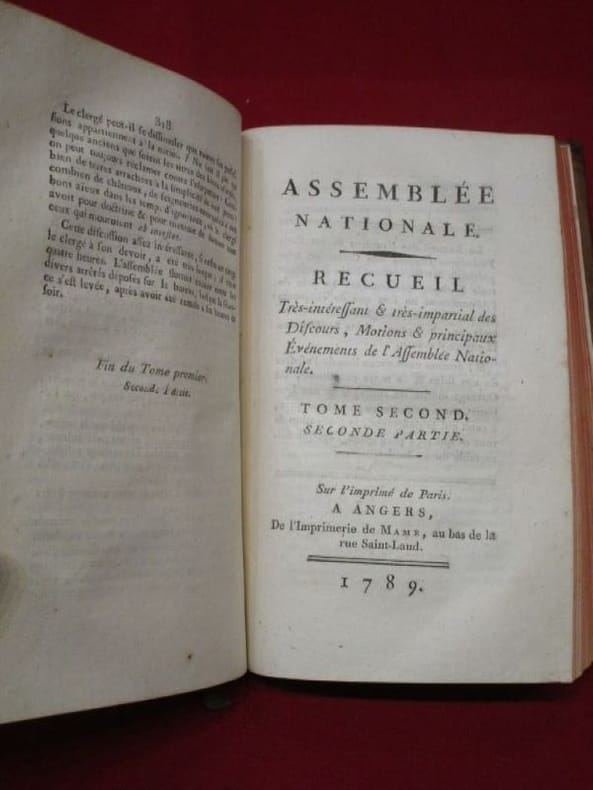
115082[Sl, sd], 1789 - A Angers, Pavie, 1789, 2 volumes in-8 de 125x195 mm, 318,320 pages - 612 pages. Pleines reliures marbrées, dos à cinq nerfs portant titres et tomaisons dorées sur pièces de cuir bordeaux et vert, caissons ornés, filet doré sur les coupes, tranches rouges, gardes de papier marbré à la coquille. Bon état général malgré les défauts de reliure à signaler (une coiffe manquante, début de fente sans gravité sur le mors supérieur du deuxième volume, des griffures et manques de cuir, coins émoussés), ex libris tamponné sur les pages de titre, erreurs de pagination sans manques, 8 feuillets insérés au deuxième volume ( "Projet de bienfaisance", "Avis du sieur Pavie"), intérieur frais.
Roy. 4to., First Edition; original printed wrappers, wire-stitched as issued, covers lightly age-marked and soiled else a very good, clean copy. Painter's review appears on p.823.