LYND] [RobertMareMagnum

47 062 résultats
Roy. 4to., First Edition; original printed wrappers, wire-stitched as issued, covers mildly browned and frayed at edges a very good, clean copy.
Very Good Turkish, Ottoman (1500-1928) Original newspaper issue. 64x45 cm. In Ottoman script. 4 p., richly illustrated. Half of the first page of the newspaper is devoted to the disagreement Monsieur Edward Höcknen, who was ex-director of the Turkish Anatolian - Baghdad Railways. The caricature shows that Monsieur Höcknen stops the train with his giant arms. According to the news on the newspaper, this international question is solved by Zekâi Bey who was Aydin muavini. Tevhîd-i Efkâr was a daily political newspaper published between 15 June 1921 and 6 March 1925. Its editor-in-chief was Velid Ebüzziya, (1884-1945). It was published in Istanbul during the Turkish War of Independence, (1919-1922), and supported the War of Independence. But after the proclamation of the Republic, he started an intense criticism campaign. Thereupon, 'Yeni gün' [i.e. New Day in Anatolia], Hakimiyet-i Milliye newspapers started opposition to the Istanbul press and Tevhid-i Efkar. With the approval of the three-point Takrir-i Sükûn Law on 4 March 1925, newspapers such as Tevhid-i Efkâr, Istiklal, Son Telgraf, and Tanin, which were published in Istanbul, and the magazine Sebilürresad were closed. Extremely rare.
Very Good Turkish, Ottoman (1500-1928) Contemporary cloth bdg. made after the Turkish Letter Revolution, in Latin script. Folio. (38 x 28 cm). In Ottoman script (Old Turkish with Arabic letters). 36 issues complete set. Exceedingly rare complete ran of important illustrated "Bosbogaz ile Güllabi" [i.e. The Gabbler and the Asylum Guard], which is an Ottoman satirical magazine, published twice a week from 6 August to 14 December 1908 in Istanbul by Hüseyin Rahmi Gürpinar (1864-1944) and Ahmet Rasim (1864-1932) in a total of 36 issues. The articles of the magazine contained original and fine jokes and satire. In addition to various writings, it also contained caricatures of famous people of the time and jokes about the magazine Mizan. Among other things the caricatures related to the annexation of Bosnia and Herzegovina. Some of the humorous articles were published in series and the articles were written in simple language and in a linguistic style appropriate to the period. In addition, Bosbogaz ile Güllabi contained daily news and serious articles that appeared under the name "Bosbogazin ciddî makalesi" ("Serious Bosbogaz Articles"). Apart from the signed articles, there were many anonymously written articles in the magazine. It is possible to trace them back to Hüseyin Rahmi because of the same writing style. Due to his critical style, he took over the administration of the magazine, which was published several times by the Ottoman government. Another famous writer besides Gürpinar and Ahmet Rasim was Mithat Cemal Kuntay (1885-1956). (Wikipedia). Duman 262.
Very Good Turkish, Ottoman (1500-1928) Contemporary quarter leather bdg. Handsomely bound. Six raised bands to spine, the second compartment has the title, the fifth has "issue 1-104", and the sixth has ex-owner's name of the volume, "Semseddin" lettered gilt. Original end-papers of the period. Slightly age-toned on the lower pages, fading on extremities of boards, overall a very good volume. Folio. (41 x 29 cm). In Ottoman script (Old Turkish with Arabic letters) and Turkish with Latin letters. This folio volume consists of 104 issues of the periodical, each issue has 4 pages, which has mostly color illustrated covers as well as several b/w ones. A rare togetherness of the first 104 issues of this Turkish satirical magazine, richly illustrated with thousands of attractive illustrations and caricatures, was published in Istanbul twice a week every Wednesday and Saturday with at least four, at most eight pages, during the Letter Revolution 1928, when the transition from the Arabic alphabet to new Latin letters was ensured. The collection provides an invaluable resource, reflecting the changes in society during and after the Letter Revolution in New Turkey, 1928, placing the new Latin alphabet instead of old Arabic letters and contributing to the development of reading and writing skills of the new Turkish society, as well as "creating the basis for the rapid social evolution in the young Turkish Republic Revolution" soon after the proclamation of the Republic in 1923. The newspaper had a printing house with the same name headquartered in Bab-i Ali (The Sublime Porte of Constantinople), the place where the heart of the Ottoman press was. Burhan Cahid Morkaya left Karagöz Newspaper and founded Köroglu Newspaper in 1928 and wanted the people living in Istanbul and Anatolia to be able to read and write new letters. Indeed, during the period of its publication, Köroglu Newspaper reached the most remote corners of the New Turkish Republic with its attractive cartoons covering local and mostly international subjects. In addition to this news and cartoons, Morkaya also published Turkish reading passages with Arabic letters that were transcripted into Latin letters. Therefore, he created a great positive effect that facilitated the transition to new letters during the Turkish Alphabet Revolution. Duman 1155.
Very Good Tatar Paperback. A little split on cover. A good copy. Large roy. 8vo. (25 x 18 cm). In Tatar (with Arabic letters). 41 p. Yana milli yul.= Yana millî yol. Jahrg. 4. Januar 1932. No: 1. Chefredakteur und Herausgeber: Ayas Ishaki. Ishaki was a leading figure of the Tatar national movement, author, journalist, publisher and politician. Gayaz Ishaki was born in 1878 in the village of Yaushirma near Kazan to a Mishar Tatar family. He was home-schooled by his father at an early age and was sent to study in a madrasah (religious school). He continued his education in the Russian-Tatar teachers' school (1898-1902). Gayaz Ishaki moved to Kazan in 1904, where he became acquainted to socialists and adopted some of their views. He became involved in revolutionary activities and subsequently was arrested and sent to a prison near the city of Arkhangelsk in northern Russia in 1907. After the February revolution of 1917 he was involved in activities aimed at achieving cultural autonomy for the Volga Tatars and other Turkic peoples of Russia. As a result of his activities, the Soviet authorities started a campaign of harassment and persecution against him and his associates. He was forced to emigrate in 1920. After settling in Germany, Gayaz Iskhaki started publishing a Tatar-language magazine "Milli Yul" ("the Way of the nation") in 1928. In 1939 the magazine was closed and Iskhaki decided to immigrate to Turkey. After World War II he became involved in political activities. At this stage his main goal was the restoration of the Tatar nationhood lost in 1552 when the Kazan Khanate was defeated and occupied by the Moscow Principality. Throughout his life Gayaz Iskhaki traveled to Poland, Germany, Japan, China and Turkey where he tried to establish Tatar-language press and unite disparate Tatar emigree communities. Gayaz Iskhaki died in 1954 and was buried in Edirnekapi graveyard of Istanbul.
Very Good Tatar Paperback. A little split on cover. A good copy. Large roy. 8vo. (25 x 18 cm). In Tatar (with Arabic letters). 33 p. [The way of the nation] Yana milli yul.= Yana millî yol. Jahrg. 4. Dezember 1932. No: 12. Chefredakteur und Herausgeber: Ayas Ishaki. Ishaki was a leading figure of the Tatar national movement, author, journalist, publisher and politician. Gayaz Ishaki was born in 1878 in the village of Yaushirma near Kazan to a Mishar Tatar family. He was home-schooled by his father at an early age and was sent to study in a madrasah (religious school). He continued his education in the Russian-Tatar teachers' school (1898-1902). Gayaz Ishaki moved to Kazan in 1904, where he became acquainted to socialists and adopted some of their views. He became involved in revolutionary activities and subsequently was arrested and sent to a prison near the city of Arkhangelsk in northern Russia in 1907. After the February revolution of 1917 he was involved in activities aimed at achieving cultural autonomy for the Volga Tatars and other Turkic peoples of Russia. As a result of his activities, the Soviet authorities started a campaign of harassment and persecution against him and his associates. He was forced to emigrate in 1920. After settling in Germany, Gayaz Iskhaki started publishing a Tatar-language magazine "Milli Yul" ("the Way of the nation") in 1928. In 1939 the magazine was closed and Iskhaki decided to immigrate to Turkey. After World War II he became involved in political activities. At this stage his main goal was the restoration of the Tatar nationhood lost in 1552 when the Kazan Khanate was defeated and occupied by the Moscow Principality. Throughout his life Gayaz Iskhaki traveled to Poland, Germany, Japan, China and Turkey where he tried to establish Tatar-language press and unite disparate Tatar emigree communities. Gayaz Iskhaki died in 1954 and was buried in Edirnekapi graveyard of Istanbul.
Very Good Tatar Paperback. A little split on cover. A good copy. Large roy. 8vo. (25 x 18 cm). In Tatar (with Arabic letters). 33 p. [The way of the nation] Yana milli yul.= Yana millî yol. Jahrg. 6. Marz 1934. No: 3 (74). Chefredakteur und Herausgeber: Ayas Ishaki. Ishaki was a leading figure of the Tatar national movement, author, journalist, publisher and politician. Gayaz Ishaki was born in 1878 in the village of Yaushirma near Kazan to a Mishar Tatar family. He was home-schooled by his father at an early age and was sent to study in a madrasah (religious school). He continued his education in the Russian-Tatar teachers' school (1898-1902). Gayaz Ishaki moved to Kazan in 1904, where he became acquainted to socialists and adopted some of their views. He became involved in revolutionary activities and subsequently was arrested and sent to a prison near the city of Arkhangelsk in northern Russia in 1907. After the February revolution of 1917 he was involved in activities aimed at achieving cultural autonomy for the Volga Tatars and other Turkic peoples of Russia. As a result of his activities, the Soviet authorities started a campaign of harassment and persecution against him and his associates. He was forced to emigrate in 1920. After settling in Germany, Gayaz Iskhaki started publishing a Tatar-language magazine "Milli Yul" ("the Way of the nation") in 1928. In 1939 the magazine was closed and Iskhaki decided to immigrate to Turkey. After World War II he became involved in political activities. At this stage his main goal was the restoration of the Tatar nationhood lost in 1552 when the Kazan Khanate was defeated and occupied by the Moscow Principality. Throughout his life Gayaz Iskhaki traveled to Poland, Germany, Japan, China and Turkey where he tried to establish Tatar-language press and unite disparate Tatar emigree communities. Gayaz Iskhaki died in 1954 and was buried in Edirnekapi graveyard of Istanbul.
Very Good Bulgarian Original blue cloth bdg. with embossing. Slightly stains on boards and toned on pages. Otherwise a very good copy. 12mo. (16,5 x 12 cm). In Bulgarian. 1230, [2] p. [HOLY BOOK IN BULGARIAN PRINTED IN TSARIGRAD (CONSTANTINOPLE)] Bibliia sirech sveshtenoto pisanie na Vetkhiia i Noviia zavet: Viarno i tochno prevedena ot pûrvoobraznoto. [.] In 1840 5,000 copies of the first complete translation of the New Testament were printed in Smyrna by the British and Foreign Bible Society. A second edition which was printed in Smyrna in 1850 was an almost exact reprint of the 1840 edition. A third edition followed in 1853 with 15,000 copies. The fourth edition was published in 1857 in Bucharest, and for the first time civil characters type was used. In 1859, two more editions were published. In 1866, a new "pocket" edition with text revised by Elias Riggs and Dr. Albert Long was printed in Constantinople. The New Testament was revised and reprinted a total of nine times. In the period from 1840 to 1860 the Eastern (Tarnovo) dialect was adopted as literary Bulgarian language and the Macedonian dialect, in which the New Testament had been translated, was widely rejected. By 1858 Neofit Rilski had finished large portion of the Old Testament. Riggs met with Neofit Rilski and discussed a possible revision of the Bulgarian New Testament to remove the Macedonian dialect elements. Neofit objected the revision, so Riggs took the translation and returned to Constantinople. In January 1859 Riggs invited the Bulgarian teacher Hristodul Kostovich to help him with the revision. In 1862 Long and Riggs visited the noted Bulgarian writer and poet Petko Rachov Slaveykov in Tryavna. Slaveykov agreed to help with the translation and began the work on the revising of Neofit's New Testament at once. Long joined the revision of the New Testament into the Eastern dialect in 1863 and later assisted with the translation of the Old Testament. In June 1871, after more than 12 years of revision and translation, 36,000 copies of the complete Bible translation in Bulgarian were published in Constantinople. The translation came to be known as the "Tsarigrad (Constantinople) Edition". Tsarigrad [or; Tsargrad, Tzargrad, Czargrad] Tsargrad is a Slavic name for the city or land of Constantinople, the capital of the Eastern Roman (Byzantine) Empire, and present-day Istanbul in Turkey. A physical copy of this edition is not located in OCLC. For digital register: OCLC 181122059.
This is a very good softcover copy with just light cover wear. Very clean inside and out. Spine rubbed faded. Text in English and Japanese. This is the March 1974 issue of a + u Architecture and Urbanism Volume 5, No. 39. This issue was one in a series a + u did in 1974 on contemporary American residential architecture. One of the features is titled 'Study of American Architecture, 100 Works of Contemporary Houses, Part 2'. Illustrated in black & white and color, with photographs, interiors, elevations, architectural drawings and details. 12" high X 9" wide, 127 pages. This book will be securely packed and shipped with tracking.
19464000907621946 1946. A. Ancel: Le communisme et les paysans/ Providence du Prado 1946 . A. Ancel: Le communisme et les paysans/ Providence du Prado 1946
- Editions de la Nouvelle Revue Française, Paris 1er septembre 1909, 14,5x22,5cm, broché. - Edition originale, un des rares exemplaires de luxe sur Japon. Edition pré-originale d'A André Chénier de François-Paul Alibert. Contributions de Michel Arnaud, François-Paul Alibert, François Porché, Jean Talva et Louis Laloy. Quelques infimes taches sur le second plat et une trace de pliure sur le premier, sinon bel exemplaire. Rarissime exemplaire en grand papier d'un des tous premiers numéros de la revue littéraire française la plus célèbre du vingtième siècle. [ENGLISH DESCRIPTION ON DEMAND]
- In La Nrf N°330 de la 29ème année, Paris 1194, 14x22,5cm, broché. - Edition originale. Autres contributions de M. Jouhandeau, J. Merrien, Alain... Rousseurs sur les plats. [ENGLISH DESCRIPTION ON DEMAND]
- Nrf, Paris 1er août 1941, 14,5x23cm, broché. - Edition originale. Autres contributions de M. Jouhandeau "Minos et Moi", C. Vermorel "Marche de Nuit", B. Fay "Caractère de l'Esprit français", J. Merrien "Le Breton", Alain "Les aventure du Coeur", R. Fernandez "De Melville à Giono"... Agréable exemplaire. [ENGLISH DESCRIPTION ON DEMAND]
A9781345901139Hardback. New. hardcover
052609351X.Ghardcover. Good. Access codes and supplements are not guaranteed with used items. May be an ex-library book. hardcover
19011000929.60Government Printing Office Washington D. C 1901. Hardcover. Very Good. 4to. Hardcover maroon cloth no dj. Vg condition for its age. Ex-Lib of Congress copy front bookplate library markings to opening pgs. front cover gilt-stamped "Librarian's Office". 1/4-inch chip across upper & lower spine cloth board corners mildly rubbed 1-inch split to rear edge of lower spine to minor effect; otherwise contents clean binding & hinges tight. 292 pp. Geographically arranged & revised to the close of the 19th century. Government Printing Office, Washington, D. C hardcover
1929180117Washington, 1929. 4°. 209 S. OBr. Rücken etwas angerissen u. m. Fehlstelle Umschl. M. kl. Eckabschnitt u. kl. Flecken.
Saggi di: Emma Abate (Sedecia e l'assedio di Gerusalemme: funzioni mitiche e rituali di un racconto biblico), Alessandro Catastini (La lettere di Cesare Malanima a Gian Bernardo De Rossi), Mohamed Elmedlaoui, Akeel Almarai, Vincenzo Vergiani, Phyllis Granoff (Mahakala's journey: from Gana to God), Arcangela Santorno (Gandhara and Kizil: the Buddha's life in the Stairs Cave), T. K. Bhatia, Ashok Koul (Colloquial Urdu. A complete course for beginners), et al. . 8vo. pp. 306. . Perfetto (Mint). . Volume LXXVII, Fasc. 1-4 (2003). .
193397828452357991933, Sans mention de l'éditeur, in 4 broché. | Etat : Bon état général. (Ref.: G9774)
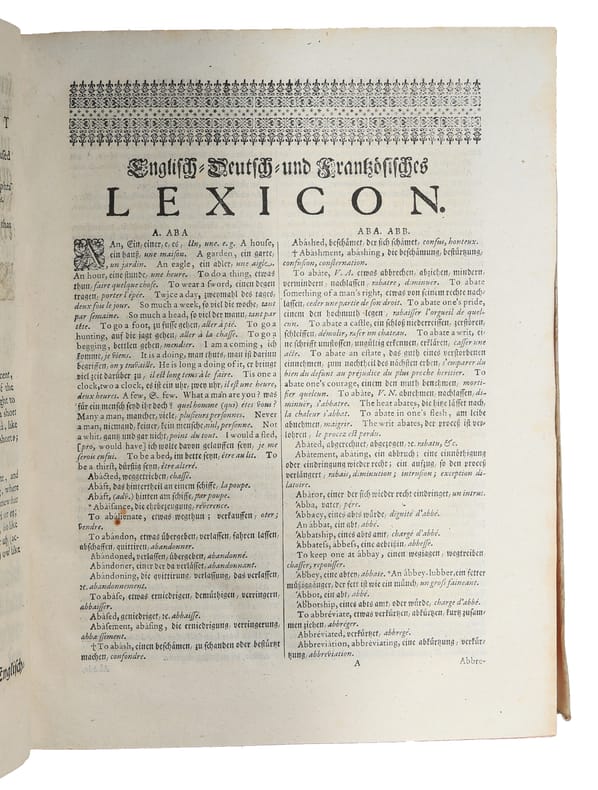
176354078London, Millar, Nourse, and Vaillant, 1763. Folio. Contemp. full sprinkled calf. 6 raised bands. Titlelabel with gilt lettering. IV a. (10) pp. + Ca. 600 unnumbered pages.
170661320Leipzig, Thomas Fritschen, 1706. 4to. In contemporary full vellum with yapp edges and gilt lettering to spine. All edges coloured in red. Light wear to extremities. Ex-libris (Carl Juel, Danish statesman and owner of Valdemar's Castle) pasted on to pasted down front end-paper. Two-line note in contemporary hand to front free end-paper. First 5 leaves evenly browned. A very nice and clean copy. (14), 786 pp. + frontispiece depicting Sophia Electress of Hanover, Hereditary Princess of England, mother of George I.
First Edition, orig. cloth. Over 400 items described.
Wiesbaden, Otto Harrossowitz, 1966. Royal8vo. Orig. full cloth with dustjacket. XVII,1110 pp.
London, Millar, Nourse, and Vaillant, 1763. Folio. Contemp. full sprinkled calf. 6 raised bands. Titlelabel with gilt lettering. IV a. (10) pp. + Ca. 600 unnumbered pages.
1849jk1511051317xbvk(Lisboa), na Imp. da Epoca, 1848/1849. 430 / 400 pages, printed in two columns; with many illustrations. - Ca. mid-20th-century solid dark-red halfcloth binding with giltstamped title at spine (spanish bookbinder-label); 4to.(ca. 28 x 21 x 4 cm; ca. 1,6 kg.).