133 résultats
1769123270London: J Cooke 1769. Hardcover. Good. Rare. 4vo. 792pp with list of subscribers. From the George III preface onwards the condition of the text is very good/fine as is that of all the many full page engravings. The full leather binding is probably original but the front board is missing and the back boards and last few pages are detached. There are no front endpapers but the binding of all the rest of the text until the last pages is tight and robust. The title page has wear and tear with some inches of paper loss to the top edge near the spine and a little paper loss also to the middle of the outside edge. No foxing. Photos available on request. <br/> <br/> J Cooke hardcover
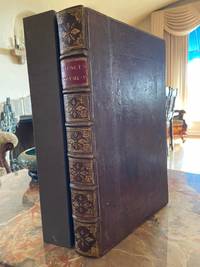
1747223<b>First Edition 1747. Complete with 41 plates. Tall folio 11 by 17 inches contemporary full tan polished calf newly rebacked to style with elaborately gilt-decorated spine with seven compartments. Engraved frontispiece portrait by George Vertue after Isaac Whood 17 vignette tailpieces and 41 full-page engraved plates four double-page two of these folding by Boitard after Paderni and others. Covers & corners slightly rubbed. Internally there is a little intermittent light spotting but generally a clean and bright copy now housed in a custom slipcase made by The Heritage Bindery. Many years in the making this large and finely printed volume traces classical mythology in Roman art and literature. "Remains an agreeable book owing to the urbanity of its old-fashioned scholarship the justice of some incidental observations and its affluent stores of quotation; and as an intellectual if heterogeneous banquet may be compared with the Deipnosophists of Athenaeus. Gibbon speaks of its taste and learning" DNB. Samuel Johnson wrote of Spence: "His criticism was commonly just; what he thought he thought rightly and his remarks were recommended by coolness and candor" DNB. "A highly regarded work" Brunet.</b><br /> Published by London; R Dodsley 1st edition,, 1747. hardcover
1731048653Lisboa: Officina Herreriana 1731. Second Edition. Hardcover Full Leather. Very Good Condition. Attractively bound in later but old acid calf with gilt spine. Light wear remains of old paper label to spine inner joint slightly cracked but binding quite firm; marbled endpapers later blank endpapers. Small section with a bit of worming in the lower margin not really touching any text slight creasing to text. A bright attractive copy of the second Spanish language edition. 18 252pp<br /> <br /> Related to Portuguese poet and historian de Faria y Sousa's planned history of the Portuguese in all the parts of the world of which Asia Portuguesa Europa Portuguesa and Africa Portuguesa appeared posthumously . The first edition of this work appeared in 1642 but without de Faria y Sousa listed as the author. Palau 86689 Brunet V 272 1642 ed<br /> <br /> Provenance: Jose da Silva Santos Porto bookplate or bookshop ticket; Dorothy Willard Straight bookplate Size: Folio. Quantity Available: 1. Shipped Weight: Under 1 kilo. Inventory No: 048653. Officina Herreriana hardcover
17753730London: Printed for T.Lowndes 1775 1775. First edition. 4to. 265x210mm. pp. iv 764 10 index. Ten engraved plates frontispiece portrait of the author and a further nine. The verso of the second leaf of preliminaries is numbered vi. Some foxing in places but otherwise internally very good with the plates in excellent condition. Handsomely bound in slightly later red straight-grained morocco upper and lower covers decorated with two double fillet borders in gilt enclosing a continuous "drawer-handle" design in blind and framing a continuous swag and drop border in blind. Spine with five double raised bands decorated in gilt and blind and lettered in gilt to the second and fifth compartment. Edges of the boards decorated in gilt. Turn-ins decorated in gilt with a wavy dotted line and ears of wheat with a flower motif in the corners. All edges gilt. The binding is of a very high standard. It is unsigned but the tooling and overall design conforms to the work of the German emigré binders and we would tentatively attribute the binding to either Christian Kalthoeber or John Bohn and date it to the 1790s or the very early years of the 1800s. A previous owner has inscribed the verso of the front free endpaper "Bound by Edwards of Halifax ". This seems unlikely but it is possible given the subject matter of the book and the links between Edwards and the German emigré binders that this copy did pass through Edwards's hands. John Watson 1723-1783 was that perfect eighteenth-century combination of clergyman and antiquary. He was the curate of Halifax between 1750 and 1754 and retained links with the town throughout his life. Starting with Druidical remains and moving through Roman affairs Watson brings the reader up to the eighteenth century. He covers the history of Halifax and provides details of the main buildings in the town as well as exploring fascinating byways such as "Remarks on the Dialect of Halifax""Vocabulary of Uncommon Words used in Halifax" and "A Catalogue of Plants Growing in the Parish of Halifax". London: Printed for T.Lowndes 1775 hardcover
17754402888London: F. Newberry 1775. Twelve duodecimo volumes with 117 engraved plates of 118 lacking plate XXVII 'Black tiger male panther and lynx'; preliminaries thumbed title of one volume perforated and another significantly browned one leaf of text ink-stained general foxing and offsetting; original sheep leather binding scuffed with split hinges; worn as is often the case with juvenile literature of this period but a charming set. <p><p>A comprehensive natural history encyclopaedia for young people based on Pennant's system of classification. Animals are arranged according to quadrupeds fish birds and insects and each of these classifications is separately indexed. Besides the more usual natural history descriptions of animals vegetables and minerals this work is the first to describe for children Australia's most famous marsupial -- the kangaroo. The entry under the Jerboa vol. III p. 172 reads "Mr. Banks brought home the skin of an animal which he calls the kanguroo sic which from its general outline and the most striking peculiarity of its figure greatly remembers the jerboa yet it entirely differs in size and in many of those minute distinctions which point out the general ranks of nature. The kanguroo is often known to weigh above fifty pounds."</p> <p>The kangaroo was first seen by both Banks and Cook on 24 June 1770 and the first description of it appeared in Hawkesworth's Account of the Voyages published in 1773: "I should have taken it for a wild dog if instead of running it had not leapt like a hare or a deer. Mr. Banks also had an imperfect view of this animal and was of opinion that its species was hitherto unknown." During the remainder of the exploration of the east coast of Australia Cook records that both he and Banks shot and ate kangaroo on several occasions. He records two in particular that weighed eighty pounds and fifty-four pounds the skins of which Joseph Banks took back to England with him.</p> <p>Illustrations of over four hundred animals finely engraved in copper complete this charming eighteenth-century work intended solely to be used by children.</p> </p> . F. Newberry unknown
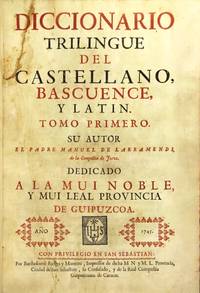
174542910San Sebastian: por Bartholome Riesgo y Montero impressor de dicha M N y M.L. Provincia 1745. First edition 2 volumes folio pp. 18 ccxxix 1 436; 2 392 12; titles printed in red and black lexicon in double column engraved amorial headpiece errata leaf at the back of vol. II; full 19th-century speckled calf red edges double gilt-ruled borders on covers gilt-decorated spine in 6 compartments red and black morocco labels in 2; a few minor imperfections hinges tender else a very good sound set. Bookplate of "Milton / Peterborough." This is the first dictionary of Basque preceded only by Oihenartus' Notitia utriusque Vasconiae tum Ibericae tum Aquitanicae Paris 1638 to which was appended a Basque word list. Larramendi also compiled a Basque grammar 1729. Entry words are in Castilian with Basque and Latin equivalents. The 230-page introduction is an extensive history and grammar of the Basque language the only non-Aryan language of western Europe and a language unaffilliated with any other. Not in NUC. Not in Collison Dictionaries of Foreign Languages; Trübner's Catalogue of Dictionaries and Grammars cites only the 1853 revision. Palau 132048; Zaunmuller col. 28. por Bartholome Riesgo y Montero, impressor de dicha M N y M.L. Provincia unknown
174542910San Sebastian: por Bartholome Riesgo y Montero impressor de dicha M N y M.L. Provincia 1745. First edition 2 volumes folio pp. 18 ccxxix 1 436; 2 392 12; titles printed in red and black lexicon in double column engraved amorial headpiece errata leaf at the back of vol. II; full 19th-century speckled calf red edges double gilt-ruled borders on covers gilt-decorated spine in 6 compartments red and black morocco labels in 2; a few minor imperfections hinges tender else a very good sound set. Bookplate of "Milton / Peterborough." This is the first dictionary of Basque preceeded only by Oihenartus' Notitia utriusque Vasconiae tum Ibericae tum Aquitanicae Paris 1638 to which was appended a Basque word list. Larramendi also compiled a Basque grammar 1729. Entry words are in Castilian with Basque and Latin equivalents. The 230-page introduction is an extensive history and grammar of the Basque language the only non-Aryan language of western Europe and a language unaffilliated with any other. Not in NUC. Not in Collison Dictionaries of Foreign Languages; Trubner Catalogue of Dictionaries and Grammars cites only the 1853 revision. Zaunmuller col. 28. <br/><br/> por Bartholome Riesgo y Montero, impressor de dicha M N y M.L. Provincia unknown books
17700012203England: 18th Century Religious Sermons Early Typography Manuscript Christian. Very Good with no dust jacket. 1770. Hardcover. On offer is a beautiful hard-bound collection of sermons written by many prominent religious scholars of the time dating from late 18th century England and curated by the Reverend Dr. John Trusler 1735-1820. The book is a collection of sermons and homilies. They include homilies with such titles as On domestic Happiness The notice of the World a motive to virtue The Advantage of Public or Private Calamities On partaking of other men's Sins and more. The collection belonged to William Armstrong whose name appears on the front flyleaf. However our informal research has not found any additional information about him. From some notes made in the book this volume was used in 1770-1771. Curated by Rev John Trusler the sermons are printed with beautiful early typography intended to mimic manuscript font. This was a part of Truslers lucrative scheme in which he proposed printing sermons in script type to imitate handwriting and then sell them to clergymen who did not want to write their own sermons. Each sermon is credited to their original author at the end. Included sermons are credited to Baptist minister James Foster 1697-1753 British Unitarian minister William Enfield 1741-1797 Anglican clergyman Laurence Sterne Archbisop of Canterbury William Wake 1657-1737 and Bishop of Chichester Thomas Manningham 1651 -1722. A few sermons are listed as compiled and some are not credited but include additional notes and annotations from the collections curator Rev John Trusler. Trusler has signed his name in ink at the end of many of the sermons. This book is an example of Dr. Truslers early attempts at establishing a printing and bookselling business. In 1769 Trusler sent circulars to every parish in England and Ireland proposing to print in script type in imitation of handwriting about a hundred and fifty sermons at the price of one shilling each to save the clergy both study and the trouble of transcribing Wikipedia. This collection of sermons therefore seems to be an example of Truslers sermon curation peppered with his own additions and notes some in the form of small attached pages others in the form of full pages of manuscript notes. Before becoming a printer and bookseller Trusler took his holy orders and became a priest in 1759 rising through the ranks of British clergy work. He also worked as a lecturer eventually establishing an academic academy only to give it up when it was not lucrative and move on to medical school at Leyden University. While his name does not appear in their catalogue of graduates he did assume the title of doctor. In the end his most lucrative undertaking was his sermon sales and publishing business in which he published many books including his own memoir. This absolutely remarkable unique relic of 18th century British Christian history and early typography would be a sensational asset to any library and the sermons contained within provide an excellent window into the religious/moral thinking of the day as preached in Christian congregations in England Interesting to note one single annotated page of a sermon contained in this book in the same typescript sold for 1500 British pounds through Forum Auctions in September of 2021. The volume measures approximately 8.5 inches by 5.5 inches and contains 100 pages. The hard covers although stained are in good condition. The pages are all in excellent condition save for one page with some rips and tears. Both the typography and handwriting is not only clear but beautifully done. The title Sermons M. S is stamped on the spine. ; Manuscripts; 8vo 8" - 9" tall; 100 pages; Signed by Author . 18th Century Religious Sermons Early Typography Manuscript Christian hardcover