133 résultats
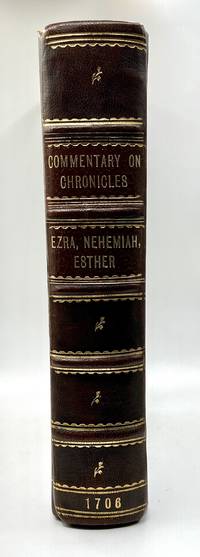
17060104485<p>A Commentary Upon the Two Books of Chronicles: Ezra Nehemiah and Ester By The Right Reverend Father in God Symon Lord Bishop of Ely. Printed for R.I Chilwell at the Rose and Crown in St. Paul's Churchyard 1706. First edition. Leather binding. It appears that this has been rebound at some point. The spine is in beautiful condition- with five raised bands. The boards maybe original as they are a slightly different colour and have more signs of wear and scuffing. The end papers seem to be newer paper than the book contents. Rest of the book is original. Some chipping to page edges and some marks including what look like finger prints to page edges. Some staining to top half of first few pages but text is still completely legible. Pre-owned.</p> R.I.Chilwell hardcover
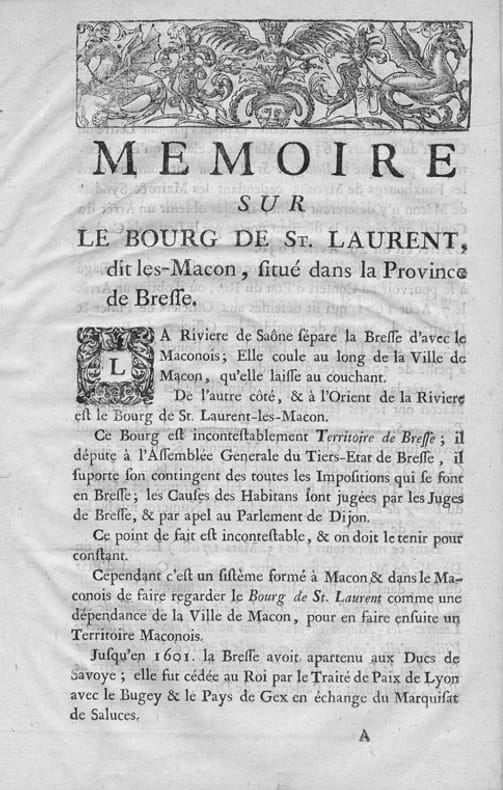
17689853S.l., s.n., s.d. (circa 1768) ; in-4 ; demi-veau havane (reliure moderne) ; 13 pp.
179495941/2 reliure usagée tardive. Très rare plaquette éditée à Rome par le curé de Villes (Sur Ozon ?) refugié à Rome pendant la Révolution. 1/2 basane Bon Rome Fulgoni 1794 1 volume in-8°
1766016077London: Printed for S. Crowder 1766. Book. Very Good. Hardcover. The Second Edition. Folio 21 x 32cm. The second edition with additions and improvements; pp. iv 45 iii publisher's adverts; engraved frontispiece map of the world five further engraved plates of maps and one engraved plate of globes ten engraved figures and diagrams within the text. Contemporary half textured calf binding with marbled paper boards expertly restored with a new spine in matching style re-corned. contents clean and tight a few small marks/reading wear; frontispiece plate with a couple of short edge-tears expertly and inconspicuously repaired a few corners re-tipped. A very good well-presented copy. Scarce. Printed for S. Crowder Hardcover
1758075560Madrid: Oficina de Joachin Ibarra 1758. Tapa dura. Good. 311 296 pp. 145 x 195 cm. Oficina de Joachin Ibarra hardcover
1753023000Madrid: Imprenta de la Viuda de Manuel Fernández 1753. No consta edición. Tapa dura. Good. 352 pp. 15 x 20 cm. Cubiertas y lomo deteriorados. Interior en buen estado. Papel limpio. Imprenta de la Viuda de Manuel Fernández hardcover
17753730London: Printed for T.Lowndes 1775 1775. First edition. 4to. 265x210mm. pp. iv 764 10 index. Ten engraved plates frontispiece portrait of the author and a further nine. The verso of the second leaf of preliminaries is numbered vi. Some foxing in places but otherwise internally very good with the plates in excellent condition. Handsomely bound in slightly later red straight-grained morocco upper and lower covers decorated with two double fillet borders in gilt enclosing a continuous "drawer-handle" design in blind and framing a continuous swag and drop border in blind. Spine with five double raised bands decorated in gilt and blind and lettered in gilt to the second and fifth compartment. Edges of the boards decorated in gilt. Turn-ins decorated in gilt with a wavy dotted line and ears of wheat with a flower motif in the corners. All edges gilt. The binding is of a very high standard. It is unsigned but the tooling and overall design conforms to the work of the German emigré binders and we would tentatively attribute the binding to either Christian Kalthoeber or John Bohn and date it to the 1790s or the very early years of the 1800s. A previous owner has inscribed the verso of the front free endpaper "Bound by Edwards of Halifax ". This seems unlikely but it is possible given the subject matter of the book and the links between Edwards and the German emigré binders that this copy did pass through Edwards's hands. John Watson 1723-1783 was that perfect eighteenth-century combination of clergyman and antiquary. He was the curate of Halifax between 1750 and 1754 and retained links with the town throughout his life. Starting with Druidical remains and moving through Roman affairs Watson brings the reader up to the eighteenth century. He covers the history of Halifax and provides details of the main buildings in the town as well as exploring fascinating byways such as "Remarks on the Dialect of Halifax""Vocabulary of Uncommon Words used in Halifax" and "A Catalogue of Plants Growing in the Parish of Halifax". London: Printed for T.Lowndes 1775 hardcover
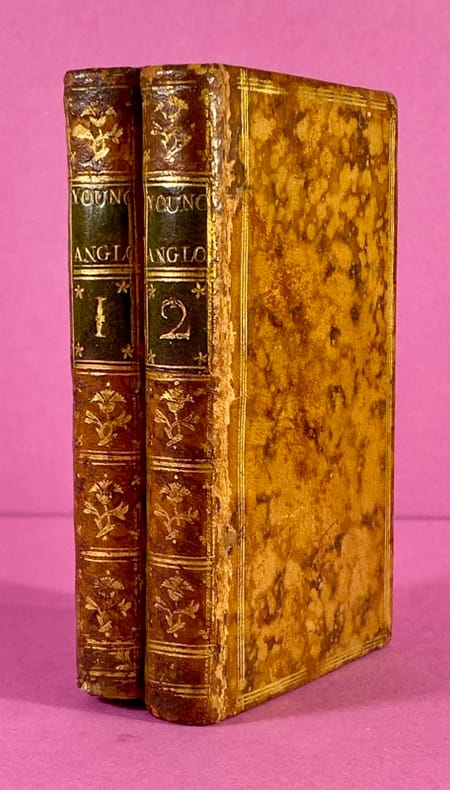
178318291783 Couverture rigide Londres, sans mention d'éditeur, 1783. Deux volumes in-16 (12 x 7 cm) reliure pleine basane d'époque, tranches dorées, triple filet doré d'encadrement sur les plats, dos lisse orné de fleurons dorés, pièces de titre et de tomaison en maroquin olive, quelques frottements aux charnières et épidermes sur les plats, coiffe inférieure du tome I arasée. Tome I : faux-titre, titre, 160 pages, marque d'étiquette au 1er contreplat ; tome II : faux-titre, titre, 189 pages, quelques feuillets brunis. Ex-libris gravé et contrecollé au 1er contreplat. The Complaint, or Night-Thoughts on Life, Death, & Immortality est l'oeuvre phare du Révérend Edward Young, un poème épique, méditatif et philosophique rédigé en vers blancs. Le poème a été écrit après une série de deuils personnels dévastateurs pour l'auteur : le décès de son beau-fils, Narcissa, le décès de sa femme, Elizabeth, et le décès de son gendre, Philander. Ces pertes successives ont plongé Young dans une profonde mélancolie, qui est le moteur central de l'œuvre. Le poème se présente comme le journal nocturne d'une âme en deuil. L'œuvre est divisée en neuf parties, appelées "Nights" (Nuits). Notre ensemble de deux volumes (Vol. I & II) regroupe les premières Nuits (Nuit I à IV, puis Nuit V à IX). Le poème se déroule symboliquement entre minuit et l'aube. L'obscurité est le moment privilégié pour la réflexion solitaire et la confrontation avec la mortalité. Chaque Nuit est une méditation autonome, mais contribue à une progression thématique globale, allant du désespoir à la consolation et à l'espoir. Ce poème, qui a notamment inspiré des philosophes des Lumières (Diderot, Rousseau) s'inscrit dans le mouvement pré-romantique européen. Bon exemplaire.