79 résultats
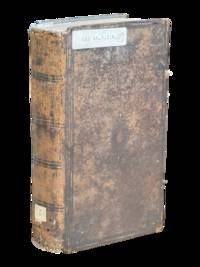
1st Edition Period Half Leather with raised bands and gilt spine lettering and adornment. 8vo, iv, 572, iv, 572 pages. Complete 1st 24 issues of the New Series of this monthly spiritualist periodical. Continuation of The British Spiritual Telegraph and The Christian spiritualist. Includes essays by Henry Ward Beecher, and about Bengal Spiritualism, Levitation in Spain, Spiritualism and Christianity, Zouave a Young Creative Medium, etc. Bibliography of Spiritualism, Lincolns Dream of Warning, Manx Superstitions, SUBJECT(S): Spiritualism -- Periodicals. OCLC: 728344879. OCLC lists only 3 holdings worldwide (Boston Pub Libm Kings Col London, British Lib). Front blank endpaper of Vol I loose, all text pages clean and nice, binding solid and good. Some rubbing and edgwear to boards and spine, Still attractive, About Very Good- Condition Overall. Rare and important. (AC-22-18)
16458917Lyon: Chez Nicolas Gay ruë Merciere à l’enseigne du Phenix 1645. 8vo 17x10cm 8 324 4 58 and 13pp plus 8ff manuscript neumatic notation rectos and versos at rear. Both publications in Latin and French printed in red and black with woodcut vignettes on titles woodcut head and tailpieces and historiated initials. Red-ruled musical notation throughout the first publication. Contemporary mottled calf triple blind fillet around sides floral blind stamp to each corner central blind stamped decoration modern typescript label on upper board corners bumped head and tail of spine chipped and partially lacking tail of spine that is lacking extends to small portion of lower board some wormholes in spine modern typescript library label on spine contemporary metal and leather clasps intact purple library stamp on upper pastedown and title page contemporary ownership inscription on verso of front free endpaper damp stain to lower gutter through p. 46 very occasional faint foxing damp stain to lower gutter from p. 288–final leaf of second book small wormholes running from p. 299 through to lower pastedown affecting text but sense still clear. A Very good example. <br /> <br /> <br /> <p>Roman Catholic book of rituals and other ecclesiastical functions as commanded by Pope Paul V. Instructions printed in red ink in French and sacred text in black ink in Latin. Containing many pages with chants and hymns to be sung during sacred practices. Included are baptisms as prescribed for various ages; exorcisms as a subsection of baptism; penitence; the eucharist mass; communion; the sacrament of extreme unction to be performed when one is gravely ill and expected to perish; funeral and wedding rites; processionals; benedictions; and then another section on exorcisms that are specifically to do with expunging the devil from one’s soul. With the library stamp of the Capuchin Monastery of Sursee Switzerland established in c.1608 now disbanded and converted into a museum. This copy likely well-used in all manner of ritual with contemporary plainchant neumes on 4 lines covering 16 pages at rear. </p> <br /> <p>Both of these texts not found in OCLC in this particular edition. </p> . Chez Nicolas Gay, ruë Merciere, à l’enseigne du Phenix unknown
No Date [1854] 1st edition. Original Green Cloth with embossed gilt illustrated front board & spine Small 8vo, [i]-x, [11]-282 pages; with 6 pages of undated ads. Includes 2 dramatic frontispieces separated by a tissue guard, one shows casting out the evil spirits, the other shows table tipping (reproduced in gilt on the front cover), both with attractive young women at the center. Published just 6 years after the founding of the Spritualist movement in America. Spiritualists often set March 31, 1848, as the beginning of their movement. On that date, Kate and Margaret Fox, of Hydesville, New York, reported that they had made contact with a spirit that was later claimed to be the spirit of a murdered peddler whose body was found in the house, though no record of such a person was ever found. The spirit was said to have communicated through rapping noises, audible to onlookers. The evidence of the senses appealed to practically-minded Americans, and the Fox sisters became a sensation .many early participants in Spiritualism were radical Quakers and others involved in the mid-nineteenth-century reforming movement. These reformers were uncomfortable with more prominent churches because those churches did little to fight slavery and even less to advance the cause of women's rights. Such links with reform movements, often radically socialist, had already been prepared in the 1840s, as the example of Andrew Jackson Davis shows. After 1848, many socialists became ardent spiritualists or occultists. Socialist ideas, especially in the Fourierist vein, exerted a decisive influence on Kardec and other Spiritists (Wikipedia). Only one copy has appeared at a major auction house in the last 100 years. OCLC: 504493987. OCLC lists only 1 copy worldwide (British Library). Rear board also attractively embossed. Spine sunned, occasional light foxing. Very Good Condition. An excellent attractive copy of this exceedingly rare book. (AC-22-20)
170620083Germany 1706. Manuscript in brown ink on paper in Latin and German written in two highly legible secretary hands by one scribe one for Latin and one for German single- and double-column 27 lines to a full page. Contemporary blind-ruled black morocco red edges. Authorial inscription on the pastedown dated 1706 ex-libris inscription on the title verso “J.M. Herré Presbyt. 1802.†In excellent condition. A unique and curious manuscript manual for pharmaceutical exorcisms highlighting a pivotal moment in Enlightenment Era Europe when scientific innovation collided with deeply rooted religious traditions. Divided into four parts the first and longest section of the text provides the necessary incantations psalms and prayers for exorcising evil spirits and putting protections over the body and home. It lists specific saints to invoke for assistance and biblical excerpts to read in different situations. It also includes recipes for holy water talismanic salt and anointing oil as well as holy baths for dunking witches purgatives for vomiting up demons and potions for expelling evil spirits from the house. The recipes for holy water differ according to the intended use: menstruating women plague victims gardens and building foundations. There are also illustrated instructions for making cross talismans.<br /> <br /> The second part of the manuscript is more proscriptive listing practical instructions for conducting exorcisms and equipment necessary such as vessels herbs and fire. It is about setting the stage for the ceremony: arranging furniture restraining the cursed victim administering medications and ointments and creating cleansing smoke. It includes numerous recipes for pharmaceutical implements which are written in German as opposed to Latin for the clerical text presumably because the compounds would be prepared by a layman pharmacist or healer who did not read Latin and because the recipes incorporate contemporary metals and plants that did not have Latin names. The section concludes with an alphabetic glossary of pharmaceutical terms with their definitions in Latin.<br /> <br /> The third part focuses specifically on exorcising demons sent by Satan. The text describes the steps to identify a demonic possession and invoke the help of angels to expel it. The final section comprises an alphabetic materia medica sorted according to ailment. Each entry lists ingredients for medications to treat the illness incorporating pharmaceutical symbols for amounts and dosage. As with the previous section the directions for mixing the compounds are written in German. The manuscript concludes with two alphabetic indices—one for prayers and exorcisms the other for medicine. <br /> It is perhaps worth note that this bookseller has handled dozens of grimoires that were placed on the Index of banned books and used as evidence to convict healers of witchcraft and I find few differences between those texts and this manuscript. This text demonstrates how the essential elements of faith and medicine were at play in very similar ways both within the Church and in the communities of its supposed enemies. unknown