2 542 résultats
234328Paris, Frédéric Léonard, 1711 in-4, [3] ff. n. ch., pp. 7-32, avec 3 belles vignettes gravées (dont une au titre), et un cul-de-lampe, broché sous couverture d'attente de papier coquille.
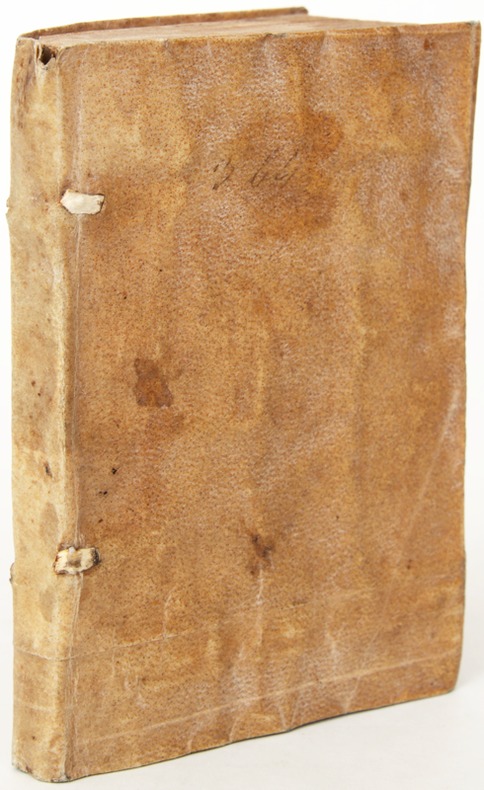
ORD-10433Arrest de la Cour du Parlement de Toulouse du 26 février 1763. Petit in-12 (98 x 162mm) broché, sans couverture, tiré d'un recueil factice, 16 pages. Première feuille détachée sinon bon état. Vigoureuse attaque contre les Jésuites dont les livres seront lacérés & brûlés, comme séditieux, destructifs de tous principes de Morale Chrétienne, enseignant une doctrine meurtrière et abominable...
ORD-10435Toulouse. Vve Bernard Pijon. 1763. In-12 (96 x 161mm) broché, couverture imprimée, tiré d'un recueil factice, 98 pages. Rare.
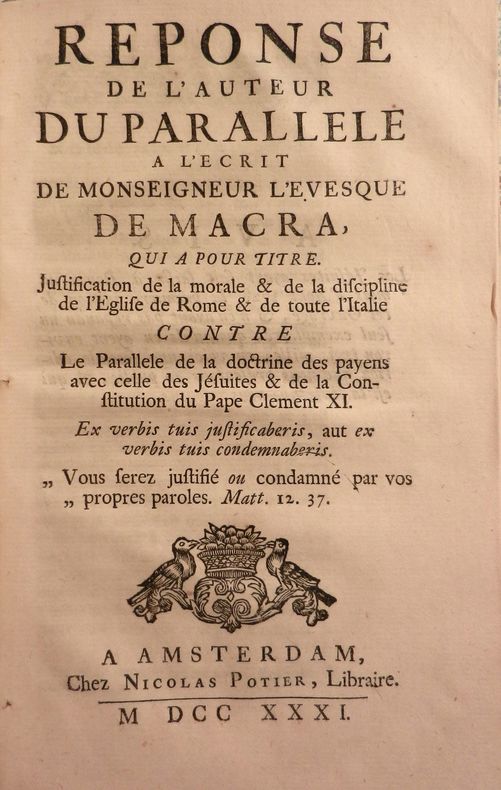
157325Amsterdam, Nicolas Potier, 1731 in-8, 48 pp., cartonnage de papier marbré, pièce de titre cerise en long (reliure moderne). Bon exemplaire.
1983LFA-126736155Un ouvrage de 179 pages, format 145 x 205 mm, broché, publié en 1983, U.E.R. des Lettres et des Sciences Humaines, bon état
1667158961667 basane marbrée (usagée, coiffes arrasées) 2 tomes en 1 vol. in-12, (5ff.), 460pp. et titre, 346pp. (1f.), Lyon Barth. Riviere 1667
1976LFA-126735759Revue mensuelle : 30 pages, format 155 x 210 mm, illustrée, brochée, bon état
1891748861891 Lille, Sté de Saint Augustin, Desclée de Brouwer, 1891grand in 8° relié demi-basane brune, dos lisse orné de filets dorés, 296 pages ; nombreuses gravures.
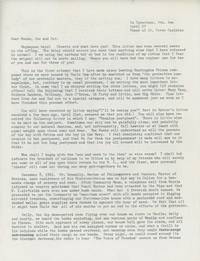
1945List2748Philippines 1945. Single letter; five 8.5 x 11†pages. Pinhole at top of first page missing final pages overall fine. The unknown author of this letter was an American Jesuit missionary in the Philippines who before the war was a novice living in Novaliches just outside Manila. He apparently had not written a significant letter home for a long time: in this letter written in April of what is likely 1945 he recounts his experiences from between December 8 1941 and early January of 1945 shortly before the civilian POW camp in which he was interned was liberated.<br /> <br /> After the “Nips†bomb Pearl Harbor “A feverish month ensuedâ€:<br /> <br /> “We proceeded to put the Community on ‘war-time alert’ with all hands occupied in digging air-raid trenches camouflaging our fortress-like house with a garlanded roof and mud-daubed walls; grain supplies were rushed in against the hour of need. We felt that all it might take Uncle Sam all of six months to put an end to the efforts of the pretender.â€<br /> Around Christmas they evacuated to the Jesuit Ateneo Grade School then in Intramuros as the Japanese were advancing quickly towards Novaliches. Of course this did not prove to be much safer:<br /> <br /> “When darkness came the Japs began their bombing of the Port Area. The bombs began to bounce off the pavement; bombers just skimming our roof-top on their way. We spent the night on our tummies and how we prayed. We thought that each decade of the beads would be our last this side of Purgatory. . When the church sto Domingo was hit the floor beneath us did some tricks and we were lifted up a bit and let down amidst the dust and smoke that poured in from above.â€<br /> <br /> The missionaries try to “salvage important papers and other valuables from the Mission House prior to abandoning it to the fire which threatened the entire Walled City.†During this time they and “a thousand refugees†live in the Ateneo while “Dawn and night raids were supplied by the Japs with nary an American plane to say to them no†– American forces had taken a serious hit and withdrawn outside Manila. It was declared an open city before “the little scrawny but arrogant Japs came into the city and took over†in January of 1942.<br /> <br /> The missionaries persuade the Japanese to let them stay in the Ateneo:<br /> <br /> “We convinced them that it was impossible for us to give up the building because it belonged to the Pope and the Vatican State would hold us responsible. This argument with many ingenious trimmings enabled us to hold on to the Ateneo until June ‘43 when the main building was taken for a military hospitalâ€.<br /> <br /> The author describes how despite what he calls his “partial internment†in Manila he is able to get around checkpoints by pretending to be Belgian. He finishes his studies and begins work at a Belgian convent in Paranaque in February of 1943 living between there and Manila:<br /> <br /> “Incidentally none of this would have been possible if the Japs had gumption enough to find out that I was one of the hated Americans. . All vehicles were obliged to stop here a checkpoint at Baclaran and all passengers get down and file between a Jap sentry and a Filipino constabulary soldier to be searched for hidden arms etc. Since several Belgian Fathers not considered enemy aliens frequently passed this way I was able to walk through unmolested as an unoffending Belgian. . I carefully kept my helmet covering the tell-tale red arm-band which was worn on the arm furtherest away from the Jap. The Filipino would do no more than give me a knowing grin.â€<br /> <br /> On July 10 1944 all of the American civilian POWs are taken to internment camps in Santo Tomas and then Los Baños. In Los Baños the POWs cut wood repair roads and farm. Los Baños would be liberated in February of 1945; the author paints a slightly confusing picture of the leadup to this:<br /> <br /> “Conditions generally ‘worsened’ when on Jan. 8th about the time that the American troops landed at Mindero an island just across from Batangas the Japs got jittery believing that the Yanks were going to do the obvious and cross over the bay to Batangas and they the Japs at Batanga decamped! ‘You are free but remain in camp until the Americans come. Outside your camp Japanese troops will shoot any who leave.’ Great was the joy in Mudville. From nowhere came flag poles on which we quickly unfurled American and British flags .; a short-wave radio was set up and we enjoyed daily Frisco broadcasts .â€<br /> <br /> It sounds as if the missionary was reporting contrary to the usual narrative of the Los Baños raid that the Japanese had essentially given up control of the camp and were like the prisoners simply waiting for the Americans to come get their people. Perhaps something further happened in the nearly two intervening months; however the remainder of the letter is missing.<br /> <br /> Of interest to scholars of modern Jesuit history and of the civilian POW experience during the Second World War. unknown
215063Paderborn [Paris], 1661 [1761]; in-12, 191 pp., texte latin et traduction française en regard, veau fauve marbré, dos lisse cloisonné et fleuronné, simple filet doré sur les coupes, tranches rouges (reliure de l'époque). Importants manques de cuir au dos, mors fendus.
11011Paris, sans date (1929?). 1 volume in-4, (46) pp. (ouvrage non paginé) sur papier à fort grammage, enrichi de nombreuses illustrations photographiques, d'une carte et d'une caricature de Sapajou, broché, très bon état général.
11012Paris, sans date (1929?). 1 volume in-4, (46) pp. (ouvrage non paginé) sur papier à fort grammage, enrichi de nombreuses illustrations photographiques, d'une carte et d'une caricature de Sapajou, reliure moderne plein cuir, couvertures conservées, très bon état général.
239944Paris, Imprimerie A. Quelquejeu, 1896 in_8, 46 pp., demi-toile souple cerise, dos muet (reliure de l'époque).
1969LFA-126714272Un ouvrage de 216 pages, format 150 x 210 mm, illustré, broché couverture couleurs, publié en 1969, Flammarion, collection "Histoire Illustrée de l'Europe", bon état
1969LFA-126714449Un ouvrage de 216 pages, format 150 x 210 mm, illustré, broché couverture couleurs, publié en 1969, Flammarion, collection "Histoire Illustrée de l'Europe", bon état
29379Paris Typographie Firmin-Didot et Cie (sans date, fin XXe) 1897 in 8 (22,5x14,5) 1 volume broché, frontispice, VII [2] et 459 pages, quelques rousseurs éparses. Bon exemplaire ( Photographies sur demande / We can send pictures of this book on simple request )
191725960Montréal Collège Sainte-Marie 1917 -in-8 broché un volume, broché marron-clair in-octavo Editeur (paperback in-octavo editor)(23,2 x 15,8 cm), dos et couverture imprimés en noir, toutes tranches non-rognées, 98 pages (augmentées de fac-similés) + 1 page de Tables, 1929 Montréal Collège Sainte-Marie Editeur,
1865110558Paris-Bruxelles-Leipzig-Livourne, Librairie internationale, A. Lacroix, Verboeckhoven et Cie, impr. Poupart-Davyl et Cie, à Paris 1865 2 volumes. In-8 22,5 x 14,5 cm. Reliure demi-chagrin havane, dos à nerfs encadrés de petits fers dorés, 438-480 pp., table des matières à la fin de chaque volume. Coin accidenté, rousseurs marginales.
1865fy110Librairie Internationale Relié 1865 2 volumes in-8 (23x14 cm), relié demi-cuir, dos à 4 nerfs titré, 438 et 481 pages, pseudo de l'abbé Michon (théologien, archéologue et graphologue) ; rousseurs et traces dans le texte, état très correct. Livraison a domicile (La Poste) ou en Mondial Relay sur simple demande.
160540266Limoges, Jacques Barbou, 1605. In-16 de 130 pp. chiffrées 30 par erreur (sign A-H8, I1), trigramme IHS sur le titre, vélin souple (reliure de l'époque).
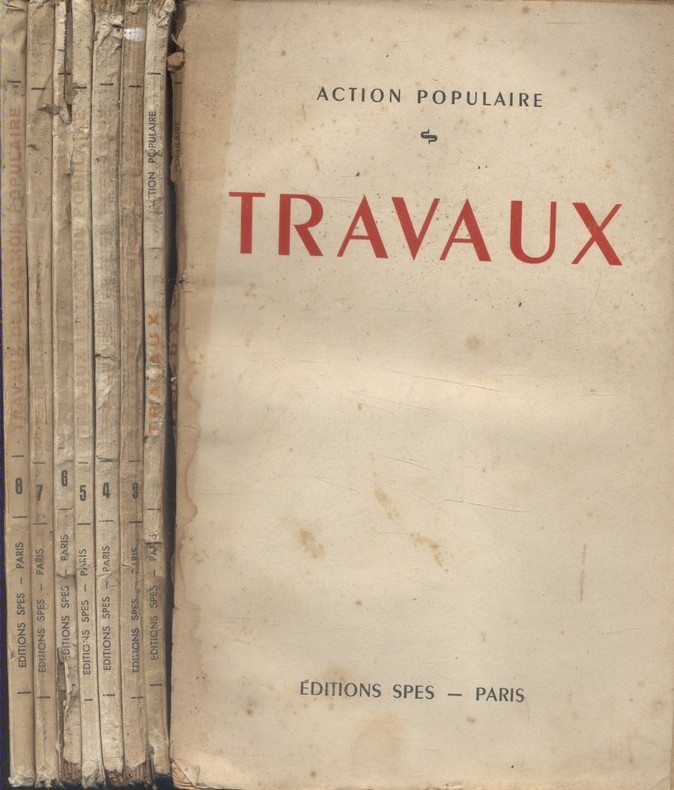
1946129214Couverture souple. 8 revues d'environ 100 pages. 16 x 25 cm. Rousseurs. Papier bruni.
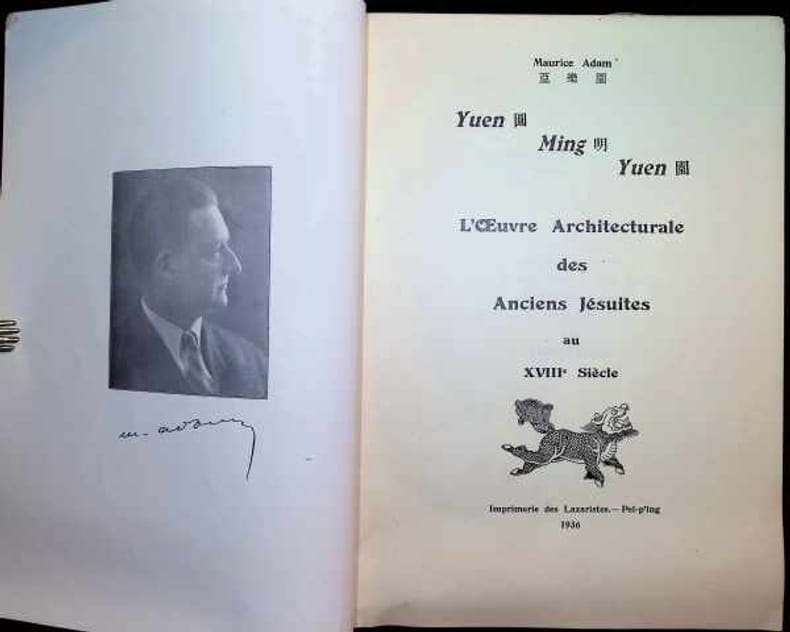
1936030110Pei-p'ing 1936 imprimerie des Lazaristes Soft cover 1st Edition
1760182300Sans lieu ni date Sans lieu ni date, 1760. In-16 broché de 16 pages. Qui condamne tous les Jésuites de France solidairement, à payer la somme de trente mille livres dûes en vertu d'une lettre de change tirée par le Père Lavelette, supérieur des missions aux Isles du Vent, avec les profits & intérêts depuis l'échéance de ladite lettre, & tous les dépens, au jour de la demande. Peu courant
Bilbao, Imp. del Corazón de Jesús, 1893, 18 x 12 cm., tela, 108 págs. con láminas.
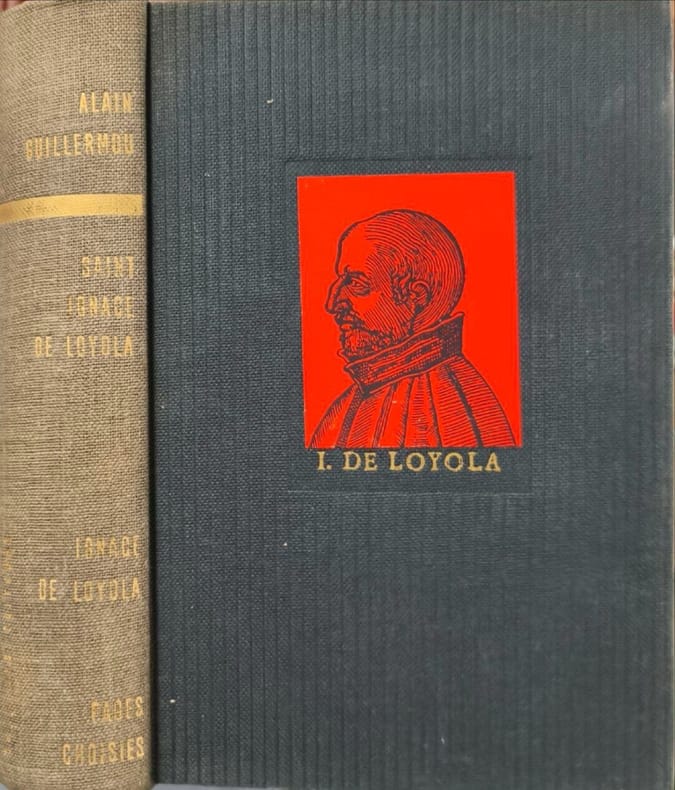
195713247CLUB DES ÉDITEURS 1957 345 pages in8. 1957. reliure editeur. 345 pages. Cet ouvrage d'Alain Guillermou présente la vie et l'expérience spirituelle de saint Ignace de Loyola fondateur de la Compagnie de Jésus. Il décrit son caractère sa sainteté son discernement et son humilité alliant action et contemplation. Le livre inclut des textes choisis une chronologie et une bibliographie