Antiquariat.de

82 résultats
156819156Nürnberg o. V., 1568. 225 S. 8° Oktav Ldr.
153960188Wittemberg, Nickel Schirlentz, 1539. 4to. In a later paper binding. Blank white paper label pasted on to spine. Woodcut title-page depicting Herod's guest with Salome and the decapitated John the Baptist. Woodcut-initials in text. Two stamps to verso of title-page. Small paper mark pasted on to lower outer margin on title-page. Title-page with light soiling and last 30 ff. with dampstain to upper and lower outer corner. 120 ff. + 1 blank (H4) (Complete).
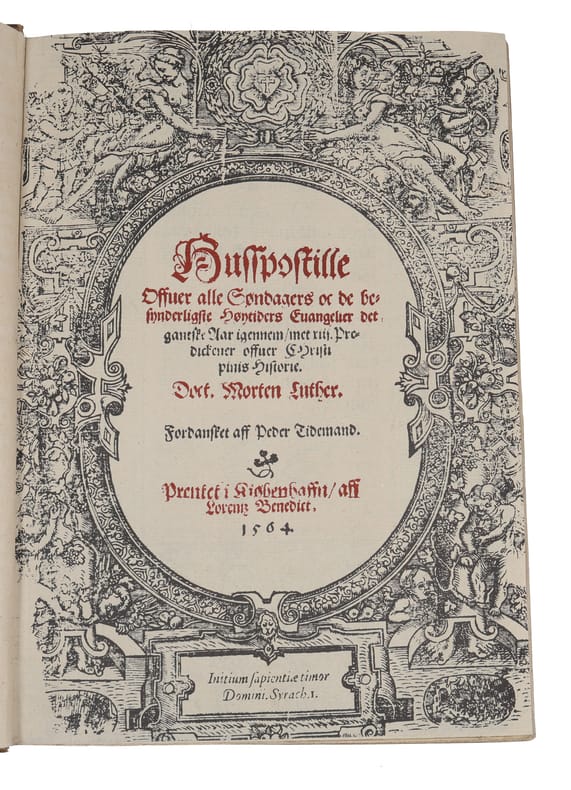
156415908Kiøbenhaffn, Lorentz Benedict, 1564. 4to. Senere helldrbd. 188,156,114 blade. Titelblad og fortale samt sidste blad i smuk lystryk faksimile ( 3 blade ialt). de sidste 10 blade kantrepareret. Lettere brugsspor. 3 træskårne titelblade, tæt beskåret foroven. Talrige større træsnitillustrationer i teksten.
157757412Kiøbenhaffn, Matz Vinggaard, 1577. Folio. Samtidigt hellæderbind over træ. 2 messinbeslag efter 2 lukkestroppe. Ryg med ophøjede bind. Ryg fornyet i ældre tid. Kapitælslid. De rigt blindtrykte permsider kun delvist bevarede, panelleret med rullestempler. Hjørner restaurerede. En nyere, på permens inderside, indklæbet beskrivelse, hævder, at bindet er udført af P. Knufflack.(14),171,155,114 blade. 4 blade i faksimile (A1-2 og B4-5). En del blade kantflossede. Nogle skjolder, brugsspor. Enkelte blade defekte med lidt tab af bogstaver. Spredte kantreparationer og mindre revner i marginer. De to deltitelblade med bred træskåren ramme. Gennemillustreret med store bibelske træsnit som er kopier af Hans Brosamers illustrationer til en tysk bibel, trykt i Frankfurt 1548-49. Folio. Contemporary full calf binding over wooden boards with old rebacking. Two brass clasps, no ties. Raised bands to spine. Capitals worn. The richly blindstamped boards have only partly been preserved. Corners restored. A newer decription pasted into the inside of front board claims that the binding was made by P. Knufflack. Several leaves worn at edges. Some damp staining and wear. A few leaves defective with loss of a few letters. Scattered edge repairs and small tears to margins. The two half-titles with wide woodcut border. Illustrated throughout with large biblical woodcuts that are copies of Hans Brosamer's illustrations for a German bible printed in Frankfurt 1548-49. 4 leaves in facsimile (A1-2 and B4-5). (14), 171, 155, 114 ff.
1526269548Hagenau Setzer (Secerium) 1526. 40 Bll. spät. Pappband. *Deckel mit Feuchtigkeitsschaden*die letzte Bll fleckig* sonst schöner Druck* VD 16, B 7892; Benzing, Luther 2310* Einzige Ausgabe des "Schwäbischen Synagrams mit diesem Titel und der Vorrede Martin Luthers*.
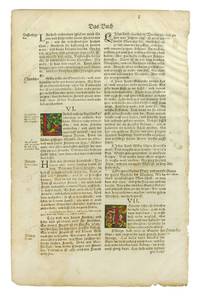
15571228691557. Wittenburg: H. Lufft 1557. <br /> <br /> 8.5 x 13 inches. Double sided page with three illuminated initials: a knight a putto and the other a floral pattern. Hand decorations in faded brown ink. Two pages of "Jesus' Sayings".<br /> <br /> § An attractive leaf with bold painted initials and a number of manicules and marginal marks. unknown
15202401040023xbvkOhne Druckerangabe (gem. VD16 gedruckt in Leipzig bei Melchior Lotter d. Ä., 1520) [MDXX]. (7) Seiten (inkl. der unbedruckten 'Titelblatt'-Rückseite) auf 4 Blättern, mit figürlicher Holzschnitt-Initiale 'N' auf S. (3); in braunem Halbleineneinband der 1. Hälfte des 20. Jahrhundert mit Pappdeckeln (blaues Überzugspapier) und handschriftlichem Papierrückenschild; kl.-4to.(ca. 20 x 15,5 cm).
157064786(Leipzig, Jakob Bärwald, 1570). 4°. Mit Holzschn.-Titelvignette u. -Druckermarke am Schluß. 39 nn. Bll., Geheftet (ausgebunden; ohne Einband).
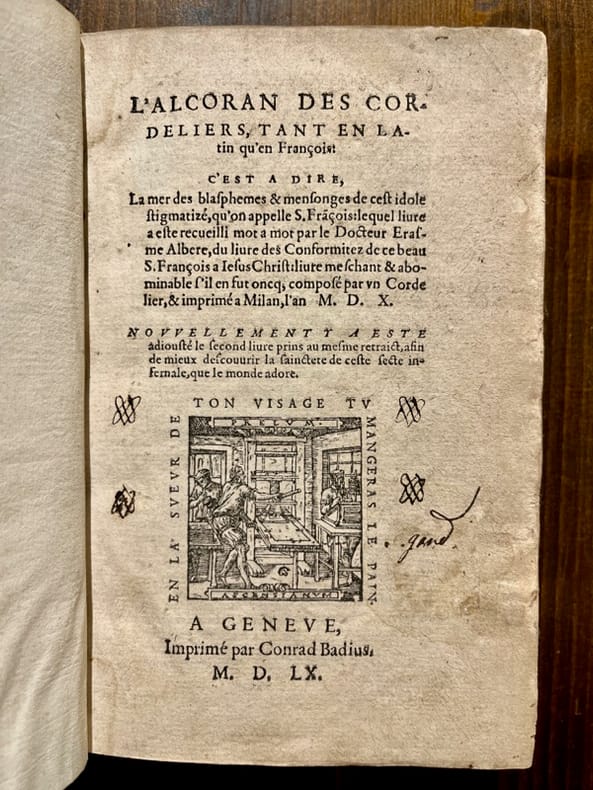
156019664A Genève, imprimé par Conrad Badius, 1560. 2 parties en un volume in-8 de 8-278-[2] et [16]-303-[1] pages [A4; a-r8; s4; *8; A-T8]. Reliure 19ème en plein veau brun, dos à nerfs orné de petits fleurons dorés. Les plats sont constitués du cuir de la reliure originale, ornés au centre d'une large pastille dorée, décorée d'arabesque; encadrés de double filets dorés et à froid, Tranches dorées.
155120987o. O. u. Dr. [Magdeburg: Lotter], 1551. 19,8 x 15,6 cm. 12 Bll. Ohne Umschlag geheftet.
1552SB-22329Magdeburg, Michael Lotther, 1552. Unpag, (100 S.). Neuerer Ganzlederband im Format 21 x 15 cm mit im Vorderdeckel eingelassener Prägeplakette (Schloßkirche zu Wittenberg, 1517) und ledernen Schließbänden. Theologische Programmschrift des Reformators und Luther-Mitstreiters Johann Timann (1499 - 1557). Der in Amsterdam geborene Timann mußte 1522 mit den holländischen Augustinern seine Heimat verlassen und gelangte nach Wittenberg, wo er Martin Luther und Philipp Melanchthon kennenlernte, mit denen er künftig eng zusammenwirken sollte. Timann wandte sich nach Bremen, wo er gemeinsam mit dem Augustinermönch Jacob Probst, der sich ebenfalls in Wittenberg aufgehalten hatte, an die Spitze der reformatorischen Bewegung trat. 1534 hatte er wesentlichen Anteil an der Ausarbeitung der Bremer Kirchenordnung, die von Luther und dessen Mitstreiter Johannes Bugenhagen abgesegnet wurde. Timann trat ferner in der Auseinandersetzung mit der radikalreformatorischen Täuferbewegung hervor. So vertrat er die Stadt Bremen auf dem Hamburger Konvent vom 15. April 1535, wo scharfe Maßnahmen gegen die Täufer beschlossen wurden. Ebenso nahm Timann als bremischer Abgeordneter 1537 gemeinsam mit Luther und Melanchthon am Fürstentag in Schmalkalden und an den Religionsgesprächen in Worms und Regensburg 1540 und 1541 teil, wodurch er seinen Ruf als Theologe über Bremen hinaus festigte. Timann, der in enger Verbindung mit Luther eine Reihe theologischer Schriften verfaßte, kann als einer der führenden reformierten Theologen der norddeutschen Region gelten.
154820988Magdeburg, Lotter, 1548. 20 Bll. 19,8 x 15,7 cm. Ohne Umschlag geheftet.
152356059(Straßburg, Johann Grüninger, 1523). 4°. Mit einer breiten figürl. Holzschn.-Bordüre u. einigen Holzschn.-Initialen. 30 nn. Bll., Mod. Ppbd.
15564183Wittenberg:: Georg Rhau 1542 1556. Octavo:. 15 x 10 cm. I. a-h8; A-Z8 Aa4 lacking blank Aa4. II. A-L8 with blank L8 Bound in contemporary alum-tawed pigskin over wooden boards one clasp defective binding soiled and mildly worn and with small defects. The boards are ruled and tooled in blind signed and dated “IPN 1556â€. The contents are in excellent crisp condition one leaf working loose marginal tear in margin of leaf E5 no loss. With a historiated woodcut title border to the “Apologiaâ€. Woodcut coat-of-arms to verso of final leaf of the “Confessio†and fine woodcut initials in the Saxon Confession. Text of second work in Latin and German. With 16th c. notes on the f.f.e.p. This is the authorized text of the Augsburg Confession 1st ed. 1531 approved by Luther edited by and with the "Apologia" of Philip Melanchthon. It was printed by Georg Rhau who also printed the first editions both in Latin and German of the “Confessio†and “Apologiaâ€. The “Apologia†of this 1556 edition is dated 1542 see VD 16 ZV 31340. This edition was printed in the wake of the agreement reached in 1555 between the Lutheran princes and Charles V known as the Peace of Augsburg which granted Lutheranism legal status within the Holy Roman Empire. Bound into this copy is the 1553 Leipzig edition of the Saxon Confession which was drawn up by Melanchthon and intended for presentation at the Council of Trent; it presented the doctrinal status of the Lutheran Church of Germany as of 1552 and was the basis for the signing of the Peace of Augsburg. The Augsburg Confession: "On January 21 1530 the Emperor Charles V issued letters from Bologna inviting the German diet to meet in Augsburg on April 8 for the purpose of discussing and deciding various important questions. The far-seeing Landgrave of Hesse hesitated to attend the diet but the Elector John of Saxony who received the writ March 11 directed Luther Jonas Bugenhagen and Melanchthon to meet in Torgau and present a summary of the Protestant faith to be laid before the Emperor at the diet. This summary has received the name of the "Torgau articles". On April 3 the Elector and the reformers started from Torgau and reached Coburg on April 23. There Luther was left behind. The rest reached Augsburg May 2. On the journey Melanchthon worked on an "Apology" using the Torgau articles and sent his draft to Luther at Coburg who approved it. "The Emperor had ordered the confession to be presented to him on June 24. The evangelical princes however declared that they would not part with the confession until its reading should be allowed. The 25th was then fixed for the day of its presentation. In order to exclude the people the little chapel of the Episcopal palace was appointed in place of the spacious city hall. The two Saxon chancellors Bruck and Beyer the one with the Latin copy the other with the German stepped into the middle of the assembly and against the wish of the Emperor the German text was read. "Although the emperor prohibited the printing of the evangelical confession without his special permission during the diet six German editions and one in Latin were published. Their inaccuracy and incorrectness induced Melanchthon to prepare an edition to which he added the Apology. Thus originated the so-called 'editio princeps' of the Augustana and the Apology which was published in the spring of 1531." Schaff-Herzog "Melanchthon drafted the ‘Confession’ in both German and Latin using the Torgau Schwabach and Marburg Articles. The intention of the German Protestants was to present a single creed. Since they could not all agree on one several versions were presented to the Diet meeting at Augsburg. Of these it is the ‘Augsburg Confession’ that is remembered today; the others have long been forgotten. The presentation of the ‘Augsburg Confession’ was probably Melanchthon’s finest hour as a theologian. He had written a theological document that presented a reasonable compromise in the ongoing religious disputes in Germany. Luther himself said that he could never have ‘trod so lightly’ in treating such matters. The ‘Confession’ has come to be the standard Lutheran statement of faith and was included in the ‘Book of Concord’ of 1580."Kessler I. VD 16 ZV 31340; II. VD 16 C 4807 Georg Rhau, 1542, unknown books
154864788Wittenberg, (Georg Rhau), 1548. 4°. Mit einigen Holzschn.-Initialen u. -Vignetten. 24 nn. Bll., Geheftet (ausgebunden; ohne Einband).
153461049Augsburg, Alexander Weissenhorn, 1534. Fol. Titel in Rot u. Schwarz m. figürl. Holzschn.-Titelbordüre von Jörg Breu sowie mit 48 Textholzschnitten von Hans Schäufelein. 6 nn., 272 (recte 273) num., 1 nn. Bll., Blindgepr. Schweinsldr.-Bd. d. Zt. über Holzdeckeln auf 4 Bünden m. einer (statt 2) Schließe.
152456060[Leipzig, Jakob Thanner], März 1524. 4°. Mit einer breiten figürl. Holzschn.-Titelbordüre. 22 nn. Bll., Mod. Ppbd.
152438233[Strassburg, Johann Grüninger], (1524). 8°. 22 nn. Bll., Mod. marmor. Ppbd.
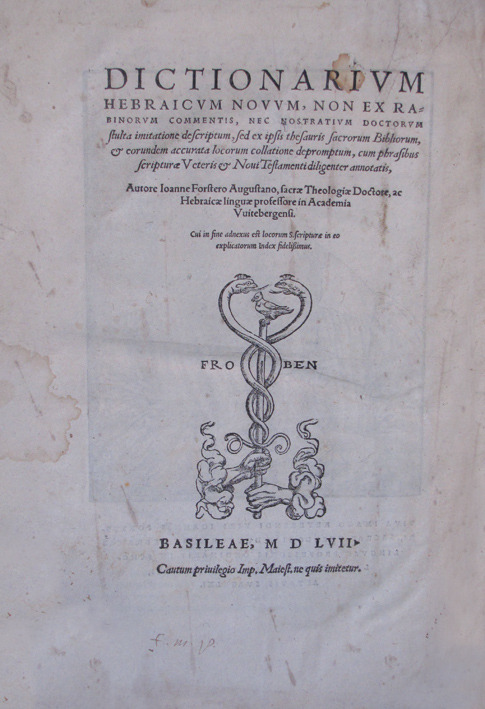
155716334Basilae (Bâle, Froben) apud Hieronymus Frobenium et Nicolaus Episcopius, 1557; in-folio ; veau granité foncé, dos à nerfs très décoré et doré, nombreuses fleurs de lys (reliure du XVIIIe siècle); (12) ff., le dernier blanc, 912 pp., (12) ff., marque de Froben à la dernière page ; (alpha-beta ; a-z ; A-Z ; Aa-Zz ; AA-II, 6) ; portrait gravé sur bois de Johannes Forster daté de 1556, dans sa 61e année, signé HBW.
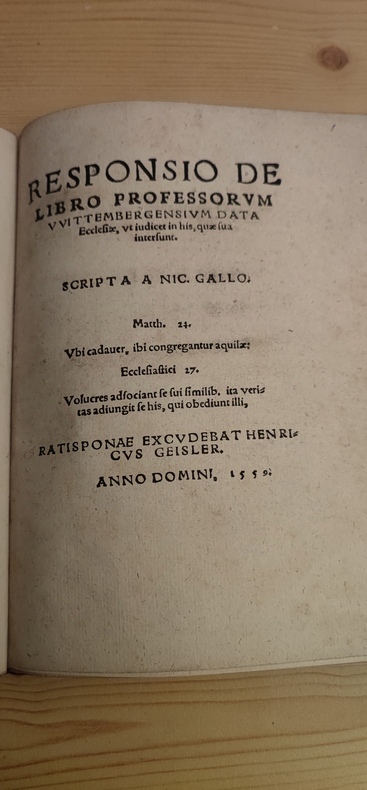
15593447Ratisponae, excudebat Henricus Geisler, 1559. In-8 carré (19x15 cm), 4 feuillets imprimés d'un seul côté, dont la page de titre, demi-maroquin grenat, dos janséniste à cinq nerfs, titre et date inscrits sur le dos (reliure signée Lortic). Mélanchthon (1497-1560), auteur de la Confession d'Augsbourg en 1530, a félicité Nicolaus GALLUS (1516-1570) pour son action primordiale concernant la réforme Lutherienne à Ratisbonne.Ratisponae excudebat Henricus Geisler, 1559
1593N856Wittenberg, Matthes Welack, 1593. Erste Ausgabe der seltenen Streitschrift des lutherischen Theologen und Professors an der Universitäten in Marburg und Wittenberg Ägidius Hunnius des Älteren (1550-1603). Er "nimmt unter den streng lutherischen Theologen der zweiten Hälfte des 16. Jahrhunderts eine der ersten Stellen ein ... An gelehrter Gründlichkeit und Scharfsinn übertraf er seine gleichzeitigen Parteigenossen, an Verdienst ist er sogar der Dritte nach Luther genannt worden" (ADB). In seiner Schrift wandte sich Hunnius vehement gegen den Calvinismus und begründete damit die lutherische Frühorthodoxie und seine Lehre des ?Gnadenuniversalismus?. Eine zweite Ausgabe erschien 1600 bei Georg Müller in Wittenberg (VD16 H 6142). Von besonderem Interesse ist der große Textholzschnitt, der Christus als jugendlichen Salvator mit der Weltkugel zeigt, auf der man Adam und Eva am Baum der Erkenntnis mit Mond und Sonne sieht. Christi Hand ist zum Segensgestus erhoben, während sein Antlitz von der Strahlenaureole hinterleuchtet wird. Auf Wolkenbänken umgeben ihn 10 Putti, die die Arma Christi, die Marterwerkzeuge seines Martyriums präsentieren. Über seinem Haupte schwebt der Heilige Geist als Taube und ganz oben ist ? der Trinität entsprechend ? Gottvater als drei hebräische Buchstaben dargestellt. Papierbedingt leicht gebräunt, wenige Wasserränder, insgesamt wohlerhalten. - Vorgebunden: Chemnitz, Martin, Polycarp Leyser und Urbanus Rhegius. Enchiridion D. Martini Chemnitii. Darinnen die fürnembste Häuptstück der Christlichen Lehr, durch Frag vnd Antwort, auß Gottes Wort eynfältig vnd gründlich erkläret werden, Wie man fürsichtiglich, und ohne Ergernuß von den fürnembsten Artickeln Christlicher Lehr reden soll. Frankfurt, Johann Spieß, 1593. [21], 534, [2] S. Mit in Rot und Schwarz gedrucktem Titel und großer Holzschnitt-Druckermarke am Ende. - VD16 C 2180. Die kompendiarische Darlegung seiner Dogmatik anlässlich der Reformation des Herzogtums Braunschweig-Wolfenbüttel erschien zuerst unter dem deutschen Titel "Die furnemsten hauptstiick der Christi Lehre, wie darin die Pastores examiniret und unterwiessen werden, 1569, Wolfenbüttel". Bis 1608 immer wieder aufgelegt, wurde sie zu einem Kernstück der orthodoxen Lutheraner der zweiten Generation.VD16 H 6141. Nicht im STC (vgl. aber STC 424). [2 Warenabbildungen]
1539230704052067ybvkIngolstadt, Georg Krapff [bzw. Alexander Weissenhorn], 1539 [MDXXXIX]. / Blätter a1-a4 (einseitig bedrucktes Titelblatt mit breitem figürlich und allegorisch illustriertem Holzschnitt-Rahmen, beidseitig bedrucktes Widmungsblatt ''Dem hochwürdigen Vate ~
15686812AFrankfurt, Feyrabend, 1568. 4°. 13 unn., 524 Bll. Mit 1 gest. Portrait M. Luthers. Geprägter Pergamentband d. Zeit auf Holzdeckeln. Ebd. gebräunt, Kanten u. Ecken mit kl. Läsuren. Innen nur sehr gering fleckig.
159214640Lyon, Q. Hug. A Porta, Fratres de Gabiano (Excudebat Guichardus Jullieron anno 1592), 1592 ; in-8 (164), plein vélin ivoire à recouvrements de l'époque ; (8), 312, (7) index, (1 bl.) ; 34 pp., (1) p., (1 bl.), 2 ff. blancs.
15417867CBStrassburg, Müller, 1541. Kl.-4°. (8) Bl., 695 S. Schweinslederband mit Platten- und Rollstempelprägung auf Holzdeckeln sowie zwei Metallschliessen.