82 résultats
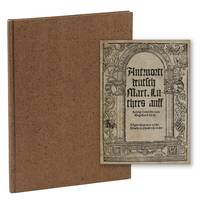
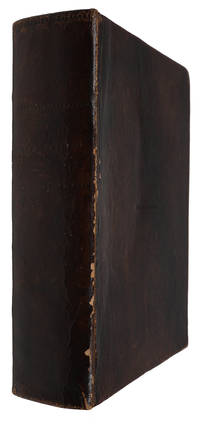
152033261-1160Wittenberg Melchior Lotter the younger 1520. Title within nice decorative woodcut border attributed to Lucas Cranach and woodcut initial on A3. 50 ff. Small 4to 212 x 157 mm. Late 19th century half cloth one corner bumped. Wittenberg Melchior Lotter the younger 1520. First printing of the editio definitiva Druck B of the appeal "To the Christian Nobility of the German Nation" addressed to the Emperor and the German nobility. Present here is for the first time the complete enlarged and finally text immediately issued after printing the forthy-eight-page template from Aug. 5 1520. Considered Martin Luther's 1483-1546 pivotal work this is the most influential and important of the first of his three primary treatises. It is Luther's answer to the "Bull of Excommunication" published in Rome in June 1520. A first and most important powerful call to action urging the nobility and leaders to participate actively in reforming the Church and society. Here Luther asserts the right of civil power to reform the spiritual and asks the government to exercise this right. He boldly identifies the pope as the Antichrist and goes on to attack the concept that the Church is superior to the State by his assertion that every baptized Christian is a priest. The new added chapter 26 on the false legal claims of the popes' claims to have taken over the Holy Roman Empire from Byzantine Emperors and brought it into the German nation. This gave the work additional explosive force. Luther then proposes drastic reforms against the authority of the Pope against a celibate priesthood and against corruption in the Church. It is interesting to note that Machiavelli and Morus both looked critically at political power and the behavior of rulers. So in summary these connections demonstrate that Luther's "An den Christlichen Adel deutscher Nation" is embedded within a broader philosopical context that also includes the works of Thomas Morus and Niccolò Machiavelli. Luther's book was in effect a call for the Reformation to begin and had a most profound influence on the history of Europe and later on large parts of the world over all centuries.- Nice copy of outmost and exceptionally rarity. - VD 16 L 3759; Benzing 684; cf. PMM 49; Stickelberger Coll. 407; Pflugk-Harttung 49; not in Adams nor Knaake or Kuczynski. REFORMATION ; GERMANY ; Wittenberg, Melchior Lotter, the younger hardcover
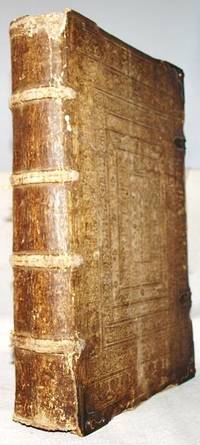
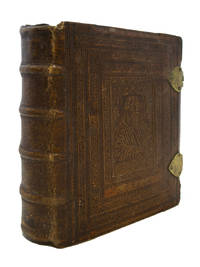
155660674Ihenae Jena Rhodius Rödinger 1556. 4to. In contemporary blindstamped pigskin over wooden boards with three raised bands and two clasps. Wear and soiling to extremities. Pigskin partly detached to upper part of boards. Previous two owner's names in contemporary hand to title-page. A few occassional underlignings and marginal annotations in contemporary hand throughout. Small worm-tract affecting last 20 leaves internally generally fine. 10 367 pp. <br/><br/><em>Rare first printing of Martin Luther's early letters from 1507 to 1522 spanning the years from the celebration of his first Mass to his removal to Wartburg Castle after the Diet of Worms. Among them is a notable letter Cardinal Albrecht Archbishop of Magdeberg and Mainz accompanying a copy of the 95 Theses composed on the very day October 31st 1517 when Luther affixed the Theses to the door of the church in Wittenberg and Luther's first letter to Erasmus penned on March 28th 1519. These letters provide a most interesting perspective into Martin Luther's personal and public reflections on crucial aspects of the early days of the Reformation. The collection encompasses correspondence with figures such as Emperor Charles V Pope Leo X King Henry VIII Georg Spalatin Philip Melanchthon Frederick Elector of Saxony Andreas Karlstadt Cardinal Tommaso de Vio Cajetan and many others. The present work was edited by Joannes Aurifaber 1519-1575 Luther’s private secretary who lived with Luther at the time of his death: “Joannes Vinariensis; 1519–1575 was born in the county of Mansfeldt in 1519. He studied at Wittenberg where he heard the lectures of Luther and afterwards became tutor to Count Mansfeldt. In the war of 1544–45 he accompanied the army as field-preacher and then lived with Luther as his famulus or private secretary being present at his death in 1546. In the following year he spent six months in prison with John Frederick elector of Saxony who had been captured by the emperor Charles V. He held for some years the office of court-preacher at Weimar but owing to theological disputes was compelled to resign this office in 1561. In 1566 he was appointed to the Lutheran church at Erfurt and there remained till his death in November 1575. Besides taking a share in the first collected or Jena edition of Luther’s works 1556 Aurifaber sought out and published at Eisleben in 1564–1565 several writings not included in that edition. He also published Luther’s Letters 1556 1565 and Table Talk 1566. This popular work which has given him most of his fame is unfortunately but a second or third hand compilation.†Encyclopedia Britannica. A second volume was published as “Secundus tomus epistolarum†in 1565. Adams L1805 BM STC German 1455-1600; p. 535 </em> hardcover
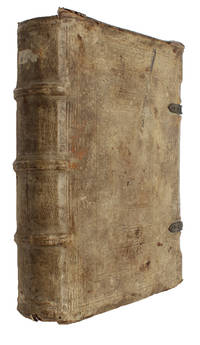
155660674Ihenae (Jena), Rhodius (Rödinger), 1556. 4to. In contemporary blindstamped pigskin over wooden boards with three raised bands and two clasps. Wear and soiling to extremities. Pigskin partly detached to upper part of boards. Previous two owner's names in contemporary hand to title-page. A few occassional underlignings and marginal annotations in contemporary hand throughout. Small worm-tract affecting last 20 leaves, internally generally fine. (10), 367 pp.
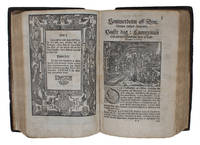
154538532(Leipzig, Nikolaus Wolrab), 1549 (im Kollophon: 1544 bzw. 1545). Fol. Titeln in Rot u. Schwarz m. Titelholzschnitt bzw. m. breiter figürl. Holzschn.-Bordüre. Mit zahlr. Textholzschnitten von Hans Brosamer. 4 Bll., 382 num., 10 Bll. (das letzte weiß); 1 nn., 69 num., 4 nn. Bll. (das letzte weiß); 6 nn., 281 num., 7 nn. Bll.; 6 nn., 88 num., 1 nn. Bll., Blindgepr. Schweinsldr.-Bde. d. Zt. über Holzdeckeln a. 4 Bünden m. goldgepr. Rückenschild sowie blindgepr. Deckeltitel (?Postil sumer teyl und fest? bzw. ?Postil winter Teill?, dat. ?1550?) u. 2 Schließen.
15564183Wittenberg:: Georg Rhau 1542 1556. Octavo:. 15 x 10 cm. I. a-h8; A-Z8 Aa4 lacking blank Aa4. II. A-L8 with blank L8 Bound in contemporary alum-tawed pigskin over wooden boards one clasp defective binding soiled and mildly worn and with small defects. The boards are ruled and tooled in blind signed and dated “IPN 1556â€. The contents are in excellent crisp condition one leaf working loose marginal tear in margin of leaf E5 no loss. With a historiated woodcut title border to the “Apologiaâ€. Woodcut coat-of-arms to verso of final leaf of the “Confessio†and fine woodcut initials in the Saxon Confession. Text of second work in Latin and German. With 16th c. notes on the f.f.e.p. This is the authorized text of the Augsburg Confession 1st ed. 1531 approved by Luther edited by and with the "Apologia" of Philip Melanchthon. It was printed by Georg Rhau who also printed the first editions both in Latin and German of the “Confessio†and “Apologiaâ€. The “Apologia†of this 1556 edition is dated 1542 see VD 16 ZV 31340. This edition was printed in the wake of the agreement reached in 1555 between the Lutheran princes and Charles V known as the Peace of Augsburg which granted Lutheranism legal status within the Holy Roman Empire. Bound into this copy is the 1553 Leipzig edition of the Saxon Confession which was drawn up by Melanchthon and intended for presentation at the Council of Trent; it presented the doctrinal status of the Lutheran Church of Germany as of 1552 and was the basis for the signing of the Peace of Augsburg. The Augsburg Confession: "On January 21 1530 the Emperor Charles V issued letters from Bologna inviting the German diet to meet in Augsburg on April 8 for the purpose of discussing and deciding various important questions. The far-seeing Landgrave of Hesse hesitated to attend the diet but the Elector John of Saxony who received the writ March 11 directed Luther Jonas Bugenhagen and Melanchthon to meet in Torgau and present a summary of the Protestant faith to be laid before the Emperor at the diet. This summary has received the name of the "Torgau articles". On April 3 the Elector and the reformers started from Torgau and reached Coburg on April 23. There Luther was left behind. The rest reached Augsburg May 2. On the journey Melanchthon worked on an "Apology" using the Torgau articles and sent his draft to Luther at Coburg who approved it. "The Emperor had ordered the confession to be presented to him on June 24. The evangelical princes however declared that they would not part with the confession until its reading should be allowed. The 25th was then fixed for the day of its presentation. In order to exclude the people the little chapel of the Episcopal palace was appointed in place of the spacious city hall. The two Saxon chancellors Bruck and Beyer the one with the Latin copy the other with the German stepped into the middle of the assembly and against the wish of the Emperor the German text was read. "Although the emperor prohibited the printing of the evangelical confession without his special permission during the diet six German editions and one in Latin were published. Their inaccuracy and incorrectness induced Melanchthon to prepare an edition to which he added the Apology. Thus originated the so-called 'editio princeps' of the Augustana and the Apology which was published in the spring of 1531." Schaff-Herzog "Melanchthon drafted the ‘Confession’ in both German and Latin using the Torgau Schwabach and Marburg Articles. The intention of the German Protestants was to present a single creed. Since they could not all agree on one several versions were presented to the Diet meeting at Augsburg. Of these it is the ‘Augsburg Confession’ that is remembered today; the others have long been forgotten. The presentation of the ‘Augsburg Confession’ was probably Melanchthon’s finest hour as a theologian. He had written a theological document that presented a reasonable compromise in the ongoing religious disputes in Germany. Luther himself said that he could never have ‘trod so lightly’ in treating such matters. The ‘Confession’ has come to be the standard Lutheran statement of faith and was included in the ‘Book of Concord’ of 1580."Kessler I. VD 16 ZV 31340; II. VD 16 C 4807 Georg Rhau, 1542, unknown books
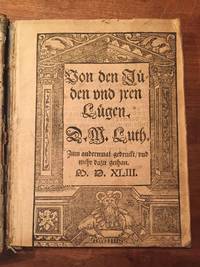
1543Boston2Von den Jüden und iren Lügen Zum andernmal Gedruckt vnd mehr dazu gethan.Wittemberg Lufft 1543. 128 pages. 18.5 cm. Bound in a 15th century leaf. 17th century inscription on the inside board. This is Panzer 3425.This work is printed in the same year as the first edition but enlarged as the title indicates. Title page lower margin cut. Else good. <br /> German religious reformer and founder of the Lutheranism movement Martin Luther grew increasingly hostile towards the Jews following their refusal to accept his religious reformations. <br /><br /> In the present work the most virulent of Luther's anti-Semitic attacks he subjects the Jews to a torrent of vile abuse. His practical suggestions range from forced labor to outright banishment: "First their synagogues should be set on fire and what ever does not burn up should be covered over with dirt so that no one may ever be ale to see a cinder or stone of it. Secondly their homes should likewise be broken down and destroyed.And this ought be done for the honour of God and of Christianity in order that God may see that we are Christians and that we have not wittingly tolerated or approved of such public lying cursing and blaspheming."<br /><br /> Due to Luther's vituperative anti-Jewish polemics the Lutheran church retained all the superstitious abhorrence of the Jews inherited from the medieval Catholic church.On Luther's conception of the Jews in this work see J. Trachtenberg The Devil and the Jews- The Medieval Conception of the Jew and its Relation to Modern Anti-Semitism 1983 p.183 et<br /><br /><br /><br /><br /><br />
1538LCS-1864037<p><strong>The Smalkalde Articles written by Luther in 1536 in preparation for the Council of Mantua.</strong></p><p><strong>"<em>Schmalkaldic Articles</em></strong><em> <strong>are one of the confessions of faith of Lutheranism</strong></em><strong>".</strong></p><p>4to of 32 ll. Half-vellum flat spine brown morocco lettering piece. <em>20th century binding</em>.</p><p>191 x 151 mm.</p><p>Rare first edition of the "Articles of Smalkalde" written by Luther in 1536 and which offer a synthesis of his doctrine.</p><p>Graesse <em>Trésor de livres rares</em> 306.</p><p>Luther's attacks on the papacy were repeated and virulent. In 1535 Pope Paul III wearily proposed convening a council. The Protestants of the Smalkalde League meeting in assembly nevertheless made demands to take part. The council was convened in Mantua for May 1537. Immediately Luther compounded what would later be known as the Smalkalde articles in which he exhibited the essential points of his doctrine. The Council was postponed and did not take place until 1545 in the city of Trent.</p><p>" In 1534 Alessandro Farnese was elected as Pope Paul III with a clear message of internal church reform. To further this mission and to respond to the rise of Protestantism he called for an ecumenical church council to meet at the Italian city of Mantua in 1537. Given the importance of this council for Christian unity and the future of reformed forms of worship the elector of Saxony asked Luther to prepare an official statement of doctrine that would both represent his views and indicate where negociation might be possible. Luther agreed and with some imput from his Wittenberg colleagues carefully laid out what he saw as the central pillars of Christian teaching. Yet these doctrinal statements or articles were never presented at the council which was delayed a number of times finally meeting in Trent beginning in 1545. Instead they were discussed at a general meeting of the Protestant Schmalkaldic League although even here the collected princes and theologians declined to affirm them due mostly to concerns that they were too exclusionary and divisive especially the statements on the Eucharist and papacy. Luther then published the articles in 1538 adding a preface but leaving their structure and content otherwise intact. As these articles offered a clear and comprehensive summary of Luther's doctrine they would be extremely important as a Lutheran confession of faith and in 1580 would be incorporated into the authoritative collection of fundamental Lutheran documents known as the 'Book of Concord'" The Essential Luther 23.</p><p><strong>"Schmalkaldic Articles</strong> are one of the confessions of faith of Lutheranism written by Martin Luther in 1536. The articles were prepared as the result of a bull issued by Pope Paul III calling for a general council of the Roman Catholic Church to deal with the Reformation movement. The council was actually postponed several times until it met in Trent in 1545. John Frederick I Lutheran elector of Saxony wished to determine what issues could be negotiated with the Roman Catholics and what could not be compromised. He asked Luther to review earlier statements of faith by the reformers to determine what was absolutely essential to the faith. After Luther prepared the articles he invited several reformers to Wittenberg to discuss them and after some minor changes eight theologians signed them. They were then sent to the elector in January 1537.</p><p>In February 1537 the Protestant secular heads of state who were members of the Schmalkaldic League met with several theologians at Schmalkalden to decide how to deal with a council of the Roman Catholic Church. Luther became ill and could not attend but John Frederick I presented Luther's articles to the gathering. Because of Luther's somewhat controversial doctrine of the Lord's Supper Philipp Melanchthon urged that the Augsburg Confession and its Apology previously presented to Emperor Charles V adequately presented the reformer's faith and that additional statements should not be added. This decision was adopted and the Schmalkaldic Articles were not officially accepted. They were however circulated and read and 44 theologians signed them as an expression of their personal faith. Subsequently they were included in the <em>Book of Concord</em> 1580.</p><p>The Schmalkaldic Articles are divided into three sections. The first discusses the unity of God the Trinity the Incarnation and Christ and on these subjects Luther believed there was no real controversy between Roman Catholics and Protestants. The second section dealt with Christ and justification by faith. According to Luther "<em>On this article rests all that we teach and practice against the pope the devil and the world.</em>" This section also discusses the mass monastic orders and the papacy. The third section discusses 15 articles that could be considered by Roman Catholics and Protestants. It includes such subjects as sin the Law repentance the sacraments confession the ministry and a definition of the church".</p><p>FRANCAIS</p><p><strong>Les articles de Smalkalde rédigés par Luther en 1536 en vue du concile de Mantoue.</strong></p><p>In-4 de 32 ff. Demi-vélin dos lisse pièce de titre de maroquin brun en long. <em>Reliure du XXe siècle</em>.</p><p>191 x 151 mm.</p><p>Rare édition originale des " articles de Smalkalde " rédigés par Luther en 1536 et qui offrent une synthèse de sa doctrine.</p><p>Graesse <em>Trésor de livres rares</em> 306.</p><p>Les attaques de Luther contre la papauté sont réitérés et virulents. En 1535 de guerre lasse le pape Paul III propose de réunir un concile. Les protestants de la ligue de Smalkalde réunis en assemblée posent quand même des exigences pour y participer. Ce concile est convoqué à Mantoue pour le mois de mai 1537. Aussitôt Luther compose ce qu'on dénommera plus tard les articles de Smalkalde où il expose les points essentiels de sa doctrine. Le concile sera reporté et n'aura lieu qu'en 1545 dans la ville de Trente.</p> H. Lufft
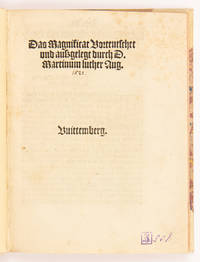
15213036<p>Wittenberg: Melchior Lotter 1521. </p><p>Price: $5600.00 </p><p>Quarto: 19 x 13 cm. 88 pp. a-l4</p><p>FIRST EDITION.</p><p>Modern marbled boards vellum spine and corners. A fine copy with contemporary marginalia in red and black. Provenance: Alain Moirandat Switzerland.</p><p>Luther wrote his "The Magnificat Translated into German and Explained" in two parts the first composed before his appearance at the Diet of Worms and the second part while he was in hiding in the Wartburg in May and June 1521. Given that Luther's vision of the church and of Mary's nature and place within Christianity were evolving and were to evolve much further over time and the fact that Luther left the Diet a changed man living in changed circumstances it is no wonder that Luther's exposition of the Magnificat has been the subject of numerous conflicting interpretations.<br /><br />In Albert Steinhaeuser's view the work "is a classical discussion of the place that the Virgin Mary occupies in the Protestant system. Although Luther regards her in one place as sinless and invokes her aid and intercession at the beginning and close of his work these are isolated instances; the whole tenor of the exposition is evangelical and as far removed from the Mariolatry of Rome as from an ultra-protestant depreciation of the Mother of our Lord. 'She does not want you to come to her but through her to God.' There is something very human and altogether unlike the radiant Queen of Heaven in the Mary who 'goes about her household tasks milking the cows cooking the meals washing pots and kettles sweeping out the rooms.' It is Luther's contribution to the German Madonna and the Weimar editors well compare this and similar passages of the Magnificat with Albrecht Durer's Marienleben a series of quaint woodcuts portraying the life of the Virgin 1503-10."<br /><br />But Hartmann Grisar one of the leading Catholic writers on Luther writes "Luther's 'Exposition of the Magnificat' has frequently been taken as a proof of Luther's great piety. It indeed contains many good thoughts even apart from those relating to Mary but in numerous passages the author uses his pen for a highly prejudiced vindication of his new teachings on the state of grace. It should also be borne in mind that the printers started on the book just before the Diet of Worms and that it was intended to attract and secure the support of the future rulers of the Saxon Electorate. Luther was also engaged at that time on his exceedingly violent screed against Catharinus in which he attempts to reveal the Pope in his true character as Antichrist. When after the Diet of Worms he continued his work on the Magnificat he was certainly in no mood to compose a book of piety on Mary. The result was that the book became to all intents and purposes a controversial tract which cannot be quoted as a proof of his piety or serenity of mind during those struggles. Luther's Magnificat is as little a serious work of edification and piety as his exposition of certain of the Psalms which appeared almost simultaneously and was also directed " against the Pope and the doctrine of men.".</p><p>VD16 L-5453; Benzing Luther 855; Kuczynski 1431</p> Melchior Lotter, books
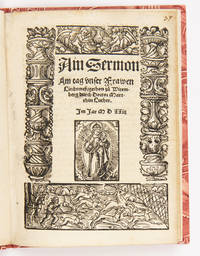
15233029<p>Augsburg: Melchior Ramminger 1523. </p><p>Price: $5500.00 </p><p>Quarto: 20 x 15 cm. 8 pp. Collation A4</p><p>One of five editions all printed in 1523.</p><p>Modern boards. A fine copy with a beautiful four-part title page border the lower register of which shows a stag hunt. There is also a small woodcut of the Virgin balancing on the crescent moon and holding the infant Christ.</p><p>A sermon for Lichtmeß Candlemas the feast of the presentation of the infant Jesus in the temple and the purification of Mary February 2. Jesus takes as his text Luke 2:22-39.<br /><br />For the complexities of Luther's evolving Mariology see Thomas O'Meara Mary in Protestant and Catholic Theology 1966. "Luther's attitude toward the theology of Mary and toward the devotion which a Christian should have to the Mother of God is a small-scale representation of his entire religious accomplishment. During any discussion of Luther and the Blessed Virgin we must keep uppermost in our minds that there was a development in his ideas a change more or less drastic in each aspect of Marian theology. This development has its beginning in Catholicism; it passes through contradictions struggles and uncertainties and terminates in a new Marian viewpoint one which Luther decided was Christocentric biblical unexaggerated and edifying."p. 123.</p><p>Benzing 1746; VD16 L-6084</p> Melchior Ramminger, books
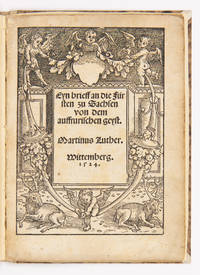
15243177Wittenberg:: Cranach and Döring 1524. FIRST EDITION. Quarto:. 21 x 15 cm. . 20 pp. A4 B2 C4 Bound in marbled boards. With an excellent woodcut title page by Lucas Cranach Luther 43c cut from a single block with putti cornucopiae architectural motifs and stags. A good copy light soiling a few stains. First edition of Luther’s response to the growing danger posed by the radical preacher Thomas Münzer who was ultimately executed the following year for leading the violent open revolt that came to be known as the Peasants’ War. In 1523 Thomas Münzer formerly the leader of the radical “Zwickau Prophets†began to radicalize the area of Allstedt where he was then pastor preaching that the ungodly were to be eliminated and the elect would establish a kingdom of Christ on earth and threatening the political rulers of the area with rebellion. In early 1524 as Münzer “grew bolder in his denunciation of the authorities and called for an elimination of the enemies of God†he divided the citizenry into military units in order to resist any outside interference in his activities. Münzer openly challenged and attacked Luther who was openly opposed to Münzer’ ministry of the elect as one of “our mad debauching pigs which are horrified by the windstorm the raging billows and by all the waters of wisdom.†In his “Letter to the Princes of Saxony Concerning the Rebellious Spirit†written in July 1524 in response to the recent violence and Münzer’s mystical theology Luther “appealed to the rulers to act before the incendiary suggestions of Münzer led to civil rebellion and open revoltâ€. Luther “distinguished two sides of Münzer’s behavior that of violence and that of precept. Only the subject of violence concerns the princes and to this subject he devotes almost his entire letter. Satan can here be seen at work in a new way and has shown us his hoofprint all too plainly –meaning Münzer says that one is not to leave it up to the Word but that it is time to resist the authorities with fists with the sacking of cloisters with the destruction of images. Luther demanded that the princes respond preventively by rigorous prohibitions. If the Allstedters wished to defend themselves and show their true colors let them do so in a public trial before whomever they choose. “Luther’s book is noteworthy not because he admonished them to suppress violence but much more because he drew boundaries for them to observe. They do not have to defend themselves against Münzer’s teaching: ‘Let them preach as confidently and as boldly as they are able and against whomever they wish…There must be sects and the Word of God must be under arms and fight…Let the spirits collide and fight it out. If meanwhile some are led astray let it be; such is war. Where there is battle and bloodshed some must fall and some are wounded. Whoever fights honorably will be crowned.’… “The princes became convinced that the disturbances might lead to rebellion and they summoned the leaders before them. The Allstedt council and Münzer were examined in Weimar at the beginning of August. To escape the impending verdict Münzer fled to Mühlhausen where later in the year he gained leadership over the city. He became a central figure in the Peasants’ Revolt and suffered death in May 1525 when the revolt was crushed.â€Bornkamm Luther in Mid-Career p. 152 ff. Benzing 1927; Kessler 553; Title border: Luther “Titeleinfassungen der Reformationszeit†43c Cranach and Döring, unknown books
1522140948314Wittemberg Wittenberg: Nickell Schyrlenz Schirlentz 1522. First edition. Near Fine. First edition of Martin Luther's riposte to King Henry VIII's pamphlet "In Defense of the Seven Sacraments" preceding the Latin edition by one month. Unpaginated 47 pp blank A-F4. Laid paper text in German woodcut title illustration featuring cupids. Collated complete. Small quarto recently bound in brown speckled paper-covered boards. Near Fine with tape marks to rear board perceptible in raking light light toning and thumbing and occasional foxing to contents. Title page repaired with backing paper to margins soiling to first and last pages faint dampstain to upper right corner of first few leaves. Binding solid interior overall clean and bright.<br /> <br /> <p>A well-preserved copy of a treatise by one of the most famous men in history. In 1521 Henry VIII of England published an attack on Martin Luther and defense of the Catholic Church that earned him the title "Defender of the Faith" from Pope Leo X. Henry's Assertio Septem Sacramentorum was swiftly translated into German and sold well on the Continent. Luther perceived a threat and published this furious response the following year mocking Henry''s new title and his qualification for the role. Henry himself would soon defy the Catholic Church after his demand for the annulment of his first marriage was rejected but he and Luther continued their acrimonious correspondence and never reconciled. Nickell Schyrlenz [Schirlentz] unknown
15501503130064Gedruckt zu Wittemberg : Durch Hans Lufft 1550-01-01. Hardcover. Acceptable. Folio. 380 of 383p. Collation: A1-Z6 A1-Z6 Aa1-Aa2 lacking Aa3-Aa4 Aa5-Rr4 Lacking Rr5 Rr6 Ss1-Ss5 in 6's. Bound in contemporary pigskin. Bindings decorated in blind. 5 raised bands. Contemporary brass corners and latches. Woodcut title page and 62 woodcuts throughout most by Hans Brosamer and some by Georg Lemberger. Good binding. Shelfwear. Chipping and loss to head and tail of spine. Loss to board edges. Lacking clasps. Lacking first and final blank. Top of title page missing from signature removal. Cracking to hinges. Soiling to pages. Loss to tail of leaf 33 affecting last 2 sentences of text. Marginal loss to f209. Tear to halfway of leaf 216. Contemporary marginal notation to the Gospels. Contemporary underlining to select pages throughout. Repairs to leaf 229 and 277. Tanned pages with some staining. <br><br> The Prophets of the Old Testament with the New Testament and Apocrypha from Martin Luther's translation of the Bible. Gedruckt zu Wittemberg : Durch Hans Lufft hardcover
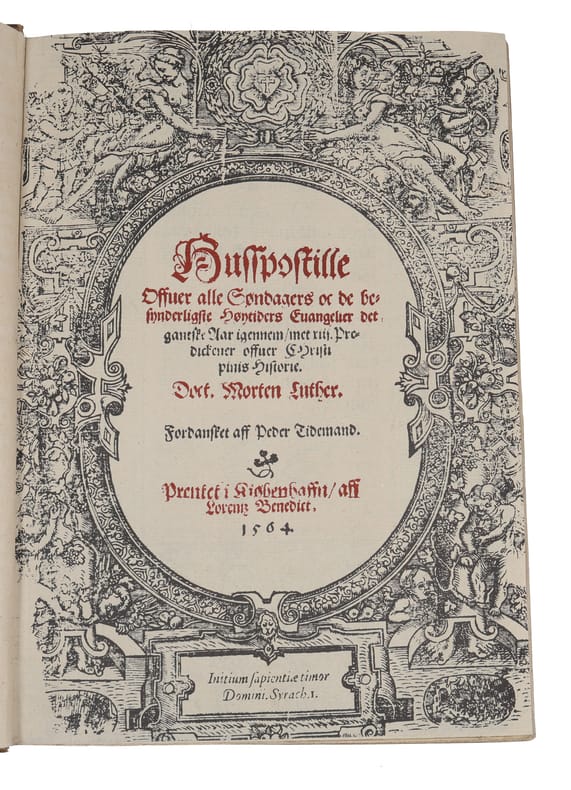
156415908Kiøbenhaffn, Lorentz Benedict, 1564. 4to. Senere helldrbd. 188,156,114 blade. Titelblad og fortale samt sidste blad i smuk lystryk faksimile ( 3 blade ialt). de sidste 10 blade kantrepareret. Lettere brugsspor. 3 træskårne titelblade, tæt beskåret foroven. Talrige større træsnitillustrationer i teksten.
156415908Kiøbenhaffn Lorentz Benedict 1564. 4to. Senere helldrbd. 188156114 blade. Titelblad og fortale samt sidste blad i smuk lystryk faksimile 3 blade ialt. de sidste 10 blade kantrepareret. Lettere brugsspor. 3 træskårne titelblade tæt beskåret foroven. Talrige større træsnitillustrationer i teksten. <br/><br/><em>Første danske udgave af Luthers Postil og af største sjældenhed i komplet stand. Kun ganske få bevarede på private hænder. De fleste eksemplarer i de offentlige biblioteker er ukomplette Lauritz Nielsen anfører kun 7 komplette eksemplarer. En af de mest betydningsfulde bøger fra Benedichts trykpresse og det største i omfang.Extremely scarce first Dansih edition of Luther's "Hauspostille" with only af few copies still on private hands.Thesaurus I 104. - Birkelund 24. - Lauritz Nielsen 1084. - Paulli 20. </em> unknown
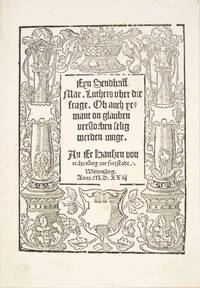
15233175Erfurt:: Stürmer 1523. FOURTH PRINTING. Quarto:. 20 x 14.5 cm. 8 pp. A4 Modern boards with a stamped Luther rose. With a narrow woodcut title border. A very fresh clean copy with an intricate title page border. All printings are rare. Luther wrote this letter in August 1522 to Hans von Rechenberg a strong supporter of the Reformation and a man who distinguished himself in battle against the Turks. There is no evidence that Luther knew von Rechenberg personally but the question that Luther addresses in the letter whether a person who dies without faith may be saved seems to have been one of personal concern to the addressee. Luther’s reply is quite direct and to the point: whether men like it or not Luther says God saves no one without faith for to do so would be contrary to his word. Furthermore faith does not seek to penetrate why God does not save without faith. Luther cites four passages of scripture: Mark 16:16 where Jesus says “Whoever does not believe will be condemnedâ€; Hebrews 11:6 which says “Without faith it is impossible to please Godâ€; John 3:6 “Whoever is not born anew of the Spirit and water cannot see the kingdom of Godâ€; and John 5:18 “Whoever does not believe is already judged.†Luther writes: “Now if God were to save someone without faith he would be acting contrary to his own words and make himself out to be a liar. Yes he would be denying himself and that is impossible. For St. Paul says in 2 Timothy 2:13 “God cannot deny himself.†As impossible as it is for divine truth to lie it is just as impossible for him to save someone without faith.†He continues: “It would be a completely different question to ask whether God could grant faith to a few at the moment of their death or after death and thereby save them through faith. Who would doubt that he could do this But no one can prove that he does do this. For we only read that he has already raised the dead and given them faith. No matter what he does whether he grants faith or not it is impossible for anyone to be saved without faith. Otherwise all preaching and the Gospel and faith itself would be futile false and deceptive since the entire Gospel makes faith necessary.†Benzing 1270 Stürmer], unknown books
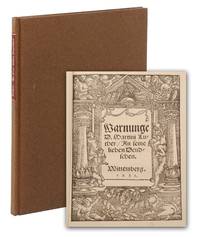
1531140949420Wittenberg Germany: Hans Lufft 1531. First edition. First edition. First printing with date misprinted as "1231" on the title page as per Benzing. 63 pp. Bound in recent brown paper over boards with red morocco spine label. Text in German. Small 4to A1-D4. Title page with Georg Lemberger woodcut border Luther Taf. 34 showing angels surrounding the entrance to the book. Near Fine annotations in a contemporary hand have been washed out with varying degrees of success much of them still visible; tidemark to fore tail corner otherwise a very clean and fresh copy. Uncommon in its first printing. <p>After the Diet of Augsburg Charles V gave Protestants six months to renounce the Evangelical reforms and return to the Catholic church or else face armed persecution. During this period a confederation of Protestant states dubbed The Schmalkaldic League was formed with the intention of defending themselves from the Empire's repression. Luther joined Philip Melanchthon and several other theologians at Torgau in signing a declaration in defense of the creation of an armed Protestant league something he had adamantly refused to do on multiple prior occasions. The Warnunge An Seine lieben Deudschen was composed as a theopolitical justification of this new declaration of the right to armed resistance at Torgau. In it Luther walks a fine dialectical line with one of the clearest practical applications of his Two Kingdoms doctrine: as a minister of the Gospel he must counsel peace and could not press for war; but neither would he reprove those who took up arms to defend themselves against tyranny. Benzing 2908; VD16 L7736. Hans Lufft unknown
157568885Wittenberg: Gedruckt Durch Hans Lufft 1575. Die Fürnemsten vnd besten Schrifften des Hocherleuchten vnd Geistreichen Mannes . Herrn Doctoris Martini Lutheri von den beiden Sacramenten des Newen Testaments nemlich von der Heiligen Tauff vnd dem Abendmal des Herrn. Itzt aus Christlichen vnd groswichtigen ursachen von newes in druck verordnet und den Sacramentsfeinden und Schwermern der Carlstadischen Zwinglischen und Caluinischen Secte alten und newen entgegen gesatzt zu schutz und erklerung der Warheit und zu dempffung der meuchlinge schleichenden gifft und Schwermerey. Durch die Theologen der Vniversitet Witteberg. Wittenberg: Gedruckt Durch Hans Lufft 1575.<br> <br> Full Description:<br> <br> LUTHER Martin. Die Fürnemsten vnd besten Schrifften des Hocherleuchten vnd Geistreichen Mannes . Herrn Doctoris Martini Lutheri von den beiden Sacramenten des Newen Testaments nemlich von der Heiligen Tauff vnd dem Abendmal des Herrn. Itzt aus Christlichen vnd groswichtigen ursachen von newes in druck verordnet und den Sacramentsfeinden und Schwermern der Carlstadischen Zwinglischen und Caluinischen Secte alten und newen entgegen gesatzt zu schutz und erklerung der Warheit und zu dempffung der meuchlinge schleichenden gifft und Schwermerey. Durch die Theologen der Vniversitet Witteberg. Wittenberg: Gedruckt Durch Hans Lufft 1575.<br> <br> First edition of these collected works of Martin Luther. Quarto 7 3/4 x 6 1/8 inches; 196 x 155 mm. 20 424 leaves. A few page numbers misprinted but collates complete. Title-page printed in red and black. Printed in black letter. Engraved initials.<br> <br> Full contemporary pigskin over wooden boards. Boards heavily stamped in blind. With a central device portrait of Martin Luther embossed to front board and another unknown person's portrait to back board. With two brass clasps fully intact. Boards beveled. All edges dyed brown. Some chipping to head and tail of the spine and some minor cracked to top of spine hinges but still very strong. Preliminary leaves with some fraying and toning to edges but not affecting text. Pastedowns not fully complete. Front free endpaper with old ink manuscript notes. Lacking rear free endpaper. A few other leaves with neat marginalia. Some minor dampstaining and toning throughout. Leaves 5M3-5N2 with some holes to outer blank margin not affecting text. Leaves 5N3 and 5N4 with small paper repair to outer upper corners not affecting text. Overall a very good copy in a wonderful binding.<br> <br> A collection of Martin Luther's writings disputing the sacraments of Holy Baptism and the Lord's Supper. "Theological and doctrinal disputes were to persist for the rest of Luther's career on issues such as the Eucharist or Lord's Supper: Heiliges Adendmahl and baptism both within the evangelical movement involving figures such as the sacramentarian Karlstadt and the Swiss reformers Ulrich Zwingli 1484-1531 and Johannes Oecolampadius 1482-1531 and outside it with the Anabaptists. On both issues Luther resisted the accounts of these sacraments as having a mere symbolic value often arguing that this viewpoint comes from an urge to put reason above the authority of scripture. The Stanford Encyclopedia of Philosophy.<br> <br> HBS 68885.<br> <br> $3750. Gedruckt Durch Hans Lufft unknown
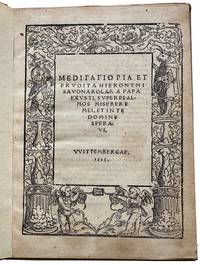
152343260Wittemberg: Np. 1523. First Edition with preface by Martin Luther. Wittemberg. N.p. 1523. 8vo. 20cm First Edition with preface by Martin Luther decorated title-page un-paginated i18p. text in Latin engraved folded frontis portrait Savanorola contemporary annotations in margins small worm-holes in leaves slightly affecting some text bound in modern grey boards with title in black: "Luther- Meditatio Heir . Savanolae. 1523" very good to fine rare. very good to fine. ~~ Savonarola's last writings "Inflex ego" & "Trestilia" when in prison before execution in 1498. Martin Luther was a great admirer of Savonorola as a harbinger of the Protestant Reformation and was impressed by these pair of meditations the second of which was unfinished. The location of the publication-Wittenberg-is significant being associated with Martin Luther and considered the birthplace of the Protestant Reformation. Although "Meditopia" has no publisher listed a copy of the book is in the University of Warsaw with a contemporary hand-written publisher's name; Johann Rhau-Grunenberg 1508-1825 noted for publishing Martin Luther's earliest works including the Indulgences of 1517. Np. unknown
152379343Wittenberg: Jobst Gutknecht 1523. First edition of Dr. Martin Luther's Maundy Thursday Sermon with explicit instruction on the correct preparation for receiving the holy sacraments. Quarto 24 leaves of German text disbound from the original Gutknecht edition and tipped in to accompany a rare 16-page handwritten manuscript containing a literal translation in English from 1864. Bound in full brown morocco elaborate tooling to the front and rear panels tooling to the spine yellow silk endpapers gilt turn-ins inner dentelles all edges gilt. Best known for initiating the Protestant Reformation in 16th century Europe German theologist Dr. Martin Luther's writings represented one-fifth of all materials printed in Germany between 1500 and 1530. His translation of the Bible from Latin into German and use of Gutenberg's printing press had an enormous impact both the accessibility of the Biblical teachings and on the German language itself. Jobst Gutknecht unknown books
1531139085Wittenberg: Hans Lufft 1531. modern boards. 8vo. modern boards. 10 leaves. First edition second issue the first issue was 1530. Benzing 2955. Title within woodcut historiated architectural border. Covers slightly warped; worming in blank lower inner corners minor repair on C3. Contemporary signature on title of Wolfgant Linhart marginalia in same hand. Luther's sermon on angels originally delivered on 29 September 1530. A very rare Lutheran pamphlet. Hans Lufft unknown
152692291526 Colophon: gedruckt durch Gabriel Kantz [in Zwickau], 1526. Un volume petit in-8° (105 x 145 mm) de 51 (sur 52) feuillets non numérotés, le dernier blanc (signatures A-E8, F4,G7); le second feuillet blanc (G8) manque. Reliure de la fin de XIXe ou du début du XXe siècle en plein parchemin, étiquette de titre en maroquin rouge. Discrets soulignements et notes marginales à la plume dans le texte, datant probablement du XIXe siècle. Grand ex-libris gravé (58 x 101 mm) au premier contreplat: «Bücher Sammlung Johannes Merck», soit Johannes Theodor Merck (Manchester, 1855-Hambourg, 1934), commerçant international, directeur de la Hamburg-Amerika Line en 1896). Ex-dono manuscrit, au bas de cet ex-libris,à un certain Fritz Sieveking, par «Herbert Merck, Hamburg, 21. II. 1949», soit le Dr. phil. nat. Herbert Theodor Merck (Hambourg, 1900- Hambourg, 1982), troisième enfant de Johannes Theodor Merck.
157757412Kiøbenhaffn, Matz Vinggaard, 1577. Folio. Samtidigt hellæderbind over træ. 2 messinbeslag efter 2 lukkestroppe. Ryg med ophøjede bind. Ryg fornyet i ældre tid. Kapitælslid. De rigt blindtrykte permsider kun delvist bevarede, panelleret med rullestempler. Hjørner restaurerede. En nyere, på permens inderside, indklæbet beskrivelse, hævder, at bindet er udført af P. Knufflack.(14),171,155,114 blade. 4 blade i faksimile (A1-2 og B4-5). En del blade kantflossede. Nogle skjolder, brugsspor. Enkelte blade defekte med lidt tab af bogstaver. Spredte kantreparationer og mindre revner i marginer. De to deltitelblade med bred træskåren ramme. Gennemillustreret med store bibelske træsnit som er kopier af Hans Brosamers illustrationer til en tysk bibel, trykt i Frankfurt 1548-49. Folio. Contemporary full calf binding over wooden boards with old rebacking. Two brass clasps, no ties. Raised bands to spine. Capitals worn. The richly blindstamped boards have only partly been preserved. Corners restored. A newer decription pasted into the inside of front board claims that the binding was made by P. Knufflack. Several leaves worn at edges. Some damp staining and wear. A few leaves defective with loss of a few letters. Scattered edge repairs and small tears to margins. The two half-titles with wide woodcut border. Illustrated throughout with large biblical woodcuts that are copies of Hans Brosamer's illustrations for a German bible printed in Frankfurt 1548-49. 4 leaves in facsimile (A1-2 and B4-5). (14), 171, 155, 114 ff.
157757412Kiøbenhaffn Matz Vinggaard 1577. Folio. Samtidigt hellæderbind over træ. 2 messinbeslag efter 2 lukkestroppe. Ryg med ophøjede bind. Ryg fornyet i ældre tid. Kapitælslid. De rigt blindtrykte permsider kun delvist bevarede panelleret med rullestempler. Hjørner restaurerede. En nyere på permens inderside indklæbet beskrivelse hævder at bindet er udført af P. Knufflack.14171155114 blade. 4 blade i faksimile A1-2 og B4-5. En del blade kantflossede. Nogle skjolder brugsspor. Enkelte blade defekte med lidt tab af bogstaver. Spredte kantreparationer og mindre revner i marginer. De to deltitelblade med bred træskåren ramme. Gennemillustreret med store bibelske træsnit som er kopier af Hans Brosamers illustrationer til en tysk bibel trykt i Frankfurt 1548-49. Folio. Contemporary full calf binding over wooden boards with old rebacking. Two brass clasps no ties. Raised bands to spine. Capitals worn. The richly blindstamped boards have only partly been preserved. Corners restored. A newer decription pasted into the inside of front board claims that the binding was made by P. Knufflack. Several leaves worn at edges. Some damp staining and wear. A few leaves defective with loss of a few letters. Scattered edge repairs and small tears to margins. The two half-titles with wide woodcut border. Illustrated throughout with large biblical woodcuts that are copies of Hans Brosamer's illustrations for a German bible printed in Frankfurt 1548-49. 4 leaves in facsimile A1-2 and B4-5. 14 171 155 114 ff. <br/><br/><em>The exceedingly scarce re-issue of the first Danish edition of Luther's "Huuspostille" which was printed by Lorenz Benedicht in 1564. Thesurus states that only two copies of this incredibly rare book has been on the market since World War II. Only very few copies on private hands. Det yderst sjældne re-issue af førsteudgaven der blev trykt af Lorentz Benedicht i 1564. Thesaurus anfører at der kun har været to eksemplarer på markedet siden 2. Verdenskrig.Thesaurus I 104. - Birkelund 24 1564-udgaven - Lauritz Nielsen 1085. </em> hardcover
158960075Wittemberg:: Durch Johan. Krafft 1589-1590. very old wooden boards wormed; four of eight metal corners and portion of one clasp remaining; covering material entirely absent except for vellum spine underlayment. The original sewing structure is intact. The final leaf of text has been trimmed close to the printed area and laid down; corners of text block thumbed and rounded. . Folio. Engraved title page; engraved text illustrations. Durch Johan. Krafft, hardcover
1522911Strasbourg : Matthias Schürer Erben 1521-1522: Strasbourg : Matthias Schürer Erben 1521-1522 1522. First Edition. Bound in modern 1/4 deer with some hair still on the leather. water stained throughout with paper damage in the lower margin not affecting the text contemporary marginal notes red and capitals stroked in red. This is a wonderfully visible example of large bearer type on the reverse of the title page.<br /> https://www.digitale-sammlungen.de/en/view/bsb11230143page=2 Quarto20 x 15 cm. A-B 4 C 8 D-E 4 F 8 G-H 4 I 8 K-L4 M8 N-O4 P8 Q-R4 S6.<br /> <br /> VD 16 L 3763; Luther WA 6: 282 M and 351 O 400 P ;Benzing Luther 12; Benzing Schürer Erben 1961. [Strasbourg] : [Matthias Schürer Erben], (1521-1522?) unknown