21 005 résultats
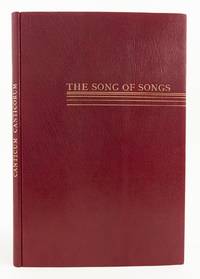
1962ST15876Frankfurt am Main: Ars Libri Verlag Gotthard de Beauclair 1962. No. 93 of 250 COPIES IN ENGLISH SIGNED by the illustrator and designer. 494 x 320 mm. 19 3/8 x 12 5/8". 40 pp. 2 leaves.Designed by Gotthard de Beauclair. <br/> FINE RED CRUSHED MOROCCO BY ROLAND MEUTER signed "R. Meuter Ascona" on rear turn-in upper cover with gilt lettering underlined with four gilt rules smooth spine with gilt titling leather hinges. In the original linen clamshell box backed with matching morocco. With 30 lithographs in the text by Gerhart Kraaz and one additional lithograph in a portfolio. ◆Slight discoloration from a bookmark in the lower gutter of colophon opening otherwise in perfect condition.<br/> <br/> Handsomely bound and beautifully designed and printed this very large folio first publication from the Ars Libri Press later called Ars Librorum exemplifies the kind of high quality work for which leading German publisher and book designer Gotthard de Beauclair was known. Beauclair 1907-92 began his career at Insel Verlag where he rose to art director and according to the Oxford Companion to the Book "turned inexpensive Insel books into collectors' items with excellent typography." He also founded three different publishing houses where he produced special limited editions that made full use of his excellent design and typographical skills. The present item is one such work recognized by the Association of German Book Artists as one of the most beautiful books of 1962. Gerhart Kraaz 1909-71 studied painting and worked as a graphic designer before becoming a serious book illustrator. The present title is considered his first major work in the realm of bibliophilic editions. His illustrations in charcoal are sensuous and shadowy capturing the romance and allure of the most beguiling Old Testament book. This edition in English appeared the same year as the German language edition but is much rarer--apparently the publisher cancelled a number of copies and very few ever made it to market. The binding characterized by an elegant simplicity is appropriate for the subject matter and for the stately large-format volume. Our binder Roland Meuter maintains an atelier in Ascona Switzerland where he continues to produce imaginatively designed bindings that attract considerable attention. Ars Libri Verlag, Gotthard de Beauclair unknown
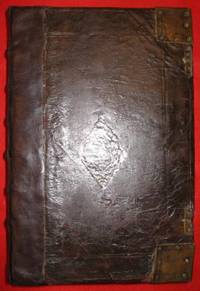
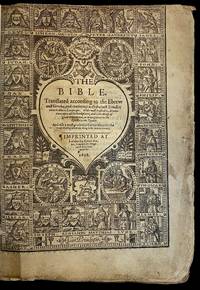
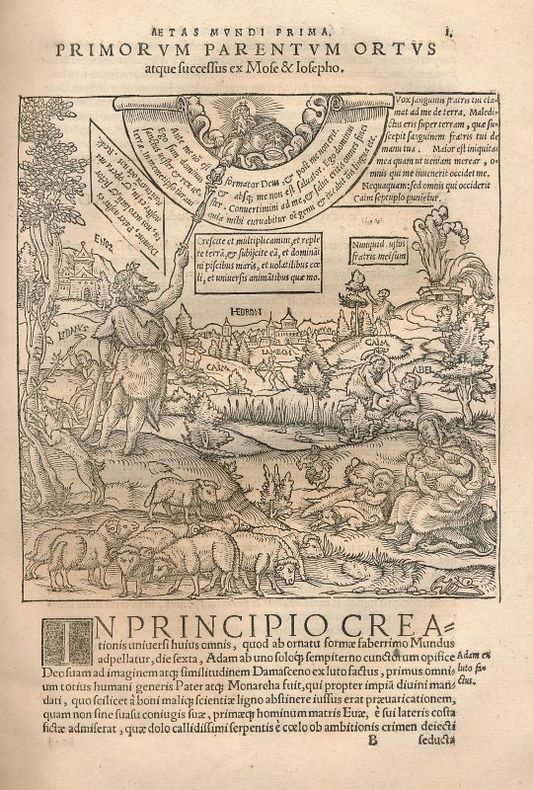
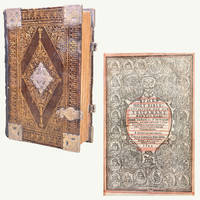
1611805London: Robert Barker 1611. Leather Bound. Very Good . 9 x 13 1/4 inches. Folio. 78 of 80 pages. Lacking title page. Griffiths 1611/2. Bound with: The Bible: That is The holy Scriptures contained in the Old & New Testament. London: Robert Barker 1612. 4 362 OT 361-444 Apocrypha 135 NT 7 tables leaves. Collates as A 4 leaves A-Lll in 6s Mmm - Ooo in 8s Ppp - Eeee in 6s Ffff 4 leaves. Engraved title page with old repair to closed tear at bottom. Full page woodcut of Garden of Eden presentwith loss to lower outer corner of image. B6 with old manuscript repair to loss at outer corner. Lacks 2Z3.4 Isaiah 17:13-24:18. Herbert 312. STC 2218. NT with separate title page dated 1611. Printed in two column Roman type. Bound with: Sternhold Thomas and John Hopkins. The Whole Booke of Psalmes: Collected into English Meeter. London: Printed for the Company of Stationers 1612. 114 6 of 8 pages. Collates as A-K in 6s L 1 of 2 leaves lacking index. STC 2539. Endpapers with 17th and 18th Century owners' inscriptions. Some marginal soiling and minor dampstains. Bound in contemporary brown calf with blindstamped arabesque centerpiece on covers brass corner pieces catches and clasps now lacking. Covers with old repairs and modern professional rebacking. A very good collection of the BCP of James I with the Geneva/Breeches Bible and Psalmes in folio with brass hardware. More complete than the copy located in Hills. Robert Barker unknown
1612263145London: Imprinted by Robert Barker 1612. 2344double-spread map; 4362 i.e. 366 361-444 2 3- 135 7 leaves; 1114 i.e. 1137pp. 1 vols. Small folio. Old calf rebacked with portions of original backstrip laid down remnants of gilt borders on boards 20th century endsheets and inserted sectional dividing blanks. Maps illustrations engraved general title to Bible. Entirety of all three works ruled in red. Genealogies: map has repairs to edges and is remargined at gutter no loss to image small spot to margin and a bit of soiling. Bible: engraved title and full-page woodcut of the Garden of Eden trimmed close and shaved at fore-margin normal page numbering errors in gathering 3K occasional modest soiling and some generally minor spotting. a few small marginal repairs one a tear in lower edge of 2Z3 across several lines without loss minute worm track in inner gutter of 2M-T; Psalms: repaired tear in upper margin of A3 touching a few letters K1-7 a bit limp and frayed with repairs to two lower blank forecorners; K8 terminal blank wanting; some moderate scattered soiling minute wormhole in black fore-margin of leaves G8 to end some rust satins to gutter/inner margins of gatherings G and H resulting in a few small holds; bookseller's annotations on pastedowns in ink !!! describing it an "exceptionally fine volume" and giving partially erroneous bibliographic citations. Still generally a good volume. 2344double-spread map; 4362 i.e. 366 361-444 2 3- 135 7 leaves; 1114 i.e. 1137pp. 1 vols. Small folio. A characteristic gathering of the three texts the Bible being the Geneva-Tonson-Junius version in an edition that is a very close reprint of Barker's 1607 edition. The general engraved title is undated and the sectional full title-page for the NT is dated 1611 but the printer's colophon at the end is dated 1612. The text of the Apocrypha is included as a part of the contiguous whole. The edition of the Genealogies which is here bound prior to the Bible is one of the several folio printings attributed to Beale that are partially sorted as to minute variants in STC and ESTC; however this example does not conform to the variants in ESTC in regard to the line-breaks in the side note on A1V. The present edition of the Sternhold and Hopkins Psalms includes some music settings. This is among the last folio London printings of the Geneva text the standard text of 16th century Protestantism and the text referenced by Shakespeare Donne Bunyan et al. The first edition of the NT was printed in Geneva in 1557 and was first printed in England in 1575-6. ESTC S1189; S101955; and S122901. Herbert 312. STC 2218; 23039 REF; and 2560 Imprinted by Robert Barker unknown books
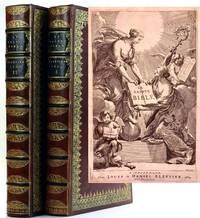
1669505324Louys & Daniel Elzevier 1669. Leather. FINE. 'Without exception the most splendid French Bible ever printed' Bibliotheca Sussexiana. The Great Elzevier Bible two-volume printing on fine paper: a spectacular printing of the French Geneva Bible in folio with full notes. The greatest achievement of the famed house of Elzevier and a serious contender for one of the finest Bibles in any language. 'Un des plus beaux monuments de la typographie elzevirienne . Édition exécutée avec un grand luxe typographique mais que l'on dit peu correcte' Willems Les Elzevier; Histoire et Annales Typographiques. Willems references the catalog of 1675 as offering three different paper options for this Bible: 'Imperiael coté 110 florins; Frans Real 56 florins; Veluws Real 50 florins; grand Mediaen 44 florins.' These latter three range from 430-44mm; our copy is the 'Imperiael' fine-paper edition without its original decklage now 460mm but came off the press at a full half meter. The Elzevier Bible was a decade-long production for which all stops were pulled out. First conceived by Louis Elzevier; although he retired from the press in 1665 his cousin Daniel's personal respect for him and regard for his contributions to this Bible led him to insist on retaining is former partner's name on the title page. The Elzeviers commissioned the Huegenot Father-Son team Samuel and Henri Marets to produce the ultimate French Geneva Bible. Using the 1552 de Hayes edition of Olivetan's French Bible first translated from the Greek and Hebrew originals for the French Protestants in 1535 they included all of the original Geneva notes along with translations of the Dutch notes printed in Dort 1637 as well as many other notes gleaned from other sources including their own original contributions. This astounding work of scholarship is matched by the frontispiece and greatly detailed maps four of which were newly commissioned by the Elzeviers from the great Dutch painter Nicolaes Pieterszoon Berchem. The fifrth Jerusalem and the Temple was copied from the London Polyglot Bible of 1655. These were engraved by Amsterdam printmakers Abraham Blooteling and Jan de Vissche. All this alongside the extaordinary typographical work by Daniel Elzevier make this a truly special Bible. DETAILS: Folio 46 x 30cm. Splendid modern calf binding with ornate gilt borders and gilt spine titles blocked in black with fresh endpapers and originals retained. Double pagination vol. 1 Three folding maps; 82 366 732pp; Vol. 2 Two folding maps; 4 162 432 Prophets; 4 202 403 NT; 4 3-70 134pp. Apocrypha. Collation in sixes: Vol. 1: 2 original endpapers Engraved Frontispiece 41 unsigned A1-PPP6; Vol. 2: Prophets Title A2-Dd6 2 OT; 2 A-Kk6 4 NT; 1 A2-M4. CONDITION: Faint tidemark to the upper margin of latter NT from Timothy on and to the Apocrypha bound after NT as an appendix in smaller type without study notes; 'Les Voyage des Israelites' foldout map fore edge is a bit tattered with a 1x2' chip just barely affecting the print border untrimmed edges darkened as expected otherwise remarkably clean and fresh internally with the fine paper remaining very bright. Darlow & Moule 3761; Willems 1402; Chambers Bibliography of French Bibles Vol. II 482ff. Louys & Daniel Elzevier unknown
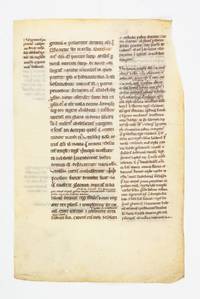
ST17586Abbey of St. Oyan at St.-Claude du Jura France ca. 1175. 245 x 158 mm. 9 3/4 x 6 1/4". Single column of text with two columns of gloss text column with 26 lines in a fine proto-gothic book hand. <br/> Verso with scant remnants of mounting tape in a couple of places along one edge. See Gwara Handlist no. 77. ◆Upper margin of fore edge unevenly trimmed away but no text lost a dozen-and-a-half small round wormholes touching just a couple letters light soiling to edges and other minor imperfections but still IN FINE CONDITION the vellum very clean and the ink dark and legible.<br/> <br/> The most important innovation in biblical scholarship during the 12th century was the development of the "Glossa Ordinaria" to the Bible. Drawing on the whole earlier tradition of biblical exegesis but especially that of Latin patristic writers like Augustine and Jerome scholars working in the French cathedral schools of Laon and Paris systematized this material in an apparatus of marginal and interlinear glosses arranged around the relevant biblical passages. The present leaf showing a particularly beautiful and regular script is a lovely example of one such work. The biblical text appearing in the center column is differentiated by larger lettering and gloss appears interlineally and in a column on either side of the main text all in smaller lettering by the same hand. Scott Gwara notes that the parent manuscript was formerly in the Medieval library of St. Oyan at St.-Claude du Jura a Benedictine monastery founded as the Abbey of Condat around 425 and later known as St. Oyen after an obscure saint who served as Condat's fourth abbot. In the 13th century it was renamed St.-Claude. By the 20th century the manuscript was in the collection of William L. Clements d. 1934 the bulk of which was sold by his estate between 1934-37. The manuscript was then acquired and dismembered by biblioclast Otto Ege around 1939. Gwara notes that the manuscript was incomplete by the time it reached Ege containing only 80 leaves but was "otherwise in excellent condition." The present leaf certainly attests to this assertion being extremely clean bright and with comfortable margins. unknown
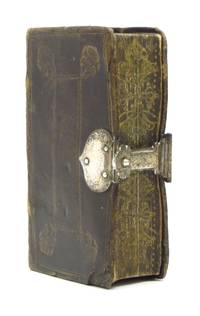
162812589Sedan Ioannis Iannoni 1628. 571 1 p. 32°. Contemporary Leather binding fine gauffred and gilt-edged text block and a silver clasp. Greek miniature Bible H. 85 x L. 5 x W. 23 cm. Sedan, Ioannis Iannoni hardcover
16084431London Robert Barker 1608 Très bel exemplaire d'une Bible en culotte de cheval publiée par Robert Barker en 1608. Contient : Un titre général ; l'Ancien Testament (mais pas de page de titre séparée pour l'Ancien Testament) ; le Nouveau Testament avec un titre ; l'Apocalypse ; 2 concordances (avec un titre séparé indiquant qu'elles ont été rassemblées par R.F.H.) ; le Livre des Psaumes (avec un titre séparé indiquant qu'elles ont été rassemblées par Thomas Sternehold & John Hopkins). Reliure en plein veau moucheté du 20e siècle. Les pages de garde sont neuves et unies. 4 bandes surélevées au dos, décorations aveugles sur les compartiments. Bords de la planche à motifs. Étiquette et titres noirs et dorés au dos. Toutes les pages de titre sont présentes. Les 3 dernières pages, Psaumes avec de très vieilles réparations et une page insérée dans le désordre. Les Psaumes sont complets mais le Credo est incomplet à la fin du livre (il se termine à la page 92). Toutes les sections sont datées de 1608. Robert Barker. Les problèmes notés dans cet exemplaire sont : f68 marqué comme f96 ; f173 avec une note de bordure collée ; f329 (dernière page d'Ezéchiel mal reliée à Daniel) ; f330 présent mais avec perte d'une grande partie du texte ; f434 mal paginé comme f435 ; f435 a une grande tache d'encre au verso ; f464 petite déchirure fermée ; f483 déchiré avec une certaine perte ; f490 mal paginé comme f499 ; f534 complet mais déchiré ; Livre des Psaumes : Les 10 premières pages ne sont pas paginées ; p28 mal paginée comme p27 ; p86 mal paginée comme p66 ; pps 87/88 échangées avec pps 89/90 ; Les deux derniers feuillets ont été réparés, et le dernier feuillet avec une perte modérée sur les bords. Comme c'est inévitable avec une Bible de cet âge, il y a aussi de petites déchirures, des entailles et un assombrissement général des pages, mais c'est un très bel exemplaire. Cette édition de la Bible de Genève a reçu le surnom de Bible à culotte, en raison de sa traduction erronée du chapitre 3, verset 7 de la Genèse. Le texte se lit comme suit : Les yeux de l'un et de l'autre s'ouvrirent, et ils connurent qu'ils étaient nus. Ils cousirent ensemble des feuilles de figuier et se firent une culotte. Chaque page n'étant numérotée qu'au recto (voire pas du tout), il s'agit en fait de numéros de feuilles (nous nous référons donc à fn). Pour compliquer encore les choses, le livre des psaumes numérote chaque page, et non chaque feuille. Collation complète : [ii], 1-554, [1-98], [1]-91.pp Collation : [manque le blanc q1], q2-Zzz10, A-L2, A-G3. Notre exemplaire est en grande partie conforme à Darlow & Moule 225a. Il s'agit d'une réimpression proche du quarto de 1605, avec le texte se terminant sur fo.554 (comme le nôtre pour l'AT et le NT) et avec Gen. i. 3 : 'Then God Sayd...' 240 par 170mm (9œ par 6Ÿ pouces).
16084431London: Robert Barker 1608. A very nice copy of a Breeches Bible published by Robert Barker in 1608. Contains: A general title; The Old Testament but no separate Old Testament Title page; The New Testament With Title; Revelation ; 2 Concordances With separate title stating that these were collected by R.F.H. ; Book of Psalms Separate title state that they were collected by Thomas Sternehold & John Hopkins. Bound in full 20th century mottled calf. Plain new endpapers. 4 raised bands to spine blind decorations to compartments. Board edges patterned. Black and gilt label & titles to spine. All title pages present. Final 3 pages Psalms with very old repairs and one page inserted out of order. Psalms complete but Creed incomplete at end of book So ends at page 92. All sections dated 1608. Robert Barker. The noted issues with this copy are: f68 marked as f96; f173 with pasted down border note; f329 last of Ezekiel misbound in Daniel; f330 present but with loss of a large are of text; f434 mispaginated as f435; f435 has large ink stain to verso; f464 small closed tear; f483 torn with some loss; f490 mispaginated as f499; f534 complete but torn; Book of Psalms: 1st 10 pages unpaginated; p28 mispaginated as p27; p86 mispaginated as p66; pps 87/88 exchanged with pps 89/90; The final two leaves have been repaired and the final leaf with moderate loss to the edges. As is inevitable with a Bible of this age there are also tiny tears nicks and edgewear and a general darkening of the pages nevertheless s a very nice example. This edition of the Geneva Bible received the nickname Breeches Bible because on its erroneous translation of Genesis Chapter 3 Verse 7. The text reads: 'Then the eyes of them both were opened and they knew that they were naked and they sewed figge tree leaves together and made themselves breeches.' Each page is numbered to the recto only if at all so these are actually leaf numbers so we refer to fn. To confuse matters further the book of psalms numbers each page not leaf. Full collation: ii 1-554 1-98 1-91.pp Collation: lacks blank q1 q2-Zzz10 A-L2 A-G3. Our copy substantially conforms to Darlow & Moule 225a. The states that it is substantially a close reprint of the 1605 quarto with text ending on fo.554 as does ours for the OT and NT and with Gen. i. 3: 'Then God Sayd.' 240 by 170mm 9½ by 6¾ inches. . Très bel exemplaire d'une Bible en culotte de cheval publiée par Robert Barker en 1608. Contient : Un titre général ; l'Ancien Testament mais pas de page de titre séparée pour l'Ancien Testament ; le Nouveau Testament avec un titre ; l'Apocalypse ; 2 concordances avec un titre séparé indiquant qu'elles ont été rassemblées par R.F.H. ; le Livre des Psaumes avec un titre séparé indiquant qu'elles ont été rassemblées par Thomas Sternehold & John Hopkins. Reliure en plein veau moucheté du 20e siècle. Les pages de garde sont neuves et unies. 4 bandes surélevées au dos décorations aveugles sur les compartiments. Bords de la planche à motifs. Étiquette et titres noirs et dorés au dos. Toutes les pages de titre sont présentes. Les 3 dernières pages Psaumes avec de très vieilles réparations et une page insérée dans le désordre. Les Psaumes sont complets mais le Credo est incomplet à la fin du livre il se termine à la page 92. Toutes les sections sont datées de 1608. Robert Barker. Les problèmes notés dans cet exemplaire sont : f68 marqué comme f96 ; f173 avec une note de bordure collée ; f329 dernière page d'Ezéchiel mal reliée à Daniel ; f330 présent mais avec perte d'une grande partie du texte ; f434 mal paginé comme f435 ; f435 a une grande tache d'encre au verso ; f464 petite déchirure fermée ; f483 déchiré avec une certaine perte ; f490 mal paginé comme f499 ; f534 complet mais déchiré ; Livre des Psaumes : Les 10 premières pages ne sont pas paginées ; p28 mal paginée comme p27 ; p86 mal paginée comme p66 ; pps 87/88 échangées avec pps 89/90 ; Les deux derniers feuillets ont été réparés et le dernier feuillet avec une perte modérée sur les bords. Comme c'est inévitable avec une Bible de cet âge il y a aussi de petites déchirures des entailles et un assombrissement général des pages mais c'est un très bel exemplaire. Cette édition de la Bible de Genève a reçu le surnom de Bible à culotte en raison de sa traduction erronée du chapitre 3 verset 7 de la Genèse. Le texte se lit comme suit : Les yeux de l'un et de l'autre s'ouvrirent et ils connurent qu'ils étaient nus. Ils cousirent ensemble des feuilles de figuier et se firent une culotte. Chaque page n'étant numérotée qu'au recto voire pas du tout il s'agit en fait de numéros de feuilles nous nous référons donc à fn. Pour compliquer encore les choses le livre des psaumes numérote chaque page et non chaque feuille. Collation complète : ii 1-554 1-98 1-91.pp Collation : manque le blanc q1 q2-Zzz10 A-L2 A-G3. Notre exemplaire est en grande partie conforme à Darlow & Moule 225a. Il s'agit d'une réimpression proche du quarto de 1605 avec le texte se terminant sur fo.554 comme le nôtre pour l'AT et le NT et avec Gen. i. 3 : 'Then God Sayd.' 240 par 170mm 9½ par 6¾ pouces. Robert Barker hardcover
199330780ABLuzern, Faksimile-Verlag 1993. Qu.-oblong-8° (18,5 x 39 cm). 36 Bll. Rotes Orig.-Maroquin auf 5 (echten) Bünden mit reicher Deckel-, Rücken-, Steh- und Innenkanten-Vergoldung, Goldschnitt; 2 Rückenschilder, Vorsätze mit roter Moiré-Seide bespannt. Eine Ecke ganz minimal berieben.
1933891Paris Les Cent Bibliophiles 1933 In-folio (37 x 28 cm.) Pleine reliure de maroquin havane, alignements de cercles concentriques à froid avec en leur centre une alternance de disques dorés ou à froid, reprise du décor sur le dos lisse avec titre doré, tranches dorées, étui. Edition illustrée de 95 gravures au burin dont 54 hors-texte par Albert Decaris. Tirage à 130 exemplaires sur Vélin d’Arches, celui-ci le n°54 imprimé pour Paul Hébert. Reliure signée G. Cretté succ. Marius Michel.
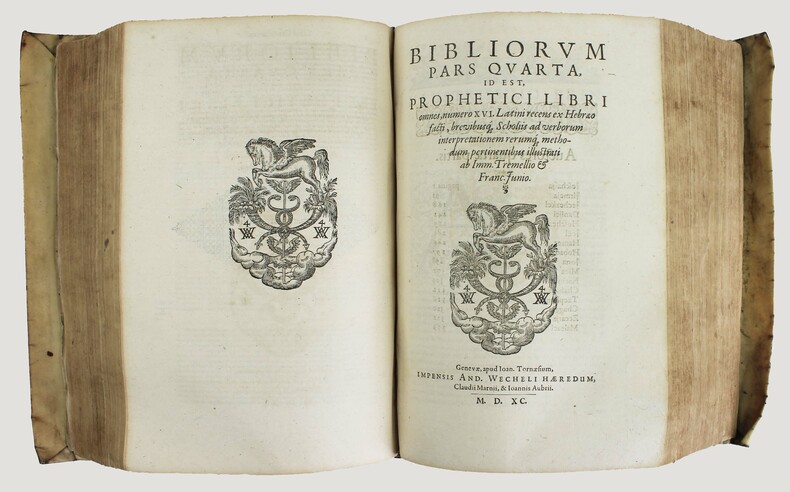
18607Genève, Jean de Tournes, pour André Wechel, 1590.
16528254Excudebat Antonius Vitré 10 x 16 Parisiis 1652 Huit volumes in-12, reliure plein maroquin bordeaux de l'époque, dos à cinq nerfs ornés d'entrelacs de petits fers dorés, pièce de titre de maroquin bordeaux, titre et tomaison dorés, plats « à la du seuil » présentant deux encadrements de filets dorés sur les plats, avec des fleurons aux angles de lencadrement intérieur, roulette dorée sur les coupes, toutes tranches dorées, roulette intérieure dorée, gardes marbrées. Frontispice gravé en tête du tome I, nombreux culs-de-lampe, 12 ff., 768, 714-[1] avec la marque typographique d'Antoine Vitré à la fin du tome II, Hercule terrassant un monstre et sa devise "virtus non territa monstris", 622, 648, 780, 583-[1], 480, 144-447-[1] pp., suivies in fine de 27 ff. d'index sur deux colonnes. Les pages de titre des vol. II à V indiquent la date de 1651, avec pour les vol. II et IV la date de 1652 au colophon. Édition de la bible selon la vulgate sixto-clémentine, avec les versets numérotés, imprimée par décision de lAssemblée du clergé de 1650 et sortie des presses du grand imprimeur parisien Antoine Vitré (1595-1674). Bel exemplaire, bien relié, quelques légers frottements sur les plats, très légère plissure à un coin du vol. I, petit accroc à la pièce de titre du vol. II, tache sur les plats du vol. VII, petites usures aux coins du vol. VIII. Ex-libris gravé par Jacques Nicolas Tardieu filius (1716-1791) sur chaque contre plat, aux armes de René Pucelle, dit l'abbé Pucelle (1655-1745), abbé commandataire de Corbigny, conseiller clerc au parlement de Paris, neveu par sa mère du maréchal de Catinat, exilé par le Régent en 1732 à la suite de l'affaire des convulsionnaires et de ses positions jansénistes. PHOTOS NUMERIQUES DISPONIBLES PAR EMAIL SUR SIMPLE DEMANDE-DIGITAL PHOTOGRAPS MAY BE AVAILABLE ON REQUEST
16528254Excudebat Antonius Vitré 10 x 16 Parisiis 1652 Huit volumes in-12, reliure plein maroquin bordeaux de l'époque, dos à cinq nerfs ornés d'entrelacs de petits fers dorés, pièce de titre de maroquin bordeaux, titre et tomaison dorés, plats « à la du seuil » présentant deux encadrements de filets dorés sur les plats, avec des fleurons aux angles de lencadrement intérieur, roulette dorée sur les coupes, toutes tranches dorées, roulette intérieure dorée, gardes marbrées. Frontispice gravé en tête du tome I, nombreux culs-de-lampe, 12 ff., 768, 714-[1] avec la marque typographique d'Antoine Vitré à la fin du tome II, Hercule terrassant un monstre et sa devise "virtus non territa monstris", 622, 648, 780, 583-[1], 480, 144-447-[1] pp., suivies in fine de 27 ff. d'index sur deux colonnes. Les pages de titre des vol. II à V indiquent la date de 1651, avec pour les vol. II et IV la date de 1652 au colophon. Édition de la bible selon la vulgate sixto-clémentine, avec les versets numérotés, imprimée par décision de lAssemblée du clergé de 1650 et sortie des presses du grand imprimeur parisien Antoine Vitré (1595-1674). Bel exemplaire, bien relié, quelques légers frottements sur les plats, très légère plissure à un coin du vol. I, petit accroc à la pièce de titre du vol. II, tache sur les plats du vol. VII, petites usures aux coins du vol. VIII. Ex-libris gravé par Jacques Nicolas Tardieu filius (1716-1791) sur chaque contre plat, aux armes de René Pucelle, dit l'abbé Pucelle (1655-1745), abbé commandataire de Corbigny, conseiller clerc au parlement de Paris, neveu par sa mère du maréchal de Catinat, exilé par le Régent en 1732 à la suite de l'affaire des convulsionnaires et de ses positions jansénistes. PHOTOS NUMERIQUES DISPONIBLES PAR EMAIL SUR SIMPLE DEMANDE-DIGITAL PHOTOGRAPS MAY BE AVAILABLE ON REQUEST
In -4°, pp. (8), 203, (5), cartonato. Frontespizio in rosso e nero. Prima (e unica) edizione. “Zaccaria Pasquale nelle “Decisioni morali” avea sostenuto che i padri hanno diritto di mutilar i flgliuoli per conservarne o svilupparne la voce. Il gesuita Teofilo Raynaud di Sospello genovese, famoso per ampia e disordinata dottrina, lo confutò” in quest’opera (cfr. Cesare Cantù, “L’abate Parini e la Lombardia nel secolo passato”), che tratta di castrazione e di asessualità derivata da varie cause, raccogliendo materiale dottrinario e letterario. Da notare che la condizione di “eunuco”, secondo alcune tradizioni sacre, comprende anche l’omosessualità (gli eunuchi classificati come “nati”). Théophile Raynaud, italianizzato come Teofilo Rainaldo (Sospello, 15 novembre 1583 – Lione, 31 ottobre 1663), è stato un teologo gesuita francese. Entrò nei gesuiti il 21 novembre 1602. Insegnò grammatica e lettere ad Avignone, poi filosofia e teologia a Lione e Roma. The eunuchus condition, according to some interpretation of Scriptures, could include homosexuals (i.e. the eunuchi classified as “nati” i.e. “born”). In this review the author, a jesuit prolific writer, take in exam the holy and profane litterature about the eunuchs condition and status.
Ex magnifica Helvetiorum Urbe Berna (Mathias Apiarius) 1550. In-Folio (302 x 201) relié plein vélin de l'époque, titre manuscrit en dos. 1 feuillet blanc, titre avec marque typographique à l'ours. 5 feuillets non chiffrés et XCIX feuillets, marque typographique à l'ours répétée en fin de volume, un feuillet blanc. La dédicace est datée 4 nonas Augusti 1540 et précédée de "De usu et Utilitate". Comprend une bible et une suite chronologique de Rois et Papes. Ouvrage abondamment illustré de lettrines et figures sur bois de formats divers (154 gravures sur bois, hors lettrines ) par Hans Holbein ; les signatures se trouvent pages XLVII (HB 1549). Signature du graveur IK (Jacob Kallenberg) pages V et XXV. Avec 2 marques d'imprimeur sur bois, gravures sur bois partiellement répétées par Jakob Kallenberg et Hans Galatin. Petit manque de vélin en bordure du plat et à la dernière de couverture. Ex-libris manuscrit en page de titre Anquetil-Duperron (Indianiste et traducteur du XVIIIeme). Brunet tome 4 pages 1473 - 1474. Bel exemplaire, propre et complet.
155046588Mathias Apiarius Ex magnifica Helvetiorum Urbe Berna (Mathias Apiarius) 1550. In-Folio (302 x 201) relié plein vélin de l'époque, titre manuscrit en dos. 1 feuillet blanc, titre avec marque typographique à l'ours. 5 feuillets non chiffrés et XCIX feuillets, marque typographique à l'ours répétée en fin de volume, un feuillet blanc. La dédicace est datée 4 nonas Augusti 1540 et précédée de "De usu et Utilitate". Comprend une bible et une suite chronologique de Rois et Papes. Ouvrage abondamment illustré de lettrines et figures sur bois de formats divers (154 gravures sur bois, hors lettrines ) par Hans Holbein ; les signatures se trouvent pages XLVII (HB 1549). Signature du graveur IK (Jacob Kallenberg) pages V et XXV. Avec 2 marques d'imprimeur sur bois, gravures sur bois partiellement répétées par Jakob Kallenberg et Hans Galatin. Petit manque de vélin en bordure du plat et à la dernière de couverture. Ex-libris manuscrit en page de titre Anquetil-Duperron (Indianiste et traducteur du XVIIIeme). Brunet tome 4 pages 1473 - 1474. Bel exemplaire, propre et complet.
1638371697London: Robert Barker Printer to the Kings most Excellent Majestie and by the Assignes of John Bill 1638. A-F8 G4; A-3K8; A-F8 G4. 8vo. Early black morocco tooled in gilt marbled endpapers a.e.g. GTS bookplates at front and rear. Autograph ownership signatures with several additional textual annotations. A few small interior tears with vernacular repairs. 2D2 torn with loss. A-F8 G4; A-3K8; A-F8 G4. 8vo. Includes Robert Barker's 1638 editions of the Book of Common Prayer and the Holy Bible both Old and New Testaments plus Apocrypha along with the 1637 edition of Thomas Sternhold's Whole Book of Psalms printed by G.M. for the Companie of Stationers in London all designated "Cum privilegio." Text in two columns with printed glosses. Three discrete ownership signatures of Richard Jacob are present - two on the versos of the title pages for the Old and New Testaments and one facing the title page for the Whole Book of Psalms - along with several autograph annotations and vernacular repairs. Robert Barker, Printer to the Kings most Excellent Majestie, and by the Assignes of John Bill unknown
1593371924London: Excudebant G. Bishop R. Newbery & R. Barker 1593. Six parts in one. Text printed in verse form double column references and notes in margins. 81771 blankpp; 31041 blank leaves; 3 75 i.e. 73 leaves; 6 numbered 1-12pp 13-129 leaves 1 blank; 3 4-74 leaves; 3 198 leaves. With additional blanks bound in at the front and rear. 1 vols. Folio. Eighteenth century reverse calf covers blocked in blind red morocco lettering piece repairs to joints minor loss at head of spine. Repairs at hinges scattered minor paper repairs. Provenance: Peckham Williams armorial bookplate; General Theological Seminary bookplate. Six parts in one. Text printed in verse form double column references and notes in margins. 81771 blankpp; 31041 blank leaves; 3 75 i.e. 73 leaves; 6 numbered 1-12pp 13-129 leaves 1 blank; 3 4-74 leaves; 3 198 leaves. With additional blanks bound in at the front and rear. 1 vols. Folio. The third edition of the Latin Bible printed in England in this case printing Tremellius and Junius's version of the Old Testament with Beza's translation of the New Testament accompanied by Tremellius's version based on the edition printed in Geneva in 1590 see D&M 6182. Texts printed in double columns. The complete text was printed in six parts each with a divisional title and independent pagination or foliation. The fifth part Junius's translation of The Apocrypha was never bound into this copy. A variant of this edition with the imprint for "Guliel. N." i.e. William Norton appeared the same year. ESTC S106974; STC 2061.5; Darlow & Moule 6185; BM 1. b. 12; Copinger 534 Excudebant G. B[ishop] R. N[ewbery] & R. B[arker] unknown
1790374001New York: Hugh Gaine 1790. 336pp. Text printed in two columns printer's device on the title. 12mo. Contemporary sheep minor wear. Tear to front endpaper else very good. 336pp. Text printed in two columns printer's device on the title. 12mo. The second NT printed in New York preceded only by the prior edition by Gaine dated 1789 known in but one extant example at NYPL and evidently from the same setting of type as this edition. The complete Bible was not published in New York until 1792. Evans 22359; Hills 27; ESTC W4679 Hugh Gaine unknown
172654196Berlenburg: n.p. 1726. First edition. Hardcover. Good. Eight volumes bound in four folio published between 1726 and 1742. All volumes with letterpress title page; sectional half titles; woodcut headpieces. Vol. 1 engraved frontispiece often not present here precedes vol. 7; appropriate engraved title leaves have been supplied from another German bible edition and inserted in vols. 1 3 4 and 5. Text in two columns. Contemporary calf over beveled wooden boards ruled in blind; spines with raised bands gilt morocco lettering pieces paper labels; marbled edges. Catches and clasps perished. Slight remains of paper labels. One volume with vertical crack through center of upper board else covers sound worn at extremities especially spine ends. Text with variable mild embrowning and light foxing occasional mild dampstains but overall clean. A good set complete and sturdily bound.<br /> <br /> Vol. 1 1726: 12 804 pp. - Vol. 2 1728: 8 880 pp. - Vol. 3 1730: 8; 784 pp. - Vol. 4 1732: 6 858 pp. - Vol. 5 1735: 8 820 pp. - Vol. 6 1737: 8 792 - Vol. 7 1739: 8 600 pp. - Vol. 8 1742: 4 556 44 index pp. with letterpress half-title: Der Berlenburgischen Bible Achter und Letzter Theil.<br /> <br /> First edition of this rigorous revision of Luther's version in the spirit of mystical Pietism edited by Johann Heinrich Haug d. 1753 and other scholars as is reflected in the main title: Welchem allem noch untermängt Eine Erklärung die den inneren Zustand des geistlichen Lebens oder die Wege und Wirckungen Gottes in der Seelen zu deren Reinigung Erleuchtung und Vereinigung mit Ihm zu erkennen gibt. Underlying everything is an explanation that reveals the inner state of the spiritual life or the ways and effects of God in in souls for their purification enlightenment and union with Him. A theologian and orientalist Haug was expelled from Strasburg for holding an assembly of Philadelphians and other mystic Separatists. He fled to the castle of Casimir Graf von Sayn-Wittgenstein-Berlenburg which had become a refuge for radical pietiests. Remaining there until his death Haug directed a Philadelphian organization that extended throughout western Germany. "He is said to have been a man of great piety and charming personality and was regarded by Count Casimer as a prophet of God" Schaff-Herzog. <br /> <br /> "The new spirit of mystical Pietism. was fully revealed in the Marburg Bible 1712. The interpretation of type and prophecy in this follows the federal theology of Cocceius that of Canticles and Revelation Madame Guyon. It was the forerunner of a larger work in the same spirit the Berleburg Bible of 1726-42. projected and prepared chiefly by Johann Heinrich Haug. The text is a revision of Luther's with comparison of the English and French versions; the commentary reflects the views of the Philadelphian communities and quotes the mystical books current among them especially Madame Guyon's but its teaching goes back beyond Dippel and Petersen to Jakob Böhme or even to Origen in some points. It lacks unity of belief and of treatment; it is the work not of a single mystic giving voice to his inner convictions but of a propagandist sect with radical tendencies. It is not without value however from different points of view; it edifies by its continual application of Scriptural works to the spiritual life and it prepares the way for historical criticism by an appendix vol. 8 containing apocrypha Old and New Testament pseudepigrapha and postapostolic writings." Schaff-Herzog. Christopher Sauer the agent for the sale of the Berlenburg Bible in the United States used the text as a model for the first German-American Bible 1743.<br /> <br /> Provenance: Bookplates of United Brethren Historical Society Dayton Ohio. D&M 4239. Jackson S. M. ed. The New Schaff-Herzog Encyclopedia of Religious Knowledge 1908 vol. 2 p. 157; vol. 5 p. 170.<br /> <br /> Main title and imprint vol. 1: Die Heilige Schrift Altes und Neues Testaments nach dem Grund-Text aufs neue übersehen und übersetzet: Nebst Einiger Erklärung des buchstäblichen Sinnes Wie auch der fürnehmsten Fürbildern und Weissagungen von Christo und seinem Reich und zugleich Einigen Lehren die auf den Zustand der Kirchen in unseren letzten Zeiten gerichtet sind; Welchem allem noch untermängt Eine Erklärung die den inneren Zustand des geistlichen Lebens oder die Wege und Wirckungen GOttes in der Seelen zu deren Reinigung Erleuchtung und Vereinigung mit Ihm zu erkennen gibt. Gedruckt zu Berlenburg im Jahr unsers Erlösers und Ursprungs der heiligen Schrifft JEsu Christi. [n.p.] hardcover
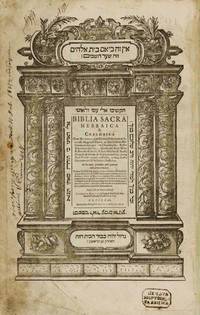
161948847Basel: Ludwig König 1619. First editions. Hardcover. Good. Seven parts in two volumes folio biblical texts and commentary in four parts continuously foliated; two supplemental sections each with separate foliation; Tiberias 1620 with separate pagination here bound after the second part - Vol. 1: 6 title and prelims 1-228 1 sect. title 234-441 1 blankff.; 6 sect. title and prelims 2 blank 114 2 blankpp. Vol. 2: 442-946; 8 Targum Yerushalmi; last leaf unfoliated; 67 Masora 1 blankff. Largely arranged in two columns of biblical texts in square font surrounded by commentaries in rabbinic Rashi font; text reads from right to left. This copy with collective Latin title surrounded by biblical quotations in Hebrew set within elaborate woodcut architectural borders. Hebrew sectional titles set within the same woodcut borders for the second and fourth parts with a plain letterpress half-title for the Five Megillot. The third sectional title for the Latter Prophets is lacking as are the Ashkenazi Haftarot readings not found in all copies. Apart from these lacks the Rabbinic Bible collates complete despite numerous errors in foliation throughout as per the detailed notes in Prijs Die Basler hebräischen Drucke. Opening word of each biblical book set in large one-third to one-half page cartouche vignettes with elaborate woodcut borders and surrounding letterpress Hebrew text. Main Latin title dated 1619 with the editor's Latin preface to the reader appearing at the verso. Jewish date chronogram for the second section Former Prophets dated 5378 1618/1619. Early twentieth-century black cloth boards worn at extremities gilt-lettered spine. Title moderately soiled re-inforced at gutter; neat old repairs to corners and fore-edge of title and next three leaves; old Russian stamp at bottom margin title manuscript entry in Russian along fore-edge dated 1837; intermittent mild to moderate marginal dampstains largely confined to corners and embrowning throughout both volumes somewhat more heavily in the first especially throughout Tiberias; top right corner of the opening leaf in vol. 2 repaired with loss of about 12 words surrounding title cartouche recto and some text in 9 lines of the commentary at the verso. Overall a good set with a notable chain of provenance. <br /> <br /> Sixth Rabbinic Bible in Hebrew: Mikra'ot Gedolot edited by Johann Buxtorf I 1565-1629 professor of Hebrew at the University of Basel and the foremost Christian Hebraist of his era with the assistance of the Jewish scholars Abraham Braunschweig who served as the principal corrector and Mordechai Gumplin of Posen. This was "a truly audacious undertaking for his time" Burnett From Christian Hebraism to Jewish Studies as no Christian scholar had yet attempted to edit the entire biblical corpus including the Aramaic versions Targumim and masoretic notes. Based mainly on the third Rabbinic Bible published by Daniel Bomberg at Venice in 1546-1548 the editor has carefully incorporated elements from two other Venetian editions. At the verso of the Latin title Buxtorf provides a detailed bibliographical excursus on the earlier Venetian editions and offers a tribute to Bomberg's industry by reprinting the colophon of the second Venetian Rabbinic Bible 1524-1525 at the conclusion of the masoretic appendix with text by the Hebrew grammarian and lexicographer Elijah Levita 1468 or 1469-1549 and a new introduction by Abraham Braunschweig. The design of the sectional titles and separate book title vignettes closely model those of the Venetian editions. "Buxtorf did not plan simply to reprint one of the existing Venice editions but rather to assemble the best features of them all into one work" and "to provide theologians with what he considered the most important tools for interpreting the Old Testament" Burnett. Buxtorf served in an official capacity as Basel's Hebrew censor charged with the oversight of all Jewish printing in the city and insuring that "no 'blasphemies' or slurs against Christians or Christianity appear in any book printed in Basel" Burnett. He carefully edited the Jewish commentaries in the Rabbinic Bible in accordance with this mandate "and removed many words and phrases which had escaped the attention of earlier censors" Burnett. <br /> <br /> The Rabbinic Bible contains the vocalized Masoretic text of the Hebrew Scriptures with accents and a vocalized Targum an Aramaic paraphrase of the biblical text: Onkelos for the Pentateuch; Jonathan b. Uzziel for the Prophets; and Targum Hagiographa for the Writings. The Hebrew and Aramaic versions are printed in square characters and presented in facing columns at the center of each page. The Jerusalem Targum of the Pentateuch appears as an appendix. In addition to the Aramaic paraphrases the Rabbinic Bible includes a massive scholarly apparatus of biblical commentaries by Rashi Ibn Ezra Baal ha-Turim Jacob b. Asher R. David Kimchi Radak R. Levi b. Gershon Ralbag Saadia Gaon and R. Isaiah along with the Masora a corpus of critical notes on the external form of the Biblical text compiled by Jewish scholars from late antiquity through the medieval era. As frequently occurs a copy of Buxtorf's work on the textual history of the Hebrew Bible Tiberias the 1620 first edition is bound-in. This work was made possible by the publication in 1538 of Elijah Levita's Masoret ha-Masoret a commentary on the Masora which Buxtorf translated into Latin for his own private use in 1593. "Buxtorf was concerned with the integrity of the consonantal text and the origin and integrity of the vowel points and accents of the Hebrew Bible from the very beginning of his scholarly career" and while he had earlier published a long excursus on the age of the vowel points and accents in his 1609 Thesaurus Grammaticus "Tiberias is Buxtorf's fullest and most impressive work on the history of the biblical text" Burnett. Intended as a reference work for Christian students and scholars interested in studying the Masora Buxtorf was also keen to refute the view advanced by Levita that the Hebrew vowel points were early medieval innovations. Our folio version of Tiberias was intended to accompany the Rabbinic Bible and has the same architectural borders at the title. König also published a quarto edition in the same year but only the folio version includes a critical commentary on the Masora in which Buxtorf proposes various corrections to the Masoretic notes. <br /> <br /> As noted at the title Buxtorf's faithful study and tireless labor studio fido et labore indefesso yielded notably long-lasting results: "The Basel rabbinical Bible became a standard tool for research among Christian scholars and would remain so. until the end of the nineteenth century" Burnett. A vast array of early modern scholars including Protestants like Johannes Drusius and John Selden as well as Roman Catholics like Robert Bellarmine and Andreas Masius owned a copy or two of the Rabbinic Bible. "Johannes Buxtorf's thoroughly censored "Christian" version of the Rabbinic Bible Basel 1618-19 only made it easier for Hebraists to own copies of their own" Burnett Christian Hebraism in the Reformation Era p.163.<br /> <br /> A note on the date of publication: "The actual printing began between the mid-August and mid-September of 1618. According to the colophon production ended on the 24 of Ab 5379 = August 4 1619 but since this date also appeared on the colophon of the Bomberg Biblia rabbinica edition of 1524-25 reprinted unchanged in the 1546-48 and 1568 editions it is suspect. Prijs suggested that the probable completion date was sometime during Ab of 5379 between July 12 and August 10 of 1619" Burnett. <br /> <br /> Provenance: from the library of acclaimed theologian and biblical scholar Brevard Childs with his entry at the free endpaper in the second volume. The earlier bookplate of judge Samuel Heller with his motto in Hebrew: Mi-kol melamdai hiskalti from all my teachers I have learned appears at the front paste-down. An old blue ink-stamp in Hebrew characters makes occasional appearances the text: Bet ha-Midrash ha-Gadol Minsk The Great Synagogue of Minsk. A Russian entry dated 1837 appears at the fore-margin of the main title along with an old ink stamp in Russian at the bottom margin the last word of which reads "Rabbina" References: Biblia Sacra: Burnett 7. Cowley 87. Darlow & Moule 5120 bound with the 1665 second edition of Tiberias cf. 5093. Davidson Otsar ha-shirah vol.1 p.406 no.8954. Prijs 219. Steinschneider 423 423b. VD17 23:675325G. S. Burnett Christian Hebraism in the Reformation Era Leiden: Brill 2012 p.163. Tiberias: Burnett 111. Prijs 222a. For detailed analyses of both works see: S. Burnett From Christian Hebraism to Jewish Studies Leiden: Brill 1996 pp.169-239 chaps. 6 & 7.<br /> <br /> Full Latin title: Biblia Sacra Hebraica & Chaldaica cum Masora quae critica Hebraeorum sacra est Magna & Parva ac selectissimis Hebraeorum interpretum commentariis Rabbi Salomonis Jarchi R. Abrahami Aben Esrae R. Davidis Kimchi R. Levi Gerson R. Saadie Gaon R. Jeschajae & Notis ex authore quem Baal Turim vocant collectis quibus textus grammaticè & historicè illustratur. In his nunc primum post quatuor editiones Venetas textus Chaldaicus qui Targum dicitur à deformitate punctationis & pravitate vocum innumeratum vindicatus; loca in Masora transposita deficientia pugnantia numeris depravata subsidio diversorum exemplarium & Concordantiarum Hebraicarum quantum fieri potuit reposita restituta & conciliata sunt ut in praefatione amplius declarabitur. Studio fido & labore indefesso Johannis BuxtofI linguae sanctae in Academia Basileensi Professoris Ord. Basileae: Sumptibus & typis Ludovici König 1619.<br /> <br /> Collation vol. 1 Rabbinic Bible: ital.a6 a-z8 A-E8 F4 G-Z8 Aa-Hh8 Ii9 Ii10 blank; 1 blank :3 1 blank A-N4 O5.<br /> <br /> Collation vol. 2 Rabbinic Bible: Kk-Rr8 Kk1 lacks Ss6 Tt10 Vv-Zz8 AA-PP8 QQ-TT6 VV9 VV10 blank XX-ZZ8 Aaa-Nnn8 Ooo3 Ooo4 blank PppTtt8 Vuu3 Vuu4 blank Xxx-Zzz8 AAaa-EEee8 8 A-G8 H6 I5 I6 blank. Ludwig König hardcover
18801052551880. BIBLE. Bibl yr Addoliad Teuluaidd. London and New York: London Printing and Publishing Company circa 1880. Thick folio 11-1/2 by 16 inches period-style full dark purple pebbled morocco tooled in gilt and blind raised bands brass name plate on front cover brass clasps and catches all edges gilt. $3500.Victorian edition of the ""Family Worship Bible"" in Welsh with engraved vignette title page frontispiece and 45 folio engraved illustrations beautifully bound with brass furniture.As with many vernacular translations the rendering of the Bible into Welsh was important to the survival of the language. Recognizing Welsh as a liturgical language helped ensure its continued use as a means of everyday communication down to the present day despite the pressure of English. Not in Darlow & Moule. Fine condition splendidly bound. hardcover
1633156London: Robert Barker.by the Assignes of John Bill 1633. Very Early Elizabethan Printing. Tooled leather. Very Good /Custom Case. 12mo original tooled leather 17th century binding engraved frontispiece very closely cut borders all edges gilded original green silk page divider viii blank ~ 524 vi blank pages. THE NEW TES_/ TAMENT / Of our Lord and / S A V I O V R / - Jesus Christ Newly translated out of the / Originall Grrek : and / with the former transla- / tions diligently compared / and revised by his Maie- / sties special commande- / ment. ---------------------------- Imprinted at London / By Robert Barker Printer / to the Kings most Excel- / lent Majesty and by / the Assignes of John Bill 1633. Cum privilegia. A GEM! In an original tooled leather binding no less. Beautiful clear type. Minimal wear. Some pages so closely cropped by the printer that the chapter headings at the top have been partially excised though not the text. In order to ensure its proper long-term preservation we commissioned Scott Kellar distinguished Chicago bookbinder and restorer to make minor professional repairs and to construct a protective box for this already Exceptional and Rare tiny edition of the Authorized King James version of the New Testament. Finely bound in contemporary tan embossed calf over wooden boards richly gilt to spine. four hubs and boards. Marbled pastedowns & endpaper. a.e.g. and gauffered. Spine very slightly rubbed with partial loss of caps at head and foot restored and almost invisible. Edges of engraved title page reinforced; overall a fine copy. Ink inscriptions on two front free endpapers naming "Edmund James Gore" & his London addresses. The continental binding on this small format Authorized version MAY suggest that it might be a pirated edition of the English Bible pirated in Amsterdam. For example the Stam printing family were printing small format Bibles in 1673-- after our publication see Cambridge History of the Book in Britain IV p.467. Herbert 713-14 Wing B2511A. Robert Barker...by the Assignes of John Bill hardcover books
18957527New York: American Bible Society 1895. Hard Cover. First edition of this Bible volume I only; folio 14" x 13" 164 leaves embossed in the New York Point Alphabet for the Blind which is a system of tactile raised dots similar to Braille. Contemporary 3/4 calf over tan cloth covered boards spine ruled in gilt; spine label is absent. New York Point for the Blind was invented by William Bell Wait 1839-1916 educator for the Blind as an alternative to the "Line Letter" system consisting of raised letters of the standard alphabet which was in use in the late 19th Century and lasted for several decades. But Braille had been invented by Louis Braille in 1824 but fell into disuse only to be revived in the early 20th Century and Braille remains today the standard in reading and writing for the Blind throughout the world. Internally quite clean with the embossed dots in very good condition; small loss at head of spine and corners worn through; a very good copy now quite scarce on the market. <br/><br/> American Bible Society hardcover books
1640T93<p><strong>Description</strong></p><p>Octavo approx. 7" x 4.75". Engraved general title page 1640 with engraved border featuring the twelve Tribes and the twelve Disciples. Text ruled in red throughout in two column Roman font. Genesis 1 with small woodcut of Adam and Eve in the Garden. Without Apocrypha likely removed before it was first bound. Similar New Testament title page 1639. Bound with the <em>Whole Booke of Psalms </em>1640 with printed title page and border.</p><p><strong>Collation</strong></p><p>A-Z8 Aa-Pp8 Old Testament Bbb-Nnn8 New Testament. Complete with both title pages.</p><p><strong>Binding</strong></p><p>Rebacked black goatskin with original spine laid down. Boards elaborately and extensively decorated in gilt with rolls and drawer handle tools with central lozenge surrounded by a paneled border. Metal bosses and eight cornerpieces with the words "Recordare Matrem Jane Strode" Remembering Mother Jane Strode to upper and lower boards. Metal hasps with evidence of clasps. All edges gilt. Inner dentelles. Marbled endpapers.</p><p><strong>Condition</strong></p><p>Ex-libris stamp of David Parsons to front free endpaper. Clean and bright throughout with no notable flaws. An excellent example far better than typically seen in a lovely period binding.</p><p><strong>References</strong></p><p>Herbert 546; STC 2342.</p> Robert Barker hardcover