291 résultats
154049324Paris: F. Gryphius 1540. Two parts in one volume 16mo in 8s. 199 1 blank; 136 16 indexff. "Novvm testamentum" in cartouche vignette at title-page along with Gryphius' griffin device Renouard 413; 90 three-quarter page including repeats and 15 smaller woodcut illustrations including repeats; 21 historiated initials and woodcut lettrines; cartouche vignettes with book titles; printed marginalia; half-title for the second part Epistles and the Book of Revelation. Text not divided into verses; occasional quotations in Greek. Later vellum over boards; manuscript title at the spine faded; speckled paper endleaves; edges stained red. Light dampstain at bottom margins extending up into text and gutter at the later leaves; small puncture at leaf 140 resulting in slight loss of text. A good complete copy of a very scarce illustrated New Testament with clean woodcut illustrations throughout.<br /> <br /> Collation: a-z8 &8 Aa8 A-T7 blank leaf 200; lacks final blank T8.<br /> <br /> Third Gryphius New Testament in 16mo format. Arranged in two parts with the Epistles and the Book of Revelation presented separately it reproduces the Vulgate text edited by Robert I Estienne for his Latin Bible edition of 1532. While some of the woodcuts appear in Gryphius' complete octavo Bible of 1541 this separate Testament is even more lavishly illustrated. Based upon Mortimer's description of the 1541 Bible we can ascertain that at least some of the Apocalypse woodcuts in the present volume are based on Holbein while most of the other illustrations whose blocks had been completed by 1539 "are relatively independent of earlier sets" Mortimer.<br /> <br /> An important shift in Bible illustration occured in the Netherlands in the late 1520s as printers began to focus on copiously illustrated small format editions of the New Testament to better explain the text and assist private devotion. The subtitle in our volume "cum ad ueritatem historiae tum ad uenustatem singulari artificio expressis" with the truth of history as well as beauty expressed by a singular artifice is clearly suggestive of this shift. Adopting this new format François Gryphius became the "first Paris printer to illustrate a Bible in the Renaissance style" Johnson quoted in Mortimer. These illustrations first appeared in the Acts of the Apostles and the Book of Revelation in Gryphius' pocket New Testament edition of 1537 Novum Testamentum additis picturis in Acta Apost. et Apocalipsin quibus miracula et visiones exprimuntur The New Testament with added illustrations in the Acts of the Apostles and the Book of Revelation depicting miracles and visions. Subsequent editions would include an expanding suite of woodcuts and were published at Paris by Gryphius under the present title in 1539 1540 1541 and 1542; Antwerp editions appeared in 1542 and 1545. The suite of illustrations in the present work is identical in placement and inventory with the data cited by Mortimer for the 1541 edition 90 cuts by repetition of 58 blocks from the larger set and 15 cuts by repetition of 6 small blocks and confirmed by inspection of the digitized version of the 1541 edition at the Bibliothèque de la Ville de Lyon. The only notable differences in graphic materials between the two editions appears occasionally in the selection of woodcut initials; the later edition also has several more unset initials indicated by guide letters than appear in our 1540 edition. <br /> <br /> All editions are quite scarce with only a handful of copies of each surviving.<br /> <br /> Provenance and annotations: Old entries at paste-down and front endleaf of George Woodhouse with his note about prior provenance dated May 1875; E. Holwell noting "This curious edition published in A.D. 1540" References: Cf. Deleveau & Hillard Bibles imprimées Paris 1539 and 1542; Antwerp 1542; Le Long/Masch 2.3 1783 p.279 Paris ed. 1542; R. Mortimer French 16th Century Books no.70 ed. 1541 illustrating woodcuts on a3 recto and P3 recto as per our copy and no. 69 8vo Bible 1541. For a discussion of the development of the woodcut series in these Gryphius pocket bibles see: A.F. Johnson "Some French Bible illustrations" Gutenberg Jahrbuch 1935 p.190.<br /> <br /> Full title and imprint: Novvm testamentum illvstratum insignium simulacris cum ad ueritatem historiae tum ad uenustatem singulari artificio expressis. Excudebat Fran. Gryphius An. M.D.XL. Cum priuelegio Regio.<br /> <br /> Typeface: Gryphius's own Brevier Roman or Petite-Text with scattered Greek. U. Aberdeen note via OCLC. F. Gryphius unknown
154355533Paris: Simon de Colines and Galliot du Pré 1543. Very good. Benedictine" edition of the New Testament in Latin edited through careful comparison of multiple medieval manuscript sources. An important New Testament edition in the Latin history of the Bible for which Benoît collated "most of the then known" medieval manuscripts Schreiber 149 seeking the most accurate readings and correcting transcription errors. Produced in the midst of the foment about translations spurred partly by the Reformation this translation did not seek novelty but rather a refinement of the established tradition. First issued as part of the complete Bible also by Colines in 1541 this is the first independent printing of the translation. Two years after its publication the Council of Trent would affirm the doctrinal preference for Latin editions in the Catholic Church. Octavo 6.5'' x 4.25''. 18th-century full speckled calf raised bands red goatskin spine label gilt-stamped spine compartments. Marbled endpapers all edges stained red two silk ribbon markers. Index at rear. 183 1; 140; 8 ff. 18th-century ink notes to rear fly leaf listing the order of Epistles according to Fleury; later ink annotation to front fly leaf "très rare" and noting it was published two years before the Council of Trent. Cracking to front hinge still firm; light chipping and wear to boards. Faint dampstaining to text block. Simon de Colines and Galliot du Pré unknown
1571A161-11711571. original Holzschnitt von Jost Amman auf der ganzen Buchseite mit ornamentaler Umrahmung, Darstellung ca. 5,5 x 7 cm, verso weiss / original woodcut by Jost Amman on the whole book page with ornamental framing, image ca. 5,5 x 7 cm, verso blank
1571A161-11721571. original Holzschnitt von Jost Amman auf der ganzen Buchseite mit ornamentaler Umrahmung, Darstellung ca. 5,5 x 7 cm, verso weiss / original woodcut by Jost Amman on the whole book page with ornamental framing, image ca. 5,5 x 7 cm, verso blank
1571A161-12631571. original Holzschnitt von Jost Amman auf der ganzen Buchseite mit ornamentaler Umrahmung, Darstellung ca. 5,5 x 7 cm, verso weiss / original woodcut by Jost Amman on the whole book page with ornamental framing, image ca. 5,5 x 7 cm, verso blank
1566THEO0797Ljubljana, DELO 1987. Nachdruck einer Ausgabe der Biblioteca Apostolica Vaticana (Augsburg 1566). 12x17,2 cm, 162 S., weißer OLdrbd. m. gldgepr. Deckeltitel u. Ornament, etwas abgestoß., sonst sehr gut erhalten. Slowenisch, Kroatisch, Deutsch, Italienisch, Lateinisch
152253365Mainz: J. Schöffer 1522. First Mainz edition. Octavo. 562 2: colophon blankpp. Collation: A-Z8 Mm8 chi2 O4/O5 reversed complete. Title within historiated woodcut border. Woodcut initials throughout. Text in italics. Printed side-glosses. Errata at final text leaf. Contemporary beveled wooden boards backed in tooled pigskin; spine with raised bands. Brass catch and clasp with expert restoration of leather thong. Contemporary manuscript musical scores used as pastedowns at front and back. Seven leather stubbs affixed at front edge as indexes. Occasional faint smudging mostly at margins else text crisp and fresh. A very good copy in a well-preserved sixteenth-century binding with a notable provenance.<br /> <br /> Scarce very early collective edition of the Latin "Paraphrases" of the Pauline Epistles prepared by the celebrated humanist scholar theologian and educational writer Desiderius Erasmus of Rotterdam 1466-1536. Preceded by the Froben collective editions of 1520 and 1521 this first and only edition of the Pauline Epistle Paraphrases to be printed at Mainz was issued by Schöffer in two parts each with full title and separate register and pagination; our volume contains the first part only: the Epistles to the Romans; Corinthians 2; Galatians; Ephesians; Philippians; Colossians; and Thessalonians 2.<br /> <br /> "In the vast and sustained labour he devoted to the New Testament Erasmus saw the culmination of his commitment to scholarship. and nothing else he wrote not even the Moriae encomium was to have so great an influence on posterity. The first edition of the New Testament appeared in 1516 and was followed in his lifetime by four more 1518/10 1522 1527 1535 each newly revised. Each consisted of the Greek text Erasmus' translation thereof and a copious apparatus of notes Annotations published as a separate volume. Beginning in 1517 he also published a Paraphrase of all parts of the New Testament save Revelation. Written in smooth and comprehensible Latin it was usually fuller than the original text. If offered his own interpretatiton but often avoided the provocative statements found in the Annotations. From the outset the translation the Annotations and to a lesser degree the Paraphrases drew criticism originally from conservative theologians who found heresies in his humanist philology but soon also from Lutherans and Catholics who denounced him for departures from their respective doctrines" Bietenholz. The Paraphrases were composed between May 1517 and January 1524. "Erasmus began with the Pauline Epistles. The paraphrase of Romans was published in quarto by Dirk Martens in Louvain in November 1517 and reprinted by Erasmus's friend Johann Froben in January of the following year; it sold well and was soon reprinted in octavo. Corinthians was published by Martens in February 1519 and reprinted in Basel by Froben in March; Galatians appeared later that year with editions from both publishers. The remaining Epistles followed in 1520 and 1521 the last to appear being Hebrews. In the autumn of 1521 Erasmus moved from Louvain to Basel and from that time Froben published the first editions of the remaining Paraphrases" Mynors. <br /> <br /> Our edition was printed by Johann Schöffer the son of Peter Schöffer who was the principal workman of Johannes Gutenberg. Apart from those of the Pauline Epistles the only other complete Paraphrase of Erasmus to be published by Schöffer was that on the Gospel of Matthew also in 1522. He did in 1521 however issue a series of four brief excerpts from the Paraphrases in German translation which appear to highlight provocative exegesis by the great scholar of Rotterdam concerning for example the hypocracy of the Pharisees Matthew 23 or the exhortation to "Take My yoke upon you and learn from Me" Matthew 11.29.<br /> <br /> Provenance and annotations: Contemporary manuscript entry at the title-page of the Benedictine monastery library at Amorbach; contemporary 50-word manuscript note in Latin at the free endleaf facing the title which discusses the present work. Early manuscript note in German at the final blank endleaf. Early leaves with light rubrication in red ink; about twenty leaves with contemporary annotations throughout. Later stamps of the Leiningen Palace Library at the bottom margin of the title and very faintly at the pigskin covers. Bookplate of United Theological Seminary Dayton Ohio noting the gift of Dr. Walter N. Roberts with their vertical entry stamp Mar 28 1963 at the dedication leaf lightly over the left-hand edge of the text but not impairing legibility. Full title and imprint: Paraphrases Eras. Rot. In omnes epistolas Pauli apostoli germanas : et in eam quae est ad Hebraeos incerti autoris cum ijs quae Canonicae uocantur diligenter recognitae excusaeque & ita binos in tomos digestae ut cuique secare in formam enchiridij siuelit liberum sit.<br /> <br /> References: P.G. Bietenholz Encounters with a Radical Erasmus Univ. Toronto 2009 p.13; R.A.B. Mynors "The Publication of the Latin Paraphrases" in: R.D. Sider ed. New Testament Scholarship: Paraphrases on Romans and Galatians University of Toronto Press 1984 pp. xx-xxix; USTC 682534; Vander Haeghen p.145: Paraphrases in omnes epistolas Pauli. Moguntiae Io. Schoeffer m. augusto 1522 octavo; VD16 E-3379 Berlin; Halle; Leipzig; Wittenberg; Wolfenbüttel. This first part not in Adams but cf. E-795 the second part 378pp. J. Schöffer unknown
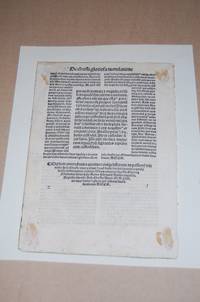
151315483Basilee Basel:: Michaelis Furter February 1513. First edition. Extremely rare. 15 x 20.5 cm. Daniel Agricola Urs Graf Michael Furter commentary. Leaf XXVI recto colophon page with title publisher and date on verso. Mounted right side corners remnants from previous corner mounts. Suitable for framing or perhaps mating with another copy. This is a very rare leaf from a very rare book. Text in double columns Gospel narrative in larger print in center commentary on outer columns. Agricolas classic work on the Passion of Christ. VD16: B4703. OCLC lists only 3 copies. Michaelis Furter, unknown
152566040Paris:: Simon de Colines 1525. old full calf; gilt spine. A few old ink notes to the title page; rubbed at corners and extremities. 16mo. Trad. S. Hieronymus. Renouard ICP III 770. Simon de Colines, unknown
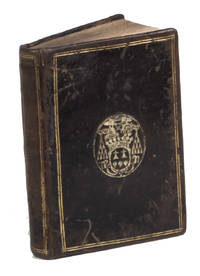
1584V6854Antwerp 1584. 16mo 118 x 8 cm. Christophe Plantin Late 17th-century dark brown calf with gold-stamped coat of arms of Pierre-Daniel Huet on both covers and gold-tooled dubbel-lined borders on covers and spine faded red speckled edges. With woodcut printer's device on the title page the text is partially printed in Greek. 267 13 pp. The text of this Book of Psalms is printed in Greek and Latin in parallel columns and on each page the inner column contains the text in Greek while the outer column contains the same in Latin. There are separate Greek and Latin indexes at the end of the work. This copy belonged to Pierre-Daniel Huet 1630-1721 a French clergyman and scholar. According to the title page this bilingual work was published by Plantin after the example of the Complutensian Polyglot Bible 1520. Plantin also issued a 24mo edition in the same year.The present copy is bound in dark brown leather with the coat of arms of Pierre-Daniel Huet stamped in gold on the front and back covers. Huet was the Bishop of Soissons and later Avranches. He was the cofounder of the Académie de Physique in Caen and in 1674 he became a member of the Académie française. He was one of the most learned men of his age; he studied Greek and Hebrew and he claimed to have read the Hebrew text of the Bible 24 times. The present volume also contains a few marginal corrections of the Greek text in a contemporary neat hand. Huet was known for his very fine and neat handwriting. As a linguist with an interest in Greek and Hebrew it is highly probable that Huet extensively used this copy and that he himself added the annotations. Despite his knowledge of Hebrew the partly obscure Hebrew annotations on the first endleaf "this book belongs to me Cardeliac" are probably not his. Although Huet was not a member of the Jesuit order he lived his final years in a Jesuit home in Paris. After his death he bequeathed his library to the Jesuits and upon the dissolution of the order in France in 1764 king Louis XV bought Huet's books and they are now part of the colleciton of the Bibliothèque Nationale de France. The bookplate on the front pastedown was made by the Jesuits to commemorate Huet's donation of his library.Covers show signs of wear spine has been expertly restored. With an ex libris-label of Pierre-Daniel Huet on the front pastedown: "Ex libris bibliothecae quam Illustrissimus Ecclesiae Princeps. D Petrus Daniel Huetius . 1692." an inscription in brown ink in Hebrew and several inscriptions in pencil all on the first fly leaf. With crossed out inscriptions except for "164" in the bottom left corner on the verso of the third fly leaf and at the head of the title-page with some annotations in dark brown ink in Greek throughout very slight foxing throughout a small water stain in the top margin of the second half of the book without affecting the text. On pp. 29-30 a small corrosion spot on p. 30 a marginal stain and a small hole in the text in p. 87 all very slightly affecting the text. This is a well preserved copy of a bilingual book of psalms with an interesting provenance.l BMC STC Dutch p. 26; Voet 671; Olivier 1684. cf. NBG XXV col. 381-385; Voet 672; Adams B-1390 "32mo". ABE CAT Bibles Sermons & Psalmbooks hardcover
1571A161-12491571. original Holzschnitt von Jost Amman auf der ganzen Buchseite mit ornamentaler Umrahmung, Darstellung ca. 5,5 x 7 cm, verso weiss / original woodcut by Jost Amman on the whole book page with ornamental framing, image ca. 5,5 x 7 cm, verso blank
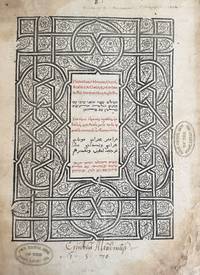
1516371021Genoa: Petrus Paulus Porrus 1516. Title printed in red and black within woodcut arabesque border printer's device on final leaf. Parallel text in Hebrew Latin Greek Arabic and Chaldaean Aramaic 4 columns to a page 41 lines. 13 woodcut floriated initials. A10 B-Z8 &8 con6; 200 leaves complete. Folio 13-1/8 x 9-3/8 inches. Contemporary blind tooled pigskin over bevelled wooden boards boards with repeated roll of hound hunter and stag spine with floral tools. Clasps perished early repairs with vellum at lower corners; spine darkened with chip at foot joint starting wormholes to the covers. Toning throughout worm holes throughout but heavier to the preliminary and terminal leaves paper loss not affecting text at the lower outer corners of the first 3 leaves minor dampstaining at the lower corners of most leaves and extending from the top inner margin. Scattered early marginalia. Title printed in red and black within woodcut arabesque border printer's device on final leaf. Parallel text in Hebrew Latin Greek Arabic and Chaldaean Aramaic 4 columns to a page 41 lines. 13 woodcut floriated initials. A10 B-Z8 &8 con6; 200 leaves complete. Folio 13-1/8 x 9-3/8 inches. The Genoa Psalter also known as the Octaplum or Quadruplex Psalter was the first polyglot psalter to be published and the first polyglot edition of any part of the Bible. Financed by the Oriental language scholar Bishop Agostino Giustiniani and printed in Genoa in 1516 it presents the psalms laid out in eight columns i.e. four per page on double-page spreads: in Hebrew a Latin paraphrase the Vulgate Latin the Septuagint Greek Arabic Chaldean Aramaic a Latin paraphrase and the editor's notes. "A monument of Renaissance typography this Psalter was linguistically the most ambitious work attempted to date and the first Polyglot work ever published. It provides the Psalms in five languages as well as a marginal scholarship based largely on rabbinic sources. The Arabic text is one of the first two texts and the first biblical text ever printed in this language. The Hebrew types used in this book were apparently never used again" B. Sabin Hill Hebraica from the Valmadonna Trust The Piermont Morgan Library 1989 no. 18.<br /> <br /> Notably within a lengthy editor's note to Psalm XIX is what is considered the first printed biography of Christopher Columbus along with a very early description of his voyage. A native son of Genoa Giustiniani presents the discovery of the new world as a fulfilment of Biblical prophecy appropriately glossing verse four of Psalm XIX to include his biography of Columbus: "Their sound is gone out through all the earth and their words to the end of the world." <br /> <br /> The text of the biography of Columbus written a decade after his death includes a brief account of his childhood and continues at length on his discovery of America. Translated from the Latin it begins: "And so their words have reached unto the ends of the earth at least in our own times in which by the marvelous daring of Christopher Columbus of Genoa almost another world was discovered and joined to the community of Christians. And since Columbus often declared that he was chosen by God so that through him this prophecy would be fulfilled I did not consider it unsuitable to include his life here. Therefore Christopher surnamed Columbus a Genoese by birth . lived in our age and through his own efforts explored more lands and seas in a few months than almost all other mortals had done throughout all previous ages . More swiftly than the Portuguese had done he approached new lands and new peoples and at last penetrated regions unknown before now. The news of this matter quickly reached the King who - both out of rivalry with the Portuguese kings and a desire for such new marvels and glory that might accrue to him and his descendants - after long discussions with Columbus finally ordered two ships to be outfitted. With these Columbus set sail from the Fortunate Islands directing his course slightly off the western line . After many days of sailing they had covered great distances. While the others having lost all hope urged a change in course Columbus persisted asserting by reason and conjecture that continuing but a little longer might lead them to discover continents or islands. Nor was he wrong. On the following dawn they sighted land. From this event immense confidence arose in human minds. Later it was learned that these were islands and observations were made of certain peoples there uncultivated and prone to raids on their neighbors even devouring human flesh like wolves. There were violent encounters yet eventually some of these islanders were brought safely to Spain astonishing and delighting all who saw them because they were at first timid unfamiliar with approach easy to persuade and marveling at everything as new."<br /> <br /> An important and desirable work from a liturgical linguistic and historical perspective. Adams B1370; BM STC Italian p. 97; Darlow & Moule 1411; Sabin 66468; European Americana 516/4; Harrisse BAV 88; JCB 3 I:64; Smitskamp 236; Roper Early Arabic Printing in Europe in Sprachen des Nahen Ostens und die Druckrevolution p. 132; Vinograd Genoa 1. Provenance: Cenobii Alois 1570 inscription below title; Bibliotheca Regia Monacensi pencil inscription on the inside front board identifying it as a duplicate; General Theological Seminary ink and blindstamps and other markings Petrus Paulus Porrus unknown
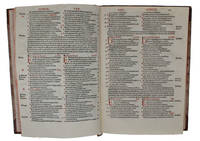
151359254Paris Henricus Stephanus 1513. Folio. Bound in a nice 18th century brown half calf with six raised bands to richly gilt spine. Corners slightly bumped and capitals worn especially the lower one where the capital band is showing and has loosened a bit. Inner hinge slightly weak. Front free end-paper with 18th century ink-annotation title year etc. A very light damp stain top the last portion of leaves a bit heavier to the last two leaves. Otherwise internally very nice and clean. All in all a very nice copy with only very light scattered brownspotting. Beautifully printed in two columns and in red and black throughout. Pp. 233-294. <br/><br/><em>Second edition following the original of 1509 of the final two parts of Estienne's typographic masterpiece "Quincuplex Psalterium" also known as the "First book of French Protestantism". These two final parts which make up complete works in themselves consist in the "Psalterium Vetus" - the Old Latin Psalter i.e. the version used by the churches before Jerome's revisions and the "Psaltarium Conciliatum" consisting in Lefevre's own version based on the Vulgate text corrected according to the Hebrew text and using the Aristarchian signs. This spledid publication had an immense impact upon protestantism early bible-scholarship and theology in general and is famed because of its beauty elegance and typographical excellence along with its immense importance historically speaking. "Lefèvre's epoch-making work was awaited impatiently by the learned world and is the topic of many a letter among the extant humanist correspondence of the period: thus Cardinal Ximeèz the future editor of the first polyglot Bible in a letter to Charles de Bovelles praises Lefèvre's scholarship and the usefulness of his "Psalterium". This famous volume is also Henri Estienne's typographical masterpiece and is commonly singled out as one of the outstanding monuments of early 16th-century French typography." Schreiber. "Lefèvre agreed with Erasmus that theology must be based on accurate texts and translations of the Scriptures; as the title of the volume indicates Lefèvre presents five different versions of the psalms" Schreiber. As described the present copy contains the final two. The three parts that were printed before those two were all printed in three columns and consisted in the three versions of St Jerome namely the "Psalterium Romanum" Jerome's first version of the Old Latin Psalter according to the Septuagint the "Psalterium Gallicum" Jerome's second revision first adopted by the churches of Gaul and the "Psalterium Hebraicum" Jerome's translation directly from the Hebrew. Schreiber nr. 8 1509 ed.; Renouard 1509 nr. 1.; Mortimer 1 nr. 62 present edition. </em> hardcover
1571A161-11791571. original Holzschnitt von Jost Amman auf der ganzen Buchseite mit ornamentaler Umrahmung, Darstellung ca. 5,5 x 7 cm, verso weiss / original woodcut by Jost Amman on the whole book page with ornamental framing, image ca. 5,5 x 7 cm, verso blank
1571A161-11831571. original Holzschnitt von Jost Amman auf der ganzen Buchseite mit ornamentaler Umrahmung, Darstellung ca. 5,5 x 7 cm, verso weiss / original woodcut by Jost Amman on the whole book page with ornamental framing, image ca. 5,5 x 7 cm, verso blank
1571A161-11841571. original Holzschnitt von Jost Amman auf der ganzen Buchseite mit ornamentaler Umrahmung, Darstellung ca. 5,5 x 7 cm, verso weiss / original woodcut by Jost Amman on the whole book page with ornamental framing, image ca. 5,5 x 7 cm, verso blank
1571A161-11851571. original Holzschnitt von Jost Amman auf der ganzen Buchseite mit ornamentaler Umrahmung, Darstellung ca. 5,5 x 7 cm, verso weiss / original woodcut by Jost Amman on the whole book page with ornamental framing, image ca. 5,5 x 7 cm, verso blank
1571A161-11871571. original Holzschnitt von Jost Amman auf der ganzen Buchseite mit ornamentaler Umrahmung, Darstellung ca. 5,5 x 7 cm, verso weiss / original woodcut by Jost Amman on the whole book page with ornamental framing, image ca. 5,5 x 7 cm, verso blank
1571A161-11861571. original Holzschnitt von Jost Amman auf der ganzen Buchseite mit ornamentaler Umrahmung, Darstellung ca. 5,5 x 7 cm, verso weiss / original woodcut by Jost Amman on the whole book page with ornamental framing, image ca. 5,5 x 7 cm, verso blank
1571A161-11801571. original Holzschnitt von Jost Amman auf der ganzen Buchseite mit ornamentaler Umrahmung, Darstellung ca. 5,5 x 7 cm, verso weiss / original woodcut by Jost Amman on the whole book page with ornamental framing, image ca. 5,5 x 7 cm, verso blank
1571A161-11821571. original Holzschnitt von Jost Amman auf der ganzen Buchseite mit ornamentaler Umrahmung, Darstellung ca. 5,5 x 7 cm, verso weiss / original woodcut by Jost Amman on the whole book page with ornamental framing, image ca. 5,5 x 7 cm, verso blank
1571A161-11811571. original Holzschnitt von Jost Amman auf der ganzen Buchseite mit ornamentaler Umrahmung, Darstellung ca. 5,5 x 7 cm, verso weiss / original woodcut by Jost Amman on the whole book page with ornamental framing, image ca. 5,5 x 7 cm, verso blank