[NEWTON, Sir Isaac]Biblio.com
527 résultats
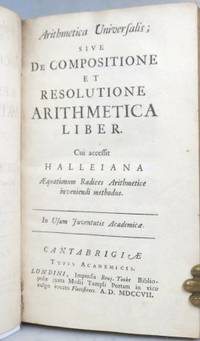
170751058Cantabrigiæ Cambridge: Typis academicis; Londini London impensis Benj. Tooke 1707. First edition. 8vo. viii 343 1 pp. 19th century full diced calf spine with raised bands gilt lettered black label blind tooled borders to the boards ownership inscription of a William Fitton dated June 1800 to the half title another contemporary owner's inscription - that of a Philip Crampton the date cropped "180" mathemetical annotations to the front and rear leaves and in the margins at intervals within. Joints skilfully repaired some mild soiling to the front and rear leaves an attractive copy. A mathemetical text composed entirely in Latin by Newton and edited by William Whiston who had succeeded him as the Lucasian professor of Mathematics at Cambridge University in 1702. The two had become acquainted during the previous decade and Newton was impressed enough with his acolyte that he invited him to lecture at the university when he was occupied with his other work. It was Whiston who persuaded Newton to publish some of his lectures on algebra but Newton was dissatisfied with Whiston's editing and additions to the text - to the extent that he considered buying the entire stock of the book to prevent its appearance in public. That clearly didn't happen although Newton succeeded in having the book published anonymously and its relative scarcity in commerce suggests a truncated print run. The first ownership inscription is that of the Irish geologist William Fitton 1780-1861. The son of a Dublin lawyer his paternal grandfather had been a mathematical instrument maker. Fitton began his studies at Trinity College Dublin in 1794 and earned his B.A. in 1799 but continued studying there until 1803. He went on to study medicine at Edinburgh University becoming a doctor in 1810 and continued his medical studies in London and Cambridge during the following six years. Fitton's interest in geology and mineralogy were his true passions and after marrying into a wealthy family he was able to devote his studies exclusively to these subjects. He subsequently served as secretary and later as president of the Geological Society published numerous reviews and papers plus a small number of books including 'A Geological Sketch of the Vicinity of Hastings' in 1833. Fitton was awarded the Wollaston Medal the society's highest prize in 1852. The other inscription is almost certainly that of Sir Philip Crampton 1777-1858 an Irish surgeon who awarded many honours and held various senior positions in a long and illustrious career: "elected FRS in 1812. In 1813 he was appointed surgeon-general to the forces in Ireland and he was surgeon to the queen in Ireland a member of the senate of the Queen's University of Ireland and four times president of the Royal College of Surgeons in Ireland in 1811 1820 1844 and 1855. In 1839 he was created baronet" ODNB. Cantabrigiæ [Cambridge]: Typis academicis; Londini [London], impensis Benj. Tooke unknown
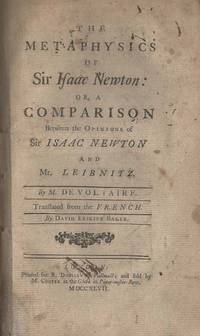
174731752AB1747. First English Edition. London Printed for R.Dodsley 1747. Octavo. 72 pages. Modern cloth. The bookblock with signs of stitching to the inner margin possibly used to be part of a Sammelband. Last three leaves with paper-restoration and manuscript inscription to last page looks like a 18th century gift-inscription. With numerous manuscript - annotations in the tracts of George Berkeley namely in "A Word to the Wise" "Farther Thoughts on Tar-Water" "The Querist". From the library of Daniel Conner Manch House County Cork. Bound with: "Berkeley George Bishop of Coyne - "A Miscellany Containing Several Tracts on Various Subjects. By the Bishop of Cloyne. London Printed for J. and R. Tonson and S.Draper 1752. VI 267 1 pages. Title-page witme minor paper-restoration. This wonderful collection by the eminent ANglo-Irish Philosopher includes the following Pamphlets / Tracts as called for: 1. Farther Thoughts on Tar-Water 2. An Essay towards preventing the Ruin of Great-Britain 3. A Discourse addressed to Magistrates and Men in Authority. Occasioned by the enormous Licence and Irreligion of the Times. 4. A Word to the Wise - Or an Exhortation to the Roman Catholic Clergy of Ireland This section "A Word to the Wise" includes several interesting annotations: a. an underlining of the sentence: "Seeing you are obnoxious of the Law" with a comment "Oh! infamous" b. annotation: "the catholic clergy cannot be accused even by there greatest enemies of having been influenced by interested motives therefore this hint of his lordship was not of much avail" 5. A Letter to the Roman Catholics of the Diocese of Cloyne 6. Maxims concerning Patriotism 7. The Querist - Containing several Queries proposed to the Consideration of the Public 8. Verses on the Prospect of Planting Arts and Learning in America 9. A Proposal for the better supplying of Churches in our Foreign Plantations and for converting the Savage Americans to Christianity by a College to be erected in the Summer Islands otherwise called The Isles of Bermuda 10. A Sermon preached before the Incorporated Society for the Propagation of the Gospel in Foreign Parts; at their Anniversary Meeting in the Parish-Church of St.Mary-le-Bow in 1731 11. De Motu ; sive de motus principio & natura & de causa communicationis motuum ______________________________________________________________________________ hardcover
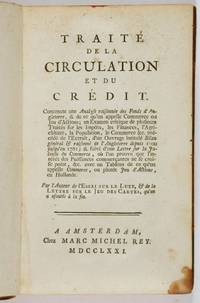
177153117Amsterdam: Marc Michel Rey 1771. First Edition. Very Good. Octavo. xvi 128 8: "Etat des Finances en Angleterre" 129-384 2: errata; blankpp. Woodcut ornaments; 4 half-titles. Collation: 8 A-H8 H4 I-Z8 Aa8 chi1 = 205 leaves. Contemporary marbled calf lightly rubbed at extremities gilt-tooled spine with raised bands gilt morocco lettering piece; edges stained red; marbled endleaves. Small patch of marginal damp staining to bottom corner of first 15 and final 10 leaves; signature Aa mildly embrowned else text crisp and clean throughout. Overall a very good copy.<br /> <br /> Rare complete first edition of "one of the great documents in the history of political economy" EJ. In addition to the brief discursus on English finances inserted between the second and third parts of the main treatise our copy includes the usually missing supplement pp. 369-384 "Addition au Traité de la Circulation et du Crédit. Mémoire pour la suppression du Belasting" along with the concluding errata leaf.<br /> <br /> The present Treatise is a refutation of the physiocrats who had advocated a primarily agricultural economy. Arguing against Hume de Pinto seeks to defend the economically productive role of the national debt which he sees exemplified in the current British system. While Marx notoriously described de Pinto as "the Pindar of the Amsterdam stock exchange" for his advocacy of speculation Werner Sombart regarded him as the "beginner of the modern age of economics and the first to understand the growth of credit" EJ. De Pinto's other works include Essai sur le luxe and Du jeu de cartes both reprinted in the present work and the later Precis de arguments contre les matérialistes The Hague 1774.<br /> <br /> The main treatise is divided into four parts followed by six brief works: 1. Lettre sur la jalousie du commerce Letter on the Jealousy of Commerce; 2. Tableau ou Exposé de ce qu'on appelle le Commerce ou plutôt le Jeu d'Actions en Hollande A Presentation of What is Called Commerce or the Game of Actions in Holland; 3. Methode dont on se sert en Hollande pour faire la perceptions des taxes & des impôts sur les biens fonds; & comment on en verse le provenu dans la Caisse de l'Etat The Method Used in Holland to Collect Duties and Real Estate Taxes and How the Proceeds Are Payed into the State Treasury; 4. Essai sur le luxe An Essay on Luxury first printed at Amsterdam 1762; 5. Lettre de l'autheur à Mr. D. sur le jeu des cartes The Author's Letter to Mr. Diderot on Card Playing first printed at London 1768; 6. Mémoire pour la suppression du Belasting ou Impôt sur les Actions de Compagnie des Indes Orientales A Memorandum for the Suppression of the "Belasting" or Tax on the East India Company Shares. The final opuscule which appears in relatively few copies of the Traité is published here for the first time.<br /> <br /> Isaac de Pinto 1717-1787 was the scion of a wealthy Sephardic family which traced their origins back to Portugal and had emigrated to the Dutch Republic. "He had a broad education and had mastered many languages in which he corresponded with famous philosophers and maintained contact with the European elite of his day including the court of the Dutch stadholder. In 1748 he helped to finance Stadholder William IV's war against France" Bernfeld & Wallet. "For his services in arranging favorable terms for English trade in India at the Treaty of Paris which ended the Seven Years' War 1756-63 Pinto was lavishly rewarded by the East India Company a few years later 1767" EJ. His correspondents included David Hume and Denis Diderot. De Pinto made a name for himself when he responded to Voltaire's mocking article on the Jews which appeared in the latter's Dictionnaire Philosophique with his Apologie pour la nation juive Amsterdam 1762. Presenting himself as a proud Portuguese he argued that "Voltaire had neglected to draw a distinction between the often wealthy Sephardim with their refined manners and the Ashkenazim whom he regarded as far poorer and sometimes unprincipled as a result of persecution and economic misery" Bernfeld & Wallet. Barbier 4: 752; T. L. Bernfeld & B. Wallet Jews in the Netherlands: A Short History Amsterdam Univ. Press 2023 p. 89; Enc. Jud. 13: 553-554; Goldsmiths' 10792; Kress 6812.<br /> <br /> Full title and Imprint: Traité de la Circulation et du Crédit. Contenant une Analyse raisonnée des Fonds d'Angleterre & de ce qu'on appelle Commerce ou Jeu d'Actions ; un Examen critique de plusieurs Traités sur les Impôts les Finances l'Agriculture la Population le Commerce &c. précédé de l'Extrait d'un Ouvrage intitulé Bilan général & raisonné de l'Angleterre depuis 1600 jusqu'en 1761 ; & Suivi d'une Lettre sur la Jalousie du Commerce où l'on prouve que l'intérêt des Puissances commerçantes ne se croise point &c. avec un Tableau de ce qu'on appelle Commerce ou plutôt Jeu d'Actions en Hollande. Par l'auteur de l'Essai sur le Luxe & de la Lettre sur le Jeu des Cartes qu'on a ajoutés à la fin. A Amsterdam chez Marc Michel Rey. MDCCLXXI. Marc Michel Rey unknown
1744L57-1626London 1744. Hardcover. Very Good. Speckled calf gilt-stamped lettering and ornament on spine. Both volumes a little rubbed along spine and edges of boards with small chips at head of spine and numbered stickers affixed to tail of spine. Some faint browning along edges of paste-down prelims and terminals -- but overall a nice clean text block. <br/><br/>Includes an interesting bookplate on the front paste-down engraved by Benjamin Levi for Isaac Mendes in London 1746 the earliest known bookplate made for a Jew. hardcover
17326441London: Various printers to the Royal Society 1732. 1665-1732. <p>First edition of the first 426 issues an unbroken run from March 1665 to December 1732 of the world's oldest continuous scientific journal and the single most important record of the first announcement and communication of scientific discoveries and inventions PMM. It contains groundbreaking research by Newton - all 17 of his optical papers and therefore his first printed contribution to science - and by Halley Hooke Boyle Flamsteed Leeuwenhoek Cassini Hevelius Huygens and many others across astronomy physics chemistry mathematics medicine and natural history. Through Newton's optical papers of 1672-1676 the Transactions saw the first experimentally grounded proposal for the radical reform of a scientific theory to be advanced through a technical journal - a proposal that became the first to arouse international discussion and debate in print and within the pattern of public announcement discussion and professional consensus then established science has advanced ever since. Provenance: armorial bookplate of Sir Marcus Beresford 1st Earl of Tyrone 1694-1763; contemporary inscription at the end of one issue January 1692/3 noting its donation by Robert Hooke; manuscript corrections and notes on more than eighty pages with eight further pages on the measurement of the Earth bound in at the end.</p>. The World's Oldest Continuous Scientific Journal. <p>First edition of the first 426 issues an unbroken run from March 1665 to December 1732 of the world's oldest continuous scientific journal and the single most important record of the first announcement and communication of scientific discoveries and inventions PMM. It contains groundbreaking research by Newton - all 17 of his optical papers and therefore his first printed contribution to science - and by Halley Hooke Boyle Flamsteed Leeuwenhoek Cassini Hevelius Huygens and many others in astronomy physics chemistry mathematics medicine and natural history. Thomas Henry Huxley observed in his 1866 address On the Advisableness of Improving Natural Knowledge that if every book in the world apart from the Philosophical Transactions were destroyed the foundations of physical science would remain secure and the intellectual progress of the last two centuries largely recoverable. Long unbroken runs of the first four-and-a-half decades are now of the greatest rarity. ABPC and RBH record only two comparable sets at auction in the last three decades - Norman 1694 Christie's New York 15 June 1998 lot 716 $112500 and Macclesfield 1782 Sotheby's 25 October 2005 lot 1782 £96000 = $171400 - and a set of just the seven volumes containing Newton's papers on light realised $75600 at Christie's in October 2022.</p> <br /> <br /> <p>Provenance: armorial bookplate of Sir Marcus Beresford 1st Earl of Tyrone 1694-1763 Anglo-Irish peer and politician on the front pastedowns; contemporary inscription at the end of one issue January 1692/3 noting its donation by Robert Hooke; numerous manuscript corrections on more than sixty pages additional notes on about twenty pages and eight pages of manuscript notes on the measurement of the Earth bound in at the end.</p> <br /> <br /> <p>In November 1660 members of the Oxford Philosophical Club - John Wilkins John Wallis Robert Boyle Christopher Wren Robert Hooke among them - met a group of London natural philosophers at Gresham College and agreed to form a philosophical society that would meet weekly to exchange information and to conduct experiments. The society received its charter from the newly restored Charles II in 1662 and Henry Oldenburg a German-English diplomat and friend of Boyle was installed as one of its two secretaries. One of the charter's terms called for the exchange of information with other learned societies and Oldenburg almost at once began a sustained correspondence - with the Cimento Academy in Florence the Montmor Academy in Paris and after its foundation in 1666 the Académie Royale des Sciences - and with hundreds of working natural philosophers in places that had no scientific society of their own. Oldenburg was fluent in German Dutch French English and Latin and he was able to translate most foreign correspondence himself including Antoni van Leeuwenhoek's letters on his microscopical investigations and the communications of Johannes Hevelius of Gdansk and Marcello Malpighi of Bologna. After some years writing letters without salary Oldenburg decided to compile a monthly newsletter summarising a month's Royal Society activities and send it out to his correspondents in a single printing. On 6 March 1665 Old Style; 16 March by the Gregorian calendar then in use on the continent the first issue of the Philosophical Transactions appeared. It consisted of letter-excerpts reviews and summaries of recently published books and accounts of observations and experiments from European natural philosophers. Some of the pieces Oldenburg wrote himself summarising the minutes of Society meetings; others he translated or adapted from printed sources; still others were composite pieces assembled from the letters of several correspondents on a common subject. After his death in 1677 the journal passed through the hands of a succession of editors frequently also Secretaries of the Society - Edmond Halley and Hans Sloane the best-known among them - and through a succession of printers its form and content broadly reflecting the priorities of the current editor and to a degree of the Society. The Royal Society assumed financial responsibility for the journal only in 1752.</p> <br /> <br /> <p>Until the last third of the seventeenth century most original contributions to science appeared in books in which an author's own findings were embedded within a systematic exposition of a larger subject. The chartering of the Royal Society in 1662 and of the Académie Royale des Sciences in 1666 and the launching in 1665 of the Journal des Sçavans at Paris and the Philosophical Transactions at London gave institutional expression to a new conception of science as a cooperative enterprise: the immediate objective of the individual scientist became the experimental contribution to an eventual system of nature rather than the construction of the system itself and the journal article began to replace the book as the unit in which that contribution was made. Newton was the first to advance through this new medium an experimentally grounded proposal for the radical reform of a scientific theory and his proposal was the first to arouse international debate within the columns of a scientific journal. Through that exchange - in which all the participants modified their positions - a consensus of scientific opinion was produced; and within the same pattern of public announcement discussion and professional consensus science has advanced ever since Kuhn in Cohen Isaac Newton's Papers and Letters on Natural Philosophy 2nd ed. 1978 pp. 27-29.</p> <br /> <br /> <p>Newton's seventeen optical papers comprising his entire published optical contribution to the journal across the 1670s run as a single intellectual sequence: the seminal 1672 New Theory paper No. 80 pp. 3075-3087 introducing the prism experiment and the spectral analysis of white light; the catadioptrical-telescope paper No. 81; a series of exchanges with the French Jesuit Pardies Nos. 82 84 85 with Christiaan Huygens via an 'ingenious person from Paris' Nos. 96 97 and with the Liège Jesuits Linus and Lucas Nos. 110 121 123 128 - together more than half of the seventeen papers all responding to objections raised against the New Theory. Newton's answer to Hooke's objections No. 88 is the most polemical of the set prefiguring the priority dispute that would dominate the Principia years; the answer to Sir Robert Moray on behalf of the Royal Society No. 83 the most measured. Across the seven volumes containing them the papers transformed optics from a body of empirical reports into a quantitative experimental science driven by decisive testing among hypotheses and supplied the methodological core that Newton would eventually assemble decades later into the Opticks of 1704.</p> <br /> <br /> <p>These papers together constitute the first major contribution to science made through a technical journal - the medium that rapidly became the standard mode of communication among scientists - and as Christianson puts it if Newton had published nothing else the optical papers alone would guarantee him a place among the immortals of modern science Christianson In the Presence of the Creator 1984 p. 150. They yield further an insight into Newton's mental processes that the Principia and the Opticks - formal impersonal Olympian - conceal; it is in these early brief sometimes hasty letters to Oldenburg as in his notebooks and unpublished manuscripts that the creative scientist is to be found Kuhn in Cohen pp. 27-29.</p> <br /> <br /> <p>When Newton was first appointed Lucasian Professor at Cambridge in 1669 he chose optics for the subject of his first lectures and researches and by the end of that year he had worked out in detail the decomposition of a beam of white light into rays of different colours by means of a prism the complete explanation of the rainbow following from this discovery. These results formed the subject of his Lucasian lectures in 1669 1670 and 1671 and their principal conclusions were communicated to the Royal Society in February 1672 and printed soon afterwards in the Transactions No. 80. Before Newton light had been believed to be a homogeneous substance and colour was held to be produced by the mixture of light with darkness - the prism in the standard account supplying the darkness that coloured the light with all rays of white light striking the prism at the same angle being equally refracted. Newton's experiments led him to the radically different conclusion that white light is a mixture of rays of many distinct types each refracted at a slightly different angle and each responsible for producing one spectral colour. He set up a prism near his window at Trinity College and projected the spectrum onto a wall twenty-two feet away; to prove that the prism refracted light rather than colouring it he refracted the beam a second time back to white. The crucial experiment that confirmed the theory was to isolate a narrow ray of a single colour from the first spectrum and pass it through a second prism where no further elongation or separation occurred - a demonstration that each spectral ray was itself unmixed and uniformly refrangible. The reception of the paper was mixed. Many contemporaries simply ignored it; Mariotte in 1679 Pardies 1672 and Linus 1675 all claimed to have failed to replicate the basic experiments described. Rather than argue with them in detail Newton invited his critics to repeat his experiments with greater care; they did so without success. Others - Hooke among them who confirmed the experiments himself before a committee of the Royal Society in April 1676 - conceded the results but held that they could be accommodated by minor modification of existing theories making Newton's radical interpretation unnecessary. The controversy lasted six years after the paper's first appearance and left Newton conspicuously wary of publication.</p> <br /> <br /> <p>Newton's invention of the reflecting telescope reported in the issue immediately following his first optical paper No. 81 had in fact prompted the optical work rather than the other way round: the chromatic aberration of refracting lenses - their inability to bring different colours of light to a single focal point - was the original stimulus for Newton's investigation of the nature of light. Newton had sent Oldenburg his letter describing the telescope before his letter describing the new theory and had hoped to present the telescope as a practical test-piece for the theory. Oldenburg however printed the material in the reverse order the theory first followed by the description of the instrument. The telescope made a considerable impression at the Royal Society which promptly elected Newton a Fellow; a corresponding notice appeared in the Journal des Sçavans in February 1672 with emphasis on the instrument's compactness and it was the telescope rather than the theory of light that first made Newton's name known on the Continent Dilaura Bibliotheca Opticoria 1475-1925 2019 pp. 235-236.</p> <br /> <br /> <p>Newton published three non-optical papers in his lifetime all anonymously. His only published paper on chemistry Scala Graduum Caloris No. 270 April 1701 pp. 824-829 states what has since become known as Newton's law of cooling - that the rate at which a hot body loses heat is proportional to the difference between its temperature and that of its surroundings - and describes the construction of a thermometer capable of measuring temperatures up to almost 1000 °C. An Account of the Book entituled Commercium Epistolicum Collinii & Aliorum De Analysi promota No. 342 February 1715 pp. 173-224 is Newton's anonymous review of the Commercium epistolicum the official report of the committee appointed by the Royal Society to adjudicate in the dispute between Newton and Leibniz over priority in the invention of calculus - the most bitter and consequential priority dispute in the history of science; the Account purports to be impartial but was in fact written like the Commercium epistolicum itself by Newton. In the same volume No. 347 March 1716 pp. 399-400 appeared Newton's Problematis Mathematicis Anglis Nuper Propositi Solutio Generalis his response to a challenge problem set by Johann Bernoulli to the English mathematicians; tradition has it that Newton solved it in a single evening after returning from a day's work at the Mint. With the exception of this minor paper none of Newton's original work on gravitation or on mathematics was published in the Transactions. Edmond Halley's review of the Principia however appeared soon after its publication No. 186 pp. 291-297 - Halley was then the journal's editor - and is prefaced by an advertisement apologising for the fact that the Transactions had been delayed for some months because Halley had had the entire care of the Principia's own edition and had therefore as he put it been more serviceable to the Commonwealth of Learning in seeing Newton's book into print than he would have been in issuing his own periodical on time. Halley pointed out with justice that one of the most striking features of the Principia was Newton's great skill in using the new mathematics - by which Halley meant Newton's own method of infinite series.</p> <br /> <br /> <p>Edmond Halley 1656-1742 was one of the most original minds of his time and he made a long series of important contributions of his own to the Transactions. The best-known of them is Astronomiae cometicae synopsis No. 297 March 1705 pp. 1882-1899 the first printing of the theory according to which comets belong to the solar system and move in eccentric elliptical orbits; it was here that Halley set out his method of computing the motion of comets of establishing their periodicity in elliptical orbits and of identifying the comet that would bear his name DSB. The confirmation of the comet's return - in 1759 after Halley's death - was the first time that a body other than a planet had been shown to orbit the Sun the earliest successful observational test of Newtonian physics and a vivid demonstration of its explanatory power; the comet was named after Halley by the French astronomer Nicolas-Louis de Lacaille in 1759. Halley's other major contributions to the journal include his Methodus singularis No. 348 June 1716 pp. 454-464 in which he challenged the international astronomical community to use the transits of Venus across the Sun predicted for 1761 and 1769 to transform astronomy into a fully empirical science by measuring the Earth-Sun distance - a challenge that astronomers took up organising expeditions to the farthest corners of the globe and overcoming obstacles of every kind; A short History of the several New-Stars No. 346 December 1715 pp. 354-356 in which he observed that the new stars of 1572 and 1604 Tycho's and Kepler's stars were not the only changing stars on record that others had been observed in 1596 1600 1670 and 1686 some of them fading and reappearing and one of them - Mira - appearing to wax and wane with a regular 330-day period; An Account of several Nebulae or lucid Spots like Clouds No. 347 March 1716 pp. 390-392 in which Halley assembled the first list of known nebulae with their discoverers crediting the Great Nebula in Orion to Huygens the Andromeda nebula to Boulliau and the two spherical nebulae in Centaurus and Hercules to himself; 'Of the infinity of the sphere of fix'd stars & Of the number order and light of the fix'd stars' No. 364 April 1720 pp. 22-26 in which Halley posed what later generations would call Olbers's paradox a century before Olbers did; and outside astronomy his paper on the Breslaw life table No. 196 January 1692/3 pp. 596-610 which produced the first life table based on sound demographic data and gave the first correct calculation of annuities using essentially the methods still in use today - a paper of first importance in the history of statistics.</p> <br /> <br /> <p>John Flamsteed 1646-1719 was with Halley the most important English astronomer of his generation; his major works are the Historiae coelestis first published in 1712 without his consent by Halley and Newton and the Atlas coelestis published posthumously in 1729 but he also contributed more than thirty articles to the Transactions chiefly on observational astronomy. No other Astronomer Royal before Airy displayed anything like Flamsteed's concern for the reduction and manipulation of his own data: far from bequeathing the mass of raw observations that Bradley would he reduced and applied them himself DSB.</p> <br /> <br /> <p>Robert Boyle 1627-1691 contributed some thirty-seven papers to the Transactions Fulton p. 138 among them his influential questionnaire General Heads for the Natural History of a Country a number of major experimental essays that sometimes filled a whole issue and most revealingly An Experimental Discourse of Quicksilver growing hot with Gold No. 122 February 1675/6 pp. 515-533 - a paper on a kind of mercury that would incalesce when amalgamated with gold suggesting that Boyle had achieved the long-sought alchemical philosophical mercury capable of transmuting base metals. Boyle's trials went back to 1652 when he had received the recipe from his American mentor George Starkey; his decision to go public in 1676 signalled a newly intense period of alchemical activity on his part. The paper drew from Newton - himself a committed alchemical enthusiast - a letter to Oldenburg urging that such matters were not to be communicated without immense damage to the world if there should be any truth in the Hermetic writers; Oldenburg took the hint and the incalescence paper remained a one-off in the Transactions Hunter Alchemy in the Transactions Royal Society blog 1 July 2015.</p> <br /> <br /> <p>The Dutch microscopist Antoni van Leeuwenhoek 1632-1723 contributed 116 articles to the Transactions over the half-century 1673-1723; the most famous of them the letter on the protozoa No. 133 March 1677 pp. 821-831 gives the first detailed description of protists and bacteria in a range of environments. Leeuwenhoek is universally acknowledged as the father of microbiology: he discovered both protists and bacteria but more than being the first to see the microscopic world of his animalcules he was the first even to think of looking - certainly the first with the power to see. Using his own deceptively simple single-lensed microscopes he did not merely observe but conducted ingenious experiments exploring and manipulating his microscopic universe with a curiosity that belied his lack of any map or bearings. The verification of Leeuwenhoek's new world by the natural philosophers of the Royal Society set out the ground rules that still define experimental science today Lane The unseen world: reflections on Leeuwenhoek 1677 Philosophical Transactions B370 2015 pp. 1-10.</p> <br /> <br /> <p>Martin Lister 1639-1712 contributed in 1673 what is now regarded as the earliest journal article on palaeontology: A description of certain stones figured like plants No. 100 pp. 6181-6191 on the preservation of St Cuthbert's beads - crinoid remains - in the approximately 350-million-year-old Carboniferous limestones of northern England. The biological nature of fossils was then controversial: Kircher had argued that they formed by abiogenic plastic forces within the rock while Hooke and Steno had suggested they were the remains of living organisms. Lister was the first to explore how direct observation could decide between the two making observations about what modern geobiology calls taphonomy and biogenicity criteria - observations that presage current debates about the earliest signs of life on Earth and Mars Brasier Philosophical Transactions A373 2015 pp. 1-16. Other natural-historical papers scattered through the journal's first century - Account of a very odd monstrous calf Some experiments and observations on May-dew Some observations on strange swarms of insects - are in places fanciful but in many others acute; Hooke's own contributions which began in the very first issue March 1665 with A spot in one of the belts of Jupiter are sometimes held to include the first observation of the Great Red Spot still visible on Jupiter today.</p> <br /> <br /> <p>The early volumes also contain the record of the world's first experiments with blood transfusion conducted in England in the mid-1660s. The procedure - gruesome - was first carried out between dogs with arteries and veins in the animals' necks opened and blood transferred from one to another through quills most likely of goose feather inserted into the vessels and clamped with running knots; in the physician Richard Lower's account No. 20 pp. 353-358 the transfusion came to an end when the emittent dog fell into convulsions and died. Shortly afterwards Boyle published a remarkable set of questions about the likely effects of transfusion on the animal receiving blood No. 22 pp. 385-388 asking whether transfusion might change a dog of one breed into another alter its temperament render a fierce dog cowardly transmit satiety or hunger obliterate learned behaviours or make a dog forget its master - a sequence of questions which as recent commentators have noted read like an alchemical programme turned inward upon the living body. Researchers soon proposed transfusion into a human subject. Since the procedure generally killed the emittent a human-to-human transfusion was thought impossible and a sheep was settled upon as donor. The choice of human recipient fell in 1667 upon Arthur Coga - mentally unstable but sufficiently educated to report in Latin on the effects of the procedure - and the operation was performed by Lower and the physician Edmund King No. 30 pp. 557-559 who judged that Coga had received nine or ten ounces of sheep's blood. A few days afterwards Coga reported back to the Society in Latin and Samuel Pepys meeting him at a dinner party shortly thereafter found him to speak very reasonably though cracked a little in his head.</p> <br /> <br /> <p>Other contributors in these decades include Cassini on the satellites of Jupiter Huygens on mechanics and optics Malpighi Swammerdam Borelli Steno Fahrenheit and Redi whose experimental refutation of spontaneous generation appeared in the journal alongside a steady stream of domestic material from Harvey Wren Ray Petty Locke Wallis Winthrop Tyson Lancisi Leibniz and Hales. To turn the pages of these thirty-seven volumes is to watch the first two generations of a new scientific public discover how to work together - how to record observation propose hypothesis invite replication agree or disagree in print and build by open argument the provisional consensus that is the hallmark of modern science.</p> <br /> <br /> <p>References: Grolier/Horblit 95b - Macclesfield 1782 - Norman 1694 - PMM 148 Vol. 1 - Brasier Deep questions about the nature of early-life signals: a commentary on Lister 1673 Philosophical Transactions A373 2015 pp. 1-16 - Christianson In the Presence of the Creator 1984. Cohen ed. Isaac Newton's Papers and Letters on Natural Philosophy 2nd ed. 1978 - Dilaura Bibliotheca Opticoria 1475-1925 2019 - Fulton A Bibliography of the Honourable Robert Boyle 1932 - Lane The unseen world: reflections on Leeuwenhoek 1677 Philosophical Transactions B370 2015 pp. 1-10.</p> <br /> <br/> <br/> 37 vols. bound in 22 4to 215 × 165 mm containing all issues from March 1665 No. 1 through December 1732 No. 426 with 380 engraved plates 306 folding 176 woodcut illustrations and diagrams and 7 folding tables occasional damp-staining a few tears and small holes occasionally affecting a word or two a few headlines shaved the plate in No. 56 map of part of Languedoc with a 7 cm tear that in No. 60 apparatus shaved at head and that in No. 196 with bottom corner repaired with loss of about a quarter of the plate relating to the dissection of a rat. Uniformly bound in eighteenth-century probably mid-1730s sprinkled calf spines ruled and tooled in gilt in compartments with title and volume-number labels some joints cracking but firm a few labels missing slightly rubbed. Generally very clean and well-preserved. Various printers to the Royal Society unknown
1731EAHll[SA32Stockholm: Benjamin Gottlieb Schneider 1731. 1731. 2 Volumes in 1. pp. 8 p.l. 398 2; 1 p.l. 88 64 90 72. first title in red & black. woodcut ornaments. contemporary sprinkled calf gilt back rubbed spine & label bit chipped. old inscription on front free-endpaper: "Till Advocat Fisalen George Adolf Rutenschiöd". First Edition. "A survey of Dutch commercial affairs with considerable emphasis on its overseas companies and alliances." Bell Large sections are devoted to the Dutch East and West India Companies and their activities in Africa India south-east Asia and America. The engraved frontispiece to Volume II announced on the last page of Volume I was never published. Rare: two copies cited in NUC Harvard and Bell Library. Bell S35. Kress S.3380. Not in Sabin. Signed by Authors. F. Hardcover. Stockholm: Benjamin Gottlieb Schneider, 1731. Hardcover
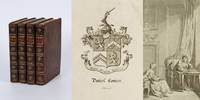
176429779AB1764. Four Volumes complete set. London Printed for J. and R. Tonson J.Buckland H. Woodfall etc. 1764. Small Octavo 11 cm x 17 cm. Frontispiece 2 300 14 Frontispiece 3 336 13 Frontispiece 5 318 16 Frontispiece 7 320 12 pages. Hardcover / Oiginal 18th century full leather with original spinelabels and gilt lettering on spine. All four Volumes complete and in protective Mylar. Housed in a wonderful bespoke Solander-Box. Excellent condition with some minor signs of wear only. From the library of Daniel Conner Connerville / Manch House with his Exlibris / Bookplate to pastedown of each Volume. Includes wonderful and bizarre articles of 18th-century literature: Earthquakes Pills against them / Education Proposals for reforming the education of Females / Wax-work in Germany / Wine-Brewers / Instructions to unmarried women / Women the happiness or misfortunes of mankind depend on them / Women have ill fancies in their dress / Machiavel author of a mischievous sect / Xerxes why he burst into tears / Mr.Walpole going to England with the Preliminaries of Peace / Witchcraft described and explained / Women natural to talk to themselves / Women More understanding than men in their own affairs / etc. The Tatler was a British literary and society journal begun by Richard Steele in 1709 and published for two years. It represented a new approach to journalism featuring cultivated essays on contemporary manners and established the pattern that would be copied in such British classics as Addison and Steele's Spectator Samuel Johnson's Rambler and Idler and Goldsmith's Citizen of the World. The Tatler would also influence essayists as late as Charles Lamb and William Hazlitt. Addison and Steele liquidated The Tatler in order to make a fresh start with the similar Spectator and the collected issues of Tatler are usually published in the same volume as the collected Spectator. Tatler was founded in 1709 by Richard Steele who used the nom de plume "Isaac Bickerstaff Esquire". This is the first known such consistently adopted journalistic persona which adapted to the first person as it were the 17th-century genre of "characters" as first established in English by Sir Thomas Overbury and then expanded by Lord Shaftesbury's Characteristicks 1711. Steele's conceit embodied in the title "Tatler" was to publish the news and gossip heard in various London coffeehouses in reality he mixed real gossip with invented stories of his own and so he declared in the opening paragraph to leave the subject of politics to the newspapers while presenting Whiggish views and correcting middle-class manners while instructing "these Gentlemen for the most part being Persons of strong Zeal and weak Intellects.what to think." To assure complete coverage of local gossip he pretended to place a reporter in each of the city's four most popular coffeehouses and the text of each issue was subdivided according to the names of these four: accounts of manners and mores were datelined from White's; literary notes from Will's; notes of antiquarian interest were dated from the Grecian Coffee House; and news items from St. James's Coffee House. The journal was originally published three times a week and Steele eventually brought in contributions from his literary friends Jonathan Swift and Joseph Addison though both of them pretended to be writing as Isaac Bickerstaff and authorship was revealed only when the papers were collected in a bound volume. The original Tatler was published for only two years from 12 April 1709 to 2 January 1711. A collected edition was published in 171011 with the title The Lucubrations of Isaac Bickerstaff Esq. In 1711 Steele and Addison decided to liquidate The Tatler and co-founded The Spectator magazine which used a different persona than Bickerstaff. Wikipedia hardcover
1793List2998Charlestown Ohio County Virginia now Brooke County West Virginia 1793. Single two-page letter measuring 7 ½ x 12 ½ inches. Folded with small tears at folds some holes intersecting with text; overall excellent. A letter from Isaac Prince Robbins 1770–1846 in what is now West Virginia to his parents Rev. Chandler Robbins 1738–1799 and Jane Prince 1740–1800 in Plymouth Massachusetts. Isaac Robbins was likely teaching in the area as he mentions the “price of my school†and that the oncoming spring had “call’d the larger scholars away†to farm. He also notes that smallpox had been running through the area and inquires about the family’s health as they had contracted the disease the previous October.<br /> <br /> Robbins also informs his family that there is “No prospect of peace while the Indians commit depredations as frequent as they do. Kill’d and took seven families at a station 30 miles this side Lymestone Kentucky Landingâ€. It is not clear whether he is referring to “Hartshorne’s defeat†part of the Northwest Indian War where the Northwestern Confederacy attacked Euro-American settlers near Limestone now Maysville—this attack occurred in 1790 though it is possible that Robbins had not contacted his family since prior to this event.<br /> <br /> He closes by ruminating on his own sin telling his parents “I have erred and gone astray point out to me the way that I shall ask forgiveness whereby I can be saved.†This letter probably predates Isaac Robbins’ following in his father’s footsteps and becoming a minister.<br /> <br /> Of interest to historians of the settlement of West Virginia and related conflicts with Indigenous tribes. unknown
179862494London:: J. Stockdale 1798 1807. engraved map. Vertical creases where folded; otherwise fine. Approx. 7 x 9 inches. From Isaac Weld's Travels Through the States of North America; 4th ed. London 1807. J. Stockdale, unknown
179862495London:: J. Stockdale 1798 1807. engraved map. Vertical creases where folded; otherwise fine. Approx. 7 x 9 inches. From Isaac Weld's Travels Through the States of North America; 4th ed. London 1807. J. Stockdale, unknown
179862497London:: J. Stockdale 1798 1807. engraved map. Vertical creases where folded and some light spotting. Approx. 7 x 9 inches. From Isaac Weld's Travels Through the States of North America; 4th ed. London 1807. J. Stockdale, unknown
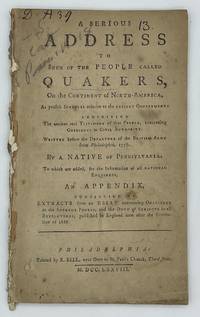
177810698Philadelphia: Printed by R. Bell 1778. 8vo disbound pamphlet 2 36 pp Lacking four leaves at the end including pages 37 to 42 of the appendix. A rare pamphlet calling for Quakers to support the Continental Congress and pay war taxes. Evans 15843 which notes that "This edition was bought up and suppressed by the Quakers and only a few copies escaped destruction." Toning to pages foxing to first and last leaf some tearing along spine bit of chipping to lower margin of title page inscriptions to upper margin of title page. Printed by R. Bell unknown
171011775Hanoviae Hannover: NP 1710. Second revised. Hardcover. fair. Folio. 7 pp .L.3-343 f.9 1 L. 11 f . 3/4 calf over brown blind-embossed cloth boards with gilt lettering. Marbled end papers. 2 Title pages Hebrew and Latin. Dedication in Latin. Commentary on the Hebrew Bible by renowned Medieval Jewish philosopher Don Isaac Abarbanel 1437-1508 see below. Age wear to binding. Front board detached but present. Rear endpaper reinforced with gray binder's tape along gutter. Publisher's mark on Title and endpaper. Minor browning throughout with sporadic foxing. In Hebrew. Binding in fair inside in good condition. On the author Source: Public Domain:<br /> Isaac ben Judah or Yitzchak ben Yehuda Abravanel 1437 - 1508 was a Jewish statesman philosopher Bible commentator and financier. In many works he is referred to solely by his last name which is variously spelled as Abravanel Abarbanel and Abrabanel. Many Torah and Talmud scholars today simply refer to him as "The Abarbanel". He was born in Lisbon Portugal. He died in Venice and was buried in Padua next to Rabbi Judah Minz Rabbi of Padua. Isaac Abravanel developed many works during his lifetime which are often categorized into three groups: exegesis philosophy and apologetics. Exegesis refers to biblical commentary his philosophy dealt with the sciences and how the general field relates to the Jewish religion and traditions and apologetics defends the Jewish idea of the coming of the Messiah. Abravanel’s exegetic writings were different from the usual biblical commentaries because he took social and political issues of the times into consideration. He believed that mere commentary was not enough but that the actual lives of the Jewish people must be deliberated on as well when discussing such an important topic as the Bible. He also took the time to include an introduction concerning the character of each book he commented on as well as its date of composition and the intention of the original author in order to make the works more accessible to the average reader. Christian scholars appreciated the convenience of Abravanel's commentaries and often used them when preparing their own exegetical writing. This may have had something to do with Abravanel’s openness towards the Christian religion since he worked closely with Messianic ideas found within Judaism. Because of this Abravanel’s works were translated and distributed within the world of Christian scholarship.<br /> Ozar Hasefer p164 item #65. NP hardcover
175537868Salzburg: Meshulam Zalman b. Aaron 1755. Revised. Hardcover. g. Folio. 15 leaves. Contemporary brown leather with gold tooling on the spine. Red edges and decorated floral endpapers. Illustrated title page with Moses and Aaron on the sides with depictions of the scenes from Genesis of Jacob stealing the blessing the binding of Isaac and Jacob's ladder on the bottom. Revised edition of the 1695 Amsterdam Haggadah illustrated by the convert to Judaism Abraham b. Jacob. These woodcut illustrations are largely based on the work of the early 17th century Swiss Christian biblical artist Matthaeus Merian. Of particular note are the illustrations of Abraham smashing his father's idols the four sons and the drowning of the Egyptians. Includes the "Zevach Pesach" commentary of Isaac Abarbanel as well as a mystical commentary. The songs Adir Hu Ahad mi Yodaya and Had Gadya are translated into Judeo-German. Revised edition offers a larger and clearer print. This edition should not be confused with the Furth Haggadah printed in the same year also with the Abarbanel commentary. Text in Hebrew and Judeo-German. Inscription on front free endpaper. Name of previous owner on title page. Boards bowed chipped and scratched. Hole in center of title page. Staining chipping and creasing to leaves. Numerous leaves are strengthened. Overall in good condition. Yaari 138; Yudlov 216. Meshulam Zalman b. Aaron hardcover
178132033Amsterdam: Yaccov Proops 1781. Third edition. Hardcover. g-. Quarto. 2 52 double-sided leaves. Rebacked in modern brown leather spine over original period brown leather boards. Gilt lettering and ruling on the spine. Modern endpapers. Profusely illustrated throughout with copperplate engravings. Includes both an initial illustrated title page with copperplate engravings surrounding the text Ma'aleh Bet Horin and a printed title page with decorative woodblock borders and the publisher's device. In addition to the Hebrew text a few sections throughout are in Judeo-German Yiddish printed in Vaybertaytsh script.<br /> <br /> This third edition of the famous Amsterdam Haggadah found the work reformatted into a smaller size and saw the title officially changed to Maleh Beit Horin meaning "house free men". Most of the same famous copperplate engravings by Abraham ben Jacob aka Abraham bar Yaccov that previously appeared in the 1695 and 1712 editions are retained here. The two images added to the 1712 second edition are included the illustrated order of the Seder and the complete ten plagues but four of the full series of images included in the first two editions are not present. These missing images are Abraham smashing the idols of his father Moses receiving the Ten Commandments a Mount Sinai Moses and Aaron coming to Pharaoh and the Holy Temple in Jerusalem. In our copy the engraved title and three other other engravings contain contemporary hand-coloring the rabbis of Bene Brak the Four Sons the angels visiting Abraham. <br /> <br /> The text of this third edition replaces the complete running commentary from Isaac Abravanel of the earlier editions with 3 additional text commentaries. These include the "Gevurot Hashem" from the Maharal of Prague Judah Loew ben Bezalel writings by Rabbi Moshe Alshich and "Olelot Ephraim" a collection of ethical homilies by Rabbi Shlomo Ephraim Luntschitz. However Abravanel's commentary is present following Yishtabach through the end of the Seder and in the initial six-leaf section preceding the text of the Passover seder which discusses the laws of Passover.<br /> <br /> This copy is lacking the original engraved map of the Holy Land at the rear as it was originally issued. Binding with some rubbing and abrasions to the original boards and spine. Interior with heaving staining to pages throughout with text still legible. Biding and interior in in good- condition overall. Hebrew title: מעלה בית חורין ×•×”×•× ×¡×“×¨ הגדה של פסח <br /> Alternate Hebrew title: הגדה של פסח: ×›×ž× ×”×’ ××©×›× ×–×™× ×•×›×ž× ×”×’ ספרדי×<br /> Publication: יעקב פרופס ××ž×©×˜×¨×“× ×ª×§×ž"×<br /> Alternate transliterations: Ma'ale Bet Horin Ma'ale Beit Khorin Ma'ale Beit Chorin Ma'ale Beit Horin <br /> Bibliographic references: Yaari 199 Vinograd: Amsterdam 2113 Yudlov 300 Yerushalmi: Plate 75<br /> <br /> This contravenes the statement made by Yerushalmi Plate 75 that all of the engravings of the previous editions are retained. Yaccov Proops hardcover
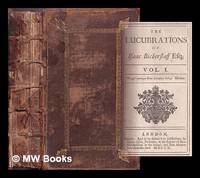
1710375347London : Charles Lillie and John Morphew 1710. First Edition. Hardcover. Poor copy bound in full aniline calf with gilt decorations to the the boards. Wear and tear as with age with loss to the spine bands and the spine cracked. Text remains well preserved overall; bright and clean. Provenance; from the library of Thos. Boycotte with the owner's armorial bookplate dated 1761. Series; The Tatler. Subjects; 18th century humour. The Tatler. Isaac Bickerstaff. London : Charles Lillie and John Morphew hardcover
173096216London: Jacob Tonson;. Good. 1730. Second Edition. Hardcover. Due to weight this is not available to amazon customers outside the UK. Other customers will be charged excess postage please ask; 4to; . Original calf bindings; the spines with 5 raised bands leather splitting at spine edges in places; also worn at panel cover edges; rear cover very worn and scratched - some surface removed; front hinge cracked but cover still firmly attached; contents however still generally nice and clean; text in old english; numerous blank pages after title pagetext begins at page 219 - The Spectator Tuesday December 11. Text proceeds to page 358 then goes to The ~Tatler - page 175 Thursday 26th 1709. And proceeds to page 372. Then The Guardian. The Guardian starts at page 121 May 28th 1713 to 271 The lover plus other articles - The present state of the war the Late tryal and conviction of Count Tariff The Whig-Examiner The Free-Holder 335 - 522 ; Extremely heavy; ; Vol. 3; 4to 11" - 13" tall . Jacob Tonson; hardcover
173054290London; Jacob Tonson; 1730. 1730. Hardcover. Full leather binding; 4to; ; 4to 11" - 13" tall . London; Jacob Tonson; 1730 hardcover
173736347Glasgow: Glasgow-College printed for Mr. James Cullen preacher Archibald Ingram James Dechman John Hamilton and John Glasford merchants in Glasgow 1737. 4to 20.8 cm; 8.25". 4 xvi 99 3 336 167 1 pp. <br><br>First published in 1650 this text begins with a conversation on how one properly converts and ends with a discussion of life after death but chiefly focuses on the privileges and duties allotted to followers of Christ. Ambrose 15911664 a Church of England clergyman and ejected minister offers surprisingly practical advice and instruction including a lengthy section promoting meditation and general self-awareness as well as specific sections on how one should conduct oneself as part of a family and society.<br>Â Â Â Â "Media; the Middle things in reference to the first and last things" and "Ultima; the Last things in reference to the first and middle things" each have their own sectional title-pages and pagination.<br>Â Â Â Â Provenance: From the Colgate Rochester Divinity School properly deaccessioned. <br>Â Â Â Â <br>Â Â Â Â ESTC T223079. Contemporary calf Cambridgestyle binding with raised bands ruled in blind and gilt-lettered leather spine label covers double framed and panelled in blind; artfully rebacked binding abraded some loss of board at corners and edges. Moderately age-toned with the occasional spot or bent corner; title-page damaged and mounted on sheet front free endpaper with medium tear a few leaves missing part of bottom margin one with loss of a few lines of text. Ex-library: bookplates on front pastedown call numbers on pastedown and title-page verso embossed stamp on title-page and one leaf of text light pencilling and inking on endpapers. One annotation on half-title identifying the author a handful of leaves with inked marginal scribbles. Glasgow-College, printed for Mr. James Cullen preacher, Archibald Ingram, James Dechman, John Hamilton, and John Glasford, merch hardcover books
1771906645Edinburgh: Alex Mccaslan 1771 A Very Rare Copy Of This Book. At Some Point The Book Was Rebound And The Spine Replaced With Brown Leather The Original Boards Attached And New Eps. The Block Text Is All Original. The Original Ffep Has A Hand Written Name And Date Of 1851. All Pages Are Foxed And Some Edges Worn But Text Is All Intact. . Ambrose Dedicated The Book To The Right Honourable William Earl Of Bedford Lord Russel Baron Of Thornhaugh And This Is Printed On Page A2. The Book Is Divided Into Books I Ii Iii And Iv Parts I Ii Iii Iv V And Vi Followed By Book V And Is Listed Such In The Contents Pages At The Rear Of The Book. Last Page Is The Names Of Books By This Printer. 577 Pages. The Boards Are Leather Original Worn At The Corners Which Are Rounded. The Spine Has Been Professionally Added No Titles. Rubbing To The Leather On The Boards. A Rare Find Of An Isaac Ambrose Book In Excellent Condition. Alex Mccaslan hardcover
1737038A61Printed for James Cullen Archibald Ingram James Dechman John Hamilton and John Glasford Glasgow: . 1737 4to. 3 parts in 1 volume. pp. xvi 1-993 336 167 1. Pagination with errors. Browned throughout but not brittle. Contemporary full calf binding worn and somewhat broken. Early signature of "Elijah Lathrop 1748"; also signed by A. C. Saxton. Lathrop was a Captain and later a Major in the local militia. Isaac Ambrose baptized 1604-died 1664 was a Church of England clergyman and ejected minister and author "His Prima media & ultima first edition - 1650 while beginning with a call to new birth and ending with reflections on death and judgement that read like a collection of sermons is largely concerned with the 'middle things' - the means 'for continuance and increase of a Godly life.' These include a commitment to systematic meditation which is reinforced by a few illustrations from his own diary kept during his annual monthly retreat in May in the woods near Hoghton Tower. Ambrose's works were highly regarded at the time and continued to be reprinted after his death appearing in Wesley's Christian Library. Alongside Ambrose's unwavering doctrinal Calvinism is a personal warmth that seems to have attracted both gentry and people as well as his fellow ministers." - Oxford DNB. ESTC T223079. Lowndes 35. W151 CTR STK PRICE JUST REDUCED!. Signed by Authors. Hardcover. Very Good. Printed for James Cullen, Archibald Ingram, James Dechman, John Hamilton, and John Glasford, Glasgow: . hardcover
179371714Imprimerie Nationale exécutive du Louvre | à Paris 1793 | 20.50 x 25.50 cm | relié
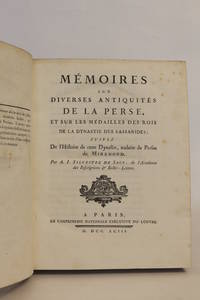
179371714à Paris: Imprimerie Nationale exécutive du Louvre 1793. Fine. Imprimerie Nationale exécutive du Louvre à Paris 1793 20.50 x 25.50 cm relié First edition illustrated with 9 plates medals inscriptions. Full jasper paper binding smooth spine black shagreen title-label binding signed Goy & Vilaine. Trace of dampstain to upper margin of 3 folding plates and to left margin of the first otherwise fresh throughout. Faint trace of dampstain to right margin of first leaves. Several leaves show traces of dampstain to upper margin over a few millimeters. Archaeological studies composed of 4 memoirs that were read at sessions of the Académie des Inscriptions et de Belles-Lettres in the years 1787 1788 1790 and 1791: Memoir on the inscriptions and monuments of Nakschi-Roustam; Memoir on the Arabic and Persian inscriptions of Tchéhel-Minar; Memoir on the medals of the kings of Persia of the Sassanid dynasty; Memoir on the monuments and inscriptions of Kirmanschah or Bi-Sutoun in Kurdistan. This publication concludes with the Persian translation of the work on the history of Persia by Mirkhond author from the end of the 9th century which signifies: The garden of purity or history of the prophets kings and caliphs. The studies by the orientalist and linguist Silvestre de Sacy attest to as much erudition as sagacity; he would be named in 1806 professor of Persian at the Collège de France and administrator of the École spéciale des langues orientales also at the Collège de France. He powerfully contributed to the development of studies and knowledge of oriental languages and civilizations particularly Persian. Imprimerie Nationale exécutive du Louvre unknown
1727026143London: J. Tonson 1727. First Edition. Quarto. 12 327 pages 18 leaves of tables one folding errata mounted to bottom of the second page of contents verso. This volume includes plate 18 which was done by Sir Isaac Newton near the end of his life Wallis 'Newton & Newtoniana' #357 while he was Master of the British Mint 1700-1727; During Newton's tenure at the mint he issued at least thirteen reports which like this one are all rare. Table 34 which is a fold-out of plate 18 is among his very last original works accomplished in his lifetime. While Newton is certainly best known for his scientific work in mathematics and physics a large part of his working life was his time as Master of the Mint; in fact his precise measurements enabled savings in the minting process. The previous system had not been uniform his keen measurements enabled an exact weight in determining the number of grains in an ounce of gold with precision had not been available previous to his work. The table is also known in Scottish bibliographies for the section on Scottish Weights and Measurements. Bound in full calf ruled in gilt earlier and fine rebacking decoratively stamped in gilt renewed endpapers all edges red wear to corners some toning. A very good copy. J. Tonson unknown books
17101395682Amstelodami Amsterdam: Sumptibus Thomæ Fritsch Thomas Fritsch 1710. Hardcover. Quarto 12 xxviii 580 324 60 pages. In Good plus condition. Bound in full vellum has gilt ornamentation to boards and spine. Binding with armorial stamp on both boards. Boards have slight yellowing small brown dots to front board and minor cracking to head of front joint. Extremities have slight discoloration from wear and mild bumping to corners in some cases exposing the board. Contains 1 of 4 ties intact. Textblock has slight separation and closed tears along the pastedowns splitting along the gutter between the second front free end page and titlepage age toning and foxing ranges from mild to moderate plus and speckling to edges. Text in Latin and Greek. Shelved in Room A. 1395682. Special Collections. Sumptibus Thomæ, Fritsch [Thomas Fritsch] hardcover