1 504 résultats
16962447Leipzig: Gross & Fritsch 1696. First edition. vellum marbled boards. Very Good. FIRST PRINTINGS OF THE PAPERS DOCUMENTING THE PROPOSAL AND SOLUTION OF THE "BRACHISTOCHRONE PROBLEM" ONE OF THE MOST FAMOUS MATHEMATICAL CHALLENGES AND ONE OF THE EARLIEST PROBLEMS POSED IN THE CALCULATION OF VARIATIONS. The challenge of the brachistochrone "began in June of 1696 when Johann Bernoulli published a challenge problem in Leibniz's journal Acta Eruditorum. Obviously a legacy of public challenge remained from the days of Fior and Tartaglia. Although contests were now conducted in the sedate pages of scholarly journals they retained their power to make or break reputations as Johann himself observed:<br /> <br /> '. it is known with certainty that there is scarcely anything which more greatly excites noble and ingenious spirits to labors which lead to the increase of knowledge than to propose difficult and at the same time useful problems through the solution of which as by no other means they may attain to fame and build for themselves eternal monuments among posterity.'<br /> <br /> "Johann's particular challenge was a good one. He imagined points A and B at different heights above the ground and not lying one directly above the other. There is certainly an infinitude of different curves connecting these two points from a straight line to an arc of a circle to any number of other wavy undulating paths. Now imagine a ball rolling from A down to B along such a curve. The time it take to complete the trip depends of course on the curve's shape. Bernoulli challenged the mathematical world to find that one particular curve AMB along which the ball will roll the shortest time. He called this curve the 'brachistochrone' from the Greek words for 'shortest' and 'time'.<br /> <br /> "An obvious first guess is to take AMB as the straight line joining A and B. But Johann cautioned against this simplistic approach:<br /> <br /> '. to forestall hasty judgment although the straight line AB is indeed the shortest between the points A and B it nevertheless is not the path traversed in the shortest time. However the curve AMB whose name I shall give if no one else discovered it before the end of this year is one well-known to geometers.'<br /> <br /> "Johann gave the mathematical world until January 1 1697 to come up with a solution. However when his deadline arrived he had received but one solution from the 'celebrated Leibniz' who:<br /> <br /> 'has courteously asked me to extend the time limit to next Easter in order than in the interim the problem might be made public . that no one might have cause to complain of the shortness of the time allotted. I have not only agreed to this commendable request but I have decided to announce myself the prolongation and shall now see who attacks this excellent and difficult question and after so long a time finally masters it.'"<br /> <br /> At this point Johann and others were surprised and perhaps a little delighted that they had not received a solution from their English rival Sir Isaac Newton. Wondering if Newton has not noticed the challenge Johann sent Newton directly a personal letter outlining the problem. When Newton received the letter he did not disappoint. As Newton's niece Catherine Conduitt explained:<br /> <br /> "When the problem in 1697 was sent by Bernoulli - Sir I.N. was in the midst of the hurry of the great recoinage and did not come home till four from the Tower very much tired but did not sleep till he had solved it which was by four in the morning."<br /> <br /> "Even late in life and tired from a hectic day's work Isaac Newton triumphed where most of Europe had failed! It was a remarkable display of the powers of the great British genius. He had clearly felt his reputation and honor were on the line; after all both Bernoulli and Leibniz were waiting in the wings to publish their own solutions. So Newton rose to the occasion and solved the problem in a matter of hours. Somewhat exasperated he is reported at one point to have said 'I do not love . to be . teezed by foreigners about Mathematical things.'<br /> <br /> "Back in Europe as Easter neared a few solutions came into the hands of Johann Bernoulli. The curve that everyone was seeking - one that 'is well-known to geometers' - was none other than an upside-down cycloid. This important curve was studied by Pascal and Huygens but neither of these mathematicians had realized that it would also serve as the curve of quickest descent. Johann wrote with characteristic hyperbole '. you will be petrified with astonishment when I say that precisely this cycloid . of Huygens is our required brachistochrone.'<br /> <br /> "On Easter the challenge period had expired. All together Johann had received five solutions. There was his own and the one from Leibniz. His brother Jakob came through perhaps to Johann's dismay with a third and the Marquis de l'Hospital added a fourth. Finally there was a submission bearing an English postmark. Opening it Johann found the solution correct although anonymous. He clearly had met his match in the person of Isaac Newton. Although unsigned the solution bore the unmistakable signs of supreme genius.<br /> <br /> "There is a legend - probably of dubious authenticity but nonetheless of great charm - that Johann partially chastened partially in awe put down the unsigned document and knowingly remarked 'I recognize the lion by his claw.'" Quoted from William Dunham Journey Through Genius: The Great Theorems of Mathematics Wiley 1990 page 199-202.<br /> <br /> The Brachistochrone Papers - the proposal and the solutions included:<br /> <br /> Johann: Supplementum defectus geometria cartesianae circa inventionem locorum; 2. Leibniz: Communicatio suae pariter duarumque alienarum ad edendum sibi primum a Dn. Joh. Bernoullio; 3. Johann: Curvatura radii in diaphanis non uniformibus . ; 4. Jakob: Solutio problematum fraternorum . ; 5. L'Hospital: Solutio problematis de linea celerrimi descensus; 6. Tschirnhaus: De methodo universalia theoremata eruendi . ; 7. Newton: Epistola missa ad praenobilem virum D. Carolum Mountague .<br /> <br /> Note: Newton's solution original appeared in the Philosophical Transactions.

<br /> <br /> Provenance With stamps and withdrawal markings 7-3-1984 from the famous John Crerar Library Chicago. <br /> <br /> In: Acta Eruditorum vol. 15 and 16: no.1 in 15:264-69 1 plate; no. 2 in 16:201-5 1 plate; no. 3 in 16: 206-11; no. 4 in 16:211-17; no. 5 in 16: 217-20; no. 6 in 16: 220-23; no. 7 in 16: 223-24. Leipzig: Gross & Fritsch 1696-1697. The two entire volumes offered. Quarto 208x170 mm. Two volumes in uniform contemporary three-quarter vellum over marbled boards. pp 2 604 and 9 plates; 8 594 and 8 plates. Some heavy worming to pp 324-42 and plate vi of volume 15 which is not part of any of the above mentioned articles. 1697 volume with repaired gutter tear to plate 8; reinforcement to p.449/50 and minor restoration to binding. Some toning throughout as usual with the Acta. In all a very good set. Gross & Fritsch unknown books
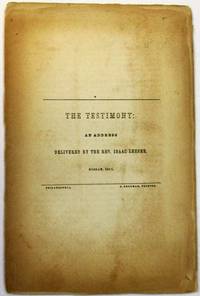
185136329Philadelphia: C. Sherman Printer 1851. Original front title wrapper stitched. 2 19 1 blank pp lacking the rear wrapper. Toned some shallow blank edge chipping and light wear. Good with some Hebrew printing in text. The caption title reads: 'An Address Delivered at the Schoolhouse of the Hebrew Education Society of Philadelphia at the First Opening of Their School on Sunday the 4th of Nissan 5611 April 6th 1851 by Isaac Leeser.'<br/><br/> "This address celebrated the opening of the day school launched by the Hebrew Education Society of Philadelphia the first of its kind in the city. 'It has always been to me a subject of profound astonishment and deep regret that there was not a single school all over the country until very lately where a Jewish child could obtain any information on his religion' Swann Catalog September 2019 Lot 120.<br/> "Leeser was the driving force behind the founding in 1846 of the Hebrew Education Society of Philadelphia chartered for 'the establishment of a school or schools within . Philadelphia in which are to be taught the elementary branches of education together with the sciences and modern and ancient languages always in combination with instruction in Hebrew language literature and religion.' In his address at its official opening delivered at the Society's schoolhouse on Sunday the 4th of Nissan 5611 April 6th 1851 Leeser expressed great hopes for the new Philadelphia Day School. 'We propose to combine elementary and afterwards scientific education with a gradual and progressive acquirement of Hebrew Hebrew literature and religion. It is not to be as in other schools a secondary matter whether the children learn Hebrew and religion or not but they are to acquire these even if nothing else can be imparted' p. 12." Sotheby catalog 2014 09239-20. <br/>Singerman 1195. Not in Goldman. OCLC 21968696 5- JTS U PA AJHS Hebrew Union College Princeton as of October 2019. C. Sherman, Printer unknown books
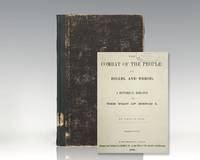
185982600Cincinnati: Bloch & Co 1859. First edition of American Reform Rabbi Isaac Mayer Wise's historical account of the era of Herod I. Octavo contemporary cloth over boards lacking the front free endpaper library bookplate to the front pastedown later collector's stamps to the title page with some rubbing and wear to the extremities. In good condition. Rare. American reform rabbi editor and author Isaac Mayer Wise established the first synagogue in the United States to include a mixed-gender choir family pews and count women in forming a quorum. Published in 1847 his Manhag American prayer-book was adopted and became the standard prayer book in most congregations throughout the Western and Southern states. He additionally published over two dozen works on the history of Judaism and Christianity including The Martyrdom of Jesus of Nazareth Judaism and Christianity: Their Agreements and Disagreements and The Cosmic God. Bloch & Co hardcover books
1719SS13189London:: Printed for B. Creake . . . J. Sackfield . . .; And sold by W. Mears . . . 1719. 1719. Sm. 4to. xxii 201 5 pp. 10 folding engraved copperplates 5 figs. pp. 24 54 75 112 half-title is a publisher's ad for Boerhaave rear publisher's ads 2 ff. head and tail-pieces; title edges chipped. With errata. Title p.101 perforated stamp and with a rubber stamp on verso of the John Crerar Library eight plates with the ex-library rubber stamp on versos; waterstained throughout. WITH FREQUENT EARLY INK CORRECTIONAL NOTES. Modern half blind-stamped dark calf gilt spine title raised bands marbled paper over boards new endleaves bindery ticket at rear: Pat M. Bruno. Inscription on recto of front blank verso is ad for Boerhaave book "W. --- 1720 Power." SPURIOUS EDITION OF DESAGULIERS' FAMOUS PRIVATE LECTURES CONTAINING NOTES ON BOYLE'S AIR PUMP AND NEWTON ON COLOR THEORY. FIRST ENLARGED EDITION early issue without "All carefully Examined and Corrected by Mr. Desaguliers" on title which otherwise is re-titled "Lectures of Experimental Philosophy". Includes: Sir Isaac Newton's Colours. Proposition. Lights which differ in Colour differ also in Degrees of Refrangibility. Initially published without the author's permission and then by evidence of the printed Preface agreed to issue the book with an erratum. / There are multiple forms of this edition as different copies collate differently Andrade Kenney Honeyman copies. The Honeyman copy called a second edition has two title-pages and the Preface by Desaguliers with an imprint of 1719. There are also differences in the title-pages. The fiasco of the unauthorized edition is the cause of the various issue differences. "Perhaps Dawson hoped . . . to ingratiate himself with his patron but instead he incurred the wrath of the lecturer. Immediately Desaguliers became aware of the book which he called 'ill put together sadly transcrib'd and worse corrected' he approached the booksellers. He found that two-thirds of the imprint had already been sold by Messrs Mears Creake and Sackfield but they paid him ten guineas 'to pacifie me'. They also promised to insert into all remaining copies a preface that Desaguliers would write together with a substantial errata. The preface follows the Dawson dedication in some copies of the book entitled A System of Experimental Philosophy but precedes it in another version called Lectures in Experimental Philosophy." See: Carpenter pp. 34-5 119. / Contents: Mechanical experiments Mechanical powers & definitions; How to make a heavy Body seem to rise it self; gravity balance leaver pulley wheel axle wedge screw laws of nature hydrostatics; Description of Robert Boyle's Air-Pump uses & experiments; How to make an air vacuum; Barometers Thermometers Hydrometers; Catoptrichs; Dioptrichs; Sir Isaac Newton's Colours; Condensing Engine; "Rowley's Horary being a machine to represent the Motion of the Moon about the Earth and the Earth Venus and Mercury about the Sun." / The preface written by Desaguliers himself explains that this volume of lectures was released "before I designed to publish them." He then retells how Paul Dawson "took a copy of the lectures . . . that they may be service to him when he went thro' my courses and they were afterwards sold and published without my knowledge." He obtained a copy of the text and made numerous corrections :: thus the micro-print 1 ½ page errata. The he invites the owner to annotate the book throughout "before he begins to read the lectures." And indeed the owner named Powers did annotate this copy :: clear evidence he read that Preface. A2-3. / The DNB asserts that Desaguliers "held in great esteem by Sir Isaac Newton" "is said to have been the first to deliver learned lectures to general audiences. Lectures by him at his London house were widely attended and were made attractive by experiments." In addition it mentions that Paul Dawson was responsible for the work and that Desaguliers himself "disavowed" himself of the edition. :: DNB pp. 850-1. / Nicholas A Hans describes the types of persons attending Desaguliers' lectures: "merchants craftsmen and clerks and his private audiences consisted of gentlemen and courtiers and included ladies as well." :: Nicholas A Hans New Trends in Education in the Eighteenth Century 1951 p. 141. / Westfall says of Desaguliers he "became a fixture at the meetings of the Royal Society where he carried out sets of experiments intimately related to various aspects of Newtonian natural philosophy. Some of his experiments such as the transmission of heat through a vacuum influenced Newton's views and other found their way into the third edition of the Principia." :: Never at Rest pp. 685-6. / Writing for the DSB A. Rupert Hall points out that Desaguliers did not produce his own version of these lectures until 1734 "when he took occasion to denounce this unauthorized version. . ." :: DSB IV pp. 43-6. / John Theophilus Desaguliers 1683-1744 born at La Rochelle emigrated to England in 1685 as a Huguenot refugee hidden in a tub at 2-years of age studied at Oxford he became a Fellow of the Royal Society in 1714. As the Society's experimenter and a close friend of Newton he often verified Newton's theories through experimentation. "In 1717 he published Physico-Mechanical Lectures an eighty-page abstract of the twenty-two lectures of his course. Although not authorized by Desaguliers the present work is the first full account of his lectures edited by his student Paul Dawson. Primarily of interest as a textbook of Newtonian physics many chemical topics are included. The first issue appeared with the title A System of Experimental Philosophy." / REFERENCES: Bakken title: "Lectures of experimental philosophy . . . 1719" pp. 52-3; Goodison English Barometers 1680-1860 p. 369; Keynes Boyle 366 pp. 122-9; Roy G. Neville I p. 354 second issue; Poggendorff I 554; Wellcome II p. 451; Wheeler 249. Not in Babson Barchas Gray or Verne L. Roberts catalogues. See: DSB IV p. 45; Taylor Mathematical Practitioners 1714-1840 35; Audrey T. Carpenter John Theophilus Desaguliers: A Natural Philosopher Engineer and Freemason in Newtonian England Bloomsbury Academic 2011. FULL TITLE: A System of Experimental Philosophy Prov'd by Mechanicks wherein the principles and laws of Physicks Mechanicks Hydrostaticks and Opticks are demonstrated and explained at large by a great number of curious experiments. . . To which is added Sir Isaac Newton's colours: the description of the condensing engine with its apparatus: and Rowley's Horary; a machine representing the motion of the Moon about the Earth; Venus and Mercury about the Sun according to the Copernican System. Printed for B. Creake, . . . J. Sackfield . . .; And sold by W. Mears, . . . 1719. hardcover books
1815275647New York: New-York Courier 1815. First. pamphlet. 21 pages printed with text in double columns. Original pamphlet sewn dampstain at upper corner and rough at edges but well inside the ample margins; some pages still un-opened. New York: At the Office of the New-York Courier 1815. First edition. A very good copy of this exceedingly scarce pamphlet. OCLC lists only 13 copies including those at Columbia Cornell Yale Harvard and the New York Historical Society.<br/><br/> Attributed to Isaac Bronson by F. Redlich in "The Molding of American Banking" 1868 volume 1 page 308. "Isaac Bronson was a highly successful financier of the Jacksonian era who was also one of the period's most original and influential banking theorists. Bronson accumulated his very considerable fortune in New York primarily by judicious personal money-lending operations on long-term bonds and mortgages at a cautious 7 per cent annual return supplemented by successful ventures in land speculation. In addition to wealth he had by the 1830's acquired a weighty reputation for sober financial conservatism and was regarded as an authoritative exponent of sound banking principles. Prominent in the financial community he had long thrown his weight as a sound banking theorist against the "wild-cat" practices of the then rampant state banks." --Venit A. 1945. The Journal of Economic History<br/><br/> New-York Courier unknown books
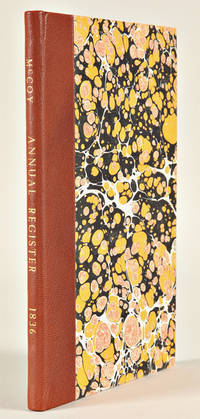
1836WRCAM43669Shawanoe Baptist Mission Ind. Ter. Ks.: J. Meeker 1836. 88pp. Modern half morocco and marbled boards spine gilt. A bit of light foxing. Very good. The second number of McCoy's THE ANNUAL REGISTER. of which only four numbers were ever printed containing valuable first-hand particulars regarding the western Indian tribes. McCoy first visited the Prairies in 1828 with follow-up tours during the next three years. In 1831 he settled at the Shawanoe Mission in 1831 which had been founded by Lykins earlier that year. During the following years McCoy travelled widely in the western country. In 1835 he had Jothan Meeker who had established a press at the Mission a year earlier print the initial number of THE ANNUAL REGISTER. McCoy's works are full of information regarding the Indian emigrant's introduction into the new country and provide details concerning many tribes e.g. Pawnee Otoe Omaha Cherokee Delaware Kickapoo Osage Kansas etc. Also included are descriptions of the military posts within Indian Territory conditions of various tribes etc. Complete sets of the four numbers are rarely met with - even the Streeter set lacked the first number. Printing began in Kansas in 1834 and McCoy's ANNUAL REGISTERs are the first works of any substance printed in the state. SABIN 43111. HOWES M67 "aa." FIELD 983. GRAFF 2586. STREETER SALE 544 ref. McMURTRIE & ALLEN Meeker 41. J. Meeker hardcover books
189917557Barcelona: Universo Musical Antes J. Bta. Pujol y Ca. ca. 1899. Used; Like New/Used; Like New. Espagne Souvenirs. Åuvres nouvelles pour le piano . N° 1 Prélude. Signed and inscribed presentation copy of the Spanish virtuoso pianist and composer's Prelude. He has penned on the first page of music translated from the French: "To Madame Henry Lerolle in sincere friendship and affection. I. Albeniz Paris January 6 1906." 7 pp. PN U.336.M.1. Rather heavily toned pages largely detached; front wrapper with multiple tears and losses. Stamped on the front wrapper by the bookseller L. E. Dotésio. Overall good with the inscription in fine condition. 9.5 x 12.5 inches 24.3 x 31.5 cm.<br style="">Madeleine Escudier Lerolle 1856â1937 was the sister-in-law of Ernest Chausson and moved in the musical circles of Paris. Her husband was the painter and and art collector Henry Lerolle 1848â1929.<br style=""><br style="">Albeniz's Prelude part of his piano suite Espagne Souvenirs evokes the sunrise on the "poetic plain of Granada."<br style="">Autograph material by Albeniz is seldom offered for sale. We have traced only two other inscribed scores from the composer on the market in over 50 years of records. Universo Musical Antes J. Bta. Pujol y Ca. unknown books
1963C1354Program for the First Piatigorsky Cup: International Grandmaster Chess Tournament July 2 to 27 1963 48 pages with photographs including photographs of the contestants table and diagrams. Octavo 8 1/2" x 4 1/2" bound in original publisher's spiral binding in blue felt wrappers with black and silver Piatigorsky Cup stamped to cover. Included nine first day tickets for the cup. Signed or inscribed by all the contestants to Mrs Piatigorsky. <br /><br />The Piatigorsky Cup was a triennial series of double round-robin grandsmaster chess tournaments held in the United States in the 1960's. Sponsored by the Piatigorsky foundation only two events were held in 1963 and 1966. the Piatigorsky Cups were the strongest U S Chess tournaments since New York 1927. Jacqueline Piatigorsky was married to cellist Gregor Piatigorsky. One of the strongest woman chess players in the U S and a regular competitor in the U S Women's Chess Championship she designed the cup and was the primary organizer of the tournaments. The prize funds were among the largest of any chess tournament up to that time. Every player was guaranteed a prize and all traveling and living expenses were paid. The First Piatigorsky Cup was held in the Ambassador Hotel Los Angeles in July 1963. The tournament field of eight included players from five countries. the soviet representatives Paul Keres and World Champion Tigran Petrosian finished equal first to share the cup with a score of 8 1/2/14 receiving more than half of the $10000 prize fund $3000 for first. Keres won most of the games in the tournament six but lost twice to Samuel Reshevsky. The Cup was Petrosian's first tournament since winning the 1963 World Championship match with Mikhail Botvinnik and was one of two first prizes he shared in his six-year reign as champion. He was the first reigning champion to play in an American tournament since Alexander Alekhine at Pasadena 1932. After losing the second round to Svetozar Gligoric Petrosian was never in danger the rest of the tournament. The remainder of the tournament field included to Americans Reshevsky and Pal Benko two Argentinians Oscar Panno and Miguel Najdorf and two Europeans Gligoric Yugoslavia and Frank Olafsson Iceland. U S Champion Bobby Fischer decline an invitation after his demand for $2000 appearance fee was refused by the tournament organizers. Gligoric led halfway through the tournament with 4 1/2/7 but scored only three draws in the last seven games and finished fifth behind Najdorf and Olafsson. Petrosian finished the strongest with 5/7 in the second half. Before the last round Petrosian led with 8 points followed by Keres with 7½ and Najdorf and Ólafsson with 7. Both Petrosian and Keres had Black in the final round. Petrosian drew his game against Reshevsky but Keres beat Gligorić to result in a tie for first place with 8½ points each.<br /><br /><b>Condition:</b> Edges sunned inscriptions to front end paper and title else spiral spine cracked else very good. Piatigorsky Cup Committee paperback books
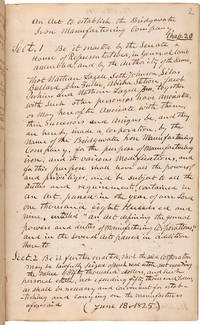
1887WRCAM55893Bridgewater Ma 1887. 364 i.e. 368pp. 91pp. blank. Broadside 11 1/4 x 4 3/4 inches laid in. Folio. Contemporary paneled reverse calf red morocco gilt labels on both boards and spine. Boards lightly worn front joint starting but still strong. Light tideline to outer margin throughout slight tanning. Overall very good. An impressive manuscript copy book documenting the rise and development of Bridgewater Iron Manufacturing Company of Massachusetts one of the largest iron works in the United States in the 19th century and a vital industrial partner during the Civil War under the direction of Nahum Stetson. These records chart the huge growth of the company as it purchased land and competing mills diversified its products building not only nails but large castings for military and commercial vessels and forming and utilizing railroads to quickly and efficiently expand their markets. <br> <br> Completed entirely in manuscript on hand- ruled paper this volume records the company's acts of incorporation minutes from stockholder and other important meetings directors' records by-laws and other important records relating to the growth of the company. The first page features a list of acts establishing and incorporating the company with relevant page numbers in the hand of Stetson: "An Act to Establish the Bridgewater Iron Manufacturing Company" 1825; "An Act to increase the Capitol Stock of the Bridgewater." 1846; "An Act to Amend an Act to Incorporate the Bridgewater." 1866; "An Act to Incorporate the Bridgewater & Taunton Rail Road Company" 1867; and additional acts. Among these are the general Massachusetts incorporation laws 1808-21 that required corporations to have a clerk keep a record book such as this one and that said clerk was designated an official justice of the peace who would record company stock votes and business decisions and maintain records of by-laws and changes to by-laws. <br> <br> Early entries include a vote in 1827 approving the company investigate the land below the existing furnace to potentially erect a new mill; examine Nippenicket Pond to improve water flow to the mills; and how with these improvements the company was able to pay dividends of $100 per share on the $16000 profits in 1830. In subsequent years minutes reference land purchases as they expand mill operations; and then adding a counting room next to the safe in 1835 after the death of Nathan Lazell Jr. along with notes about the company helping with funeral expenses for Lazell. Records show the company beginning to expand rapidly in hardware manufacturing in the 1840s thanks in large part to the Fall River Railroad reaching Bridgewater in 1845 and connecting to Boston the following year allowing the company much easier access to these markets. They greatly increased production of "American iron nails" in 1842; erected a "steam engine to drive our Rolling Mill when the water fails" in 1845; paid assessments on $16500 in stocks owned by the company in the "Fall River Middleboro Bridgewater & Randolph Rail Road Company" and incurred minor losses building a new rolling mill and rebuilding and expanding the forge in 1847. By the 1850s the company employed nearly 250 men working ten acres of manufacturing space supervised by legendary machinist James Ferguson. <br> <br> With the outbreak of the Civil War Bridgewater was on its way to becoming the largest iron works in the country. Specializing in heavy castings and forgings including key components for large ships they supplied the iron plate and fittings for the U.S.S. Monitor U.S.S. New Ironsides and all other iron-clad warships as well as the large forgings for every steamer for the Pacific Mail Steamship Company. The company's profits grew accordingly the ledgers reporting over $350000 in 1863 $450000 in 1864 and over $500000 in 1867. By 1868 the company had expanded to nearly 600 men and a manufacturing space of almost seventy acres. <br> <br> The "Directors' Records" start at the rear of the volume inverted. This portion is briefer and primarily discusses balloting for company officer elections dispersing and paying out shares in subsidiary operations such as the Providence Iron Company which Stetson purchased in 1854 and sales of land in Massachusetts and Rhode Island owned by the company and its subsidiaries including the Weymouth Iron Company. <br> <br> In 1694 David Perkins received permission from the colonial government of Massachusetts to construct a dam across the Town River and by 1707 Perkins had a working blacksmith shop at the site. In 1785 Nathan and Isaac Lazell built a slitting mill on the site to expand the blacksmithing operation. They added a second slitting mill in 1793. In time the company came to be known as Lazell Carey & Company and produced cannons during the War of 1812 and iron pots for the whaling industry along with cut nails and barrel hoops. In 1825 the company formally incorporated as the Bridgewater Iron Manufacturing Company but continued doing business as Lazell Perkins & Company for many years after. <br> <br> Nathan Lazell Jr. 1796-1835 was the first company clerk and many of the early records and acts copied into this volume are in his hand. Nahum Stetson 1807-1894 joined the company as a clerk in 1825 and was selected as treasurer effectively CEO when Lazell Jr. died in 1835. Stetson led the company for over half a century overseeing tremendous growth. In addition to acquiring Weymouth and Providence Iron companies Bridgewater also acquired Parker Iron Mills Wareham Massachusetts and helped form several railroads including the Fall River and Cape Cod railroads. In 1899 the site was purchased by the Stanley Works of New Britain Connecticut for the manufacture of machinery and tool production until 1928 when production shifted to New Britain. Between 1946 and 1988 part of the site was operated by the Bridgewater Foundry Company which produced grey iron castings. The property was donated to the Town of Bridgewater in 1994 by the Brousseau and Landner families the last owners of the foundry. Much of the site has been converted into Iron Works Park. <br> <br> The accompanying small broadsheet is caption titled LIST OF STOCKHOLDERS IN THE BRIDGEWATER IRON CO. and dated "May 1 1885." It has marginal annotations in Stetson's hand as well as a small slip of paper pasted to the bottom of the sheet with an additional seven shareholders added in manuscript. The total voting shares are 480 for a total capital value of $480000. <br> <br> A fascinating look into the development of industrialization in the Northeast through the eye of the company that led the charge. J. Leander Bishop A HISTORY OF AMERICAN MANUFACTURES FROM 1608 TO 1860. Vol. 3 Philadelphia: Edward Young & Co. 1868 pp.488-91. hardcover books
2305Engraved vignette on title & 13 folding engraved plates. Title printed in red & black. 4 p.l. 344 pp. Large 4to cont. Dutch vellum over boards lower cover a little soiled final ten leaves with faint marginal dampstain panelled in blind central panel of each cover with large arabesque stamped in blind. Leyden: J. & H. Verbeek 1732. The Leyden edition the first to be edited by 'Gravesande and with additional treatises by Halley Colson DeMoivre Maclaurin and Campbell. There is also an Appendix "De Solutione et Constructione Aequationum Scripta Varia" excerpted from the Phil. Trans. Fine copy. Bookplate and signature of Karen Figala the historian of science. ❧ Babson 204. hardcover books
1732D427Amsterdam: R. en J. Wetstein en W. Smith 1732. Hardcover. Very Good. 2 volumes Elephant folio 445 x 296mm. 16 524pp. 4. Title-page in black and red with engraved vignettes. Text in Dutch and Latin parallel. Contemporary vellum with central medallion stamped in blind; occasional spotting and marginal dampstaining; vellum soiled and covers somewhat bowed corners bumped. A fine two volume set of the Metamorphoses illustrated with in-text copper-engravings by Bernard Picart Charles le Brun and several other artists. The translator of this edition Isaac Verburg was born in Leiden around the year 1684. He was Rector of the Latin schools in Amsterdam and author and translator of several books; he died in 1745 in Amsterdam. Rare copy of the popular Dutch translation of Ovids masterpiece in prose Metamorphoses with clean bright and large illustrations. <br/><br/> R. en J. Wetstein, en W. Smith hardcover books
198160758Goshen CT: Angler's & Shooter's Press 1981. First edition 1/26 copies in the De Luxe issue this one noted in ink "Unlettered / Author's copy" and signed by Harry Marschalk. Tall 8vo. xi 266 pp. Illustrated from photographs plates photoengraved frontispiece and photoengraved extra title page portrait of Eugene Connett publisher of the Derrydale books; publisher's prospectus for the book laid in. Describes 169 items published at the press with short prose sketches on de luxe edition and rarities issued by the press its privately printed books the "non-Connett" Derrydales previous bibliographical efforts etc. Fine copy of a beautiful book. Full black niger gilt gilt title and date between raised bands on spine six-color leather onlay picturing the Derrydale Press printer's device on the upper board marbled endpapers top edge gilt others untrimmed publisher's morocco-backed and silk lined tray case with gilt spine title by Gray Parrot. #7846. <br/><br/> Angler's & Shooter's Press hardcover books
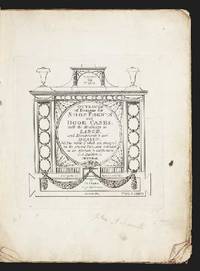
5153Engraved title-page & 24 engraved plates several plates slightly dampstained. Large 4to orig. blue wrappers frayed & scribbled upon by an early owner stitched as issued uncut. London: I. & J. Taylor 1792. First edition and very rare; ESTC locates only two copies: at the Bodleian and Avery Architecture Library. This is very attractive work of designs for storefronts and specialized doors issued by the leading publishers of architectural works of Britain the Taylor's Architectural Library. The Taylors father and son were shrewd businessmen and gave priority to the practical manuals required to support the building boom of the late eighteenth century. Bound-in at end is a two leaf folio catalogue of the Taylor's publications this seems to be ESTC T80563 dated after 1795. Good copy of a very rare book preserved in a box. ❧ ODNB. unknown books
1778001367London: J. W. Parsham 1778. Hand-Painted Vellum; With Full Morocco Box. Near Fine. 2 volumes in one. 12mo 4.75 by 3" 12 by 7 cm. 4 240 20 4 216 26 pp. Above all else this is a beautifully painted vellum binding in the style of the Edwards of Halifax a family of bookbinders in the late 18th century who developed a process of producing painting on vellum or parchment. The painting would actually lie under the surface giving it a greater permanence as well as a subtle glassy aura. On the front of this particular binding is a lady in late Georgian attire playing an organ with a cherub at her side and a lute at her feet. The rear board has a tinted illustration of a castle in a park-like setting. The spine is divided into five compartments four of which have a lyre ornament. Gilt ornamental borders and other detail work add further refinement to the binding. This comes with a brown levant gilt folding case shaped like book octavo in size and with plush interior with resting compartment for book itself by Sangorski & Sutcliffe. The joints of the book are partly cracked. The first title page has some light soilage. There is a small tear partially repaired on pp 1/2 of the second work. The vellum has light soilage and wear. Front joint of box repaired. Some minor scuffs and rubbing along edges. Notwithstanding these issues the book remains a highly attractive work of book art. <br/><br/> J. W. Parsham hardcover books
170208586Oxoniae Oxford: Sheldonian Theatre 1702. First Edition. The first astronomical book on gravitational principles; important because it contains the first publication of Isaac Newton's Lunar Theory "Lunae Theoria" pp. 332-336. The rather lengthy Preface contains Newton's Classical Scholia." Folio 14 1/8" x 9 1/2" 124942. bound in contemporary full paneled calf rebacked to style with red leather label on spine; with a plethora of diagrams in the text and a fine engraving on the title page. A lovely wide-margined copy printed on laid paper. First several leaves with light marginal dampstain affecting only a few words of text; small chip at foot of FFEP; discreet archival repair to gutter and lower part of title page; page 237 with light marginal soiling. David Gregory 1659 - 1708 was a close friend and associate of Isaac Newton. Babson 71. <br/><br/> Sheldonian Theatre hardcover books
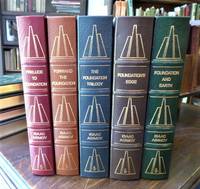
2005014724Norwalk Connecticut: The Easton Press 2005. FIVE VOLUMES. With uniformly-printed and designed covers. "Prelude To Foundation" is bound in deep red leather; "Foundfation and Earth" in green; "The Foundation Trilogy" in blue; "Forward the Foundation" in umber brown; and "Foundation"s Edge" in dark brown. All edges are gilt. Sewn-in bookmarks. All have full-page color frontispieces. A lovely finely-bound set. First published as a series of short stories in 1942-50 then into three collections as the "Trilogy" in 1951-53. Subsequently two sequels "Edge" and "Foundation and Earth" and twp prequels Prelude" and "Forward" were added. The "Trilogy" won the one-time Hugo Award for "Best All-Time Series" in 1966. See photos. Collected Edition. Full Leather Various Colors. Fine/No Dudst Jacket. Royal Octavo. The Easton Press hardcover books
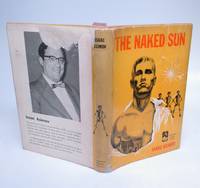
1957263944New York: Doubleday 1957. First. hardcover. near fine/good. 8vo yellow cloth d.w. New York: Doubleday 1957. First Edition.<br/><br/> Presentation copy signed in full. The dust jacket presents well but is extensively re-inforced on the verso with a large chip on the back panel.<br/><br/> Doubleday unknown books
183067190Leeser's First Issued Work LEESER Isaac translator. JOHLSON Joseph author. Instruction in the Mosaic Religion. Translated from the German of J. Johlson Teacher of an Israelitish School at Frankford on the Maine. By Isaac Leeser Reader of the Portuguese Jewish Congregation in Philadelphia. Philadelphia: Adam Walde 5590 1830. First American edition and first edition in English. Octavo 8 1/4 x 5 1/8 inches; 210 x 131 mm. viii 139 1 blank pp. Full contemporary sheep. Red morocco spine label. Marbled endpapers. Page 35 with a large closed tear professionally repaired with no loss of text. Internally very clean. Overall a very good copy. "Leeser brought with him to Philadelphia his translation of J. Johlson's Instruction in the Mosaic Religion. He had it published there in 1830 appropriately dedicated to his uncle Zalman Rehine. The book is a catechism published in Germany and translated and adapted by Leeser for "the instruction of the younger . of Israelites of both sexes who have previously acquired some knowledge of the fundamental part . of their religion." Leeser undertook its publication because there was a great scarcity of elementary textbooks for Jewish children. It is significant that this Instruction in the Mosaic Religion Leeser's first issued work is a textbook of religious instruction for the young for though Leeser attained distinction as an author translator editor and a national leader of the American Jewish community he considered himself first and foremost an educator." The Jewish Virtual Library "Leeser's career as a translator also began in Philadelphia in 1830 with the publication of his rendering from German of J. Johlson's Instruction in the Mosaic Religion. Leeser as part of his ongoing efforts to contribute to the development of Jewish education and culture in America translated a number of important works into English from German Spanish French and Hebrew. " Penn Libraries. Rosenbach 321. HBS 67190. $3000 Adam Walde unknown books
1760RW1581Geneva:: Sumptibus Cl. & Ant. Philibert 1760. 1760. 3 volumes. 4to. xxxii 548; viii 422; 8 xxviii 703 1 pp. Half-titles woodcut title vignettes title printed in red & black woodcut head & tail pieces numerous mathematical figs. index. Contemporary mottled calf raised bands gilt-stamped spines maroon & green spine labels; occasional browning. Ownership signature "Nolland avocat"auvcat. An excellent set. Very good . Second Jesuit edition emended and corrected based on the text of the third London edition of the Principia. This version is valued for its excellent annotations and copious commentary which is nearly the same length as the Principia itself. It contains Newton's Dedication to the Royal Society; Prefaces to the first second and third editions and Roger Cotes's Preface. In addition the Jesuits' edition of the Principia is prized for the inclusion of the important treatises on the theory of the tides: Daniel Bernoulli's Traite sur le Flux et Reflux de la Mer Colin MacLaurin's De Causa Physica Fluxus et Refluxus Maris and Leonardo Euler's Inquisitio Physica in causam Fluxus ac Refluxus Maris. These three works gained the prize given by the Royal Academy of Sciences in 1724 for resolving tidal problems relating to the theory of gravity. They represent the most significant discovery concerning tidal mechanics between the publication of the Principia and the discoveries of Laplace. REFERENCES: Babson 31; Gray 14; Wallis 14. Sumptibus Cl. & Ant. Philibert, 1760. hardcover books
1760SW1581Geneva:: Sumptibus Cl. & Ant. Philibert 1760. 1760. 3 volumes. 4to. xxxii 548; viii 422; 8 xxviii 703 1 pp. Half-titles woodcut title vignettes title printed in red & black woodcut head & tail pieces numerous mathematical figs. index. Contemporary mottled calf raised bands gilt-stamped spines maroon & green spine labels; occasional browning. Ownership signature "Nolland avocat"auvcat. An excellent set. Very good . Second Jesuit edition emended and corrected based on the text of the third London edition of the Principia. This version is valued for its excellent annotations and copious commentary which is nearly the same length as the Principia itself. It contains Newton's Dedication to the Royal Society; Prefaces to the first second and third editions and Roger Cotes's Preface. In addition the Jesuits' edition of the Principia is prized for the inclusion of the important treatises on the theory of the tides: Daniel Bernoulli's Traite sur le Flux et Reflux de la Mer Colin MacLaurin's De Causa Physica Fluxus et Refluxus Maris and Leonardo Euler's Inquisitio Physica in causam Fluxus ac Refluxus Maris. These three works gained the prize given by the Royal Academy of Sciences in 1724 for resolving tidal problems relating to the theory of gravity. They represent the most significant discovery concerning tidal mechanics between the publication of the Principia and the discoveries of Laplace. REFERENCES: Babson 31; Gray 14; Wallis 14. Sumptibus Cl. & Ant. Philibert, 1760. hardcover books
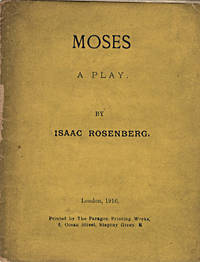
1916WRCLIT64204London: Printed by the Paragon Printing Works Stepney Green 1916. 12mo. Original printed yellow wrappers. Wrappers darkened and a bit frayed along spine with narrow chips to the fold otherwise a very good copy of a scarce and fragile book. Half morocco slipcase and chemise. First edition of the poet/painter's third separate publication like its predecessors printed at his own expense and privately distributed. As often this crudely printed pamphlet bears some manuscript corrections in the text. The title is slightly deceptive as a small group of poems including war poems are appended. With a presentation inscription inside the front wrapper from Sydney Schiff to Lydia Sherwood January 24 1926. Schiff 1868-1944 translator of Proust patron of Joyce and Wyndham Lewis and friend of Eliot and Max Beerbohm published novels under the pseudonym "Stephen Hudson." His wife Violet nee Beddington was the younger sister of Wilde's friend Ada Leverson "The Sphinx". Rosenberg met Schiff in the spring of 1915. "Like Edward Marsh Schiff became Rosenberg's 'absentee patron' in the sense that he put no pressure on him to produce works in return for occasional support and was available whenever Rosenberg needed him . His new friendship with Schiff also contributed to his growing consciousness of being a Jew. They communicated easily . To Schiff Rosenberg could say things which would have been inappropriate to Marsh. ." "Moses" evolved from Rosenberg's exposure to anti-Semitism during his military service. Schiff was an important Jewish friend at the time and was instrumental in helping distribute copies of the play in literary circles. Lydia Sherwood d. 1989 was a British actress both stage and film from the 1920s to 1960s. See Joseph Cohen JOURNEY TO THE TRENCHES: THE LIFE OF ISAAC ROSENBERG 1890 - 1918 New York 1975. REILLY WWI p.279. Printed by the Paragon Printing Works, Stepney Green unknown books
1740S13116Lausannae & Geneva: Marci-Michaelis Bousquet & Sociorum 1740. 1740. 4to. iv xxxii 363 1 pp. Half-title engraved frontispiece portrait of Newton engr. Jean-Louis Daudet after Vanderbank 12 engraved folding plates title vignette of 4 cherubs and a female figure each using an optical instrument representing learning optics/perspective drawn by Delamoncein and engraved by Daudet head & tail pieces and woodcut initial letters drawn by Papillon index; first 11 leaves browned. Contemporary full vellum green leather gilt-stamped spine label edges with decorative red freckling as designed by the binder; foot of spine with faint ink marking "11-". Paper unevenly browned. Verso of title with small ink annotation "=1135="; rear pastedown with another notation "á 20.Luglio 1801." Very good. Third Latin edition edited by Bousquet with a dedication to Joannes Bernoulli. This edition contains the full array of 31 querries. / "Newton's contributions to the science of optics :: his discovery of the unequal refractions of rays of different color his theory of color and his investigations of 'Newton's rings' to mention only a few of the most noteworthy :: place him among the premier contributors to that science. . . . Today we recognize that his work on optics offers unique rewards in its exciting innovative conjunction of physical theory experimental investigation and mathematics and in the revealing glimpse that it provides of a crucial period in the evolution of experimental science." :: Alan E. Shapiro The Optical Papers of Isaac Newton: Volume 1 1984 p. xi. / Jean-Louis Daudet 1695-1756 who made the frontispiece and title vignette was an engraver and print publisher active in Lyon inherited business from his father Etienne Joseph Daudet. He flourished from 1722 till his death in 1756. Thereafter the business continued by his widow in association with his son-in-law Louis Martin Roch Joubert until 1773. / "Newton famously declared that it is not the business of science to make hypotheses. However it's well to remember that this position was formulated in the midst of a bitter dispute with Robert Hooke who had criticized Newton's writings on optics when they were first communicated to the Royal Society in the early 1670's. The essence of Newton's thesis was that white light is composed of a mixture of light of different elementary colors ranging across the visible spectrum which he had demonstrated by decomposing white light into its separate colors and then reassembling those components to produce white light again. However in his description of the phenomena of color Newton originally included some remarks about his corpuscular conception of light perhaps akin to the cogs and flywheels in terms of which James Maxwell was later to conceive of the phenomena of electromagnetism. Hooke interpreted the whole of Newton's optical work as an attempt to legitimize this corpuscular hypothesis and countered with various objections." / "Newton quickly realized his mistake in attaching his theory of colors to any particular hypothesis on the fundamental nature of light and immediately back-tracked arguing that his intent had been only to describe the observable phenomena without regard to any hypotheses as to the cause of the phenomena. Hooke and others continued to criticize Newton's theory of colors by arguing against the corpuscular hypothesis causing Newton to respond more and more angrily that he was making no hypothesis he was describing the way things are and not claiming to explain why they are. This was a bitter lesson for Newton and in addition to initiating a life-long feud with Hooke went a long way toward shaping Newton's rhetoric about what science should be. . ." / "The first edition of The Opticks 1704 contained only 16 queries but when the Latin edition was published in 1706 Newton was emboldened to add seven more which ultimately became Queries 25 through 31 when in the second English edition he added Queries 17 through 24. Of all these one of the most intriguing is Query 28 which begins with the rhetorical question "Are not all Hypotheses erroneous in which Light is supposed to consist of Pression or Motion propagated through a fluid medium" In this query Newton rejects the Cartesian idea of a material substance filling in and comprising the space between particles. Newton preferred an atomistic view believing that all substances were comprised of hard impenetrable particles moving and interacting via innate forces in an empty space as described further in Query 31." :: Newton's Cosmological Queries :: MathPages. / Grace K. Babson Sir Isaac Newton 1950 141; George J. Gray A Bibliography of the Works of Sir Isaac Newton 182; Wallis 182. See: Printing and the Mind of Man 172. Marci-Michaelis Bousquet & Sociorum, 1740. hardcover books
1970WRCLIT57895New York: Touchstone Publishers 1970. 244pp. plus lithographs. Large folio 65 x 48 cm; 25.5 x 19 inches. Loose sheets and signatures laid into folding cloth case. Case rather faded and smudged with lower edge of upper lid broken internally very good; except for two small marginal spots to one plate the plates are in fine state. First edition. One of the earliest of the several collaborations between the Nobel Prize-winning author and Soyer. From an edition of 175 copies and 20 a.ps. this is one of 150 numbered sets with the lithographs printed on Arches each signed and numbered by the artist in the margin and with the title-leaf signed by the author. Touchstone Publishers hardcover books
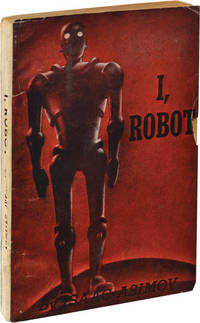
1950160914008New York: Gnome Press 1950. First Edition. Paperback. Very Good. First edition wrappered issue. Though the publishing history is murky this is assumed to be either an example from the publisher's short foray into paperback publishing or an Armed Services edition. Very Good. Pages toned. Wraps lightly worn with a short tear and associated creasing at the base of the front joint light foxing to verso of covers and rear cover light bit of production-caused waviness to front cover. Exceedingly scarce in this format and much more uncommon than the hardcover edition. Gnome Press paperback books
1950131030New York: Gnome Press 1950. First Edition. First Edition. Presumed "Armed Forces" edition or the publisher's short-lived attempt to produce paperbacks bound in wrappers identical to the jacket art of the hardcover edition. More scarce than the hardcover a stopper for Asimov collectors. <br/><br/>Asimov's classic work a collection of short stories that had immediate and lasting impact on both science fiction and popular culture introducing the author's now legendary "Three Laws of Robotics." <br/><br/>Very Good plus in illustrated wrappers. A small chip to the front wrapper a larger corner chip to the rear wrapper silverfish damage to some preliminary pages and light shelfwear and toning overall. Gnome Press unknown books