NEWTON, Sir IsaacBiblio.com
26 496 résultats
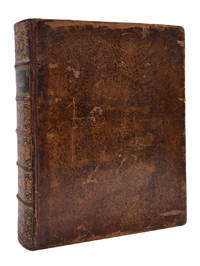
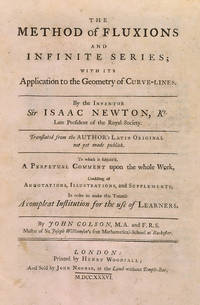
173614348London: Henry Woodfall 1736. FIRST EDITION. With engraved frontispiece interpolated leaf 143-144 and leaf containing errata on the recto publisher’s advertisements on the verso. Paneled sprinkled calf in a contemporary style; a large paper copy with very wide margins a few contemporary annotations. First edition of Newton’s treatise on the calculus a work of great importance and rarity. Ready for publication in 1671 Newton circulated the manuscript among his friends who urged him to establish priority by publishing his own work. He steadfastly refused and prior to his death entrusted it to Henry Pemberton who never had it published. It was not until 1736 that Method of fluxions was finally published in the present English translation by John Colson who added a lengthy commentary. The original Latin edition did not appear until 1779 in the Opera omnia.<br /> <br /> Babson 171; Gray 232; Wallis 232; Smith History of Mathematics I p. 404. Henry Woodfall unknown
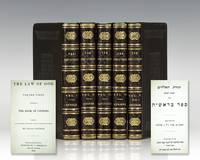
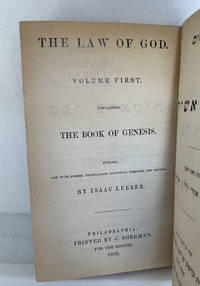
39481Philadelphia: Printed by C. Sherman 5605. 8vo 5 volumes. 8 7/8 x 5 1/2 inches. Hebrew and English text on facing pages. Each volume inscribed at the head of the English-language title "To my beloved wife from her affectionate husband" the first volume with a later family annotation. Contemporary purple morocco spine in six compartments with raised bands lettered in gilt in the second and fourth repeating gilt decoration in others marbled edges marbled endpapers.<br/> <br/> Provenance: Solomon Nunes Carvalho each cover stamped in gilt<br/> <br/> Rare large-paper association copy of the first Jewish translation of the Pentateuch into English.<br/> <br/> More than any other person of his time Isaac Leeser 1806-1868 envisioned the development of a major center of Jewish culture and religious activity in the United States. He single-handedly provided American Jews with many of the basic religious texts institutions and conceptual tools they needed to construct the cultural foundation of what would later emerge as the largest Jewish community in the history of the Jewish people. Printed in 1845 this edition of the Pentateuch in five volumes included a vocalized Hebrew text of each of the Five Books of Moses together with an English translation and notes as well as the haftarot prophetic readings. Leeser actually began working on The Law of God in 1838. Among the factors involved in his decision to begin systematically working on a translation was the recent opening of Rebecca Gratz's Sunday School which met for the first time in March 1838 in Philadelphia and was desperately in need of appropriate study material. Students were compelled to use the King James Bible for want of a Jewish alternative. Religiously objectionable passages in other texts provided by Protestant organizations were either pasted over or torn out by Gratz's staff. Leeser who supported the Sunday School and was its chief academic resource person felt compelled to find more suitable texts for the students. The impetus for Leeser throughout was always his desire to provide the Jews of America with an English text of the Bible that was produced by one of their own and was not tainted by conversionist motivations. This copy with provenance to Solomon Nunes Carvalho who was a noted American painter photographer writer and inventor best known for traveling with John C. Fremont on his fifth expedition through Kansas Colorado and Utah. He published an account of that journey titled "Incidents of Travel and Adventure in the Far West; with Colonel Fremont's Last Expedition" 1860 and was considered a pioneer in travel photography. Isaac Leeser the hazzan of Congregation K.K. Mikveh Israel married Carvalho and his wife Sarah Miriam Solis on October 15 1845 in Philadelphia where Carvalho's father had a workshop.<br/> <br/> Rosenbach 569; Singerman 884; Goldman 7; Lance J. Sussman "Another Look at Isaac Leeser and the First Jewish Translation of the Bible in the United States" Modern Judaism Vol. 5 No. 2 Gershom Scholem Memorial Issue. May 1985 pp. 159-190. Printed by C. Sherman unknown
184549020Philadelphia: C. Sherman 5605 1845-46. First edition of the “first English translation of the Pentateuch in America†the 1845 Hebrew-English Bible by one of the most prominent and influential figures in American Jewish history. Octavo 5 volumes. Translated by Isaac Leeser. Bound in contemporary polished calf gilt titles and tooling to the spine rebacked. Lightly rubbed moderate wear. A very nice example of a scarce and important work. Previous editions published by Jews in England had simply utilized the King James translation. The translator was Isaac Leeser 1806-1868 who worked without assistance. In his preface he apologizes for any errors: "How can it be expected that I should escape when I have no Jewish compositors and have necessarily to be often away when the work goes to press" Despite these obstacles Leeser doubted that "the precious word of God ever appeared among us in a more beautiful form than the volumes in which I am now engaged." Leeser avoided reliance on earlier English translations though he made some use of German translations and noted that "the arrangement is strictly Jewish. My intention was to furnish a book for the service of the Synagogue both German and Portuguese." Leeser’s “contributions to every area of Jewish culture and religion made him a major builder of American Judaism.†The publication of his Pentateuch was the first time that any portion of the Bible was published in America under Jewish auspices. “The translation of the Bible was Leeser’s great literary achievement and represented many years of patient labor and devotion to a task which he considered sacred… He made good use of the various German translations by Jews of the collective commentary known as the Biur and of other Jewish exegetic works. As a result his translation though based in style upon the King James version can be considered an independent work for the changes he produced are numerous and great… until the new Jewish Publication Society version was issued in 1917 it was the only source from which many Jews not conversant with Hebrew derived their knowledge of the Bible in accordance with Jewish tradition†Waxman 1090. C. Sherman, 5605 unknown
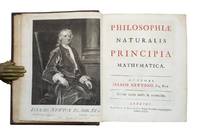
172669561London: Apud Guil. & Joh. Innys 1726. Full Description:<br> <br> NEWTON Sir Isaac. Philosophiæ naturalis principia mathematica. Editio tertia aucta & emendata. London: Apud Guil. & Joh. Innys 1726.<br> <br> Third edition. One of only 1250 copies printed. Quarto. 34 530 6 index pp. Engraved frontispiece portrait facing title by George Vertue after I. Vanderbank. Bound without the advertisement leaf. Numerous diagrams in the text and one engraving of cometary orbit on p. 506. Title printed in red and black. With the Royal Privilege printed on verso of the first leaf as in Babson copy 2.<br> <br> In full goatskin. Spine ruled and lettered in gilt. Boards paneled in blind. Inner hinges repaired. Some old ink manuscript notes on front flyleaf. Numerous instances of light early pencil marginalia and a few in ink. Some ghost dampstaining throughout. Previous owner's bookplate on front pastedown. Overall a very good copy.<br> <br> "This edition was the last published during the author's lifetime and the basis of all subsequent editions. It was edited by Henry Pemberton M.D. F.R.S. and contains a new preface by Newton and a large number of alterations the most important being the scholium on fluxions in which Leibnitz had been mentioned by name. This had been considered an acknowledgement of Leibnitz's independent discovery of the calculus. In omitting Leibnitz's name in this edition Newton was criticized as taking advantage of an opponent whose death had prevented any reply" Babson p. 12.<br> <br> Third edition of "the greatest work in the history of science" Printing and the Mind of Man. In the Principia Newton formulated the three laws of motion from which he derived the principle of universal gravitation "wherein all bodies of whatever mass attract one another in proportion to their masses and in inverse ratio as the square of the distance between them. This applies to dust particles as to the mightiest celestial bodies" Dibner.<br> <br> "Copernicus Galileo and Kepler had certainly shown the way; but where they described the phenomena they observed Newton explained the underlying universal laws. The Principia provided the great synthesis of the cosmos proving finally its physical unity. Newton showed that the important and dramatic aspects of nature that were subject to the universal law of gravitation could be explained in mathematical terms within a single physical theory.The same laws of gravitation and motion rule everywhere; for the first time a single mathematical law could explain the motion of objects on earth as well as the phenomena of the heavens. The whole cosmos is composed of inter-connecting parts influencing each other according to these laws. It was this grand conception that produced a general revolution in human thought equalled perhaps only by that following Darwin's Origin of Species" Printing and the Mind of Man 161 describing the first edition.<br> <br> Babson 13. Gray 9. Wallis 9.<br> <br> HBS 69561.<br> <br> $22500. Apud Guil. & Joh. Innys unknown
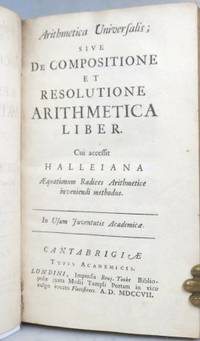
116359Cambridge & London Typis Academicis; Benj. Tooke 1707. . First edition; 8vo 20 x 12.5 cm; contemporary ownership inscription in ink to front endpapers contents fresh; contemporary sprinkled calf ruled in blind with floral tools in the corners red speckled edges spine lettered in gilt but rubbed with loss of the gilt joints ends of spine and hinges professionally conserved very good condition; 343 pp.<br /> First edition of Newton's treatise on algebra his 'most often read and republished mathematical work' Whiteside.<br /><br />'Sometime between the autumn of 1683 and early winter of 1684 Newton according to the statues of the Lucasian Chair deposited with the university his Lucasian Lectures on Algebra. The lectures bear dates from 1673 to 1683 but these were added in retrospect and it is highly unlikely that they were ever delivered to Cambridge students. From one point of view Arithmetica Universalis can be seen as a fulfilment of the program outlined by Descartes in Géometrie because it teaches how problems especially geometrical problems but also arithmetical and mechanical ones can be translated into the language of algebra which is here seen as the tool for problematic analysis; on the other hand Arithmetica Universalis contains two criticisms directed at Descartes' those being the preference for Apollonian geometry over Cartesian algebra in solving indeterminate problems and the argument that Descartes relied too heavily on algebraic criteria Guicciardini Isaac Newton on Mathematical Certainty and Method pp 61-62.<br /><br />By 1707 Newton had moved to London and his successor mathematician William Whiston took it upon himself to edit and publish the text. It is unclear how much say Newton had in this but he was unhappy with various aspects of the editing and typesetting and refused to have his name on the title page though in the end most of Whiston's changes would be retained in the 1722 edition seen through the press by Newton himself Cohen 'The Case of the Missing Author' in Isaac Newton's Natural Philosophy pp. 35-38.<br /> Cambridge & London, Typis Academicis; Benj. Tooke, 1707. unknown
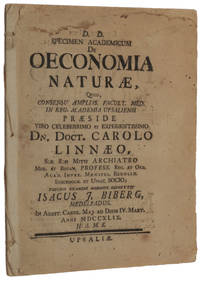
17495245Uppsala: np 1749. First edition. <p>First edition extremely rare. "This essay was the first sketch of a science of ecology. Linnaeus used his economy-of-nature concept as an organising principle to unify an important but previously amorphous part of natural history. In so doing he was also attempting to transform an important background concept into the central theory of a new science" Egerton. "In regard to Linnaeus' concepts of an economy of nature Darwin used these ideas as major explanations of the workings of natural selection. So Linnaeus supplied major assistance for Darwin's arriving at his theory of evolution" Stauffer.</p>. THE BIRTH OF THE SCIENCE OF ECOLOGY. <p>First edition extremely rare of Linnaeus' pioneer dissertation which created the science of ecology. "This essay was the first sketch of a science of ecology. Linnaeus used his economy-of-nature concept as an organising principle to unify an important but previously amorphous part of natural history. In so doing he was also attempting to transform an important background concept into the central theory of a new science . The term 'economy of nature' bore an obvious similarity to the contemporary term for animal physiology 'animal economy' which involved studying how the parts contributed to the functioning of the whole. Linnaeus may indeed have had in mind an analogy between the organs in an animal and the species in a habitat because his analysis of the interrelations between the plants and animals in nature implied a close and well-defined interaction for the good of the whole: 'To perpetuate the established course of nature in a continued series the divine wisdom has thought fit that all living creatures should constantly be employed in producing individuals that all natural things should contribute and lend a helping hand towards preserving every species and lastly that the death and destruction of one thing should always be subservient to the restitution of another' . The Oeconomia naturae begins with the above-quoted definition and then explains how that concept can be used to interpret phenomena in inanimate nature and in the plant and animal kingdoms. For both the plant and animal kingdoms Linnaeus considered propagation preservation and destruction as the phenomena which maintained the economy of nature" Egerton p. 335. "The phrase 'Oeconomy of Nature' "should be familiar to readers of Darwin for he claims in the Origin p. 102 that 'all organic beings are striving it may be said to seize on each place in the economy of nature.' When the work 'economy' appears in Darwin's texts there is a tendency to look to political economy for precursors . but concepts like the animal economy and the economy of nature debatable belonged to intellectual lineages that were relatively independent of their social and political context . I will argue that Darwin's idea of a place in the economy of nature stems from the work of previous naturalists like Carl Linnaeus and Charles Lyell and that it played a key role in the development of his evolutionary ideas. . Darwin read translations of Linnaeus' dissertations Oeconomia naturae 1749 and Politia naturae 1760 in May 1841. Although the phrase 'economy of nature' appears only once in Darwin's notebooks of the late 1830s it can be found throughout his first sketches on transmutation in 1842 and 1844. Given this chronology it is likely that the idea came to play a greater role in Darwin's work because of his encounter with these Linnaean texts" Pearce pp. 494-6. The dissertation was dictated by Linnaeus in Swedish to Isaac Biberg a doctoral candidate who translated it into Latin and defended it according to the academic custom of the eighteenth century. ABPC/RBH lists no copy in the last 80 years. OCLC lists 5 copies in US Madison Wisconsin; Kansas; Harry Ransom Texas; Minnesota; Huntington.</p> <br /> <p>"Like most naturalists of his time Linnaeus was trained in medicine and thus would have been familiar with the term 'oeconomia animalis' as employed by Charleton Hermann Boerhaave and others. However Linnaeus set his sights higher - what he wanted to describe was not the animal economy but the economy of nature as a whole. Of course others had used the term 'economy of nature' e.g. Sir Kenelm Digby in a variety of works but only as a brief metaphor. For example Digby writes in 1644 that natural motion 'hath its birth from the universall oeconomy of nature here among us.' What Linnaeus did instead was extend the physiological idea of the animal economy to nature in its entirety. In his eyes the economy of nature deserved a description just as detailed and rational as that of the animal economy.</p> <br /> <p>"In the dissertation 'Oeconomia Naturae' defended by his student Isaac Biberg in 1749 Linnaeus defines his title as follows: 'By the oeconomy of nature we understand the all-wise disposition of the creator in relation to natural things by which they are fitted to produce general ends and reciprocal uses.' The 'reciprocal uses' are the key to the whole idea for 'the death and destruction of one thing should always be subservient to the restitution of another;' thus mould spurs the decay of dead plants to nourish the soil and the earth then 'offers again to plants from its bosom what it has received from them.' Linnaeus points out that natural processes always follow a certain order with each stage dependent on the previous. A fallen tree for instance does not go to waste but is colonized and eliminated by an ordered series of creatures: liverworts mushrooms beetles caterpillars and woodpeckers. Just as the respiratory cardiovascular lymphatic and digestive systems play different functional roles in the economy of the human body different species play different functional roles in the economy of nature as a whole. For example each kind of insect lays its eggs on a particular kind of plant:</p> <br /> <p>'. every different tribe chooses its own species of plant. Nay there is scarce any plant which does not afford nourishment to some insect; and still more there is scarcely any part of a plant which is not preferred by some of them. Thus one insect feeds upon the flower; another upon the trunk another upon the root; and another upon the leaves.'</p> <br /> <p>"Each type of organism therefore according to Linnaeus has its special function in nature's economy. Just as the animal economy ensures the health and well-being of the animal body the economy of nature ensures the health and well-being of the natural world. Linnaeus discusses the many creatures that help cleanse and purify nature's body without which the 'whole earth would be overwhelmed with carcases and stinking bodies.' Thus if a horse dies near a roadway its body will 'be filled with innumerable grubs of carniverous flies by which he is entirely consumed and removed out of the way that he may not become a nuisance to passengers by his poisonous stench.' Likewise specialized aquatic predators like the thornback the hound fish or the conger eel consume fish carcasses near the shore. Linnaeus even suggests an experiment to prove the purifying potential of insects:</p> <br /> <p>'. knats lay their eggs in stagnant putrid and stinking waters and the grubs that arise from these eggs clear away all the putrefaction; and this will easily appear if any one will make the experiment by filling two vessels with putrid water leaving the grubs in one and taking them all out of the other. For then he will soon find the water that is full of grubs pure and without any stench while the water that has no grubs will continue stinking.' </p> <br /> <p>"Thus for Linnaeus even scavengers and grubs the lowest of all species play an essential role in the economy of nature" Pearce pp. 497-8.</p> <br /> <p>"Oeconomia Naturae is both the culmination of a great tradition - that of Christian natural theology and the starting point of a new science the one that Ernst Haeckel named 'ecology' in 1866. In accordance with the natural theology and the 'age of optimism' celebrated in the works of William Derham John Ray Bernhard Nieuwentyt Gottfried von Leibniz and Christian von Wolff Linnaeus defines 'the economy of nature' as the Creator's wise arrangement and deposition of all things according to which they fulfil their purpose for the glory of God and the happiness of Man.</p> <br /> <p>"And although individuals perish their roles persist . The roles in Linnaean nature are what today's ecologists call 'niches': a multidimensional 'space' defined by the abilities of the species and their interactions with the environment - their physiology and habitat preferences position in food chains and ecosystem structure. Although the Oeconomia Naturae reads like an ecology textbook it also sparkles with the eroticism of the Baroque. Like a voluptuous painter Linnaeus revels in the splendour of life in its beautiful 'costumes' its sensual appeal and showy extravagance the delightful colours forms and adaptations the impressive devices for preservation survival defence attack sex and propagation mating and pollination the means of dispersal and child-rearing .</p> <br /> <p>"Between 1743 and 1776 Linnaeus wrote more than 180 such academic theses. But few achieved the instant success of the Oeconomia Naturae. A Swedish translation was produced within a year. English and German versions soon appeared. It was also reprinted in Latin in the many editions of Linnaeus's Amoenitates academicae published in Amsterdam Leyden Erlangen and Graz through the second half of the eighteenth century. New translations continue to appear today" Hestmark.</p> <br /> <p>"Darwin's influence on the history of ecology resulted in the very christening of the science itself by Ernst Haeckel who once explained that 'By ecology we mean the body of knowledge concerning the economy of nature' and who concluded 'in a word ecology is the study of all those complex interrelationships referred to by Darwin as the conditions of the struggle for existence' .</p> <br /> <p>"When we come to consider the sources of Darwin's ecological insight the importance of his personal experience is obvious . Besides the influence of Darwin's field observations there was the influence of his reading . The importance for Darwin of Lyell's discussion of the economy of nature and allied topics in his Principles of Geology is very clear . Lyell's references in regard to the economy of nature point directly back to the major earlier source: the writings of Carl Linnaeus. The importance of Linnaeus in the evolution of ecology is very great and it is striking that among the naturalists writing after Linneaus and before Darwin it is the geologist Charles Lyell who shows the clearest grasp of Linnaeus' ideas on the economy of nature and who makes the fullest use of them in his own work . After coming to know in the pages of Lyell's Principles ideas and facts from a number of these Linnaean essays Darwin encountered Linnaeus himself in English translation in May of 1841 . From this year of 1841 on Darwin made increasing use of the phrases 'economy of nature' and 'polity of nature' .</p> <br /> <p>"The conventional wisdom is that Darwin overthrew the work of Linnaeus in so far as he replaced the orthodox dogma of fixity of species by his theory of evolution. But in regard to Linnaeus' concepts of an economy of nature Darwin used these ideas as major explanations of the workings of natural selection. So Linnaeus supplied major assistance for Darwin's arriving at his theory of evolution" Stauffer.</p> <br /> <p>"In German and Swedish universities in the eighteenth century the serious test of the student was the skill with which he conducted his oral defence of the thesis he presented. His major professor who presided at the disputation was often the author of the thesis to be defended. At Uppsala Linnaeus generally dictated the essays which his students published and paid the printer's bill for. He quite naturally regarded these dissertations as his own work. In a letter to his friend the English naturalist John Ellis he wrote:</p> <br /> <p>'The fourth volume of my Amoenitates Academicae is very nearly printed . Among the dissertations I am about to publish are Genera morborum Aer habitabilis Flora Jamaicensis Sus porcus Anthropomorpha & Generatio ambigens. In the last of these I shall show that the brain and spinal marrow only proceed from the mother and the rest of the body from the father.'</p> <br /> <p>"Nowadays unless there is direct evidence to the contrary it is customary to regard Linnaeus as the author of all these dissertations" ibid.</p> <br /> <p>Soulsby Catalogue of the works of Linnaeus 2nd ed. 1933 1514. Egerton 'Changing concepts of the balance of nature' The Quarterly Review of Biology 48 1973 pp. 322-50. Hestmark 'Oeconomia Naturae L' Nature 405 2000 p. 19. Pearce 'A great complication of circumstances - Darwin and the Economy of Nature' Journal of the History of Biology 43 2010 pp. 493-528. Stauffer 'Ecology in the long manuscript version of Darwin's 'Origin of Species' and Linnaeus' 'Oeconomy of Nature'' Proceedings of the American Philosophical Society 104 1960 pp. 235-41.</p> <br /> <br/> <br/> 4to pp. viii 48 woodcut initials head- and tail-pieces first and last pages tanned spotted water stain to upper edge of the first two leaves. String bound. A very good copy in original state of this extremely rare dissertation. np unknown
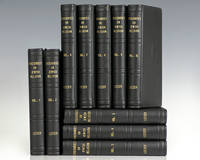
1866107732Philadelphia: Sherman & Co 1866-68. Rare first editions of one of the 'major builders of American Judaism' Isaac Leeser's Discourses on the Jewish Religion. Octavo 10 volumes bound in full leather gilt titles to the spine raised bands. In near fine condition. Complete sets are of the utmost rarity. American Jewish lay minister author translator and publisher Issac Leeser’s “contributions to every area of Jewish culture and religion made him a major builder of American Judaism." In addition to his influence on the Jewish pulpit in the United States Leeser became the first American Jewish publisher and produced the first Jewish translation of the bible into English. “The translation of the Bible was Leeser’s great literary achievement and represented many years of patient labor and devotion to a task which he considered sacred…until the new Jewish Publication Society version was issued in 1917 it was the only source from which many Jews not conversant with Hebrew derived their knowledge of the Bible in accordance with Jewish tradition†Waxman 1090. Sherman & Co hardcover
184578547Philadelphia: C. Sherman 5605 1845-46. First edition of the “first English translation of the Pentateuch in America†the 1845 Hebrew-English Bible by one of the most prominent and influential figures in American Jewish history. Octavo 5 volumes. Translated by Isaac Leeser. Bound in full contemporary calf gilt titles and tooling to the spine. In near fine condition. A nice example rare in contemporary binding. Previous editions published by Jews in England had simply utilized the King James translation. The translator was Isaac Leeser 1806-1868 who worked without assistance. In his preface he apologizes for any errors: "How can it be expected that I should escape when I have no Jewish compositors and have necessarily to be often away when the work goes to press" Despite these obstacles Leeser doubted that "the precious word of God ever appeared among us in a more beautiful form than the volumes in which I am now engaged." Leeser avoided reliance on earlier English translations though he made some use of German translations and noted that "the arrangement is strictly Jewish. My intention was to furnish a book for the service of the Synagogue both German and Portuguese." Leeser’s “contributions to every area of Jewish culture and religion made him a major builder of American Judaism.†The publication of his Pentateuch was the first time that any portion of the Bible was published in America under Jewish auspices. “The translation of the Bible was Leeser’s great literary achievement and represented many years of patient labor and devotion to a task which he considered sacred… He made good use of the various German translations by Jews of the collective commentary known as the Biur and of other Jewish exegetic works. As a result his translation though based in style upon the King James version can be considered an independent work for the changes he produced are numerous and great… until the new Jewish Publication Society version was issued in 1917 it was the only source from which many Jews not conversant with Hebrew derived their knowledge of the Bible in accordance with Jewish tradition†Waxman 1090. C. Sherman, 5605 unknown
16661299Nurnberg 1666. Houzeau & Lancaster 3039; Zimmer 5089 1628 Strasbourg ed.; Poggendorff 1984. Warner The Sky Explored pp. 104-5. Extremely rare German edition a Latin edition was published the same year of Sturms enlargement of Habrechts famous treatise on the making of celestial and terrestrial globes published in 1628. The Habrecht family of clock and instrument makers were famous throughout Europe from the last quarter of the sixteenth century to the end of the seventeenth century. The authors father also called Isaac was responsible for making the monumental second Strasbourg clock which was one of the mechanical wonders of its time on the Continent. Isaac Habrecht 1589-1633 was a Strasbourg physician mathematician and maker of globes. He was much influenced by Blaeu and Hondius and his globes were highly regarded. J. C. Sturm was Habrechts student and a scientist of vision. He organized the first scientific academy in Germany the Collegium Curiosum sive Experimentale at Altdorf in 1672 and introduced the first course in experimental physics in a German university. In 1666 he undertook the task of augmenting Habrechts original text and adding a number of folding plates. The plates include two handsome polar projections of the world two polar stereographic celestial charts of the northern and southern constellations and ten folded engravings showing the various parts of his planiglobiums.The fourteen folded engravings superbly executed by Jacob von der Heyden were probably intended to be mounted and assembled to form several instruments each with a revolving plate measuring 27 cm in diameter and a movable pointer. Each was to be supported on an approximately 12-cm base. The work is one of the most beautiful instrument books published in the seventeenth century and certainly one of the rarest particularly with the full complement of plates. Despite being an obvious Americanum see pp. 205 228 231 and America pictured on one of the maps it is not in Sabin JCB Palmer and other standard bibliographies. Houzeau & Lancaster lists a 1650 edition that is clearly an error as Sturm would have been 15 years old at the time.OCLC lists Yale for the German and Chicago for the Latin editions. unknown
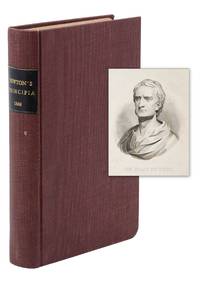
1848140949208New York: Daniel Adee 1848. First American Edition. Very Good. First American edition first printing with date 1848 on title page and publisher's address listed as 107 Fulton-Street. 4 v-viii 9-581 pp. illustrated with engraved frontispiece protected by tissue guard. Recently bound in maroon buckram title label to spine. Very Good with light wear to covers and slight bumping to lower corners; title label beginning to lift at one corner. Band of paper residue to front free endpaper. Light toning and moderate foxing to textblock edges and contents dampstain to outer textblock edge and outer margin throughout. Cohen pp. 347-352.<br /> <br /> <p>The first American edition of the foundational physics text first published in Latin in 1687. Andrew Motte's 1729 translation was reprinted in 1803 and 1819 in Britain but subsequent 19th century editions were printed only in the United States and Germany. The New York-based publisher Daniel Adee deposited a copyright for the Principia in 1846 then printed five issues between 1848 and 1850. A contemporary notice in the Scientific American declared:<br /> <br /> <p>"For a long time the 'Principia' was kept far out of the reach of the mere English Scholar as if Newton had written it exclusively for the classical student and philosopher. It was a scarce book when printed in the Latin language; it is now thanks to the spirit of an American publisher printed in our mother tongue and should find a place in every family library. Daniel Adee unknown
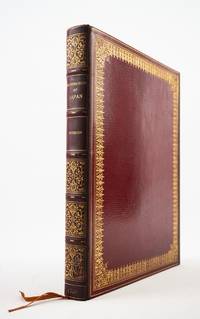
84308102London 1822 Ackermann. Red original cloth very goodsmall folio gold stamped 325p. 25 aquatint illustrations on 13 hand colored copper etched plates many color foldouts 25 x 32.3 cm. THE FIRST & ONLY EDITION. Q U I T E R A R E . . . . ONE OF THE MOST IMPORTANT HAND-COLORED BOOKS . . . ON JAPAN OF THE 19 CENTURY. . SUBTITLE: continued: ".And of the Ceremonies Customary Marriages and Funerals: to Which are Subjoined Observations of the Legal Suicide of the Japanese Remarks on their Poetry an Explanation of their Mode of Reckoning time Particulars Respecting the Dosia Powder the Preface of a Work by Confoutzee Confucius on Filial Piety &c. &c. Translated from the French by Frederic Shoberl." . THE SUPERB COLOR COPPER-ETCHED ENGRAVINGS: . The book contains hand-tinted engravings along with color printed illustrations. . Magnificently copper-engraved color plates showing illustrations of early 19th century Japan which at that time was still closed to Foreigners. Titsingh was chief agent for the Dutch East India Company stationed in Nagasaki. He described feasts & ceremonies of the Japanese court a hand-tinted color foldout plate 98 cm. long ! marriages funerals law poetry chronology furniture earthquakes &c. . TITSINGH'S PRIMARY OBSERVATIONS: He also gave valuable and new first-hand information on Japan based on his personal observations which otherwise were not available elsewhere. The most important book of the time period because Japan was essentially closed to the rest of the world. With lavish hand-colored plates. . A treasure & superb addition to any collection and library. . By and large the most important and most valuable small folio color plate book published on Japan in English of the epoch. . DESHIMA ISLAND: A marvelous primary resource and historic work ! Titsingh was the chief for the Dutch East India Company and was stationed in at Deshima a tiny island reserved for the Dutch in the Nagasaki harbour. Deshima was closed off of to the rest of Japan. . Color photos are posted to our website. . SPECIFIC COPY DETAILS: . COPY 1: The Binding: Bound in full recent red moroccan leather gold-stamped rule lines 5 raised bands marbled endpapers firmly bound and solid. A fine example of excellent workmanship and binding about as good as it can get. . Contents: This copy has a perforated library name on the back side of the color frontispiece and on the right side of the title page barely touching the last 3 letters of "Nagasaki." This is on several other pages and all of the color plates. . There is also a red oval library stamp with "withdrawn" stamped in black on this page. . The title page has the same perforated library name in the right margin partially over the last 3 letters of "Nagasaki.". . There is an identical oval red stamp over the word: "Printed" For R. Ackerman." . The title page has somef eint foxing please see photos posted to our website for details see spine.jpg and images: illus09.jpg through illus14.jpg for this copy details. . Several other pages have occasional feint foxing through out. . Otherwise the contents are bright clean no marks or stains. . The book looks stunningly beautiful in is superb binding. . COPY 2: IN THE ORIGINAL PUBLISHER'S RED CLOTH BINDING: The Binding: . This book is bound in the original 1822 red blind-stamped cloth with gild spine titles and front & back cover embossed & gilt-stamped oval design reading: "THE SOCIETY OF WRITERS TO THE SIGNET." . Below that is the blind-stamped impression of a Chinese man and woman in elaborate robes looks like the publisher didn't know the difference between Japanese & Chinese. . The original cloth spine has been laid over a pebbled red-matching cloth spine. There is some minor loss to the original spine near the head & tail. The top and bottom edges are a bit rubbed and the corners are bent rubbed. There are 2 small lines of what looks like period black writing ink about 1 cm. & 1.5 cm. long by 1-2 mm. wide on the front lower cover. . The Contents: . The title page and hand-colored frontispiece as well as all of the plates and text are bright superbly clean and in fresh condition no transfer or issues. There is a touch of the usual minor bit of 'toning' to the leading edges of the signatures as usual. . See photos on our website illus08.jpg & illus09.jpg. . COPY 3: Binding: Bound in full dark purple morocco leather with elaborate gold-stamped decorations lines blind-stamping five raised bands and marbled endpapers. There is some of the usual cover scuffing scratches and small imperfections. . The inside front cover hinge was reinforced with stiff period marbled paper & a small patch inside the front cover in the left corner. The inside back hinge and marbled papers are completely intact. All edges gilt the book is firmly bound and solid. . The contents: Contents are very bright clean & solid the illustrations are fine with no transfer or issues. There is a tiny bit of the usual minor & feint signature edge 'toning' but not greatly noticible. . This copy has the armoral book plate and Coat-of-Arms of James Garland Albert Jr.1870-1906 an American socialite. . See 3 photos of this binding on our website: illus06.jpg illus07.jpg & illus15.jpg. . REFERENCES: . google: JAMESALBERTGARLANDJR. H. Cordier: JAPONICA Japonica 449 Abbey Travel 557 Tooley 489 . . unknown
003111London: printed by Joseph Moxon: and sold at his shop in Corn-hill at the signe of Atlas 1659. Hardcover. Very Good. Folio. vi 34pp. Engraved architectural title. First English edition a translation of the Nouvelle invention de lever l'eau London 1644 illustrated with the same plates. Nineteenth-century calf repaired. With twenty-six numbered engraved plates and numerous woodcuts in text. Woodcut initials type ornament headpieces. Johnson 64 for engraved architectural title; Norman 417; Cf. Thorndike VII pp. 592-593; Wellcome II p.315; Wing C1527; ESTC R17548. <br/> <br/> London: printed by Joseph Moxon: and sold at his shop in Corn-hill at the signe of Atlas, 1659. hardcover
184542820862<p>FIRST EDITION IN ENGLISH of the Pentateuch translated by a Jew and the first American translation of the Torah. Isaac Leeser was the single most influential Jewish figure in 19th-century America. His many accomplishments include establishing the vernacular sermon as a permanent feature in the American synagogue publishing the first successful American Jewish newspaper and founding the first American rabbinical school.</p><p>"When Leeser commences his public career the scattered Jewish individuals and the members of the congregation in the United States did not number more than from 12000 to 15000. His purpose to mold these into a community was to be achieved in part by the pulpit and in part by the press. … Leeser participated in all Jewish movements. He was the earliest promoter of all the national enterprises—the first congregational union the first Hebrew day-schools the first Hebrew college the first Jewish publication society—and of numberless local undertakings. The 'Occident' acquired a national and even an international reputation; the Maimonides' College of which he was president paved the way for future Jewish colleges in the United States; and his translation of the Bible became an authorized version for the Jews of America" Jewish Encyclopedia.</p><p>"Practically every form of Jewish activity which supports American Jewish life today as either established or envisaged by this one man" and "almost every kind of publication which is essential to Jewish survival was written translated or fostered by him" B. W. Korn.</p><p>Leeser's greatest contribution was his translation of the Bible and these volumes contain the first printing of the first and most important portion of this monumental work Leeser's English translation of the Torah. This translation was not superseded until well into the 20th century.</p><p>Emphasizing that this is an American work Leeser notes in the introduction that "I have to state that I have not looked at a single work issued by English Jews and that hence I have not borrowed a single idea or suggestion from any one of them living or dead."</p><p>Five volumes. Hebrew and English text on facing pages. Finely bound in mottled calf spines gilt a.e.g. Title neatly restored several restored perforated and ink stamps. A very handsome set in a splendid binding.</p> C. Sherman, 5605-6 hardcover
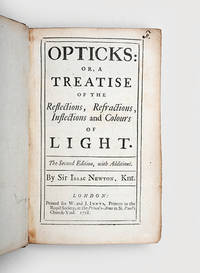
1718184239London: printed for W. and J. Innys 1718. His most important work on light with significant revisions Second edition second issue as usual of this seminal study which "did for light what Newton's Principia had done for gravitation namely place it on a scientific basis" Babson. Newton arrived at most of his innovative ideas on colour by about 1668 and Opticks was largely complete by 1692. However when he first expressed his theories in public they provoked hostile criticism. As a result Newton delayed publication until his most vocal critics - especially Robert Hooke - were dead. By the mid-1710s Opticks was established in Britain as the model for blending theoretical speculation and quantitative experimentation. Newton's aim was not to "explain the properties of light by hypotheses but to propose and prove them by reason and experiments" p. 1. The work's greatest achievement is showing that colour is a mathematically definable property. Newton demonstrates that white light is a mixture of infinitely varied coloured rays and that each ray is definable by the angle through which it is refracted. Other topics include colour circles theories of the rainbow and the phenomenon now known as Newton's rings. The textual revisions for this edition demonstrate the development of Newton's experimentation process. The first edition was published in 1704 followed by the Latin translation of 1706. This edition was the first in octavo format. It had a print run of 750 copies and within that two issues. The scarce first issue is dated 1717 on the title page and includes William Bowyer's name in the imprint; copies are recorded both with and without the cancel A2. The second issue as here has a cancel title dated 1718 and only the names of W. and J. Innys Printers to the Royal Society in the imprint; A2 the first two pages of the "Advertisement" is set as the cancel. Octavo 194 x 123 mm pp. viii 382 2 publisher's advertisement. With 12 folding engraved plates woodcut diagram on p. 330 tables in text woodcut head- and tailpieces and initials. Contemporary panelled calf spine with raised bands and early paper label edges sprinkled red. Ownership label of chemist Karol J. Mysels 1914-1998 laid in; occasional tiny marginal notations in contemporary ink to title page and p. 371 and in later pencil to pp. 323 and 328. Extremities restored spine label chipped and browned boards a little splayed contents toned and generally clean: a very good copy in an attractive period binding. Babson 134; ESTC T18663; Gray 176. hardcover
1874188323Beijing: American Board of Commissioners for Foreign Missions 1874. No man of that day equaled him in idiomatic command of the spoken Mandarin First edition of a sinological milestone: the first translation of the Old Testament into northern colloquial "Mandarin" Chinese the language spoken by most potential Chinese converts. Schereschewsky was also the first sinologist to translate directly from the Hebrew masoretic text and his efforts formed the basis of the 1919 Union Bible the most widely used Bible among Chinese Protestants in the 20th century. Born to Jewish parents in Russian Lithuania Schereschewsky 1831-1906 converted to Christianity the early 1850s. After studying for a time in New York in 1857 he volunteered for missionary work in China arriving in 1860. In 1862 he accepted a position as an interpreter to Anson Burlingame and devoted himself to textual translation spending the next 14 years working on this translation his greatest accomplishment. While earlier missionaries had produced versions of the Bible in classical Chinese and minor southern dialects Schereschewsky's was the first to make the Old Testament accessible to the country's biggest language group. After completing the mammoth project Schereschewsky returned to New York with his family where he was elected Bishop of China. Back in China in the late 1870s he founded St John's College in Shanghai and his skills as a translator excited comment for decades to come. Evaluating Schereschewsky's contributions to the missionary cause in the 1890s his contemporary Henry Blodget observed that "the translation into the Mandarin was made by a master hand seemingly raised up by God for this purpose." According to W. A. P. Martin himself a skilled translator Schereschewsky's Old Testament "stands by itself and is not likely to be superseded. For that task his qualifications were exceptional. By birth a Hebrew of the Hebrews and running over with rabbinic lore he had made himself a Chinese by adoption and by successful study. No man of that day equaled him in idiomatic command of the spoken Mandarin" both quoted in Biographical Dictionary of Chinese Christianity. Of this rare translation WorldCat records only ten copies New York Public Library Columbia Harvard Stanford Kansas Peabody Essex Emory National Library of Australia SOAS and Leiden. This is the only complete copy traced in recent commerce. In 2025 Peter Harrington also sold a presentation copy from the library of General Theological Seminary but that copy lacked the table of contents. Octavo 274 x 170 mm pp. iv title page and table of contents 4 preface 1042 = 1045 page register duplicating p. 124 and pp. 730-1 3 blank. Text in Chinese. Contemporary brown half sheep rebacked with original spine laid down spine with printed title label repurposed from original wrappers green pebble-grain cloth sides. Smattering of old blue ink marks and annotations internally. Binding refurbished and lightly soiled second and third leaves repaired at fore edge without loss to text occasional stains to contents: very good. Darlow & Moule 2683. hardcover
1822ST20877London: Printed for R. Ackermann 1822. First English Edition. 300 x 235 mm. 11 3/4 x 9 1/2". xvi 325 1 pp.Translated by Frederic Shoberl. <br/> Imposing contemporary crimson straight-grain morocco gilt covers with filigree frame with densely massed scrolling fleurons raised bands spine gilt in compartments with radiating viny scrolls surrounded by leaves and annular dots marbled endleaves all edges gilt. WITH 13 HAND-COLORED PLATES in etching and aquatint many after Japanese artworks one folding. Bookplate removed from front flyleaf. Bookseller's ticket of J. L. Thompson & Co Kobe Japan on front pastedown. Abbey Travel 557; Tooley 489; Martin Hardie "English Coloured Books" pp. 113-14. See also E. F. Strange "Japanese Illustration" pp. xxiii-xxiv. Spine and fore-edge of upper board slightly darkened a few minute flakes to lowest spine compartment but the binding extremely well preserved with very lustrous boards. Final 10 leaves slightly creased one repaired marginal tear but still A FINE COPY INTERNALLY exceptionally bright smooth and entirely fresh and clean.<br/> <br/> This generously proportioned production illustrated with 13 vibrant colored plates is a rare European account of Japan during the period in which the country was "closed" to the west offered here in its first English edition. Originally published in French in 1820 "Illustrations of Japan" is comprised of a history and description of the Tokugawa shogunate which Titsingh had translated from the Japanese plus Titsingh's own observations on the language customs and ceremonies of the Japanese people. The present English edition is accompanied by plates in etching and aquatint enhanced with hand coloring. Our author Dutch diplomat Isaac Titsingh 1745-1812 spent 14 years in Nagasaki for the Dutch East India company and between 1779-84 he served as trade director-cum-ambassador travelling to Edo now Tokyo for audiences with the shogun and other high officials in the shogunate. Unlike most of his Western contemporaries Titsingh was open-minded and curious about the people he encountered engaging with their art and culture; in fact art historian and Victoria & Albert Museum keeper Edward F. Strange tells us that Titsingh is the earliest known European collector of Japanese prints of which a number appear in the present volume. Our publisher Rudolph Ackermann 1764-1834 made his living issuing sumptuously illustrated books such as the present volume and was an early adopter of color aquatint and lithography technologies; Hardie writes that he was "the great presiding genius before whose magic wand so many pictorial books sprang into existence." In very attractive period morocco this is a particularly appealing copy of the work free of the foxing and offsetting that often plague copies of this and other large-format color illustrated books. Printed for R. Ackermann unknown
84308103London 1822 Ackerman. Dark purple tooled leather raised bands 25 hand colored aquatint copper etchings in 13 plates many fold-outs very clean 325p. small folio 24 x 31.5 cm all edge gilt gold stamped. VERY NICE COPY. QUITE RARE ! . . . . ONE OF THE MOST IMPORTANT HAND-COLORED BOOKS . . . ON JAPAN OF THE 19 CENTURY. . SUBTITLE: continued: ".And of the Ceremonies Customary Marriages and Funerals: to Which are Subjoined Observations of the Legal Suicide of the Japanese Remarks on their Poetry an Explanation of their Mode of Reckoning time Particulars Respecting the Dosia Powder the Preface of a Work by Confoutzee Confucius on Filial Piety &c. &c. Translated from the French by Frederic Shoberl." . THE SUPERB COLOR COPPER-ETCHED ENGRAVINGS: . The book contains hand-tinted engravings along with color printed illustrations. . Magnificently copper-engraved color plates showing illustrations of early 19th century Japan which at that time was still closed to Foreigners. Titsingh was chief agent for the Dutch East India Company stationed in Nagasaki. He described feasts & ceremonies of the Japanese court a hand-tinted color foldout plate 98 cm. long ! marriages funerals law poetry chronology furniture earthquakes &c. . TITSINGH'S PRIMARY OBSERVATIONS: He also gave valuable and new first-hand information on Japan based on his personal observations which otherwise were not available elsewhere. The most important book of the time period because Japan was essentially closed to the rest of the world. With lavish hand-colored plates. . A treasure & superb addition to any collection and library. . By and large the most important and most valuable small folio color plate book published on Japan in English of the epoch. . DESHIMA ISLAND: A marvelous primary resource and historic work ! Titsingh was the chief for the Dutch East India Company and was stationed in at Deshima a tiny island reserved for the Dutch in the Nagasaki harbour. Deshima was closed off of to the rest of Japan. . Color photos are posted to our website. . SPECIFIC COPY DETAILS: . COPY 1: The Binding: Bound in full recent red moroccan leather gold-stamped rule lines 5 raised bands marbled endpapers firmly bound and solid. A fine example of excellent workmanship and binding about as good as it can get. . Contents: This copy has a perforated library name on the back side of the color frontispiece and on the right side of the title page barely touching the last 3 letters of "Nagasaki." This is on several other pages and all of the color plates. . There is also a red oval library stamp with "withdrawn" stamped in black on this page. . The title page has the same perforated library name in the right margin partially over the last 3 letters of "Nagasaki.". . There is an identical oval red stamp over the word: "Printed" For R. Ackerman." . The title page has somef eint foxing please see photos posted to our website for details see spine.jpg and images: illus09.jpg through illus14.jpg for this copy details. . Several other pages have occasional feint foxing through out. . Otherwise the contents are bright clean no marks or stains. . The book looks stunningly beautiful in is superb binding. . COPY 2: IN THE ORIGINAL PUBLISHER'S RED CLOTH BINDING: The Binding: . This book is bound in the original 1822 red blind-stamped cloth with gild spine titles and front & back cover embossed & gilt-stamped oval design reading: "THE SOCIETY OF WRITERS TO THE SIGNET." . Below that is the blind-stamped impression of a Chinese man and woman in elaborate robes looks like the publisher didn't know the difference between Japanese & Chinese. . The original cloth spine has been laid over a pebbled red-matching cloth spine. There is some minor loss to the original spine near the head & tail. The top and bottom edges are a bit rubbed and the corners are bent rubbed. There are 2 small lines of what looks like period black writing ink about 1 cm. & 1.5 cm. long by 1-2 mm. wide on the front lower cover. . The Contents: . The title page and hand-colored frontispiece as well as all of the plates and text are bright superbly clean and in fresh condition no transfer or issues. There is a touch of the usual minor bit of 'toning' to the leading edges of the signatures as usual. . See photos on our website illus08.jpg & illus09.jpg. . COPY 3: Binding: Bound in full dark purple morocco leather with elaborate gold-stamped decorations lines blind-stamping five raised bands and marbled endpapers. There is some of the usual cover scuffing scratches and small imperfections. . The inside front cover hinge was reinforced with stiff period marbled paper & a small patch inside the front cover in the left corner. The inside back hinge and marbled papers are completely intact. All edges gilt the book is firmly bound and solid. . The contents: Contents are very bright clean & solid the illustrations are fine with no transfer or issues. There is a tiny bit of the usual minor & feint signature edge 'toning' but not greatly noticible. . This copy has the armoral book plate and Coat-of-Arms of James Garland Albert Jr.1870-1906 an American socialite. . See 3 photos of this binding on our website: illus06.jpg illus07.jpg & illus15.jpg. . REFERENCES: . google: JAMESALBERTGARLANDJR. H. Cordier: JAPONICA Japonica 449 Abbey Travel 557 Tooley 489 . . unknown
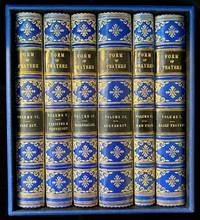
183842121Philadelphia: Printed by Haswell Barrington and Haswell 1838. Hardback. 1st Edition. Gorgeous Period-style gilt-tooled leather. 8vo. <br> Vol. 1: "Part one - Prayers for the Whole Year" siddur. VII 216 216 pages. <br> Vol. 2: "Part 2 - Prayers for Rosh Hashana". 120 121 page 121 page. <br> Vol. 3: "Part 3 - Prayers for Yom Kippur". 4 245 246 1 3 pages. <br> Vol. 4: "Part 4 - Prayers for the Festival of Succot". 175 176 1 pages. <br> Vol. 5: "Part 5 - Prayers for Pesach and for Shavuot". 182 182 pages. <br> Vol. 6 - Prayers for Fast Days". 4 184 186 4 12 pages. <br> Hebrew and English on facing pages parallel pagination. Goldman 36; Singerman 630. <br> The First Complete Machzor Jewish Prayer Book Set for the full year printed in America a stunning complete set. <br> Isaac Leeser 1806-1868 was a central leader of American Jewry in the mid-19th Century the stalwart defender of Orthodoxy against the rise of the Reform movement. He was the head of the Jewish community of Philadelphia and acted as a cantor philosopher publisher and author of many sermons and essays. He was key in the founding Jewish institutions and publications central to the building of Judaism in America including the original Jewish Publication Society the Jewish Sunday School movement and many key translations of Hebrew texts into English. <br> As such he was the first Jew to translate the Hebrew Bible into English publishing The Five Books of Moses in 1845 followed by the full Twenty-Four Books of the Old Testament in 1853. His other major translation is that offered here the first Machzor Prayer Book set for the full year published in America in 1837-1838.Publication in this case was a complex project. Leeser based his new translation on an earlier London edition improving upon both the English translation and the original Hebrew which are presented in facing pages. Once the translation was ready for publication he ordered new Hebrew types from Europe but could not find printers who were familiar with Hebrew–so he taught two Christian printers Hebrew in order to prepare them for the printing. <br> In spite of the difficulties involved all six volumes of the machzor set were published in a total of only 13 months. Leeser marketed his prayer book to audiences in both America and the British Empire and therefore included prayers on behalf of a monarch British and a republican government America. The work also includes a fascinating two-page list of subscribers spanning the Eastern US as well as Jamaica at the end of Vol. VI. The same volume here includes interesting margin notes in pen from a period Rabbi or service leader. <br> With an original run of only 500 sets complete sets of the first edition such as this are very rare. A set sold at Christies in 2006 for $60000.<br> SUBJECTS: Seder -- Liturgy -- Texts. Passover -- Judaism -- Sephardic rite -- Fasts and feasts -- Judaism -- Liturgy -- Texts. Paque -- Liturgie -- Textes. Judai¨sme -- Rite sefardi -- Liturgie -- Textes. Fetes religieuses -- Seder -- Passover -- OCLC: 18532819.<br> All pages professionally washed before rebinding the quality paper very clean and bright with beautiful marbled endpapers. Stunning matching blue leather binding with raised bands and gilt tooling in custom slipcase. Very Good Condition. Rarely found as a complete set. Gorgeous and important. KH-1-1. Philadelphia: Printed by Haswell, Barrington, and Haswell unknown
1954140945130Garden City New York: Doubleday and Company 1954. First Edition. Near Fine/Very Good. First edition stated first printing. Signed by Isaac Asimov on title page and inscribed to a former owner. 224 pp. Bound in publisher's original dark blue leatherette with spine lettered in red red topstain. Near Fine with light rubbing to spine ends pages tanned in a Very Good unclipped dust jacket with sunning to spine and edges light edge wear and light toning. The first book in Asimov's Robot series very uncommon signed. Doubleday and Company unknown
17531512210020London: Royal Society Great Britain; The Royal Society of London for Improving Natural Knowledge: 1753 - 1880; 1960 1753. Hardcover. Good. 0x0x0. A massive collection of the Philosophical Transactions of the Royal Society of London. 109 volume set in 102 volumes. Buckram red cloth. Original volumes begin with 1753 volumes: 48 50 part 1 53-56 59-61 63 67 69 71-74 76-84 86-87 89 93-95 97 135 137 140 160 166 167 169-171 end in 1880 vols. 181 186 191-192 197-198 216 1916; Also includes the Royal Society's facsimile reprint of volumes: 1-47 1665 - 1752 49 51-52 57-58 62 64 66 68 70 Index. University library stamps on front paste down title and some edges. Good binding and covers. Over 1053 plates and maps many are folding. <br> The Philosophical Transactions of the Royal Society was first published in 1665 to promote the discussion and diffusion of scientific knowledge. It was the world's first scientific journal and has lasting and significant influence. In the Philosophical Transactions peer review the scientific method and evidence based research were standardized. The discoveries described in this publication are of fundamental importance to the development of our modern world. Robert Boyle John Wilkins and Robert Hooke were some of the original 17th century English polymaths who established and contributed to the publication. Isaac Newton notably led the society which printed his first paper New Theory about Light and Colours in 1672. Notable articles in the original format contained in this set: Thomas Bayle's: An essay towards solving a problem in the Doctrine of Chances. Vol. 53 1763; Barrington's account of Mozart. Volume 60. 1770; Alessandro Volta. Del modo di render sensibilissima la piu debole Elettricita fia Naturale fia Artificiale. vol. 72. 1782; William Roy. The distance between Greenwich and Paris Observatories. Vol. 1783; Flinders. Concerning the Differences in the Magnetic Needle vol. 95. 1805; Benjamin Franklin. Physical and Meteorological Observations vol. 55. 1765; William Herschel. On the Proper Motion of the Sun and Solar System vol. 73. 1783. Printing and the Mind of Man 227; William Herschel. On Nebulous Stars. Volume 81. 1791; William Herschel. Account of a Comet. Volume 71. 1781. Other notable entries: Henry Cavendish's experiments William Hamilton's observations of an earthquake in Italy John Hunter David Rittenhouse's observation of the transit of Venus William Bartram's naturalist observations in America etc. <br> Please contact us if you would like a full list of contents. Note: Domestic shipping is included. International buyers please contact us before purchase. London: Royal Society (Great Britain); The Royal Society of London for Improving Natural Knowledge: 1753 - 1880; 1960 hardcover
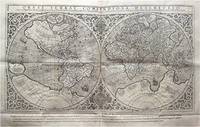
51-4179Geneva: Eustathius Vignon 1587. Folio. 34 x 21 cm. Original contemporary stiff vellum with 6 raised bands. 2 viii 602 10 224pp. Two columns printed in Latin and Greek in the first part and Latin only in the second part. Waterstain in the lower right corner throughout. The map is bound in front of page 1 and is in fine and fresh condition.This unique map was first printed as part of Isaac Casaubon’s edition of Strabo’s Geographia in 1587. In this the first printing there are columns of text underneath rhe map with the heading “Lectori S. P.†In later editions the map was included in the well known Mercator atlas which Rumold compiled. In 1603 the plate developed cracks in the top edge of the plate; two distinct cracks can be seen in the title.The preeminent example of Rumold Mercator’s map of the world first printed in this edition in Geneva in 1587. It is based on Gerard Mercator’s celebrated 1569 world map and was made while Gerard was still alive 1512- 1594. This is the only collectible world map with direct input from Gerard Mercator the greatest geographer of his era. Both his 1538 and 1569 world maps are unobtainable rarities.The present work is a reduced version of the 1569 wall map of the world on which the revolutionary Mercator Projection was introduced. This edition makes the map into a double-hemisphere format rather than the projection style.To the left is the western hemisphere. The prominent bulge in South America a characteristic introduced by Gerard Mercator and evident on his 1569 world map has been retained here. Tierra del Fuego forms part of a gigantic southern continent that continues in the eastern hemisphere. At the north pole two of the four islands that Gerard Mercator thought surrounded the pole are evident. There is also a suggestion of a Northwest Passage via the Straits of Anian.Isaac Casaubon 1559 Geneva —died July 1 1614 London. French classical scholar and theologian who was one of the leading scholars of the era.He was born in Geneva on 18th February 1559 a son of Huguenot parents Arnaud and Jeanne. He was educated at the university in his home town and taught Greek there. His first wife was Marie Prolyst but she and their daughter died. In 1586 in Geneva he married Florence daughter of Henry Estienne and they had seventeen children of whom about half did not survive infancy. His first major published work was on the Greek geographer Strabo and many other works followed. The invitation to come to England seems to have come from Richard Bancroft Archbishop of Canterbury. Isaac was later made a prebendary of Canterbury but died in London on 1st July 1614.References: This first edition not in OCLC. Shirley The Mapping of the World - Early Printed World Maps 1472 - 1700 Nr. 157; van der Krogt Koeman's Atlantes Neerlandici Vol. I 0001:1A; Adams S-1908; Graesse VI:505. Map Koeman Me12; Moreland & Bannister p. 243; Shirley 157; Wagner Northwest Coast 146 . In-folio reliure de l’époque vélin dos à 6 nerfs titre à l’encre dans le caisson de tête. Qq. taches petites déchirures nerfs et coiffe inférieure coins usés. 8-602-2 bl.-8-223 pp. et planisphère à double page rempliée. Trace de mouillure dans la partie inférieure droite sur tout l’ouvrage marquée sur le premier quart puis s’amenuisant et s’estompant jusqu’à la fin du volume. Planisphère en belle condition mouillure à peine visible pas de déchirure impression contrastée. Exemplaire complet des deux pages de titre gravées sur bois à décor identique de cariatides soutenant une couronne et de la planisphère Orbis Terrae Compendiosa Descriptio gravée par Rumold Mercator d’après la carte de son père Gérard Mercator et légendée en latin.Expertise by Christine CHATON Expertise en livres anciens et modernes C.N.E.S. 17100 SAINTES. Geneva: Eustathius Vignon, 1587. hardcover
84308101London 1822 Ackerman. Red tooled morocco leather 325p. 25 hand-colored aquatint copper etchings in 13 plates several fold-outs very clean x-library copy perforations on title & illustrations else clean small folio 22.7 x 29.5 cm.RARE . . . . ONE OF THE MOST IMPORTANT HAND-COLORED BOOKS . . . ON JAPAN OF THE 19 CENTURY. . SUBTITLE: continued: ".And of the Ceremonies Customary Marriages and Funerals: to Which are Subjoined Observations of the Legal Suicide of the Japanese Remarks on their Poetry an Explanation of their Mode of Reckoning time Particulars Respecting the Dosia Powder the Preface of a Work by Confoutzee Confucius on Filial Piety &c. &c. Translated from the French by Frederic Shoberl." . THE SUPERB COLOR COPPER-ETCHED ENGRAVINGS: . The book contains hand-tinted engravings along with color printed illustrations. . Magnificently copper-engraved color plates showing illustrations of early 19th century Japan which at that time was still closed to Foreigners. Titsingh was chief agent for the Dutch East India Company stationed in Nagasaki. He described feasts & ceremonies of the Japanese court a hand-tinted color foldout plate 98 cm. long ! marriages funerals law poetry chronology furniture earthquakes &c. . TITSINGH'S PRIMARY OBSERVATIONS: He also gave valuable and new first-hand information on Japan based on his personal observations which otherwise were not available elsewhere. The most important book of the time period because Japan was essentially closed to the rest of the world. With lavish hand-colored plates. . A treasure & superb addition to any collection and library. . By and large the most important and most valuable small folio color plate book published on Japan in English of the epoch. . DESHIMA ISLAND: A marvelous primary resource and historic work ! Titsingh was the chief for the Dutch East India Company and was stationed in at Deshima a tiny island reserved for the Dutch in the Nagasaki harbour. Deshima was closed off of to the rest of Japan. . Color photos are posted to our website. . SPECIFIC COPY DETAILS: . COPY 1: The Binding: Bound in full recent red moroccan leather gold-stamped rule lines 5 raised bands marbled endpapers firmly bound and solid. A fine example of excellent workmanship and binding about as good as it can get. . Contents: This copy has a perforated library name on the back side of the color frontispiece and on the right side of the title page barely touching the last 3 letters of "Nagasaki." This is on several other pages and all of the color plates. . There is also a red oval library stamp with "withdrawn" stamped in black on this page. . The title page has the same perforated library name in the right margin partially over the last 3 letters of "Nagasaki.". . There is an identical oval red stamp over the word: "Printed" For R. Ackerman." . The title page has somef eint foxing please see photos posted to our website for details see spine.jpg and images: illus09.jpg through illus14.jpg for this copy details. . Several other pages have occasional feint foxing through out. . Otherwise the contents are bright clean no marks or stains. . The book looks stunningly beautiful in is superb binding. . COPY 2: IN THE ORIGINAL PUBLISHER'S RED CLOTH BINDING: The Binding: . This book is bound in the original 1822 red blind-stamped cloth with gild spine titles and front & back cover embossed & gilt-stamped oval design reading: "THE SOCIETY OF WRITERS TO THE SIGNET." . Below that is the blind-stamped impression of a Chinese man and woman in elaborate robes looks like the publisher didn't know the difference between Japanese & Chinese. . The original cloth spine has been laid over a pebbled red-matching cloth spine. There is some minor loss to the original spine near the head & tail. The top and bottom edges are a bit rubbed and the corners are bent rubbed. There are 2 small lines of what looks like period black writing ink about 1 cm. & 1.5 cm. long by 1-2 mm. wide on the front lower cover. . The Contents: . The title page and hand-colored frontispiece as well as all of the plates and text are bright superbly clean and in fresh condition no transfer or issues. There is a touch of the usual minor bit of 'toning' to the leading edges of the signatures as usual. . See photos on our website illus08.jpg & illus09.jpg. . COPY 3: Binding: Bound in full dark purple morocco leather with elaborate gold-stamped decorations lines blind-stamping five raised bands and marbled endpapers. There is some of the usual cover scuffing scratches and small imperfections. . The inside front cover hinge was reinforced with stiff period marbled paper & a small patch inside the front cover in the left corner. The inside back hinge and marbled papers are completely intact. All edges gilt the book is firmly bound and solid. . The contents: Contents are very bright clean & solid the illustrations are fine with no transfer or issues. There is a tiny bit of the usual minor & feint signature edge 'toning' but not greatly noticible. . This copy has the armoral book plate and Coat-of-Arms of James Garland Albert Jr.1870-1906 an American socialite. . See 3 photos of this binding on our website: illus06.jpg illus07.jpg & illus15.jpg. . REFERENCES: . google: JAMESALBERTGARLANDJR. H. Cordier: JAPONICA Japonica 449 Abbey Travel 557 Tooley 489 . . unknown
170751058Cantabrigiæ Cambridge: Typis academicis; Londini London impensis Benj. Tooke 1707. First edition. 8vo. viii 343 1 pp. 19th century full diced calf spine with raised bands gilt lettered black label blind tooled borders to the boards ownership inscription of a William Fitton dated June 1800 to the half title another contemporary owner's inscription - that of a Philip Crampton the date cropped "180" mathemetical annotations to the front and rear leaves and in the margins at intervals within. Joints skilfully repaired some mild soiling to the front and rear leaves an attractive copy. A mathemetical text composed entirely in Latin by Newton and edited by William Whiston who had succeeded him as the Lucasian professor of Mathematics at Cambridge University in 1702. The two had become acquainted during the previous decade and Newton was impressed enough with his acolyte that he invited him to lecture at the university when he was occupied with his other work. It was Whiston who persuaded Newton to publish some of his lectures on algebra but Newton was dissatisfied with Whiston's editing and additions to the text - to the extent that he considered buying the entire stock of the book to prevent its appearance in public. That clearly didn't happen although Newton succeeded in having the book published anonymously and its relative scarcity in commerce suggests a truncated print run. The first ownership inscription is that of the Irish geologist William Fitton 1780-1861. The son of a Dublin lawyer his paternal grandfather had been a mathematical instrument maker. Fitton began his studies at Trinity College Dublin in 1794 and earned his B.A. in 1799 but continued studying there until 1803. He went on to study medicine at Edinburgh University becoming a doctor in 1810 and continued his medical studies in London and Cambridge during the following six years. Fitton's interest in geology and mineralogy were his true passions and after marrying into a wealthy family he was able to devote his studies exclusively to these subjects. He subsequently served as secretary and later as president of the Geological Society published numerous reviews and papers plus a small number of books including 'A Geological Sketch of the Vicinity of Hastings' in 1833. Fitton was awarded the Wollaston Medal the society's highest prize in 1852. The other inscription is almost certainly that of Sir Philip Crampton 1777-1858 an Irish surgeon who awarded many honours and held various senior positions in a long and illustrious career: "elected FRS in 1812. In 1813 he was appointed surgeon-general to the forces in Ireland and he was surgeon to the queen in Ireland a member of the senate of the Queen's University of Ireland and four times president of the Royal College of Surgeons in Ireland in 1811 1820 1844 and 1855. In 1839 he was created baronet" ODNB. Cantabrigiæ [Cambridge]: Typis academicis; Londini [London], impensis Benj. Tooke unknown
101737Philadelphia 1853. . 4to 28 x 23 cm; contemporary calf over boards some wear and edges rubbed tear to lower cover spine skilfully restored in six compartments decorated with elaborate gilt floral detail label to second compartment tape mark to front flyleaf; some browning throughout marbled endpapers. iii 1011 pp.<br /><br /> First edition of the first English translation of the entire Hebrew Bible by a Jew.<br /><br />Built upon Leeser's 1845 translation of the five books of the Torah previous editions published by Jewish translators in England such as Levi and Alexander had simply utilised the King James translation. Leeser's Preface explains that this massive undertaking sprung from 'a desire entertained for more than a quarter of a century since the day he quitted school in his native land to come to this country to present to his fellow-Israelites an English version made by one of themselves of the Holy Word of God'. Readers would now 'have an opportunity to study a version of the Bible which has not been made by the authority of churches in which they have no confidence'.<br /><br />Rabbi Isaac Leeser 1806-1868 was born in Germany and emigrated to America in 1824. The head rabbi of the Synagogue Mikveh Israel in Philadelphia he became America's most influential Jewish writer editor and teacher. He promulgated Jewish culture and religious activity in the United States by providing American Jews with the numerous basic religious texts and conceptual tools they needed.<br /> Philadelphia, 1853. hardcover
195115444THE FOUNDATION TRILOGY FOUNDATION FOUNDATION & EMPIRE & SECOND FOUNDATION Gnome Press 1951 1952 & 1953 respectively first editions first state bindings and full color pictorial dust-wrappers 3 volumes all fine once open the covers snap back in like full color pictorial dust-wrappers with the slightest of wear. FOUNDATION & EMPIRE and SECOND FOUNDATION have bumps at the upper rear fore edge corner tips. This work awarded the HUGO for the best all time series. Editorial note: We would love to say that our dust-wrapper for FOUNDATION is the rare issue with the main character throughout the series name misspelled on the front dust-wrapper flap but ironically this major typo Hari Sheldon for Hari Seldon exists on all first printing dust-wrappers and was not caught until the second printing of this volume. To make matters even a bit more bizarre the misspelled name also exists on the rear flap of FOUNDATION AND EMPIRE. Signed postcard by Asimov laid in. Gnome Press unknown