29 610 résultats
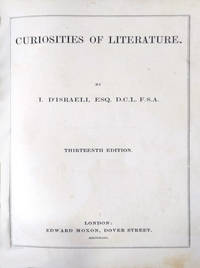
2108PA542<p>By. D.C.L. F.S.A. Thirteenth Edition. Edward Moxon. London. MDCCCXLIII 1843.</p>_x000d_<p>De 24x17 cm. Com xiv 578 págs.</p>_x000d_<p>Encadernação de Asprey e Co.Lt. inteira de pele com nervos e ferros a ouro na lombada nas pastas e seixas onde consta a assinatura do encadernador. Corte das folhas dourado e com <em>fore-edge painting</em> com uma vista de uma cidade do séc. XIX. Com folhas de guarda em papel marmoreado.</p>_x000d_<p>Ilustrado em extratexto com um retrato do autor frontispÃcio gravado datado de 1840 e um fac-simile de um manuscrito de Alexander Pope com uma passagem da sua versão da Ãliada.</p>_x000d_<p>Texto em duas colunas com cercadura de duplo filete.</p>_x000d_<p>A obra contem uma mirÃade de anedotas sobre pessoas e acontecimentos históricos livros invulgares e os hábitos dos coleccionadores de livros. A obra era muito popular e amplamente vendida no século XIX.</p>_x000d_<p>Isaac D´Israeli 1766 1848 foi um escritor estudioso e homem de letras britânico. É mais conhecido pelos seus ensaios pelas suas associações com outros homens de letras e como pai do primeiro-ministro britânico Benjamin Disraeli.</p>_x000d_<p>EN 24x17 cm. xiv 578 pp.</p>_x000d_<p>Bound by Asprey and Co.Lt. in full leather with raised bands and gilt tools on spine gilt framed on the pastedowns and gilt double line frame on the back of the boards which also have the bookbinder's signature. Gilt coloured edges and fore-edge painting with a view of a 19th century city. Marbled endpapers.</p>_x000d_<p>Illustrated <em>hors text</em> with a portrait of the author an engraved frontispiece dated 1840 and a facsimile of a manuscript by Alexander Pope with a passage from his version of the Iliad.</p>_x000d_<p>Double framed text in two columns.</p>_x000d_<p>The work contains various anecdotes about historical characters and events unusual books and the habits of book-collectors. The work was very popular and sold widely in the 19th century.</p>_x000d_<p>Isaac D´Israeli 1766 - 1848 was a British writer scholar and man of letters. He is best known for his essays his associations with other men of letters and as the father of British Prime Minister Benjamin Disraeli.</p> M-17-B-12 hardcover
1720102659Amsterdam, Humbert, 1720, , 2 vol. in-12 : XV-[1]-228 pp. + [2] pp. 331 à 583 pp. [17] pp. 12 pl, Demi-basane marbrée havane de Lobstein-Laurenchet, dos à nerfs orné de caissons dorés, pièce de titre rouge, Édition originale de la traduction depuis l'anglais par M. Coste, faite sur la seconde édition augmentée par l'auteur. Elle est illustrée de 12 planches dépliantes, reliées in fine du 2nd volume. La pagination est continue sur les 2 tomes mais chacun possède sa propre page de titre. Newton commence la rédaction de ce traité alors qu'il est encore étudiant à Cambridge et en termine la rédaction autour de 1665-1666. Il y explore notamment le spectre des couleurs, sa nature, ses réactions et ses différentes modifications autant par le prisme de la théorie mathématique que celui de l'expérimentation. L'ouvrage connaît une grande répercussion à sa publication tant chez ses détracteurs que ses admirateurs et sera maintes fois réédité et traduit. Petits frottements, restaurations de l'angle inférieur du f. *2 au premier vol, dans l'angle supérieur des ff. O7 et O8, aux pl. 2, 4, 8, 10 et 12, quelques rousseurs et taches éparses. Ex-libris manuscrits Esparron et P. Morel au titre . Babson, 139; PMM, 172; Gray, 186; Dictionary of National biography, XII, p. 275 : "His translations were of durable service and helped to introduce english thought to the French of the eighteenth century." Couverture rigide
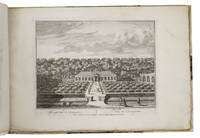
1731ABC_46670Amsterdam 1731. Small oblong folio 22 x 32.5 cm. Hendrik de Leth 20th-century half vellum marbled paper sides. With 26 numbered engraved prints including the title-page. 26 engraved ll. Second edition of a fine series of 26 beautiful and delicate etchings of the sumptuous 17th-century Heemstede estate near Utrecht not in the municipality Heemstede including a bird's-eye view of the entire estate and detailed views of the gardens house and other buildings fountains sculpture hedges and trellises all drawn and etched by Isaac van Moucheron. It also shows visitors strolling through the gardens horses coaches dogs and gardeners at work with pruning saws. "The fame of the gardens of Heemstede near Houten in the province of Utrecht was and still is considerable. . a highlight in Dutch garden art." Anglo-Dutch garden. Each print has a caption in Dutch and French the bird's-eye view with a key to five numbered features.With the bookplate of the Dutch entomologist Frans.Titus. Valck-Lucassen 1885-1939 on the front paste-down. Binding slightly worn and the vellum a little scuffed especially around the spine and the lower corners on the fore-edge vellum slightly dust-soiled. Leaves very slightly browned and slightly frayed some minor marginal staining never affecting the images overall in good condition.l Hollstein Dutch & Flemish XIV p. 94 nos. 10-35; cf. Anglo-Dutch garden pp. 193-198; STCN 4 copies of the 1st ed. incl. 2 incompl.; Springer Bibl. overzicht p. 47 1st ed. hardcover
170208586Oxoniae Oxford: Sheldonian Theatre 1702. First Edition. The first astronomical book on gravitational principles; important because it contains the first publication of Isaac Newton's Lunar Theory "Lunae Theoria" pp. 332-336. The rather lengthy Preface contains Newton's Classical Scholia." Folio 14 1/8" x 9 1/2" 124942. bound in contemporary full paneled calf rebacked to style with red leather label on spine; with a plethora of diagrams in the text and a fine engraving on the title page. A lovely wide-margined copy printed on laid paper. First several leaves with light marginal dampstain affecting only a few words of text; small chip at foot of FFEP; discreet archival repair to gutter and lower part of title page; page 237 with light marginal soiling. David Gregory 1659 - 1708 was a close friend and associate of Isaac Newton. Babson 71. <br/><br/> Sheldonian Theatre hardcover books
16094708Full ruled contemporary vellum; red morocco label to spine. Gilt armorial 'Martis et artis honos' to boards. 60 1080 32 151 pages. Wear to fore edge of rear board. Dibdin p. 350: "A most excellent edition". Typis Wechelianis apud Claudium Marnium & haeredes Iohannis Aubrii hardcover
18285934New York: J & J Harper. Good. 1828. First Edition. Hardcover. This is a rare and interesting book relating to the western frontier of the early nineteenth century-- Isaac Reed was born in Granville NY in 1787 and after trying teach and the law he turned to ministry. Reed went West in 1816 and and preached on a circuit in Kentucky before removing to Indiana. He traveled throughout southern Indiana and was in charge of churches in Indianapolis and Bloomington. The rear joint is partially split but still holding well. There is some old staining to the title page and scattered foxing elsewhere. This book is bound in the original publisher's leather spine rear joint starting and paper covered boards. It is contained in a new green cloth tray case with a leather spine label. The last leaf is unpaged and contains errata information. Ref: Howes R126 b Buck Banta Indiana Authors not in Sabin. "Observations on people manners and conditions in frontier Indiana Illinois and Kentucky by an intelligent itenerant preacher. "--Howes R126b. "The Christian Traveler published immediately after his return to the East describes his travels and adventures in Indiana and Kentucky. It is a narrative of considerable charm and historical importance and is now quite rare."--Banta Indian Authors and Their Books. Reed was a Presbyterian minister in Indiana but his labors occasionally took him into eastern Illinois."--Buck. Not in Sabin ; 12mo 7" - 7½" tall; 242 pages . J & J Harper hardcover
82278London Published by R. Ackermann 1820. Folio. XIV 2 178 s. 24 hand-coloured aquatint views by R. Havell and T. Sutherland after M. Schuetz. Folding map. Contemporary full calf. Spine gilt. Gilt border on covers. Rebacked retaining old spine. Bookplate of Madame de Gablenz née de Stieglitz. . unknown
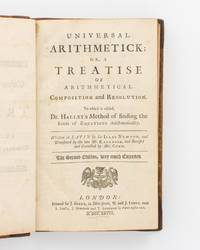
1728117773London: Printed for J. Senex W. and J. Innys J. Osborne and T. Longman 1728. 2nd Edition. Hardcover. Very Good. London Printed for J. Senex W. and J. Innys J. Osborne and T. Longman 1728 'Second Edition very much Corrected'/ 1720 first edition in English/ 1707 first edition in Latin. Octavo iv half-title and title leaves versos blank iv 271 1 publisher's advertisement pages plus 8 full-page plates. Early full polished calf decorated in blind on the sides later expertly recornered and rebacked retaining the original gilt-decorated spine with two contrasting leather title-labels; leather a little unevenly discoloured and rubbed with minor loss to the polished surface of the spine; scattered foxing moderate in places; plates offset; tiny blemish to the bottom margin of one plate a paper flaw well clear of the printed surface; trifling signs of age and use a shallow crease to the bottom corner-tip of the last ten leaves is about the extent of it; overall an excellent copy. The eight plates normally found with a small folding section are bound into this copy in an unfolded state by the simple expedient of having the narrow left-hand border of the printed surface of each plate deep in the gutter. The border is visible in four instances and although the border cannot be seen on the other four plates all of the other printed plate surface is visible. Interestingly the plates show no evidence of ever having been folded. Babson 202. Printed for J. Senex, W. and J. Innys, J. Osborne, and T. Longman hardcover
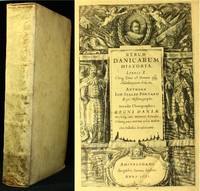
60086Amsterdam Ioannis Ianssoni 1631. Folio. Grav. titelblad 14 812 52 s. fyra utvikbara grav. kartor. Ett helsides graverat porträtt pÃ¥ författaren vid 59 Ã¥rs Ã¥lder i dedikationen. Kartorna löst bilagda Danmarkskartan lagad och uppfodrad med stor bildförlust. Ã…terkommande brunfläckiga sidor emellanÃ¥t kraftigt enstaka smÃ¥fläckar och enstaka understrykningar med rödkrita. Svag fuktrand mot slutet. Samtida pergamentband. Med professor Carl Aurivillius namnteckning pÃ¥ frampärmens insida daterad 1783. Ur Gustaf d’Albedyhlls bibliotek med hans exlibris variant 1 med devisen Mors sine musis vita och ur Ericsbergs bibliotek med Carl Jedvard Bondes exlibris klistrat över d’Albedyhlls. Warmholtz 2775. Bibl. danica III sp. 13. Thesaurus 596. Carlander II 499 & III 88 & 564ff. Ej i Nordenskiöld collection. Mycket sällsynt med kartorna. BÃ¥de Bibl. danica och Thesaurus anger tre kartor. Kartorna är en Danmarkskarta en Islandskarta en över hertigdömet Holstein och en över Fyn. Islandskartan av Carolous Flandro är densamma som sedan kom till användning först i Janssons och sedan i Blaeus stora Atlaser. StÃ¥tligt exemplar av den nya danska rikshistorien pÃ¥ latin vilken skulle ersätta Saxos krönika som internationell gÃ¥ngbar dansk historia. Detta är första delen vilket var allt som publicerades i samtiden. Den andra delen trycktes först 1740. Jobbet att fÃ¥ fram en ny rikshistoria pÃ¥ latin hade pÃ¥gÃ¥tt i Danmark sedan mitten av 1500-talet efter att publicerandet av Johannes Magnus svenska krönika 1554 gjort behovet märkbart. Ett stort antal danska historiker och rikshistoriografer hade i tur och ordning engagerats Svaning Vedel Krag Lyschander m.fl. men ingen blev färdigt. Arild Huitfelds stora historieverk som utkom under denna tid är skriven pÃ¥ danska. Slutligen utsÃ¥g man tvÃ¥ rikshistoriografer Pontanus och Johannes Meursius och under 1630-talet publicerades inte mindre än tvÃ¥ olika danska historieverk varav Pontanus är det största. Se Skovgaard-Petersen för alla turerna kring detta. Johannes Isaac Pontanus 1571-1639 frÃ¥n Helsingör studerade bÃ¥de Leiden och i England. Han blev nära vän med den inflytelserika Arild Huitfeldt och jobbade ett tag som assistent Ã¥t denne vilket skulle fÃ¥ stor betydelse för hans danska historia. Han blev 1604 professor i Harderwijk i Holland där han stannade till sin död och där han utgav en stor mängd verk i historia och geografi. 1618 blev han sÃ¥ även dansk rikshistoriograf med uppgiften att skriva den danska historien pÃ¥ latin vars första del skulle ta 13 Ã¥r i ansprÃ¥k. Resten av livet jobbade han med fortsättningen perioden 1448-1588 vilken han fullbordade strax före sin död. Denna del utgavs dock inte förrän 1740 av E. J. von Westphalen i â€Monumenta inedita rerum Germanicarumâ€. Carl Aurivillius 1717-86 var professor i österländska sprÃ¥k i Uppsala bibelöversättare och medlem i Gustav III:s bibelkommission. Hans bibliotek sÃ¥ldes pÃ¥ tvÃ¥ auktioner i Uppsala 1787 resp. 1788. Envoyén Gustaf d’Albedyhlls 1758-1819 boksamling ärvdes av hans son Carl Gustaf Eichstedt d’Albedyhll 1800-56 som därigenom tillsammans med egna förvärv byggde upp en mycket stor samling f.f.a. inom nordisk historia. Denna samling skulle sÃ¥lts pÃ¥ auktion 1843 men köptes i stället i sin helhet av Carl Jedvard Bonde f.ö. samma Ã¥r som denne efterträdde d’Albedyhll som överceremonimästare. unknown
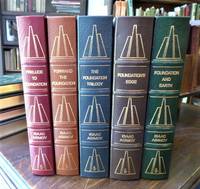
2005014724Norwalk Connecticut: The Easton Press 2005. FIVE VOLUMES. With uniformly-printed and designed covers. "Prelude To Foundation" is bound in deep red leather; "Foundfation and Earth" in green; "The Foundation Trilogy" in blue; "Forward the Foundation" in umber brown; and "Foundation"s Edge" in dark brown. All edges are gilt. Sewn-in bookmarks. All have full-page color frontispieces. A lovely finely-bound set. First published as a series of short stories in 1942-50 then into three collections as the "Trilogy" in 1951-53. Subsequently two sequels "Edge" and "Foundation and Earth" and twp prequels Prelude" and "Forward" were added. The "Trilogy" won the one-time Hugo Award for "Best All-Time Series" in 1966. See photos. Collected Edition. Full Leather Various Colors. Fine/No Dudst Jacket. Royal Octavo. The Easton Press hardcover books
1957263944New York: Doubleday 1957. First. hardcover. near fine/good. 8vo yellow cloth d.w. New York: Doubleday 1957. First Edition.<br/><br/> Presentation copy signed in full. The dust jacket presents well but is extensively re-inforced on the verso with a large chip on the back panel.<br/><br/> Doubleday unknown books
183067190Leeser's First Issued Work LEESER Isaac translator. JOHLSON Joseph author. Instruction in the Mosaic Religion. Translated from the German of J. Johlson Teacher of an Israelitish School at Frankford on the Maine. By Isaac Leeser Reader of the Portuguese Jewish Congregation in Philadelphia. Philadelphia: Adam Walde 5590 1830. First American edition and first edition in English. Octavo 8 1/4 x 5 1/8 inches; 210 x 131 mm. viii 139 1 blank pp. Full contemporary sheep. Red morocco spine label. Marbled endpapers. Page 35 with a large closed tear professionally repaired with no loss of text. Internally very clean. Overall a very good copy. "Leeser brought with him to Philadelphia his translation of J. Johlson's Instruction in the Mosaic Religion. He had it published there in 1830 appropriately dedicated to his uncle Zalman Rehine. The book is a catechism published in Germany and translated and adapted by Leeser for "the instruction of the younger . of Israelites of both sexes who have previously acquired some knowledge of the fundamental part . of their religion." Leeser undertook its publication because there was a great scarcity of elementary textbooks for Jewish children. It is significant that this Instruction in the Mosaic Religion Leeser's first issued work is a textbook of religious instruction for the young for though Leeser attained distinction as an author translator editor and a national leader of the American Jewish community he considered himself first and foremost an educator." The Jewish Virtual Library "Leeser's career as a translator also began in Philadelphia in 1830 with the publication of his rendering from German of J. Johlson's Instruction in the Mosaic Religion. Leeser as part of his ongoing efforts to contribute to the development of Jewish education and culture in America translated a number of important works into English from German Spanish French and Hebrew. " Penn Libraries. Rosenbach 321. HBS 67190. $3000 Adam Walde unknown books
183067190Philadelphia: Adam Walde 1830. LEESER Isaac. . JOHLSON Joseph author. Instruction in the Mosaic Religion. Translated from the German of J. Johlson Teacher of an Israelitish School at Frankford on the Maine. By Isaac Leeser Reader of the Portuguese Jewish Congregation in Philadelphia. Philadelphia: Adam Walde 5590 1830.<br> <br> First American edition and first edition in English. Octavo 8 1/4 x 5 1/8 inches; 210 x 131 mm. viii 139 1 blank pp.<br> <br> Full contemporary sheep. Red morocco spine label. Marbled endpapers. Page 35 with a large closed tear professionally repaired with no loss of text. Internally very clean. Overall a very good copy.<br> <br> "Leeser brought with him to Philadelphia his translation of J. Johlson's Instruction in the Mosaic Religion. He had it published there in 1830 appropriately dedicated to his uncle Zalman Rehine. The book is a catechism published in Germany and translated and adapted by Leeser for "the instruction of the younger . of Israelites of both sexes who have previously acquired some knowledge of the fundamental part . of their religion." Leeser undertook its publication because there was a great scarcity of elementary textbooks for Jewish children. It is significant that this Instruction in the Mosaic Religion Leeser's first issued work is a textbook of religious instruction for the young for though Leeser attained distinction as an author translator editor and a national leader of the American Jewish community he considered himself first and foremost an educator." The Jewish Virtual Library<br> <br> "Leeser's career as a translator also began in Philadelphia in 1830 with the publication of his rendering from German of J. Johlson's Instruction in the Mosaic Religion. Leeser as part of his ongoing efforts to contribute to the development of Jewish education and culture in America translated a number of important works into English from German Spanish French and Hebrew. " Penn Libraries.<br> <br> Rosenbach 321.<br> <br> HBS 67190.<br> <br> $3000. Adam Walde unknown
1760RW1581Geneva:: Sumptibus Cl. & Ant. Philibert 1760. 1760. 3 volumes. 4to. xxxii 548; viii 422; 8 xxviii 703 1 pp. Half-titles woodcut title vignettes title printed in red & black woodcut head & tail pieces numerous mathematical figs. index. Contemporary mottled calf raised bands gilt-stamped spines maroon & green spine labels; occasional browning. Ownership signature "Nolland avocat"auvcat. An excellent set. Very good . Second Jesuit edition emended and corrected based on the text of the third London edition of the Principia. This version is valued for its excellent annotations and copious commentary which is nearly the same length as the Principia itself. It contains Newton's Dedication to the Royal Society; Prefaces to the first second and third editions and Roger Cotes's Preface. In addition the Jesuits' edition of the Principia is prized for the inclusion of the important treatises on the theory of the tides: Daniel Bernoulli's Traite sur le Flux et Reflux de la Mer Colin MacLaurin's De Causa Physica Fluxus et Refluxus Maris and Leonardo Euler's Inquisitio Physica in causam Fluxus ac Refluxus Maris. These three works gained the prize given by the Royal Academy of Sciences in 1724 for resolving tidal problems relating to the theory of gravity. They represent the most significant discovery concerning tidal mechanics between the publication of the Principia and the discoveries of Laplace. REFERENCES: Babson 31; Gray 14; Wallis 14. Sumptibus Cl. & Ant. Philibert, 1760. hardcover books
1760SW1581Geneva:: Sumptibus Cl. & Ant. Philibert 1760. 1760. 3 volumes. 4to. xxxii 548; viii 422; 8 xxviii 703 1 pp. Half-titles woodcut title vignettes title printed in red & black woodcut head & tail pieces numerous mathematical figs. index. Contemporary mottled calf raised bands gilt-stamped spines maroon & green spine labels; occasional browning. Ownership signature "Nolland avocat"auvcat. An excellent set. Very good . Second Jesuit edition emended and corrected based on the text of the third London edition of the Principia. This version is valued for its excellent annotations and copious commentary which is nearly the same length as the Principia itself. It contains Newton's Dedication to the Royal Society; Prefaces to the first second and third editions and Roger Cotes's Preface. In addition the Jesuits' edition of the Principia is prized for the inclusion of the important treatises on the theory of the tides: Daniel Bernoulli's Traite sur le Flux et Reflux de la Mer Colin MacLaurin's De Causa Physica Fluxus et Refluxus Maris and Leonardo Euler's Inquisitio Physica in causam Fluxus ac Refluxus Maris. These three works gained the prize given by the Royal Academy of Sciences in 1724 for resolving tidal problems relating to the theory of gravity. They represent the most significant discovery concerning tidal mechanics between the publication of the Principia and the discoveries of Laplace. REFERENCES: Babson 31; Gray 14; Wallis 14. Sumptibus Cl. & Ant. Philibert, 1760. hardcover books
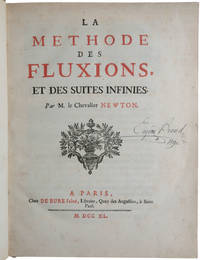
17405802Paris: De Bure l'aine 1740. First edition. <p>First edition in French of Newton's first exposition of his fluxional calculus translated with a long and impotant preface by the celebrated naturalist Comte de Buffon. Originally written in 1671 in Latin this was Newton's first comprehensive presentation of his method of fluxions which according to Hall 'might have effected a mathematical revolution in its own day' Philosophers at War pp. 65-6. It should properly be placed first in the great trilogy of Newton's major works: Fluxions Principia 1687 and Opticks 1704.</p>. BUFFON'S TRANSLATION OF NEWTON'S EXPOSITION OF CALCULUS. <p>First edition in French of Newton's first exposition of his fluxional calculus translated with a long and important preface by the celebrated naturalist Comte de Buffon. Originally written in 1671 in Latin this was Newton's first comprehensive presentation of his method of fluxions which according to Hall 'might have effected a mathematical revolution in its own day' Philosophers at War pp. 65-6. It should properly be placed first in the great trilogy of Newton's major works: Fluxions Principia 1687 and Opticks 1704. Newton's Methodus fluxionum remained unpublished until its English translation by John Colson in 1736. In it he presents a method of determining the magnitudes of finite quantities by the velocities of their generating motions. At its time of preparation it was Newton's fullest exposition of the fundamental problem of the calculus in which he presented his successful general method. Newton prepared this treatise just before his death. The autograph manuscript which survives in Cambridge University Library was entrusted to Henry Pemberton after Newton's death but he did not publish it. John Colson 1680-1760 based his translation on a copy of Newton's original manuscript made by William Jones. Both Newton's manuscript and Jones's copy lack a title page and it is unknown what title if any Newton gave to the manuscript. The title 'De methodus fluxionum' originates with Colson. In the preface Colson writes "I thought it highly injurious to the memory and reputation of our own nation that so curious and useful a piece should be any longer suppressed." Buffon translated Colson's edition in 1737 and added his lengthy preface the following year. The most interesting part of the preface is that dealing with the conception of the infinite and the metaphysical errors to which it leads. This includes a discussion of Berkeley's The analyst 1734 which oddly he criticizes although Berkeley's conclusions are very similar to his own.</p> <br /> <p>Provenance: Eugène Brand signature on title dated 1890.</p> <br /> <p>Newton wrote three accounts of the calculus. The composition of the first a tract entitled 'De analysi per aequationes numero terminorum infinitas' resulted from Newton's reception from Isaac Barrow in the early months of 1669 of a copy of Mercator's Logarithmotechnia a work which contained the series for log1 x. The work in which Newton demonstrated his much more general methods of infinite series was not published until 1711 when William Jones included it along with a number of other tracts in his Analysis per quantitatum series. In 'De analysi' however Newton "did not explicitly make use of the fluxionary notation or idea. Instead he used the infinitely small both geometrically and analytically in a manner similar to that found in Barrow and Fermat and extended its applicability by the use of the binomial theorem. . It will be noticed that although the work of Newton contains the essential procedures of the calculus the justification of these is not clear from the explanation he gave. Newton did not point out by what right the terms involving powers of o were to be dropped out of the calculation any more than Fermat or Barrow . His contribution was that of facilitating the operations rather than of clarifying the conceptions. As Newton himself admitted in this work his method is 'shortly explained rather than accurately demonstrated'" Boyer The Concept of Calculus p.191.</p> <br /> <p>It was first in 'Methodus fluxionum' that "Newton introduced his characteristic notation and conceptions. Here he regarded his variable quantities as generated by the continuous motion of points lines and planes rather than as aggregates of infinitesimal elements the view which had appeared in 'De analysi'. . In the 'Methodus fluxionum' Newton stated clearly the fundamental problem of the calculus: the relation of quantities being given to find the relation of the fluxions of these; and conversely" ibid. pp. 192-3.</p> <br /> <p>In Newton's third exposition De quadratura which was composed some twenty years after 'Methodus fluxionum' and published as an appendix to the Opticks "Newton sought to remove all traces of the infinitely small" ibid.</p> <br /> <p>"It was often lamented that the world had had to wait so many years to see Newton's masterpiece on fluxions. It is astonishing to realize that publication sixty years beforehand would have changed the history of the calculus and would have avoided for Newton any controversy over priority. In 1736 all the results contained in Newton's treatise were well known to mathematicians. However it was too concise for a beginner and Colson added almost 200 pages of explanatory notes. His commentary contributed to the establishment of a kinematical approach to the problem of foundations. In his explanatory notes Colson presents the 'geometrical and Mechanical Elements of Fluxions'. He writes:</p> <br /> <p>'The foregoing Principles of the Doctrine of Fluxions being chiefly abstracted and Analytical. I shall here endeavour after a general manner to shew something analogous to them in Geometry and Mechanicks: by which they may become not only the object of the Understanding and of the Imagination which will only prove their possible existence but even of Sense too by making them actually to exist in a visible and sensible form'.</p> <br /> <p>"Colson was convinced that by using moving diagrams it is possible to exhibit 'Fluxions and Fluents Geometrically and Mechanically . so as to make them the objects of Sense and ocular Demonstration'. The motivation for using the geometrical and mechanical elements of fluxions is clearly that of guaranteeing an ontological basis to the calculus; in fact:</p> <br /> <p>'Fluents Fluxions and their rectilinear Measures will be sensibly and mechanically exhibited and therefore must be allowed to have a place in rerum natura'.</p> <br /> <p>"Colson's approach to the calculus is representative of a whole generation of British mathematicians: his 'sensibly exhibited rectilinear measures' of fluxions are a naive anticipation of Maclaurin's kinematic definitions of the basic concepts of the calculus" Guicciardini The Development of Newtonian Calculus in Britain 1700-1800 pp. 56-57.</p> <br /> <p>"In his preface . Colson noted:</p> <br /> <p>'The chief Principle upon which the Method of Fluxions is here built is. taken from the Rational Mechanicks; which is That Mathematical Quantity particularly Extension may be conceived as generated by continued local Motion; and that all Quantities may be conceived as generated after a like manner. Consequently there must be comparative Velocities of increase and decrease during such generations whose Relations are fixt and determinable and may therefore . proposed to be found.'</p> <br /> <p>"Thus a line or a curve was seen as generated by a continuously moving point a surface by the motion of a line and a solid by the motion of a surface. After defining fluxions fluents and moments Newton went on to show how within this framework significant results could be derived. Following an introduction in which it was shown how equations could be solved with the use of infinite series seven major problems were considered:</p> <br /> <br /> From the Following Quantities fluents given to find their fluxions.<br /> From the given Fluxions to find the Flowing Quantities.<br /> To determine Maxima and Minima of Quantities.<br /> To draw Tangents to Curves.<br /> To find the Quantity of Curvature in any Curve.<br /> To find the Quality of Curvature in any Curve.<br /> To find any number of Curves that may be squared"<br /> <br /> <p>Gjertsen Newton Handbook p. 158.</p> <br /> <p>"Buffon did start his scientific career as a Newtonian. He agreed that science should search for nature's laws and that those laws should be as simple and as universal as possible. Buffon's strong stance in favor of an orthodox Newtonianism was most obvious during his academic polemics with Alexis Clairaut. Buffon also published translations of two English books: Stephen Hales's Vegetable Staticks 1735 and Newton's Treatise on Fluxions 1740. The young man who wrote the prefaces to these books praised the experimental spirit of the English. But to what extent did these texts in fact express Buffon's supposed Newtonian position .</p> <br /> <p>"The case of the preface to Newton's Fluxions 1740 was a different matter since it appeared to be a sign of allegiance both to Newton and to mathematics in the guise of the calculus. But in fact Buffon's preface while acknowledging the perfect clarity of Newton's ideas developed a metaphysical critique of the concept of the infinite that had been closely tied to the practice of geometry. Buffon asserted that our daily experience by means of sensation is restricted to the limited the finite-and therefore that the arithmetical or geometrical infinite had no actual existence. The preface to the Fluxions far from being a sign of Buffon's loyalty to mathematical conceptions of science instead stressed the lack of reality of mathematical ideas. Some of these strong statements would later be developed near the end of the 'Premier discours' of the Histoire naturelle" Hoquet pp. 39-41.</p> <br /> <p>"In his preface Buffon rewrote the history of the calculus - drawing inspiration largely from a book that Fontenelle had published in 1727 Élémens de la géométrie de l'infini - in which he sided strongly with Newton against Leibniz. He was rightly criticized for his lack of objectivity and he became closely tied with English scholars whose point of view he blindly adopted. In France furthermore he became involved with Clairaut Maupertuis and Voltaire in a battle in defense of Newton. His translation and preface must be viewed from his perspective - historical objectivity was not his main concern .</p> <br /> <p>"The debate on infinity tells us something about Buffon's intellectual temperament . At the end of the seventeenth century a lengthy evolution of ideas had led to the Newtonian conception of an infinite time and space and therefore an infinite universe . Calculus gave a new topicality to this philosophical debate since it raised the question of whether the infinitely small quantities manipulated by the new calculus really existed. Leibniz did not believe so . In 1727 Fontenelle defended their real existence and Buffon seemed at first to have accepted his argument. He now attacked Fontenelle without naming him .</p> <br /> <p>"Buffon rejected Fontenelle's conclusion mainly because he did not differentiate between geometrical and metaphysical infinities. 'The idea of infinity' he said 'is only an idea of absence and has no concrete representation.' Even 'space time and duration are not real Infinities.' Likewise 'there is no number that is at present Infinite or infinitely small or smaller or bigger than an Infinity etc.' Because 'Numbers are no more than representations and never exist independently of the things they represent' they do not have a 'real existence' and things themselves cannot be infinite .</p> <br /> <p>"The direct consequence of this philosophy was that mathematics does not teach us anything about reality. More precisely - and here Buffon distanced himself radically from Fontenelle - mathematics does not have its own reality. Fontenelle gives an intellectual reality to numbers and geometrical figures independent of all physical and metaphysical reality. For Buffon there was only physical reality. Thus mathematics was only a tool practical even indispensable but nothing more .</p> <br /> <p>"The last argument in which Buffon intervened was the one that the idealistic philosopher Berkeley had provoked by attacking the metaphysical foundations of calculus .it is clear that Buffon addressed it only to defend his friend the English doctor and mathematician James Jurin. Regardless of what he said Buffon certainly had not read Berkeley's book The analyst 1734 attentively otherwise he would have seen that Berkeley's criticisms of the status of the infinitely small corresponded exactly to his own although they were based on an extremely different metaphysics. As with Leibniz the fundamental philosophical differences prevented Buffon from recognising what they had in common. His attack on Berkeley was more satire than philosophical discussion. By intervening so lightly into a serious debate Buffon exposed himself to criticism. The interesting thing about this episode is that it shows his friendship with James Jurin and suggest that it was Jurin who had advised him in the Leibniz-Newton controversy" Roger pp. 34-38.</p> <br /> <p>Babson 173; Macclesfield 1533; Wallis 236. Hoquet 'History without Time. Buffon's natural history as a nonmathematical physique Isis 101 2010 pp. 30-61. Roger Buffon: A Life in Natural History 1997.</p> <br/> <br/> 4to 255 x 196 mm pp. xxx 4 errata and privilege 148 title printed in red and black woodcut figures in text. Contemporary quarter-morocco and marbled boards spine ruled and in gilt with red lettering-piece a little rubbed joints starting. De Bure l'aine unknown
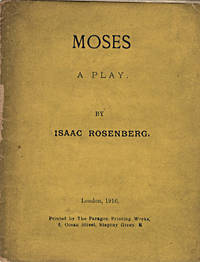
1916WRCLIT64204London: Printed by the Paragon Printing Works Stepney Green 1916. 12mo. Original printed yellow wrappers. Wrappers darkened and a bit frayed along spine with narrow chips to the fold otherwise a very good copy of a scarce and fragile book. Half morocco slipcase and chemise. First edition of the poet/painter's third separate publication like its predecessors printed at his own expense and privately distributed. As often this crudely printed pamphlet bears some manuscript corrections in the text. The title is slightly deceptive as a small group of poems including war poems are appended. With a presentation inscription inside the front wrapper from Sydney Schiff to Lydia Sherwood January 24 1926. Schiff 1868-1944 translator of Proust patron of Joyce and Wyndham Lewis and friend of Eliot and Max Beerbohm published novels under the pseudonym "Stephen Hudson." His wife Violet nee Beddington was the younger sister of Wilde's friend Ada Leverson "The Sphinx". Rosenberg met Schiff in the spring of 1915. "Like Edward Marsh Schiff became Rosenberg's 'absentee patron' in the sense that he put no pressure on him to produce works in return for occasional support and was available whenever Rosenberg needed him . His new friendship with Schiff also contributed to his growing consciousness of being a Jew. They communicated easily . To Schiff Rosenberg could say things which would have been inappropriate to Marsh. ." "Moses" evolved from Rosenberg's exposure to anti-Semitism during his military service. Schiff was an important Jewish friend at the time and was instrumental in helping distribute copies of the play in literary circles. Lydia Sherwood d. 1989 was a British actress both stage and film from the 1920s to 1960s. See Joseph Cohen JOURNEY TO THE TRENCHES: THE LIFE OF ISAAC ROSENBERG 1890 - 1918 New York 1975. REILLY WWI p.279. Printed by the Paragon Printing Works, Stepney Green unknown books
19603899GOLDMANN WILHELM 1960. 1. hardcover. Roboter-Foundation Sirmkovrilo! GOLDMANN, WILHELM hardcover
19831905HEYNE WILHELM 1983-86. 1. softcover. Isaac Asimov präsentiert: 4022402340744159421542744332 HEYNE, WILHELM paperback
mon0002953351Gnome 1951-01-01. Hardcover. Very Good. 1.0000 8.2000 5.3000. FIRST edition stated on copyright page ""B"" binding 20.3x12.5cm sheets bulk 1.4cm across top. Dust Jacket is not price-clipped and is in a removable clear plastic Brodart protector with minor wear/chipping to the extremities later issue with next two Foundation books listed on the rear flap. Navy cloth cover with red lettering. SIGNED and inscribed by Asimov on the front free endpaper: ""For John Zola / who doesn't do / things by halves / Isaac Asimov"" Zola was a fan who brought up a large stack of books to be signed at Worldcon 14 at the Biltmore Hotel in New York City on September 2 1956. Pages are tanned and clean. A copy in near FINE condition. Gnome hardcover
29008Paris, Augustin Courbé, 1638. 4 ouvrages reliés en 1 vol. in-4°, demi-basane blonde, dos lisse orné de filets dorés, pièce de titre en basane orangée, tranches jonquille. Reliure du début du XIXe siècle, petits frottements. Bon exemplaire. La Cleopatre : Titre orné d'une vignette gravée en taille-douce aux armes royales, (4) ff., 52 ff.; Gustaphe : titre orné d'une vignette gravée en taille-douce aux armes royales, (4) ff., 108 pp.; Iphis : titre orné des armes de Louis XIII gravées sur bois, (4) ff., 95 pp., (1) p.; Le Docteur amoureux : 152 pp. (incomplet du feuillet de titre et des feuillets liminaires). Rogné court en queue avec atteintes aux signatures et aux réclames pour la première pièce.
165565643[Louys & Daniel Elzevier] | [Amsterdam] 1655 | 14.50 x 19.50 cm | 3 textes reliés en 1 volume
536Lugduni : viduam Ant. de Hardy, 1612. UNE SUPERBE « RELIURE D'AGONOTHÈTE » AU DÉCOR « À L'ÉVENTAIL »
1731EAHll[SA32Stockholm: Benjamin Gottlieb Schneider 1731. 1731. 2 Volumes in 1. pp. 8 p.l. 398 2; 1 p.l. 88 64 90 72. first title in red & black. woodcut ornaments. contemporary sprinkled calf gilt back rubbed spine & label bit chipped. old inscription on front free-endpaper: "Till Advocat Fisalen George Adolf Rutenschiöd". First Edition. "A survey of Dutch commercial affairs with considerable emphasis on its overseas companies and alliances." Bell Large sections are devoted to the Dutch East and West India Companies and their activities in Africa India south-east Asia and America. The engraved frontispiece to Volume II announced on the last page of Volume I was never published. Rare: two copies cited in NUC Harvard and Bell Library. Bell S35. Kress S.3380. Not in Sabin. Signed by Authors. F. Hardcover. Stockholm: Benjamin Gottlieb Schneider, 1731. Hardcover
196691059University of Pennsylvania Press. As New. 1966. Hardcover. FREE UPGRADE to Courier/Priority Shipping Upon Request - IN STOCK AND IMMEDIATELY AVAILABLE FOR SHIPMENT - AS NEW THE TEXT BLOCK IS PRISTINE CLEAN UNMARKED AND IN EXCELLENT CONDITION - - - Corresponds to ASIN: B0007DWNN2. 177 pages. Catalogue Raisonne Catalog Raisonné Complete Works Life and Work Raisonnee University of Pennsylvania Press hardcover