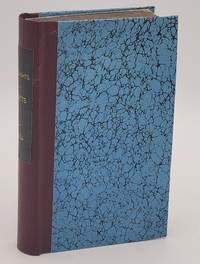
Newton, Sir IsaacBiblio.com
470 résultats
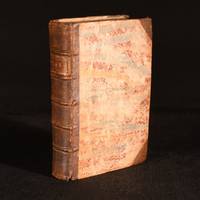
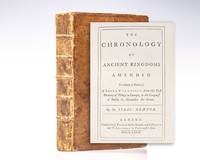
1728149863London: Printed for J. Tonson in the Strand and J. Osborn and T. Longman in Pater-noster Row 1728. First edition of Newton's ambitious attempt to reconstruct and rationalize the timelines of ancient history. Quarto bound in full contemporary Cambridge calf ruled and tooled in blind with speckled panels gilt turn-ins ordinary paper issue illustrated with 3 folding engravings. From the library of Harvard University professor Owen Gingerich. Owen Gingerich 1930–2023 was an American astronomer and historian of science renowned for his scholarship on early modern astronomy particularly his meticulous census of De revolutionibus that illuminated how Copernicus’s work was read and received in the sixteenth century. A longtime professor at Harvard and a senior astronomer at the Smithsonian Astrophysical Observatory Gingerich helped bridge scientific and humanistic inquiry demonstrating how historical context shapes the development and interpretation of scientific ideas. In very good condition. The Chronology of Ancient Kingdoms Amended published posthumously in 1728 was Isaac Newton’s ambitious attempt to reorganize and compress the timelines of ancient history by applying critical philology comparative mythology and astronomical calculation. Seeking to reconcile classical sources with biblical chronology Newton argued that the conventional dating of Egyptian Greek and Near Eastern kingdoms was excessively long and he used evidence such as eclipse records regnal lists and mythic genealogies to propose a shorter more unified ancient past. Although modern historians largely rejected Newton’s revised dates the work was significant for revealing the breadth of his intellectual pursuits beyond physics and mathematics and for illustrating how early Enlightenment thinkers employed scientific reasoning to interrogate historical and scriptural authority. Printed for J. Tonson in the Strand, and J. Osborn and T. Longman in Pater-noster Row unknown
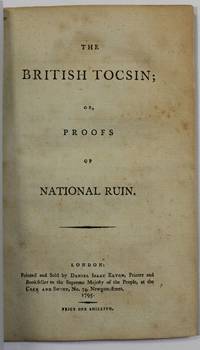
179539807London: Printed and Sold by Daniel Isaac Eaton Printer and Bookseller to the Supreme Majesty of the People at the Cock and Swine 1795. Modern plain wrappers and stitching. 54pp. Light browning Very Good.<br /> <br /> The publisher Daniel Eaton was a persistent challenger of British efforts to curtail speech critical of the Crown and government. He had been arrested and acquitted for publishing Paine's 'Rights of Man" and then for publishing a comparison of the King of England to a Game Cock. <br /> This pamphlet's thesis is that "Britain is on the brink of ruin. . . Corruption and distress walking hand in hand through the country; and war eternally compleating the triumvirate of despotism. . . That government is near its end when having once depended upon the free temper of the people they endeavor to reign by their own extent of power." The author writes "on the extravagance of the present reign" and its corrupting effects. He predicts "commercial bankruptcy! a national famine! and an unavoidable Revolution!" <br /> OCLC 221410570 4- Columbia Baylor two in England as of January 2024. Printed and Sold by Daniel Isaac Eaton, Printer and Bookseller to the Supreme Majesty of the People, at the Cock and Swine unknown
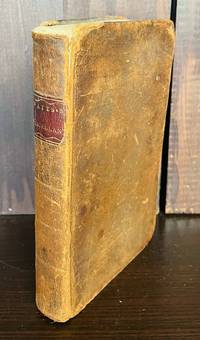
1797111111112150Edmund M. Blunt for Mathew Carey 1797. Leather. Good. Edmund M. Blunt for Mathew Carey; Newburyport 1797. Hardcover. A Good full leather binding with gilt lettering on red spine label binding intact some handling/scuffing to boards rubbing to board/spine edges and joints exposed board corners age toning to pulpy pages previous owner ownership sticker affirmed to front pastedown moisture stain top front pastedown and couple of prelims age spotting throughout rubbing to board and spine edges starting hinges upward lifting of front board appears to have book mildew to text block edges without musty odor. In a good and overall clean antiquarian condition. 18mooctodecimo or approx. 4.5 x 7 inches 239pp. We pack securely and ship daily with delivery confirmation on every book. The picture on the listing page is of the actual book for sale. Additional Scans are available for any item please inquire. Edmund M. Blunt for Mathew Carey hardcover
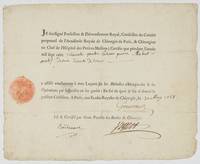
1764683291764. Academie Royale de Chirurgie de Paris 30.V.1764 1 Seite 4° mit Siegelspuren Bescheinigung über die Teilnahme an den Vorlesungen über "les Maladies Chirurgicales & les Opérations par lesquelles on les guérit" im Jahr 1764 für Dr. Pierre Mahiet am 30. Mai 1764 durch Isaac Goursaud 17.-1781 Chirurg am Hôpital des Petites-Maisons in Paris und Professor der Académie Royale de Chirurgie in Paris. Gegengezeichnet durch die "Prevôts des Ecoles de Chirurgie" Toussaint Bordenave 1728-1782 Anatom und Chirurg und François Houstet 1690-1782 Chirurg in Paris. unknown
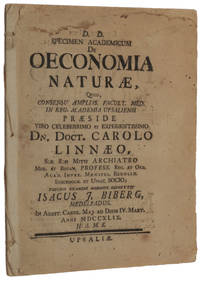
17495245Uppsala: np 1749. First edition. <p>First edition extremely rare. "This essay was the first sketch of a science of ecology. Linnaeus used his economy-of-nature concept as an organising principle to unify an important but previously amorphous part of natural history. In so doing he was also attempting to transform an important background concept into the central theory of a new science" Egerton. "In regard to Linnaeus' concepts of an economy of nature Darwin used these ideas as major explanations of the workings of natural selection. So Linnaeus supplied major assistance for Darwin's arriving at his theory of evolution" Stauffer.</p>. THE BIRTH OF THE SCIENCE OF ECOLOGY. <p>First edition extremely rare of Linnaeus' pioneer dissertation which created the science of ecology. "This essay was the first sketch of a science of ecology. Linnaeus used his economy-of-nature concept as an organising principle to unify an important but previously amorphous part of natural history. In so doing he was also attempting to transform an important background concept into the central theory of a new science . The term 'economy of nature' bore an obvious similarity to the contemporary term for animal physiology 'animal economy' which involved studying how the parts contributed to the functioning of the whole. Linnaeus may indeed have had in mind an analogy between the organs in an animal and the species in a habitat because his analysis of the interrelations between the plants and animals in nature implied a close and well-defined interaction for the good of the whole: 'To perpetuate the established course of nature in a continued series the divine wisdom has thought fit that all living creatures should constantly be employed in producing individuals that all natural things should contribute and lend a helping hand towards preserving every species and lastly that the death and destruction of one thing should always be subservient to the restitution of another' . The Oeconomia naturae begins with the above-quoted definition and then explains how that concept can be used to interpret phenomena in inanimate nature and in the plant and animal kingdoms. For both the plant and animal kingdoms Linnaeus considered propagation preservation and destruction as the phenomena which maintained the economy of nature" Egerton p. 335. "The phrase 'Oeconomy of Nature' "should be familiar to readers of Darwin for he claims in the Origin p. 102 that 'all organic beings are striving it may be said to seize on each place in the economy of nature.' When the work 'economy' appears in Darwin's texts there is a tendency to look to political economy for precursors . but concepts like the animal economy and the economy of nature debatable belonged to intellectual lineages that were relatively independent of their social and political context . I will argue that Darwin's idea of a place in the economy of nature stems from the work of previous naturalists like Carl Linnaeus and Charles Lyell and that it played a key role in the development of his evolutionary ideas. . Darwin read translations of Linnaeus' dissertations Oeconomia naturae 1749 and Politia naturae 1760 in May 1841. Although the phrase 'economy of nature' appears only once in Darwin's notebooks of the late 1830s it can be found throughout his first sketches on transmutation in 1842 and 1844. Given this chronology it is likely that the idea came to play a greater role in Darwin's work because of his encounter with these Linnaean texts" Pearce pp. 494-6. The dissertation was dictated by Linnaeus in Swedish to Isaac Biberg a doctoral candidate who translated it into Latin and defended it according to the academic custom of the eighteenth century. ABPC/RBH lists no copy in the last 80 years. OCLC lists 5 copies in US Madison Wisconsin; Kansas; Harry Ransom Texas; Minnesota; Huntington.</p> <br /> <p>"Like most naturalists of his time Linnaeus was trained in medicine and thus would have been familiar with the term 'oeconomia animalis' as employed by Charleton Hermann Boerhaave and others. However Linnaeus set his sights higher - what he wanted to describe was not the animal economy but the economy of nature as a whole. Of course others had used the term 'economy of nature' e.g. Sir Kenelm Digby in a variety of works but only as a brief metaphor. For example Digby writes in 1644 that natural motion 'hath its birth from the universall oeconomy of nature here among us.' What Linnaeus did instead was extend the physiological idea of the animal economy to nature in its entirety. In his eyes the economy of nature deserved a description just as detailed and rational as that of the animal economy.</p> <br /> <p>"In the dissertation 'Oeconomia Naturae' defended by his student Isaac Biberg in 1749 Linnaeus defines his title as follows: 'By the oeconomy of nature we understand the all-wise disposition of the creator in relation to natural things by which they are fitted to produce general ends and reciprocal uses.' The 'reciprocal uses' are the key to the whole idea for 'the death and destruction of one thing should always be subservient to the restitution of another;' thus mould spurs the decay of dead plants to nourish the soil and the earth then 'offers again to plants from its bosom what it has received from them.' Linnaeus points out that natural processes always follow a certain order with each stage dependent on the previous. A fallen tree for instance does not go to waste but is colonized and eliminated by an ordered series of creatures: liverworts mushrooms beetles caterpillars and woodpeckers. Just as the respiratory cardiovascular lymphatic and digestive systems play different functional roles in the economy of the human body different species play different functional roles in the economy of nature as a whole. For example each kind of insect lays its eggs on a particular kind of plant:</p> <br /> <p>'. every different tribe chooses its own species of plant. Nay there is scarce any plant which does not afford nourishment to some insect; and still more there is scarcely any part of a plant which is not preferred by some of them. Thus one insect feeds upon the flower; another upon the trunk another upon the root; and another upon the leaves.'</p> <br /> <p>"Each type of organism therefore according to Linnaeus has its special function in nature's economy. Just as the animal economy ensures the health and well-being of the animal body the economy of nature ensures the health and well-being of the natural world. Linnaeus discusses the many creatures that help cleanse and purify nature's body without which the 'whole earth would be overwhelmed with carcases and stinking bodies.' Thus if a horse dies near a roadway its body will 'be filled with innumerable grubs of carniverous flies by which he is entirely consumed and removed out of the way that he may not become a nuisance to passengers by his poisonous stench.' Likewise specialized aquatic predators like the thornback the hound fish or the conger eel consume fish carcasses near the shore. Linnaeus even suggests an experiment to prove the purifying potential of insects:</p> <br /> <p>'. knats lay their eggs in stagnant putrid and stinking waters and the grubs that arise from these eggs clear away all the putrefaction; and this will easily appear if any one will make the experiment by filling two vessels with putrid water leaving the grubs in one and taking them all out of the other. For then he will soon find the water that is full of grubs pure and without any stench while the water that has no grubs will continue stinking.' </p> <br /> <p>"Thus for Linnaeus even scavengers and grubs the lowest of all species play an essential role in the economy of nature" Pearce pp. 497-8.</p> <br /> <p>"Oeconomia Naturae is both the culmination of a great tradition - that of Christian natural theology and the starting point of a new science the one that Ernst Haeckel named 'ecology' in 1866. In accordance with the natural theology and the 'age of optimism' celebrated in the works of William Derham John Ray Bernhard Nieuwentyt Gottfried von Leibniz and Christian von Wolff Linnaeus defines 'the economy of nature' as the Creator's wise arrangement and deposition of all things according to which they fulfil their purpose for the glory of God and the happiness of Man.</p> <br /> <p>"And although individuals perish their roles persist . The roles in Linnaean nature are what today's ecologists call 'niches': a multidimensional 'space' defined by the abilities of the species and their interactions with the environment - their physiology and habitat preferences position in food chains and ecosystem structure. Although the Oeconomia Naturae reads like an ecology textbook it also sparkles with the eroticism of the Baroque. Like a voluptuous painter Linnaeus revels in the splendour of life in its beautiful 'costumes' its sensual appeal and showy extravagance the delightful colours forms and adaptations the impressive devices for preservation survival defence attack sex and propagation mating and pollination the means of dispersal and child-rearing .</p> <br /> <p>"Between 1743 and 1776 Linnaeus wrote more than 180 such academic theses. But few achieved the instant success of the Oeconomia Naturae. A Swedish translation was produced within a year. English and German versions soon appeared. It was also reprinted in Latin in the many editions of Linnaeus's Amoenitates academicae published in Amsterdam Leyden Erlangen and Graz through the second half of the eighteenth century. New translations continue to appear today" Hestmark.</p> <br /> <p>"Darwin's influence on the history of ecology resulted in the very christening of the science itself by Ernst Haeckel who once explained that 'By ecology we mean the body of knowledge concerning the economy of nature' and who concluded 'in a word ecology is the study of all those complex interrelationships referred to by Darwin as the conditions of the struggle for existence' .</p> <br /> <p>"When we come to consider the sources of Darwin's ecological insight the importance of his personal experience is obvious . Besides the influence of Darwin's field observations there was the influence of his reading . The importance for Darwin of Lyell's discussion of the economy of nature and allied topics in his Principles of Geology is very clear . Lyell's references in regard to the economy of nature point directly back to the major earlier source: the writings of Carl Linnaeus. The importance of Linnaeus in the evolution of ecology is very great and it is striking that among the naturalists writing after Linneaus and before Darwin it is the geologist Charles Lyell who shows the clearest grasp of Linnaeus' ideas on the economy of nature and who makes the fullest use of them in his own work . After coming to know in the pages of Lyell's Principles ideas and facts from a number of these Linnaean essays Darwin encountered Linnaeus himself in English translation in May of 1841 . From this year of 1841 on Darwin made increasing use of the phrases 'economy of nature' and 'polity of nature' .</p> <br /> <p>"The conventional wisdom is that Darwin overthrew the work of Linnaeus in so far as he replaced the orthodox dogma of fixity of species by his theory of evolution. But in regard to Linnaeus' concepts of an economy of nature Darwin used these ideas as major explanations of the workings of natural selection. So Linnaeus supplied major assistance for Darwin's arriving at his theory of evolution" Stauffer.</p> <br /> <p>"In German and Swedish universities in the eighteenth century the serious test of the student was the skill with which he conducted his oral defence of the thesis he presented. His major professor who presided at the disputation was often the author of the thesis to be defended. At Uppsala Linnaeus generally dictated the essays which his students published and paid the printer's bill for. He quite naturally regarded these dissertations as his own work. In a letter to his friend the English naturalist John Ellis he wrote:</p> <br /> <p>'The fourth volume of my Amoenitates Academicae is very nearly printed . Among the dissertations I am about to publish are Genera morborum Aer habitabilis Flora Jamaicensis Sus porcus Anthropomorpha & Generatio ambigens. In the last of these I shall show that the brain and spinal marrow only proceed from the mother and the rest of the body from the father.'</p> <br /> <p>"Nowadays unless there is direct evidence to the contrary it is customary to regard Linnaeus as the author of all these dissertations" ibid.</p> <br /> <p>Soulsby Catalogue of the works of Linnaeus 2nd ed. 1933 1514. Egerton 'Changing concepts of the balance of nature' The Quarterly Review of Biology 48 1973 pp. 322-50. Hestmark 'Oeconomia Naturae L' Nature 405 2000 p. 19. Pearce 'A great complication of circumstances - Darwin and the Economy of Nature' Journal of the History of Biology 43 2010 pp. 493-528. Stauffer 'Ecology in the long manuscript version of Darwin's 'Origin of Species' and Linnaeus' 'Oeconomy of Nature'' Proceedings of the American Philosophical Society 104 1960 pp. 235-41.</p> <br /> <br/> <br/> 4to pp. viii 48 woodcut initials head- and tail-pieces first and last pages tanned spotted water stain to upper edge of the first two leaves. String bound. A very good copy in original state of this extremely rare dissertation. np unknown
1742702044 107 7 102 pages With a statement of authenticity signed by the publisher on title page verso also contains The Money'd Man's Pocket-Book. Being Tables of Simple Interest Exactly Computed; For One to Twelve Months and for One to Ninety-one Days or a Quarter of a Year with separate title page and authentication page signed by publisher Printed for Thomas Astley hardcover
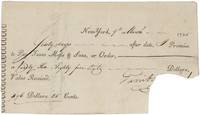
179542478New York 1795. paperback. Single leaf 4x7 inches. Printed on one side with blanks filled in in manuscript and signature obscured by cancellation tear-off; “Isaac Moses & Sons†penned on blank side in period hand. Early American Jewish merchants Isaac Moses & Sons operated on Greenwich Street.Isaac Moses 1742-1818 was born in Giessen Germany but moved to New York in 1764 and in 1766 he became a “freeman†of New York City. He became a prominent businessman and American patriot. He worked in his uncle's Hayman Levy's mercantile firm until he established Isaac Moses & Company with two new business partners in 1775. This firm supported the revolutionary army by accepting $20000 in Continental paper dollars in exchange for $20000 in hard currency thereby financing the war effort. The firm also traded for military supplies internationally and sold guns and ammunition to the army. When the British occupied New York Isaac Moses left for Philadelphia and ran the firm from there. In 1783 he returned to New York City and continued his commercial enterprises. He was generally financially successful establishing Isaac Moses & Sons an international trading company. He was also a founder and major stockholder in the Bank of New York  a Mason in New York City's Union Lodge and an important member of the New York City Chamber of Commerce. Isaac Moses was also president of Congregation Shearith Israel in New York the oldest Synagogue in American and the only Jewish congregation in New York City until 1820. He was also one of the principle organizers of the Congregation Mikveh Israel in Philadelphia. His descendants were prominent Jewish businessmen in New York who traveled internationally and served in the Union Army during the Civil War AJHS & Wikipedia. For more on Isaac Moses see the JTA’s report on the donation of his portrait by John Wesley Jarvis to the Museum of the City of New York in 1934 https://www.jta.org/archive/painting-of-isaac-moses-patriot-of-revolution- given-to-museum. Portraits of Moses can be viewed online at https://loebjewishportraits.com/portrait/isaac-moses/ and https://loebjewishportraits.com/portrait/isaac-moses-2/. An indenture signed by his heirs after his death in 1818 sold for $3500 plus commissions at auction in 2019 https://www.sothebys.com/en/auctions/ecatalogue/2019/fine-manuscripts-prin ted-americana-n10002/lot.2180.html. Promiser’s signature torn of as cancellation as often found otherwise Very Good Condition BK5 AMR-67-39. New York unknown
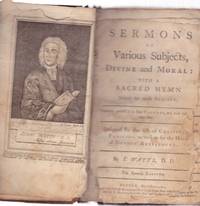
1746398441Boston: Rogers & Fowle 1746. 7th Ed. Hardcover. Fair/None. Hardcover contemporary calf. Sermons on Various Subjects Divine and Moral: With a Sacred Hymn Suited to each Subject. Designed for the Use of Christian Families as well as for the Hours of Devout Retirement. By I. Watts D.D. Formerly published in Two Volumes and now reduced into One. The Seventh Edition. Boston New-England Printed and Sold by Rogers and Fowle in Queen-street next to the Prison and by J. Blanchard at the Bible and Crown in Dock-Squre. 1746. VOLUMES I & II BOUND IN ONE; A COMPLETE WORK. 740 pages. Two title pages but first 8 leaves of text Dedication torn and chipped. Partial 28 page pamphlet laid-in at rear only pp 5-23 very worn. Book itself is firmly bound with mostly bright clean pages. Previous owner's name on front fly leaf. Three pages of advertisements in rear with tears light stain. DUE TO SIZE DOMESTIC SHIPPING ONLY. Record # 398441 Rogers & Fowle hardcover
1755000341Various: Various 1755. Bound volume containing six sermons dated from 1755 to 1788: I. Lyman Joseph. A Sermon Preached Before His Excellency James Bowdoin Esq. Governour; His Honour Thomas Cushing Esq. Lieutenant-Governour.of the Commonwealth of Massachusetts May 30 1787 Being the Day of General Election. Boston: Adams and Nourse 1787 61 pages front cover used as pastedown for the volume with some old insect damage to pastedown and margins of first two leaves. II. Cumings Henry. A Sermon Preached in Billerica on the 23rd of November 1775 Being the Day appointed by Civil Authority for a Public Thanksgiving Throughout the Province of Massachusetts-Bay. Worcester Massachusetts-Bay: I. Thomas 1775. 29 pages. Final two leaves dampstained but very readable next-to-last leaf has margin chip. III. Morrill Isaac. The Soldier exhorted to Courage in the Service of his King and Country from a Sense of God and Religion: in a Sermon Preach'd at Wilmington April 3 1755 to Capt. Philehas Osgood and his Company of Soldiers Before their going out into Publick Service. Boston New-England: J. Draper 1755. 23 pages. Large margin chip at bottom of one leaf not affecting text. IV. Bridge Ebenezer. A Sermon Preached before his Excellency Francis Bernard Esq. Governor.of the Province of the Massachusetts-Bay in New-England May 27th 1767. Being the Anniversary for the Election of His Majesty's Council for the Province. Boston: Green and Russell 1767. 60 pages last three leaves have internal tears with the last two having some paper loss and affecting a small part of the text. V. Cumings Henry. A Thanksgiving Sermon Preached at Billerica November 27 1766. Boston N.E.: Kneeland and Adams for Thomas Leverett 1766. 32 pages. VI. Parsons David. A Sermon Preached Before His Excellency John Hancock Esq.of the Commonwealth of Massachusetts May 28 1788 being the day of General Election. Boston: Adams and Nourse 1788.46 pages. The group is bound into a full blind-tooled calf binding measuring 21.75 cm x 13 cm. Other than the noted issues with the individual sermons cited above the pages are mainly clean and free from significant chips or tears with age-tanning and intermittent foxing throughout. The binding is lightly shelfworn with some minor separation at the spine ends joints good with covers firmly attached. A good collection of mainly scarce sermons. Full Leather. Good/None. 8vo - over 7¾" - 9¾" tall. Various Hardcover
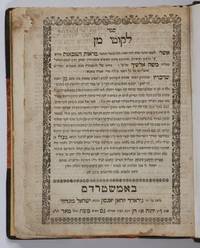
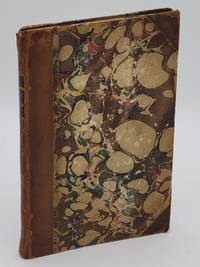
176448351Amsterdam: Gerard Johan Janson/ Yisrael Mondavi 1764. First edition. Hardcover. vg to vg. Quarto. 149 double-sided leaves 1. Rebound in modern 3/4 dark brown soft leather over red marbled paper boards. Raised bands on the spine. Modern endpapers. Title page with decorative woodcut border. This work contains Rabbinic commentaries on the Haftorot readings including relevant selections from the writings of Rabbi Moshe Alshich 1508–1593 aka "Alshich Hakadosh" Spanish Rabbi Joseph ben Abraham Hayyun d.1497 and Isaac Abravanel. The Hebrew text of commentary is printed throughout in single and dual-column formats in Rashi script surrounding the regular Hebrew text of the biblical verses from the Prophets and the Writings. Errata leaf at the rear.<br /> <br /> Binding with some light smudges to the covers minor rubbing to corners and some light sticker residue and light scratches to the spine. Interior with some light markings in pencil to the front free endpapers. A few pages throughout with some sporadic minor chipping and/ or water stains along the side margins and edges. No text loss. Book block tight. Binding in very good interior in very good condition overall. Hebrew title: ספר לקוטי מן<br /> Authors: ×ליעזר ×ž× ×—× ×ž×¨×§×‘×¨×™×˜ יוסף בן ××‘×¨×”× ×—×™×•×Ÿ משה ×לשיך יצחק ××‘×¨×‘× ×ל<br /> Publication: דפוס על יד ×’'ר×רד יוה×ן ×™× ×¡×•×Ÿ ובבית ישר×ל ×ž×•× ×“×•×•×™<br /> Alternate transliteration: Liqute Man Likkutei Man Likutei Man<br /> <br /> Bibliographic reference: Vinograd Amsterdam #1839. Gerard Johan Janson/ Yisrael Mondavi hardcover
177948502Livorno: Carlo Giorgi 1779. First edition. Hardcover. g to near fine. Octavo. 4 80 leaves double-sided. Rebound in modern brown cloth over brown decorative paper boards. Title page with decorative woodcut borders. This the first printed edition of Medieval Italian Rabbi Isaiah ben Mali of Trani's ca.1180 – 1250 work collecting discussions of 92 different halakhic topics relating to the tractate Ta'anit of the Mishnah which deals with the Jewish laws of fasting. The work was edited by Italian Rabbi Isaac Joseph Nunes Vais d. 1768. A few decorative woodcut head and tailpeices as well as borders to text throughout.<br /> <br /> Text in Hebrew with some Rashi script mostly printed in a two-column format.<br /> <br /> Binding with minor rubbing to corners. Interior with light worming to pages throughout resulting in minial text loss. Sporadic water stains throughout mostly in the margins. Orange sticker on the interior front cover. Binding in near fine interior in good condition overall. Hebrew title: ספר המכריע : ×•×”×•× ×¦×´×‘ פסקי ×“×™× ×™×Ÿ וחדושי מסכת ×ª×¢× ×™×ª<br /> Author: ישעיה בן מ×לי מטר×× ×™. × ×•× ×™×¡ ו×יס יצחק<br /> Publication: ×œ×™×•×•×¨× ×•<br /> Alternate transliteration: Sefer Hamachria<br /> <br /> Bibliographic references: Vinograd p.382 Livorno Leghorn #154. Carlo Giorgi hardcover
1766978Z34London: T. Becket and P. A. De Hondt; W. Griffin; et al. 1766-7. First edition. Leather. Very Good. 7.5" by 5". None . A collection of seven plays bound together including David Garrick's dramatic play 'Cymon' bound in half calf. Seven volumes bound together This volume contains; "The Maid of the Mill. A Comic Opera." Isaac Bickerstaff first edition 1765 "Cymon. A Dramatic Romance" David Garrick early edition 1765 "The Accomplish"d Maid: A Comic Opera" Niccolo Piccini 1767 "The Perplexities: A Comedy" Thomas Hull first edition 1767 "The Earl of Warwick A Tragedy" second edition Thomas Franklin 1766 "The Clandestine Marriage A Comedy" David Colman and David Garrick first edition 1766 "The Country Girl A Comedy" David Garrick first edition 1766A sammelband of seven eighteenth century plays written by the likes of David Garrick Isaac Bickerstaff and Thomas Hull. The plays are a mix of dramatic comic tragic and romantic tales including David Garrick's five-act stage opera which tells the story of a prince who falls in love with a poor shepherdhess. Bound in half calf with marbled paper to the boards. Bound in half calf with marbled paper to the boards. Externally hinges cracked but remaining firm due to re-enforcements with rubbing to the boards and light rubbing to the extremities and joints. The odd spot to the endpapers. Internally firmly bound with bright and generally clean pages with occasional tidemarks to the tails of the pages. Very Good T. Becket and P. A. De Hondt; W. Griffin; et al. hardcover
1728000772London: James and John Knapton 1728. 2nd Edition Corrected . Hardcover. Good/N/A. Full leather darkened and some cracking to spine. 5 bands to spine. Vol 2 part 2. Illustrated with Dr. Samuel Clark's notes taken mostly out of Sir Isaac Newton's Philosophy in olde English. Rubricated title page. Hinges cracked. Also fold out tables numbered XII to XXVII laid in the back all in good shape. ex lib from the Hartford Seminary. First belonging to Aaron Day dated May 3 1737. Then belonging to H A Gleason Jr. A very rare book. photos on request. <br/> <br/> James and John Knapton hardcover
1798298991London.: I Herbert. 1798. Contemporary half brown leather over marbled boards. gilt spine title. Very good moderate foxing. 4to. 18.2x12.2 cm. weight: 0.4 lb. 14 full-page plates. I Herbert. hardcover
1796117833London: A. Strahan 1796. Leatherbound. Fair. viii 500 p. 24 cm. Leather binding. From our As Is shelf. Spine deteriorated and torn front board detached rear board loose corners and edges worn. Some foxing. Tear in title page and front free endpaper. <br/><br/> A. Strahan hardcover
1709031078Rotterdam : Reinier Leers 1709. Un volume 9x17 cm di 30-449-23 pagine. Buoni margini. Legatura coeva in tutta pelle dorso a nervi ornato e dorato con tassello di titolo. Condizioni molto buone. Prima e unica edizione di questa risposta polemica di Larrey allo scritto Avis important aux réfugiez sur leur prochain retour en France attribuito a Pierre Bayle. Exilé aux Pays-Bas Isaac de Larrey 1639-1719 s'appuya sur sa grande facilité d'écriture pour gagner sa vie avant d'être nommé historiographe des Etats Généraux des Provinces-Unies puis d'être appelé à Berlin par l'Electeur de Brandebourg. Reinier Leers unknown
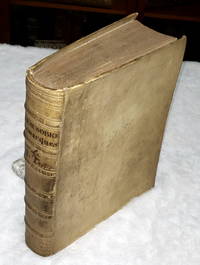
1742040691A La Haie The Hague: Pierre De Hondt 1742. 467 & 320 pages plus notice and catalogue at rear. Full contemporary vellum with raised spine bands and inked name on spine. Blind stamped outlines and decorative devices. Penciled notations on front paste down and smudges on front free end leaf. Leaves are a little darkened on edges. Scattered light creases and very light wear. Overall volume remains tight and attractive. . First Edition. Vellum. Good/No Dust Jacket. sm 4to. Pierre De Hondt hardcover
1796103121<p>Offering this original antique leather copy of <em>Reliquiae Juveniles. Miscellaneous Thoughts in Prose and Verse on Natural Moral and Divine Subjects; Written Chiefly in Younger Years. To Which is Added Remnants of Time Employed in Prose and Verse</em> by Isaac Watts D.D. Portsmouth: Charles Pierce 1796. First American Edition with Large Additions. Printed for William P. Blake in Boston. Original leather hardcover hand-sewn binding with gilt stamped red spine label 304 pps.</p><p>Overall condition is fair. Leather is worn pages are age toned and a few have tiny tears at the edges. The is a lovely handwritten calligraphy-style inked notation by the previous owner on the ffep dated 1817. On the blank page preceding the back ffep a different owner wrote her name in pencil and the date 1796. Else no writing in pages. Front joint starting at top and corresponding interior joint with endpapers is split but still attached . The page edges show some swelling even as the binding itself remains firm. A few pages are not even with the rest see last picture - possibly as bound originally as they do not seem loose from the binding threads. A solid copy of this more than 200-year-old book! Isaac Watts 1674-1748 was a British theologian best known for writing popular hymns such as "Joy to the World."</p> Charles Pierce hardcover
1734299030London.: Richard Ford and Richard Hett. 1734. 1st Edition. Modern quarter maroon stippled cloth over blue marbled boards paper spine label. Very good light scattered foxing. 12mo. 16.7x10.5 cm. Engraved headpieces tail pieces and initials. Uncommon collection of essays and poems by the famous theologian and philosopher. weight: 0.6 lb. Engraved headpieces tailpieces and initials. Richard Ford and Richard Hett. hardcover