65 résultats
1748CLL-221Sans lieu, 1748 3 parties en un volume in-12 de (16) ff., 1-122 pp., (2) ff., 123-386 pp., (2) ff., 387-548 pp., maroquin rouge, triple filet d'encadrement sur les plats, dos lisse orné de caissons de fleurons dorés, filet doré sur les coupes, tranches dorées (reliure de l'époque).
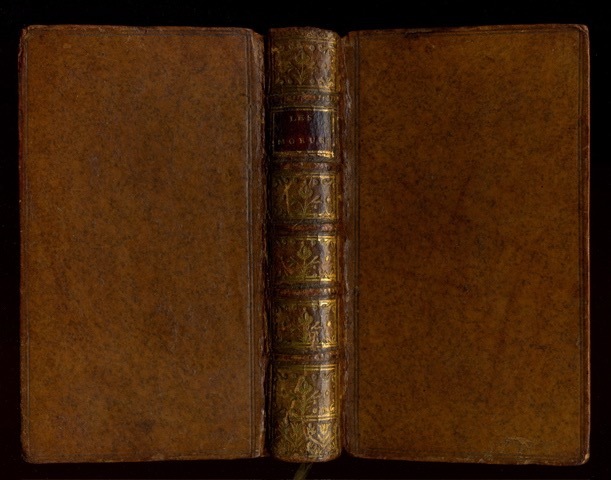
174855311748 Sans lieu ni éditeur, 1748, volume in-12 relié plein veau marbré de l'époque, XXXII (non paginé, épitre, avertissement, table, explication du frontispice, du fleuron et des vignettes)-528 pages, dos à 5 nerfs orné de caissons à fleurons dorés, pièce de titre bordeaux (les moeurs), roulette à froid encadrant les plats, sans défaut notable, très bon état
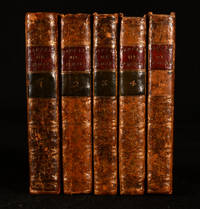
175037258Amsterdam, Pierre Mortier, 1749 1750 5 volumes in-16, plein veau blond marbré, dos à nerfs, caissons ornés, pièces de titre et de tomaison volume 2 dans une reliure différente : veau brun marbré, dos lisse orné. Frontispice et titre gravé à chaque volume. Dos passés et frottés, coins usés, deux mors fendillés. Brunissure d’hum. en tête au second volume, marquée aux 3 premiers ff. puis lég.
17482672Essai de philosophie en trois parties : De la piété, de la sagesse et des vertus sociales.Beau frontispice.Édition originale. Pleine basane mouchetée, dos à nerfs orné, pièce de titre rouge, tranches mouchetées. Reliure de l'époque. Très bon s.l. s.n. 1748 1 volume in-8°.
1749681P23Amsterdam: Pierre Mortier 1749-50. Leather. Very Good. 5.5" by 3.5". Not Stated. A nicerly bound oeuvre of the French Epicurean author Toussaint Remond de Saint-Mard illustrated with frontispieces. Complete in five volumes. A collection of the works of Toussaint Remond de Saint-Mard the noted Epicurean French author. His works include 'Reflexions sur la Poesis en General' and 'Nouveaux Dialogues des Dieux'. This oeuvre contains his letters philosophical works and poetry. Frontispiece to Volumes I II and IV. With an engraved title page to each volume. Saint-Mard wrote on aesthetics and opera and was a canon of the Notre-Dame. In a full mottled calf binding. Externally generally smart. Volume V is lacking the second spine label. Some rubbing to the spines. Some loss to the head of the spines. Minor bumping to the extremities. Very light marks to the boards. Internally firmly bound. Pages are lightly age-toned and generally clean with the odd spot. Very Good Pierre Mortier hardcover
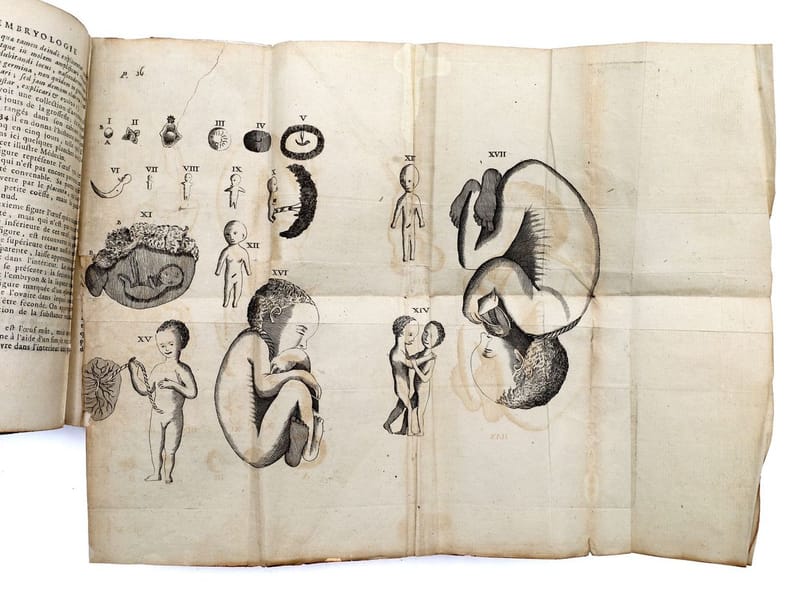
1774101549Paris, Nyon, 1774, in-12, XXXI-[1]-592 pp, 3 pl, dont 2 dépl, Veau marbré de l'époque, dos à nerfs et fleuronné, tranches rouges, Troisième édition française de ce texte de casuistique écrit par le jésuite Francesco Emanuele Cangiamila (1702-1763), traduit et adapté par l'abbé Dinouart (1716-1786). Cet ouvrage, rare pour son époque, traite des enjeux spirituels et pratiques liés à la grossesse et à l'accouchement, en abordant les questions controversées de l'avortement, l'âme du foetus et la césarienne. Cangiamila défend une position pragmatique, centrée sur le rôle des prêtres dans la prévention et la gestion des avortements. Sur la question de "l'avortement thérapeutique", il se montre prudent, en considérant qu'il est possible d'administrer remèdes et saignées pour sauver une femme enceinte si cela ne porte pas atteinte à la vie du foetus; autrement la mère aura à "se priver des secours qui pourroient lui réussir, par l'amour qu'elle a pour la loi divine" (p. 20). Le salut des âmes des avortons le préoccupe particulièrement : pour soutenir son discours théologique, le jésuite s'appuie sur les travaux scientifiques des plus récents, notamment ceux de Giovanni Bianchi (1693-1775) ? la planche n° 1, qui représente les différents stades du développement de l'embryon et du foetus, est issue de ses travaux. Cangiamila en conclut que l'infusion de l'âme intervient dès les premiers jours de la conception, s'opposant en cela à la croyance aristotélicienne d'un délai de 40 jours. Dès lors, il réaffirme le caractère criminel de l'avortement chez une femme qui serait "faussement persuadée" de l'absence d'âme dans le foetus (Tatoueix). Enfin, il développe le sujet de la césarienne, dont il défend la pratique post-mortem, et encourage la formation des sages-femmes par les curés. L'ouvrage a connu un succès européen, dès la parution de l'édition complète en italien en 1745 (Embriologia sacra overo dell' uffizio de' sacerdoti, medici, e superiori... Palerme, Francesco Valenza) : il a fait l'objet de multiples éditions, traductions et adaptations. Celle-ci, due au prêtre polémiste Dinouart, a été publiée d'abord en 1762, puis en 1766 et en 1774 (contrairement à la mention de "seconde édition" indiquée en page de titre , il s'agit donc bien de la troisième). Dinouart a ajouté à cet Abrégé une digression sur la réanimation des noyés, illustrée par une machine de fumigation destinée à être introduite par le rectum (pp. 232 à 256). Cette section remplace le commentaire original de Cangiamila, jugé trop succinct. Réparation à l'adhésif sur une planche dépliante, petite déchirure sans manque sur l'autre. Accrocs aux mors, coins usés. Laura Tatoueix, "Les enjeux spirituels de l'avortement, de la doctrine à la pratique : l'exemple de l'Abrégé de l'embryologie sacrée de F. E. Cangiamila traduit par l'abbé Dinouart (1762)". Chrétiens et sociétés, 26 | 2020, 39-54 [en ligne] Couverture rigide
17482305728S.N 1748. First Edition. First Edition. Very Good/No Jacket. Corners slightly exposed. 1748 Full-Leather. 32 106; 107-334; 335-474 pp. Contemporary mottled calf marbled endpapers spine gilt with red leather label red edges. Frontispiece engraved vignette on title and on first page of each of the three parts as called for this copy bound without the separate titles to the 2nd and 3rd parts found in some copies. An immensely popular which was banned upon its release and burned by the French court of justice. The scandal it caused would follow the author for the rest of his life eventually it became thought that the work advocated regicide. Nonetheless it became an influential work that went through at least 15 editions in 1748 and elicited a number of replies. Parts of it were later reused in Denis Diderot's Encyclopedie. This 474 page printing which was also issued in a large-paper 4to. format is generally considered the first. The book was banned by the French parlement on May 6 1748 and the author was subsequently forced to seek asylum in the Low Countries. The present volume is enhanced by having two additional items bound in: a printed copy of that Arrest de la Cour du Parlement S.N unknown books
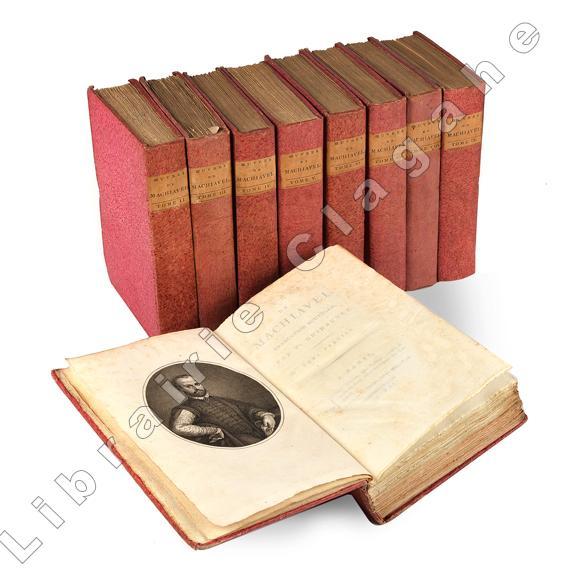
179922911Paris Potey et Pichard 1799 -in-8 plein-veau 9 volumes, reliure plein veau glacé vert olive marbré in-octavo (binding full calfskin in-8)(20,2 x 13 cm), SUPERBE RELIURE EMPIRE D'EPOQUE, dos long (spine without raised bands), décoré or (gilt decoration), titre et tomaison frappés "or", pièce de titre et de tomaison sur fond maroquin cerise, avec un filet "or" de part et d'autre, entre nerfs à fleuron "or" avec 4 doubles filets perlés "or" croisés autour du fleuron en losange avec une étoile "or" aux angles, roulette "chainette" "or" en place des nerfs avec un filet "or" de part et d'autre et en tête et en pied, plats décorés "or" d'une roulette feuillage "or", un filet "or" et une roulette fine "or" en encadrement, roulette "or" sur les coupes, toutes tranches lisses rouges, ornés d'un portrait de Machiavel en frontispice en noir peint par A. Brunzino et gravé par Levasseur (Tome I) + 7 planches hors-texte en noir Pour L'Art de la Guerre (dont 2 dépliantes et 2 planches doubles)(les planches V et VI de l'Art de la Guerre ont été mis par erreur au Tome I aux pages correspondantes, au lieu de les mettre au Tome V), (CXVII + 408) + 384 + 403 + 416 + 448 + 455 + 394 + 370 + 524 pages, An VII (1799) Paris: Potey et Pichard Editeur,
1748CLL-4Sans lieu, 1748 3 parties en un volume in-12 de (16) ff., 528 pp., maroquin rouge, 3 filets dorés en encadrement, dos à nerfs orné et doré, coupes et bordures décorées, tranches dorées (reliure de l'époque).
179920337Paris, Potey, Pochard, (imprimerie de Laran), an VII (1799) ; 9 tomes in-8 (210 mm), cartonnage rigide de papier rose à l’éponge, pièce de titre imprimée au dos, non rogné (reliure strictement d’époque) ; CXVII, [1 bl.], [2], 408 ; 384 ; 403 ; 416 ; 448 ; 455 ; 394 pp., [1] ff. bl. ; 370 pp, [1] ff. bl. ; 524 pp., portrait ovale en frontispice ; 7 planches dans “l’Art de la Guerre”, dont deux dépliantes et 2 doubles.
17761105020009J.E. Dufour & P.H. Roux Imprimeurs & Libraires Affocies 1776. Hardcover. Very Good. Elephant folio. Maestricht : J.E. Dufour & Ph. Roux 1776. Bound in tan cloth. Gilt lettering on spine over dark red title plate. 5 raised bands. Six compartments. Publishers imprint and publication date on bottom of spine. Light gray endpapers. Elaborately decorated title page with red and black lettering. Intricately detailed copperplate engravings throughout. This edition of the Bibliotheque Orientale is the second printing created in Maastricht in the year 1776. The book was Herbelots greatest achievement occupying most of his life. It was completed in 1697 by Antoine Galland. It is based on the immense Arabic bibliography the Kashf al-Zunun of Hadji Khalfa Katip Celebi of which it is largely an abridged translation but also contains the substance of a vast number of other Arabic Persian and Turkish compilations and manuscripts. Tight binding and solid boards. Minimal scuffing to boards. Small scrape along leather title plate. Slight bumping to corners. Clean unmarked pages. Library sticker gently removed from endpaper. Slight residue remains. Minor wrinkling to pages. Minimal discoloration to pages. A beautifully preserved volume in exceptional condition. Please view our images of this rare item. Brunet II 664. J.E. Dufour & P.H. Roux, Imprimeurs & Libraires, Affocies hardcover
1748elala1493np: 1748. 1748. 3 Parts in 2 Volumes. 12mo. pp. 16 p.l. 122; 1 p.l. 123-386; 1 p.l. 387-547. engraved frontis. 3 engraved headpieces. engraved title vignettes. contemporary sprinkled calf gilt backs extremities worn. This work outlining a natural code of moral conduct independent of religion was originally attributed to Diderot. It was condemned as blasphemous and immoral by the Paris parlement and ordered to be burned on May 6 1748. Both Barbier and Cioranescu cite pp. 474 for the first edition while Cohen-De Ricci cites date 1747. Cohen-De Ricci 995. cfBarbier III 322. cfCioranescu 62094. BOUND WITH: DIDEROT Denis 1713-1784. Pensées Philosophiques. 12mo. pp. 1 p.l. 136 12. lacking half-title engraved frontis. The Hague: Aux dépens de la Compagnie 1746. First Edition Second Issue without the imposition errors noted by Tchemerzine. Diderots first original work the Pensées Philosophiques consists of short reflections on christianity deism scepticism and atheism and is primarily concerned with sceptically questioning the argument from design in nature a fundamental premise of deism. At first a deist Diderot later became an experimental materialist in philosophy and an atheist in religion. The Pensées Philosophiques was condemned to be burned by the Paris parlement on July 7 1746. Barbier III 826. Cioranescu 24143. Cohen-De Ricci 305. Quérard II 554. Tchemerzine IV 427 a. 1st Edition. Hardcover. np: 1748. Hardcover
1748136497S. n. l. 1748 In-16 16,5 x 10 cm. Reliure de l’époque veau havane raciné glacé, dos à nerfs encadrés de fers dorés, pièce de titre maroquin grenat, [30]-474 pp., frontispice, vignette au titre, 3 vignettes, table des chapitres et des articles. Ex-libris collé sur la page de garde, marque de possession manuscrite en page de titre, .Exemplaire en très bon état. édition originale.
174839757, , 1748. 3 tomes en 1 vol. in-8 à pagination continue de 1 frontispice gravé, (32)-122 pp. ; (2)-123-386 pp. ; (2)-387-547 pp., maroquin vert, dos lisse orné à froid, filet à froid sur les plats, tranches dorées (reliure de l'époque).
17983421524/05/1798. <div></div><div><div class=""yj6qo""><p>At the time of the outset of the French Revolution Haiti was the French colony of Saint Domingue. The colony featured large slave plantations that generated the cash crops of sugar coffee and cotton. This was a very profitable colony to the French owing largely to the sugar plantations. By the 1780s nearly two-thirds of French trade flowed through Saint Domingue and the island supplied nearly half of Europe with sugar.</p><p>The Haitian Revolution was a complex web of affairs. At one point there were over a half dozen parties involved all fighting for different purposes. Alliances were fickle as entities changed allegiance based on who was offering the best deal. The revolution began not only as a slave revolt but also as a class struggle among white landowners non-landowners and the free black landowners. The French military became involved as did the British and Spanish forces.</p><p>In August 1791 a full-fledged slave revolt began. In March 1793 the French assembly granted full rights and French citizenship to free black people and those of mixed race. The white planter class however objected and further violence erupted. The French sent military forces and a new governor to enact these measures. At this point England and Spain joined the fight. While the English sought to restore order and sided with the white social class the Spanish who controlled the other side of the island saw an opportunity in the dysfunction. When the French in 1794 ordered all slaves freed the ire turned against the English who now sent more forces to quell the revolt. In 1795 the Spanish signed a deal with the French and exited the conflict.</p><p>Toussaint Louverture a former slave emerged as the leader of the slaves seeking their freedom in the Haitian Revolution. He drew inspiration from the ongoing French Revolution and previous American Revolution to evolve his group’s demands and ultimate goals.</p><p>At the same time the French Directoire government which now ruled France was considerably less revolutionary than it had been. Suspicions began to brew that it might reconsider the abolition of slavery. In November 1797 Louverture wrote again to the Directoire assuring them of his loyalty but reminding them firmly that abolition must be maintained.</p><p>And for the British the benefit began to be outweighed by the cost an enormous loss of life. On April 30 1798 Louverture signed a treaty with British Army officer Thomas Maitland exchanging the withdrawal of British troops from western Saint-Domingue Haiti in return for a general amnesty for the French counter-revolutionaries in those areas. In May Port-au-Prince was returned to French rule in an atmosphere of order and celebration.</p><p>Gingembre-Trop-Fort also a former slave was one of Louverture's loyal officers. He was described with exaggerated uniform accoutrements a sword almost as tall as he was wearing “large and heavy rings†and with a pillow to his saddle already “covered in velours with gold fringes.†Interestingly his name in French means ""too strong ginger.""</p><p><strong>Letter signed</strong> May 24 1798 Port Republicain former name of Port-au-Prince to <em>""Citizen Deneyve Commissary Quartermaster of Wars for the Army of the Northwest Coast""</em> with integral address leaf. <em>""Citoyen Commissary please pay the 2nd Squadron of the 1st Regiment of Dragoons Commanded by the Squadron Chief Gingembre.""</em></p><p>Letters of Louverture are very uncommon. This is a particularly early one having been signed before he took control over the entire country.</p><p>This was not the end of the conflict as tensions with France were about to increase and would test Louverture.</p><p><img class=""alignnone wp-image-25018 size-post-window"" src=""https://cdn.raabcollection.com/wp-content/uploads/20231204144051/Folder-site-11-1600x1327.jpg"" alt="""" width=""1600"" height=""1327"" /></p></div></div> unknown