BERNOULLI, JacobBiblio.com
734 résultats
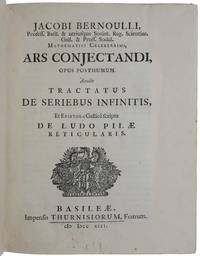
17134063Basel: Impensis Thurnisiorum Fratum 1713. First edition. First edition of the most significant early book on probability theory: it set forth the fundamental principles of the calculus of probabilities and contained the first suggestion that the theory could extend beyond the boundaries of mathematics to apply to civic moral and economic affairs. It also contained the first statement but not the proof of the law of large numbers. Hardcover. EVANS 8 - ESTABLISHED THE FUNDAMENTAL PRINCIPLES OF THE CALCULUS OF PROBABILITIES. <p>First edition an exceptionally fine copy rare in this condition. "Jakob 1 Bernoulli's posthumous treatise edited by his nephew Nicholas I Bernoulli the title literally means "the art of dice throwing" was the first significant book on probability theory: it set forth the fundamental principles of the calculus of probabilities and contained the first suggestion that the theory could extend beyond the boundaries of mathematics to apply to civic moral and economic affairs. The work is divided into four parts the first a commentary on Huygens's De ratiociniis in ludo aleae 1657 the second a treatise on permutations a term Bernoulli invented and combinations containing the Bernoulli numbers and the third an application of the theory of combinations to various games of chance. The fourth and most important part contains Bernoulli's philosophical thoughts on probability: probability as a measurable degree of certainty necessity and chance moral versus mathematical expectation a priori and a posteriori probability etc. It also contains his attempt to prove what is still called Bernoulli's Theorem: that if the number of trials is made large enough then the probability that the result will lie between certain limits will be as great as desired" Norman. This was the first statement of the law of large numbers.</p> <br /> <p>"In the first Part pp. 2-71 Jakob Bernoulli complemented his reprint of Huygens's tract by extensive annotations which contained important modifications and generalisations. Bernoulli's additions to Huygens's tract are about four times as long as the original text. The central concept in Huygens's tract is expectation. The expectation of a player A engaged in a game of chance in a certain situation is identified by Huygens with his share of the stakes if the game is not played or not continued in a 'just' game. For the determination of expectation Huygens had given three propositions which constitute the 'theory' of his calculus of games of chance. Huygens's central proposition III maintains:</p> <br /> <p>"If the number of cases I have for gaining a is p and if the number of cases I have for gaining b is q then assuming that all cases can happen equally easily my expectation is worth pa qb/p q."</p> <br /> <p>"Bernoulli not only gives a new proof for this proposition but also generalizes it in several ways .</p> <br /> <p>"Huygens's propositions IV to VII treat the problem of points also called the problem of the division of stakes for two players; propositions VIII and IX treat three and more players. Bernoulli returns to these problems in Part II of the Ars Conjectandi. In his annotations to Huygens's proposition IV he generalised Huygens's concept of expectation . This is the only instance in the annotations and commentaries to Huygens's tract where Bernoulli uses the word 'probabilitas' or probability as understood in everyday life. Later in Part IV of the Ars Conjectandi Bernoulli replaced Huygens's main concept expectation by the concept of probability for which he introduced the classical measure of favourable to all possible cases. The remaining propositions X to XIV of Huygens's tract deal with dicing problems of the kind: What are the odds to throw a given number of points with two or three dice or: With how many throws of a die can one undertake it to throw a six or a double six . The meaning of Huygens's result of proposition X that the expectation of a player who contends to throw a six with four throws of a die is greater than that of his adversary is explained by Bernoulli in a way which relates to the law of large numbers proved in Part IV of the Ars Conjectandi .</p> <br /> <p>"In the second Part pp. 72-137 Bernoulli deals with combinatorial analysis based on contributions of van Schooten Leibniz Wallis and Jean Prestet . It consists of nine chapters dealing with permutations the number of combinations of all classes the number of combinations of a particular class figurate numbers and their properties especially the multiplicative property sums of powers of integers the hypergeometric distribution the problem of points for two players with equal chances to win a single game combinations with repetitions and with restricted repetitions and variations with repetitions and with restricted repetitions.</p> <br /> <p>"Evidently Bernoulli did not know Blaise Pascal's Triangle arithmétique published posthumously in 1665 though Leibniz had alluded to it in his last letter to him in 1705. Not only does Bernoulli not mention Pascal in the list of authors that he had consulted concerning combinatorial analysis except for Pascal's letter to Fermat of 24 July 1654; it would also be difficult to explain why he repeated results already published by Pascal in the Triangle arithmétique such as the multiplicative property for binomial coefficients for which Bernoulli claims the first proof for himself. His arrangement differs completely from that of Pascal whose proof for the multiplicative property of the binomial coefficients has been judged to be clearer than Bernoulli's. It is fair to add that in the Ars Conjectandi which Bernoulli left as an unpublished manuscript he was much more honest concerning the achievements of his predecessors than Pascal in the Triangle arithmétique. It is also true that Bernoulli was concerned with combinatorial analysis in the Ars Conjectandi first of all because it constituted for him a most useful and indispensable universal instrument for dealing numerically with conjectures since 'every conjecture is founded upon combinations of the effective causes' p. 73 .</p> <br /> <p>"In the third Part pp. 138-209 Bernoulli gives 24 problems concerning the determination of the modified Huygenian concept of expectation in various games. Here he uses extensively conditional expectations without however distinguishing them from unconditional expectations. All the games are games of chance with dice and cards including games en vogue at the French court of the time like Cinque et neuf Trijaques or Basette. He solves these problems mainly by combinatorial methods as introduced in Part II and by recursion .</p> <br /> <p>"The fourth Part pp. 210-239 is the most interesting and original Part; but it is the one that Bernoulli was not able to complete. In the first three of its five chapters it deals with the new central concept of the art of conjecturing probability its relation to certainty necessity and chance and ways of estimating and measuring probability" Schneider pp. 92-100. "The relevant point for our analysis is his introduction in the fourth part of Ars Conjectandi of what has come to be regarded as the first law of large numbers. Bernoulli began the discussion leading up to his theorem by noting that in games employing homogeneous dice with similar faces or urns with equally accessible tickets of different colors the a priori determination of chances was straightforward. One would simply enumerate the possible cases and take the ratio of the number of 'fertile' cases to the total number of cases whether 'fertile' or 'sterile.' But Bernoulli asked what about problems such as those involving disease weather or games of skill where the causes are hidden and the enumeration of equally likely cases impossible In such situations Bernoulli wrote "It would be a sign of insanity to attempt to learn anything in this manner." Instead Bernoulli proposed to determine the probability of a fertile case a posteriori: "For it should be presumed that a particular thing will occur or not occur in the future as many times as it has been observed in similar circumstances to have occurred or not occurred in the past" p. 224. The proportion of favorable or fertile cases could thus be determined empirically. Now this empirical approach to the determination of chances was not new with Bernoulli nor did he consider it to be new. What was new was Bernoulli's attempt to give formal treatment to the vague notion that the greater the accumulation of evidence about the unknown proportion of cases the closer we are to certain knowledge about that proportion.</p> <br /> <p>"Bernoulli took it as commonly known that uncertainty decreased as the number of observations increased: "For even the most stupid of men by some instinct of nature by himself and without any instruction which is a remarkable thing is convinced that the more observations have been made the less danger there is of wandering from one's goal" p. 225. Bernoulli sought both to provide a proof of this principle and to show that there was no natural lower bound to the residual uncertainty: By multiplying the observations 'moral certainty' about the unknown proportion could be approached arbitrarily closely" Stigler pp. 64-5.</p> <br /> <p>The main work concludes with Tractatus de seriebus infinitis earumque summa finite et usu in quadraturis spatiorum & rectificationibus curvarum pp. 241-306 which had first appeared as a series of five extremely rare pamphlets entitled Positiones arithmeticae de seriebus infinitis earumque summa finita. "The five dissertations in the Theory of Series 1682-1704 contain sixty consecutively numbered propositions. These dissertations show how Bernoulli at first in close cooperation with his brother had thoroughly familiarized himself with the appropriate formulations of questions to which he had been led by the conclusions of Leibniz in 1682 series for pi/4 and log 2 and 1683 questions dealing with compound interest. Out of this there also came the treatise in which Bernoulli took into account short-term compound interest and was thus led to the exponential series. He thought that there had been nothing printed concerning the theory of series up until that time but he was mistaken: most conclusions of the first two dissertations 1689 1692 were already to be found in Pietro Mengoli Novae quadraturae arithmeticae seu de additione fractionum 1650 as were the divergence of the harmonic series Prop. 16 and the sum of the reciprocals of infinitely many figurate numbers Props. 17-20 . At the end of the first dissertation Bernoulli acknowledged that he could not yet sum the inverse squares of the integers in closed form Euler succeeded in doing so first in 1737 . Informative theses based on Bernoulli's earlier studies were added to the dissertations: and theses 2 and 3 of the second dissertation are based on the still incomplete classification of curves of the third degree according to their shapes into thirty-three different types.</p> <br /> <p>"The third dissertation was defended by Jakob Hermann who wrote Bernoulli's obituary notice in Acta eruditorum 1706. In the introduction L'Hospital's Analyse is praised. After some introductory propositions there appear the logarithmic series for the hyperbola quadrature Prop. 42 the exponential series as the inverse of the logarithmic series Prop. 43 . and the series for the arc of the circle and the sector of conic sections Props. 45 46. All of these are carefully and completely presented with reference to the pertinent results of Leibniz 1682; 1691. In 1698 previous work was supplemented by Bernoulli's reflections on the catenary Prop. 49 and related problems on the rectification of the parabola Prop. 41 and on the rectification of the logarithmic curve Prop. 52.</p> <br /> <p>"The last dissertation 1704 was defended by Bernoulli's nephew Nikolaus I who helped in the publication of the Ars conjectandi 1713 and the reprint of the dissertation on series 1713 and became a prominent authority in the theory of series. In the dissertation Bernoulli first Prop. 53 praises Wallis' interpolation through incomplete induction. In Proposition 54 the binomial theorem is presented with examples of fractional exponents as an already generally known theorem. Probably for this reason there is no reference to Newton's presentation in his letters to Leibniz of 23 June and 3 November 1676 which were made accessible to Bernoulli when they were published in Wallis' Opera Vol. III 1699" DSB.</p> <br /> <p>The volume concludes with a separately-paginated 35-page Lettre à un Amy sur les Parties du Jeu de Paume in French. "In his Letter to a Friend on the Game of Tennis Bernoulli begins with a summary of his considerations in the Ars Conjectandi on the difference between games of chance and games that depend on the skill of the players on the corresponding determination of probabilities a priori and a posteriori and on the law of large numbers which justifies the use of the relative frequency of winning as a measure of the probability of winning. Apart from this short introduction the letter is really an exercise in probability theory and could well have been included in Part 3 of the Ars Conjectand. "Bernoulli writes that he will not explain the rules of the game because they are well known. The game is more complicated than tennis but with the same scoring rules . Bernoulli analyzes many problems of tennis. There are however no new methods used in his analysis; he keeps strictly to the methods used by Huygens solving most of the problems by recursion between expectations. The letter is an imposing work demonstrating Bernoulli's pedagogical qualities his ability to systematize and his thoroughness" Hald p. 241.</p> <br /> <p>"Important sections of the Ars Conjectandi were sketched out in Jakob Bernoulli's scientific diary the 'Meditationes' from the mid 1680s onwards. When he died in 1705 the Ars Conjectandi was not finished especially lacking good examples for the applications of his 'art of conjecturing' to what he described as civil and moral affairs. Concerning the time that it would have needed to complete it opinions differ from a few weeks to quite a few years depending on assumptions about his own understanding of completeness. His heirs did not want his brother Johann the leading mathematician in Europe at this time to complete and edit the manuscript fearing that Johann would exploit his brother's work. Only after Pierre Rémond de Montmort 1678-1719 himself a pioneer of the theory of probability had sent an offer via Johann to print the manuscript at his own expense in 1710 and after some admonitions that the Ars conjectandi soon would become obsolete if not published Jakob's son a painter agreed to have the unaltered manuscript printed. It appeared in August 1713 . A short preface was contributed by Nikolaus Bernoulli 1687-1759 Jakob's nephew. He had read the manuscript when his uncle was still alive and had made considerable use of it in his thesis of 1709 De usu artis conjectandi in jure and in his correspondence with Montmort. He was asked twice to complete and edit the manuscript. The first time he excused himself by his absence when he travelled in 1712 to Holland England and France. After his return Nikolaus Bernoulli declared himself as too inexperienced to do the job and in his preface he asked Montmort the anonymous author of the Essay sur les jeux de hazard and Abraham de Moivre 1667-1754 to complete his uncle's work" Schneider p. 90.</p> <br /> <p>PMM 179; Dibner 110; Evans 8; Grolier/Horblit 12; Sparrow 21; Norman 216.</p> <br /> <p>Hald History of Probability and Statistics and their Applications before 1750 2003. Schneider 'Jakob Bernoulli Ars Conjectandi 1713' pp. 88-104 in Landmark Writings in Western Mathematics 1640-1940 I. Grattan-Guinness ed. 2005. Stigler The History of Statistics 1986. </p> <br/> <br/> 4to 202 x 155 mm contemporary vellum red spine label with gilt lettering 4 1-306 1-35 1 printed folding tables between pp. 24-25 and 172-173 folding woodcut diagram after p. 306. An outstanding copy in entirely unrestored binding very fresh and crisp internally. Very rare in such fine condition. / Hardcover. Impensis Thurnisiorum Fratum unknown
170644383Paris Jean Boudot 1706. 4to. Without wrappers. Extracted from "Mémoires de l'Academie des Sciences. Année 1705". Pp. 176-186 and 1 folded engraved plate. <br/><br/><em>First appearance of a founding paper in the theory of elastic curves. "Importent also is his last work on the resistance of elastic bodies 1705." DSB II p.49 s."During the last quarter of the seventeenth century and the beginning of the eighteenth centuries a rapid development of the infinitesimal calculus took place. Started on the Continent by Leibnitz.it progresssed principally by the work of Jacob and John Bernoulli. In trying to expand the field of application of this new mathematical tool they discussed several examples from mechanics and physics. One such example treated by Jacob Bernouilli.concerned the shape of the deflection curve of an elastic bar and in this way he began an importent chapter inthe mechanics of elastic bodies."Timoshenko "History of Strenght of Materials" p. 25-26. </em> unknown
1743ZB546030Tubingae: Roebel 1743. square octavo 16 pp light extraction roughness at spine and imprint trimmed off bottom margin of title but no other loss light age staining overall good and now in self wrappers. - If you are reading this this item is actually physically in our stock and ready for shipment once ordered. We are not bookjackers. Buyer is responsible for any additional duties taxes or fees required by recipient's country. Tubingae: Roebel, unknown
174710314London: Lawton Gilliver in Oxford-arms 1747. First Edition. Boards. Very good. First edition of Dr. Houstoun's Memoirs Of His Own Life-Time compiled by Jacob Bickerstaff and published in 1747. Octavo 4 435pp. Contemporary boards rebound at spine with new cloth. New endpapers. Clean text leaves worn at edges free of any marks. Sabin 33198 From Sabin: "A very curious book by a Scotch adventurer who was concerned in the Darien settlement. He was surgeon to the Assiento Company's factories in America and passed most of his life trading and negotiating in Central America and the Spanish Main. The author gives much information on Colonial Affairs Civil Military and Naval." Only two copies are known to exist in OCLC. From the title page this work includes: An Account of The Scotch Settlement at Darien; The great Advantages accruing to Great Britain from an Incorporated Union of the Whole Island; The Rise and Progress of Royal African and Assiento Companies; The Rise and Fall of the grand South Sea Bubble &c. in 1720; The Conduct of the Spaniards and Manner of their Trade in the West Indies; The secret Expedition thither in 1740; Some Anecdotes of the Government of Jamaica with the Characteristicks of its Inhabitants; The Importance of Cape-Breton to the British Nation; An Essay on Genius and Education. The autobiography of Doctor James Houstoun was called Memoirs of the Life and Travels of James Houstoun M.D. Formerly Physician and Surgeon-General to the Royal African Company's Settlements in Africa and late Surgeon to the Royal Assiento Company's factories in America From the Year 1690 to this Present Year 1747 Sabin 33197. The Works of James Houstoun was published in London in 1753 Sabin 33199. Lawton Gilliver in Oxford-arms unknown books
17053601Berolini Andr. Rüdiger Berlin Johannes Andreas Rüdigerus 1705. Hardcover. . ~ ~ NOTE: THE PRICE OF THIS BOOK IS CURRENTLY REDUCED! ~ ~ . Octavo. 205 x 170mm. Pp. xxii 175. Plus 64 numbered copperplates leaves each with 12 illustrations of coins. Engraved frontispiece and engraved portrait. Handsome woodcut head-and tail-pieces and initials. Title printed in red and black; old inscription in neat contemporary hand to first free endpaper. HARDCOVER bound in contemporary vellum manuscript lettering to spine. Plates browned as usual in this edition due to stock quality. Overall a fine copy neatly preserved. ~ The present Berlin edition printed by Johannes Andreas Rüdigerus was preceded by the Antwerp editions of 1615 and 1627 Beller and followed by the enlarged 1738 Amsterdam edition Schagen. B-1 <br/> <br/> Berolini, Andr. Rüdiger [Berlin, Johannes Andreas Rüdigerus] hardcover
17383600Amsteldam Martinum Schagen 1738. Hardcover. . ~ ~ NOTE: THE PRICE OF THIS BOOK IS CURRENTLY REDUCED! ~ ~ . Three parts in one volume. With a total of 92 plates. Royal quarto 280 x 225mm. I: Pp. xiv iv half-title second title-page dated 1737 viii 186 6 index. Plus engraved frontispiece and engraved portrait. II: 64 numbered copperplate leaves each with 12 illustrations of coins printed on recto only. III: Pp. 28 second engraved frontispiece a suite of 12 splendid copperplate portraits of Roman emperors mounted on horses with historiated backgrounds each portrait accompanied by a verse engraved at bottom. Plus a 13th such plate this with allegorical illustration concluding the suit. Plus 12 copperplate leaves each with 12 illustrations of coins printed on recto only. Main title-page printed in red and black. Footnotes; small chip to blank margin of a single plate well away from image. HARDCOVER bound in contemporary quarter goat skin dyed and glazed and marbled boards spine with 5 raised bands; paper on boards rubbed corner-tips bit worn. In a very good external condition and in fine internal condition. A wide-margined copy untrimmed. Exceptionally bright interior; crisp plates. ~ The first and only enlarged edition of this work. Beautifully illustrated this edition has an extended number of plates with a total of 912 coin impressions on 76 copperplates; 2 engraved frontispieces one engraved bust portrait and a remarkable suite of 13 exquisite equestrian emperor portraits engraved by C. de Passe after Johannes Stradanus Jan van der Straeten 1523-1605. The work went through several editions was first printed in Antwerp in 1615 and 1627 Beller; later in Berlin in 1705 Rüdiger. In 1738 publisher Martin Schagen got the publishing rights and issued the present copy. He could now reset the entire work and print it in elegant quarto format add the Johannes Stradanus suite of portraits extra suite of coin illustrations and allow the plates the freedom to remain bound separately from the text. The edition was printed on handsome laid paper with ample margins and the strikes of the plates are remarkably more beautiful than these of their predecessors. I-1 <br/> <br/> Amsteldam, Martinum Schagen hardcover
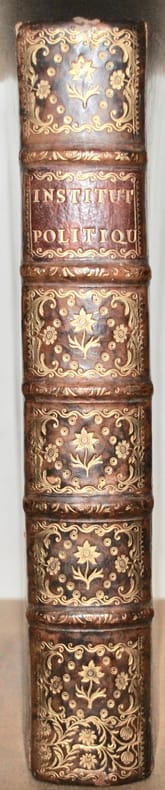
17602006A La Haye, chez Pierre Gosse Junior, 1760. 2 tomes en 1 vol. in-4 de (4)-IV-(2)-358-(6) pp. et (6)-344-(6) pp., veau havane glacé, dos orné à nerfs, tranches rouges (reliure de l'époque).
1760128439à La Haye, chez Pierre Gosse junior, Libraire de S. A. S. Monseigneur le Prince, M. DCC. LX., 1760 In-4 25 x 20 cm. Reliure de l’époque veau havane marbré, dos à nerfs encadrés, pièces de titre et de tomaison maroquin fauve, 2 ff. n. ch., IV-358-[8]-344-[6] pp., table à la fin de chaque volume, portrait en frontspice du baron par Stein gravé par Houbraken, complet des 4 tableaux repliés concernant l’Isle de France pour l’année 1759.
17946424Stockholm: Anders Jac. Nordstrom 1794. 4to 3 vols. in 2 second edition of volumes 1 and 2; first edition of volume 3; 4pp. 388 columns 264 columns 874 columns 2pp. 984 columns; 4pp. & 594-600 columns 94 columns; full contemporary calf gilt slightly scuffed; else fine. Volume 3 1794 contains a separate section for additions and corrections. From the library of George Stephens. Anders Jac. Nordstrom unknown
17946424Stockholm: Anders Jac. Nordstrom 1794. 4to 3 vols. in 2 second edition of volumes 1 and 2; first edition of volume 3; 4pp. 388 columns 264 columns 874 columns 2pp. 984 columns; 4pp. & 594-600 columns 94 columns; full contemporary calf gilt slightly scuffed; else fine. Volume 3 1794 contains a separate section for additions and corrections. From the library of George Stephens. <br/><br/> Anders Jac. Nordstrom unknown books
1776WRCAM47955London: Sayer & Bennett 1776. Single sheet 29 x 22 inches. Some light toning and offsetting. Very good. A highly important chart of the entrance into the St. Mary's River showing the soundings shoals and navigational details as well as Tiger Island Marteirs Islands part of Amelia and Cumberland Islands and the ruins of Fort William which was built by James Oglethorpe. It shows settlements and named plantations including that of the Countess Dowager of Egmont with the slave quarters labeled in the map key. The map also includes a key to the rivers buildings etc. indicated on the map and sailing directions into the harbor. This chart was originally published in the second part of THE NORTH- AMERICAN PILOT. In 1776 shortly after news of American Independence reached Great Britain publishers Sayer & Bennett issued a second part to their previously published THE NORTH-AMERICAN PILOT to encompass the coastline of the American colonies. The maps issued here include famed cartographic productions by John Gascoigne Joshua Fisher Anthony Smith and others. Many maps include additions reflecting the early battles of the war such as the plan of Charlestown showing the attack on Fort Sullivan. This second part of THE NORTH-AMERICAN PILOT was first published in 1776 and subsequently reissued with additional maps in 1777. SELLERS & VAN EE 1632. Sayer & Bennett unknown books
180041277London: William Richardson 1800. Plate: 196x144 mm. Margin: 275x200 mm. Little faint soiling right and bottom margins are trimmed faint crease in top right margin. William Richardson unknown books
180041277London: William Richardson 1800. Plate: 196x144 mm. Margin: 275x200 mm. Little faint soiling right and bottom margins are trimmed faint crease in top right margin. William Richardson unknown
174950405Erlangen: Printed at Joh. Friede. Becker's University Print shop 1749. First edition. Hardcover. Good to fine condition. Quarto. 16 206 386 2 14 256 270 34pp. 30 plates plus frontispiece. Fully rebound in three-quarter brown leather over textured paper-covered boards with blind-stamped ruling on cover gilt lettering and brown ruling on spine; raised bands. Cream endpapers. Frontispiece engraving by Gottfried Eichler 1715–1770. Both title pages printed in red and black. Historiated and decorative initials head and endpieces. <br /> <br /> Magnus Opus of Johann Christoph Georg Bodenschatz theologian and orientalist in Erlangen.<br /> <br /> This extensive work on the ecclesiastical status of the German Jews is drafted from their own and other writings. It is illustrated with thirty engravings plus frontispiece. The preface is by Kaspar Jacob Huth. Dedicated to Friederich Margrave of Brandenburg.<br /> <br /> Volume one Part one treats the origin and the fate of the Jewish people part two the church and the service of the German Jews. Volume two part three the distinguished faith and doctrines of the German Jews and part four other customs and the Jew's unique way of life. The work “treats living conditions services rituals faith and doctrines of the Jews based on his own observations. It is a formidable source particularly in view of his impartial open-mindedness for the practice of ceremonies of the German Jews before the Emancipation. The precious engravings are prepared especially for this work.†NDB II 355. Contains thirty-four page register at rear.<br /> <br /> A second edition was published under the title “Aufrichtig Deutsch redender Hebräer Sincere German speaking Hebrew†in 1756. The beautifully configured engravings at time decorated with rocaille cartouches show rites during holy days everyday life customs cult objects scripts etc. Some of the engravings were taken from B. Picart’s “Cérémonies et Coutumes religieuses de toss les peoples."<br /> <br /> Bodenschatz 1717–1797 was a German Protestant theologian educated in Gera. His teacher Schleusner interested Bodenschatz in Biblical and Oriental studies. It is said that Bodenschatz created elaborate models of Noah’s Arch and the Tabernacle as a young man. Bodenschatz went on to study oriental languages at the University of Jena. He entered the church became vicar at Uttenreuth and superintendent at Bauerndorf in 1780.<br /> <br /> Text in German Gothic script. Binding with sunned spine. Water-staining on verso of frontispiece and bottom margin below etching not affecting image. Library stamp on title page and its verso. All plates are mounted to foredge of blank bound-in pages and folded. Some staining in margins on plates iv and xii lightly affecting the upper right of image foredges of plates with light wear. 12 plates are bound in after part I. Plate vii of part II with light water staining affecting image lightly at top and bottom plate viii light water staining at bottom else only in margins. Foredges with light wear and creasing. Binding and interior in overall good to very good condition. Printed at Joh. Friede. Becker's University Print shop hardcover
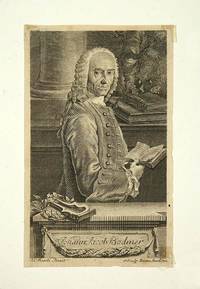
17581118AG1758. 1758. Kupferstich nach Johann Caspar Füssli. Bildgrösse: 16 x 95 cm. Blattgrösse: 165 x 10 cm. Füssli Johann Caspar 1707-1782: Schweiz. Maler Vater von Heinrich Füssli. unknown
17581118AG1758. Kupferstich nach Johann Caspar Füssli. Bildgrösse: 16 x 9,5 cm. Blattgrösse: 16,5 x 10 cm.
17753220Bath: S. Hazard for T. Mills 1775. 8vo. xvii 3 445 1 pp. Modern full calf red morocco spine label. Displeasing glue residue in gutter margin of first blank and title-page both of which are a little browned age-toning throughout not objectionable; top edge of textblock with stain near the head-cap which did not permeate through the text itself. Provenance: Mary Knowles contemporary signature on title - see below. A good copy with faults and priced accordingly. Was the "Mary Knowles" who first owned this 18th-century English translation of Boehme's first work the same as the well known English Quaker mystic poet feminist and abolitionist namely Mary Morris Knowles 1733-1807. While we have been unable to procure an autograph of Mary Morris Knowles with which to compare the two signatures if she did not own this particular copy of Boehme it is almost certain that she had in her library at least one of Boehme's texts.<br/><br/>This edition was published by Thomas Mills ca. 1735-1820 formerly a clerk in the one of the Countess of Huntington's chapels where he preached "in the Methodist way." It is not without interest that in 1778 Mills became a Quaker sic.<br/><br/>A German shoemaker turned mystic Boehme's writings found renewed interest in England during the late 18th century influencing Quakers Methodists and mystics alike William Blake in particular. Indeed Blake "inherited from Boehme the ideas which formed the foundation of his philosophy and his myth" Gerald Bentley "William Blake and the Alchemical Philosophers" B.Litt. Thesis Oxon. 1954 p. 233<br/><br/>Our copy is COMPLETE. The only other copy of this edition on the market is both ugly and seriously defective lacking everything after p. 390.<br/><br/>ESTC T216620. On Mary Knowles see: J. Jennings Gender Religion and Radicalism in the Long Eighteenth Century: The "Ingenious Quaker" and Her Connections Burlington VT: Ashgate Publishing 2006. J. Jennings "Mary Morris Knowles: Devout Worldly and 'Gay'" in: Quaker Studies Mar. 2010 vol. 14 No. 2 pp. 195-211. S. Hazard for T. Mills unknown books
1730374635Good. 1730. Hardcover. Front spine edge starting to split. Pages are heavily foxed. Vellum covers are heavily darkened. Some kind of ink stamp on front blank. Handwritten Jacob Bohmen's Theosophische Schriften III on the spine. Antiquarian bookseller label on the front endpaper. ; German text. ; 896 pages . hardcover
176412347Groningen Jacob Bolt 1764/1776. 10 250 35 z.p. 86 6 p. Origineel Leren band met ribben en goudbestempeling 8°. Groningen , Jacob Bolt unknown
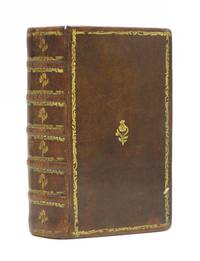
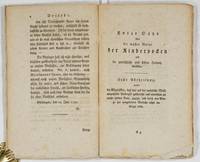
1792700781792. Aus dem Holländischen übersetzt. - Stendal bey Franzen und Grosse 1792 8° 102 pp. 1 Blatt Verlagsanzeigen Pappband d.Zt.; feines Expl. Erste deutsche Ausgabe! Inhalt: Kurze Sätzen über die wahre Natur der Kinderpocken und die gemächliche und sichere Heilung derselben. Erste Abtheilung worin die Möglichkeit daß auf die natürliche Weise mitgetheilten Pockengift geschwächt und unwirksam gemacht werden könne bezeigt und durch eine Menge gut ausgefallener Versuche näher bestätiget wurde. Zweyte Abtheilung. Entdeckung des Geheimnisses oder Auseinandersetzung der Verfahrungsart nach welcher die natürlichen und künstlichen Pocken auf eine gemächliche Weise zu behandeln sind. Anhang über das Besondere der sechs verschiedenen Mittel denen on der Erzählung der angestellten Versuche in den Genees- Natur- en huishoudkundige Jaarboeken 4ter Theil 1stes und 2tes Stück Erwähnung geschehen; wie auch über die näheren in der Epidemie 1784 gemachten Vermehrungen und Verbesserungen. Iman Jacob van den Bosch auch Immanuel Jakob van den Bosch oder Iman Jacob van den Bos 173-1788 niederländischer Mediziner und praktischer Arzt in Den Haag. Leben; Sohn des Offiziers Cornelis van den Bosch 1694-1749 und Barbara 't Hooft 1694-1749. Er studierte an der Universität Leiden Medizin promovierte unter dem Namen Iman Jacob van der Bos 1757 mit seiner Dissertation De vivis humani corporis solidis in Leiden und wirkte anschließend als praktischer Arzt zunächst in Sommelsdijk und ab 1760 dann in Den Haag. unknown
175755948Leipzig Breitkopf 1757-62. Bound in 5 uniform contemp. hcalf. Raised bands. Richly gilt spines. Tome-and titlelabels with gilt lettering. Stamp on title-pages. Light wear to two top of spines. Engraved portrait as frontispiece. In all ca. 3700 pp. Internally clean. hardcover
177015458Lovanii: Typis Academicis 1770. 2 volumes. Brown half leather. Marbled covers. iilxiv624 pp. & ii828 pp.; 25x20 cm. Text in Latin. - leather dam. edges covers dam./ rubbed library stamp on title pages title page vol. 1 stained paper sl. browned poor binding although still very good set - see image at our wesite ¶ Title on spines = 'De Muis in Plmos'. Typis Academicis hardcover
175755948Leipzig, Breitkopf, 1757-62. Bound in 5 uniform contemp. hcalf. Raised bands. Richly gilt spines. Tome-and titlelabels with gilt lettering. Stamp on title-pages. Light wear to two top of spines. Engraved portrait as frontispiece. In all ca. 3700 pp. Internally clean.
176854703Leipzig Caspar Fritsch 1768. Contemp. full calf. 4 raised bands. Titlelabel with gilt lettering. A paperlabel pasted on lower part of spine. Wear to spine ends. Light wear along edges. 14346 pp. 1 large folded engraved map. Internally clean. <br/><br/><em>First German edition. </em> hardcover
176854703Leipzig, Caspar Fritsch, 1768. Contemp. full calf. 4 raised bands. Titlelabel with gilt lettering. A paperlabel pasted on lower part of spine. Wear to spine ends. Light wear along edges. (14),346 pp., 1 large folded engraved map. Internally clean.