734 résultats
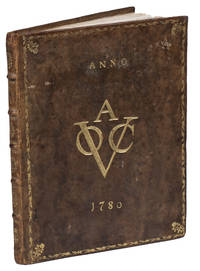
1780ABC_48891The Netherlands 1780. Late 18th-century gold-tooled brown mottled calf sewn on 5 supports bound by the so-called Acorn-and-Foliage Tool Bindery in Amsterdam Storm van Leeuwen. Both boards show the large gold-tooled monogram of the Amsterdam chamber of the VOC as a centre piece sandwiched between the gold-tooled date Anno 1780 all within a gold-tooled floral frame with floral corner pieces in the inside corners spine gold-tooled in six compartments red sprinkled edges. 4to ca. 19 x 15 cm. Manuscript in French written in black ink on paper in a neat cursive script by one hand. With chapter divisions numbered 39-75 and headings. The text is written upside down in relation to the binding. Most leaves show an identical watermark depicting a lion rampant on a pedestal with Vryheyt in a crowned ring with Pro Patria Eiusque Libertate and the letters CR below which is very close to Heawood 3149 date: 1753. Late 18th-century manuscript copy of a French childrens catechism by the Swiss theologian Jacob Vernet 1698-1789 bound in a remarkable late 18th-century binding originally produced for the Amsterdam Chamber of the Dutch East India Company VOC by the so-called Acorn-and-Foliage Tool Bindery which was active between ca. 1760 and ca. 1784 Storm van Leeuwen.It shows the large monogram of the Amsterdam Chamber of the VOC sandwiched between the date "Anno 1780" on both boards. These bindings were usually commissioned as gifts to persons important to the VOC often containing an almanac for the relevant year but possibly also produced as blank notebooks. The present work comprises chapters 39-49 and 58-75 of Vernet's work which form almost the second half of printed editions. The chapters included in the present work are complete and exactly follow the order of the printed text in the Geneva 1742 edition pp. 75-140 checked using a digital copy with a slightly different spelling and replacing some words. For unclear reasons chapters 50-57 dealing with the fourth through tenth commandment have not been copied and several leaves between the end of chapter 49 and the beginning of chapter 58 have been left blank.Vernets religious text was first published in 1741 under the title Instruction chrétienne ou catechisme familier; avec quelques prières a lusage des petits enfans . In 1742 a revised edition appeared with a slightly different title Instruction crhetienne ! ou catechisme familier. Avec quelques passages de lEcriture Sainte & quelques prières à lusage des petits enfans. Nouvelle edition. Revuë corrigée & augmentée. Both works were printed in Geneva for the Swiss bookseller Emanuel Du Villard Emmanuel Duvillard 1693-1776 and subsequently reprinted several more times until 1769. With the book block showing the remnants of 12 removed leaves probably already removed before the manuscript was finished. Both pastedowns partly detached an old annotation Ao. 44305 in black ink on the lower pastedown some foxing. Otherwise in good condition.l For the binding: Landwehr/Van der Krogt VOC pp. XXVII-XXVIII; Storm van Leeuwen I p. 175 p. 196 VOC A-stamp and pp. 612-616 the bindery; for Vernet's work: Google Books digital copy of the 1742 ed. title: Instruction crhetienne ! ou Catechisme familier; physical copy at the Biblioteca Universitaria di Torino; WorldCat 951908419 1 copy 1767 ed.; WorldCat 1040828976 1 copy 1769 ed. no author noted; for the watermark: Heawood 3149. hardcover
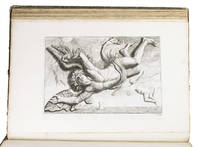
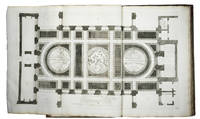
1719ABC_48483Amsterdam: David Mortier 1719. Contemporary quarter brown sheepskin sewn on 5 supports with the corresponding raised bands on the spine the title lettered in gold on the spine sprinkled paper sides red sprinkled edges. Royal folio. With a title-page in red and black with an engraved device a portrait of Erasmus in an elaborate cartouche with allegorical figures and 124 engraved architectural and sculptural illustrations on 109 numbered plates 6 double-page 103 full-page. First French edition of Van Campen's famous description of the Amsterdam City Hall the present day Royal Palace with more than a hundred plates of the architectural features and sculptures of the building including ground plans elevations and sections of the interior and exterior. Particularly impressive are the giant plates of the tympana which are more than 160 cm wide when fully unfolded. The work also includes the famous plate of the extraordinary cartographic mosaic floor of the Burgerzaal which shows the zodiac signs that were originally painted on the celestial map in the middle but are now no longer visible on the floor itself due to fading.The City Hall is the most famous and last major work by Jacob van Campen 1595-1657 the greatest Dutch architect of the 17th century. He began work on the design in 1640 and though the building opened in 1655 it was not actually completed until 1665. It was called "the eighth wonder of the world" at the time and is still considered the most important Dutch monument from the 17th century. It was designed to show off Amsterdam's wealth and magnificence. This is especially visible in the Burgerzaal the heart of the building which depicts Amsterdam as the centre of the world. The impressive mosaic floor with a celestial map in the centre and the two maps of both hemispheres of the world on either side symbolises that the world was at Amsterdam's feet. These maps are the largest ever made. They show Abel Tasman's then recent discoveries in Australia and Tasmania. Many discoveries from his second voyage remained otherwise unpublished until the end of the 17th century.The present work is the French edition of Van Campen's Afbeelding van 't stadt huys van Amsterdam 1664. The plates were drawn by Hubert Quiellinus 1619-1687 and Danckert Danckertsz. 1634-1666 and his father after drawings by Jacob Vennekool 17th century and were first published in Quiellinus' Prima et secunda pars praecipuarum . curiae Amstelrodamenis 1655-1663 and Afbeelding van 't stadt huys van Amsterdam in dartigh coopere plaaten . geteeckent door Jacob Vennekool 1661. As such most of the present engravings were published before the building was completed and may therefore reflect Van Campen's plan more closely than the finished building itself. The edges and corners of the boards are scuffed the spine has been rubbed with loss material old restoration at the head and foot of the spine. The text leaves are lightly browned the plates are very clean.l BAL 132; Berlin Kat. 2235; STCN 182312917 5 copies of which 1 incomplete; cf. Fowler 77 & 274 1661 Danckerts eds.; for the map see also: Schilder Australia Unveiled map 66; Shirley 423. David Mortier, hardcover
1780K6QE3E6Q77WKAmsterdam 1780. Large folio 49.5 x 30 cm. Johannes Covens Cornelis Mortier and Johannes Covens junior Contemporary half red roan sheepskin brown sprinkled paper sides. With the title page printed in red and black with J. Covens & C. Mortiers engraved device by Bernard Picart JCCM cypher monogram in a laurel wreath carried by 6 putti dated 1730; 2 preliminary plates containing portraits of Jacob van Campen by Lutma and Arthus Quellinus by Henricus Quellinus; CIX 109 numbered engraved and etched architectural plates 7 folding 30 double-page and 72 single-page a few printed from 2 or 3 copper plates distinguished by arabic numerals showing plans elevations tympana ceilings floors statues festoons and other ornamentation mostly engraved by Hubertus Quellinus after Arthus Quellinus but some after R.V.H. Rombout Verhulst. All plates have French captions some with laudatory verses below and are described in Dutch in the letterpress text pp. 3-15. 15 pp. A comprehensive collection of plates showing all architectural features and sculpture of the Amsterdam City Hall since 1808 the Royal Palace here in the Covens & Mortier firm's rare ca. 1780 issue with the engravings newly printed from the original copper plates from the years 1655 to 1664 and the text reissued from Leonardus Schenk's 1747 Dutch language edition the whole with a new title-page. ''This version has not been seen'' BAL. At least most of the plates were engraved for and first published in Jacob van Campen's masterpiece Afbeelding van 't stadt huys van Amsterdam Amsterdam Frederick de Wit 1664 Hubert Quiellinus's Prima et secunda pars praecipuarum . curiae Amstelrodamenis Amsterdam Frederick de Wit 1655-1663 and Afbeelding van 't stadt huys van Amsterdam in dartigh coopere plaaten . geteeckent door Jacob Vennekool Amsterdam Dancker Danckerts 1661.It includes the famous plate showing the extraordinary cartographic mosaic floor of the Burgerzaal of the Amsterdam City Hall designed by Jacob van Campen with a celestial map in the centre and the magnificent map of the world in 2 hemispheres on either side. The engraving was first published in 1661 and the map shows Tasman's recent discoveries in Australia and Tasmania and depicts California as an island. Many discoveries from his second voyage remained otherwise unpublished until the end of the 17th century. The drawing of the floor was made by Jacob Vennekool who worked closely with Van Campen and since his drawings were first published even before the building was completed they may reflect Van Campen's plan more closely than the finished building itself. They also of course show it before the alterations made at various times in later years.Binding a little worn untrimmed otherwise in good condition. The Amsterdam city hall in full glory with all its architectural features and sculpture.l BAL 132 note description of 1719 French language ed. but citing Berlin Kat. & Kuyper for unseen "1730" Dutch ed.; Berlin Kat. 2236; Kuyper Dutch Classicist architecture Delft 1980 pp. 212- 215 and note 25 p. 318; STCN 3 copies; cf. for dating the impressum: Van Egmond Covens & Mortier 2005 pp. 66 83-88. ABE CAT Architecture ABE CAT Art History unknown
179253921St. Gallen, in Commission bey Huber und Compagnie, 1792. 8°. Mit gest. Titelportrait u. gest. Titelvignette. 4 Bll., 147 (1) S., Marmor. Kart. d. Zt.
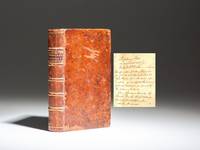
177415772Philadelphia: John Dunlap 1774. First Edition. Full leather. Very good. First edition of Observations on a Variety of Subjects; Literary Moral and Religious published by John Dunlap in 1774. Twelvemo x 241pp 1. Full calf thin gilt trim to fore edge of covers. Five raised bands title in gilt on morocco label affixed to spine. Binding heavily worn some peeling and a few wormholes to covers rubbed head and tail of spine still sound. Heavy toning internally text is still legible. George Brinley 3135 Hildeburn 3008 Evans 13259 Sabin 21055 Inscription on front free endpaper: "The following Letters are supposed to be wrote by The Rev. Mr. Dushe. such was the information of Dr. Henry Purcel Recnor of Sr. Micheals Charleston S.C. to Col. John Beale; from the same information as it appears the name of Tamoc Caspipina was formed of the following initials. The Assistant Minister of Christ Church And St. Peters or Pauls In Philadelphia In North America." A very rare example with only one other copy on the public market. This is the original edition of "Caspipina's Letters" with the final letter of the volume signed by "Tamoc Caspipina."<br /> Jacob Duché 1737-1798 was an American Episcopal clergyman known for his role in the early days of the American Revolution. He gained historical significance as the first chaplain to the Continental Congress and for delivering the opening prayer at the First Continental Congress in 1774. However in 1777 he defected to the British side and urged George Washington to negotiate peace with the British. Duché fled to England to escape criticism from the revolutionaries only returning to the states after suffering a stroke in 1792. John Dunlap unknown
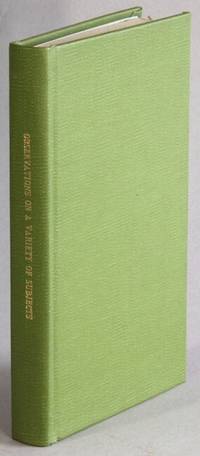
179169544London: J. Deighton 1791. Third edition 8vo pp. xii 206 2; rebound in modern green buckram gilt title on spine; "Aldine collection" stamp on verso of title page pencil annotation in text and another in ink on penultimate leaf final two leaves with a couple holes not affecting text some light foxing; good largely on account of the unfortunate rebind. Duché was a Pennsylvania born preacher who turned from Revolutionary to Loyalist during the Revolutionary War after his arrest by the British. After the war he was effectively exiled to London where he remained until 1792. ESTC T98030. J. Deighton unknown
17124343Rome: Francesco Gonzaga 1712. Extremely rare first edition of this luxuriously illustrated anthology of extracts from papal sermons delivered between 1703-09 in Latin prose and facing Italian verse: an unusual example of Baroque ecclesiastical culture from the pontificate of Clement XI. On the basis of extreme rarity and contents the volume numbers among those commemorative and honorific volumes which were never sold in the trade but offered as a ceremonial gift to cardinals ambassadors and other important personagescorroborated by the ownership inscription in the present volume by a monsignor during Clements papacy. The volume is singular in our experience for its contents. Latin extracts of Clements sermons generally rather brief are printed on the left side of the page then freely and somewhat copiously versified in Italian by the poet Guidi. The sparsity of the elegantly printed text leaves positively wasteful margins! Each sermon is preceded by a full-page engraving on the subject of the sermon the Holy Family adoring the Christ Child for Christmas the Resurrection for Easter etc. designed by Pietro Leone Ghezzi one of the principal artists in Clements retinue and engraved by Roman engravers generally also associated with Clementine projects Frey van Westerhout etc. The designs were made expressly for the present volume and are echoed as it were in a series of initials and vignettes devoted to the same theme; as such they must have been engraved for the present volume and not simply taken from the printers stock. If somewhat overshadowed by Maratti in his lifetime and by his epoch-making role as the first professional caricaturist Ghezzi 1674-1755 was nonetheless an important painter of religious subjects who worked on Albanis most prestigious public projects. The surfaces of Ghezzis paintings were considerably less finished than those of Maratti and he seems more receptive to Venetian color and unfinishednessthus showing a different aspect of Albani taste. Ghezzi was commissioned in 1712 the year this book was published to paint The Election of St. Fabian for the Albani Chapel in S. Sebastiano fuori le Mura. Within the next decade he helped paint the frescos the ancient basilica of S. Clemente and the nave decoration of St. John Lateran. His portraits including one of Clement XI are unusually informal and realistic possibly due to Ghezzis experience at caricature. Alessandro Guidi 1650-1712 who translated the sermons was a prolific Arcadian poet. OCLC records a single copy Berkeley and we locate no additional American copies. Large 4to. 28 x 20.5 cm engraved portrait of Clement XI xvi pp. full-page engraving 213 pp. including 5 full-page engravings paginated with text. 18th-c. vellum over boards spine with 5 raised bands and red morocco label gilt-stamped; covers with large blind-tooled central ornament blind-tooled filets and ornaments. Short tears at head and foot of spine and a few nicks there. Early inscription on front pastedown mentions Monsignor Bianchini Prelato Domestico e Camerario segreto di S. Santita Papa Clem. XI. Mild finger-soiling in margins of title and a little foxing on some text leaves but overall a very fine attractive copy. Francesco Gonzaga hardcover
171963083[Basel] , Joh. Jacob Genath, 1719. 4°. 32 S., Geheftet (ausgebunden).
17305023<p>Copperplate engraving 83.5 x 55.5 cm 1 folio. Fold marks minor edge wear otherwise a very good copy in very crisp dark impression.<br /></p><p>Rare large-format engraved print produced in 1730 as part of the celebrations of the 200th anniversary of the Augsburg Confession 1530 one of the foundational documents of Lutheranism. The subject of the print is the famous Tranquebar Mission in southern India which was established by King Frederick IV of Denmark 1671-1730 and led by the German missionaries Bartholomäus Ziegenbalg 1682-1719 and Heinrich Plütschau 1676-1752 who are noted for having translated the Bible into Tamil and arranged for its printing.</p><p>The engraving executed by Johann Jacob Kleinschmidt after a design by Elias Riedinger is a splendid example of 18th-century Augsburg printmaking. It takes as its compositional conceit a church altar surmounted by a framed retable. The image above the altar depicts the German missionaries preaching to an audience of natives; in the background of this scene can be glimpsed a statue of 'Biruma oder Brama' Brahma. The elaborately carved frame of the retable is enlivened with vignettes illustrating the successes of the Lutheran mission e.g. an Indian smashing an idol a native being baptized a domesticated elephant symbolizing the people under God's yoke etc.</p><p>Placed atop the altar are oval portraits of Ziegenbalg and Plütschau their names written in Tamil and the books they translated an Indian bible an Indian catechism and an Indian hymnal. A map of southern India hangs on the front face of the altar. Flanking the altar are two young natives: the boy on the left holds the Danish Royal arms and the boy on the right displays the architectural plan of the New Jerusalem Church in Tranquebar built by the Germans and dedicated in 1719. In front of the altar are fallen symbols of the old dispensation. At the foot of the sheet is a poem in Latin and German celebrating the expansion of the Lutheran faith to all corners of the world.</p><p>The engraving is one of several quite ambitious broadside prints produced in Augsburg to commemorate the bicentennial of the Augsburg Confession some of which apparently reproduced paintings executed for the occasion. These rather disparate graphic productions were collected by Johann Michael Roth in 1730/31 and released as a small-edition composite volume with an added engraved title page reading <i>Augspurgisches Iubel-Gedächtnüs</i>. The contents of this rather odd production vary greatly from copy to copy. Kleinschmidt's <i>Vorstellung der Evangelisch-Ost-Indischen Kirche</i> engraving apparently was a commercial success because in 1736 citing demand he released a small-format version of the work its composition slightly altered.</p><p>OCLC locates U.S. examples of the <i>Augspurgisches Iubel-Gedächtnüs</i> at Illinois Duke Getty Stanford Princeton Yale Harvard Emory Concordia Seminary and Cal. State Sutro. The Getty copy includes Kleinschmidt's <i>Vorstellung der Evangelisch-Ost-Indischen Kirch</i> but it is not clear which other examples include this engraving.</p><p>Drugulin <i>Historischer Bilderatlas</i> 4112; S. Neill <i>A History of Christianity in India</i>.</p> Kleinschmidt
176832180New York: Hugh Gaine 1768. pp iv 289 13 as issued. Boards detached. Old rubberstamp on front free endpaper and title page. Scattered foxing one leaf tape-repaired no loss. Good. <br /> <br /> This first American edition from the seventh London edition is considered the first layman's self-help law guide printed in America. Jacob calls his book "an instructive treatise writ in the easiest method and adapted to every capacity whereby the unskilful and those who are ignorant in the practice of the law may in some measure be their own advisers and readily avoid the common errors too often happening in the prosecution of suits." It "has been revised and corrected and many valuable additions inserted." <br /> FIRST AMERICAN EDITION. Evans 10935. I Harv. Law Cat. 1035. Marke 248. Marvin 300 8th London 1787. Hugh Gaine unknown
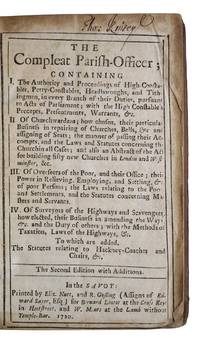
1720AQ17466London In the Savoy: Printed by Eliz. Nutt and R. Gosling.for Bernard Lintot.and W. Mears 1720. 4 138pp 10. Contemporary blind-ruled sheep. Rubbed and marked some scoring to boards lower joint split. Pastedowns sprung without fly-leaves minute worm-track to foot of text-block early inked ownership inscriptions of William Kinsey and Thomas Kinsey to FEP and head of title respectively. An early revised and extended edition of a vade mecum designed to assist parish administrators in their interpretation and enforcement of increasingly complex laws surrounding social reform including the Poor Law Act of 1601 and its numerous amendments the duties of constables and highway surveyors and the statutes relating to hackney coaches. First published in 1718 the work is commonly attributed to legal writer Giles Jacob bap. 1686 d. 1744 author of The Compleat Court-Keeper 1713 ESTC N4920. Second edition. 12mo. Printed by Eliz. Nutt, and R. Gosling...for Bernard Lintot...and W. Mears hardcover
1723AQ32419London: Printed and Sold by A. Bettesworth 1723. In two volumes. xxvi 6 444 i.e. 344; 2 vii 13 334pp 22. With an engraved frontispiece to each volume and a further 12 engraved plates. Errata slip pasted to verso of A8 Vol. I. Contemporary panelled calf later rebacked contrasting red morocco lettering-pieces. Heavily rubbed some surface loss to boards corners exposed. Leaves lightly browned scattered spotting small marginal hole to leaf R8 of Vol. I very occasional early manuscript annotations. A 'poetical register' composed by Giles Jacob 1686-1744 best remembered for his legal writings. It catalogues a canon of English poets in alphabetical order. Jacob's poetry and plays were less well received and his work earned him a place in Pope's Dunciad as 'the blunderbuss of the law'. ESTC T137465. 8vo. Printed, and Sold by A. Bettesworth hardcover
1720205887London: E. Curll 1720. First Edition. Armorial bookplates Lloyd Vincent Almirall; internally clean externally worn especially on spines. Two vols. 8vos frontispiece 2 vii 15 334 22; frontispiece xxvi 4 328 9; contemporary panelled calf recased and rebacked; gilt dentelles marbled edges. Large paper copy with engraved portraits and index in each volume. E. Curll unknown
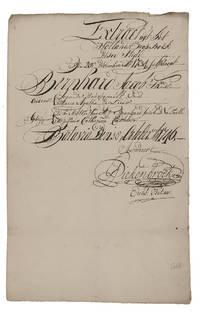
17465615Batavia 1746. 1 leaf 32.5 x 20.5 cm. In Dutch. Extract from the register of baptisms of the Dutch Reformed Church at Batavia recording the baptism of Bernard Jacob de Mauregnault son of Joan de Mauregnault and Maria Agatha De Leeuw on 28 December 1734. Witnesses were Mr Bernard Jacob De la Faille and Miss Catharina Castelein. The document is signed by the minister of the Dutch Reformed Church at Batavia Gerradus Piekenbroek and dated Batavia 18 October 1746. Bernard Jacob Mauregnault started his career in Surinam; his passport of the West India Company dated 1760 is kept in the Amsterdam City Archives.In very good condition. unknown
175717534Coloniae Agrippinae (Cologne), Paris, Londres, J. Barbou, 1757. Deux ouvrages en un volume in-12 de [2]-108; 192-[4] pages, plein veau havane marbré, dos lisse orné de fleuron et filet dorés, pièce de titre en maroquin grenat, triple filet doré en encadrement des plats, roulette dorée aux coupes et aux chasses, tranches dorées.
1735r006.134GB: A La Haye Chez Jan Den Kieboom Etc 1735. FRENCH TEXT. 167 x 95 mm. 547 and 484 pages . Full brown calf with NEW TAN CALF SPINE with five raised bands and gold rules and red title label lettered in gold. Books are in very good condition with minor signs of wear and/or age. . Hardback. VG/No DW. A La Haye Chez Jan Den Kieboom Etc Hardcover
176815781768 Sans nom d'éditeur, Amsterdam, 1768. in-12, cartonnage muet d'époque, 182 pages.
1755elala1109np: np 1755. 1755. 12mo. pp. 174. old marbled wrs. new paper spine. First Edition in Duodecimo Format. An attack on the English territorial claims and pretensions against the French in North America including discussion of the terms of the Treaty of Utrecht 1713 the disputed geographical limits of Acadia and the outbreak of hostilities in the Ohio Valley 1754. This is one of a number of polemical pamphlets issued by Moreau during the Seven Years War. Also published in Paris in quarto format.Casey I 164. Dionne II 516. JCB I 1071. Lande 656. Sabin 50563. TPL 6418. 1st Edition. np: np, 1755. unknown
1756elala1110Paris: l'Imprimerie Royale 1756. 1756. 12mo. pp. viii 275. full modern mottled calf a few scattered stains. First Duodecimo Edition. Published the same year as the first edition in quarto. This is the French reply to an English memorial addressed to the courts of Europe stating their position on the war on the Ohio justifying their actions and setting forth their claims to the region west of the Alleghenies. Accusing the English of unprovoked aggression and foul play the French sought to demonstrate that it was Washington's 'assassination' of Jumonville in the Fort Necessity campaign among other offensive actions which had sparked the war. Most of the text is composed of 'pièces justificatives' comprising documents and letters written between 1749 and 1755 by La Jonquière Governor of New France Albemarle Rouillé General Braddock Contrecoeur Villiers Sir William Johnson George Washington and Robert Stobo an engineer with Washington who had planned Fort Necessity. Among the more important papers are translations of the instructions given to Braddock by the British Crown letters to and from Braddock and Sir William Johnson and various officials two of Johnson's 'harangues' to the Indians and the first printing although in French translation of extracts from the journal kept by George Washington in the 1754 expedition to fortify the forks of the Ohio that ended with the British surrender to the French at Fort Necessity in July 1754 pp. 109-146. This is quite distinct from Washington's first journal of his mission for Governor Dinwiddie late in 1753 printed at Williamsburg in 1754. Most of these British papers were seized by the French following the capitulation at Fort Necessity. An early work on the French and Indian War described by Lawrence Wroth in his John Carter Brown Library report for 1945-46' as "one of the most important documents in American colonial history." Dionne II 548. JCB I 1123. Lande 657. Sabin 47511. TPL 250. Vlach 549. cfHowes M-787 different pag. cfGagnon II 1369 & cfStreeter II 1013 first in 4to. Wroth American Bookshelf p. 22. 1st Edition. Soft cover. Paris: l'Imprimerie Royale, 1756. Paperback
177863071Ohne Ort, ohne Verlag bzw. Drucker, 1778. 4°. Mit Holzschn.-Titelvignette. 4 nn. Bll., Geheftet (ausgebunden).
1758016251Philadelphia: William Bradford 1758. First Edition. Hardcover. Title page with a few repaired tears hinged with following Preface page; two adjoining leaves pages 441-444 of text lacking and supplied with facsimiles. Contents Very Good binding about Fine. Folio 7-1/4" x 11-1/2" bound in contemporary calf leather with a decorative blindstamped border recently rebacked with a new gilt-lettered and decorated spine preserving original paste-downs and free endpapers; 4 763 pages. Title within rule border decorative woodcut head- and tail-pieces. An important compilation of the fundamental New Jersey charters and session laws of the proprietary period 1664 to 1702 up to Lord Cornbury's commission and instructions as Royal Governor when New Jersey became a crown colony under Queen Anne. Publication was ordered by the New Jersey Assembly in 1752 but two years were required to collect the documents to be included while the typesetting and printing took Bradford an additional three. By the date of publication some 170 copies had been subscribed. This title was the largest volume issued from Bradford's press and one of the largest from any eighteenth-century American press. Evans 8205; Sabin 39527. Early owner name on the title page and early twentieth century names on the front pastedown. <br/><br/> W[illiam] Bradford hardcover
1719F5OGBDYNZ8OAAmsterdam: Gerard Valk 1719. Very large engraved folding plan comprising 1 1/2 sheets measuring 46 x 83 cm as assembled engraved by Danckert Danckertsz. and his father after drawings by Jacob Vennekool including the two hemispheres of the world map and a celestial map of the constellations of the northern hemisphere each 10 cm in diameter. Very large engraved plan showing the extraordinary cartographic mosaic floor of the Burgerzaal of the Amsterdam City Hall designed by Jacob van Campen with a celestial map in the centre and the magnificent map of the world in 2 hemispheres on either side. The engraving was first published in 1661 and the map shows Tasman's recent discoveries in Australia and Tasmania and depicts California as an island. Many discoveries from his second voyage remained otherwise unpublished until the end of the 17th-century. This engraved representation is all that is left of this cartographical work of art. Wear caused by people walking on the mosaic meant it had to be restored about a hundred years later. When in turn this restoration was damaged the two hemispheres were filled in with plain marble slabs without pictorial representation.The drawing of the floor was made by Jacob Vennekool who worked closely with Van Campen and since his drawings were first published even before the building was completed they may reflect Van Campen's plan more closely than the finished building itself. They also of course show it before the alterations made at various times in later years.Slightly wrinkled in the right margin one fold reinforced and a few tiny spots otherwise in very good condition.l Cf. BAL 533 1st Dutch ed.; Fowler 77 & 274 1st Dutch ed.; Berlin Kat. 2235 1st French ed. Gerard Valk, unknown
172263082[Basel], Drucktens Em. und Joh. Rud. Thurneysen, Gebrüdere, (1722). 4°. Mit einer Holzschn.-Anfangsvignette. 36 S., Geheftet (ausgebunden).
175139062Frankfurt / Leipzig: ohne Verlag 1751. Titel, 102 Seiten. Mit drei Holzschnittvignetten. Kl. 4° (23 x 19 cm). Unbeschnittener Block. Interimsumschlag aus Kiebitzpapier.
173711025Ulm Daniel Bartholomé 1737 -in-12 argent ciselé sur peau de requin un volume, reliure allemande d'époque en argent sur peau de requin noir avec plats avec encadrement merveilleusement et finement ciselé : thème floral et fermoirs tout aussi finements travaillés en argent (une petite merveille) in-douze (duodecimo), dos à nerfs (spine with raised bands) muet (without title), toutes tranches dorées (all edges gilt) avec dessins à froid réalisés par le relieur sur les tranches, orné d'une gravure en frontispice (frontispiece) et 4 gravures hors-texte (full page engraving) de scènes Bibliques gravées sur cuivre en noir par FRIDRICH Jacob Andreas " le vieux" 1684-1751 ( graveur allemand, Graveur à Nuremberg, mort à Augsbourg, père de Bernhard Gottlieb et de Jacob Andreas le Jeune) , 407 pages, 1737 Ulm Daniel Bartholomé Editeur,