734 résultats
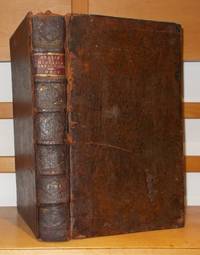
178254808Dessau, Societé typographique, 1782. Bound in fine contamp. full mottled calf, raised bands and profusely gilt spine with gilt lettering. A small paperlabel pasted on lower part of spine. Gilt borders on covers, edges of covers gilt. XXIV,502,XV pp., 7 large folded engraved plates. Clean and fine.
178254808Dessau Societé typographique 1782. Bound in fine contamp. full mottled calf raised bands and profusely gilt spine with gilt lettering. A small paperlabel pasted on lower part of spine. Gilt borders on covers edges of covers gilt. XXIV502XV pp. 7 large folded engraved plates. Clean and fine. <br/><br/><em>First edition. </em> hardcover
1774620911774. Argentorati Apud Bauerum & Socium Bibliop. 1774 8° 8 656 pp.; Loc Auctorum & Sylabus Rerum 102 pp.; Corrigenda & Addenda 2 pp. Pappband d.Zt.; feines fleckenfreises Expl. Erste Auflage - "das vollständigste Lehrbuch dieser Disziplin der Pharmakognosie zu damaliger Zeit" Hirsch/H. "Das umfangreichste Werk Spielmannss die "Institutiones materiae medicae praelectionibus academicis accomodatae" behandelt in neun Hauptkapiteln nährende stärkende erweichende reizende stillende verdünnende verdickende einsaugende und abführende Arzneimittel." Christoph Friedrich Während seiner von April 1770 bis August 1771 dauernden Straßburger Studienzeit folgte Johann Wolfgang von Goethe während des Wintersemesters als Gasthörer den Vorlesungen Spielmanns an der Straßburger Universität und in der Hirschapotheke. Von Spielmann übernahm er auch den Ausdruck 'encheiresin naturae' wörtlich übersetzt: "Zugriff der Natur". Spielmann meinte damit dass natürliche Kräfte die Bestandteile einer Substanz selbige zu einer Gesamtheit verbinden. "wunderliche Vor- und vielmehr Überkenntnisse" Brief Goethes an Frl. v. Klettenburg " Adlung/Urdang p.147496 Jacob Reinbold Spielmann 1722-1783. "Das Geschlecht Spielman oder Spilmann läßt sich in Straßburg schon im 15. Jahrhundert nachweisen. Johann Jacob S. erwarb dort 1657 von dem Großvater seiner Frau Albrecht Weßnec die Apotheke zum goldenen Hirschen welche wie es scheint schon 1268 oder doch 1349 die gleiche Stelle einnahm wie heute noch; sie bildet eine Ecke des Münsterplatzes und der Krämergasse. Jacob Reinbold der berühmte Sohn des genannten Apothekers geboren zu Straßburg am 31. März 1722 wurde von 1735-1740 von dem Vater in jener Apotheke unterrichtet wo schon 1733 der nachmals ausgezeichnete Chemiker Andreas Sigismund Marggraf ADB XX 334 als Gehülfe thätig und nicht ohne Einfluß auf den jungen Spielmann gewesen war. Diesem genügte die Pharmacie nicht; er studirte zugleich an der Universität alte und neue Sprachen und Philosophie. 1740-1742 reiste er in Deutschland um sich vielseitig auszubilden. In Nürnberg z. B. arbeitete S. in der Apotheke von J. A. Beurer in Berlin hörte er Chemie bei J. H. Pott ADB XXVI 486 und besonders bei dem ihm sehr befreundeten A. S. Marggraf in Freiberg Mineralogie bei Henkel. 1742 machte sich S. in Paris mit dem ausgezeichneten Pharmaceuten Claude Joseph Geoffroy mit den Botanikern Antoine und Bernard de Jussieu mit Réaumur und anderen Gelehrten bekannt. 1743 bestand er in Straßburg die Apothekerprüfung und trat in das väterliche Geschäft ein. Seine Studien betrieb S. jedoch mit solchem Eifer daß er hauptsächlich durch den Kliniker Sachse seinen Schwiegervater angeleitet 1748 in der medicinischen Facultät promovirt und bald zum außerordentlichen Professor berufen wurde. Auf Grund der Universitätsstatuten und der Ordnungen des Thomasstiftes erhielt Spielmann 1756 die vielbegehrte Professur der Eloquenz; pro forma hatte er sich mit griechischer und lateinischer Poesie zu befassen. Doch wurde ihm 1759 eine ordentliche Professur der Medicin übertragen welche ihm die Verpflichtung auferlegte auch über Chemie Pharmakognosie Materia medica und Botanik zu lesen so wie den botanischen Garten zu leiten. Daß er nebenbei namentlich seit des Vaters Tode 1748. die Apotheke fortführte kam seinen Vorlesungen zu gute; sie wurden wie es heißt in dem schon oben erwähnten Eckhause gehalten. In der Histoire de l'Académie royale des Sciences et Belles Lettres Année 1758 Berlin Haude & Spener 1765 105 bis 128 veröffentlichte Spielmann einen bemerkenswerthen Bericht über das elsässische Erdöl unter dem Titel: Sur le Bitume d'Alsace. Er verglich den flüchtigen Antheil von 0808 spec. Gewicht mit den ätherischen Oelen und besprach auch die Fluorescenz der schwerer flüchtigen Antheile. Spielmann war zuerst 1745 mit einer Tochter des Professors der Medicin Joh. Bapt. Sachse in Straßburg verheirathet und nach deren Tode mit einer Tochter des Straßburger Kaufmanns Joh. Daniel Engelhardt. Trotz seiner so außerordentlich vielseitigen Thätigkeit verfaßte S. eine Reihe größerer und kleinerer Schriften deren vollständiges Verzeichniß sich in den hiernach angeführten Schriften von Wittwer Oberlin und Dechambre findet. Er machte sich zuerst durch Untersuchungen der Mineralquellen von Niederbronn Sulzbach und Petersthal bekannt hierauf besonders durch die "Institutiones Chemiae" 1763 die "Institutiones Materiae medicae" 1774 und die "Pharmacopoea generalis" 1783. Ferner "Prodromus Florae Argentinensis" 1766. Nach seinem Tode 10. September 1783 erschien in Leipzig eine Sammlung seiner kleinen medicinischen und chemischen Schriften und 1785 veröffentlichte Johann Jacob S. der Sohn Jacob Reinbold's. eine deutsche Uebersetzung der Materia medica des letzteren unter dem Titel: "Anleitung zur Kenntniß der Arzneimittel zum Gebrauche der Vorlesungen". "Friedrich August Flückiger ADB XXXV pp.171-173 siehe - Friedrich Christoph "Spielmann Jacob Reinbold" in: Neue Deutsche Biographie 24 2010 pp. 688-689 Ferguson II pp.391-394; Partington II pp.689-690; Boltom p.844 unknown
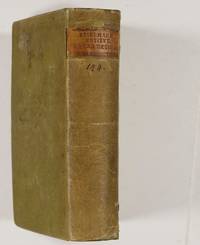
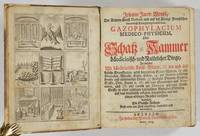
1729702381729. Leipzig Bey Friedrich Lanckisches Erben 1729 4° 8 1035 68 pp. rot/schw. Titel mit Titgelvignete Frontispiece Halbpergamenteinband d.Zt. Vollständiger Titel: "D. Johann Jacob Woyts Oeffentlichen Lehrers der Artzney-Kunst in Königsberg Gazophylacium Medico-Physicum Oder Schatz-Kammer Medicinisch- und Natürlicher Dinge$dIn welcher Alle Medicinische Kunst-Wörter inn- und äusserliche Kranckheiten nebst dererselben Genes-Mitteln alle Mineralien Metalle Ertzte Erden zur Medicin gehörige fremde und einheimische Thiere Kräuter Blumen Saamen Säffte Oele Hartze etc. alle rare Specereyen und Materialien und viel curiöse zur Mechanic gehörige Kunst-Griffe in einer richtigen Lateinischen Alphabet-Ordnung auf das deutlichste erkläret vorgestellet und mit einem nöthigen Register versehen worden. Die Sechste Auflage Aufs neue mit Fleiß übersehen verbessert und vermehret." Eines der beliebtesten medizinischen Lexika des 18. Jahrhunderts dessen erste Auflage 1701 unter dem Titel "Deutsches vollständig-medicinisches Lexicon" erschienen ist und das bis 1784 siebzehn Auflagen erreichte. Die Beiträge waren kurz gehalten gingen aber über eine bloße Begriffserklärung oft deutlich hinaus. Johann Jacob Woyt "geb. 14. August 1671 zu Elbing studirte in Königsberg und Leipzig provirte 1697 in Kopenhagen mit der Diss. "De chylificatione" wurde 1706 Professor in Königsberg 1709 Arzt der Epidemieen und starb 29. December 1709. Er schrueb unter Anderem noch: "Thesaurus pharmaceutico-chirurgicus oder gründliche Erklärung der Kunstwörter welche in Lesung deutscher med. Bücher vorkommen" Leipz. 1696; 1709; 1737; 1751 - "Heimlichkeiten des ganzen weiblichen Geschlechts" Danzig 1700 - "Trifolium chirurgicum" Leipzig 1705 - "Unterricht von den tödtlichen Wunden des ganzen menschlichen Körpers" Dresden 1716 - "Abhandlung aller innerlichen und äusserlichen Krankheiten " Leozig 1731; 140; 1753 . "Gazophyxlacium medicophysicum oder Schatzkammer medizinischer und natürlicher Dinge tec. Etc." Leipz. 1709; 12. Aufl. 1746; 15. Aufl. 1761." Pagel Hirsch-H. IV p.999 Zu Woyt siehe - Karl Reiss J.J. W.'s Schatzkammer in Wiener med. Presse. 1872 XIII p.129 unknown
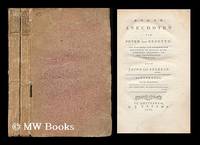
1787222478Te Amsterdam : by J. Yntema 1787. First Edition. Paperback. Fair copies bound in stiff-card wrappers which are considerably worn particularly around the spine covers. Wrappers have detached from volume 1. Internally reasonably bright and clean considering the age of the set. There is some damp staining evident in volume 1 running from the half-title fading to page 15. Binding or reading copy only.; 8vo 8"" - 9"" tall; 183 pages; 1st Dutch edition. 2 volumes: 183 225p.; 22cm. Language: Dutch. Subjects: Peter the Great -- Russia -- History -- Jacob von Staehlin-Storcksburg. Te Amsterdam : by J. Yntema paperback
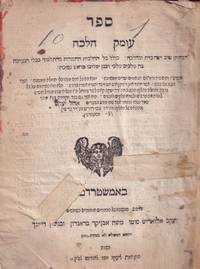
17103736Amsterdam 1710. Second edition. 19. c. half-cloth. The title page of the first work is torn but intact this was fixed with a strip of paper by its former owner the title page of the second work is dirty the following pages have slight rust stains. Numerous woodcut illustrations mathematical and astronomical charts diagrams and symbols. Including woodcut illustration of the Temple Candelabra on f. 32v and of the Kohen Gadol's clothing on verso of final unnumbered leaf. Numerous woodcut illustrations mathematical and astronomical charts diagrams and symbols. Including woodcut illustration of the Temple Candelabra on f. 32v and of the Kohen Gadol's clothing on verso of final unnumbered leaf. Second edition. 19. c. half-cloth. 40 p. <p>This work examines Talmudic references to mathematics botany engineering and geography. Also establishes the site of the Temple and its furnishings - all with the aid of vivid and vibrant diagrams and models.<p> Bound with Tzurat Beit ha-Mikdash by Yom Tov Lipmann Heller Frankfurt am Main 1714. unknown
178135359Leipzig 1781-1800. vom Anfang der Reformation bis zu der Einführung der Konkordienformel 6 Bde. in fünf Bden. Ecken teilw.bestossen insgesamt aber in gutem Zustand Holzm.-Boh.2 6360 Crusius 8°. Pbd. Religion unknown
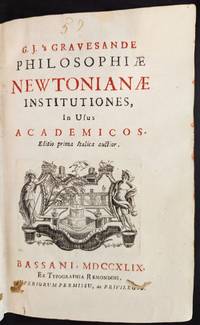
17491333Bassani: ex Typographia Remondini 1749. <p>8vo. 175 x 12 mm. 6 ¾ x 4 ½ inches. 28 244; 1 245-571 21 pp. Illustrated with 18 engraved plates of diagrams. Bound in contemporary vellum title label on spine; vellum a bit soiled with age diagrams of spheres with interior designs drawn on both covers; preliminary leaves with wormhole at lower right corner otherwise a fresh copy.</p> <br /> <p>First Italian edition of Gravesande’s student textbook explaining Newton’s physics and the most influential introduction to Newton’s works produced to date. Originally published in 1723 Gravesande’s works was on the Index until 1749 and therefore out of reach of students and most men of science in Italy. This work written in Latin for students begins with a description of the nature of matter in general and moves on to matter in motion the mutability of matter the forces which are exerted by a body in motion and the elasticity of matter when collisions occur in nature. Gravity is the next subject which Gravesande attempts to convey to his students followed by lectures on light and color. The 18 engraved plates bound throughout the text include numerous examples the illustrate the content explained in the six chapters of the book.</p> <br /> <p>Gravesande was a Dutch philosopher and mathematician member of the Royal Society of London who laid down the foundations for teaching physics. He was the most influential exponent of Newtonian science outside of England and this work is an abridged version of his Physices Elementa Mathematica and is the first textbook dealing with Newtonian physics.</p> . ex Typographia Remondini unknown
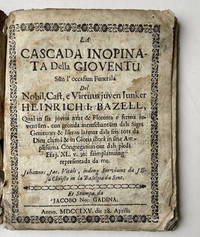
17655287<p>VITAL Johannes Jacob. La cascada inopinata della gioventü sün l'occasiun funerala del nobil cast e virtuus juven junker Heinrich I. Bazell. Gadina Scuol Jacobo Not 1765.</p><p>4to pp. 52 title within woodcut ornamental border title stained some marginal dampstains last few leaves with marginal worming touching a number of letters on final leaf corners frayed; sewn into contemporary wrappers reusing sixteenth-century German almanac leaves painted black on the outside; spine very worn.</p><p>A very rare funeral notice in Romansh or Raeto-Romance on the occasion of the early death of the young nobleman Heinrich Bazell. This eulogy is then extended to general reflections on premature death.</p><p>Romansh is considered to be one of the oldest Romance languages in Europe. It was originally spoken by people living in Raetia during the Roman Empire's rule over Europe. After Rome fell the language continued to develop independently from Latin - the language from which all Romance languages are derived—and developed its distinct characteristics. Over time it spread throughout what is now Switzerland and became widely spoken among local populations there. It is recognised as one of the offiicial languages of Switzerland together with Swiss German French and Italian.</p><p>OCLC: Cornell Berlin State Library; see Bazzell Pietro: La via verso la morte del giovane Andri. - En: Quaderni Grigionitaliani n. 1 2003 p. 83.</p> Jacob Not
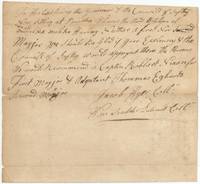
1777413501Princeton 1777. Unbound. Very Good. Laid paper. Approximately 7.5" x 7". Old folds with small tears at the edges ink has burned through in one small spot general age-toning very good. Docketed on the verso. In full:<br /> <br /> "To His Excelensy the Governor & the Council of Saftey sitting at Princeton. Whearas the third Batalyn of Middlesex militia Having Neither a first Nor second Mayjor We should be glad if your Exelensey & the Council of Saftey would appoynt there the persons we would recommend is Captin Robbert Nixon Robert Nixon for First Mayjor & Adjutant Thommas Egburts Thomas Egbert Second Mayjor.<br /> <br /> Jacob Hyer Coll.<br /> Wm. Scudder Lietenant Coll"<br /> <br /> Col. Jacob Hyer was the proprietor of Sign of the Hudibras a Princeton inn that was a center of Revolutionary foment where students and patriots would meet. He was close to the upper echelons of the Continental command and hosted John Adams and the New England delegation to the First Continental Congress. He was entrusted by Washington to bail out John Honeyman a double agent who was perhaps Washington's most reliable spy when he was arrested for high treason as a Tory. The taverns of New Jersey were central as meeting places for the Revolutionary effort. Hyer and Scudder were appointed to their positions in 1776. Hyer commanded the Third Middlesex Militia at both the Battle of Princeton on January 3rd 1777 and at the Battle of Monmouth in June of 1778.<br /> <br /> William Scudder was a prosperous Princeton miller who served in the Army throughout the War. Robert Nixon was a tanner from New Brunswick who distinguished himself as the Captain of Nixon's Troop of Light-Horse of Middlesex when he was indeed promoted to Major in the 3rd Middlesex. It appears that Thomas Egbert was promoted as well although less seems to be known of him.<br /> <br /> Interesting Revolutionary War document centered around Princeton which in itself was at the epicenter of the action at that time during the Revolutionary War. unknown
1701015598Norimbergae: Norimbergae : Sumtibus Joannis Hoffmanni vid. & Engelberti Streckii Bibliopol 1701. Book measures 34.5x22.cm. Collation half title engraved frontis 8 257143813pp. Numerous. Coat of arms woodcuts in the text. Bound in full period or early calf raised bands leather label marble edges. At some time the binding has been partially repaired. Calf rubbed worn with loss on head and tail of spine hinge joints split but boards holding. Generally binding in good condition. Internally moderate tanning throughout heavier in places. Pages in good condition. A good copy.F. Full Calf. Near Very Good. Folio. Norimbergae : Sumtibus Joannis Hoffmanni vid. & Engelberti Streckii, Bibliopol Hardcover
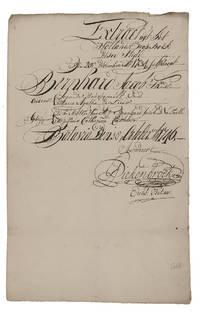
17465615Batavia 1746. 1 leaf 32.5 x 20.5 cm. In Dutch. Extract from the register of baptisms of the Dutch Reformed Church at Batavia recording the baptism of Bernard Jacob de Mauregnault son of Joan de Mauregnault and Maria Agatha De Leeuw on 28 December 1734. Witnesses were Mr Bernard Jacob De la Faille and Miss Catharina Castelein. The document is signed by the minister of the Dutch Reformed Church at Batavia Gerradus Piekenbroek and dated Batavia 18 October 1746. Bernard Jacob Mauregnault started his career in Surinam; his passport of the West India Company dated 1760 is kept in the Amsterdam City Archives.In very good condition. unknown
17383600Amsteldam Martinum Schagen 1738. Hardcover. . ~ ~ NOTE: THE PRICE OF THIS BOOK IS CURRENTLY REDUCED! ~ ~ . Three parts in one volume. With a total of 92 plates. Royal quarto 280 x 225mm. I: Pp. xiv iv half-title second title-page dated 1737 viii 186 6 index. Plus engraved frontispiece and engraved portrait. II: 64 numbered copperplate leaves each with 12 illustrations of coins printed on recto only. III: Pp. 28 second engraved frontispiece a suite of 12 splendid copperplate portraits of Roman emperors mounted on horses with historiated backgrounds each portrait accompanied by a verse engraved at bottom. Plus a 13th such plate this with allegorical illustration concluding the suit. Plus 12 copperplate leaves each with 12 illustrations of coins printed on recto only. Main title-page printed in red and black. Footnotes; small chip to blank margin of a single plate well away from image. HARDCOVER bound in contemporary quarter goat skin dyed and glazed and marbled boards spine with 5 raised bands; paper on boards rubbed corner-tips bit worn. In a very good external condition and in fine internal condition. A wide-margined copy untrimmed. Exceptionally bright interior; crisp plates. ~ The first and only enlarged edition of this work. Beautifully illustrated this edition has an extended number of plates with a total of 912 coin impressions on 76 copperplates; 2 engraved frontispieces one engraved bust portrait and a remarkable suite of 13 exquisite equestrian emperor portraits engraved by C. de Passe after Johannes Stradanus Jan van der Straeten 1523-1605. The work went through several editions was first printed in Antwerp in 1615 and 1627 Beller; later in Berlin in 1705 Rüdiger. In 1738 publisher Martin Schagen got the publishing rights and issued the present copy. He could now reset the entire work and print it in elegant quarto format add the Johannes Stradanus suite of portraits extra suite of coin illustrations and allow the plates the freedom to remain bound separately from the text. The edition was printed on handsome laid paper with ample margins and the strikes of the plates are remarkably more beautiful than these of their predecessors. I-1 <br/> <br/> Amsteldam, Martinum Schagen hardcover
17950161-B1795. Radierung, Rom 1795, auf Velin. 37,4:27,8 cm. Literatur: Andresen 27, I (von II) mit der gerissenen Schrift. - Vorzüglicher Abdruck des 1. Zustandes, mit Rand um die Plattenkante. Aus der in Zusammenarbeit mit J.Chr. Reinhart (1761-1847) und J. Mechau (1745-1808) entstandenen Folge: ?Mahlerisch radirte Prospecte von Italien?, zu der jeder Künstler 24 Blätter beitrug. Provenienz: Sammlung J.N. Seiler, München, nicht bei Lugt.
17950158-B1795. Radierung, Rom 1795, auf Bütten. 28,2:37,6 cm. Literatur: Andresen 23, I (von II) mit der gerissenen Schrift. Brillanter Abdruck des 1. Zustandes, mit Rändchen um die Plattenkante. Aus der in Zusammenarbeit mit J.Chr. Reinhart (1761-1847) und J. Mechau (1745-1808) entstandenen Folge ?Mahlerisch radirte Prospecte von Italien?, zu der jeder Künstler 24 Blätter beitrug. Provenienz: Sammlung J.N. Seiler, München, nicht bei Lugt.
17950159-B1795. Radierung, Rom 1795, auf Bütten. 28:37,7 cm. Literatur: Andresen 24, I (von II) mit der gerissenen Schrift. Brillanter Abdruck des 1. Zustandes, mit Rändchen um die Plattenkante. Aus der in Zusammenarbeit mit J.Chr. Reinhart (1761-1847) und J. Mechau (1745-1808) entstandenen Folge ?Mahlerisch radirte Prospecte von Italien?, zu der jeder Künstler 24 Blätter beitrug. Provenienz: Sammlung J.N. Seiler, München, nicht bei Lugt.
17930150-B1793. Radierung, Rom 1793, auf Velin. 28,5:37,8 cm. Literatur: Andresen 10, I (von II) mit der gerissenen Schrift. - Brillanter Abdruck des 1. Zustandes mit Rand um die Plattenkante. Aus der in Zusammenarbeit mit J.Chr. Reinhart (1761-1847) und J. Mechau (1745-1808) entstandenen Folge ?Mahlerisch radirte Prospecte von Italien?, zu der jeder Künstler 24 Blätter beitrug. Provenienz: Sammlung J.N. Seiler, München, nicht bei Lugt.
173250433Tübingen, Johannis Georgii Cottae, 1732. Folio. Bound in one contemp. full blindtooled pigskin. 5 raised bands. Remains of clasps. Engraved frontispiece. Engraved portrait. (14),692(6),241,(21) pp. and 19 engraved heraldic plates, depicting many coat of arms. Last plate with a little wormtract, 6 folded genealogical tables. Some scattered brownspots.
173250433Tübingen Johannis Georgii Cottae 1732. Folio. Bound in one contemp. full blindtooled pigskin. 5 raised bands. Remains of clasps. Engraved frontispiece. Engraved portrait. 14692;624121 pp. and 19 engraved heraldic plates depicting many coat of arms. Last plate with a little wormtract 6 folded genealogical tables. Some scattered brownspots. hardcover
173650817AB18 Teile und Register und 4 Teile in 11 Bänden. Zürich, Conrad Orell und Comp. 1736-1739. 8°. Mit einem gestochenen gefalteten Porträts Lauffers als Frontispiz. Pappbände der Zeit mit goldgeprägten Rückenschildern.
17477898J. J. Gebauer Halle 1747-1748 1747. privater Einband. 4° 3 Bände I. 885s 7 Kupfer.davon 4 Karten II. .687s 5 Kupfer.davon 2 Karten III. 756s 4 Kupfer davon 2 Karten . in gutem Zustand AZB67. HC J. J. Gebauer, Halle 1747-1748, hardcover
17946424Stockholm: Anders Jac. Nordstrom 1794. 4to 3 vols. in 2 second edition of volumes 1 and 2; first edition of volume 3; 4pp. 388 columns 264 columns 874 columns 2pp. 984 columns; 4pp. & 594-600 columns 94 columns; full contemporary calf gilt slightly scuffed; else fine. Volume 3 1794 contains a separate section for additions and corrections. From the library of George Stephens. Anders Jac. Nordstrom unknown
17946424Stockholm: Anders Jac. Nordstrom 1794. 4to 3 vols. in 2 second edition of volumes 1 and 2; first edition of volume 3; 4pp. 388 columns 264 columns 874 columns 2pp. 984 columns; 4pp. & 594-600 columns 94 columns; full contemporary calf gilt slightly scuffed; else fine. Volume 3 1794 contains a separate section for additions and corrections. From the library of George Stephens. <br/><br/> Anders Jac. Nordstrom unknown books
173442907Hamburgi: Rudolphum Beneken 1734. 4to pp. 8 35 1 unpaginated lexicon in double column one folding plate wood cut head-pieces; full contemporary sheep blind-tooled spine in 7 compartments contemporary printed paper spine label cracked; illegible contemporary notes on front pastedown lacking front free endpaper else very good and sound. Serenius was chaplin to the Swedish embassy in London 1725-35 where he tried to strengthen the relations between Sweden and Great Britain. It was during this time that he began work on his dictionary. The preliminary essay "De veterum Sveo-gothorum cum Anglis usu et commercio dessertatio" by Ericus Benzelius highlights the parallels between Anglo-Saxon and Swedish and he acknowledges in his Preface the work of George Hickes John Hudson Henry Dodwell Thomas Smith and Sir Humfrey Wanley. Kennedy 2724; this edition not in Vancil or Zaunmüller. <br/><br/> Rudolphum Beneken unknown books
173442907Hamburgi: Rudolphum Beneken 1734. 4to pp. 8 35 1 unpaginated lexicon in double column one folding plate wood cut head-pieces; full contemporary sheep blind-tooled spine in 7 compartments contemporary printed paper spine label cracked; illegible contemporary notes on front pastedown lacking front free endpaper else very good and sound. Serenius was chaplain to the Swedish embassy in London 1725-35 where he tried to strengthen the relations between Sweden and Great Britain. It was during this time that he began work on his dictionary. The preliminary essay "De veterum Sveo-gothorum cum Anglis usu et commercio dessertatio" by Ericus Benzelius highlights the parallels between Anglo-Saxon and Swedish and he acknowledges in his Preface the work of George Hickes John Hudson Henry Dodwell Thomas Smith and Sir Humfrey Wanley. Kennedy 2724; this edition not in Vancil or Zaunmüller. Rudolphum Beneken unknown