[Heilbrunner, Jakob]. - Gretser, JakobAntiquariat.de

209 résultats
160864953Ingolstadt, Andreas Angermeyer, 1608. 4°. Titel in Rot u. Schwarz m. großer Holzschn.-Vignette. Mit einigen Holzschn.-Vignetten u. -Initialen. 1 Bl., 17 (1) S., 375 (1) S., 1 weißes Bl., Geheftet (ausgebunden; ohne Einband).
165265717Ohne Ort (Basel), Georg Decker, (1652). 4°. 39 (1) S., Geheftet (ausgebunden; ohne Einband).
166365963Ohne Ort (Basel), Jacob Bertsche, (1663). 4°. Titel m. Holzschn.-Bordüre u. -Vignette. 27 S., Geheftet (ausgebunden; ohne Einband).
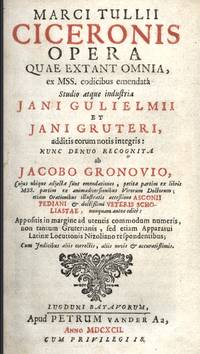
16923306804Lyon: Vander Aa 1692. One part moderately water-stained another with slight marginal worming three of the folding plates repaired. Eleven volumes duodecimo the first with four engraved folding plates and all eleven volumes embellished with charming ornamental title-pages; a handsome set in mid eighteenth-century dark panelled calf with original labels. <p><p>Attractively bound set of Cicero in eleven volumes noted as "respectable and correct" by Moss. The title-page boasts that the accuracy of the text arises from the editorial finesse of Dutch classical scholar Jacob Gronovius whose portrait appears as frontispiece to the first volume curiously the English literary lion Thomas Dibdin claimed the editorial attribution to Gronovius was spurious. Jacob Gronovius was the father of botanist Jan Frederik Gronovius correspondent and patron of Carl Linnaeus and the author of a treatise on the native plants and herbs of Virginia.</p> <p>A charming set in an appealing early binding this is a considerable publication continuously paginated for a total of 3611 pages. The folding engraved plates include the detail of an epigraphic tribute to Cicero and numismatic relics relating to the famed Roman orator.</p> </p> . Vander Aa unknown
166665960Ohne Ort (Basel), Jacob Bertsche, (1666). 4°. Titel m. Holzschn.-Bordüre u. -Vignette. 24 S., Geheftet (ausgebunden; ohne Einband).
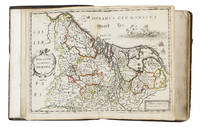
16525476Antwerp 1652. 4to 18 x 14.5 cm. Jan Huyssens Later 17th-century mottled calf sewn on 4 double cords gold-tooled spine and board edges. With a double-page letterpress title-page with a frame built up from typographic ornaments and 39 unnumbered double-page engraved maps of the northern and southern Low Countries by Jacob Aertsz. Colom each map coloured in outline. Interleaved with 38 blank leaves and with a manuscript table of contents 3 3 blank pp. at the end. Double-page title-page and 39 double-page maps. Second known copy of a pocket-atlas published at Antwerp but containing a selection of the maps of the Low Countries originally published by Jacob Aertsz. Colom at Amsterdam in 1635 with the title De Vyerighe Colom the title Colom had first used for his famous pilot guide in 1632 and the name he had given to his Amsterdam printing office where he worked from 1622 to his death in 1673 as a bookseller printer and mapmaker. The only other copy known is at the Royal Library in Brussels. The Vyerighe Colom with 47 maps and 3 plates and with extensive text in Dutch and French went through several editions in the 17th century but it was once thought that all editions before his death in 1673 had been published at Amsterdam by Colom himself. The Royal Library copy like the present one contains 39 maps but each contains one map not in the other so there are forty in total: the present copy includes Drentiae not in the Royal Library copy which includes Le terres entre la Meuse Vahal et Rhin not present here. The maps are also bound in a different order.The present edition is of great interest and gives cause to review Colom's activities. It is printed from Coloms plates so Colom may have licenced the Antwerp publisher to produce a variant edition of his Vyerighe Colom to broaden his market possibly reacting to the signing of the Peace of Münster in 1648 which finally ended the Eighty Years War and opened trade and communication between the northern and southern Low Countries. Jan Huyssens made an entirely new and practical atlas out of Colom's Vyerighe Colom. He omitted all text and the three plates that do not show maps and selected only maps of general interest leaving out the map of the ancient Low Countries and such typical Dutch maps as the separate maps of the polders De Zype Beemster Wormer Purmer Byllemermeer and Waterland also - at least in the present copy - completely rearranging the maps more in order of their geographical sequence. The title suggests that Huyssens originally planned to include a text so the present extremely rare edition may be the only surviving result of an abandoned project.l Koeman & Van der Krogt 365.23 IIIB pp. 644-645 2 copies: the present & Royal Library Brussels; UniCat 99095764 Royal Library Brussels only; cf. Koeman II Col 1 1635 Amsterdam ed.; not in KVK; STCV; WorldCat. unknown
165832984-310Lutetia i.e. Ulm n. pr. 1658. With engr. title. Printed title 2 unn. leaves 297 pp. =295 pp. 1 blank p. 4 unn. pp. last blank "Clavis Heutelia" keys for the numerous anagrams and acyrogolia. 8vo. 18th century half calf. Sm. monastic libr. stamp on title. Lutetia i.e. Ulm n. pr. 1658. Bound with: GRIMM Hans Rudolf. Kleine Schweitzer Cronica Oder Geschicht=Buch.Erstlich woher der Nahmen Schweitzer komme.Benebst auch ein Beschreibung der Natur=Wunder dess Schweitzer=lands. 4 unn. 204 12 unn. pp. index Burgdorf 1723. Ad I: First edition of a notable work of baroque literature Heutelia is one of the few literary products of Switzerland in this time and one of the wittiest. This is a journey description based on satire and utopia. Written by Veiras former advisor of the Winter King i.e. Frederick V Elector of the Palatine and King of Bohemia and by Gravisseth who was Bailiff of Oron it is a critical account on the social conditions in 17th century Switzerland. The title "Heutelia" is an anagram of "Helvetia" the Latin name of Switzerland. "Die Absicht war durchaus die Schäden und Verkehrtheiten der Schweiz aufzudecken" Feller/Bonjour. Politically the travelers represent the aristocracy and take a sharp stand against democratic Switzerland. Ad II: First edition. Although this popular writing contains numerous disortions and errors it is also characterized by lively and interesting descriptions of the mountains rivers and natural wonders of Switzerland.- Nice copy with two rare works bound together. _ - Ad I: Paisey H 1019; VD17 23:299560W; Weller Druckorte I p. 30; Hayn/Gotendorf VII 257; Haller V 1195 under Gravisset;; Barth 2193; Faber du Faur 448; Jantz 2571; Kosch II 969; Feller/Bonjour 405ff.; cf. Baechtold 473f.; not in Bircher/Bürger. Ad II: Haller IV 470; not in VD18 nor in Barth; HBLS III 747; cf. Simmen René. Vom grossen Misch-Masch 1965. LITERATURE: GERMAN ; HELVETICA: ALLGEMEIN ; yes ; Lutetia (i.e. Ulm), n. pr. unknown
169953282(Ohne Ort). Anno M. DC. XCIX (1699). 32 Seiten. Titelbroschur (Geringe Gebrauchsspuren) 19x15 cm
165832984-176Lutetia i.e. Ulm n.pr. 1658. Engr. title printed title. 2 unn. leaves 297 =295 pp. 1 blank p. 2 leaves "Clavis" name keys. 8vo. Contemporary half calf. sm. library stamp on title. Lutetia i.e. Ulm n.pr. 1658. Bound with: GRIMM Hans Rudolf. Kleine Schweitzer Cronica Oder Geschicht=Buch.Erstlich woher der Nahmen Schweitzer komme.Benebst auch ein Beschreibung der Natur=Wunder dess Schweitzer=lands. 4 unn. leaves 204 pp. 12 unn. pp. index. Burgdorf 1723. Ad I: First edition of this interesting work of baroque literature. "In the year 1658 a script was published with the purported place of publication Lutetia Paris that caused a most disagreeable sensation: Heutelia Anagram for Helvetia . It contains the following fiction: A Palatine nobleman and a jurist from Wurttemberg both Protestants flee from the Thirty Years War to Switzerland and making ironical comments as they travel from place to place . The tone is unrestrained satirical and sometimes cynical especially when the status of women is concerned. A lot of brutianism is involved. Behind that facade however there is a scientific seriousness that gets to the bottom of things . The intention was always to uncover the oddities of Switzerland." transl. from Feller/Bonjour. Politically the travellers represent the aristocracy and take a firm stand against democracy. Zurich comes away relatively lightly whereas Bale does not. Of Bern however an unsparing social picture is outlined that led to a storm of protest and the "Gnadigen Herren" tried to surpress the book by all means. "Heutelia" was already identified in the 18th c. as a "liber satyricus rarissimus". Haller talks of a rare work and names as authors Jakob Graviseth or Gravisset Herr zu Liebenegg and Landvogt von Oron. More recent research especially by Walter Weigum declares the "Heutelia" to have been written by Hans Franz Veiras 1577-1672 the secretary of the Palatine Elector and Bohemian King Friedrich V who had fled to Zurich. Graviseth maybe translated and reworked the "Heutelia" from Latin giving it a Swissgerman interpretation. At the end the key to the names is found for example: Guretum=Zurich Sebilacopolis=Bale Rusinopolis=Bern Bonzus Corvinus=Jesuit Druida=Pastor Muftus=Messpriest etc. Ad II: First edition of the historic work by the Burgdorf councilman H.R. Grimm 1665-1749 who participated in the 2nd Villmerger War in 1712. Although this popular writing has many misrepresentations and mistakes it is characterized by its lively descriptions. The work also contains popular descriptions of the mountains rivers and natural wonders of Switzerland. Nice copy of two rare works. _ - Ad I: Paisey H 1019; VD17 23:299560W; Weller Druckorte I p. 30; Hayn/Gotendorf VII 257; Haller V 1195; Barth 2193; Faber du Faur 448; Jantz 2571; Kosch II 969; Feller/Bonjour 405f.; cf. Baechtold 473f.; not in Bircher/Bürger. Ad II: Haller IV 470; HBLS III 747; not in Barth; cf. Simmen René. Vom grossen Misch-Masch 1965. LITERATURE: GERMAN ; HELVETICA: ALLGEMEIN ; yes ; Lutetia (i.e. Ulm), n.pr. unknown