262 résultats
1601WRCAM38446London: Simon Stafford and Felix Kingston for Cuthbert Burby & John Flasket 1601. 1584 leaves. Woodcut vignette of sailing ship on titlepage. Extra-illustrated with 19 engravings numbered 1-3 19 4-18 from Van Neck's HISTORIALE BESCHRIJVINGHE Amsterdam 1619. Text and plates "inlaid to size" remargined to 9 1/4 x 6 3/4 inches. Quarto. 19th-century mottled calf gilt spine gilt gilt leather label. Boards and spine slightly worn. Titlepage and plates mounted to larger sheets; printed pages of text inlaid in larger sheets. Engraved plates annotated in ink with corresponding "page" leaf recto or verso of text. Lacking the dedication leaf paraph 2 and leaf Q4 blank pages shaved with occasional slight loss of text in lower margin rust hole in leaf P3 affecting a few letters on recto tear in leaf Q3 repaired not affecting text. Overall a very good copy with the 1860 engraved bookplate of the Library of the Earls of Macclesfield on front pastedown shelf marks inscribed on verso of front free endpaper. Embossed stamp of the Earls of Macclesfield in upper extended margins of titlepage leaf and following two leaves of text. The first English edition of Van Neck's account of his 1598 voyage to the East Indies translated from the 1601 Amsterdam edition of the author's HET TWEEDE BOECKE. The Dutch navigator who represented the Verre Company commanded three ships which were part of the first successful Dutch trading voyage to the region. The other two ships were commanded by Wybrand Van Warwijck and Jacob Van Heemskerk. Van Neck's vessel became separated from the other two after rounding the Cape of Good Hope and the three did not reunite again until his arrival in Java in late December 1598. Unlike his Dutch predecessor Cornelis Houtman who three years earlier had seized the port of Bantam Van Neck dealt diplomatically with the natives. "Rather than rejecting the inflated prices asked by the local ruler he offered to pay over the odds in order to cement a lasting relationship.Van Neck's was the most profitable of the pre-VOC Dutch East India Company voyages. Despite the apparently high price paid for spices he netted a profit of 300 per cent on his overall costs. In 1601 fourteen fleets comprising sixty-five ships sailed for the East Indies but by that time competition between rival Dutch operators as well as with the Portuguese had inflated prices and none were as successful as Van Neck's first enterprise" - Howgego. While focused on activity in the East Indies EUROPEAN AMERICANA notes that the text includes references to Brazil and tobacco from the West Indies. <br> <br> Van Neck's account was popular throughout the first half of the 17th century and was reprinted and translated into German and French as well as English. It also appeared in collections of voyages such as those by De Bry Hulsius and Colijn. This extra- illustrated copy includes nineteen engraved plates from the Amsterdam 1619 edition of Van Neck's HISTORIALE BESCHRIJVINGHE published by Michiel Colijn. The images are mounted on separate sheets and bound in the book at the appropriate portion of the text. The engravings are annotated in ink indicating the appropriate page i.e. recto or verso of a specific leaf related to the image. <br> <br> A rare book on the market. Prior to this copy from the Macclesfield sale in March 2007 the last copy previously available was sold at the Boise Penrose sale in 1971. Both EUROPEAN AMERICANA and STC record only two copies in the U.S. at the Huntington and NYPL the latter noted as imperfect. EUROPEAN AMERICANA 601/66. STC 18417 noting quires A-G printed by Stafford paraph 2 and quires H-Q printed by Kingston. TIELE-MULLER p.144. HOWGEGO N13. [Simon Stafford and Felix Kingston] for Cuthbert Burby & John Flasket hardcover books
168715216London:: for Bernard White 1687. First edition in English. contemporary calf. Joints starting at head and tail of spine but still quite sound; minor rubing to boards; otherwise a clean very attractive copy. Folio. With 5 plates one folding. Cox I p. 111. Wing S5017. Hans Sloane's copy with his bookplate. for Bernard White, hardcover
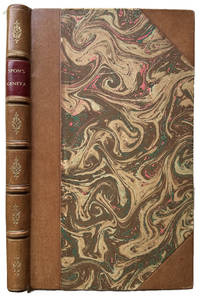
1687TK0098London:: Printed for Bernard White 1687. 1687. 4to. iv 250 6 pp. 5 plates including: engraved frontispiece "Old Geneva" p.9 City Stamps plate p. 107 folding engr. plate of the surrounding regions of Geneva city of Geneva p. 148. Ancient Inscriptions which are to be seen at Geneva p. 193; faint waterstain viewable on the outer margins rear. NOTE: A2 final leaf of Preface trimmed on the right margin replaced with similarly toned paper however with some minor loss of a few letters neatly repaired; some waterstaining. Modern half calf raised bands gilt-stamping red gilt-stamped spine label marbled boards. Ownership signature of the British politician Somerset Davies 1754-1817 of Croft Castle. Bookplate of Robert J. Hayhurst. Handsome copy. First edition in English. Jacob Spon was born into a Calvinist family of German origin in Lyon in 1647. He became a doctor and archeologist traveler and wrote respected studies of Greece. "After a period in Geneva he published Histoire de la ville et de l'Estat de Geneve 1680 a compilation of ancient chronicles of the city state". – Irini Apostolou "Jacob Spon" in: Christian-Muslim Relations 1500 - 1900 vol. 9 Western and Southern Europe 1600-1700 General Editors: David Thomas John Chesworth Brill 2017 pp. 406-412. / With the large folding plate of Geneva and the surrounding area showing Lac Leman / Lake Geneva and all the small municipalities that dot the region such as Eyvan = Evian Morges the mountainous terrain there are even a few cows shown in the plate. The city view of Geneva p. 148 shows the original wall at the city entrance. Spon was a numismatist thus his interest is shown p. 107 with a plate devoted to early coinage of the city. The frontispiece features a view of Geneva with Saint Pierre Cathedral as a focal point. That cathedral dates from 1150 and was founded in the 4th century. / With this text one learns of the origin of the name for the city of Geneva derived from the Latin word for the Juniper shrub which populated the hilly regions there. PROVENANCE: 1 Ownership signature of the British politician Somerset Davies 1754-1817 of Croft Castle; 2 Robert John Hayhurst 1929-2016 inherited and improved a successful group of retail pharmacies John Hayhurst & Son based in Nelson Lancashire. He was a keen collector of naval history and of eighteenth-century literature in contemporary bindings. Printed for Bernard White, 1687. hardcover
16171307120067Thomas Adams 1617-01-01. Hardcover. Good. Folio. Contemporary boards rebacked with later leather spine. 5 raised bands. Solid binding and cover. 20 790 122 p. Generally clean unmarked pages with minor toning. Provenance: Christopher Will 1701. Inked with calligraphic flourish on end page. Thomas Adams hardcover
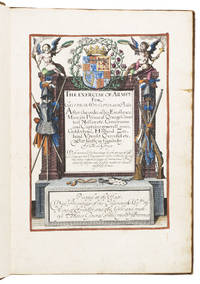
1607ABC_48580The Hague 1607. Folio ca. 37 x 27 cm. Mid-19th-century gold-tooled half faded red morocco and red cloth sides gilt edges marbled endpapers bound in 1840-ca. 1860 by the celebrated British bookbinder Robert Riviere 1808-1882 with his stamp "Bound by Riviere" in the bottom outer corner of the verso of the first flyleaf. With an engraved title page with at the head of the page the coat of arms of the dedicatee Prince Henry Frederick eldest son of King James I of England within a wreath of lilies and roses which - together with the title and the imprint were engraved on 3 separate slips of paper pasted over areas left blank for that purpose; and 117 including one repeat expertly engraved plates ca. 26 x 19 cm: 42 numbered plates in part 1 43 partly-numbered plates in part 2 and 32 numbered plates in part 3. All engravings including the engraved title-page are magnificently coloured and highlighted in gold and silver by a contemporary hand. The plates show exercises with the arquebus part 1 musket part 2 and pike part 3. 3 parts in 1 volume. 4; 2; 3 ll. Splendid copy of this very rare English edition of De Gheyn's illustrated major military manual with the plates in their first state before they were numbered and with some details added during the colouring stage instead of being engraved several puffs of smoke in the illustrations. The present copy is one of the three "presentation copies" of the first English edition New Hollstein The De Gheyn family II p. 159 1b.The history of the publication of the book is complex. It appears that Count Johann II of Nassau-Siegen 1561-1623 commissioned De Gheyn in about 1596 to publish the work together with or with the support of his nephew the great military commander and Stadtholder Prince Maurice who had re-organised the army of the Dutch Republic. Many copies have the engraved date 1607 on the title-page changed to 1608 suggesting that this may have been the true date of issue. The same title-border was used for the various early editions with the engraved texts on slips of paper to be pasted onto the places left blank on the engraved title-page. Different coats-of-arms were used for the different languages. The Dutch issues show for instance the coat-of-arms of Prince Maurice.This work is of the highest interest for military history regarding the early 17th century. It constitutes a simple transparent and well-illustrated manual for the instruction of recruits in the rapid and skilful handling of calivers an obsolete name for the arquebus muskets and pikes which had proven to be essential for the successful and revolutionary way of warfare introduced by Prince Maurice through reforming the Dutch army by introducing exercises and strict discipline in the past years. Fully coloured copies like the present were produced largely for princes and other important persons and were probably coloured by De Gheyn himself who was certainly responsible for the high standard of the colouring. In our copy the title is in the first undated state. All the early editions use the same main plate for the title-page so the text and arms for the editions in various languages and with various dedications were engraved on three separate slips of paper to be pasted over blank spaces: for the coat of arms above the engraved title centre and the imprint and privilege below. The book met immediate success and makes a considerable contribution to our knowledge of military history. The large format editions like the present were followed in 1609 and 1619 by smaller quarto editions with woodcut copies of the original engravings. The present copy varies slightly from other similar copies in that the compiler of this particular copy added plate 34 in part two twice unfortunately omitting part 2 plate 2 in that process and adding 2 plates with minor variants to this copy part 2 plates 29 and 35. Arguably this makes the present copy even rarer.The provenance of the present copy is impressive to say the least. It was most likely the presentation copy from De Gheyn for Robert Cecil first Earl of Salisbury 1563-1612 judging by the paper slip mounted on the recto of the second flyleaf which contains in early 17th-century manuscript the following text: "For my Lord ye Earle of Salisbury". This note is accompanied by a later more extensive annotation below the slip of paper reads: "This appears to have been a presentation copy to Robert Cecil Earl of Salisbury. The above inscription was on the fragment of a flyleaf and is probably the autograph of the author - De Gheyn. signature". Robert Cecil was Secretary of State to Queen Elisabeth I of England and King James I of England. In 1608 around the time the present work was published Cecil was appointed Lord Treasurer. Furthermore the splendour of the expert and strictly contemporary colouring of all engravings including the title-page prove that the present copy was made for a very important person like a nobleman or high statesman. Other bookplates show that the present work was at least part of two other collections. The first of the two is Christopher Turnor 1809-1886 with his bookplate on the front pastedown who was an English Conservative Party politician MP for South Lincolnshire between 1841 and 1847 founder of Stoke Rochford Hall and the son of English antiquarian author and politician Edmund Turnor 1755/56-1829. The second of the two is Hermann Marx 1881-1947 a famous German-born stockbroker and banker and a noted book and print collector. His "very choice and valuable library" was auctioned by Sotheby's in 1948.With the book plate of Christopher Turnor on the front pastedown the book plate of Hermann Marx on the recto of the first flyleaf and the paper slip with the 17th-century dedication to the Earl of Salisbury with the 19th-century note below on the recto of the second flyleaf. The numbers of the plates are added in a contemporary hand since the plates here appear in their first unnumbered state. The first plate of each part also contains Gheyns signature "J. De Gheyn. in." in manuscript instead of as part of the engraving. The binding shows some signs of wear some rubbing along the edges corners and the spine and fading of the leather and cloth on the front board and spine plate 2 in plate in part 2 has been replaced by a duplicate of plate 34 from the same part internally some minor marginal browning or staining but the coloured and highlighted engravings remain fine and clean. Overall in very good condition.l Cockle 79; Keynes New observations on Jacques de Gheyns The Exercise of Arms in: The Print Collectors Newsletter 13 1983 pp. 211-212; Kist Commentary to the facsimile of the Dutch edition 1971; Lipperheide nos. 2057-2060; Meij Jacques de Gheyn II als tekenaar p. 12 nos. 15-20 pp. 45-47; Muller Historieplaten no. 1117 & Suppl.; New Hollstein The De Gheyn family nos. 340-457 descriptions and illustrations of all plates; Regteren Altena Jacques de Gheyn Three generations vol. 2 pp. 64-78 nos. 342-464; Simoni A present for a Prince in: Ten studies in Anglo-Dutch relations 1975; STCN 85107989X 3 copies; cf. Jähns pp. 1005-1007 other eds. ABE CAT Costumes & Uniforms hardcover
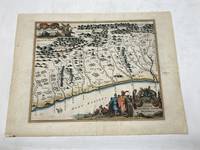
1672100390Amsterdam: Jacob van Meurs 1672. Map. Very Good. Copper engraved hand-colored map of the coastline of the Black Sea covering the region up to the Caucasus Mountains. Map: 11.5 in. x 13.75 in. Paper: 14 in. x 18 in. Brightly colored title cartouche in bollom right corner highlights the trade from the Black Sea/Georgian region to Western Europe. Second colored cartouche in upper left corner. Scale to upper left corner. Map highlights the map that was legendarily built by Alexander the Great that spanned the Caucasus Mountains sealing the uncivilized north Gog and Magog from the civilized southern region. Cities rivers mountains and forests are artistically presented <br /> <br /> Central vertical fold as originally presented. Light age-toning along edges with a couple spots and short tideline to paper's bottom left corner. Small handwritten word "Melpone" on right hand margin of paper. <br /> <br /> This map was published in "Asia Of Naukeurige Beschryving Van Het Rijk des Grooten Mogols." by Olfert Dapper Amsterdam: Jacob van Meurs 1672. Jacob Van Meurs 1619-1680 was a prominent Dutch engraver and map publisher. Jacob van Meurs unknown
1601447181601. Basileae: Typis Conradi Waldkirchii 1601 Kl.4° 28 pp. Pappband. Synopsis febrium imprimis quartanae diexodikon logon / . Pro insignis & privilegiis in Arte Asclepiadea Doctoralibus consequendis discutiendum Iatrogonistis proponit publice Ad diem 22. Iunii . Ioan. Iacobus Crafftius Basiliensis. - Basileae : typis Conradi Waldkirchii 160. Husner: Verzeichnis bas. med. Univ.Schriften Nr. 405 unknown
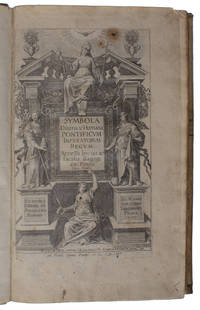
1666JC14675Arnheim: Johann Fridericus Hagius 1666. Hardcover. Very Good. 12mo 135 x 70mm. Pagination: 1 398pp. 26 index. Signatures: 1; A-R12; S7 of 8 lacking final blank one leaf of index unopened. Full-page engraved architectural frontispiece of sacred muses holding holy attributes and 176 plates with 350 devices engravings by Aegidus Sadeler of Prague 1568-1629 laid out in ovals and medallions. 19th-century morocco with gilt monogram cipher of interlocking Cs as cornerpieces and to spine marbled endpapers all edges gilt; rubbing to extremities especially the head of the spine otherwise a good copy with rich impressions. Early monogram bookplate and another later of Bibliotheque I.G. Schorsch on front pastedown. A monogram and motto Nunc nox mox lux are stamped in green on the flyleaf. Another stamp to lower margin of title with French surname Bourcier. <br/><br/>Later Arnheim edition of Jacobus Typotiuss influential collection of emblems detailing parts of sacred ritual in the Latin West church. Typotiuss Symbola Divina et Humana was first published in Prague in three volumes from 1601 to 1603. An extant manuscript of the Symbola Divina et Humana dates to about 1590 and it is known that several copies were made and circulated through the court of Prague. Typotius a Flemish humanist scholar was court historian to Emperor Rudolf II. While his name takes precedence on the title page Typotius was possibly just one of four men responsible for this work. The designs were compiled by Ottavio Strada antiquarian to Emperor Rudolf III and were reproduced by the engraver Aegidius Sadeler. Typotius wrote the Latin commentaries on the impresa except in the fourth book which was the work of Anselm Boethius de Boodt physician to the same emperor. The imprese in Typotiuss work covers a vast array of subjects including the Santa Eucharista Holy Eucharist the Santa Crucis Holy Cross popes kings emperors and rulers of various nations princes clergy and cardinals. Some notable figures represented in imprese include French kings Philip I and Louis VII Henry VIII of England and his queens Anne Boleyn and Anne of Cleves James VI of Scotland Philip II of Spain and unsurprisingly Rudolf II of Bohemia. The work was highly popular in its time and was frequently reprinted in both Germany and in the Netherlands. Praz p. 518; Landwehr 799; Cicognara 1964. Johann Fridericus Hagius hardcover books
165260208Frankfurt, G. Schönwetter, 1652. Folio (335 x 203 mm). Three volumes bound in one contemporary full vellum bindings with title in contemporary hand to spine. Binding with some miscolouring and a bit of wear. Title-page with a few dots and light soiling, otherwise a fine and clean copy. 141, (7), (4), 183, (7), 176, (3) pp. 151 engraved plates included in the pagination. Pp. 171-172 in vol. 2 copied in contemporary hand.
165260208Frankfurt G. Schönwetter 1652. Folio 335 x 203 mm. Three volumes bound in one contemporary full vellum bindings with title in contemporary hand to spine. Binding with some miscolouring and a bit of wear. Title-page with a few dots and light soiling otherwise a fine and clean copy. 141 7 4 183 7 176 3 pp. 151 engraved plates included in the pagination. Pp. 171-172 in vol. 2 copied in contemporary hand. <br/><br/><em>Later edition of Typot’s famous and beautifully illustrated work on emblems. The designs of the emblems were compiled by Ottavio Strada antiquarian to Emperor Rudolf III and were reproduced by the engraver Aegidius Sadeler - Typot wrote the Latin commentaries. The extensive work covers a broad array of subjects such as popes emperors kings and The Santa Eucharista. </em> hardcover
1666JC14675Arnheim: Johann Fridericus Hagius 1666. Hardcover. Very Good. 12mo 135 x 70mm. Pagination: 1 398pp. 26 index. Signatures: 1; A-R12; S7 of 8 lacking final blank one leaf of index unopened. Full-page engraved architectural frontispiece of sacred muses holding holy attributes and 176 plates with 350 devices engravings by Aegidus Sadeler of Prague 1568-1629 laid out in ovals and medallions. 19th-century morocco with gilt monogram cipher of interlocking Cs as cornerpieces and to spine marbled endpapers all edges gilt; rubbing to extremities especially the head of the spine otherwise a good copy with rich impressions. Early monogram bookplate and another later of Bibliotheque I.G. Schorsch on front pastedown. A monogram and motto Nunc nox mox lux are stamped in green on the flyleaf. Another stamp to lower margin of title with French surname Bourcier. <br/><br/>Later Arnheim edition of Jacobus Typotiuss influential collection of emblems detailing parts of sacred ritual in the Latin West church. Typotiuss Symbola Divina et Humana was first published in Prague in three volumes from 1601 to 1603. An extant manuscript of the Symbola Divina et Humana dates to about 1590 and it is known that several copies were made and circulated through the court of Prague. Typotius a Flemish humanist scholar was court historian to Emperor Rudolf II. While his name takes precedence on the title page Typotius was possibly just one of four men responsible for this work. The designs were compiled by Ottavio Strada antiquarian to Emperor Rudolf III and were reproduced by the engraver Aegidius Sadeler. Typotius wrote the Latin commentaries on the impresa except in the fourth book which was the work of Anselm Boethius de Boodt physician to the same emperor. The imprese in Typotiuss work covers a vast array of subjects including the Santa Eucharista Holy Eucharist the Santa Crucis Holy Cross popes kings emperors and rulers of various nations princes clergy and cardinals. Some notable figures represented in imprese include French kings Philip I and Louis VII Henry VIII of England and his queens Anne Boleyn and Anne of Cleves James VI of Scotland Philip II of Spain and unsurprisingly Rudolf II of Bohemia. The work was highly popular in its time and was frequently reprinted in both Germany and in the Netherlands. Praz p. 518; Landwehr 799; Cicognara 1964. Johann Fridericus Hagius hardcover
1698D2444Lubeck: Christoph Gottfried Jäger for Peter Böckmann and Johann Wiedemeyer 1698. Hardcover. Very Good. 4to 190 x 156mm. 16 197pp. 2 including index and errata leaf at end. Dedicated to Joseph I Holy Roman Emperor and first King of Hungary reunited under Hapsburg rule. Over 70 copper-plate engraved illustrations for portraits of kings and emperors of the Roman Empire from Albertus to Sigismundus Franciscus all on coins recto and verso giving heraldry and one engraved chapter vignette heraldic on dedication page. Text in Latin. Later paste-paper boards paper label with manuscript title to spine edges stained red; margins trimmed close lightly toned scattered light foxing; lightly rubbed. German numismatist Jacob von Melle was a renowned poly-historian and a distinguished authority on the town of Lübecks history. Notably Melle was one of the first people to use the term bracteates for thin metal or gold medals. He was also the vicar for his local parish knew ten languages and directed a museum in Lübeck. In his time Melle published countless books; among these a Low German dictionary with 20000 entries and a book about the so-called guldgubber on the Danish island Bornholm guldgubber gold old men are tiny pre-historic gold-plates with a stamped human image. Interesting record with several important imperial portraits and heraldry on coins invaluable to the study of numismatics. <br/><br/> Christoph Gottfried Jäger for Peter Böckmann and Johann Wiedemeyer hardcover books
163711639Dordrecht Hendrick van Esch voor Matthias Havius 1637. 2 uitvouwbare titelprent 52 772 136 p. Origineel Leer met ribben goudbestempeld groot 4° met tekstgravures fraai exemplaar Dordrecht, Hendrick van Esch, voor Matthias Havius unknown
1619WRCAM54737Leiden: Nicolaus a Geelkercken 1619. 1751pp. lacking blank leaf P4 which divides the two narratives but was mistakenly included as pp.119-120 in the continuous pagination; including large engraved vignette on title with twenty-five engraved plates five folding double-page and two large folding maps. Oblong quarto. Contemporary Dutch vellum. Old stains and soiling to boards manuscript "33" in ink on spine edges rubbed boards slightly bowed. Modern bookplate on front pastedown. Minor toning and foxing tiny reinforcement at mounting stub on verso of each large folding map some offsetting. Overall very good. In a blue cloth box gilt leather label. Scarce first Latin edition of one of the bestsellers of illustrated 17th-century travel literature which reports Le Maire's critical DISCOVERY OF TIERRA DEL FUEGO an alternate route to the Pacific and also recounts the Pacific pillaging of the veteran East Indies sailor-turned-pirate Joris van Spilbergen. In addition the work includes valuable early information on ports along the Pacific coast of the Americas and is also of interest for the 17th-century Dutch presence in Brazil. Rich in ethnographic detail the numerous illustrations in the SPECULUM ORIENTALIS. include images of oversized penguins llamas and an Andean condor with a nine-foot wing span. Naval battles beleaguered Spanish settlements and newly discovered islands are also depicted in detail making this a valuable compendium of adventure on the high seas during the Age of Discovery. <br> <br> In 1614 the VOC commissioned Spilbergen to sail to the Moluccas with nearly 700 men. Despite the ostensible commercial nature of his expedition Spilbergen's six vessels were heavily armed anticipating encounters with silver-laden Spanish vessels. Spilbergen spent two years calling at various Spanish and Portuguese ports along both coasts of South America failing to capture any great amounts of silver or silk from Manila but burning several settlements and emerging triumphant from a naval skirmish just south of Lima. <br> <br> By contrast Le Maire's less mercenary expedition resulted in important discoveries; his exploration of Tierra del Fuego and the Tuamotou Archipelago called into doubt the existence of a massive southern continent providing a catalyst for Tasman's discovery of New Zealand and Australia. The two expeditions crossed paths in the Dutch East Indies in 1616. <br> <br> Spilbergen's fleet of six ships was fitted out and armed to combat the Spanish colonies attacking Spanish settlements and shipping along their route. They sailed to Brazil then through the Straits of Magellan and north along the coast of America as far as California. After sailing east to the Philippines they went on to Batavia in search of a Spanish fleet reportedly planning to attack Dutch settlements in the Moluccas but they never found a fleet. On his arrival at Batavia Spilbergen encountered Le Maire and Schouten whose voyage for the newly-formed Compagnie Australe had embarked in 1615 a year after Spilbergen's. Le Maire and Schouten traveled via the newly-discovered Le Maire Strait but on their arrival at Batavia they were arrested for breaching the monopoly granted to the Dutch East India Company of the Strait of Magellan. Spilbergen took Le Maire Schouten and their crews on board and escorted them back to the Netherlands virtually as prisoners. Le Maire grew ill and died en route. <br> <br> This work is remarkable as an early document on Dutch navigation to the Brazilian coasts. Its great value lies in Spilbergen's detailed account of their stay in the Ilha Grande from October 1614 to January 1615 and in São Vicente in 1615. Plate 2 depicting the disordered landing of Dutch vessels in São Vicente clearly documents the way of life of the indigenous peoples under Portuguese occupancy. Colonial religious structures appear alongside typical Native American hammocks and traditional Brazilian costumes and methods of animal husbandry are evident. This illustration with its explanatory text is particularly important as 17th-century ethnographic documents about the future São Paulo are very rare. <br> <br> One of the large folding maps remains important for illustrating Le Maire and Schouten's route across the Pacific. Other maps show the Straits of Magellan and Manila the Moluccas and various ports on the Pacific coast of America. <br> <br> The SPECULUM ORIENTALIS. was originally published in Dutch the same year as this Latin edition with identical plates. Translations in other languages followed rapidly: German in 1620 Frankfurt and French in 1621 Amsterdam. The work was not translated into English until the 1906 Hakluyt Society edition with the title THE EAST AND WEST INDIAN MIRROR. LANDWEHR VOC 361 mistaking the first edition of the Dutch: it is 1619 as his excellent collation obviously attests not 1617. BORBA DE MORAES II:276. HOWGEGO S159. W. Klooster THE DUTCH IN THE AMERICAS 1600- 1800 cat. 24 p.12. BLAIR-ROBERTSON XV pp.328-30; illustrated XVIII p.224. LeCLERC 1994. SABIN 2288. RODRIGUEZ 2288. EUROPEAN AMERICANA 619/133. J. de Villiers THE EAST AND WEST INDIAN MIRROR Hakluyt Society 1906. JCB II:143. Lach ASIA IN THE MAKING OF EUROPE III pp.445-48. Schilder AUSTRALIA UNVEILED Ch. V pp.32-37. TIELE 66. Nicolaus a Geelkercken hardcover books
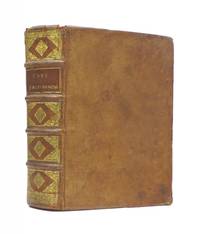
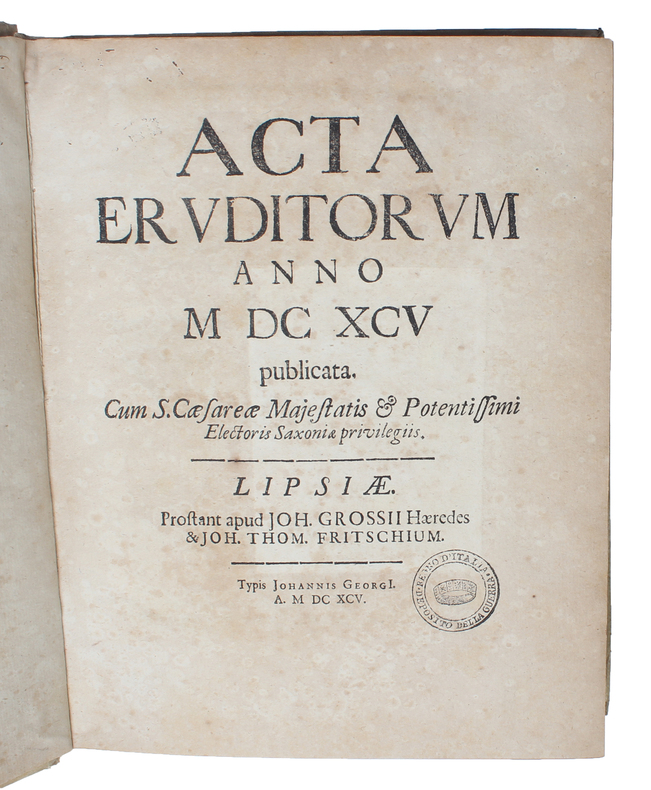
169542860Leipzig, Grosse & Gleditsch, 1695. 4to. Contemp. full vellum. Faint handwritten title on spine. A small stamp on titlepage and pasted library label to pasted down front free end-paper. In: ""Acta Eruditorum Anno MDCXCV"". (2), 560, (52) pp. + 10 plates. As usual with various browning to leaves and plates. The entire volume offered. Leibniz's papers: pp. 145-57" 184-185 310-316 369-372 493-495. Jacob Bernoulli's paper: pp. 537-553 + one folding table 65-66. Johann Bernoulli's: pp. 59-65" 374-376.
169542860Leipzig Grosse & Gleditsch 1695. 4to. Contemp. full vellum. Faint handwritten title on spine. A small stamp on titlepage and pasted library label to pasted down front free end-paper. In: "Acta Eruditorum Anno MDCXCV". 2 560 52 pp. 10 plates. As usual with various browning to leaves and plates. The entire volume offered. Leibniz's papers: pp. 145-57; 184-185; 310-316; 369-372; 493-495. Jacob Bernoulli's paper: pp. 537-553 one folding table; 65-66. Johann Bernoulli's: pp. 59-65; 374-376. <br/><br/><em>First printing of a series of influential papers by Leibniz Jacob Bernoulli and Johann Bernoulli.First publication of Jakob Bernoulli's famous and influential "Bernoulli Equation". In "Notatiuncula Constructiones Lineae" Bernoulli proposed a solution to non linear equations which today is one of the most common used solutions of the general fluid. Bernoulli equations are significant because they are nonlinear differential equations with known exact solutions. In the "Specimen dynamicum" Leibniz presents a conception of body and force which distinct between primitive and derivative forces and between active and passive forces. This article is regarded as being the clearest exposition of Leibniz' dynamics. DSB VII 151b."The first attempt at a detailed account of the dynamics was a long dialogue the "Phoranomus seu de potentia et legibus naturae" written in July 1689 while Leibniz was in Rome. This was quickly followed be the composition of the massive Dynamica de potential et legibus naturae corporeae 1689-90 . Though it was written with the intention of publication and though Leibniz work at publishing it he never considered it entirely finished and it remained unpublished during his lifetime.The later . he finally revealed some of the metaphysical foundations of the project in an essay the present paper." Garber Daniel. Leibniz: body substance monad. 2009. 132 p."Its title suggests a summary of or a selection from the earlier work . However it actually contains something in a way rather more interesting: a careful exposition of the metaphysical foundations of the new science something that is hard to find in the old Dynamica or any of the more Technical pieces." Garber Daniel. Leibniz: Body Substance Monad. 2009. 133 p. </em> hardcover
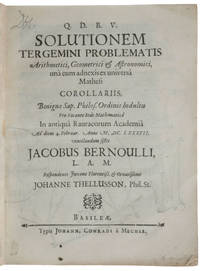
16875601Basel: Mechel 1687. First edition. First edition exceptionally rare of this dissertation which Bernoulli 1655-1705 submitted in order to secure the chair of mathematics at the University of Basel. This was the beginning of a remarkable career in mathematics in which he "greatly advanced algebra the infinitesimal calculus the calculus of variations mechanics the theory of series and the theory of probability and was one of the most significant promoters of the formal methods of higher analysis" DSB. EXCEPTIONALLY RARE DISSERTATION BY JACOB BERNOULLI. <p>First edition exceptionally rare of this dissertation which Bernoulli 1655-1705 submitted in order to secure the chair of mathematics at the University of Basel. This was the beginning of a remarkable career in mathematics in which he "greatly advanced algebra the infinitesimal calculus the calculus of variations mechanics the theory of series and the theory of probability and was one of the most significant promoters of the formal methods of higher analysis" DSB. The dissertation 'The solution of a triplet of problems arithmetical geometrical and astronomical together with corollaries from general mathematics' treats three elementary problems in number theory one arising from arithmetic one from geometry and one from astronomy/navigation. "Jacob Bernoulli's research on elementary mathematics taken as a whole constitutes a work of no mean importance very diverse in content lacking organic unity to be sure but also of exceptional historic interest. Indeed only from very few of the mathematicians who have left a lasting mark do we have the documentation which allows us to examine carefully the process of their scientific education . However in contrast from Jacob Bernoulli we actually possess some 'exercises' that he wrote beginning during the early years of his education. This is how we might characterize some of his Meditationes which he worked on with great diligence and singular ability. The interest of these exercises lies not only in their relationship to the general state of mathematics of the time but also and perhaps more in the way in which they represent an almost complete psychological picture of the formation of a great mathematician - which he certainly was - toward the end of the XVIIth century" Werke 2 p. 15. These Meditationes remained unpublished until the twentieth century except for the three published with much additional detail in the present pamphlet. On the last page of the dissertation is a list of 'Corollaries' one of which concerns the values of expectations in a lottery and is of particular interest in view of Bernoulli's posthumously-published Ars conjectandi 1713 the founding work of mathematical probability. "The academic dissertation Solutionem tergemini problematis arithmetici geometrici et astronomici which was presented at the University of Basel 4.2.1687 secured him the desired teaching post. Therefore this paper has particular biographical interest" ibid. p. 18. OCLC lists only 5 copies worldwide Yale only in US; not on COPAC.</p> <br /> <p>"Let us recall briefly what we know of Jacob Bernoulli's education before he obtained at the age of34 the chair in mathematics in his hometown Basel. Jacob was born in this city on December27th 1654 according to the old calendar in a protestant family of spice traders who had fled theSpanish low lands after the fall of the Duke of Alba. Complying with the wish of his father NicolasBernoulli a state adviser and magistrate Jacob studied philosophy and then theology until 1676. Aswas common at the time he chose a motto. His came from Phaeton who drew the solar carriageInvito patre sidera verso which may be translated by 'Despite my father I am among thestars'. Rather than exaggerated modesty this motto was a proud affirmation of superiority.</p> <br /> <p>"The young Jacob fully benefited from what Daniel Roche calls 'culture de la mobilité' promoted in the second half of the XVII century by new institutions which facilitated the movement of individuals and the spread of knowledge. Starting in August 1676 he traveled by horse to Geneva where he remained for twenty months preaching instructing a blind young girl Elisabeth von Waldkirch and serving as an opponent during the theological disputations. He relates his experience teaching mathematics to the blind in an article published in the Journal des Savants in 1685. This article is probably a reaction to an account by Spon published in the same journal in 1680 in which the author attributes to the father of the blind girl the writing system that was in fact developed by Jacob. It is here that Jacob meets Nicolas Fatio de Duillier a life long friend who recalled in a letter dating from July 22nd 1700 that he had seen Jacob play court tennis in Geneva a game on which Jacob later wrote a famous letter . </p> <br /> <p>"In June 1678 Jacob continues his extensive traveling in France residing in the Limousin in Nède with the marquis de Lostanges where he constructs two sundials in the castle courtyard then in Bordeaux and a few weeks in Paris. During this journey he begins in 1677 to write his mathematical journal Meditationes annotationes animadversiones theologicae et philosophicae which contains 236 articles . The journal is a precious testimony from this early phase of Jacob's scientific training which only really began when he encountered the Cartesian environment initially in France later mainly in the Netherlands Amsterdam and Leiden and in England during a second journey April 1681- October 1682. In August 1682 Jacob attended a meeting of the Royal Society in London. Jacob started out by acquainting himself with the Cartesian philosophy of nature after which he turned to geometry .</p> <br /> <p>"After his return to Basel in 1682 Jacob gave up the idea of a career in the clergy and decided to devote himself to mathematics. At the University of Basel he gave courses in experimental physics as can be gathered by a pamphlet printed in Basel in 1686. From 1682 on he also submitted short articles to the Journal des Savants - reactions to the works of others that he presented or criticized - initially in the area of natural philosophy machines for breathing under water to elevate water to weigh air oscillation center then from 1685 in mathematics .</p> <br /> <p>"Jacob slowly acquired a knowledge of mathematics at first through his readings of the second Latin edition of Descartes' Géométrie 1659-61 later that of Arnauld and his Logique Malebranche and Prestet . Jacob is confronted with precise problems often stemming from the area of applied mathematics. Solving these leads him to discover general methods. He begins by a thorough study of previous works which will serve him as a springboard to make further headway and produce new results. On several occasions Jacob voices the opinion that it is necessary to base one's own progress on the knowledge of what has been done in the past. Accordingly in the memoir entitled Solutionem tergemini problematis arithmetici geometrici et astronomici offered here presented on February 4th 1687 in order to obtain the mathematics chair in Basel he describes his own way of proceeding in the following way: 'In reality he who embraces a career as a mathematician is not the one who copies the inventions of others remembers them and recites them on occasion but the one who is truly innovative and is able to invent by using the divine algebra and thus to revolutionize what has been studied by others'" Peiffer.</p> <br /> <p>"Like other graduates of the University of Basel in the seventeenth century Bernoulli had a broad if not deep knowledge of all the disciplines of the liberal arts - an education he would draw on in writing Ars conjectandi 1713. The university at this time had a small faculty of philosophy including only nine chairs in logic rhetoric eloquence Greek mathematics physics history ethics and Hebrew. So although he had only an elementary education in mathematics as an undergraduate Bernoulli had a knowledge of Greek logic rhetoric and other subjects and was able to write polished Latin.</p> <br /> <p>"It was not uncommon at this time for a man to take a university post in a less desirable discipline if the chair he would have preferred was not available. He would then move if the opportunity arose to the preferred discipline without having to do everything required of a new applicant for a university position such as paying to print lists of theses to be defended in a disputation . The lists of theses that Jacob Bernoulli proposed to defend publicly in the years after his return to Basel in October 1682 reflect this list of open positions. Thus in January 1684 of the 100 theses that Bernoulli proposed to defend 34 were logical and 18 oratorical . Again in September 1685 and in February 1686 Bernoulli's theses were heavily logical. Finally after the death of the professor of mathematics in 1686 Bernoulli applied for disputed and won the chair" Sylla pp. 6-7.</p> <br /> <p>The first of the three problems treated by Bernoulli in his Solutionem tergemini problematis is: 'to find without the aid of algebra with the help of numerical arithmetic alone a number such that if we divide it into the numbers 12 and 36 and then add 8 to each of these numbers the resulting sums are in the ratio of 3 to 5.' The problem is generalized to arbitrary sets of given numbers.</p> <br /> <p>The second problem is more challenging. It "calls for the construction of a quadrilateral inscribed in a semi-circle with sides and diagonals of rational lengths in other words commensurable to the radius" Werke 2 p. 18.</p> <br /> <p>The third problem is one which could arise in navigation: 'It is observed somewhere at the sixth hour of the sun that it has an altitude of 12 degrees above the horizon and that one hour and 12 minutes after the moment of this observation the sun sets. The question is at what latitude and at what time of the year was the observation made'</p> <br /> <p>On the last page of text under 'Corollaria' Bernoulli lists some of his other Meditationes - problems dealing with logic physics meteorology geometry referring to Propositions 55-57 of Euclid Book X stereometry mechanics perpetual motion machines dioptrics perspective referring to Bosse and Desargues gnomonics referring to Münster and Sturm ballistics 'ars conjecturandi' probability and figurate numbers giving the very large example 1580972.</p> <br /> <p>The problem on probability "concerned the slowness with which the values of expectations in a lottery increase as more and more blank slips are drawn out of the urn. In an urn containing 16000 slips if it initially cost 7½ to participate 1000 blank slips in a row would have to be drawn out before the person could sell his expectation to someone else for 8" Sylla p. 27.</p> <br /> <p>Peiffer 'Jacob Bernoulli teacher and rival of his brother Johann' Electronic Journal for History of Probability and Statistics 2 2006. Sylla tr. Jacob Bernoulli. The Art of Conjecturing 2006.</p> <br/> <br/> Small 4to 198 x 156 mm pp. 16 including a full page of geometrical diagrams printed on title verso. Contemporary marbled wrappers. Mechel unknown
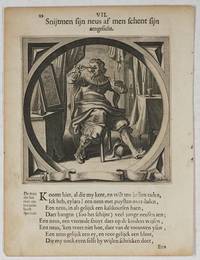
1632635801632. Spiegel van den Ouden ende Nieuwen Tijdt. - Gravenhage Isaac Burchoorn 1632 4° 225 x 170 mm. Emblem from "Spiegel van den ouden ende nieuven tijdt" Mirror of old and new times a book of emblems by Jacob Cats Amsterdam 1632 / Emblem aus "Spiegel van den ouden ende nieuven tijdt" Spiegel der neuen und der alten Zeit einem Emblembuch von Jacob Cats Amsterdam 1632. Snijtmen sijn neus af' men fchent sijn aengeficht. Koomt hier al die my ken en wilten besten raden Ick heb eylaes ! een neus met puysten over-laden Een neus in als gelijck een kalikoutsen haen Daer hangen soo het schijnt veel jonge neusen aen; Een neus een vreemde snuyt daer op de kinders wijsen Een neus 'ken weet niet hoe daer van de vrouwen ysen Een neus gelijck een ey en root gelijck een bloet Die my oock even selfs by wijlen schricken doet . Cut off his nose they say and you'll see his face. Come here all of you who know me and try to guess I have alas! a nose covered with pimples A nose like a cockatoo's beak On which it seems many young noses hang; A nose a strange snout that children point at A nose I don't know how that women ice A nose like an egg and red like blood Which sometimes frightens me as well . Jacob Cats 1577-1660 was a Dutch poet humorist jurist and politician. He is most famous for his emblem books. unknown
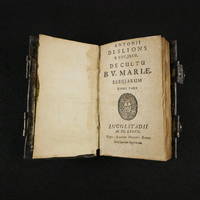
1678733Ingolstodt: Joannis Philippi Zink 1678. Hardcover. Fair. Three poetical works of early 17th century Jesuit poets bound into one binding with beautiful silver decorations covering the front and rear board. About the Literary Works - Three works are bound within: 1. 1672 De Cultu B. V. Mariae Elegiarum in three books not ""book three"" as it is often catalogued; all three ""libri"" are found within the printing by Antoine Deslions. 2. No title page bound in starts at A1 page 1 - Epigrammatum Selectrorum by Bernard Bauhuis 3. 1672 Silvulae Hendecasyllarborum by Jacob Bidermann About the Binding - No maker's mark is readily visible. The book was published in Ingolstadt where the silversmith family of Kienlin see book bindings attributed to Johann Adam Kienlin plied their trade. It was common for bindings of this time to have a silver spine but I see no hinges which indicate one might have been removed and the leather of the spine was decorated. Still a silver spine may have been removed and the board edges cut of their hinges. but removing the hinges seems unlikely. This book was sold in the 1924 Sotheby Sale of the Library of Dr. E Marion Cox. Bibliographic Details - All three works are printed by Joannis Philippi Zinck in Ingelstadt. The first and third work have a printing date of 1672; presumptively the middle work would also have been printed in 1672 the title page is not bound-in but Worldcat doesn't have record of a 1672 edition. The Deslions work is catalogued in Worldcat as OCLC 836616102 among others. The Bauhuis work is catalogued in Worldcat as OCLC 1088278417 with a printing date of 1678. The Bidermann work is catalogued in Worldcat as OCLC 78071635 among others. Physical Attributes - Measures approx. 13 x 8 x 3 cm. Leather binding with blind tooling. Over the front and rear board silver covers have been added; these are likely repousse hammered from the back side and are decorated in the French rococo style each with a proud central medallion. The front medallion is a woman holding a goblet and books the rear medallion is a woman holding her baby and guiding her child. The covers have been turned-in just like a leather binding. The silver clasps work and one clasp depicts a putti holding a spade and the other a lute. The endpapers are dutch-gilt the front one is missing the flyleaf and the rear endpaper shows a wonderful depiction of a lute player in gilt. Three works bound into one binding. The second work is missing its title page and any prefatory printed material it begins at page 1 signed A1. Pages - vi 106 128 title page vi 128 The third work seems like it might not have had a leaf bound-in; the first gathering is fifteen leaves instead of 16 but the catchwords match and nothing seems missing so it was likely a blank the binder chose not to include. Condition - See pictures. Silver tarnished with some bumps around the edges. Leather binding under is dried out. The spine is crazed and chipped from the head and tail; there is evidence of glue repair along the front and rear leather joint. There is a little rubbing noticeable on the leather under the silver covering the boards. Front flyleaf missing. Blank bookbinder endpaper mounted instead; some numbers written on it and the remnants of an auction ticket presumably. Text block has some toning throughout with occasional fox spots page edge bumps etc. A few pages seem slightly proud. The index at the back of the Deslions work insn't included. Also the title page and any intros are not bound in for the Bauhuis it starts on page 1. I see a very occasional annotation. Blank endpaper at rear has notes on which poems apply to different life situations. Rear flyleaf has a white mark at bottom and the fore-edge is a little rough; also several small holes which may be from binding. Joannis Philippi Zink
167022401670. : 8 Latere schutbladen titelblad verstevigd professioneel gerestaureerd. Binding: Contemporary Full Vellum Octavo 8vo Height cm: 205 CM Width cm: 155 CM Thickness cm: 35 CM hardcover
165140032London: John Macock for Giles Calvert 1651. 4to. 7 1/8 x 5 3/8 inches. 8 224 pp. Bound to style in half calf marble paper boards spine with raised bands in six compartments with ruled lines and center tool red lettering piece in second compartment.<br/> <br/> Rare first English edition of Jacob Böhme's a groundbreaking work of Christian mysticism translated by J. Ellistone which reveals the hidden connections between the material and spiritual worlds through its exploration of the signatures imprinted on all of creation.<br/> <br/> At once leatherworker mystic and founder of modern theosophy Böhme published little in his lifetime and what was published brought him endless trouble with the Church. Despite this Böhme had a profound influence on later philosophical movements such as German Idealism and German Romanticism with Hegel describing him as "the first German philosopher". Böhme was born in Alt Seidenberg now in present-day Poland. Deemed too weak for husbandry Böhme was sent to Seidenberg as an apprentice to become a shoemaker. While he lived with a family who was not Christian Böhme regularly prayed and read the Bible and consumed the works of visionaries such as Paracelsus Weigel and Schwenckfeld. After leaving his apprenticeship Böhme travelled as far as Görlitz before returning as a master craftsman to set up his own workshop and started a family. Böhme later joined the "Conventicle of God's Real Servants" - a parochial study group organized by poet and mystic Martin Moller. Since his youth Böhme often had spiritual experiences including one that occurred while he was travelling for business where as he later recalled was "surrounded with a divine light and stood in the highest contemplation and kingdom of joys." This title The Signature of All Things written in High Dutch in 1622 following a series of Böhme's mystic experiences appears here in the first English edition. In it Böhme explains systematically the cosmology that lies at the heart of his whole mystical approach and experience revealing his mystical pantheism and his dialectical conception of God in which good and evil are rooted in one and the same being. The book is a highly symbolic work that deals with the nature of God creation and the relationship between the spiritual and physical worlds. In brief Böhme's thesis can be summarised thus: everything in the material world bears the imprint or "signature" of its spiritual counterpart and that by understanding these signatures one can gain insight into the divine. The present work is the title for which Böhme is most famous and it is invoked by James Joyce in the Proteus episode in Ulysses "Ineluctable modality of the visible." Bohme's ideas had a significant influence on later mystics philosophers and theologians including Goethe Nietzsche and Jung. Signatura Rerum remains a classic work of Christian mysticism and esoteric philosophy and is still studied and debated by scholars and practitioners today.<br/> <br/> Wing B3419; Bach "Jacob Boehme" in Protestants and Mysticism in Reformation Europe; Hartman The Life and the Doctrines of Jacob Boehme the God-Taught Philosopher. John Macock for Giles Calvert unknown
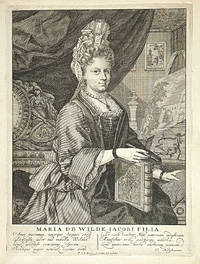
1700103081<p>Amsterdam Maria de Wilde 1700. 4to. 1 1 blank 11 1 blank pp. and 60 numbered engraved plates. = engraved title-page an engraved vignette depicting "virtute" signed "A. Schoonebeek fec." 1 large folding plate showing the interior of "Museum Wildianum" a full-page engraved portrait of Maria de Wilde signed "P. v.d. Berge ad vivum del. et fecit." decorated initials in the text and 60 numbered engraved plates by Maria de Wilde. Contemporary blind-stamped vellum sewn on 4 supports and laced through the joints with the manuscript title and author at the head of the spine red and blue sprinkled edges. With the green and white bookplate of "Collectie Buijnsters-Smets" on the inside of the front board and with the black and white bookplate of "A. Pitlo. Plus est en vous" on the verso of the now loose front paste-down. The binding is slightly browned and the paste-downs have come loose revealing the sowing supports. Internally fine and clean. Overall in very good condition.</p><p>First and only edition of an attractive display of the statues of the Museum Wildeanum once housed on the Keizersgracht in Amsterdam. The Dutch tax collector Jacob de Wilde 1645-1721 began the collection containing gems coins scientific instruments and statues. "This attractive account of a Dutch cabinet of the late seventeenth century is as much a eulogy of Maria de Wilde's gifts as an engraver as of her father's museum" Grinke. The 60 plates by Maria de Wilde 1682-1729 show the ancient Egyptian Greek and Roman statues in the museum including Egyptian figures of Isis Horus etc. some of which are now believed to be Renaissance copies of antique originals. The 6 text leaves include a brief introduction and several laudatory poems directed at Maria de Wilde and her engravings. The collection drew some important visitors including the Russian tsar Peter the Great in 1697. His visit is illustrated on the engraved folding plate where he can be identified by the double-headed eagle at his feet an element of the Russian coat of arms sitting in the museum at a table accompanied by Jacob. After De Wilde's death the collection probably dispersed. The tsar acquired part of it for his "Kunstkamera" the first museum in Russia which was completed in 1727. A catalogue of the gems and coins of the museum was published in 1703 entitled Gemmae selectae antiquae e museo Jacobi de Wilde.<br />From the library of the Dutch professor of civil and notarial law Adriaan Pitlo 1901-1987 and from the collection of Dutch book historian and professor of Dutch literature linguistics and book history Piet J. Buijnsters 1933-2022 and his wife the art historian Leontine M.A. Buijnsters-Smets 1937-2021. A beautiful copy of an art historical work showing a late 17th-century Dutch cabinet with a notable provenance. c.f. Grinke 61; Murray I p. 38 & III p. 272; STCN 842380264; Tavernier Russia and the Low Countries: an international bibliography 3178.</p> Maria de Wilde
1699SZEPEBKS005408ILubecae Lubeck: Wiedemeyer 1699. First edition . Hardcover. Fine/not applicable. 8vo. 922.5X17 cm. - 1063 pp. - Wiedemeyer Lubecae 1699. - Leather over wooden boards wood slightly broken on front and back covers leather somewhat worn. Spine with 6 raised bands. Paper partially browned but not affecting plate else fine. - With a folding plate showing both sides of 18 gold coins each with the portrait of a Hungarian king from Ludovicus through Leopoldus 1689. - With some initials and an elaborate endpiece. - In Latin. - Apponyi III 1468. <br/> <br/> Wiedemeyer hardcover
169555262Amsterdam: Be-veit ha-meshutafim Asher Anshil ben Eliezer ve-Yisakhar Ber ben Avraham Eliezer/ Moses Wiesel 1695. First edition. Hardcover. fair. Small folio 29 by 18.5 cm. Collation: aleph-vav4 zayin2 = 26 numbered leaves. Additional engraved title page engraved folding map at rear; main title with woodcut vignette; 14 half-page engraved illustrations in the text. Contemporary quarter calf over dark brown pastepaper boards skilfully rebacked. Images of Moses and Aaron at engraved title excised the seven small engraved vignettes along with letterpress text of engraved title and imprint mounted on old paper. Old marginal repairs at main title resulting in slight loss of initial letters along right margin and several leaves; slight strictly marginal worming and occasional tears. Stained throughout sometimes heavily though not impairing legibility. Map mounted to reinforce tears with virtually no loss of text or engraved imagery apart from printed border at right side. A fair copy at best; despite all defects the half-page engraved illustrations have survived intact with minimal staining. Housed in new maroon buckram slipcase.<br /> <br /> First edition of this gorgeously illustrated work now referred to simply as the Amsterdam Haggadah. The first such work to be illustrated with copperplate engravings it ranks among the most imitated of the Jewish manuals for the Passover seder. The popularity of these illustrations can be attested by the huge number of reprint editions over the centuries. Fourteen finely printed half-page engravings appear throughout the text. Some of these images illustrate the traditional content of the Passover seder or the Exodus story while others reference other biblical tales. Images include: the Rabbis of Bene Brak discussing the Passover story the four sons Abraham smashing the idols of his father Abraham welcoming the three angels Moses slaying the Egyptian overseer the rescuing Moses from the river Moses and Aaron coming to Pharaoh w/ staves turning to snakes the ten plagues the Egyptian army drowning in the Red Sea the Exodus the receiving of the Ten Commandments at Mt. Sinai the eating of the Pascal Lamb King David composing his psalms and finally an exterior view of the Jewish Temple with the cityscape of Jerusalem in the background. All images are captioned with relevant passages in Hebrew. The engravings were all created by Abraham ben Jacob a German convert to Judaism who had moved to Amsterdam although some sources over the years misattributed them to financier Moses Wiesel 6 of which were adaptations and/or modifications of previous images by Swiss artist Matthäus Merian 1593-1650 from his original work "Icones Biblicae" 1625-30.<br /> <br /> In addition to the in text engravings there is famously fold-out engraved biblical map of the Holy Land in a notable format. Measuring a total of 19.5 by 11.5" the map shows the land of Israel the Wilderness of Sinai and Egypt in landscape orientation looking eastward towards the top of the map. It traces the journey of the Israelites starting with the Exodus from Egypt through the Sinai and into the Land of Israel. The map is detailed showing the areas of the twelve tribes important locations and cities as well as geographic features including the Red Sea Mount Sinai the Dead Sea the Sea of Galilee and many others. Additional illustrations appear near the bottom along with a legend. This beautiful work also by Abraham ben Jacob is considered among the earliest if not the first map of its kind to be printed within a Hebrew publication. It is now known to have been heavily based on the previously printed 1620 map in Hebrew by Jacob ben Abraham Zaddiq and Abraham Goos 1590 - ca. 1643 which itself was based on the map of 1590 by Christian Kruik van Adrichom Adrichem printed in Latin.<br /> <br /> Text throughout is printed in Hebrew with smaller text in Rashi script underneath containing famous commentary on the Passover Haggadah by acclaimed Portuguese Rabbi and scholar Isaac ben Judah Abarbanel 1437-1508. The verso of the title page contains the order of the Passover seder with brief instructions in both Ladino Judeo-Spanish and Yiddish Judeo-German a nod to the subtitle which references both the Ashkenazi and Sephardi traditions.<br /> <br /> Provenance and annotations: Full page of text appx. 1500 words in neat Hebrew cursive at front endleaf which discusses aspects of the Haggadah text; inscription in German at front endleaf by Isidor Adler who mentions his friend Hermann Mechlenburg dated March 1906; old annotations throughout in at least two hands. In one notable instance the Hebrew phrase l'shana ha-ba'ah be-hamburg next year in Hamburg! has been added in fine block characters above the traditional phrase l'shana ha-ba'ah bi-yerushalayim next year in Jerusalem. Hebrew title: סדר הגדה של פסח ×›×ž× ×”×’ ××©×›× ×– וספרד <br /> Alternate transliterations: Seder Hagadah shel Pesah Seder Hagadah sel Pesah<br /> <br /> References: Friedberg 278 Fuks HTN II 521; Yudlov Haggadah 93; Vinograd Amsterdam 627; Ya'ari no. 59; Laor 876 Map; Nebenzahl pp.138-1389 Map; Yerushalmi plate 59-62; Rosenau "Vision of the Temple" p.135 146-7. Be-veit ha-meshutafim [Asher Anshil ben Eliezer ve-Yisakhar Ber ben Avraham Eliezer]/ Moses Wiesel hardcover
169555736Amsterdam: Be-veit ha-meshutafim Asher Anshil ben Eliezer ve-Yisakhar Ber ben Avraham Eliezer/ Moses Wiesel 1695. First edition. Hardcover. g to near fine. Small folio 30 by 18.8 cm. Collation: aleph-vav4 zayin2 = 26 numbered leaves. Full period brown paper boards re-backed with a brown leather spine with raised bands.<br /> <br /> Letterpress title-page with ornate floral woodcut device; additional engraved title-page mounted depicting Moses and Aaron along with six small biblical scenes within round borders all against an architectural background. Engraved folding map at rear mounted; main title with woodcut vignette; 14 half-page engraved illustrations in the text.<br /> <br /> This gorgeously illustrated work is the first edition of the famous and highly influential Passover Haggadah printed in Amsterdam in 1695. Simply known as the Amsterdam Haggadah this edition stands as among the most imitated and copied haggadahs in history and was the first to be illustrated with copperplate engravings. Previous illustrated haggadahs had used woodcuts. The popularity of these illustrations can be attested by the huge numbers of reprint editions over the centuries. There are 14 finely printed large in-text engravings plus the full page engraved title page showing Moses Aaron and Adam in the Garden of Eden. Some of these images illustrate the traditional content of the Passover seder and/or the exodus story while some are other biblical stories less directly related. Images include: the Rabbis of Bene Brak discussing the Passover story the four sons Abraham smashing the idols of his father Abraham welcoming the three angels Moses slaying the Egyptian overseer the rescuing Moses from the river Moses and Aaron coming to Pharaoh w/ staves turning to snakes the ten plagues the Egyptian army drowning in the Red Sea the Exodus the receiving of the Ten Commandments at Mt. Sinai the eating of the Pascal Lamb King David composing his psalms and finally an exterior view of the Holy Temple with the cityscape of Jerusalem in the background. All images are captioned underneath with relevant passages in Hebrew. The engravings were all created by Abraham ben Jacob a German convert to Judaism who had moved to Amsterdam although some sources over the years misattributed them to financier Moses Wiesel 6 of which were adaptations and/or modifications of previous images by Swiss artist Matthäus Merian 1593-1650 from his original work "Icones Biblicae" 1625-30.<br /> <br /> In addition to the in text engravings there is famously a phenomenal fold-out engraved biblical map of the holy land. Measuring a total of 19.5x11.5" the map shows the land of Israel the Sinai desert and Egypt in landscape orientation looking eastward towards the top of the map. It traces the journey of the Israelites starting with the Exodus from Egypt through the desert and into the Land of Israel. The map is detailed showing the areas of the twelve tribes important locations and cities as well as geographic features including the Red Sea Mount Sinai the Dead Sea the Sea of Galilee and many others. The map is decorated with additional illustrations near the bottom and includes a key. This beautiful work also by Abraham ben Jacob is considered among the earliest if not the first map of its kind to be printed within a Hebrew publication. It is now known to have been heavily based on the previously printed 1620 map in Hebrew by Jacob ben Abraham Zaddiq and Abraham Goos 1590 - ca. 1643 which itself was based on the map of 1590 by Christian Kruik van Adrichom Adrichem printed in Latin.<br /> <br /> Text throughout is printed in Hebrew with smaller text in Rashi script underneath containing famous commentary on the Passover Haggadah by acclaimed Portuguese Rabbi and scholar Isaac ben Judah Abarbanel 1437-1508. The verso of the title page contains the order of the Passover seder with brief instructions in both Ladino Judeo-Spanish and Yiddish Judeo-German a nod to the subtitle of Haggadah which references the both Ashkenazi and Sephardic traditions.<br /> <br /> This copy with binding in beautiful condition with being professionally restored includining spine re-backed to style. Book block tight. Interior with some staining to pages throughout from use. Binding in very good to near fine inteiror in good condition overall. Hebrew title: סדר הגדה של פסח ×›×ž× ×”×’ ××©×›× ×– וספרד <br /> Alternate transliterations: Seder Hagadah shel Pesah Seder Hagadah sel Pesah<br /> <br /> References: Friedberg 278 Fuks HTN II 521; Yudlov Haggadah 93; Vinograd Amsterdam 627; Ya'ari no. 59; Laor 876 Map; Nebenzahl pp.138-1389 Map; Yerushalmi plate 59-62; Rosenau "Vision of the Temple" p.135 146-7. Be-veit ha-meshutafim [Asher Anshil ben Eliezer ve-Yisakhar Ber ben Avraham Eliezer]/ Moses Wiesel hardcover