Kaufman, MoisesBiblio.com
9 188 résultats
0822223929New. Brand new and still unused unknown
0201050285New. Brand new and still unused unknown
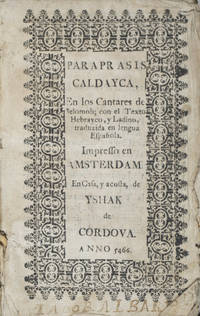
44043Amsterdam: Yshak de Cordova 5466. Fifth printing. Hardcover. poor to g-. 16mo. 3.5x6". 167pp. missing final page. Original brown calf boards. The book is a complete Spanish-language translation of the biblical book Song of Songs Song of Solomon and Perkei Avot Ethics of the Fathers the famed collection Jewish ethical sayings taken from the Talmud. Both of these works feature Moses Belmonte's translations which had been printed in Amsterdam since 1644. The translations are interlinear with each passage printed in Hebrew followed by the Spanish and in the case of Song of Songs the translation is followed by Spanish-language commentary. These works are related in their connection to the Jewish observance of Passover. Song of Songs is read on the Sabbath during Passover and chapters from Perkei Avot are traditionally read one each week between Passover and Shavuot.<br /> <br /> Pages 1-91 contain Song of Songs and 92-167 contain the text of Perkei Avot. As stated in the preface this is the "Quinta Imprension" Fifith printing of the work based on Belmonte's translation and that it was printed for the congregation of Rabbi Jacob de Mesa in Amsterdam. Title page bordered with a decorative woodblock motif. Decorative head and endpeices at the beginning and end of sections. Some of the translated text of Perkei Avot contains numerous in-text hand-corrections and Hebrew marginal notes in ink from the period. <br /> <br /> Text in Spanish with passages in Hebrew and some Ladino.<br /> <br /> Binding with spine missing rubbing and light chipping to extremities. Covers with some creasing scratches and abrasions. Starting at interior covers and some other pages throughout. Some sporadic water stains foxing and smudges throughout. The final section of Pirkei Avot is wormed in the upper corner with minimal loss of text overall. Page 103-104 with a vertical closed tear. A few pages have notes in ink. The final page p.167 containing the final passage of Perkei Avot verse 14 in Hebrew and Spanish is missing. Interior back cover is partially torn away from the board. Name of the previous owner in ink on the interior covers and the bottom of the title page. Binding fairly tight overall. Binding in poor interior good- condition overall. Moses Belmonte 1619 – 1647 Amsterdam was a poet and translator of Portuguese Jewish origin.<br /> <br /> Alternative titles: <br /> "Paraphrasis Caldayca en los Cantares de Selomoh con el Texto Hebrayco y Ladino traduzida en lengua Española"<br /> "Paraphrasis Caldaica en los cantares de Selomoh: con el Texto Hebrayco y Ladino traduzida en lengua Española"<br /> <br /> This copy belonged to Jacob Alvarez-Pereira 1684-1754 who was a prominent Sephardic Jewish merchant. <br /> <br /> References: SILVAROSA 1933 18 KAYSERLING p.181 under bible. Yshak de Cordova hardcover
1820B2235London: Rodwell and Martin 1820. Plates and text are clean and crisp an excellent copy. Binding: recent ½ calf with marbled boards. Spine with 6 compartments of raised bands gilt lettering on two. Notes: Henry Englefield was an antiquary and scientific writer. He was a made a fellow of the Society of Antiquites in 1779 and also served as the president for a brief period. National Bibliography Size: Large 4to Illustration: 39 beautifully engraved plates of ancient Roman and Greek vases 1 of which is hand coloured not including frontis and engraved title page. Pages: P. Frontis engraved title 1-7 Plates and descriptions unpaginated Category: ; Book Plate Books General; Book Antiquities; Book Art Architecture & Design; Rodwell and Martin hardcover
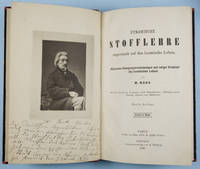
188015524Paris: Privately Printed Sybille Hess 1880. Second edition. Hardcover. g. Scarce Only two libraries worldwide own this book according to OCLC. 8vo. 182 1 pp. Half maroon leather over marbled paper covered boards with gilt lettering to spine. Raised bands. Modern endpapers. Inscribed by Sybille Hess post mortem to original free front endpaper. Gravure frontispiece. Lithographic illustrated throughout. Fold-out map. Rare second edition of of this scientific work by the "father of modern socialist Zionism" Moses Hess 1812-1875. A philosophic work on science the cosmos and mankind. It draws upon scientific and philosophical ideas with influence from Hegel and Feuerbach. Hess had worked in this field most of his life and it was posthumously published by his devoted wife in 1877 as a pious monument to his memory. He is best known as the Zionist author of "Rome and Jerusalem." Head of spine corners worn. Minor scuffing and rubbing to boards. In German. In overall good condition. Privately Printed [Sybille Hess] hardcover
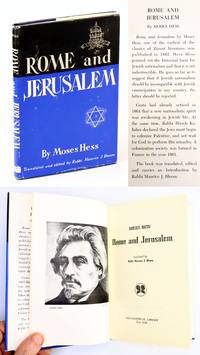
1958222j2706New York: Philosophical Library. Very Good in Good dust jacket. 1958. Reprint. Hardcover. A classic of Zionist literature first published in German in 1862. "In this his magnum opus Hess argued for the Jews to return to Palestine and proposed a socialist country in which the Jews would become agrarianised through a process of 'redemption of the soil.' Initially met with a cold reception this book prefigured ideas laid out by Theodor Herzl in Der Judenstaat by some thirty-five years." - Wikipedia. 13-89 p. Black and white frontis portrait of Hess. Book very clean tight and unmarked with light peripheral wear. Moderate wear to dust jacket now in glossy new archival-grade protection. A quality example. ; 8vo . Philosophical Library hardcover
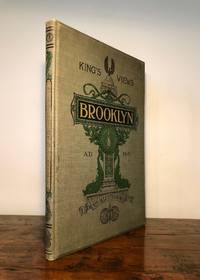
19057558New York: Moses King 1905. First Edition. Hardcover. Very Good. Henry M. Pettit F.W. Jopling Richard Rummell. Folio. i ii-viii 5 2-72. With a history of Brooklyn by John W. Chadwick. Laden with illustrations and photography throughout. Two maps. Index to views and photographs. Uncommon original cloth binding beveled edges with title and design stamped on the front board in darker green black and gilt. A trifle soiling to front cover; light wear to extremities of cloth. The writing pen featured in the final photo was added to provide scale. "The Greatest of the Five Boroughs of Greater New York" as Chadwick's history is titled. Some-300 of the photographs are by George P. Hall and Son documenting commercial buildings cemeteries bridges banks public works houses and apartment houses schools hotels street and waterfront scenes churches etc. Printed by the Plimpton Press. Scarce in cloth. Moses King hardcover
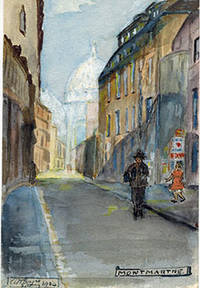
51-3452Paris: 1934. . Original watercolor presumably by Moise Kisling. 173 x 115 mm. Part of a collection from his friend Thadé Thódore Tadé Bloch. Titled and dated on the front and annotated: "A Memory of Spring:1934" on the verso. This was the year Kisling had an exhibition at the Carnegie Institute in Pittsburgh. Image shows an artist with his portfolio. This image not referenced in the major oeuvre catalogue which only included oils : "Kisling" Text by Joseph Kessel and Jean Kisling. NY: Harry Abrams 1971 Paris: 1934. unknown
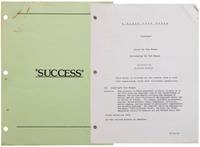
8128N.P.: N.P. 1982. Very good. 11†x 8½â€. Thin card wrappers/loose leaves three-hold and punched printed rectos only. pp. 61. Very good: front wrap with staining from paperclip otherwise bright and clean throughout. <br /> <br /> This is a screenplay for an African American soap opera which never aired Success. The title page mentions that “this story is created by the author from a true life experience with some fictional creativity.†The author's name is too common to successfully research and we'll note that IMDB has a listing for a Tom Moses who was a Black actor who appeared on McCloud and Columbo in the early 1970s. <br /> <br /> This script predates television's first Black soap opera Generations which premiered March 27 1989 and ran through January 1991. The plot of this pilot begins with flashbacks initially in Washington D.C. where we meet Angela Saunders a ten year old girl who overheard her parents arguing and learned that her father was not her biological father. The next scene took place in 1974 and Angela asked her mother about her birth father wanting to know who he was and it was revealed that he was “in Hollywood†and that his name was Tom Phillips. The action then cuts to 1983 with Tom reading a letter from Angela asking if he was her real father and we learn that Tom was an actor and also ran a performing arts school. Later Angela goes to California to meet Tom and stay with his family; on arrival she asks if her mother could visit as well. Tom's wife agrees setting up one of the story's major conflicts. Interspersed throughout is standard soap opera fare including sexual trysts a philandering producer familial misunderstandings searing hatreds blackmail and other juicy bits. <br /> <br /> OCLC locates no copies. N.P. unknown
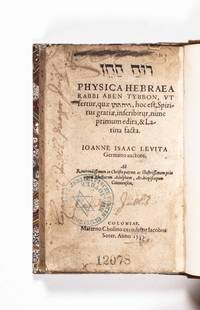
155548871Köln Cologne: Maternus Cholinus and Jakob Soter 1555. First Latin diglot edition. Hardcover. Good. Small octavo. A-L16 = 88 leaves signed on each side e.g. A8 verso is signed A16; H9 missigned G9. 16 157 2 epigram 1 blankpp. Pagination and register run from right to left. Modern quarter sheep over marbled boards gauffered edges endleaves renewed. Library stamps and old owner entries at title; early marginal annotation and underlinings in the “Epistolaâ€; text toned with dampstain affecting bottom quarter of text throughout not impairing legibility; marginal tear at C7. A good complete copy with ample margins.<br /> <br /> Third edition per Steinschneider and the first Latin diglot version of this anonymous introductory work. First published at Venice in 1544 it is notable that a Latin translation appears so soon after a sixteenth-century editio princeps of a Hebrew work. It comprises a commentary on and explanation of difficult terms in Maimonides' Moreh Nevukhim Guide for the Perplexed with an elucidation of terminology in the translations of Arabic to Hebrew as well as the jargon of medieval philosophical literature in general. As the editor of the present edition notes at the title "Ru'ah Hen has been attributed to the renowned translator R. Judah ben Saul ibn Tibbon c. 1120-c. 1190 and to R. Jacob ben Abba Mari ben Samson Anatoli 13th century also a translator of note. Ibn Tibbon known as the 'father of translators' was born in Granada Spain but relocated to Lunel in Provence France to escape the persecution of the Jews in the former location. He supported himself as a physician coming into contact with many sages one of whom R. Meshullam ben Jacob requested that ibn tibbon translate R. Bahya ibn Paquda's Hovot ha-Levavot into Hebrew. In addition to translating that work from Arabic ibn Tibbon also translated several other books into Hebrew among them R. Judah Halevi's Kuzari R. Saadiah Gaon's Emunot ve-De'ot and R. Solomon ibn Gabirol's Middot ha-Nefesh and Mivhar Peninim" Heller. While this is the fourth known printing of the work it is the first to include vowel points and the translation of the formerly Jewish convert to Christianity Johann Isaac Levita 1515-1577 a descendant of Elias Levita the most famous in his time of those Jews who sought scholarly contact with Christians and taught Christians Hebrew. As an added bonus the present edition includes Maimonides' De astrologia epistola elegans. The celebrated English jurist and Hebrew scholar John Selden is known to have had a copy of Ruah ha-Hen in his library Oxford Library note.<br /> <br /> Adams J-403. Cf. Heller The Sixteenth Century Hebrew Book 815 noting the present ed. Steinschneider 1 col. 639; no. 4038. VD 16 I1. Hebrew title: רוח החן. Maternus Cholinus and Jakob Soter hardcover
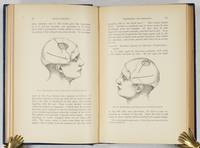
1893665411893. New York: William Wood & Company 1893 8° XII 295 pp. 55 Figs. orig. cloth; rebacked; with stamp of "Worchester State Hospital Medical Library". First Edition! Embossed stamp on title a stamp on the head of the first page ex-libris of the Worchester Hospital and Arthur Edwards Lyons on the front endpaper. Moses Allen Starr's "Brain surgery" was the first American book on neurosurgery published the same year as Macewen's pioneering neurosurgical classic. Moses Allen Starr 1854-1932 'Professor of Neurology in the College pf Physician and Surgeons at Columbia University New York City' "had plans for a career in classical culture when he graduated from Princeton and embarked for Germany to study Greek and Roman history. In Berlin however several visits to Helmholtz's laboratory revived a latent interest in natural science. He returned to his native New York graduated from the College of Physicians and Surgeons P&S Columbia University did a residency at Bellevue Hospital then returned to Europe to work at Heidelberg Vienna and Paris. On return to New York he set up a laboratory in his home and in 1884 published an essay on the sensory tracts of the central nervous system elucidating some of the then-current questions of myelination. Starr's regard as an American pioneer in the field of cerebral localization stemmed from his participation in a symposium on that subject with the famous English neurologist David Ferrier and neurosurgeon Victor Horsley who were delegates to the 1888 Congress of American Physicians and Surgeons in Washington D.C. He became professor of nervous diseases at the Montreal Neurological Institute. During neurosurgical operations they electrically stimulated the surface of the exposed unanesthetized brains of patients who were talking. On-going speech was blocked by excitation of the parietal-temporal area the inferior frontal area and the supplemental motor area of the left hemisphere Penfield & Roberts 1959. Those experimental protocols were a continuation of Penfield's long quest to add to the knowledge of body representations on the neocortex." H.W. Magoun & L. Marshall; American Neuroscience in the Twentieth Century 2005 pp.383-384 Garrison & Morton No.9637 hardcover
17360001326MARLBOROUGH MASSACHUSETTS MASS MA 1736. On offer is a charming relic of Marlborough Massachusetts ephemera being a manuscript dated 1736 detailing the specifics of a new road in the town. "A way laid out beginning near the dwelling house of Jeremiah Barstow & so running along between the land of Col Thomas How & the land of Simon Gates & is bounded by said Gates land by boundry mark't trees & it is Eight rods wide until it comes to that which is called the Indian land & then running across the County road along by the house of Zachariah Maynard four rods wide & still extends four rod wide along between land of Daniel Rice & land of Eliazer Rice & along through the land of Thomas Martin down where the path now goeth. Down that which is called Sandy Hill & then it is tow rods wide & then turning & then running through the land of Joshua Rice through a corner of Rice's land and then through Daniel Rice's land & the land of Thomas Martin down to that which is called the new Bridge over Fort Meadow Crook. between the meadow of Daniel Rice and the Meadows of Simon Gates & it is two rod wide to the lot granted to Abraham How as the way is mark't on the west side by markt trees & then running on westerly end of said lot granted to Said How four rods wide & so running a long through the lot of Hezekiah Bush & so running along over Sto. Low Bridge markt with trees on the east side of sd way running along the way which runs along by the Dwelling house of Peter How near Alfabeth sp River." This was accepted by the town March 3d 1729: "A True Coppy Attest Moses sp WoodsTown Ca. Marlboro Feb 27 1736." The paper document measures 9 7/8 x 6 inches and overall is G. Autograph. Manuscript. Good. 8vo - over 7¾" - 9¾" tall. Paperback
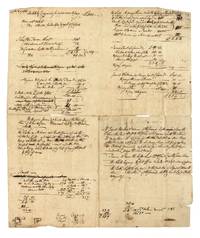
178655770Providence 1786. Folio sheet approx. 15" x 12" docketed on the verso; previous folds with splits no loss; overall toning; good. Brigadier General James Angell 1723-1785 descendant of one of the first settlers of Providence died February 2 1785. This inventory was taken by Moses Brown 1736-1838 executor of the will and both a friend and relative. The Angell's daughter Abigail married a Goddard relatives of the Brown family. Among assets listed are Angell's Johnston farm lot 160 acres of Vermont land a third of an acre lot in North Providence; "we to give James and Jacob a Deed of the Whole of remd of Johnston farm & North Providence lott." James Angell was town clerk of Providence until 1775 and Theodore Foster said of him "I became intimately acquainted with the said James Angell and many of his Family Connexions among whom was the Honorable Stephen Hopkins Esq. whose Sister married the said James Angell." Documentary History of R.I. Angell was also appointed chairman of the committee to revise laws of the state. unknown
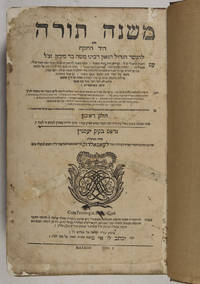
173927896Jessnitz Saxony-Anhalt: Bi-defus Yisrael bar Avraham 1739. Hardcover. Good. Four volumes folio published between 1739 and 1742. Woodcut printer's device at titles; woodcut endpieces in first volume. Hebrew text opens from right to left; leaf numbers in Hebrew characters. Hebrew chronograms yield Jewish dates of publication 5499-5502. Brown library buckram scuffed at extremities spines lettered in gilt. Endleaves renewed. A good set. See foliation and condition notes for each volume below.<br /> <br /> Scarce eighteenth-century edition of this seminal compendium of Jewish law halakhah. Compiled between 1170 and 1180 while Maimonides was living in Egypt the Mishneh Torah is regarded as the author's magnum opus. It is the only Medieval-era work that surveys the full panoply of Jewish observance including those laws that are only applicable when the Jerusalem Temple is in existence. The present edition is the first to contain Judah Rosanes' commentary Mishneh le-melekh. "Mishneh Torah" The Repetition of the Law is an appellation originally applied to the biblical book of Deuteronomy; the subtitle "ha-Yad ha-Hazakah" The Book of the Strong Hand plays on its subdivision into fourteen books: the numerical value fourteen is represented in Hebrew letters as Yud 10 Dalet 4 which forms the word "yad" hand. Maimonides sought to provide a complete statement of the Oral Law so that a person who mastered first the Written Torah and then the Mishneh Torah would be in no need of any other book. Contemporary reaction was mixed with strong and immediate opposition focusing on the absence of sources and the belief that the work appeared to be intended to supersede study of the Talmud itself. Maimonides responded to these criticisms and the Mishneh Torah endures as an influential work in Jewish religious thought. According to several authorities a decision may not be rendered in opposition to a view of Maimonides even where he apparently militated against the sense of a Talmudic passage for in such cases the presumption was that the words of the Talmud were incorrectly interpreted. Likewise: One must follow Maimonides even when the latter opposed his teachers since he surely knew their views and if he decided against them he must have disapproved their interpretation.<br /> <br /> Vol. 1: 1 title 8 234 102 3 ff. Repairs at title page with very slight loss of text at verso following leaf and the final leaf. Text embrowned often heavily in first half with some light marginal dampstains throughout. Old manuscript entries in Hebrew at title in at least three hands.<br /> <br /> Vol. 2: 1 title 148 112 2 ff. Marginal repairs to first and last two leaves no loss of text. Moderately dampstained throughout with some mild embrowning. Old manuscript entries in Hebrew at title in at least two hands; three old stamps at title including at least one censor's approbation.<br /> <br /> Vol. 3: 1 title 221 169 ff. Repairs at bottom margin to title with loss of some text below imprint and at final lines of rabbinic approbations at verso and at bottom margin following leaf with some text loss and obscuration by translucent paper tape. Small marginal repair at final leaf. Light dampstaining in first half; remaining text with mild embrowning. Old manuscript entries in Hebrew at title in at least two hands; two old stamps at title including at least one censor's approbation.<br /> <br /> Vol. 4: 1 title 135 138-154 157 1 ff. Marginal repairs to title and final leaf no loss of text. Sporadic light embrowning and marginal stains. Old manuscript entry in Hebrew at title.<br /> <br /> A complete set with only minimal text loss in a few places -- a very usable scholar's copy. References: Vinograd Jessnitz 46; Fürst 2: p. 295; Zenker p. 583<br /> <br /> Title in Hebrew: ×ž×©× ×” תורה ×”×•× ×”×™×“ החזקה ×œ×”× ×©×¨ הגדול ×”×’×ון ×¨×‘×™× ×• משה בר מימון זצ׳׳ל ×¢× ×”×©×’×ª הר×ב׳׳ד זצ׳׳ל ופירוש הרב מגיד ×ž×©× ×” וכסף ×ž×©× ×” להג×ון המשביר ×¨×‘×™× ×• יוסף ק×רו זצ׳׳ל ומגדל עוז והגהות ×ž×™×ž×•× ×™×™×•×ª ופירוש ×¨×‘×™× ×• עובדי והרב המוסמך מדר׳׳ל ן׳ חביב על הלכות קידוש החדש ×¢× ×›×œ הצורות השייכות להלכות ×לו ולהלכות שבת וסוכה ×•×¢× ×ž×•×¨×” ×ž×§×•× ×¢×œ דברי הרב המגיד וכסף ×ž×©× ×” ×’× ×©×ª×™ מפתחות גדולות ורחבות ×חת על סדר ×”×¤×¨×§×™× ×•×חת על דרך ××œ×¤× ×‘×™×ª×” ×œ× ×—×¡×¨ דבר מכל כפי ×שר × ×“×¤×¡ ב×משטרד×<br /> <br /> Rabbi Moses Maimonides the Rambam was a 12th century Jewish philosopher and halachic legal scholar. A highly controversial figure both during his lifetime and after his death he is generally acknowledged as the preeminent Jewish thinker of the Middle Ages. He was born in Córdoba Spain but fled as a child from the Almohad persecution. He eventually settled in Egypt where he served as a rabbi physician and philosopher. His fourteen-volume Mishneh Torah his only work not in Arabic still carries canonical authority particularly within the Yemenite Jewish community as the codification of Talmudic law. His other works include "Kitab al-Siraj" a commentary on the Mishnah "Kitab al-Fara'I" a book on precepts and the celebrated philosophical work "Dalalat al-Ha'irin" known in Hebrew as the "Moreh Nevukhim" The Guide to the Perplexed. In this latter work Maimonides attempted a philosophical/theological reconciliation of the Hebrew Bible and Greek knowledge. This work came to play a central role in all subsequent major controversies over philosophy within the Jewish community during the Middle Ages. Bi-defus Yisrael bar Avraham hardcover
SKU0190385Wolters Kluwer Law & Business 2017-04-18. Loose Leaf. Good. Textbook May Have Highlights Notes and/or Underlining BOOK ONLY-NO ACCESS CODE NO CD Ships with Tracking Wolters Kluwer Law & Business unknown
17970009109NEW FRANKFURT HARRISON CO. WEST VIRGINIA 1797. On offer is are two lovely and fascinating letters from a father and mother to their daughter detailing their situation mere weeks after moving to New Frankford Virginia. The letter is signed Moses Starr and Elizabeth Starr and addressed to their Dear Daughter. The first letter is dated November 17th 1797 and the second is dated December 23 1797. In the letters they describe their journey to their new home in West Virginia their home and their farm. They now live in New Frankfurt in Harrison County Simpsons Creek Eight Miles From Clarkburg. The first letter begins Dear Daughter we embrace this opportunity to wright to you informing thee that we are all in great haealth at present thanks bea to God for his tender Merceys to us ward from time to time. They write that they have we have had no letters from thee this two years.and have had no opertunity to send any. We long to see thee and hear from thee if thou art single write whether thou would incline to come upon and live with us we think of comeing Down within two years more; like wise let us know how our Relations are in them parts.The back of the letter is a short sermon like passage stating Dear child strive to ear and Love God who is able to Love the utmost oall that come to him through Jesus Christ the Redeeme of lost Man. The next letter begins with them writing that they have received her last letter which gave us some cause to rejoice of hearing from our relations in general but gave us concern of mind for the loss of Nelly Starr and the disolate state of Uncle Joseph. They then remark on the their life in what is now West Virginia. Thy mother was braught to be of a daughter the Eleventh of last month wich we call Polly. They speak of their journey to Virginia taking two weeks from when they left their home. The farming has been good a well reaping 200 bushals of Sound Corn and 150 bushals of Oats with a trifel of buck wheat. I have 20 acres of wheat and Ry in the ground this fall. The letter ends with the usual pleasantries and again is signed by Moses and Elizabeth Starr. The two letters are in fair shape both having a fair share of rips tears and discoloration. The first letter has some moth damage that affects the readability of a sentence or two. The second letter has its tears along the creases and edges but it does not affect the content at all. Neither does the discoloration on either letter though it is very noticeable it does not block out any words. The ink on both letters has faded the first more than the second but both letters are fairly easy to read throughout. These letters are an interesting little snapshot of a family life in 1790s Virginia representing a change in a brand new America and hope for a new setting in this burgeoning nation. Good. 4to - over 9¾" - 12" tall. Manuscript. unknown
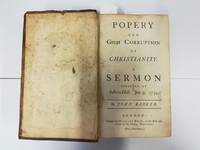
1735002177London: Printed for Richard Hett 1735. 1st Edition . Hardcover. Fair/No Jacket. 8vo - over 7¾ - 9¾" tall. 17 Sermons and a Conference bound together followed by contemporary hand written list of contents; full calf Cambridge binding with raised bands etc. Worn; scuffed; hinges/joints broken; ffep absent; pp. 848. Contents: 1 Popery; The Great Corruption of Christianity Barker 1735 pp. 34. 2 The Notes of the Church Considered 2nd ed. Chandler1735 pp. 57. 3 A Second Treatise on the Notes of the Church Chandler 1735 pp. 60. 4 The Supremacy of St Peter and the Bishops of Rome his Successors 2nd ed. Neal 1735 pp. 40. 5 The Church of Rome's Claim of Authority and Infallibility Examined Smyth 1735 pp. 71. 6 Scripture and Tradition Considered Wright 1735 pp. 54. 7 A discourse Concerning Transubstantiation: In jWhich the Words of the Institution of the Lord's Supper are Particularly Considered. Harris 1735 pp. 46. 8 A Second Discourse Concernign Tansubstantiation; in Which the Sixth Chapter of St John's Gospel is Particularly Considered. Harris 1735 pp. 38. 9 The Veneration of Saints and Images as Taught and Practis'd in the Church of Rome Examined. Hughes 1735 pp. 58. 10 The Sources of Corrupting both Natural and Revealed Religion Exemplified in the Romish Doctrine of Penance and Pilgrimages. Hunt 1735 pp. 40. 11 The Church of Rome's Doctrine and Practise with Relation to the Worship of God in an Unknown Tongue examin'd. Bayes 1735 pp. 48. 12 The Popish Doctrine of Auricular Confession and Priestly Absolution Considered. Burroughs 1735 pp. 48. 13 The Popish Doctrine of Merit and Justification Considered Newman 1735 pp. 48. 14 The Popish Doctrine of Purgatory Repugnant to the Scripture account of Remission through the Blood of Christ. Earle 1735 pp. 52. 15 The Principles of Popery Schismatical. Lowman 2nd ed. 1735 pp. 48. 16 Persecution and Cruelty in the Principles Practices and Spirit of the Romish Church Grosvenor 2nd ed. 1735 pp. 39. 17 The Reasons and Necessity of the Reformation Leavesly 1735 pp. 40. 18 Two Conferences.at the Bell Tavern.Between two Romish Priests a Divine fo the Church of England and Mr. Chandler and Dr. Hunt Dissenting Divines on the following Subjects. the Blashemy of many Popish Writers.Transubstantiation; Praying to Saints and Angels. 1735 pp. 28. 19 Pp. 2 hand written list of sermons. Rather a lovely volume if worn. <br/> <br/> Printed for Richard Hett hardcover
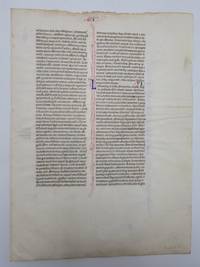
290159circa 1250. Very good; light wrinkling and marginal foxing to pages. Folio 30.5x22.5 cm. One sheet fine vellum folded with text from the book of Numbers in two columns. weight: 0.2 lb. Unknown scribe. hardcover
2411Bloomington Indiana: Research Center for Language and Semiotic Studies 1991. 14 volumes 6" x 9" each volume 1: pp. 128 volume 2: pp. 163 volume 3: pp. 138 volume 4: pp. 111 volume 5: pp. 121 volume 6: pp. 123 volume 7: pp. 135 volume 8: pp. 102 volume 9: pp. 107 volume 10: pp. 154 volume 11: pp. 120 volume 12: pp. 143 volume 13: pp. 222 volume 14: pp. 218. Off-white wrappers with blue text. Volume 12 has a small chip with loss at the top edge of the spine. Volumes 1-5 are lightly toned. Text is bright and clean. Very good. <br /> <br /> 14 volumes of the Journal of the Mongolian Society featuring articles covering a variety of topics related to Mongolia. <br /> <br /> Some articles include: Chinese Titles in Mongol Iran Life of a Mongol Woman Mongolian Art The Panching System Khitan Writing Systems and many more. Research Center for Language and Semiotic Studies unknown
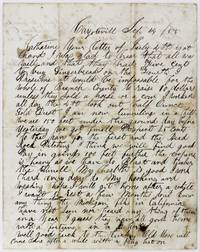
18553206Coyoteville: September 12 1855. Very good. 2pp. plus integral blank. Original mailing folds moderate toning staining and ink spotting but still easily readable. Bottom fourth of integral blank excised. An informative Gold Rush letter about mining in the long-vanished ghost town of Coyoteville which was an extraordinarily rich gold area for a couple of years in the early 1850s. A noted tunneling method nicknamed "coyoteing" was developed in the town and subsequently inspired the name of the town. In the present letter Moses Pine writes to "Catherine" in Branch County Michigan and signs his name simply as "Mose Esq" at the conclusion. The author informs Catherine presumably his wife or sister of his activities some of the economic realities and some of the practical details of prospecting for gold in California. Presuming that "it would be impossible for the whole of Branch County to raise $10 unless they sell a horse" Pine comments that he had ginger bread on the Fourth of July after working all day and yielding a "half Ounce Gold Dust." He then provides a detailed description of his mining: "I am now tunneling in a hill. We are 150 feet under the ground. Day before yesterday we got small respect 25 cents to the pan for the first and the bed rock pitching. I think we will find good pay in the going 100 feet further the expense is heavy as we have to blast and timber the tunnel." Pine also talks of his health and that "I work hard every day do my cooking and baking." He then expresses his hope to get back to Michigan to "rest a few months" but knows nothing of other Michigan folks in California: "Have not seen nor heard anything of them in a year. I guess they have all gone home with a fortune in a horn. Well good luck to the lucky. Old Mose will come home after a while with a pretty hat on." A nicely-detailed letter from an unusual and obscure Gold Rush location. September 12 unknown
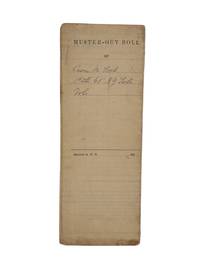
1863215941863. Medal of Honor Recipient Moses Veale Signed Civil War muster out roll dated June 8 1863 documents the discharge of 1st Lieutenant Orson Foot of the 60th New York Volunteer Infantry so he could accept a commission as Captain during the opening phase of the Gettysburg campaign. Issued at Aquia Creek Virginia the document bears the signature of Captain Moses Veale as mustering officer a Union officer later awarded the Medal of Honor for extraordinary gallantry during the Civil War. Veale's citation records that during the Battle of Wauhatchie Tennessee he continued directing his men after being struck by four enemy bullets and having his horse shot from under him. The presence of Veale's signature transforms the document from routine military administration into a signed record connected to one of the war's most decorated acts of battlefield courage. At the same time the roll records Foot's discharge to accept promotion during the Gettysburg Campaign. <br /> Foot Orson. Civil War muster out roll. Aquia Creek Virginia June 8 1863. One manuscript sheet completed in official Union Army muster format and signed by Captain Moses Veale as mustering officer. The document certifies that the officer "carefully examined this Roll. and mustered the said Orson Foot for discharge; and I hereby honorably discharge him from the service of the United States." It records Foot's enrollment at Ogdensburg New York on September 16 1861 identifies his rank as 1st Lieutenant in the 60th New York Volunteer Infantry and notes in the remarks that he was mustered out "to accept Commission of Captain." The sheet therefore documents the administrative transition by which an officer left one commission to assume another within the wartime command structure.<br /> <br /> The document's date and place situate it at the evacuation of Aquia Creek Landing one of the Army of the Potomac's principal logistical bases. Established during earlier campaigns in northern Virginia Aquia Creek served as a major supply depot linking Washington with Union forces in the field. As Robert E. Lee advanced north in June 1863 the Union command dismantled and abandoned the installation to support the army's rapid movement toward Pennsylvania. By the very day this roll was issued June 8 Federal forces were evacuating and destroying the depot to prevent its use by Confederate troops. Foot's promotion therefore occurred amid the redeployment that would culminate at the Battle of Gettysburg. Single manuscript sheet measuring approximately 32 x 11 inches when unfolded. Some age toning scattered ink staining and edge wear consistent with large-format wartime administrative documents; overall good condition. A substantial Civil War military document combining Gettysburg campaign context with the signature of Medal of Honor recipient Moses Veale whose later battlefield heroism makes his autograph particularly desirable within Civil War military manuscripts. A substantial Civil War military document produced during the evacuation of Aquia Creek and the opening phase of the Gettysburg campaign. unknown
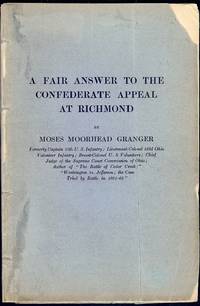
190746511907. Granger Moses Moorhead. A FAIR ANSWER TO THE CONFEDERATE APPEAL AT RICHMOND. Self-published 1907. 12mo. printed blue wraps; 32 pages. First- and only- edition. A treatise debunking many claims made by Southern states and politicians that led to the Civil War. "Richmond" in the title refers to the unveiling of a statue of Jefferson Davis on June 3 1907 in that city and speeches at the time stating that Davis and the Southern states will eventually be vindicated for their actions leading to and during the Civil War. Granger 1831-1913 was born and also died in Zanesville Ohio where he was a lawyer and a judge. He served with Company S of the 122nd Regiment of the Ohio Volunteer Infantry during the Civil War where he earned the ranks of Lt. Colonel and Colonel. With an autograph note signed by Granger inside the front cover discussing some copyright confusion over the book's publication and with a "Publisher's Weekly" ink stamp on the same page. With another lengthy autograph note on the last page by Granger discussing the politics and various historic events that led to the war mentioning The Missouri Compromise The Nebraska Bill etc. Very rare with the only copies I have been able to locate in institutional libraries. Good condition some chipping covers but contents clean & tight; some repair to covers spine & inside front cover with clear archival tape. $1250.00. unknown
167852858Paris: G. Caillou 1678. First edition. Hardcover. Good. Quarto. 16 384pp; 3 unnumbered double-suite engraved plates with legends in the margins. Engraved printer's device at title. Woodcut head- and tailpieces lettrines. Text in Latin with some key terms in Hebrew; printed marginalia. Contemporary calf rubbed and lightly worn at extremities; spine with raised bands gilt-tooled compartments old manuscript title on paper in upper compartment. Text lightly toned throughout else clean and crisp. A good or better copy.<br /> <br /> Collation: atilde6 etilde2 e2 signed e3 A-3B4 = 200 leaves<br /> <br /> First edition of this Latin version of Sefer Avodah The Book of Divine Service being the eighth book of the Mishneh Torah Moses Maimonides' systemic treatment of Talmudic and post-Talmudic Jewish law halakhah. The nine chapters of Sefer Avodah comprise a legal digest of Israelite cult practices at the Jerusalem Temple: The Chosen Temple; Vessels of the Sanctuary and Those Who Serve Therein; Admission into the Sanctuary; Things Forbidden on the Altar; Sacrificial Procedure; Daily Offerings and Additional Offerings; Sacrifices Rendered Unfit; Service on the Day of Atonement; Trespass. "Whereas Christian interest in Maimonides' thought was focused on his philosophic work the Guide of the Perplexed during the Middle Ages -- the so-called Age of Faith -- this interest shifted during the Renaissance the Reformation and the Enlightenment to his Halakic work the Mishneh Torah. It was through the Mishneh Torah that Christian thinkers and theologians viewed normative Judaism" Dienstag.<br /> <br /> Born Daniel de Weil in the Jewish quarter of Metz Louis-Compiègne de Veil d. c.1710 was the son of the town's rabbi David Weil d. 1645 and a descendant of the Nürnberg rabbi Jacob Weil. Both he and his brother Charles Marie de Veil converted to Catholicism under the influence of the new Catholic archdeacon Jacques-Bénigne Bossuet who arrived at Metz in 1652. The archdeacon "shared in the current apocalyptic excitement of both Christians and Jewish cabbalists and the conviction of the former of an imminent large-scale conversion of the Jews" ODNB. He was sponsored at his baptism by Louis XIV as reflected in his new Christian name and went on to study theology at the Sorbonne. Both Louis and his brother subsequently converted to Calvinism and immigrated to England. "Designated sub-keeper of the Royal Library in 1678 de Veil was licensed ‘ad docendum litteras in et per totam urbem Londinensem' in 1685" Massil. As noted by Dienstag de Veil "devoted himself to the interpretation of Maimonides' code Mishneh Torah."<br /> <br /> The present work was dedicated to the son of Minister Jean-Baptiste Colbert the churchman Jacques Nicolas Colbert 1655-1707 who later become Archbishop of Rouen in 1691 and was one of the first members of the Académie des Inscriptions et Belles-Lettres. <br /> <br /> Provenance and annotations: With the 19th-century bookplate of "Mr. F. Theremin Ministre du S. Evangile" at the front paste-down and his stamp at the bottom margin of the title-page. The opening blank end-leaf contains detailed bibliographical lists in French. The first notes thirteen authors and their works which discuss de Veil including Richard Simon Pierre Daniel Huet and Job Ludolf; the second notes seven bibliographies which include the present work followed by a list of later printings. References: J. I. Dienstag "Christian Translators of Maimonides' Mishneh Torah into Latin" in: Salo Wittmayer Baron Jubilee Volume NY: Columbia Univ. 1974 pp.288; 303 no. 4; S.W. Massil “Immigrant Librarians to Britain: Huguenots and Some Others†69th IFLA General Conference and Council and Council 1-9 August 2003 Berlin; S. Wright "Charles Marie de Veil" in: ODNB.<br /> <br /> Full title and imprint: De cultu divino ex R. Mosis Majemonidae Secunda lege seu Manu forti liber VIII. Dividitur in IX. tractatus quorum seriem pagina è regione Elenchi posita declarabit. Accesserunt tabulae aere incisae in quibus exprimitur Hierosolymitanti templi forma accuratissimè & eleganter descripta. Hunc librum ex hebraeo latinum fecit & notis illustravit Ludovicus de Compiegne de Veïl D.A. Parisiis apud Guidonem Caillou Bibliopolam viâ Jocabaeâ sub Constantia. M.DC.LXXVIII. G. Caillou hardcover
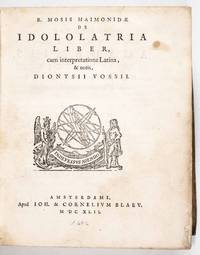
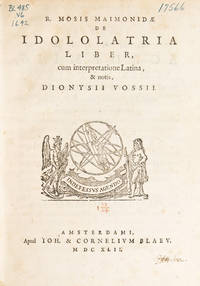
164248836Amsterdam: Joan and Cornelis Blaeu 1642. Second edition. Hardcover. Very good. Sammelband of two works jointly issued the latter in two parts quarto. 12 174 1 errata 1 blank; 12 732 pp. 353-360 repeated xvii addenda 19 index x addenda 28 index 1 emendanda 1 blankpp. All four addenda and indices to the De theologia gentili bound following the second part. Each work with woodcut printer’s device at title; occasional woodcut lettrines; printed marginalia. De idololatria with Hebrew text and Latin translation in parallel columns interspersed with Latin notes. Contemporary vellum lightly soiled manuscript title at spine intermittant light dampstain largely confined to first work else crisp clean and amply margined.<br /> <br /> Collation: I. asterisk4 2asterisk2 A-Y4 = 94 leaves; II. asterisk4 2asterisk2 A-2P4 2Q-4Y4 4Z2 asterisk-4asterisk4 5asterisk2 cross-5cross4 = 414 leaves 2Y-2Y4 repeated. <br /> <br /> Re-issue of the first edition 1641 of the first two books of four of G. J. Vossius' De theologia gentili with new preliminaries including an Elegy written by Caspar Barlaeus on the occasion of the death of Gerhard's son Dionysius dated IV Kal. Novembris MDCXXXIII 1633 and a preface by another of Vossius' sons Isaac; along with an edition of the Hebrew text of Maimonides' treatment of the laws of idolotry in the first book of the Mishneh Torah with accompanying Latin translation by Dionysius Vossius.<br /> <br /> "The work has a two-fold aim. In the first place it is a Theologia gentilis. Of this the subtitle says that the work treats. the origin and history of heathen mythologies and cult forms. But at the same time the book is a Physiologia christiana a study 'de naturae mirandis quibus homo adducitur ad Deum' an account as complete as possible of the rich diversity of all creation that in the inention of the creator must serve to reveal to man the greatness of God. It is simultaneously an ambitiously arranged textbook of mythology a summary of what was written about nature in all its manifestations up until Vossius' time and finally also a first specimen of what would be done profusely in the eighteenth century a book on the natural knowledge of God" Rademaker. <br /> <br /> Provenance: The manuscript entry “Jan de Wind. 17 april An. 1697.â€. References: J. I. Dienstag “Christian Translators of Maimonides’ Mishneh Torah into Latin†in: Salo Wittmayer Baron Jubilee Volume 31 De idololatria. Fuks/Fuks-Mansfeld 202 De idololatria ed. 1641 noting that there exist copies without the Hebrew text. The 1641 ed. contains no preliminaries after the title. Katchen Christian Hebraists and Dutch Rabbis esp. pp.24-25. Rademaker Life and Work of G.J. Vossius Assen 1981 no. 24: “In his last large work the Theologia gentilis. he dared to make full use of Scaliger’s chronological innovations†185. For more detailed commentary see: pp. 306-310. For Dionysius see 163f. Joan and Cornelis Blaeu hardcover
1642254936Amsterdam: Jioh & Corneium Blaeu 1642. Second edition of each title. Publisher's device on title pages; woodcut tailpieces ornamental initials. Maimonides text in Hebrew with facing Latin translation by Vossius. 12 1-174. 2; 12 304; xvii 19 305-732 x 30. 1 vols. 4to. Contemporary vellum with ms. spine title covers slightly soiled upper joint cracked. Institutional shelfmark in ink on title-page ; bookplae of HENRY FERGUSON of Stamford Connecticut "Henry Ferguson from the Library of Rev. FREDERIC GARDINER" and signed by Gardiner on the front pastedown "Leipzig 1854. Second edition of each title. Publisher's device on title pages; woodcut tailpieces ornamental initials. Maimonides text in Hebrew with facing Latin translation by Vossius. 12 1-174. 2; 12 304; xvii 19 305-732 x 30. 1 vols. 4to. Scarce second edition of Maimonides' tract on idolatry with an important new foreword "to the Reader" by Isaac Vossius brother of the recently deceased translator Dionysius Vossius 1612-1642 as well as a new dedicatory poem by Caspar Barlaeus. Maimonides' text is usually accompanied as it is here by the massive commentary by Gerardus Vossius father of Isaac and Dionysius DE THEOLOGIA GENTILI . a book said to have been an iinfluence on Isaac Newton; his library contained an "extensively dog-eared" copy of the book John Harrison THE LIBRARY OF ISAAC NEWTON Cambridge University Press p. 258.<br /> <br /> This particular copy has a very distinguished provenance. Dr. Frederic Gardiner was an Episcopal clergyman Biblican scholar founder of the American Exegetical Society and author of several books including a Harmony of the Gospels. Henry Ferguson of Stamford Ct. "studied theology in the Berkeley Divinity School. In 1872 he was made rector of Christ Church in Exeter N. H. and in 1878 rector of Trinity Church Claremont in the same state. In 1883 he became professor of history and political economy in Trinity College a position he filled with distinguished credit until commencement in 1906 when he resigned to become rector of St. Paul's School Concord N. H. In 1873 he married Emma J. Gardiner daughter of Professor Gardiner of the Berkeley Divinity School . His original specialty was Hebrew." Norris Galpin Osborn ed. MEN OF MARK IN CONNECTICUT Vol I p. 132. OCLC: 37317703 one copy in US; Vossius: Brunet V col. 1373 for editions of 1641 and 1668 Jioh, & Corneium Blaeu unknown